
Traditional SEO is no longer enough.
The real battle in AI SEO is not just about ranking on Google.
It’s about becoming the answer inside ChatGPT, Claude, and Gemini.
And here’s the problem most marketers still don’t understand:
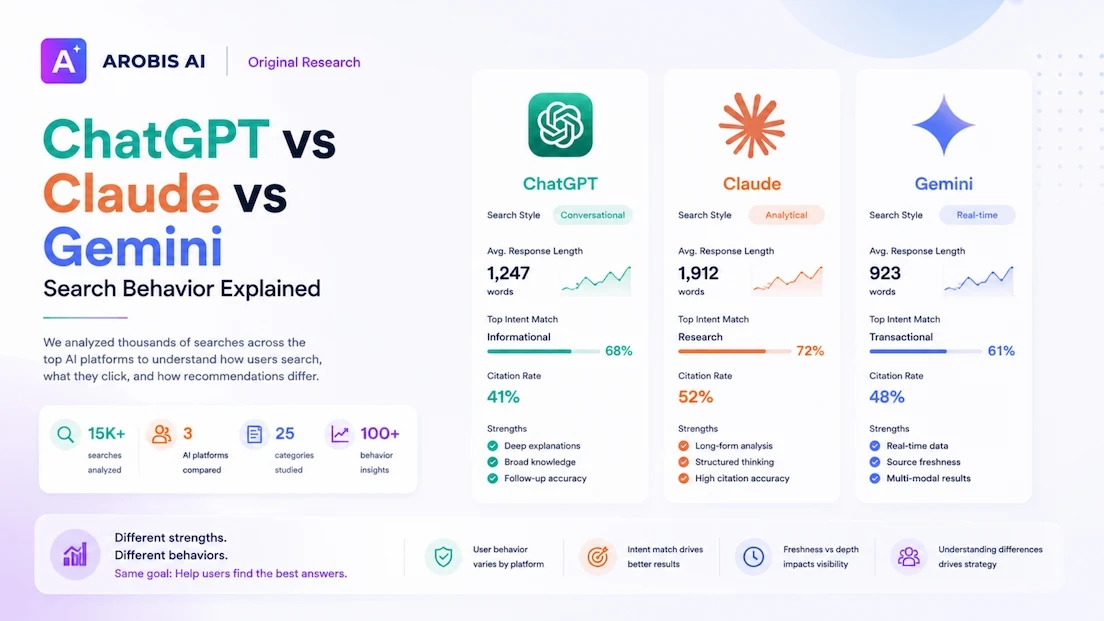
These AI systems do not search the web the same way.
They retrieve differently.
They summarize differently.
They trust different sources.
They cite differently.
And they influence user behavior differently.
If your content performs well in Google Search but disappears inside AI-generated answers, you’re already losing traffic you can’t even measure yet.
This is where SEO evolves into:
- GEO (Generative Engine Optimization)
- AEO (Answer Engine Optimization)
And the companies adapting early are quietly dominating visibility while everyone else keeps optimizing meta titles.
The Shift From Search Engines to Answer Engines
For 20+ years, users searched.
Now users ask.
Instead of:
“best CRM software comparison”
People now type:
“What’s the best CRM for a 20-person SaaS company with WhatsApp support?”
That single behavioral shift changes everything.
AI engines don’t simply return links.
They synthesize answers.
And whichever sources influence those synthesized answers become the new winners of the internet.
Recent research shows generative AI systems retrieve and present information very differently from traditional search engines. Google Search, AI Overviews, and Gemini often surface entirely different source sets for the same query.
This means:
You are no longer competing for Position #1.
You are competing to become part of the AI’s reasoning layer.
Why ChatGPT, Claude, and Gemini Behave Completely Different
Most comparison articles talk about features.
That’s surface-level thinking.
The real difference is behavioral architecture.
Each platform has a different philosophy for:
- Retrieval
- Trust
- Citation
- Memory
- Reasoning
- Personalization
- Source prioritization
And that changes how content gets discovered.
ChatGPT Search Behavior: The “Synthesizer”
ChatGPT behaves like a strategic researcher.
It tries to:
- Aggregate information
- Compress complexity
- Produce polished summaries
- Deliver direct recommendations
- Minimize cognitive load for users
Its biggest strength is synthesis.
Its biggest weakness is source transparency.
Research found ChatGPT Search was highly inconsistent in attribution accuracy across news queries, sometimes failing to correctly credit original publishers.
What ChatGPT Prioritizes
ChatGPT tends to favor:
- High-authority domains
- Widely referenced content
- Structured explainers
- Long-form educational pages
- Comparative content
- Consensus-driven information
- Semantic completeness
This means ChatGPT loves content that feels:
- definitive
- comprehensive
- well-organized
- deeply contextual
How To Rank Inside ChatGPT
If you want ChatGPT to reference your content:
1. Write “citation-worthy” paragraphs
AI models extract reusable blocks.
The best-performing paragraphs are:
- concise
- data-backed
- standalone
- context-rich
2. Create complete topical coverage
Thin pages rarely survive AI synthesis.
- depth
- entity relationships
- FAQs
- contextual completeness
3. Use semantic clustering
Modern AI retrieval relies heavily on semantic proximity.
Instead of optimizing only keywords:
Optimize concepts.
Example:
A page about “AI customer support” should naturally include:
- conversational AI
- intent recognition
- omnichannel support
- automation workflows
- customer experience
- ticket deflection
- human handoff
4. Structure content for extraction
AI loves:
- bullets
- comparison tables
- short definitions
- numbered frameworks
- FAQs
Not because humans like them.
Because LLMs parse them efficiently.
Knowing whether any of this is landing means tracking your name inside ChatGPT answers instead of guessing. We compared the best ChatGPT SEO tools on what each one actually measures and what it costs.
Claude Search Behavior: The “Reasoner”
Claude behaves differently.
It feels less like a search engine and more like a thoughtful analyst.
Users consistently describe Claude as requiring less prompt correction and producing more coherent long-form reasoning.
Claude is exceptional at:
- long-context understanding
- nuanced interpretation
- synthesis across massive documents
- maintaining logical consistency
But Claude is not aggressively search-first.
That distinction matters.
Claude Prioritizes Context Over Popularity
Claude appears to value:
- informational clarity
- logical consistency
- nuanced writing
- low-noise content
- expert framing
- readability
It is less obsessed with “SEO-style optimization.”
And that changes the game dramatically.
What Performs Best in Claude
Claude favors content that feels:
- human
- insightful
- deeply reasoned
- educational
- less “salesy”
Over-optimized content often performs worse.
This is a massive shift.
For years, marketers wrote for algorithms.
Claude rewards writing for intelligent humans.
How To Optimize for Claude
1. Reduce fluff aggressively
Claude is unusually good at detecting filler.
Generic intros hurt performance.
2. Increase reasoning density
Claude thrives on:
- comparisons
- tradeoffs
- nuanced analysis
- contextual framing
3. Build trust through intellectual depth
Claude tends to favor:
- expert opinions
- transparent explanations
- balanced arguments
- evidence-backed insights
4. Write naturally
Keyword stuffing performs terribly here.
Claude responds better to conversational semantic flow.
Gemini Search Behavior: The “Ecosystem Engine”
Gemini is fundamentally different because Google owns the infrastructure.
That changes everything.
Gemini is deeply connected to:
- Google Search
- YouTube
- Maps
- Gmail
- Docs
- Android
- Chrome
- Workspace
Google is turning Gemini into a full ecosystem assistant rather than a standalone chatbot competitor.
Gemini also powers Google's AI Mode, so it is worth understanding how Google AI Mode behaves for SaaS buyers.
Gemini Prioritizes Google-Native Signals
Research shows Google’s generative systems often retrieve different sources than traditional organic search and may heavily favor Google-connected ecosystems.
Gemini appears to value:
- freshness
- structured authority
- entity recognition
- E-E-A-T signals
- Google ecosystem integration
- multimodal relevance
This makes Gemini incredibly powerful for:
- local search
- real-time information
- product discovery
- visual content
- transactional queries
Gemini Is Closest to Traditional SEO
Among the major AI systems, Gemini still behaves most like a search engine.
But with generative overlays.
That means:
Classic SEO still matters here.
Especially:
- schema markup
- topical authority
- Core Web Vitals
- backlinks
- freshness
- entity relationships
How To Optimize for Gemini
1. Double down on structured data
Schema matters more than ever.
Especially:
- FAQ schema
- product schema
- organization schema
- author schema
- review schema
2. Build entity authority
Google increasingly evaluates entities instead of just pages.
Become associated with:
- industries
- topics
- categories
- expertise clusters
3. Create multimodal content
Gemini is deeply multimodal.
Pages connected to:
- YouTube videos
- visual explainers
- charts
- diagrams
- images
gain an advantage.
4. Keep content continuously updated
Gemini heavily rewards freshness signals.
Especially for:
- AI
- SaaS
- finance
- healthcare
- news
- product comparisons
The Most Important Discovery: AI Engines Cite Differently
This changes modern SEO completely.
Research on GEO found that citation behavior varies dramatically across AI platforms. Perplexity and Google systems cite more sources overall, while ChatGPT often absorbs fewer sources more deeply into generated answers. We saw the same split in our own test of three engines, which is why the eight strategies to increase AI citations treat each engine's source pool separately.
Meaning:
Being cited isn’t enough anymore.
Your content must influence the generated response itself.
This is the future of GEO.
Not rankings.
Influence.
The Hidden Ranking Factor Nobody Talks About: “Answer Absorption”
The next era of SEO is not about clicks.
It’s about becoming embedded inside AI-generated reasoning.
Researchers now call this:
Citation Absorption
That means:
The AI doesn’t merely mention your site.
It learns from your framing.
Your explanations.
Your structure.
Your comparisons.
Your language patterns.
And then reproduces those patterns in future responses.
This is why generic AI-generated content fails.
LLMs prefer original framing.
Unique perspectives.
Strong informational architecture.
The New SEO Stack
If your strategy still looks like:
- keyword → blog → backlink
you’re behind.
Modern optimization now requires:
SEO + GEO + AEO
SEO
Optimize for discoverability.
GEO
Optimize for AI retrieval.
AEO
Optimize for direct answer inclusion.
The companies winning right now are designing content specifically for:
- extractability
- synthesis
- citation-worthiness
- semantic authority
- contextual completeness
Few teams can run that full stack in-house, which is why the fastest movers hand it to SaaS SEO specialists who run SEO, GEO, and AEO as one program. We tested nine of those specialists against the engines themselves.
What Actually Wins Across All Three AI Engines
After analyzing emerging patterns, one thing becomes obvious:
The internet is moving away from “optimized content.”
And toward:
Useful content with informational gravity
The winners are creating:
- firsthand insights
- proprietary data
- strong opinions
- original frameworks
- real testing
- deep expertise
- contextual richness
Because AI systems increasingly reward:
Information density + trustworthiness + clarity
Not just keywords.
If ChatGPT is the engine you care about most, read our full guide to ChatGPT visibility for how to measure your standing there specifically.
Final Verdict: Which AI Search Engine Matters Most?
Here’s the truth nobody wants to say:
There will not be one winner.
Search is fragmenting.
Recent market data already shows ChatGPT’s dominance gradually declining while Gemini, Claude, Perplexity, and others continue gaining share.
And users are developing platform-specific behaviors:
- ChatGPT → workflow + synthesis
- Claude → reasoning + writing
- Gemini → ecosystem + live search
This means brands must optimize for all three simultaneously.
Watching three engines at once is where single-engine trackers run out of road. Our rundown of the best Peec AI alternatives covers which platforms cover ChatGPT, Claude and Gemini on one plan, and what each of them charges to start.
The future of search will belong to companies that understand:
AI engines are not search engines!
They are decision engines.
And the brands shaping those decisions earliest will own the next decade of digital visibility.