
TL;DR: AI recommendation authority is what separates SaaS brands that get consistently recommended by ChatGPT, Gemini, Claude, and Perplexity from brands that are only cited in passing. It is built through five layers: entity foundation, category ownership content, competitive positioning, third-party validation, and recommendation frequency monitoring. Arobis AI calls this methodology Authority Engineering.
This article covers:
- Why AI citations alone do not generate pipeline
- The five signals AI engines actually use to decide who to recommend
- The complete Authority Engineering framework, layer by layer
- The five mistakes that keep SaaS brands cited but never recommended
- How to get started building recommendation authority
There is a difference between appearing in an AI-generated answer and being recommended in one.
The first is passive. The second is where demand is actually won.
Most content strategies today are still optimizing for AI citations — making sure a brand appears in AI answers, gets mentioned alongside competitors, shows up in the right category searches. That is a useful starting point. But for SaaS companies trying to generate pipeline, citations should not be the goal in your AI Search Visiblity Strategy.
Recommendations are.
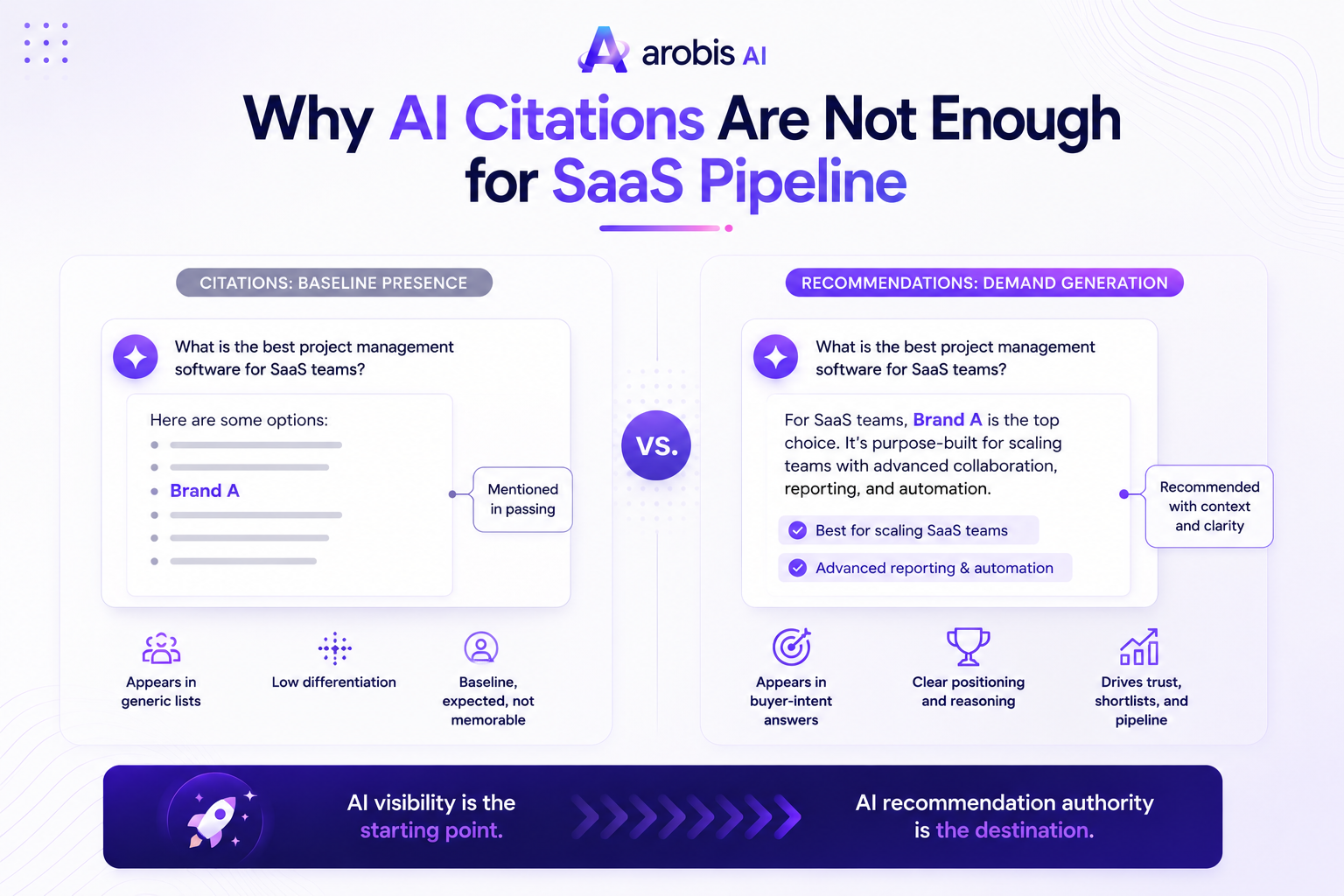
When a buyer asks ChatGPT "what's the best [category] software for my SaaS company," three things can happen. Your brand is not mentioned at all. Your brand is mentioned as one of many options. Or your brand is actively recommended — with context, with a reason, and with enough authority that the buyer comes to you already pre-convinced.
Only the third outcome generates pipeline.
AI Search Demand Generation is built around this distinction. And the discipline that makes the difference between being cited and being recommended is what Arobis AI calls Authority Engineering.
Why AI Citations Are Not Enough for SaaS Pipeline
The citation framework made sense when AI visibility was new. Brands that appeared anywhere in AI answers were ahead of brands that didn't appear at all. That gap was meaningful in 2023 and 2024.
By 2026, that gap has largely closed. Most established SaaS companies in competitive categories have some AI presence. They appear in answers. They get cited in passing. They show up in the generic list of five options an AI provides when a buyer asks a broad category question.
That is not a demand generation advantage. That is baseline presence.
Recommendation Frequency is what separates baseline presence from real demand generation impact. It measures how often a brand appears in buyer-intent prompts — not all prompts, but the specific ones where buyers are forming shortlists and making decisions. How often it appears with clear positioning. How often it appears without a long list of competitors diluting the recommendation.
The brands that win AI-assisted buying journeys are not the ones that appear the most. They are the ones that are recommended most clearly, most consistently, and most specifically for the right buyer use cases.
AI visibility is the starting point. AI recommendation authority is the destination.
What AI Engines Actually Use to Decide Who to Recommend
Understanding this requires understanding how AI engines actually form recommendations — not how they crawl content, but how they decide which brand deserves to be the answer.
AI engines do not rank. They synthesize. When a buyer asks Perplexity "what's the best project management software for a 20-person SaaS team," Perplexity does not return a list of links. It forms an opinion — drawing on everything it has encountered about project management software, about team sizes, about what practitioners recommend, about which brands appear consistently in trusted contexts.
The inputs AI engines use when forming these opinions fall into five categories.
Entity strength is the first. How clearly does the AI engine understand who this brand is, what it does, and who it serves? Brands with strong, consistent entity signals — the same description, the same category association, the same use cases appearing across many independent sources — are the ones AI engines can confidently describe. Brands with weak entity signals get vague, hedging descriptions even when they appear in an answer.
Cross-source validation is the second. AI engines trust brands that appear across multiple independent sources more than brands that only appear on their own website. Review sites, community forums, third-party publications, expert mentions, analyst coverage — all of these contribute to the multi-source signal that makes a brand feel safe to recommend.
The domains that most influence AI search authority are not always the highest-traffic sites. They are the sites AI engines treat as trusted arbiters of opinion in a given category. Appearing on those sites consistently builds the cross-source validation that moves brands toward recommendation.
Category association clarity is the third. AI engines recommend brands for specific use cases, specific buyer types, and specific problems — not for generic category membership. A brand clearly associated with "AI-powered customer support for SaaS companies under 100 employees" will be recommended more specifically and more accurately than one generically associated with "customer support software."
Competitive context is the fourth. AI engines understand competitive landscapes. They form opinions about how brands compare — which is stronger for enterprise, which works better for self-serve, which is newer but faster-moving. Brands that have built comparison content and explicit "best for" signals are the ones AI engines can most confidently recommend for specific buyer situations.
Comparison content is one of the highest-leverage assets for building competitive context signals — not because it wins comparison traffic directly, but because it tells AI engines exactly how a brand positions itself relative to alternatives.
Recency and momentum is the fifth. AI engines weight recent citations more heavily than old ones. A brand consistently building its authority footprint over the past 12 months will be recommended more frequently than a brand that published heavily in 2022 and then went quiet.
Third-party platforms carry outsized weight here, and none more than Reddit, so it is worth learning how to build authority on Reddit the right way.
The Authority Engineering Framework
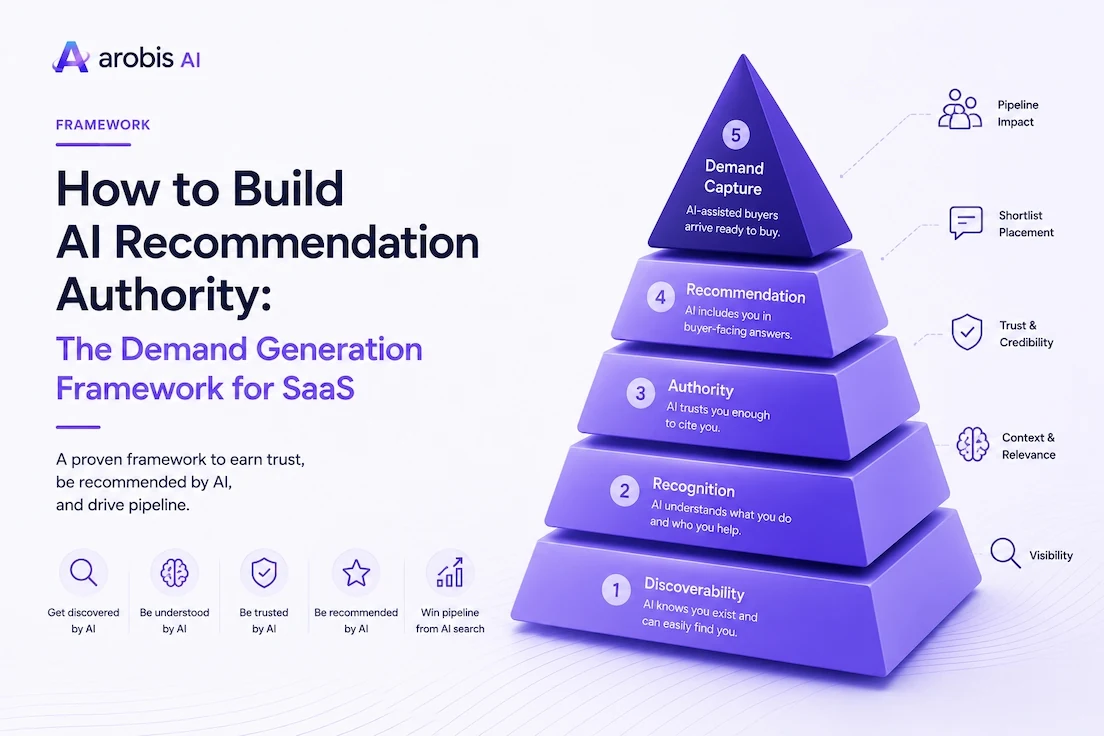
Authority Engineering is Arobis AI's methodology for building the recommendation authority that moves brands from Stage 3 to Stage 5 of the Arobis AI Search Demand Framework™ — from being trusted, to being recommended, to generating demand. It operates across five layers. Each layer contributes independently and compounds with the others.
Layer 1: Entity Foundation
The entity foundation is what AI engines know about a brand before any buyer prompt is entered. It is the sum of signals that tell AI engines what a brand does, who it serves, and why it exists.
Building a strong entity foundation means ensuring consistency across every surface: the company website, the LinkedIn page, G2 and Capterra profiles, directory listings, press releases, third-party reviews. The description must be consistent, specific, and category-accurate everywhere.
Inconsistency is the most common entity weakness in SaaS. A company that describes itself as "AI-powered customer success platform" on its website, "customer support automation tool" on G2, and "SaaS helpdesk software" on a directory has given AI engines three different category signals. The result is a vague, uncertain AI description that rarely converts into a strong recommendation.
Layer 2: Category Ownership Content
Category ownership content is the content that defines what a brand does in the AI engine's conceptual model. It includes pillar articles, comparison pages, and educational content that makes a brand the authoritative source for a topic.
The key insight: AI engines are more likely to recommend brands that educate the category than brands that only describe their product. A company that has written the definitive content on "how to choose customer success software for SaaS companies" will be recommended more often in buyer-intent prompts than one that has only published product-focused content.
The Arobis AI Search 100 confirms this. The most consistently recommended SaaS brands in their categories are disproportionately the ones that have established strong topical authority around buyer education — not just product marketing.
For example, a complete pillar guide to answer engine optimization is exactly the kind of category-defining asset AI engines reward.
Layer 3: Competitive Positioning Assets
Comparison content is the most direct lever for influencing AI recommendations in competitive prompts.
When a buyer asks ChatGPT "what's the best alternative to [competitor]?" or "compare [your brand] vs [competitor]," AI engines turn to competitive positioning signals available across the web. Brands that have built clear, well-structured comparison content — positioned honestly and specifically — appear in these answers with much stronger recommendation signals than brands that have avoided comparison entirely.
Every comparison page is a recommendation asset. Not just for the buyer who searches that comparison directly, but for every AI engine that uses that comparison page as a signal when forming opinions about how brands relate to each other.
Layer 4: Third-Party Validation Signals
Third-party validation is the layer most SaaS companies underinvest in relative to its impact on AI recommendations.
AI engines weight independent sources heavily. A brand mentioned positively in a respected industry newsletter, cited in a thought leadership piece by a recognized practitioner, or discussed helpfully in a community forum carries more recommendation weight than ten self-published blog posts from the brand itself.
This is why brands that appear invisible in ChatGPT despite strong Google rankings often discover the same root cause: their content authority is entirely self-built. They have not earned the third-party validation signals that AI engines use to confirm a brand is worth recommending.
Building third-party validation means contributing to community discussions in forums relevant to the category, earning coverage in publications AI engines treat as trusted sources, getting mentioned in podcasts and newsletters, and building a review footprint on sites like G2 and Capterra where AI engines look for social proof.
Layer 5: Recommendation Frequency Monitoring
The fifth layer is the feedback loop: systematically testing how often a brand appears in buyer-intent prompts, tracking changes over time, and using that data to prioritize the next round of Authority Engineering activity.
Recommendation Frequency is the metric that tells you whether the other four layers are working. Without measuring it, Authority Engineering becomes guesswork.
The monitoring process: identify the 10-20 buyer-intent prompts most relevant to your category, run them weekly across ChatGPT, Gemini, Claude, Perplexity, and Copilot, and track which brands appear, how they are described, and how often your brand earns a clear recommendation versus a passing mention.
The Arobis AI Visibility Checker gives SaaS companies a fast starting point for understanding their current recommendation position before building the Authority Engineering plan.
The Five Mistakes That Keep SaaS Companies Cited But Never Recommended
Several patterns consistently appear in brands that have some AI presence but cannot convert that presence into pipeline.
Relying entirely on self-published content. A brand can publish excellent content and still be invisible in AI recommendations if the only sources the AI engine has seen are the brand's own properties. Self-published authority cannot substitute for third-party validation.
Optimizing for general category searches instead of buyer-intent prompts. Getting mentioned in an answer to "what is customer success software?" is not the same as getting recommended in an answer to "what's the best customer success software for a 50-person B2B SaaS company?" The second prompt is where shortlists form. The first is background noise.
Having weak entity consistency. Brands with inconsistent descriptions across sources give AI engines conflicting signals. The result is either a generic description in AI answers or an absence from recommendations entirely.
Avoiding comparison content. Brands that have no comparison assets cannot benefit from the recommendation authority comparison content provides. Every comparison search in their category goes to competitors — and every AI recommendation in those comparison prompts goes to competitors.
Measuring the wrong metric. Tracking whether a brand appears in AI answers at all, rather than tracking Recommendation Frequency across buyer-intent prompts, creates a false sense of progress. The gap between appearing and being recommended is where pipeline is won or lost.
How to Get Started
The starting point for building AI recommendation authority is always the same: understand the current baseline.
Run your ten most important buyer-intent prompts across ChatGPT, Gemini, Claude, and Perplexity. Record which brands appear. Record how they are described. Record whether your brand is recommended specifically or mentioned generically. That gap analysis is the input for your Authority Engineering plan.
The brands winning AI-assisted buying journeys in 2026 are not the ones that optimized for search engine rankings and hoped AI would figure it out. They are the ones that built deliberate, layered authority signals designed specifically for how AI engines form recommendations.
An AI Visibility Audit maps exactly where those gaps are — and which Authority Engineering actions will close them fastest. Or work with one of the top GEO agencies.
Benchmark yourself first with a free AI visibility tools check.
The data on AI-assisted buyer behavior is clear: buyers who arrive via AI recommendations convert at significantly higher rates. They arrive pre-educated, pre-qualified, and partially pre-sold. That is the pipeline prize. Not more citations. Not more AI mentions. More recommendations — in the right prompts, to the right buyers, with the right context.
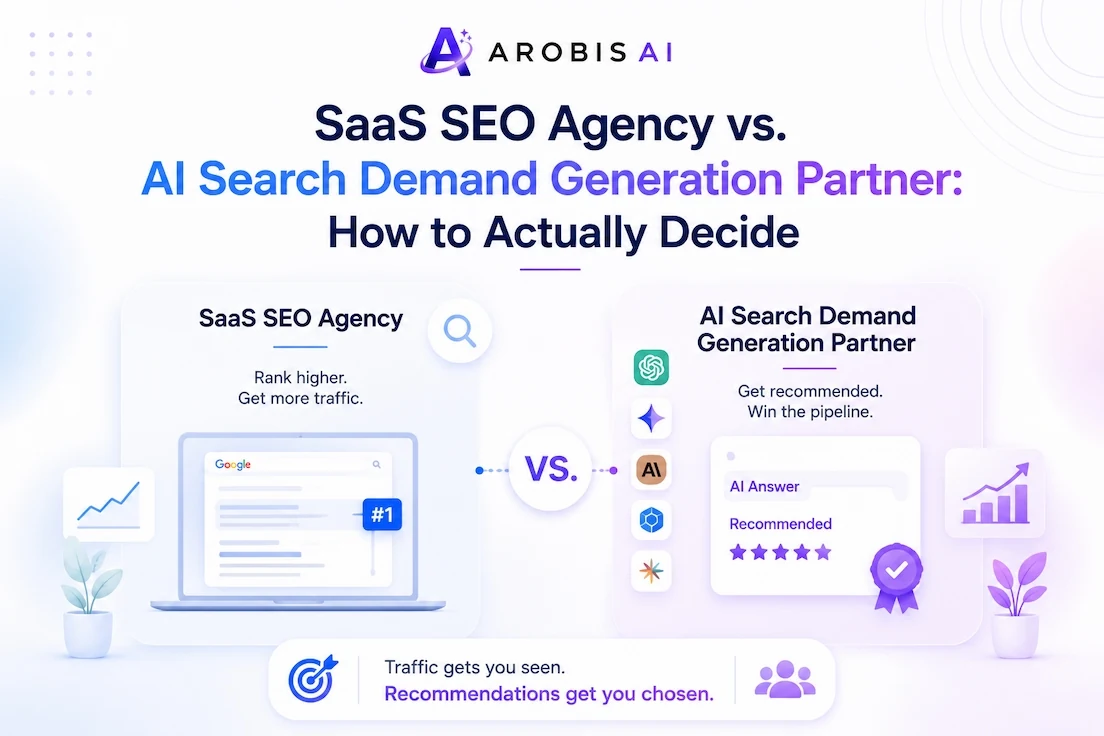
Visibility gets you seen. Recommendations get you chosen.
Check your current AI recommendation position — free.
Frequently Asked Questions
What is the difference between an AI citation and an AI recommendation?
An AI citation means a brand appears in an AI-generated answer — often as one of many options, without specific context or a clear reason to choose it. An AI recommendation means the AI engine specifically endorses the brand for a particular use case or buyer type — with context and positioning that moves the buyer toward that brand specifically. For SaaS demand generation, recommendations are what drive pipeline. Citations are just presence.
What is Authority Engineering?
Authority Engineering is Arobis AI's methodology for building the external citation footprint, entity signals, and cross-source validation that AI engines use to decide which brands to recommend. It operates across five layers: entity foundation, category ownership content, competitive positioning assets, third-party validation signals, and recommendation frequency monitoring. Unlike traditional link building or PR, Authority Engineering is designed specifically for the signals AI engines use to form recommendations.
How long does it take to build AI recommendation authority?
Initial improvements in Recommendation Frequency are typically visible within 60-90 days of structured Authority Engineering execution. Compounding effects build over 3-6 months. AI recommendation authority is a long-term demand generation asset — not a short-term tactic.
Which AI platforms should SaaS companies prioritize?
ChatGPT, Gemini, Claude, and Perplexity should all be included in any AI recommendation authority strategy. Each platform has different weighting signals and retrieval mechanisms, but the underlying authority and entity signals compound across all of them. Prioritize ChatGPT and Perplexity for initial measurement, since they are most commonly used for research-oriented queries.
How do I measure whether my Authority Engineering is working?
Through Recommendation Frequency tracking: run a defined set of buyer-intent prompts weekly across your target AI platforms and track how often your brand appears, how it is described, and whether the descriptions are recommendation-quality or citation-quality. Pipeline Influence — tracking whether AI-assisted buyers enter and convert in your pipeline — is the ultimate validation metric.
Can I build AI recommendation authority without a big content budget?
Yes. The highest-leverage Authority Engineering activities are not content-volume plays. A single original research asset cited widely by AI engines is worth more than 50 generic blog posts. One well-structured comparison page builds more recommendation authority in competitive prompts than a large content library. Focus on depth, originality, and cross-source validation over volume.
What is the Arobis AI Search Demand Framework™ and how does it relate to recommendation authority?
The Arobis AI Search Demand Framework™ is a five-stage model — Discoverability, Recognition, Authority, Recommendation, and Demand Capture. Recommendation authority specifically powers Stages 3, 4, and 5. Most SaaS companies are stuck at Stages 1 and 2 — known to AI engines but not trusted or recommended. Authority Engineering is the methodology that moves them to Stage 3 and beyond, where AI search becomes a measurable demand generation channel.