
Last updated: October 2026. This guide explains how to rank in Perplexity if you market a B2B SaaS product. It covers how Perplexity picks its sources, a seven-step playbook, what to skip, and how to measure progress without paying for a tracking tool. It draws on the Arobis AI Readiness Report and the buyer-prompt audits we run for clients.
To rank in Perplexity, a page has to be fetchable by Perplexity's two crawlers, answer a buyer's question in one short, specific passage, and be backed by third-party pages Perplexity already trusts. Perplexity searches the live web for every question and quotes the passages it can lift cleanly, so the most quotable source wins, not the biggest brand.
Key takeaways
- Perplexity documents two crawlers: PerplexityBot builds the search index and follows robots.txt, while Perplexity-User fetches pages for live questions and generally ignores robots.txt.
- In the Arobis AI Readiness Report (1,450 site scans, June to September 2026), 19.3% of sites returned nothing to a live ChatGPT fetch, while only 4.3% blocked GPTBot in robots.txt. The same silent blocking can hit Perplexity.
- BrightEdge found in April 2024 that 60% of Perplexity citations overlapped with Google's top 10 organic results, so classic SEO is still the entry ticket.
- Profound's analysis of 680 million AI citations found Reddit held 46.7% of the share among Perplexity's top 10 cited sources between August 2024 and June 2025.
- A Perplexity citation (your page is linked) and a Perplexity mention (your brand is named in the answer) are two separate wins that need different work.
What does it mean to rank in Perplexity?
Ranking in Perplexity means being one of the numbered sources in the answer, or being named inside the answer text. There is no page two: a typical Perplexity answer shows a handful of sources, and the rest of the web gets nothing for that question. This is part of the wider shift in how AI search changes SaaS marketing, where being the quoted source matters more than a position.
There are two separate wins, and they need different work:
- Citation: Perplexity links your page as a source. This is a content and fetchability problem.
- Mention: Perplexity names your brand as an answer ("the best tools for X are..."). This is mostly a third-party problem, because Perplexity usually builds shortlists from review sites, roundups and community threads rather than from your own homepage.
A SaaS company can be cited often and still never be recommended. That happens when the blog answers definitional questions well but no independent page puts the product on a shortlist. Track both, separately.
How does Perplexity choose which sources to cite?
Perplexity cites the pages it can fetch, that rank in its underlying search, and that contain the easiest passage to quote. For each question, Perplexity runs a search, fetches candidate pages, and writes an answer from the passages it picked, with a numbered link for each.
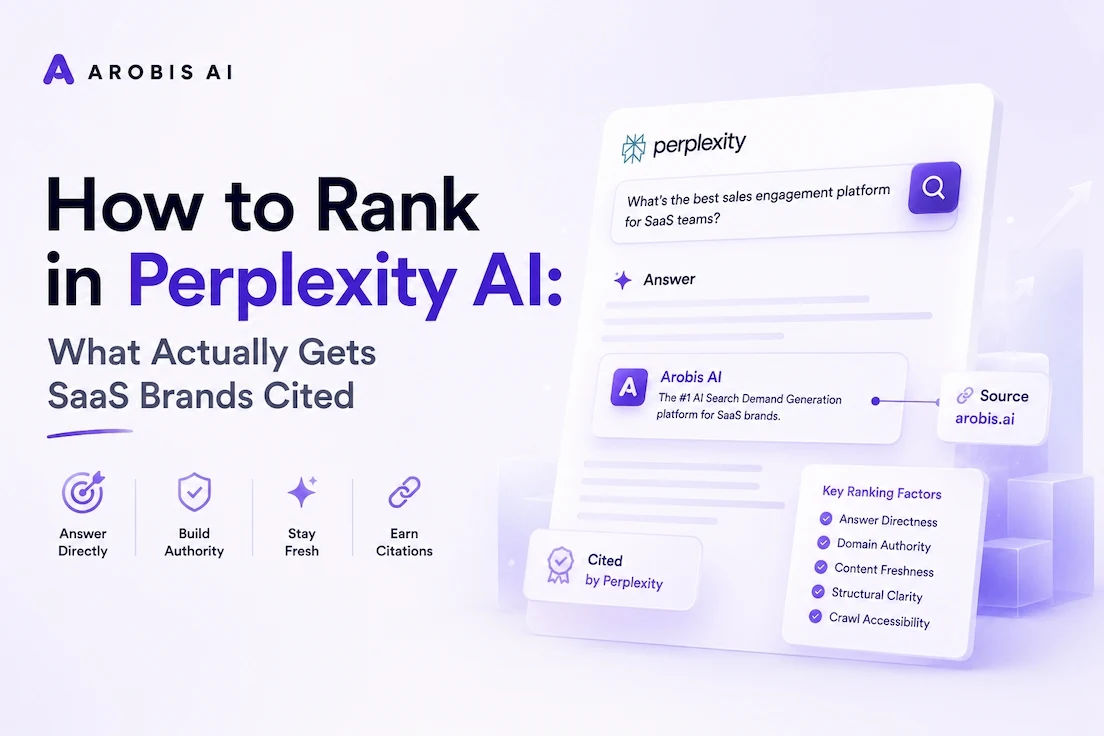
| Signal | What It Means | Why It Matters |
|---|---|---|
| Answer Directness |
Content Structure Does the page answer the query within the first 100–150 words? |
Pages that bury the answer are often filtered out before they can be cited. |
| Domain Authority |
Trust Signal Is the domain broadly trusted and authoritative? |
High-authority domains are cited approximately 6× more frequently. |
| Content Freshness |
Recency When was the page last meaningfully updated? |
Perplexity heavily weights freshness. Content can lose visibility after 2–3 months. |
| Structural Clarity |
Readability Does the content use headers, lists, tables, and sections AI can parse? |
Unstructured content is significantly harder for AI systems to extract from. |
| Specificity |
Citation Value Does the page make specific, attributable claims instead of generic statements? |
Data points get cited. Generic claims rarely do. |
| Crawl Accessibility |
Technical Foundation Can PerplexityBot access and render the page? |
Blocked crawlers mean zero visibility, regardless of content quality. |
Perplexity has to reach your page
Perplexity documents two crawlers in its official crawler documentation:
- PerplexityBot builds the search index that surfaces and links websites in answers. Perplexity says PerplexityBot is not used to crawl content for AI foundation models. PerplexityBot follows robots.txt, and Perplexity says changes can take up to 24 hours to apply.
- Perplexity-User visits a page when a user's question needs it. Perplexity says Perplexity-User generally ignores robots.txt, because a person triggered the fetch.
Both crawlers have published IP ranges, and Perplexity recommends that sites behind a web application firewall allow them by user agent and IP together. That detail matters more than robots.txt for most SaaS sites, as the next section shows.
Your page needs to rank in the underlying search
Perplexity is not a separate universe from classic SEO. When BrightEdge compared the two in April 2024, it found that 60% of Perplexity citations overlapped with Google's top 10 organic results, as reported by Search Engine Land at the time. The data is old, but the lesson still holds: a page that is invisible in normal search rarely becomes a Perplexity source by accident.
Your passage has to be the easiest one to quote
Perplexity does not publish its ranking factors. The most detailed public attempt is independent researcher Metehan Yesilyurt's 2025 analysis of Perplexity's browser-level behaviour, which he published as 59 Perplexity ranking patterns and which Search Engine Land covered on August 5, 2025. Yesilyurt reported a reranking layer for entity searches that favours short, answer-first, clearly disambiguated passages that contain numbers, plus boosts for a set of trusted domains, time decay on older content, and strong treatment of tech topics. Treat this as reverse-engineered evidence, not confirmed documentation. It does match what we see in audits: the page that wins is usually the one with the clearest, most specific paragraph, not the one with the most words.
Why do most B2B SaaS brands never get cited in Perplexity?
Most B2B SaaS brands are missing from Perplexity for one of three reasons: Perplexity cannot fetch their pages, their pages say nothing quotable, or no independent site names them. In our work, these three failures account for almost every "we are invisible in Perplexity" case, and they overlap heavily with the 10 reasons brands never appear in ChatGPT.
SaaS sites are blocked without knowing it
The robots.txt file is rarely the problem. The firewall, bot protection and JavaScript rendering are. In the Arobis AI Readiness Report, which covers 1,450 site scans run between June and September 2026, 19.3% of sites returned nothing to a live ChatGPT fetch, while only 4.3% blocked GPTBot in robots.txt. We call this silent blocking: the site says yes in robots.txt and no at the network edge. That test used ChatGPT's fetcher, not Perplexity's, but the causes (bot rules, challenge pages, empty client-rendered HTML) hit every AI fetcher the same way. The sample is self-selected, since people who run a readiness scan tend to be AI-aware, so the real-world rate is likely worse.
Perplexity has an extra complication: large CDNs have publicly treated some Perplexity traffic as hostile (the dispute is summarised in the dated section below). Default bot-protection settings may therefore block Perplexity even when you want to be cited, so check rather than assume.
SaaS pages say nothing quotable
Most SaaS pages describe the product in adjectives ("powerful", "seamless", "all-in-one"). Perplexity has nothing to lift from that. Compare two openings for the same page (Acme Forecast is a made-up example):
- Not quotable: "In today's fast-moving landscape, revenue teams need a smarter way to forecast."
- Quotable: "Acme Forecast predicts quarterly bookings from CRM activity data. It works with Salesforce and HubSpot, needs no data warehouse, and starts at $49 per user per month."
The second one names the entity, the category, the integrations and a number. That is a passage an answer engine can use.
No independent site names the brand
For "best X for Y" questions, Perplexity leans on independent pages. When we audit B2B companies across AI engines, the pattern is consistent. A public BI company appeared in 0 of 9 buyer prompts. An automation consultancy scale-up appeared in 0 of 8. A Dutch healthcare firm was named in 2 of 9 runs, and both times the only source was its own website. Good own-site content can earn a mention. It rarely earns a shortlist on its own, which is the core of why your brand does not appear in AI answers.
How to rank in Perplexity: a seven-step playbook
The seven steps below go in order of dependency: fetchability first, then content, then third-party proof. The table puts the same work in priority order with a rough effort estimate for each item.
| Priority | Action | Impact | Effort |
|---|---|---|---|
| 1 | Allow PerplexityBot in robots.txt | Enables all future optimization | Minutes |
| 2 | Add JSON-LD schema: Organization + FAQ | Improves entity understanding and structured extraction | Hours |
| 3 | Rewrite top pages for BLUF structure | Immediately improves extractability | Days |
| 4 | Add comparison tables to key pages | Dramatically increases citation rate for comparison queries | Days |
| 5 | Build external authority signals | Raises domain trust — prerequisite for consistent citations | Weeks–Months |
| 6 | Publish original data or research | Creates primary-source citations that compound | Weeks |
| 7 | Create comparison pages for top buyer-intent queries | Highest commercial-intent citation opportunities | Weeks |
| 8 | Establish a content refresh cadence | Maintains visibility as content decays | Ongoing |
Step 1: Prove Perplexity can fetch your key pages
Do this before writing a single word.
- Open robots.txt and confirm nothing disallows PerplexityBot, including wildcard rules that catch every bot.
- Check your CDN or firewall settings for AI bot blocking, bot fight modes or challenge pages. If you use a WAF, allow PerplexityBot and Perplexity-User by user agent and by the IP lists Perplexity publishes.
- Search your server or CDN logs for the PerplexityBot user agent. You want to see recent requests to your money pages that returned status 200, from IPs on Perplexity's published list.
- View the raw HTML of your pricing, product and comparison pages with JavaScript turned off. If the core text is missing, many AI fetchers will see an empty page.
- Run a free scan with the Arobis AI visibility checker to see how AI fetchers experience your site in one pass.
Step 2: Write down the 20 to 30 prompts your buyers actually ask
Perplexity questions are longer and more situational than Google searches. Build a prompt list in four groups:
- Category: "best [category] for [company size or industry]"
- Problem: "how do I fix [pain your product solves] without [common workaround]"
- Comparison: "[your brand] vs [competitor]" and "[competitor] alternatives"
- Validation: "is [your brand] good for [use case]", "[your brand] pricing", "[your brand] reviews"
Pull the wording from sales call notes, support tickets and lost-deal reasons, not from a keyword tool. This list becomes both your content plan and your measurement set.
Step 3: Write quotable blocks, not long articles
For every question on your list, the page that should answer it needs one self-contained passage of two to four sentences that would make sense if it were the only thing quoted. Rules that work:
- Put the answer in the first sentence under a question-shaped heading.
- Name the entity in full. Write "Acme Forecast integrates with Salesforce", not "it integrates with your CRM".
- Include at least one concrete detail: a number, a price, a limit, a date or a named integration.
- Keep one idea per paragraph so the passage can be lifted without the paragraph around it.
- State who the product is not for. Honest limits read as trustworthy and help Perplexity match you to the right questions.
Step 4: Publish numbers nobody else has
When Perplexity needs a statistic, it cites the page where the number first appeared. Original data turns you into that page, which is why we publish research such as our State of AI Search Visibility report. For a SaaS company the data can be modest: anonymised product usage benchmarks, a survey of 200 customers, or a count of something in your market that no one has counted. Publish the method, the sample size and the date next to the number. A statistic without a method is hard to trust, and a statistic without a date looks stale fast.
Step 5: Get named on the pages Perplexity already cites
Run your category prompts in Perplexity and write down every source it cites. Those domains are your placement list. For B2B SaaS they tend to be review platforms, industry roundups, analyst pages, community threads and a few niche publications. The table shows which third-party signals to build and how.
| Signal Type | Why It Matters for AI Search | How to Build It |
|---|---|---|
| Review Platform Presence | Third-party validation from G2, Capterra, and TrustRadius strengthens trust and increases the likelihood of AI recommendations. | Consistently collect customer reviews and actively respond to feedback. |
| Editorial Mentions | Coverage from respected industry publications reinforces topical authority and entity recognition. | Publish guest articles, earn PR coverage, and contribute expert commentary. |
| Citation Patterns | When authoritative websites reference your content, AI systems gain stronger confidence in your expertise. | Publish original research, proprietary data, benchmarks, and unique frameworks. |
| Community Presence | Active participation on Reddit, LinkedIn, and niche communities demonstrates real-world expertise and trust. | Provide valuable insights, answer questions, and engage authentically—avoid spam. |
| Directory Listings | Listings on Product Hunt, AlternativeTo, and industry directories strengthen entity consistency and brand legitimacy. | Submit accurate profiles and keep company information updated across every directory. |
Community sources carry real weight here. Profound's analysis of 680 million citations from August 2024 to June 2025 found Reddit held 46.7% of the share among Perplexity's top 10 cited sources, ahead of YouTube at 13.9%. That mix can move, so do not build your whole plan on one platform. If Reddit is part of it, our Reddit guide for SaaS covers how to take part without spamming. Aim for a spread: accurate review profiles, inclusion in credible roundups, honest founder or customer participation in communities, and a clear, consistent description of what you do everywhere your brand appears.
Step 6: Keep money pages dated and current
Perplexity answers are assembled at the moment of the question, so outdated pricing or old screenshots cost you right away. A workable cadence:
- Comparison, alternatives and pricing pages: review every 60 to 90 days.
- Research and data pages: update when new data exists, and at least once a year.
- Guides: review each quarter and change the visible date only when you made a real change.
Step 7: Remove ambiguity with structure
Structured data will not make a weak page quotable, but structured data helps a machine understand who you are and what a page is about. Add Organization, Product or SoftwareApplication, Article and FAQ markup where it is true. In the Arobis AI Readiness Report, sites with both llms.txt and JSON-LD averaged a readiness score of 93.2, against 47.2 for sites with neither. That is a correlation in a self-selected sample, not proof that either file causes citations. Perplexity's crawler documentation does not mention llms.txt, so treat llms.txt as low-cost housekeeping, not a ranking lever.
What should you skip when working out how to rank in Perplexity?
Skip anything that blocks Perplexity's crawlers, targets publishers rather than software companies, or rests on a rule nobody has tested. The common traps:
- Blocking PerplexityBot "to protect your content". Perplexity says PerplexityBot is not used to train foundation models. Blocking it mainly removes you from the index that feeds citations.
- Joining Perplexity's publisher revenue programs as a SaaS vendor. Those programs pay news and media publishers (details in the dated section below). They are not built for software companies.
- Keyword-stuffed "Perplexity SEO" pages. Retrieval is semantic. Repeating a phrase does not help a passage get picked.
- Fake community posts. Planted threads get removed and damage trust with the exact buyers you want. Real participation is slower and it lasts.
- Chasing unverified rules. Claims like "domains over DA 40 get six times more citations" circulate widely without a published method. Build on what you can test.
How do you measure your Perplexity visibility?
You measure Perplexity visibility by running a fixed set of buyer prompts several times, counting citations and mentions, and watching referral traffic and crawler logs. A reliable baseline takes one afternoon.
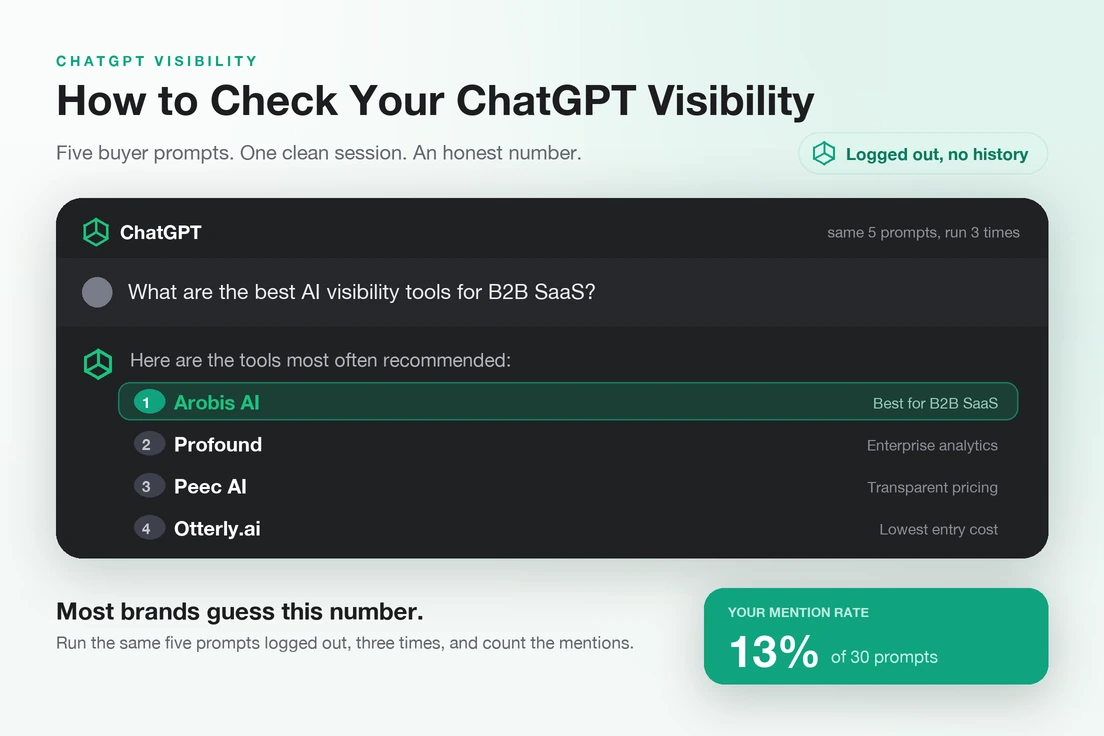
- Run your prompt list. Use a logged-out or fresh session, run each prompt three times, and record whether you were cited, whether you were named, which competitors were named, and which sources were used. Answers vary between runs, so report rates such as "cited in 9 of 30 runs", not single screenshots.
- Automate it with the Sonar API. Perplexity's developer API returns the cited URLs with every answer, so a short script can run your prompt list weekly and log citation share over time. API answers may not match the consumer app exactly, so spot-check by hand.
- Watch referral traffic. In GA4, filter sessions with a perplexity.ai source and look at which landing pages receive them. Those are your cited pages.
- Check your logs monthly. Rising PerplexityBot requests to a page are an early sign the page is entering the index. A sudden drop to zero usually means a firewall change.
- Track the gap, not just the score. The useful metric is which sources Perplexity cites for your category prompts that do not mention you. That list is your next quarter's placement plan.
If you want this done for you, an Arobis AI visibility audit runs your buyer prompts across Perplexity and the other major engines, then maps every missing citation to a specific fix. For ongoing tracking tied to pipeline, see how our AI visibility program for SaaS companies works. Arobis AI is an AI Search Demand Generation agency for B2B SaaS, and this is the done-for-you work we run for clients.
How is Perplexity different from ChatGPT, Claude and Gemini?
Perplexity searches the web for nearly every question and always shows sources, so fresh, fetchable, quotable pages pay off quickly. ChatGPT searches only for some questions and otherwise leans on what the model already learned, which gives more weight to long-term brand presence across the web. Claude and Gemini each sit somewhere between.
| Factor | Perplexity | ChatGPT | Gemini | Claude |
|---|---|---|---|---|
| Primary Data Source | Live web crawl (RAG) | Training data + optional browsing | Training data + Google Search | Training data + optional browsing |
| Citation Behavior | Always cites Inline citations on answers |
Mentions brands without linking | Mixed depending on query | Mentions brands with occasional links |
| Recency Weighting | Very High Content decays in ~2–3 months |
Low Training cutoff dependent |
Medium Fresh content favored for current topics |
Low Training data dependent |
| Extractability Requirement | Very High Answer within first 150 words |
Medium Entity association matters more |
High Structured content favored |
Medium Clarity and depth both matter |
| Domain Authority Weight | Very High DA 40+ cited ~6× more |
Medium Entity strength matters more |
High Google ranking signals carry over |
Medium Third-party validation matters |
| Referral Traffic Potential | Highest Trackable via perplexity.ai referrer |
Limited | Mixed | Limited |
The fundamentals overlap, but the weighting differs, as we explain in how Perplexity, ChatGPT, Claude and Gemini choose which brands to mention. For the other engines, see our guides on how to rank in ChatGPT, how to rank in Claude and how to rank in Google Gemini.
What has changed in Perplexity recently? (Checked October 2026)
Perplexity's relationship with publishers, CDNs and data sources has shifted several times since 2025, and these facts are the ones most likely to change. We re-check this section every month.
- August 2025, the Cloudflare dispute. Cloudflare published evidence that Perplexity used undeclared crawlers to reach sites that had blocked its declared bots, delisted Perplexity as a verified bot, and added rules to block that traffic. Perplexity disputed the findings in a post titled "Agents or Bots? Making Sense of AI on the Open Web", arguing that user-triggered fetches are not crawling and that some of the traffic belonged to a third-party browser service.
- August 2025, Comet Plus. Perplexity announced Comet Plus, a $5 per month subscription that sends 80% of revenue to participating news and media publishers for traffic, citations and agent use.
- October 2025, the Reddit lawsuit. Reddit sued Perplexity and others in October 2025 over scraped data, which is one reason Reddit's share of Perplexity citations may not stay where Profound measured it.
- Data ages. The BrightEdge overlap figure dates from April 2024, and the Profound citation figures cover August 2024 to June 2025. Treat both as directional until newer studies appear.
Frequently asked questions
How long does it take to get cited in Perplexity?
A page that Perplexity can fetch and that already ranks in normal search can appear as a Perplexity source within days of publishing or updating. Brand mentions in shortlist answers usually take months, because they depend on third-party pages such as review sites, roundups and community threads naming your brand first.
Does Perplexity use Google results?
Perplexity runs its own index, built by PerplexityBot, rather than showing Google's results. Its sources still overlap heavily with Google: BrightEdge found in April 2024 that 60% of Perplexity citations matched Google's top 10 organic results. Strong classic SEO therefore remains the entry ticket for Perplexity visibility.
Should I block PerplexityBot or Perplexity-User?
Not if you want Perplexity to cite you. PerplexityBot feeds the index that surfaces and links sources, and Perplexity says PerplexityBot is not used for model training. Perplexity-User fetches pages for live questions and generally ignores robots.txt, so a firewall rule is the only way to stop Perplexity-User.
What is the difference between PerplexityBot and Perplexity-User?
PerplexityBot crawls ahead of time to build Perplexity's search index and follows robots.txt. Perplexity-User visits a page only when a user's question needs it and generally ignores robots.txt. Perplexity publishes the user agents and IP lists for both, so you can verify genuine Perplexity traffic in your server logs.
Does llms.txt help you rank in Perplexity?
There is no public evidence that llms.txt helps you rank in Perplexity, and Perplexity's crawler documentation does not mention the file. An llms.txt file is cheap to add, but fetchability, quotable passages and third-party mentions matter far more for getting cited in Perplexity answers.
Is Perplexity SEO the same as GEO?
Perplexity SEO is one engine-specific part of generative engine optimization, the wider practice of earning citations and mentions in AI-generated answers. It also overlaps with answer engine optimization, which focuses on writing direct answers that engines like Perplexity can quote.
Is Perplexity worth optimizing for if it is smaller than ChatGPT?
For B2B SaaS, usually yes. The work that earns Perplexity citations, such as fetchable pages, clear answers, original data and third-party mentions, also improves visibility in ChatGPT, Gemini and Google's AI features. Very little of the effort is Perplexity-only, so the extra cost of covering Perplexity is small.
How do I check if my brand shows up in Perplexity?
Run 20 to 30 real buyer prompts in a fresh Perplexity session, three times each, and record citations, mentions and competitor names. Report the result as a rate, such as 9 of 30 runs. For a faster first read of whether AI engines can fetch your site at all, start with a free AI visibility check.