
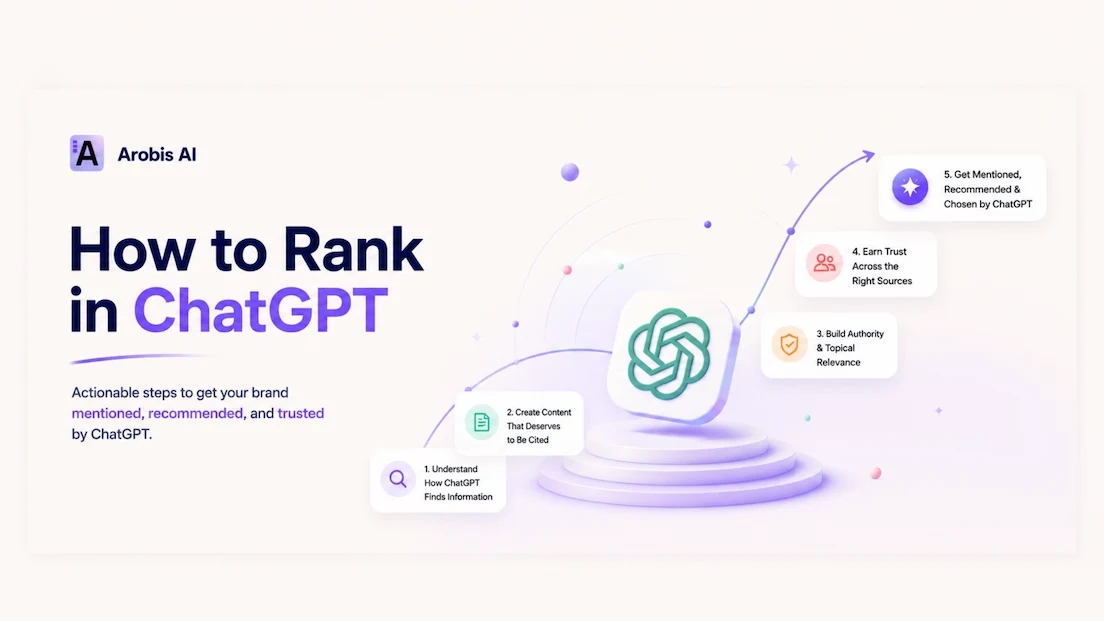
Last updated: October 2026. When a B2B buyer asks ChatGPT for a software recommendation, the answer names a handful of brands and ignores the rest. This guide explains how to rank in ChatGPT, how to stay on that list from one run to the next, and how to prove progress with a number. It draws on 1,450 site scans and the buyer-prompt audits we run at Arobis AI.
How to rank in ChatGPT: make sure ChatGPT can fetch your site, get your brand onto the third-party pages its searches return, and give it specific, independent evidence to repeat. ChatGPT has no fixed positions, so measure success as shortlist share, the percentage of buyer-prompt runs in which ChatGPT names your brand.
Key takeaways
- ChatGPT does not rank pages in fixed positions. It names a short list of brands for each prompt, and that list changes from run to run.
- A SparkToro and Gumshoe study of 2,961 AI runs found less than a 1 in 100 chance of getting the same brand list twice.
- The Arobis AI Readiness Report (1,450 site scans, June to September 2026) found that 19.3% of sites return nothing to a live ChatGPT fetch, while only 4.3% block GPTBot in robots.txt.
- An Ahrefs study of 75,000 brands found that web mentions correlated with ChatGPT visibility far more strongly than backlinks did.
- The metric worth tracking is shortlist share: the share of runs, across 20 to 40 real buyer prompts, in which ChatGPT names your brand.
Whether you call it how to rank on ChatGPT, how to show up in ChatGPT or how to get recommended by ChatGPT, the work is the same three gates: ChatGPT can reach your site, its searches find pages that name you, and the evidence it finds gives it a reason to recommend you for that specific buyer. This guide is written for B2B SaaS teams.
How to rank in ChatGPT: what does "ranking" actually mean?
Ranking in ChatGPT means being one of the brands named inside the answer, because ChatGPT does not show a list of ten blue links. When someone asks it for a recommendation, it writes an answer and names a handful of brands. Being named first, or being the brand it explains in the most detail, is a bonus. Being left out is the only real loss.
The key fact most guides skip is that those names are not stable. SparkToro and Gumshoe ran 12 prompts through ChatGPT, Claude and Google's AI 2,961 times with 600 volunteers. They found less than a 1 in 100 chance of getting the same brand list twice, and roughly a 1 in 1,000 chance of getting the same order. But in their headphone test, the top brands still appeared in 55% to 77% of nearly 1,000 responses. The list is random; the leaders are not.
So the useful question is not "what position am I in?" It is "in what share of runs, across the prompts my buyers actually use, am I on the shortlist?" We call that shortlist share, and the rest of this guide is about raising it. If you are new to the wider discipline, our AI visibility guide sets the scene, and the guide to generative engine optimization and the guide to answer engine optimization explain the two methods behind this work.
Why is ChatGPT a shortlist problem, not a ranking problem?
ChatGPT is a shortlist problem because buyers use it to narrow a category down to two or three names, then ignore everything else. They do not type a keyword. They describe a situation: company size, stack, budget, a compliance requirement, a tool they want to leave. ChatGPT turns that into a small set of options and explains the trade-offs.
That changes what you optimize for in three ways:
- The unit is the prompt, not the keyword. "Best CRM" and "CRM for a 20-person agency already on HubSpot Marketing" produce different shortlists. You need to be named for the second kind, because that is where deals come from.
- Consistency beats a single good answer. One screenshot of ChatGPT naming you proves little. Appearing in 6 of 10 runs is a result. Appearing in 1 of 10 is noise.
- The reason matters as much as the mention. ChatGPT usually says why it lists a brand. If the reason is vague ("a popular option"), a sharper competitor wins the click. If it matches the buyer's constraint ("built for teams under 100 that need SOC 2 in weeks"), you win it. We cover the selection logic in more depth in how AI engines choose which brands to mention, and the vendor side of it in how AI analyzes and ranks SaaS products.
Every tactic below maps to one of three gates. If you fail an early gate, work on the later ones is wasted.
Gate 1: Can ChatGPT actually reach your site?
ChatGPT can only recommend what it can read, and access is where the most surprising failures sit. OpenAI documents its crawlers separately. According to OpenAI, OAI-SearchBot is what surfaces websites in ChatGPT's search features, and sites that block it will not appear in search answers. GPTBot collects content that may be used for model training. ChatGPT-User visits pages when a user's request needs them, and OpenAI notes that robots.txt rules may not apply to it. OpenAI also says robots.txt changes take about 24 hours to reach its systems.
Most teams check robots.txt, see nothing blocked, and move on. That is not enough. In the Arobis AI Readiness Report, which covers 1,450 site scans from June to September 2026, 19.3% of sites returned nothing to a live ChatGPT fetch, while only 4.3% blocked GPTBot in robots.txt. We call the gap silent blocking: the site looks open on paper, but a firewall rule, bot-protection setting, JavaScript-only rendering or a region block means ChatGPT gets an empty page.
How to check Gate 1
- Open robots.txt and confirm OAI-SearchBot is allowed. Decide on GPTBot separately, since blocking training does not remove you from search.
- Ask ChatGPT to open and summarise a specific URL on your site, such as your pricing page. If it says it cannot access the page, or describes content that is not there, you have a fetch problem.
- Check your CDN or bot-protection settings (Cloudflare, Vercel, Akamai and similar) for rules that challenge or block AI user agents.
- View your key pages with JavaScript disabled. If the pricing, product and comparison content disappears, assume a crawler may see the same empty page. Our breakdown of what AI crawlers actually read shows what survives and what does not.
- Verify the site in Bing Webmaster Tools and confirm your key pages are indexed. OpenAI's help documentation says ChatGPT search uses third-party search providers and may share de-identified queries with Bing, so a page Bing cannot find is harder for ChatGPT to find too.
Two smaller signals are worth adding while you are here. In our scans, 45.6% of sites publish an llms.txt file and 75.3% ship JSON-LD structured data. Sites with both averaged a readiness score of 93.2, against 47.2 for sites with neither. That sample is self-selected, since sites that run an AI readiness scan are already AI-aware, so treat it as a correlation, not proof that llms.txt causes citations. It does show that the sites taking this seriously have usually done the basics, and if you want to cover that one, a free llms.txt generator builds the file in your browser.
Gate 2: Do ChatGPT's searches find pages that name you?
ChatGPT names brands that appear on the pages its searches return, so your brand has to be on those pages. When a prompt needs current information, ChatGPT searches the web and reads what it finds before it writes the answer (our explainer on how AI search engines work walks through that loop). For a recommendation prompt, the pages it finds are mostly not your homepage. They are comparison articles, "best tools for X" lists, review sites, forum threads, analyst notes and videos. If your brand is absent from those pages, it is absent from the material ChatGPT is summarising.
This is why the question-shaped queries matter so much. Across the Arobis AI Google Search Console data, about 35% of impressions come from long, prompt-style queries, the kind AI search produces when it breaks one question into several searches. The pages that catch those searches are the ones that answer a narrow, specific version of the buyer's question.
Third-party data points the same way. Ahrefs' study of 75,000 brands found that mentions across the web, with YouTube showing the strongest link, correlated with ChatGPT visibility far more than backlinks did. Links still help you get indexed and ranked in the searches ChatGPT runs. They are just not the thing that gets you named, which is one reason traditional SEO on its own is losing ground.
How to pass Gate 2
- Find the pages ChatGPT already cites. Run your buyer prompts, open the sources it links, and list the domains that keep coming back. That list is your real target list, and it is usually shorter and more specific than a generic PR list. Our research on the most influential domains in AI search is a useful starting point.
- Get into the lists that exist. For most B2B SaaS categories, a small number of "best X for Y" articles and review-site category pages show up again and again. Getting included, accurately, on the ones ChatGPT reads is often the fastest single lever.
- Keep your review profiles current. G2, Capterra and TrustRadius category pages are common sources for software prompts. A thin or outdated profile gives ChatGPT little to work with.
- Publish pages for the specific versions of the question. A page titled "[Your category] for [segment] teams" or "[Competitor] alternatives for [use case]" matches the searches ChatGPT runs far better than a general features page.
- Show up where practitioners talk. Community threads and videos are read too. Genuine answers from your team in the places your buyers ask questions count; a burst of promotional posts does not. Our Reddit guide for SaaS covers how to do that well.
Gate 3: Does the evidence give ChatGPT a reason to recommend you?
Being found is not the same as being recommended. ChatGPT has to explain why each option is on its list, and it can only do that with evidence it can repeat. This is where most B2B SaaS brands quietly lose.
Our audits show the pattern clearly (company names withheld):
- A public BI and analytics company appeared in 0 of 9 buyer prompts, despite being a well-known listed business.
- An automation-consultancy scale-up appeared in 0 of 8.
- An edtech payments company appeared in 0 of 6 decision prompts.
- A Dutch healthcare operations firm was named in 2 of 9 runs, and both times the only source ChatGPT cited was the company's own website.
The last case is the most useful. ChatGPT could find the company, but the only evidence available was the company describing itself. With nothing independent to point to, ChatGPT had no strong reason to include the firm in the other seven runs. Size and brand recognition did not help the first three either. What they lacked was specific, repeatable proof tied to the buyer's situation.
How to pass Gate 3
- Write one clear identity sentence and use it everywhere. What you are, who it is for, and the one thing you do better. Put the same wording on your site, LinkedIn, review profiles and directory listings, and in Organization schema. This consistency is the core of building AI recommendation authority.
- State constraints, not adjectives. "Deploys in under two weeks for teams on Salesforce" gives ChatGPT something to match to a prompt. "Powerful and easy to use" gives it nothing.
- Put your proof on pages other people wrote. Customer stories on partner sites, analyst mentions, interviews, podcast notes and reviews that mention a specific outcome all give ChatGPT a source that is not you. Independent proof is one of the five signals AI engines use to recommend brands.
- Publish honest comparison pages. Say plainly who each alternative is best for, including when it is not you. Pages that describe the trade-offs fairly are easier for a model to quote than pages that only praise the author, as in our Searchable vs Profound vs AthenaHQ comparison.
- Publish something only you have. Original data, benchmarks or research give other writers a reason to cite you, and each of those citations becomes Gate 2 material. Our own State of AI Search Visibility research is built for exactly that.
- Keep facts current. Pricing, plan names, integrations and customer counts that disagree across sources make you harder to recommend with confidence.
How to rank in ChatGPT: a 30-day plan
A 30-day plan for ranking in ChatGPT should fix the cheap, blocking problems first and the slow, compounding ones last. If you are starting from zero, use this order.
- Week 1: measure and unblock. Build your prompt set (see the next section) and record a baseline. Run the Gate 1 checks, fix any silent blocking, allow OAI-SearchBot, and submit your key pages to Bing Webmaster Tools.
- Week 2: fix your own pages. Rewrite the opening of your homepage, pricing and top product pages so the first two or three sentences say what you are, who it is for, and what it costs or how it is bought. Add Organization, Product and FAQ schema. Publish llms.txt.
- Week 3: close the source gap. From your baseline, list the third-party pages ChatGPT cited for your prompts. Update your review profiles, correct any wrong facts on those pages, and request inclusion where you genuinely fit.
- Week 4: publish for the specific prompts. Write one or two pages that answer the exact buyer situations where competitors are named and you are not, with the constraints and proof from Gate 3.
Then re-run the same prompt set. Technical fixes can register quickly, since OpenAI says robots.txt changes apply in about a day. Third-party inclusion and new pages take longer to be found and repeated, so judge the trend over one to three months rather than week to week.
How do you measure your ChatGPT visibility?
Measure ChatGPT visibility as shortlist share across many prompts and repeated runs, because a single check tells you almost nothing. SparkToro's conclusion was that visibility percentage across many prompts, each run several times, is a reasonable metric, while any "ranking position in AI" is not. Here is the method we use.
- Build 20 to 40 prompts from real buyer language. Pull them from sales calls, demo requests and lost-deal notes. Cover four types: category ("best X for Y"), constraint ("X that works with Z under $N"), comparison ("A vs B for our use case") and alternatives ("alternatives to competitor").
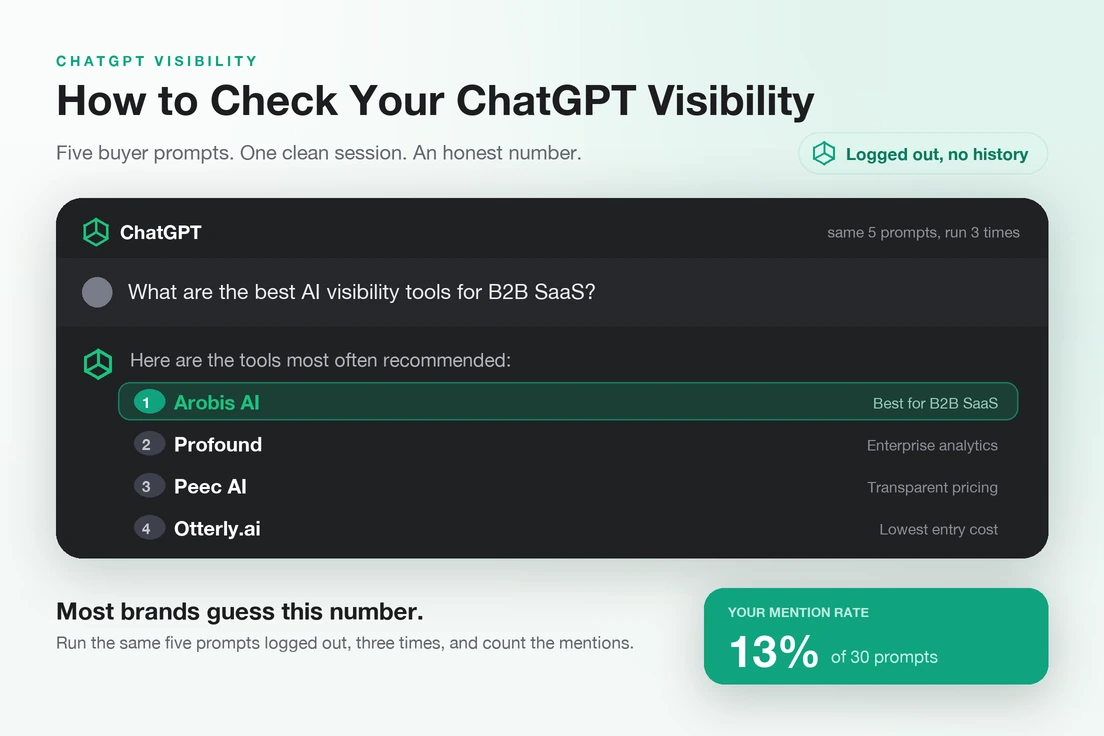
- Run each prompt three to five times in clean sessions, logged out or in temporary chats, so your history does not skew the result. Use the same location settings each time.
- Record four things per run: were you named, where in the list, the reason ChatGPT gave, and which sources it cited.
- Calculate shortlist share: runs where you were named, divided by total runs. Track it per prompt type and next to your top three competitors.
- Watch the reasons and sources, not just the count. A rising share with vague reasons is fragile. A named source list tells you which Gate 2 pages to work on next.
- Connect it to traffic. In GA4, filter sessions by source for chatgpt.com to see referral visits and which landing pages they hit. It undercounts, because many buyers read the answer and search your brand later, so treat it as a floor.
For a quick baseline, the free ChatGPT visibility checker runs a set of buyer prompts and shows who ChatGPT recommends instead of you. To see the same picture across engines, use the AI visibility checker. Our companion guide on what ChatGPT visibility is and how to check it goes deeper on the clean-session method. If you would rather automate the tracking, our reviews of the 17 best AI visibility tools and the best free AI visibility tools compare the options, and our AI search statistics page gives you market benchmarks to set expectations.
What mistakes keep brands out of ChatGPT?
The mistakes that keep brands out of ChatGPT are mostly measurement and evidence mistakes, not content volume. These are the ones we see most in audits.
- Checking one prompt once and drawing conclusions from a single screenshot, good or bad.
- Trusting robots.txt alone while a firewall or bot-protection rule silently blocks the fetch.
- Relying on your own site as the only evidence. ChatGPT can find you and still decline to recommend you.
- Chasing broad head terms instead of the specific, constrained prompts buyers actually use.
- Letting facts drift across your site, review profiles and old press, so the model sees conflicting information.
- Treating each AI engine as the same. The gates are similar, but the sources differ. Perplexity, for example, puts its sources in front of the reader on every answer, which changes the work; see our guide on how to rank in Perplexity. The sibling guides cover how to rank in Claude, how to rank in Google Gemini, how to rank in Microsoft Copilot and how to rank in Google AI Overviews, and we compare the engines side by side in how ChatGPT, Claude and Gemini search differently.
If you are missing from almost every answer, start the diagnosis with why your brand doesn't appear in AI answers, then work through the 10 reasons your brand never appears in ChatGPT.
Why does ChatGPT visibility matter for B2B SaaS?
ChatGPT visibility matters for B2B SaaS because the shortlist forms before a buyer ever talks to sales. If ChatGPT names a competitor and not you, the deal narrows before a rep is involved. That makes this AI search demand generation, not a technical checkbox, and our page on AI visibility for SaaS lays out the full case. For the strategic shift behind it, read how AI search changes SaaS marketing, and for the version you can take to the board, the CMO guide to AI recommendation share.
When does it make sense to get help?
Getting help makes sense once Gate 1 and the baseline are done, because Gates 2 and 3 are slower and more labour-heavy. Most of Gate 1 and the measurement work is something an in-house marketer can do in a few days. Gates 2 and 3 involve outreach to the publishers and review sites ChatGPT reads, pages written for dozens of specific buyer situations, and monthly re-measurement.
Arobis AI is an AI Search Demand Generation agency for B2B SaaS, and this is the done-for-you work we run for clients, often alongside a SaaS SEO program so Bing, Google and AI answers are handled as one job. If you want to see where you stand first, an AI visibility audit maps your shortlist share, the competitors named instead of you, and the sources behind each answer (here is what an AI visibility audit covers). Our pricing page lays out the options, and if you are comparing partners, see our roundup of the best SEO, GEO and AEO agencies for SaaS.
Which ChatGPT facts in this guide change over time?
The facts most likely to change are OpenAI's own documentation and the data sets below, so they are collected here with their dates. Each was checked against its source in October 2026.
- OpenAI documents four bots: OAI-SearchBot for ChatGPT search, GPTBot for training, ChatGPT-User for user-requested visits, and OAI-AdsBot, which only visits pages submitted as ChatGPT ads. OpenAI says robots.txt changes take about 24 hours to reach its systems.
- OpenAI's help documentation says ChatGPT search uses third-party search providers and may share de-identified queries with Bing.
- SparkToro and Gumshoe (January 2026): across 2,961 runs, less than a 1 in 100 chance of the same brand list twice and about 1 in 1,000 of the same order.
- Ahrefs (published March 2026, updated August 2026): across 75,000 brands, web mentions correlated with ChatGPT visibility more strongly than backlinks.
- Arobis AI Readiness Report (1,450 scans, June to September 2026): 19.3% of sites unreadable to a live ChatGPT fetch, 4.3% blocking GPTBot, 45.6% with llms.txt, 75.3% with JSON-LD. For more market data, see our 100 AI search statistics research.
Frequently asked questions
Can you actually rank in ChatGPT?
Yes, but not in a fixed position. ChatGPT names a short, changing list of brands for each prompt. You can raise how often your brand appears on that list by making your site reachable, getting onto the third-party pages ChatGPT reads, and giving ChatGPT specific, independent evidence it can repeat to the buyer.
How long does it take to rank in ChatGPT?
Technical fixes can register within days, since OpenAI says robots.txt changes apply in about 24 hours. Getting included on third-party pages and publishing prompt-specific content usually takes one to three months to show a clear trend in shortlist share, so judge progress monthly rather than week to week.
What is the fastest way to improve ChatGPT visibility?
The fastest way is to confirm that ChatGPT can actually fetch your key pages, because silent blocking is common: 19.3% of sites in the Arobis AI Readiness Report returned nothing to a live ChatGPT fetch. Then find the third-party pages ChatGPT cites for your buyer prompts and get your brand accurately included on them.
Does ChatGPT use Google or Bing?
OpenAI's help documentation says ChatGPT search uses third-party search providers and may share de-identified queries with Bing. Being indexed in Bing, verified through Bing Webmaster Tools, is a sensible baseline, but inclusion on the comparison articles, review sites and lists those searches return matters more for whether ChatGPT names your brand.
Do backlinks help you rank in ChatGPT?
Backlinks help indirectly. Links help your pages rank in the web searches ChatGPT runs before it answers. But Ahrefs' study of 75,000 brands found that brand mentions across the web, with YouTube showing the strongest link, correlated with ChatGPT visibility much more strongly than backlinks did.
How do I know if ChatGPT recommends my brand?
Run 20 to 40 real buyer prompts three to five times each in clean, logged-out sessions, and count the share of runs where ChatGPT names your brand. A single check is not reliable, because a SparkToro study found less than a 1 in 100 chance of an AI tool returning the same brand list twice.