
The New Marketing Question Nobody Was Asking 12 Months Ago
A year ago, SaaS marketing leaders were obsessed with one thing:
How do we rank #1 on Google?
Today, the smartest teams are asking a completely different question:
How do we get ChatGPT to recommend us?
Because something fundamental has changed.
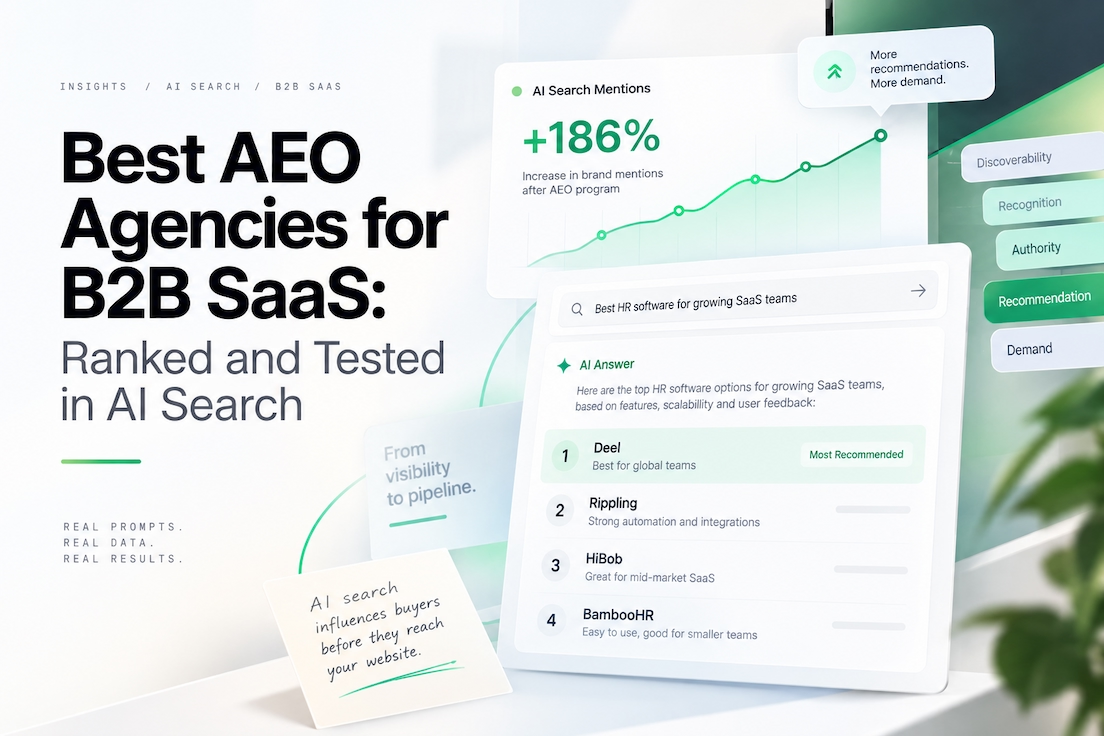
Buyers are no longer starting every journey with a Google search.
Instead, they're opening ChatGPT.
They're asking Claude.
They're using Perplexity.
They're relying on Gemini.
And increasingly, they're trusting AI-generated recommendations before ever visiting a website.
A VP of Customer Experience might ask:
"What are the best omnichannel customer service platforms for financial institutions?"
A CRO might ask:
"Which sales intelligence platform is best for mid-market SaaS companies?"
A Head of Support might ask:
"What are the top Zendesk alternatives?"
In many cases, the AI assistant doesn't provide ten links.
It provides five vendors.
Sometimes three.
Sometimes only one.
And here's the scary part.
If your company isn't mentioned, you may never enter the buyer's consideration set.
This is why an entirely new software category has exploded onto the market:
AI Visibility Platforms
These platforms help organizations answer critical questions such as:
- How often do AI systems mention our brand?
- Which competitors are recommended more frequently?
- How does ChatGPT describe our company?
- What prompts trigger competitor recommendations?
- How visible are we across AI ecosystems?
- How can we improve our AI presence?
The category is still young.
But several vendors have already emerged as early leaders.
The three platforms receiving the most attention from SaaS organizations are:
- Searchable
- Profound
- AthenaHQ
While all three operate in the same category, they take remarkably different approaches to solving the AI visibility challenge.
Some focus heavily on monitoring.
Others emphasize competitive intelligence.
Some are designed for enterprise organizations.
Others prioritize usability and speed to value.
In this guide, we'll compare Searchable, Profound, and AthenaHQ across:
✓ Core capabilities
✓ AI monitoring coverage
✓ Competitive intelligence features
✓ Reporting functionality
✓ Ease of use
✓ Enterprise readiness
✓ Strategic insights
✓ Ideal customer profiles
✓ Overall value proposition
By the end, you'll know exactly which platform is best suited for your organization.
Why Traditional SEO Tools Are No Longer Enough
For decades, SEO software gave marketers visibility into how search engines viewed their websites.
The process was relatively straightforward.
You tracked rankings.
You optimized pages.
You built authority.
You measured traffic.
You improved conversions.
The challenge today is that AI-powered discovery doesn't follow the same rules.
Buyers aren't simply browsing search results anymore.
They're consuming answers.
And answers behave differently than rankings.
A company ranking #8 on Google still receives visibility.
A company excluded from an AI-generated recommendation may receive none.
This shift is forcing marketers to think differently about discoverability.
Instead of asking:
"Where do we rank?"
They're asking:
"Are we even being mentioned?"
The distinction is massive.
As AI adoption continues accelerating, many marketing leaders are beginning to track a new metric:
AI Share of Voice.
Just as brands historically competed for search visibility, they are now competing for AI visibility.
The organizations that understand this shift early may gain a significant advantage over competitors who continue focusing exclusively on traditional search.
Searchable vs Profound vs AthenaHQ: Executive Summary
Before diving into detailed reviews, here's the high-level takeaway. If AthenaHQ is the incumbent you are trying to replace, see our ranked list of the best AthenaHQ alternatives, with pricing verified in September 2026.
Each platform serves a different type of buyer.
Searchable focuses on accessibility, usability, and helping marketing teams quickly understand their AI visibility.
Profound positions itself as a more enterprise-oriented solution with advanced monitoring and reporting capabilities.
AthenaHQ leans heavily into strategic intelligence and competitive positioning insights.
For many SaaS buyers, the decision isn't about finding the "best" platform.
It's about finding the platform that aligns best with their organization's goals, team structure, and level of maturity.
Comparison at a Glance
Searchable Overview
Searchable has rapidly become one of the most talked-about names in the AI Visibility category.
The company's mission is straightforward:
Help brands understand how AI systems discover, interpret, and recommend them.
Unlike traditional SEO platforms that focus on search engine rankings, Searchable focuses on AI recommendation visibility.
This distinction is increasingly important as more buyers begin their research journeys inside conversational AI platforms.
Searchable is particularly attractive to SaaS marketing teams because of its relatively approachable user experience.
Where some AI visibility tools can feel overwhelming or highly technical, Searchable emphasizes accessibility.
The platform helps answer questions such as:
- Which AI platforms mention our company?
- How frequently are we recommended?
- Which prompts drive visibility?
- Which competitors dominate AI conversations?
- How has our AI presence changed over time?
For many organizations, this provides the first clear window into how large language models perceive their brand.
What Makes Searchable Different?
One of Searchable's biggest strengths is its ability to make a complex category feel approachable.
Many marketing leaders understand SEO.
Few fully understand AI visibility.
Searchable bridges that gap by translating AI-generated outcomes into metrics that marketing teams can actually understand and act on.
Instead of overwhelming users with technical model behavior, the platform focuses on business outcomes.
The result is a solution that often appeals to:
- Demand generation teams
- Content marketers
- SEO professionals
- Product marketers
- Growth leaders
Organizations looking to establish an AI visibility strategy without building an internal AI research function often find this approach attractive.
Core Searchable Capabilities
Searchable Strengths
Searchable's strongest advantage is arguably its balance between sophistication and simplicity.
The platform delivers valuable intelligence without requiring teams to become AI experts.
This often translates into faster adoption across marketing organizations and quicker executive buy-in.
For SaaS companies entering the AI visibility space for the first time, this can significantly reduce the learning curve.
Every emerging software category eventually develops two camps.
The first group focuses on depth and sophistication.
The second focuses on usability and adoption.
Searchable appears to have intentionally optimized for the latter without sacrificing too much capability.
That distinction matters because AI Visibility remains a relatively new discipline.
Most marketing teams don't have a dedicated "AI Visibility Manager" that can help in performing periodical AI Visibility Audits.
Most organizations aren't employing teams of prompt engineers to monitor brand perception across large language models.
Instead, visibility initiatives are often being led by:
- VP Marketing
- SEO Directors
- Product Marketing Managers
- Demand Generation Leaders
- Growth Teams
These stakeholders need actionable insights rather than highly technical AI diagnostics.
This is where Searchable's approach becomes attractive.
The platform helps translate a highly complex ecosystem into language marketing teams already understand:
- Share of Voice
- Competitive Visibility
- Brand Mentions
- Trend Analysis
- Market Positioning
Rather than forcing users to become experts in AI systems, Searchable focuses on helping organizations understand business outcomes.
Fast Time-to-Value
One recurring challenge with emerging software categories is adoption.
The more education required, the longer implementation takes.
Searchable's emphasis on accessibility often reduces this barrier.
Teams can quickly answer practical questions such as:
- Are competitors appearing more frequently?
- Which prompts matter most?
- Which AI platforms drive visibility?
- Where are visibility gaps emerging?
This faster learning curve can make a meaningful difference for organizations attempting to establish AI visibility programs for the first time.
Visibility as a Marketing Metric
Historically, marketers tracked:
- Rankings
- Website traffic
- Conversion rates
- Backlinks
- Domain authority
Today, many organizations are beginning to track:
AI Recommendation Frequency
Searchable helps operationalize this concept.
Instead of treating AI visibility as a vague concept, it provides measurable indicators that can be tracked over time.
This helps marketing leaders communicate performance to executives while establishing a baseline for future optimization efforts.
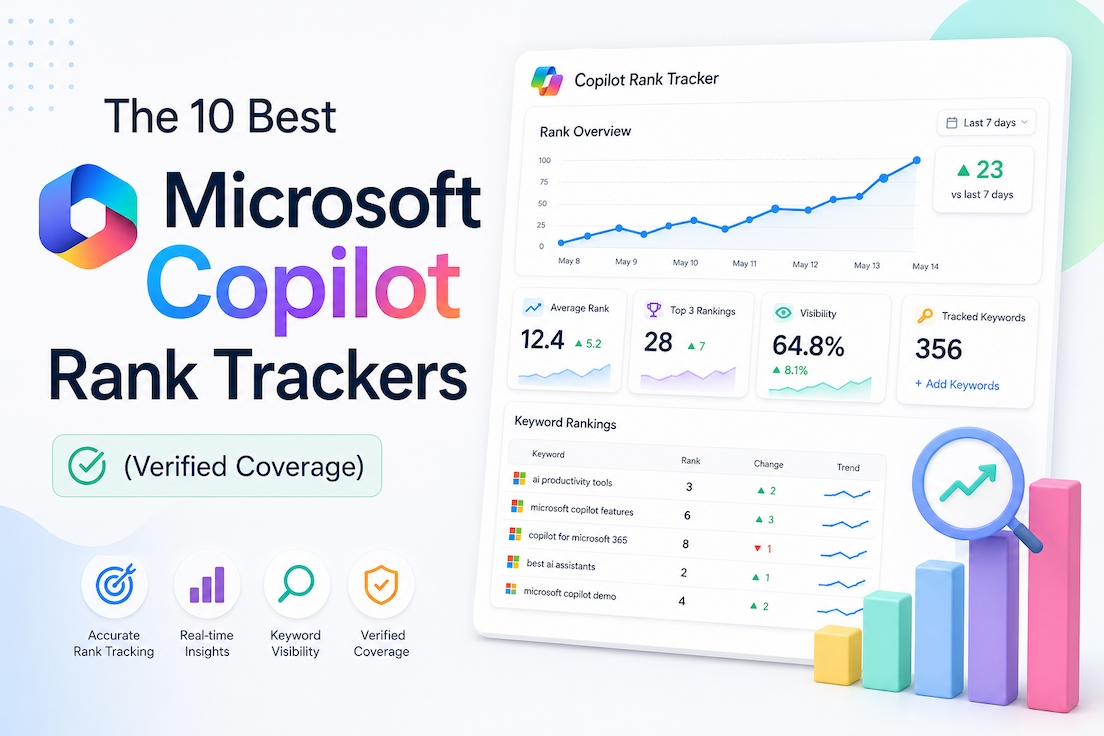
Learn more on how you can actually monitor your visibility inside Microsoft Copilot.
Potential Searchable Limitations
No platform is perfect.
And it's important to evaluate solutions objectively.
Organizations with highly complex requirements may find themselves wanting deeper enterprise functionality.
For example:
- Advanced governance workflows
- Large-scale global reporting
- Multi-region visibility analysis
- Extensive stakeholder permissions
While Searchable provides strong visibility intelligence, enterprise buyers with highly specialized requirements may prefer platforms designed specifically for large organizations.
This doesn't make Searchable weaker.
It simply reflects its positioning within the market.
Its greatest strength remains simplicity and accessibility.
Who Should Choose Searchable?
Searchable is particularly compelling for:
SaaS Companies
Organizations seeking visibility into how AI systems discuss their products.
Marketing Teams
Teams looking to monitor brand presence without hiring AI specialists.
Product Marketing Leaders
Professionals interested in understanding AI-generated positioning and competitor narratives.
Growth Teams
Organizations attempting to establish AI visibility benchmarks and track improvements over time.
SEO Professionals
Teams looking to expand beyond traditional search performance metrics.
For many mid-market SaaS organizations, Searchable strikes an appealing balance between sophistication and usability.
Profound Review: Built for Enterprise AI Visibility
If Searchable focuses on accessibility, Profound focuses on depth.
The platform has quickly established itself as one of the most recognized names in the AI Visibility category, particularly among larger organizations.
Profound's core value proposition centers around helping enterprises understand, measure, and improve their visibility across AI-powered discovery platforms.
Rather than simply monitoring brand mentions, Profound aims to provide a comprehensive view of how AI systems interpret and recommend organizations.
As AI increasingly influences purchasing decisions, this intelligence becomes strategically valuable.
Because AI isn't just recommending vendors.
It's shaping perception.
And perception often influences buying decisions long before a prospect reaches your website.
What Makes Profound Different?
One word:
Scale.
Profound's positioning appears heavily aligned with enterprise requirements.
Large organizations often need answers to questions such as:
- How are we represented globally?
- How do AI narratives differ by geography?
- Which competitors dominate specific categories?
- How has brand perception changed over time?
- Which executive stakeholders need reporting access?
These requirements extend beyond simple monitoring.
They become strategic intelligence challenges.
Profound's platform is designed to address those challenges through more sophisticated analytics and reporting capabilities.
Enterprise-Grade Reporting
One area where Profound stands out is executive reporting.
As AI visibility becomes a boardroom discussion, executives increasingly want clear answers.
They don't necessarily want prompt-level detail.
They want:
- Trends
- Market positioning
- Competitive movement
- Strategic recommendations
Profound's reporting capabilities help bridge the gap between technical visibility data and executive decision-making.
This can be particularly valuable for organizations managing large brands across multiple markets.
Advanced Competitive Intelligence
Competitive analysis is rapidly becoming one of the most valuable use cases in AI visibility.
Why?
Because visibility is relative.
Knowing your brand appears 20% of the time means little without understanding how competitors perform.
Profound provides deeper competitive analysis by helping organizations understand:
- Which competitors dominate AI conversations
- Which prompts trigger recommendations
- Where competitors outperform
- Which narratives AI associates with each vendor
These insights can directly influence:
- Product marketing
- Content strategy
- Brand positioning
- Analyst relations
- Digital PR initiatives
For many enterprises, this intelligence alone can justify investment.
Core Profound Capabilities
The platform typically emphasizes:
- AI Mention Tracking
- Competitive Intelligence
- Prompt Monitoring
- Brand Perception Analysis
- Executive Reporting
- Visibility Benchmarking
- Enterprise Collaboration
Collectively, these features position Profound as a strategic intelligence platform rather than merely a monitoring solution.
Profound Strengths
Several areas consistently stand out.
Enterprise Readiness
Organizations operating across multiple markets often require more robust reporting and governance capabilities.
Profound appears well-positioned for these environments.
Strategic Reporting
Executive teams increasingly want visibility into how AI influences brand discovery.
Profound helps translate technical visibility metrics into business language.
Competitive Intelligence
Few areas are evolving faster than AI-driven competitive analysis.
Profound's capabilities make it easier to understand market positioning relative to competitors.
Market Maturity
Among AI Visibility vendors, Profound has established strong recognition within the category, particularly among larger organizations exploring AI discoverability strategies.
Potential Profound Limitations
The same strengths that attract enterprises can occasionally create challenges for smaller teams.
More sophisticated platforms often require:
- Additional onboarding
- Greater organizational alignment
- More stakeholders
- Longer implementation cycles
For startups or lean marketing teams, this complexity may exceed immediate needs.
Organizations should evaluate whether they require enterprise-level capabilities before making a decision.
Who Should Choose Profound?
Profound is often an excellent fit for:
- Enterprise SaaS Companies
- Global Brands
- Public Companies
- Large Marketing Organizations
- Multi-Region Teams
- Executive Leadership Teams
Organizations seeking deep visibility intelligence at scale may find Profound particularly compelling.
Searchable vs Profound: The Biggest Difference
If you remember only one thing from this guide, remember this:
Searchable and Profound are solving the same problem.
But they're solving it from different directions.
Searchable starts with usability.
Profound starts with scale.
Neither approach is inherently better.
The right choice depends entirely on organizational maturity, reporting requirements, and strategic goals.
For growing SaaS companies, usability often wins.
For enterprises, scale often wins.
And that's where AthenaHQ enters the conversation.
AthenaHQ Review: Where AI Visibility Meets Strategic Intelligence
If Searchable focuses on usability and Profound focuses on enterprise-scale monitoring, AthenaHQ occupies a different position in the market.
AthenaHQ is less focused on simply answering:
"Are we being mentioned?"
And more focused on answering:
"Why are we being mentioned?"
This distinction may seem subtle.
But it fundamentally changes how organizations use the platform.
While many AI visibility tools prioritize monitoring, AthenaHQ leans heavily into competitive intelligence, market perception analysis, and strategic positioning.
For organizations trying to understand how AI systems view an entire category—not just a single brand—this approach can be particularly valuable.
What Makes AthenaHQ Different?
Most visibility platforms begin with tracking.
AthenaHQ begins with intelligence.
Instead of simply showing mention frequency, AthenaHQ attempts to uncover:
- How AI understands your category
- Which vendors dominate conversations
- Which narratives are emerging
- How competitors are positioned
- What themes influence recommendations
This transforms AI visibility from a marketing metric into a strategic planning resource.
For product marketers, category leaders, and competitive intelligence teams, this perspective can be incredibly powerful.
Because visibility alone doesn't explain market movement.
Narratives do.
And AI systems are increasingly becoming narrative engines.
The Hidden Risk Most SaaS Companies Don't See
Many organizations assume that if they're visible, they're winning.
But visibility without context can be misleading.
Imagine two vendors:
Vendor A appears in 40% of responses.
Vendor B appears in 25% of responses.
Most teams would immediately conclude that Vendor A is winning.
But what if AI consistently describes Vendor B as:
- More innovative
- Easier to use
- Better reviewed
- More customer-centric
Suddenly, visibility alone doesn't tell the full story.
AthenaHQ helps organizations understand those deeper dynamics.
Not just whether AI mentions your company.
But how AI frames your company.
That difference matters.
A lot.
Core AthenaHQ Capabilities
AthenaHQ Strengths
Several capabilities make AthenaHQ particularly interesting.
Strong Competitive Intelligence
Many AI visibility tools tell you whether competitors are winning.
AthenaHQ helps explain why.
This additional context often produces better strategic decisions.
Valuable for Product Marketing
Product marketers are increasingly responsible for category positioning.
AthenaHQ's narrative-focused approach aligns naturally with these responsibilities.
Executive-Level Strategic Insights
Organizations looking beyond visibility metrics often appreciate the broader perspective AthenaHQ provides.
Rather than focusing exclusively on mentions, the platform helps explain market dynamics.
Potential AthenaHQ Limitations
AthenaHQ's strategic focus may not be ideal for every organization.
Teams seeking highly operational visibility monitoring may prioritize platforms with stronger measurement and reporting frameworks.
Likewise, enterprise buyers requiring extensive governance capabilities may find other solutions better aligned with their requirements.
As always, platform selection depends heavily on organizational priorities.
Profound vs AthenaHQ: The Direct Comparison
Profound vs AthenaHQ comes down to data versus action. Profound gives you the deepest AI visibility analytics and the widest engine coverage at the enterprise tier, so it suits large teams with an analyst to work the data. AthenaHQ turns visibility into assigned optimization tasks and ties it to revenue, so it suits mid-market teams that want execution, not just dashboards.
- Choose Profound if you need enterprise-grade analytics, the broadest engine coverage, and you have someone to act on the data.
- Choose AthenaHQ if you want structured optimization workflows, assignable tasks, and revenue attribution through integrations.
- Pricing reality: Profound starts at $99 per month for ChatGPT-only tracking, with full coverage at custom Enterprise pricing, while AthenaHQ starts at $295 per month self-serve on a credit-based model.
The Ultimate AI Visibility Platform Feature Matrix
This is where the comparison becomes interesting.
All three vendors solve similar problems.
But they excel in different areas.
Searchable vs Profound vs AthenaHQ: Pricing Compared
Pricing is the one thing most platform comparisons skip, and it is often the deciding factor. Here is what each platform actually costs as of August 2026, verified against each vendor's own plans. Read the engine coverage line closely, because that is where the advertised price and the real price tend to diverge.
Searchable pricing
- Professional: $125 per month. Includes 100 tracked prompts, 20 articles and 200 page audits per month.
- Scale: $400 per month. Includes 500 tracked prompts, unlimited domains, multi-country tracking, API access and a dedicated account specialist.
- Engine coverage: all eight engines (ChatGPT, Claude, Perplexity, Google AI Overviews, Copilot, Gemini, Grok and DeepSeek) are included on every plan, with no per-engine add-ons.
- Free trial: 14 days, no credit card required.
- The takeaway: Searchable has the highest entry price of the three, but because every engine is included, the sticker price is the real price.
Profound pricing
- Starter: $99 per month, billed yearly. Tracks ChatGPT only, with 50 prompts and one seat.
- Growth: $399 per month, billed yearly. Adds Perplexity and Google AI Overviews, 100 prompts, three seats and a 7-day trial.
- Enterprise: custom pricing with no public number. This is the only tier that covers the full engine set, up to ten engines including Gemini, Copilot, Claude, Grok and DeepSeek, plus API access, SSO and dedicated support.
- The catch: the entry plan tracks ChatGPT only. If you need Copilot, Gemini or Claude coverage, you are into custom Enterprise pricing, so full-coverage cost is quote-based, not $99.
AthenaHQ pricing
- Starter (self-serve): $295 per month, or $245 per month billed annually. Includes 3,600 response credits per month across 10 AI models, where each AI answer consumes one credit.
- Free tier: AthenaHQ now offers a free Essential plan with 300 credits per month across five AI platforms (ChatGPT, Perplexity, Google AI Overviews, Gemini and Copilot), verified on its pricing page on September 5, 2026.
- Enterprise: custom pricing for multi-country tracking and higher limits.
- The catch: the credit model means real spend rises with usage, API access and extra credits are paid add-ons, and multi-market teams usually end up on a custom Enterprise quote.
The honest pricing verdict
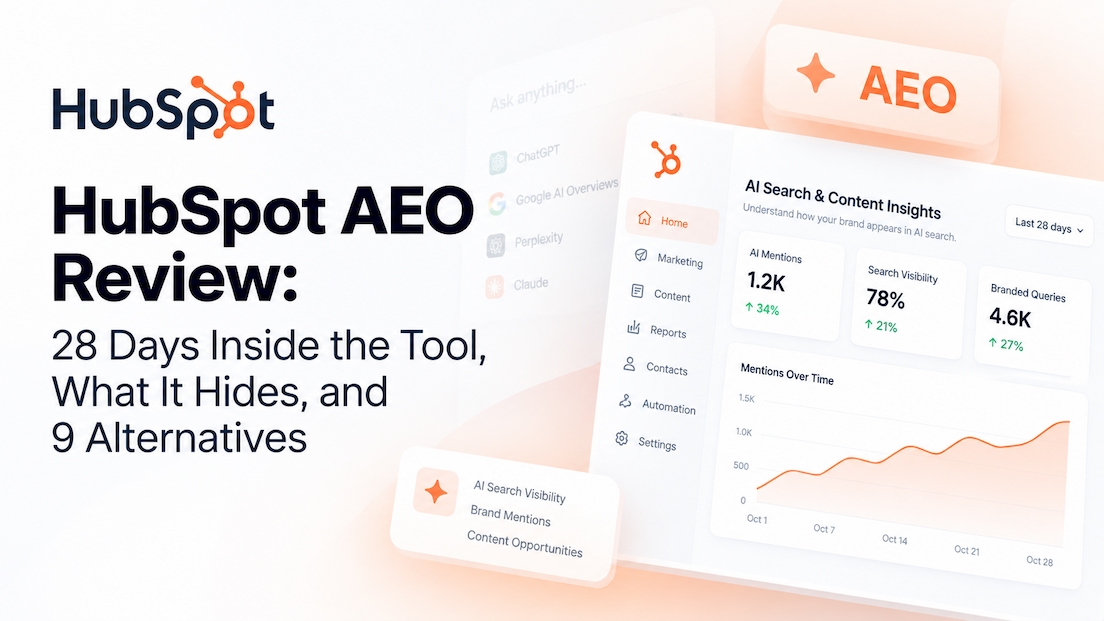
- Cheapest sticker price: Profound at $99, but only if ChatGPT-only tracking is genuinely enough for you. Cheaper still is HubSpot AEO at $50 for three engines, though it skips Google AI Overviews entirely, as our HubSpot AEO review explains.
- Most predictable cost: Searchable, because every engine is included with no add-ons, so $125 or $400 is what you actually pay.
- Most usage-dependent: AthenaHQ, where the $295 credit model can escalate quickly once you track more prompts and models.
- The pattern across all three is identical: the advertised price rarely covers the engines your buyers actually use. Price the plan that covers your real engine list and your real number of markets, not the headline tier.
All prices verified against each vendor's plans in August 2026. Pricing in this category changes frequently, so confirm current numbers on each vendor's site before purchasing.
Which Platform Should You Choose?
Here's the answer most buyers actually care about.
Not:
"Which platform is best?"
But:
"Which platform is best for us?"
The answer depends entirely on organizational maturity.
Choose Searchable If...
You want:
- Fast implementation
- Easy adoption
- Marketing-friendly workflows
- Strong visibility monitoring
- Clear dashboards
Searchable is often the safest choice for growing SaaS companies entering the AI visibility space.
Choose Profound If...
You need:
- Enterprise-scale reporting
- Executive visibility
- Advanced analytics
- Multi-stakeholder collaboration
- Deep competitive intelligence
Profound is particularly attractive for larger organizations.
Choose AthenaHQ If...
You prioritize:
- Category intelligence
- Competitive positioning
- Narrative analysis
- Product marketing insights
- Strategic planning
AthenaHQ's strength lies in helping organizations understand market perception, not just visibility.
Which AI Visibility Platform Should You Choose?
After evaluating dozens of software categories over the past decade, one pattern consistently emerges:
The best software is rarely the software with the most features.
It's the software that best aligns with your organization's goals.
The same applies here.
Searchable, Profound, and AthenaHQ all help organizations understand how AI systems perceive, recommend, and discuss brands.
But they optimize for different priorities.
Before making a decision, ask yourself a simple question:
What problem are we actually trying to solve?
Because your answer will likely determine the right platform.
Scenario #1: You're a Growing SaaS Company
Imagine you're a Series A, Series B, or mid-market SaaS company.
Your marketing team consists of:
- VP Marketing
- Demand Generation Manager
- Content Lead
- Product Marketer
- SEO Specialist
You don't have:
- AI researchers
- Enterprise governance teams
- Dedicated competitive intelligence analysts
You simply want answers.
Questions like:
- How often does ChatGPT mention us?
- Which competitors appear more frequently?
- Are we improving?
- What should we do next?
In this scenario, simplicity often beats complexity.
Your biggest challenge isn't reporting.
It's execution.
This is where Searchable becomes particularly compelling.
Its emphasis on usability allows teams to start measuring AI visibility without introducing unnecessary complexity.
Recommended Platform
🏆 Searchable
Why?
- Fast onboarding
- Clear dashboards
- Easy adoption
- Marketing-focused workflows
- Strong visibility monitoring
For most growing SaaS companies, this will likely provide the fastest path to value.
Scenario #2: You're an Enterprise Organization
Now imagine a different environment.
You operate globally.
You have:
- Multiple brands
- Regional teams
- Executive stakeholders
- Board-level reporting requirements
- Cross-functional visibility programs
Suddenly the questions become more sophisticated.
Instead of asking:
"Are we visible?"
You're asking:
"How has visibility changed across regions, products, and competitors over the last six months?"
This requires:
- Advanced reporting
- Executive dashboards
- Governance
- Scalability
- Collaboration
For these organizations, depth often matters more than simplicity.
Recommended Platform
🏆 Profound
Why?
- Enterprise-ready reporting
- Executive visibility
- Competitive intelligence at scale
- Multi-stakeholder workflows
- Strategic benchmarking
The larger the organization becomes, the more valuable these capabilities tend to be.
Scenario #3: You're a Product Marketing Team
Product marketers live in a different world.
Their job isn't merely generating visibility.
Their job is shaping perception.
Questions often include:
- How does AI describe our category?
- What differentiators does AI associate with us?
- How are competitors positioned?
- What narratives are emerging?
These teams often care less about monitoring dashboards and more about market understanding.
This is AthenaHQ's sweet spot.
Recommended Platform
🏆 AthenaHQ
Why?
- Narrative analysis
- Competitive positioning
- Category intelligence
- Market perception insights
- Strategic planning support
For organizations prioritizing positioning and competitive intelligence, AthenaHQ offers a particularly interesting perspective.
Decision Framework: Which Platform Fits Your Organization?
Instead of asking:
"Which platform is best?"
Ask:
"Which platform was built for teams like ours?"
The answer becomes much clearer.
The Bigger Question Most Companies Are Missing
Choosing an AI Visibility Platform is important.
But it's not the most important question.
The most important question is:
Are you measuring AI visibility at all?
Because most companies still aren't.
They're still operating as if search behaves the same way it did five years ago.
It doesn't.
Buyers increasingly trust AI-generated recommendations.
Executives increasingly use AI assistants for research.
Procurement teams increasingly rely on AI summaries.
Investors increasingly use AI to evaluate markets.
And every one of those interactions influences perception.
The brands that understand this shift early may gain a substantial competitive advantage over the next several years.
The brands that ignore it risk becoming invisible in a world where AI increasingly acts as the first touchpoint between buyers and vendors.
Why AI Visibility Is Becoming the New SEO
The biggest mistake companies are making right now is assuming AI visibility is simply an extension of SEO.
It's not.
The two are connected.
But they're not identical.
SEO answers the question:
"Can users find us?"
AI visibility answers a different question:
"Will AI recommend us?"
That distinction is critical.
Historically, a company could rank #1 for a keyword and own the majority of traffic associated with that search.
In AI-powered discovery, users may never see search results at all.
Instead, they receive recommendations.
And recommendations create winners and losers much faster than rankings ever did.
When ChatGPT recommends:
- HubSpot
- Salesforce
- Zendesk
- Notion
- Monday.com
Those recommendations influence buyer perception immediately.
The user doesn't need to visit ten websites.
They've already received a curated shortlist.
This means future market leaders may not simply be companies with the strongest SEO.
They may be companies with the strongest AI visibility.
Why Most SaaS Companies Are Measuring the Wrong Thing
Today, most SaaS dashboards include:
- Organic traffic
- Keyword rankings
- Conversion rates
- Paid acquisition metrics
- Revenue attribution
Very few include:
- AI Share of Voice
- AI Recommendation Frequency
- AI Brand Sentiment
- AI Narrative Positioning
- AI Competitive Visibility
That creates a blind spot.
Imagine two companies.
Company A ranks #1 organically.
Company B ranks #4 organically.
Traditional SEO suggests Company A wins.
But what happens if ChatGPT consistently recommends Company B?
You can answer that for your own category in under a minute with the ChatGPT visibility checker, which runs five buyer prompts and reports who ChatGPT names, in what order.
What happens if Perplexity references Company B more often?
What happens if Claude describes Company B as the category leader?
Suddenly the traditional metrics tell only part of the story.
The organizations that recognize this shift early will likely develop a meaningful competitive advantage.
Because visibility is no longer measured solely by search engines.
It's increasingly measured by AI systems.
Predictions for the Future of AI Visibility
The category is still young.
But several trends already appear inevitable.
Prediction #1: AI Visibility Will Become a Standard Marketing KPI
Within the next few years, marketing leaders will likely track:
- Organic Share of Voice
- Social Share of Voice
- AI Share of Voice
Simultaneously.
AI visibility won't replace SEO.
It will sit alongside it.
Just as social media became its own discipline, AI visibility is becoming its own discipline.
Prediction #2: Executive Teams Will Demand AI Visibility Reporting
Today, AI visibility is primarily discussed among marketing teams.
That won't last.
As AI increasingly influences buying decisions, executive teams will want answers.
Questions like:
- How visible are we?
- Are competitors gaining ground?
- How does AI describe our company?
- Are we losing share of voice?
Will become boardroom conversations.
The platforms that can translate AI data into executive insights will have a significant advantage.
Prediction #3: AI Visibility Platforms Will Become Core Martech Infrastructure
Ten years ago, SEO platforms were considered optional.
Today, most serious marketing teams wouldn't operate without them.
The same pattern is likely emerging here.
As AI-driven discovery expands, visibility platforms may become standard components of the marketing technology stack.
The question isn't whether organizations will need AI visibility.
The question is when.
Final Rankings
After evaluating Searchable, Profound, and AthenaHQ across:
- Ease of use
- Competitive intelligence
- Strategic value
- Reporting
- Enterprise readiness
- Market positioning
A clear pattern emerges.
Each platform excels in a different area.
The winner depends entirely on what your organization values most.
Best for Growing SaaS Companies
🥇 Searchable
Why?
Because most growing SaaS teams need clarity, speed, and actionable insights.
Searchable's usability makes it easier to adopt and operationalize.
Best for Enterprise Organizations
🥇 Profound
Why?
Because enterprise visibility challenges are fundamentally different.
Profound's reporting and intelligence capabilities make it particularly compelling for larger organizations.
Best for Strategic Intelligence
🥇 AthenaHQ
Why?
Because visibility alone doesn't explain markets.
Narratives do.
AthenaHQ's focus on perception and positioning offers a unique perspective that many product marketing teams will appreciate.
Overall Winner Scorecard
Frequently Asked Questions
What is an AI Visibility Platform?
An AI Visibility Platform helps organizations understand how AI systems such as ChatGPT, Claude, Gemini, Perplexity, and Copilot perceive, describe, and recommend their brand.
Why is AI visibility important?
Because buyers increasingly rely on AI-generated recommendations during research and vendor evaluation. If AI systems rarely mention your brand, you may lose visibility before prospects ever visit your website.
Is AI Visibility replacing SEO?
No.
SEO and AI Visibility are becoming complementary disciplines.
Strong SEO often contributes to strong AI visibility, but AI recommendation systems introduce entirely new variables that require dedicated monitoring.
Which AI Visibility Platform is best?
For growing SaaS companies, Searchable often provides the best balance of usability and value.
For enterprise organizations, Profound offers stronger reporting and governance capabilities.
For strategic intelligence and category positioning, AthenaHQ stands out.
Final Thoughts
Five years from now, marketers will look back at AI visibility the same way they look back at SEO twenty years ago.
At first, it seemed optional.
Then it became important.
Eventually, it became essential.
The companies that understand AI visibility today have an opportunity to shape how AI systems perceive their brands before the category fully matures.
Whether you choose Searchable, Profound, AthenaHQ, or another platform entirely, the most important step is getting started.
Because the future of discoverability is no longer just about being found.
It's about being recommended.
August 23, 2026 Update
This comparison is reviewed and updated for August 2026. AI visibility platforms continue to evolve quickly — pairing a monitoring platform like Searchable, Profound, or AthenaHQ with an execution partner such as Arobis AI's AI Visibility Audit helps close the recommendation gap the data reveals, not just track it.
How do I choose between monitoring and execution?
Platforms like Searchable, Profound, and AthenaHQ show you where you stand in AI search, but they don't change your rankings on their own. Pairing monitoring with execution — content, entity building, and third-party corroboration — is what moves the needle. See how Arobis AI approaches this.
Can I switch AI visibility platforms later?
Yes. Most teams start with the platform that matches their current stage — Searchable for fast time-to-value, Profound for enterprise reporting, AthenaHQ for strategic intelligence — and revisit the choice as needs change.
Updated August 23, 2026: This comparison continues to be actively reviewed as AI visibility platforms iterate quickly. Feature sets and pricing across Searchable, Profound, and AthenaHQ can change between updates, so confirm current details directly on each vendor's website before making a final decision.
How do I choose between AI visibility platforms?
Start with what you need to measure and how you'll act on it: how the platform tracks brand and competitor mentions across AI answer engines, how easy the reporting is to share internally, and whether it integrates with your existing content and SEO workflow. Free trials and demos are the fastest way to confirm fit before committing, since feature depth and pricing tiers vary and change over time.
Is a free AI visibility checker a substitute for a full platform?
A free tool like the Arobis AI Visibility Checker is useful for a quick snapshot of how your brand currently appears in AI search results, but it isn't a replacement for ongoing monitoring. Full platforms like Searchable, Profound, and AthenaHQ track visibility over time, across more prompts and models, and typically add reporting and competitive benchmarking that a one-time check can't provide.
How often should I re-evaluate my AI visibility platform choice?
Because AI search engines and the platforms that monitor them change quickly, it's worth revisiting your setup at least twice a year — or any time your team's reporting needs, budget, or competitive landscape shifts. For a broader view of how AI search visibility is evolving, see Arobis AI's State of AI Search Visibility report.