
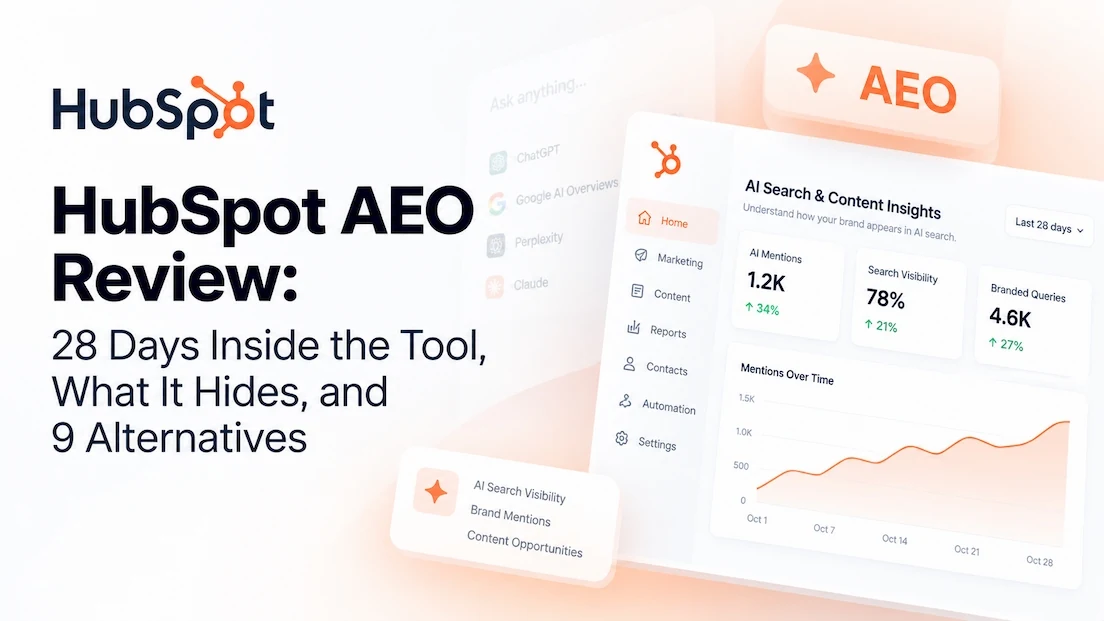
TL;DR: HubSpot AEO is one of the cheapest credible ways to see whether ChatGPT, Gemini and Perplexity mention your brand. For $50 a month you get 25 tracked prompts, run daily across three engines, with sentiment, share of voice, citation analysis and a list of recommendations. That's good value, and the 28-day free trial needs no credit card. The catch is everything the dashboard doesn't show you: no Google AI Overviews, no Google AI Mode, no Claude, no Copilot, a 25-prompt ceiling that fills up fast, prompt suggestions users on Reddit call "AI slop", and recommendations that tell you to go post on Reddit without telling you how. It measures. It doesn't move the number. This review covers what you actually get, what it hides, what 145 G2 reviewers and the r/hubspot crowd say, a week-by-week plan for the trial, and 9 alternatives with their published pricing.
HubSpot AEO review scorecard (out of 10)
- Price and value: 9. $50 a month, or $45 billed annually. Otterly.ai's Lite plan costs less, but few other serious trackers do.
- Engine coverage: 4. ChatGPT, Gemini and Perplexity only. The biggest AI surface on earth, Google AI Overviews, isn't tracked. Neither is Google AI Mode, Claude or Copilot.
- Prompt capacity: 5. 25 prompts on the standalone plan and on Marketing Hub Professional, 50 on Enterprise. Extra capacity comes in packs of 10.
- Metrics and dashboard: 8. Visibility, sentiment, share of voice, citations and competitor benchmarking, updated daily. Clean, easy to read.
- Recommendations: 5. Useful as a to-do list, weak on the how. The Reddit and outreach suggestions are the most criticised part of the product.
- Fit for agencies: 3. Single brand, single portal, no white-label reporting.
- Does it change your AI visibility: 2. It's a monitoring tool. The work that gets you recommended still happens outside the dashboard.
- Overall: 6.5. Buy it if you're a HubSpot Marketing Hub user with one brand and no AI visibility data today. Skip it if you need Google's AI surfaces, Claude, more than 25 prompts, or someone to actually do the work.
What HubSpot AEO is, and where it came from
HubSpot AEO is HubSpot's answer engine optimization product. It tracks how often your brand appears in AI-generated answers, who gets mentioned instead of you, which sources those answers cite, and what HubSpot thinks you should publish next. It launched in public beta on April 14, 2026, and it's available two ways: bundled into Marketing Hub Professional and Enterprise, or as a standalone subscription for $50 a month with no other HubSpot plan required.
The product didn't start life inside HubSpot. On October 31, 2025 HubSpot announced it was acquiring XFunnel, an Israeli AEO startup founded by Beeri Amiel and Neri Bluman that was less than a year old at the time. The deal closed in early November 2025 and HubSpot AEO is XFunnel rebuilt inside the HubSpot interface. That matters for two reasons. First, it explains why a company the size of HubSpot shipped a full AI visibility dashboard within six months. Second, it explains the beta label: HubSpot's own "best AEO software" page still describes the product as being in beta, and the knowledge base still reads like a product that's being extended month by month.
HubSpot's stated reason for building it is blunt. In the launch announcement the company said organic traffic for its customers was down 27% year over year, that beta customers who prioritised answer engines saw 20% more AI referral traffic than non-users, and that 850+ customers were in the beta. HubSpot also claims that its own AEO work produced a 1,850% increase in qualified leads and that leads from AI convert 3x better than leads from traditional search. Those are HubSpot's numbers about HubSpot, so treat them as a sales deck, but the direction matches what we see in our own State of AI Search Visibility data: AI answers are eating the click, and B2B buyers increasingly shortlist software inside a chat window before they ever hit a website.
HubSpot AEO pricing, decoded
The headline price is simple. The real cost depends on how many prompts you need and how many engines you care about. The table breaks it down plan by plan.
HubSpot AEO pricing and limits by plan
| Plan | Price | Prompts | Answers / month | Engines | What you get |
|---|---|---|---|---|---|
| HubSpot AEO standaloneReviewed hereNo Marketing Hub plan required | $50 / mo$45 / mo billed annually | 25run daily | 2,500 | ChatGPT, Gemini, Perplexity | Visibility score, sentiment, share of voice, citation analysis, competitor benchmark, recommendations |
| Marketing Hub ProfessionalAEO included | from $800 / mo | 25 | 2,500 | ChatGPT, Gemini, Perplexity | Everything in standalone, plus CRM-based prompt suggestions and blog post generation from recommendations |
| Marketing Hub EnterpriseAEO included | from $3,600 / mo | 50 | 5,000 | ChatGPT, Gemini, Perplexity | Everything in Professional, with 50 prompts instead of 25 |
| Extra capacity packBuy anytime inside the portal | Not publishedprice shown inside the portal | +10 | +1,000 | ChatGPT, Gemini, Perplexity | Same features, more tracked prompts |
| 28-day free trialNo card | $0 | 25 | 2,500 | ChatGPT, Gemini, Perplexity | Full standalone feature set for 28 days |
Not tracked on any plan: Google AI Overviews, Google AI Mode, Claude, Microsoft Copilot, Grok.
Two things the table can't show. HubSpot's product page says you can "purchase additional prompts anytime", but its pricing page doesn't publish what an extra pack of 10 prompts costs. And the trial has changed: it now gives you the full 25 prompts across all three engines for 28 days, but at launch in April it was 10 prompts on ChatGPT only, so if you read an older review that mentions 10 prompts, that's why.
The number nobody prints: cost per tracked prompt per engine
Sticker prices hide how much tracking you actually get, because every tool counts prompts and engines differently. So we did the maths the same way for every tool: monthly price, divided by prompts included, divided by engines included at that price. It's the fairest single number for comparing trackers. Prices are month-to-month entry tiers.
Cost per tracked prompt per engine, cheapest to priciest
| Tool and tier | Monthly price | Prompts | Engines | Per prompt per engine | Google AI covered? |
|---|---|---|---|---|---|
| Otterly.aiLite | $29 | 15 | 4 | $0.48 | YesAI Overviews; AI Mode as add-on |
| Scrunch AICore | $250 | 125 | 4 | $0.50 | YesAI Overviews; AI Mode on Enterprise |
| Peec AIStarter | $95 | 50 | 3chosen from 6 | $0.63 | Optionalif you pick it as one of your 3 |
| HubSpot AEOReviewed hereStandalone | $50$45 on annual | 25 | 3 | $0.67 | Nono AI Overviews, no AI Mode |
| Semrush SEO + AI SearchStarter, $165.17 billed annually | $199 | 50per day | 4 | $1.00 | YesGoogle AI |
| ProfoundEnterprise (only paid plan) | Custom | Custom | Up to 9 | n/a | YesAI Overviews |
| Ahrefs Brand RadarBrand Radar AI, standalone | $199 | Not published$50 prompt pack is about 80 a day | 1at $199; all 7 for $699 | Not published | YesAI Overviews and AI Mode |
Formula: monthly price ÷ prompts included ÷ engines included at that tier. Engine counts are the entry tier as published by each vendor.
Look at the price column and the per-unit column together. Only Otterly.ai has a smaller monthly bill than HubSpot AEO, yet HubSpot sits mid-table on cost per unit of tracking, and it's the only tool on the list that doesn't cover a single Google AI surface at any price. The cheap headline is real. The "best value" story is not.
What HubSpot AEO actually tracks
Once you add your brand, competitors, products and ideal customer profile, HubSpot generates prompts (or you write your own), runs each one daily on the three engines, and rolls the answers up into five views.
- Brand visibility: the percentage of tracked prompts where your brand appears at least once, plus how consistently it shows up across engines. This is the number on the main dashboard.
- Sentiment: a score from -100 to +100 for how positively the engines describe you, tracked over time.
- Share of voice: your share of brand mentions against the competitors you chose. Change your competitor list and only future runs are affected, so pick carefully on day one.
- Citation analysis: which domains the engines cite, what content types and channels they lean on, and how often your own site is the source. This is the most useful view in the product.
- Recommendations and Insights: a prioritised list of content to create or update, plus an Insights tab split into owned content, social channels and outreach.
HubSpot's own knowledge base adds a warning worth repeating: different engines generate different answers, and you should review performance across multiple days or weeks before reading anything into a trend. That's honest, and it's true of every tracker. It also means the first fortnight of your trial is mostly baseline noise, which is why the week-by-week plan further down matters.
What HubSpot AEO hides
None of this is secret. It's all in the documentation. It's just not on the pricing page, and it's the part that decides whether $50 is a bargain or a distraction.
1. The biggest AI surface on the planet isn't tracked
HubSpot AEO tracks ChatGPT, Gemini and Perplexity. It doesn't track Google AI Overviews or Google AI Mode. For a B2B SaaS company that's a strange gap, because AI Overviews sit on top of the same Google results your SEO team already fights for, and AI Mode is where Google is pushing the whole search experience. If you sell software, the buyer who types "best CRM for a 20-person sales team" into Google and reads the AI Overview is a real buyer you can't see in HubSpot AEO. Our guides to ranking in Google AI Overviews and Google AI Mode for SaaS exist precisely because those surfaces behave differently from ChatGPT.
2. No Claude, no Copilot, no Grok
Claude is the engine your prospects' engineers and product teams are most likely to be using, and it's missing. Microsoft Copilot, which sits inside the Office suite many of your buyers live in, is missing. So is Grok. HubSpot hasn't published a roadmap date for any of them. One G2 review (3.5 out of 5) makes exactly this complaint: the reviewer wishes AEO integrated with Claude the way other parts of HubSpot do. If Claude matters to you, read how to rank in Claude, and if Copilot does, our list of Copilot rank trackers covers the tools that do track it.
3. 25 prompts is not a lot of prompts
A B2B SaaS buyer journey has more than 25 questions in it. There are category prompts ("best AI visibility tools"), comparison prompts ("HubSpot vs Salesforce for a startup"), use-case prompts ("CRM that integrates with Slack and Notion"), pricing prompts, and brand prompts. Cover three products and two competitors properly and you've burned the allowance before lunch. The agency Blend wrote that it typically generates "around 200 or more" prompts per project. Getting from 25 to 200 prompts takes 18 extra packs of 10, and HubSpot doesn't publish the pack price, so ask before you plan on it.
4. The prompt suggestions are the weakest part
The top-voted answer in the r/hubspot thread asking whether anyone had tried the tool sums it up: it's "a little rote", basically a prompt tracker limited to 25 or 50 prompts, and the suggested prompts are "total AI slop". The same user liked tracking performance inside HubSpot and sources prompts elsewhere. That's the pattern we'd recommend too: write your own prompts from real buyer language. Our AI buying-intent prompt library is a good place to steal from.
5. Recommendations tell you what, not how
The recommendations engine is where HubSpot AEO tries to earn its keep, and it's also where the harshest feedback lands. Big Sea, an agency that ran the tool across three organisations, reported that auto-setup "isn't reliable enough to trust", that you can't independently monitor URLs of your own choosing, and that the outreach and social amplification suggestions assume resources most teams don't have. The G2 reviewer above says the Reddit suggestions feel more likely to damage the brand than help it, and that almost every action needs additional research before it can be executed. We agree with the diagnosis. Reddit does shape what ChatGPT says about software categories, but showing up there badly is worse than not showing up. If you want to try it anyway, the Reddit guide for SaaS we wrote shows how to post without getting your brand nuked by a moderator.
Teams that want judgement rather than automation often end up hiring an AEO agency instead.
6. It measures visibility, it doesn't create it
Big Sea's most important line was this: the tool "doesn't create search visibility where none exists". Their three test accounts scored 24 to 34%, 1.56% and 0.06% visibility, and the gap tracked domain authority more than content quality. That's the truth about every AI visibility tracker, HubSpot included. The dashboard is a scoreboard. The score moves when your brand is present on the sources the engines trust: comparison pages, review sites, community threads, third-party listicles and your own well-structured product pages. We wrote up the difference, including when monitoring is worth paying for, in our SEO agency vs AI search demand generation guide, and it's the single most useful frame for deciding what to buy.
7. It's one brand, one portal, one language
HubSpot AEO is built for a single in-house team tracking a single brand. There's no multi-client workspace, no white-label reporting and no cross-brand roll-up. Tracking a second brand in one account needs Marketing Hub Enterprise plus HubSpot's Brands add-on, so in practice agencies need a separate subscription per client portal. Rankability's review reached the same conclusion for agencies, and it's a fair one.
The free AEO Grader: what a score out of 100 really means
Before the paid tool, HubSpot offers a free, one-time AEO Grader (its own page still calls it the AI Search Grader). No account, results in under two minutes, and it's a smart lead magnet. HubSpot explains the scoring itself, and it breaks down like this:
- Sentiment: 40 points. The tone and credibility of how the engines describe you.
- Presence quality: 20 points. Depth of mentions, quality of sources, richness of data.
- Brand recognition: 20 points. How widely the brand appears in training data.
- Share of voice: 10 points. Where you rank against competitors.
- Market competition: 10 points. Competitive positioning and how innovative the engines think you are.
Two things to notice. First, 40% of the grade is sentiment, so a brand that's rarely mentioned but described nicely can outscore a brand that's mentioned everywhere with a caveat. Second, HubSpot says the check is based on what the engines say "based on their training data", using GPT-5.4 mini, Perplexity and Gemini. It's a snapshot of brand-level chatter, not a test of whether you get recommended when a buyer asks a real buying question. Use it as a conversation starter with your CEO, not as a strategy. If you want the buyer-question version, type a real prompt your customers would use into ChatGPT and Perplexity yourself, then compare the two results. They'll disagree, and the disagreement is the insight.
For a free second opinion that uses live web-search answers rather than training data, run the ChatGPT visibility checker and compare which brands each tool says ChatGPT names.
What real users say (G2 and Reddit, September 2026)
- G2: HubSpot AEO holds 4.4 out of 5 from 145 reviews. One recent review rates it 3.5 and describes the shift as "before: blind, after: decent clarity", while dinging the Claude gap and the Reddit recommendations.
- r/hubspot: several separate threads about the tool since launch. The recurring verdict is that it's a solid prompt tracker for the average Marketing Hub user, that the prompt suggestions are weak, and that "as with all HubSpot tools, there is always a better purpose-built tool out there".
- Agencies that ran it: Big Sea's three-account test found the tool useful for measurement and gap identification, and useless as a shortcut around the underlying authority work.
Put together, that's a consistent picture: good scoreboard, mediocre coach.
Where HubSpot AEO is genuinely good
It would be lazy to review a $50 tool as if it were a $5,000 platform, so this is the fair side.
- The price lowers the bar for everyone. At $50 a month, daily tracking on three engines stops being a budget line that needs sign-off.
- Citation analysis is the best view in the product. Seeing which domains ChatGPT cites for your category, and whether any of them are yours, tells you exactly where to earn a mention. If you want to see that pattern at scale, our study of the most influential domains in AI search applies the same reasoning across the whole field.
- Daily runs on every prompt. Several competitors run weekly on lower tiers. Daily data across three engines for $50 is real value.
- CRM-based prompt suggestions (Marketing Hub only). Pulling prompt ideas from what your actual contacts and deals look like is a smart idea, even if the execution is early.
- Sentiment tracking is included, not an add-on. Some trackers still charge extra for it.
- Zero learning curve for HubSpot users. If your team already lives in Marketing Hub, there's nothing new to log into.
How to spend 25 prompts without wasting a single one
This is the section HubSpot should have written. Twenty-five prompts is enough if you allocate them like a buyer, not like a brand manager. For a B2B SaaS company with one core product, we'd split them like this.
- 10 category prompts. "Best [category] software for [segment]", written five different ways, for the two segments that pay you most. These are the prompts where recommendation share is won or lost.
- 7 comparison prompts. "[You] vs [top competitor]", "[competitor A] vs [competitor B]" (yes, without you in it, so you see when you get added as a third option), and "alternatives to [competitor]".
- 5 use-case prompts. The integration, workflow or compliance questions your sales team hears on every second call.
- 2 pricing prompts. "How much does [category] software cost" and "[competitor] pricing". Watch who gets cited as the price authority.
- 1 brand prompt. Just one. Your brand name plus "review". Brand prompts make the visibility number look great and teach you nothing.
Skip the AI-generated prompt suggestions entirely for the first month. Write your own from sales calls, support tickets and the phrasing in your G2 reviews. Then, and only then, let HubSpot suggest additions to fill gaps you didn't see.
The 28-day trial plan, week by week
Most people start the trial, look at the dashboard on day two, feel either smug or sad, and forget about it. Use the 28 days like this and you'll end the trial with a real answer.
Week 1: set the baseline properly
- Enter every brand name variation, including the old name, the abbreviation and the way customers misspell you.
- Pick competitors deliberately. Changes only affect future runs, so choose the three you lose deals to, not the three you admire.
- Load the 25 prompts from the allocation above. Don't touch them again for two weeks.
Week 2: read citations, ignore the visibility score
- Export the citation view. List every domain the engines cite for your category prompts that isn't yours.
- Sort into three buckets: pages you could get listed on this month (listicles, directories, review sites), pages you could publish a better version of, and pages you'll never touch (Wikipedia, analyst reports).
- Check whether your own site appears as a citation at all. If it doesn't, no recommendation inside the tool will fix that before the trial ends.
Week 3: ship two things and watch one prompt
- Publish one comparison page and one use-case page that directly answer two of your tracked prompts, structured the way we describe in our GEO guide.
- Get listed on one third-party page from your bucket one. One is enough for the test.
- Watch the two prompts those assets answer. Daily. Write down the day the answer changes, if it changes.
Week 4: decide with data, not vibes
- Compare week 4 visibility against week 1 on the same 25 prompts. Anything under a 5-point move is noise.
- Ask one question: did the tool tell you anything you couldn't have found by typing your 25 prompts into ChatGPT once a week by hand? If yes, $50 is fine. If no, keep the prompts and cancel.
- Run the same prompts manually in Google AI Mode and Claude on the last day. Whatever you find there is the part of your market HubSpot AEO will never show you.
HubSpot AEO vs 9 alternatives
Prices are taken from each vendor's pricing page unless a note says otherwise. Engine counts are the entry tier unless stated. We've ranked these for a B2B SaaS team, which is who we work with every day, so read the ranking with that bias in mind.
HubSpot AEO vs 9 alternatives at a glance
| Tool | Entry price | Prompts at entry | Engines | Best for |
|---|---|---|---|---|
| HubSpot AEOReviewed here | $50 / mo$45 on annual; 28-day trial | 25 | 3ChatGPT, Gemini, Perplexity | Single-brand teams already inside Marketing Hub |
| Arobis AIAgency | from $2,500 / mo3-month minimum | Not a tracker | 4 auditedChatGPT, Claude, Gemini, Perplexity | B2B SaaS that wants to be recommended rather than measured |
| Otterly.ai | $29 / mo | 15 | 4plus Claude, AI Mode, Gemini add-ons | Lowest monthly-billed plan with ChatGPT, AI Overviews, Perplexity and Copilot |
| Semrush SEO + AI Search | $199 / mo$165.17 billed annually | 50 / day | 4 | Teams already paying for Semrush |
| Ahrefs Brand Radar | from $199 / mostandalone; prompt packs from $50 / mo | Not published$50 pack is about 80 / day | 1all 7 for $699 / mo | Largest prompt database |
| Peec AI | $95 / mo | 50 | 3 of 6 | European, privacy-first teams |
| Profound | Free trial7 days, then custom Enterprise | 50on the trial | 3 to 9 | Enterprise depth with an AEO owner |
| Scrunch AI | $250 / moCore; 7-day trial | 125 | 4 | Most tracked prompts at entry |
| AthenaHQ | Free tierStarter $295 / mo, 17% off on annual | Credit-based | 5 free, 11 on Starter | Competitive intel |
| Free AI visibility tools | $0 | Varies | Varies | Zero budget, one-off checks |
Ranked for B2B SaaS teams. Full notes on each tool, and who should skip it, are in the sections below.
1. Arobis AI: best if you want to be recommended rather than measured
Arobis AI is not a HubSpot AEO substitute in the dashboard sense: we're an AI Search Demand Generation agency for B2B SaaS, and we won't pretend our reporting competes with a tracker. What we do is the work HubSpot AEO's recommendations tab describes and doesn't perform: the comparison pages, the third-party placements, the review-site presence and the community footprint that make ChatGPT, Claude, Gemini and Perplexity recommend a product when a buyer asks. Engagements start at $2,500 a month on the Foundation plan with a three-month minimum, and every engagement begins with an AI visibility audit across those four engines. Skip us if you have no budget beyond a tracker, or if you just want a number for a board slide. Take a look at the pricing page if the demand side is what you're missing.
2. Otterly.ai: the lowest monthly bill for four engines
$29 a month for 15 prompts across ChatGPT, Google AI Overviews, Perplexity and Microsoft Copilot, with Claude, Google AI Mode and Gemini as add-ons. The Standard tier is $189 for 100 prompts and extra prompts are $99 per 100. It's the obvious swap if the HubSpot price attracted you but the Google gap put you off. Full breakdown in our Otterly.ai alternatives post.
3. Semrush AI Visibility Toolkit: for teams already paying Semrush
Teams not on a Semrush plan can buy the AI Visibility Toolkit by itself for $99 a month per domain (annual billing), which covers 25 prompts, half the bundle's 50. The SEO + AI Search bundle is $199 a month, or $165.17 billed annually, for 50 prompts tracked daily on one domain, across ChatGPT, Google AI, Gemini and Perplexity, plus an AI-readiness site audit. Twice HubSpot's prompt allowance at four times the price, but it covers Google. We cover the trade-offs in Semrush AI Visibility Toolkit alternatives.
4. Ahrefs Brand Radar: the largest prompt database
Brand Radar AI doesn't need a base Ahrefs subscription. Ahrefs' Brand Radar page puts it at $199 a month to cover one AI platform or $699 a month for every platform, with custom prompt packages from $50 a month. The full set covers AI Overviews, AI Mode, ChatGPT, Perplexity, Gemini, Copilot and Claude (Claude is available on the all-platforms option), backed by an index of hundreds of millions of search-backed prompts. If engine coverage is your objection to HubSpot, this is the answer. Our head-to-head of Ahrefs Brand Radar vs Semrush AI Visibility Toolkit sets the two side by side, and if Brand Radar is more than you need, the Brand Radar alternatives list has lighter options.
5. Peec AI: the European, privacy-first pick
Starter is $95 a month for 50 prompts across three AI models chosen from six, with Pro at $245 and Advanced at $495, up to 350 prompts, and 15% off on annual billing. Extra engines are paid add-ons. Twice HubSpot's prompt allowance at just under twice the price ($95 against $50 a month), minus the HubSpot integration. Our Peec AI alternatives post has the trade-offs, and Peec AI vs Otterly.ai settles the budget question.
6. Profound: the enterprise reference point
Profound no longer lists its self-serve Starter and Growth plans for brands. Instead, there's a free week for brands: seven days in which 50 prompts get tracked daily over ChatGPT, Gemini and Google AI Overviews, before a custom Enterprise plan that can cover up to nine engines. Deep, expensive and built for teams with an AEO owner. We broke the tiers down in Profound pricing and listed the best Profound alternatives for everyone who isn't enterprise.
7. Scrunch AI: the most prompts at entry
Scrunch's Core plan is $250 a month and buys 125 unique prompts on ChatGPT, Perplexity, Copilot and Google AI Overviews, and you can trial it for seven days first. That's five times HubSpot's prompt count, plus Google AI Overviews and Copilot, which HubSpot doesn't cover, for five times the monthly price. Claude, Gemini, Google AI Mode and Meta AI need the custom-priced Enterprise plan. Our Scrunch AI review covers the agentic-web angle, and the Scrunch AI alternatives post covers who should pass.
8. AthenaHQ: best for competitive intel
You can start on the free Essential tier, which gives $25 of credits on ChatGPT, Perplexity, Gemini, Copilot and Google AI Overviews; Starter costs $295 a month (17% less if billed annually) and widens coverage to eleven models, Claude, AI Mode, Grok, DeepSeek and Meta AI among them. Credit-based rather than prompt-based, so the maths is different. See AthenaHQ alternatives and our three-way Searchable vs Profound vs AthenaHQ comparison.
9. Free and budget AI visibility tools
If $50 is the entire budget, there are cheaper trackers with more engines, and there are free ones. There's a separate list of free AI visibility tools and a broader ranking of the 17 best AI visibility tools if you want the whole market on one page.
Who should buy HubSpot AEO, and who should skip it
Buy it if:
- You're on Marketing Hub Professional or Enterprise. It's already included, so the only question is whether you set it up properly.
- You have one brand, one market and no AI visibility data today. Going from blind to daily data for $50 is one of the best deals in the category.
- Your buyers genuinely live in ChatGPT, Gemini and Perplexity and you've checked that Google AI Overviews isn't where your category gets decided.
Skip it if:
- You need Google AI Overviews, Google AI Mode, Claude or Copilot. That's most B2B SaaS companies, honestly.
- You need more than 25 prompts and you'd rather not pay per prompt to get them.
- You're an agency. One brand per portal and no white-label reporting will hurt on the second client.
- You already know you're invisible and you need the number to move, not to be measured. A tracker can't publish a comparison page or earn a listicle placement for you.
Run the test yourself in five minutes, no tools
Before you start any trial, do this. It costs nothing and it tells you whether a tracker is even the right purchase.
- Open ChatGPT, Gemini, Perplexity, Claude and Google AI Mode in five tabs. Log out or use a fresh window so your history doesn't bias the answers.
- Type the same category prompt into all five: "best [your category] software for [your ideal customer]". Not your brand name. The buyer's question.
- Score each answer 0 to 3: 0 you're absent, 1 you're mentioned in passing, 2 you're recommended with a reason, 3 you're recommended first with a source link to your site.
- Add it up. Under 5 out of 15 and you have a demand problem, not a measurement problem. Between 5 and 10, a tracker will earn its keep because you have something to improve. Over 10, congratulations, buy the cheapest tracker that covers your engines and protect what you've got.
- Note which two engines HubSpot AEO would not have shown you. That's the blind spot you'd be paying $50 a month to keep.
To run this test across real buyer prompts instead of a single check, follow our guide on how to check if AI recommends your brand; the five signals AI engines use to recommend brands explain why your scores land where they do.
Our verdict on HubSpot AEO
HubSpot AEO is a good $50 scoreboard with a $50 blind spot. It gets a marketing team from zero to daily data on three engines faster and cheaper than most alternatives, the citation view is really useful, and the sentiment and share-of-voice numbers are enough to make a board slide. It also can't see Google's AI answers, can't see Claude, runs out of prompts the moment you take the buyer journey seriously, and hands you recommendations you'll have to research before you dare act on them.
The bigger point is one HubSpot itself keeps proving. HubSpot didn't become the CRM that ChatGPT recommends by tracking prompts. It got there by being on every comparison page, every review site and every "best CRM" listicle the engines trust. We measured that in our HubSpot vs Salesforce AI visibility study, and the pattern is the same in every category we look at. If you're a SaaS company that wants that outcome, the tracker is the thermometer. The demand generation work is the medicine. Buy the thermometer if it's cheap, and don't confuse it with getting better :)
Frequently asked questions
How much does HubSpot AEO cost?
The standalone product is $50 per month, or $45 per month billed annually, for 25 prompts tracked daily across ChatGPT, Gemini and Perplexity (2,500 answers a month). It's also included in Marketing Hub Professional (from $800 a month, 25 prompts) and Marketing Hub Enterprise (from $3,600 a month, 50 prompts). Extra capacity is sold in packs of 10 prompts; HubSpot doesn't publish the pack price on its pricing page.
Is there a free trial of HubSpot AEO?
Yes. HubSpot offers a 28-day free trial with 25 prompts across all three engines and no credit card. At launch in April 2026 the trial was limited to 10 prompts on ChatGPT only, which is why some older reviews quote that number.
Which AI engines does HubSpot AEO track?
ChatGPT, Google Gemini and Perplexity. It doesn't track Google AI Overviews, Google AI Mode, Claude, Microsoft Copilot, Grok, Meta AI or DeepSeek, and HubSpot hasn't published a date for adding any of them.
Is HubSpot AEO worth it?
For a single-brand team on Marketing Hub Professional or Enterprise, yes, because it's already included and it replaces guessing with daily data. For a standalone buyer, it's worth $50 if your buyers live in ChatGPT, Gemini and Perplexity and 25 prompts cover your journey. It's not worth it if you need Google's AI surfaces or Claude, if you're an agency, or if you need your visibility to change rather than be measured.
What is the HubSpot AEO Grader and is it accurate?
The AEO Grader (also called the AI Search Grader on its own page) is a free, one-time check that produces a score out of 100 from five weighted parts: sentiment (40), presence quality (20), brand recognition (20), share of voice (10) and market competition (10). It uses GPT-5.4 mini, Perplexity and Gemini and reflects what the engines say about your brand from training data. It's accurate for what it measures, which is brand-level chatter on one day. It doesn't test whether you get recommended for real buyer questions.
Does HubSpot AEO improve my AI visibility or just track it?
It tracks it and suggests what to do. It doesn't publish content, earn third-party placements or build the review and community presence that make AI engines recommend a brand. Marketing Hub Professional and Enterprise can now generate blog drafts and LinkedIn articles from recommendations, paid for in HubSpot Credits, but a draft is not a placement, and the work that gets you recommended still happens outside the dashboard.
What are the best alternatives to HubSpot AEO?
For cheaper tracking with Google coverage, Otterly.ai from $29. For the largest prompt database, Ahrefs Brand Radar. For the most tracked prompts at entry, Scrunch AI. For enterprise depth, Profound. For existing Semrush customers, SEO + AI Search from $199. For getting recommended rather than measured, an AI Search Demand Generation agency like Arobis AI.
Can agencies use HubSpot AEO for multiple clients?
One owned domain per AEO setup (a second brand needs Marketing Hub Enterprise plus HubSpot's Brands add-on), with no white-label reporting or cross-client roll-up, so each client needs its own subscription. Agencies are better served by multi-workspace trackers such as Otterly.ai or Peec AI, or by an agency partner that does the execution work as well as the tracking.
Related reading
- What the Arobis AI visibility audit includes
- How to track AI traffic to your website in GA4
- The CMO's guide to reporting AI recommendation share to the board
- How to rank in ChatGPT, how to rank in Perplexity and how to rank in Google Gemini, the three engines HubSpot AEO tracks
- Best SEO, GEO and AEO agencies for SaaS if you'd rather hire the work out