
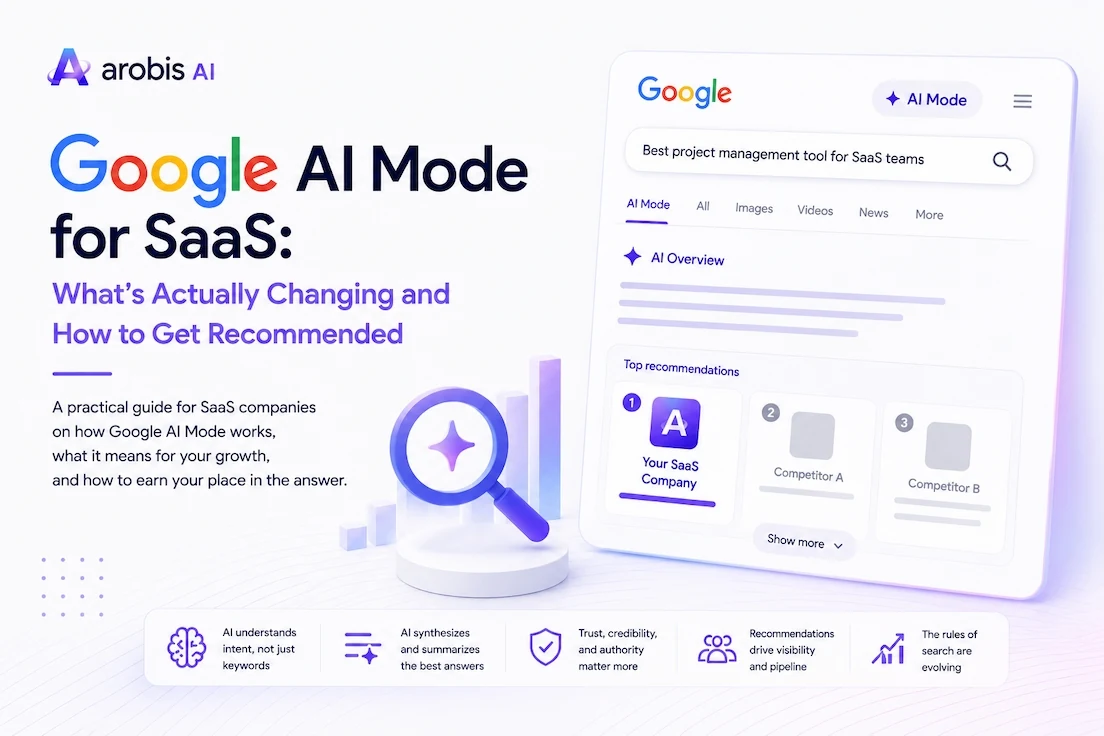
TL;DR: Google AI Mode is a chat-based, Gemini-powered search interface that forms direct recommendations instead of returning ranked links. Ranking on Google no longer guarantees appearing in its answers, since AI Mode selects content at the chunk level and weighs entity signals and cross-web validation alongside traditional ranking factors.
This article covers:
- What Google AI Mode actually is and how query fan-out works
- How it changes the SaaS brands buying journey and the Pre-Website Funnel
- How AI Mode selects what to surface, and why so few ranked URLs get cited
- The difference between Google AI Mode and Google AI Overviews
- Why optimizing for citations is the wrong goal for SaaS pipeline
- The three-layer framework for earning AI Mode recommendations
Most coverage of Google AI Mode focuses on traffic loss.
Organic click-through rates declining. Zero-click searches increasing. Publishers losing referral traffic.
That is the wrong frame for SaaS companies.
The more important question is not "how do we protect our traffic?" It is "how does Google AI Mode change where SaaS buying decisions form — and how do we get recommended, not just cited?"
Those are different questions. They lead to completely different strategies.
What Google AI Mode Actually Is
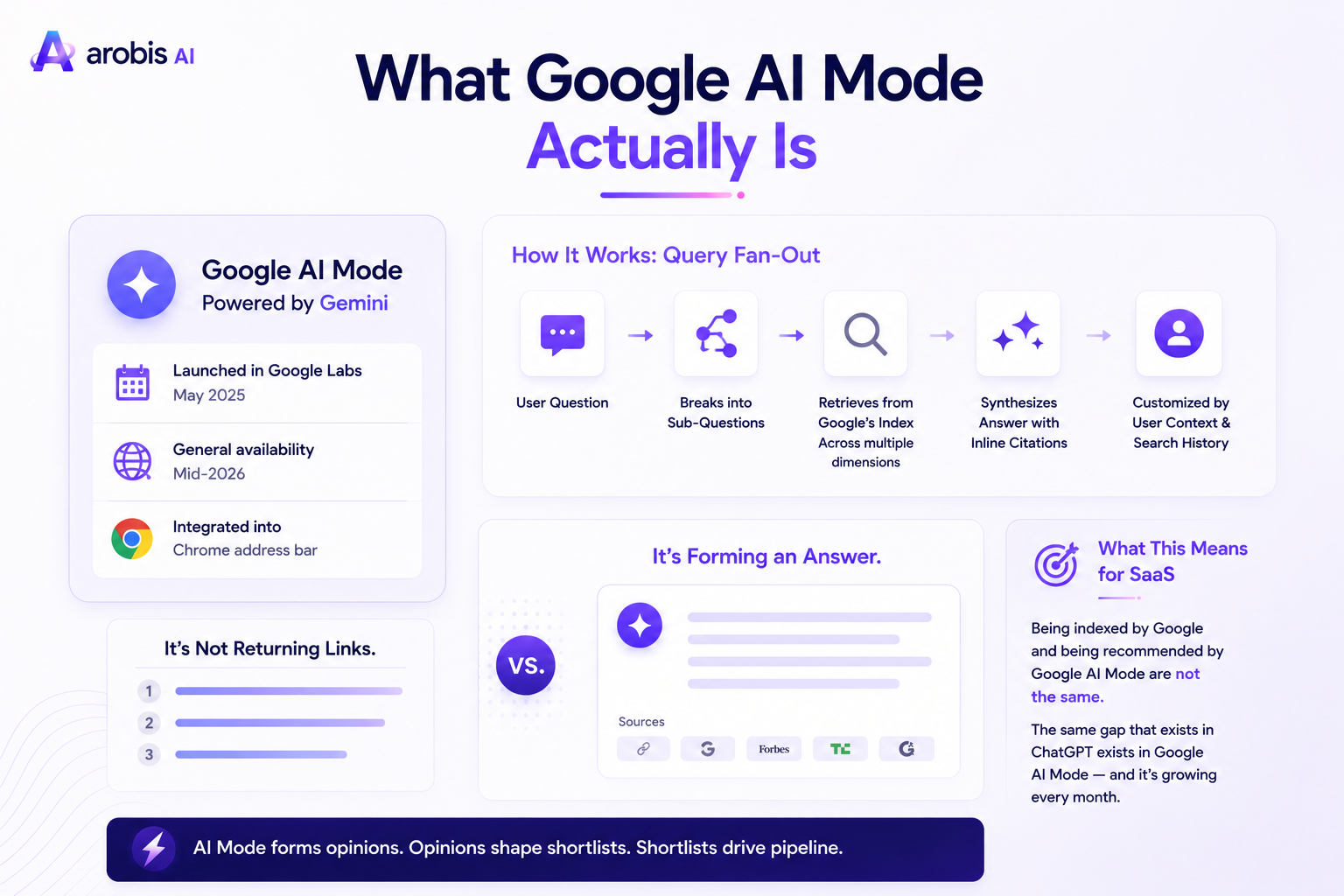
Google AI Mode is a chat-based AI search interface powered by Gemini. It launched as a Google Labs experiment in March 2025, opened to everyone in the US in May 2025, and by May 2026 Google said it had passed one billion monthly users. It is now integrated into the Chrome address bar, which means it is the AI interface most commonly encountered by users who don't specifically seek out ChatGPT or Perplexity.
The core mechanism is query fan-out. When a user enters a question, AI Mode breaks it into sub-questions, retrieves content from Google's index across multiple dimensions simultaneously, and synthesizes the results into a direct answer with inline citations. Each user sees a customized response shaped by their search history and context.
What this means in practice: AI Mode is not returning ranked links. It is forming an answer — and part of forming that answer is deciding which brands to mention, which to recommend, and which to omit entirely.
For SaaS companies, the distinction matters enormously. Being indexed by Google and being recommended by Google AI Mode are not the same thing. The same gap that exists in ChatGPT exists in Google AI Mode — and it is growing every month.
How Google AI Mode Changes the SaaS Buying Journey
The SaaS buying journey used to look roughly like this: a buyer recognized a problem, searched Google for solutions, scanned a few category pages, visited three or four vendor websites, read some G2 reviews, and eventually booked a demo.
Google AI Mode compresses and front-loads this journey. A buyer now asks a conversational question — "what's the best customer success platform for a 50-person B2B SaaS company?" — and receives a synthesized answer that includes specific vendor recommendations with context.
The buyer has formed a shortlist before visiting a single website. That's is the entire concept of AI recommendations and AI search visibility.
This is the Pre-Website Funnel. And Google AI Mode is now one of the primary surfaces where it operates. Buyers arrive at vendor websites with pre-formed opinions — either in favor of the brand if AI Mode recommended it clearly, or neutral and skeptical if it was mentioned vaguely or omitted entirely.
AI-referred visitors convert at significantly higher rates than traditional organic search visitors. They are not browsing. They are confirming. The buying decision has already started forming inside AI Mode before they ever reached the website.
This is why optimizing for AI Mode citations is the wrong goal. The right goal is earning AI Mode recommendations — clear, specific, contextual endorsements that send buyers to your website already partially sold.
How Google AI Mode Selects What to Surface
Google AI Mode uses Google's web index as its primary retrieval layer, which means traditional SEO signals still matter as a prerequisite. But they are not sufficient for recommendation.
SE Ranking's 2025 study of about 10,000 keywords found that only around 14% of the URLs AI Mode cites match the pages in Google's organic top 10, and only about 22% of cited domains do, even though 92% of queries shared at least one domain with the top 10. AI Mode selects at the content chunk level — not the page level. A section of a page can be cited even if the full page doesn't rank prominently.
This has several implications for SaaS content strategy.
Each section of content must be able to stand independently. AI Mode retrieves chunks of content and synthesizes them — which means a section about "who [your brand] is best for" may be cited separately from a section about "how [your brand] pricing works." Each section needs a clear heading, a direct-answer opening paragraph, and specific, verifiable content.
Entity strength matters as much as page authority. AI Mode doesn't just assess whether a page ranks well. It assesses whether Google's systems understand and trust the brand behind the page. The domains and sources that most influence Google's AI recommendations are not the same as the pages that rank first for commercial keywords.
Cross-web validation signals influence AI Mode recommendations independently of page rankings. A brand that is well-reviewed on G2, consistently mentioned in industry publications, and discussed in professional communities will be recommended more confidently by AI Mode than a brand that only exists on its own high-ranking website.
The Arobis AI Search 100 research documents the patterns behind consistent AI recommendation across platforms — including Google AI Mode — and confirms that the highest-recommended brands have built deliberate, layered authority footprints rather than relying on traditional SEO strength alone.
How Google AI Mode Selects What to Surface
Google’s web index is still the retrieval layer, so SEO matters. But ranking is only the prerequisite. Recommendation depends on content chunks, entity strength, and authority across the web.
Queries sharing a domain with Google top 10
Most AI Mode answers cite at least one domain that also ranks organically, which means SEO strength still matters.
Specific URL overlap
AI Mode often cites different content chunks than the exact URLs ranking in organic search.
Chunk-level content selection
AI Mode can retrieve and cite a specific section of a page, even if the full page does not rank prominently for the query.
Standalone answer structure
A section about “who your product is best for” may be evaluated separately from pricing, features, integrations, or comparison sections.
Entity strength
AI Mode does not only assess whether a page ranks. It also evaluates whether Google understands and trusts the brand behind the page.
Cross-web validation
Reviews, industry publications, expert mentions, communities, and third-party sources influence whether AI Mode recommends a brand with confidence.
Layered authority footprint
The Arobis AI Search 100 shows that consistently recommended brands build deliberate authority across multiple trusted surfaces, not just traditional SEO assets.
Google AI Mode vs Google AI Overviews: The SaaS Distinction
AI Mode and AI Overviews are related but distinct features, and the distinction matters for SaaS demand generation strategy.
AI Overviews appear automatically in standard Google search results — surfacing brief AI summaries above organic results for relevant queries. They are triggered without user intent and are designed to answer simple questions quickly.
AI Mode is opt-in. Users deliberately enter the AI Mode interface to ask complex, research-oriented questions with follow-up capability. Sessions average significantly more time per query than AI Overviews because users are doing genuine research, not quick lookup.
For SaaS companies, this means AI Mode is disproportionately used for the highest-value queries: vendor comparison, category research, shortlist building, and purchase decision support. These are exactly the queries where being recommended versus cited versus absent has the greatest pipeline impact.
Optimizing for AI Overviews and optimizing for AI Mode are not identical strategies. AI Overviews require structured, concise content that answers specific questions cleanly. AI Mode requires deeper category authority, stronger entity signals, and richer competitive positioning — because the users in AI Mode are making more serious decisions.
Why Getting Cited Is the Wrong Goal for SaaS
Most practical advice about Google AI Mode focuses on citation optimization: structure your content well, use clear headings, add schema markup, produce original data. This is sound tactical advice. We have documented that tactical layer, with our own before-and-after numbers, in how to get your content cited by AI.
But it is incomplete for SaaS demand generation.
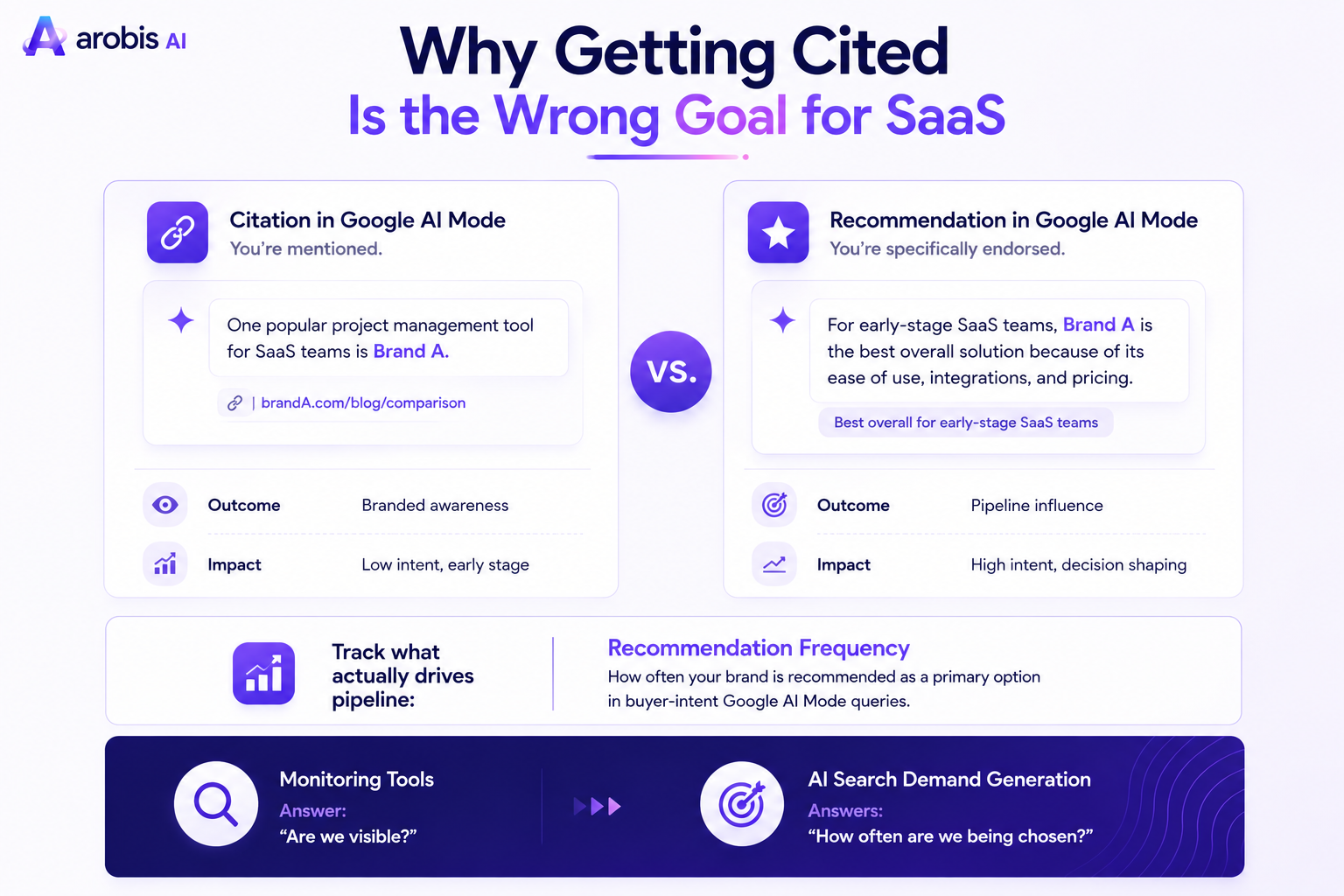
A citation in Google AI Mode means a brand appears in a response with a link. A recommendation in Google AI Mode means a brand is specifically endorsed for a buyer's situation — with context, with positioning, and with enough authority that the AI engine includes it as a primary option rather than a supporting reference.
These produce different outcomes. Citations drive branded awareness. Recommendations drive pipeline.
Recommendation Frequency — tracking how often a brand appears as a primary recommendation in buyer-intent AI Mode queries — is the metric SaaS companies should be tracking, not citation counts or AI visibility scores.
This is the distinction at the core of AI Search Demand Generation. Monitoring tools and citation trackers answer "are we visible?" AI Search Demand Generation answers "how often are we being chosen?"
How to Get Recommended in Google AI Mode
Building consistent AI Mode recommendations requires work across three interconnected layers: content structure, entity authority, and cross-web validation.
Content Structure for Chunk-Level Retrieval
Since AI Mode retrieves and synthesizes at the section level — not the page level — every section of every content asset must be independently useful and directly answering. Lead each H2 section with a direct, answer-first paragraph. Use descriptive headings that function as answers to implied questions. Keep each section focused on a single concept. This structure makes content extractable at the chunk level — which is how AI Mode actually reads it.
For SaaS companies, this means restructuring category pages, comparison pages, and pillar articles around buyer questions rather than product features. A section titled "Best Customer Success Software for Startups" performs better in AI Mode than a section titled "Our Product Features" — even if the underlying content quality is identical.
Entity Authority for Confident Brand Recommendations
AI Mode uses Google's Knowledge Graph and entity understanding systems to assess brand authority before deciding whether to recommend. This means consistency across every surface where your brand appears — your website, your G2 and Capterra profiles, your LinkedIn page, your press mentions, your directory listings — is not just good housekeeping. It is a direct input to whether Google AI Mode trusts your brand enough to recommend it confidently.
AI visibility starts with entity clarity. A brand that describes itself differently in different places gives Google's systems conflicting signals — and conflicting signals produce absent or vague AI Mode recommendations regardless of how well the brand's pages rank.
Entity authority also means being clearly associated with specific use cases and buyer types — not just a general category. A brand strongly associated with "customer success software for B2B SaaS companies" will be recommended more specifically and confidently than a brand associated generically with "customer support software."
Cross-Web Validation for Recommendation Confidence
Google AI Mode is more likely to recommend a brand that independent, trusted sources have validated than a brand whose authority comes entirely from its own properties. Third-party reviews, industry publication mentions, expert citations, and community discussions all contribute to the cross-web validation that gives AI Mode confidence to recommend a brand specifically.
The competitive dynamics in AI Mode recommendations are not driven by who ranks first. They are driven by who has built the strongest combination of entity clarity, content quality, and cross-web validation in their category. That combination is the competitive moat for AI Mode recommendation authority.
For SaaS companies, the highest-leverage cross-web validation activities are: building a strong review footprint on G2 and Capterra, earning editorial coverage in publications Google treats as authoritative, contributing genuinely useful content to community discussions in forums relevant to the category, and securing mentions in newsletters and podcasts that AI engines have encountered in their training data.
How to Get Recommended in Google AI Mode
Consistent AI Mode recommendations come from three connected layers: content Google can extract, entities Google can trust, and validation Google can verify across the web.
Content Structure
AI Mode retrieves and synthesizes at the section level, so every section must be useful on its own.
Weaker: “Our Product Features”
Entity Authority
Google needs to clearly understand who your brand is, what category you belong to, and which buyers you serve.
Cross-Web Validation
AI Mode recommends brands more confidently when independent sources validate them across the web.
Measuring Your Google AI Mode Impact
Measurement is where most AI Mode guidance becomes vague. GA4 does not surface AI Mode as a distinct traffic source. Search Console does not isolate AI Mode clicks. The tracking infrastructure is still maturing.
Rather than waiting for perfect tracking, here is a practical measurement framework for SaaS companies.
The first layer is Recommendation Frequency tracking. Select 10-20 buyer-intent queries most relevant to your category and test them weekly in Google AI Mode. Track which brands appear as primary recommendations, which appear as supporting citations, and which are absent. Record the specific language AI Mode uses to describe your brand — that language tells you whether your entity signals are working.
The second layer is behavior-based traffic segmentation. AI-referred visitors behave differently from traditional organic search visitors — they arrive more informed, spend more time on product and pricing pages, and convert at higher rates. Segmenting your GA4 traffic by engagement patterns can help isolate the AI-influenced cohort even without direct source attribution.
The third layer is branded search monitoring. When AI Mode recommends a brand, the buyer often searches the brand name directly before visiting the website. Tracking branded search volume over time gives a proxy signal for AI Mode recommendation momentum — even before perfect attribution exists.
The broader data on AI search traffic patterns confirms what the measurement framework reveals: fewer but higher-quality visits from AI-influenced channels, with conversion rates that justify significant investment in recommendation authority even before perfect tracking exists.
Google AI Mode and the Broader AI Search Ecosystem
Google AI Mode is significant, but it is one surface in a broader AI search ecosystem that includes ChatGPT, Claude, Perplexity, and Copilot. SaaS companies that treat Google AI Mode as an isolated challenge miss the strategic picture.
Gemini-powered AI Mode and ChatGPT recommendations draw on overlapping but distinct authority signals. A brand that builds strong entity and authority signals for Google AI Mode will also improve its position in ChatGPT and Perplexity — because the underlying recommendation mechanisms share core inputs.
The most efficient AI Search Demand Generation strategy is not to optimize for each platform separately. It is to build the foundational entity clarity, content authority, and cross-web validation that all platforms draw on — and then layer in platform-specific optimizations as additional amplifiers.
Claude's recommendation model emphasizes specificity and evidence quality. Understanding how AI Search Demand Generation differs from GEO helps SaaS companies avoid the trap of treating AI Mode optimization as a content structure problem when it is actually a brand authority problem.
What This Means for Your Demand Generation Strategy
Google AI Mode is not a feature to adapt to. It is a structural shift in where SaaS buying decisions form.
The companies that get this right early will capture a compounding advantage. AI recommendation authority is not a one-time optimization — it builds over time. Every additional third-party citation, every stronger entity signal, every new piece of comparison content adds to the authority footprint that AI Mode uses to form confident recommendations.
The companies that treat AI Mode as a traffic problem — and optimize for citations and click recovery — will work hard for incremental results. The companies that treat it as a demand generation opportunity — and optimize for recommendations and pipeline influence — will build a durable competitive moat.
The monitoring tools can tell you where you appear today. AI Search Demand Generation is how you change what you're recommended for tomorrow.
The Arobis AI Visibility Checker gives SaaS companies a fast read on their current AI recommendation position — including how they appear in Google AI Mode and the broader AI search ecosystem.
For a deeper analysis, an AI Visibility Audit maps the specific recommendation gaps, identifies the authority signals most worth building, and produces a prioritized roadmap for turning AI Mode visibility into measurable pipeline.
Visibility gets you seen. Recommendations get you chosen. Find out where you stand in Google AI Mode today.
What This Means For Your SaaS Growth Strategy
Google AI Mode isn't simply another search feature. It's changing where buying decisions happen, how vendors are shortlisted, and what creates sustainable competitive advantage.
Old Mindset
Optimize for rankings, citations and recovering lost clicks from AI experiences.
New Mindset
Optimize for recommendation authority so AI consistently places your brand on buyer shortlists before competitors.
Entity Signals
Google clearly understands your brand.
Authority
Third-party trust accumulates across the web.
Recommendations
AI Mode recommends your company more often.
Pipeline
More qualified buyers arrive already convinced.
Visibility gets you seen.
Recommendations get you chosen.
Companies that build recommendation authority today will create a durable competitive moat tomorrow. Every review, comparison page, publication mention and entity signal compounds over time.
Start with your baseline.
Use the Arobis AI Visibility Checker to understand where your brand stands today, then use an AI Visibility Audit to identify the highest-impact recommendation gaps across Google AI Mode and the broader AI search ecosystem.
Frequently Asked Questions
What is Google AI Mode?
Google AI Mode is a chat-based AI search interface powered by Gemini, available through Google's search interface and integrated into the Chrome address bar. It lets users ask complex, conversational questions and receive synthesized answers with inline citations drawn from Google's web index. It uses query fan-out — breaking each question into sub-questions and retrieving content across multiple dimensions — to produce more comprehensive, nuanced answers than standard search.
How is Google AI Mode different from Google AI Overviews?
AI Overviews appear automatically in standard Google search results with brief AI summaries designed to answer simple questions quickly. AI Mode is an opt-in, conversation-based interface where users ask complex questions and receive in-depth, synthesized answers with follow-up capability. AI Mode users represent higher-intent research behavior — typically vendor comparison, shortlist building, and purchase decision support — which makes AI Mode recommendations more pipeline-significant than AI Overview citations.
Does ranking on Google guarantee appearing in Google AI Mode recommendations?
No. SE Ranking's 2025 study found that only about 22% of cited domains and 14% of cited URLs in AI Mode match the Google organic top 10, even though most queries share at least one domain with it. AI Mode selects at the content chunk level and weighs entity signals and cross-web validation alongside traditional ranking signals. A brand can rank well on Google and still be absent from or poorly represented in AI Mode recommendations.
What is the difference between being cited and being recommended in Google AI Mode?
A citation means a brand appears in an AI Mode response, often as a supporting reference or one item in a long list. A recommendation means AI Mode specifically endorses the brand for a buyer's situation — with context, positioning, and enough confidence that the buyer treats it as a primary option. For SaaS demand generation, recommendations drive pipeline. Citations drive awareness. The goal is Recommendation Frequency, not citation volume.
How should SaaS companies measure their Google AI Mode performance?
Through three layers: Recommendation Frequency tracking, testing buyer-intent queries weekly in AI Mode and tracking which brands are recommended; behavior-based traffic segmentation in GA4, isolating AI-influenced visitor cohorts by engagement patterns; and branded search volume monitoring, tracking whether AI Mode recommendations are driving direct brand searches. Perfect attribution is not yet possible, but partial tracking gives enough signal to make investment decisions.
How does Google AI Mode affect the SaaS buying journey?
AI Mode compresses and front-loads the SaaS buying journey. Buyers now arrive at vendor websites with pre-formed opinions shaped by AI recommendations — either in favor of a brand if AI Mode recommended it clearly, or skeptical if it was mentioned vaguely or omitted. Buyers referred by AI recommendations convert at higher rates because they have been pre-qualified by the AI recommendation. The buying journey increasingly starts in AI Mode, not on a vendor's website.
What is the fastest way to improve Google AI Mode recommendations for a SaaS brand?
The fastest path is fixing entity inconsistency first. If a brand describes itself differently across its website, G2 profile, LinkedIn page, relevant Reddit discussions and directory listings, AI Mode receives conflicting signals and defaults to vague or absent recommendations. Establishing a single, consistent, specific brand description across every external surface creates an immediate improvement in how AI Mode understands and describes the brand. Layer in third-party validation and buyer-intent content structure on top of that foundation for compounding results.