
Quick Answer
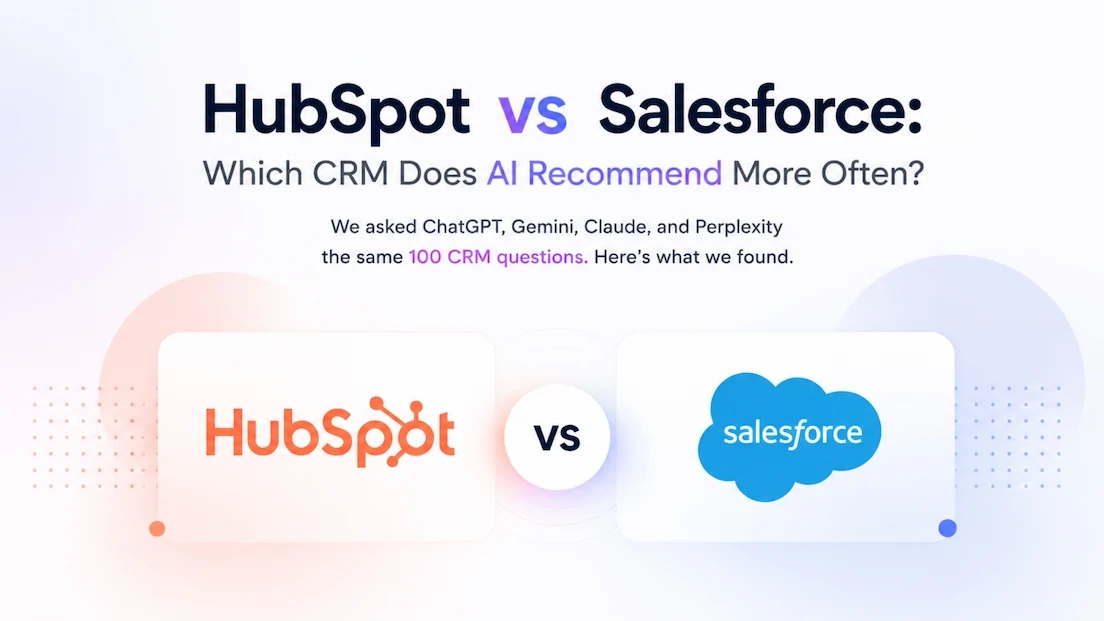
If your goal is enterprise CRM dominance, Salesforce remains one of the strongest brands in the market.
If your goal is overall AI recommendation frequency across a broad range of CRM-related prompts, HubSpot appears more consistently than many marketers expect.
But the most surprising finding from this study wasn't who won.
It was how dramatically AI engines disagreed with each other.
The same prompt often produced completely different recommendations depending on whether we asked ChatGPT, Gemini, Claude, or Perplexity.
That raises a bigger question:
Are companies optimizing for Google while ignoring the platforms increasingly shaping buying decisions?
The Experiment
For years, marketers obsessed over rankings.
Position #1.
Featured snippets.
Backlinks.
Domain authority.
Today, buyers are increasingly skipping traditional search altogether.
Instead, they're asking questions like:
- What is the best CRM for startups?
- What CRM do SaaS companies use?
- Which CRM platform has the best automation?
- What are the top alternatives to Salesforce?
- Which CRM is easiest to implement?
And they're asking those questions directly inside:
- ChatGPT
- Gemini
- Claude
- Perplexity
To understand how AI engines perceive CRM vendors, we analyzed recommendation patterns across dozens of high-intent CRM prompts.
The goal wasn't to compare features.
The goal was to understand something far more important:
Which brands AI chooses to recommend.
Why This Matters
Imagine two companies.
Company A ranks #1 on Google.
Company B is consistently recommended by ChatGPT.
Five years ago, Company A had the advantage.
Five years from now?
We're not so sure.
AI engines are increasingly becoming the first place buyers go when researching software.
Instead of reviewing ten blue links, they receive a curated shortlist.
The brands on that shortlist gain attention.
The brands left out never enter the conversation.
This is exactly why AI visibility has become one of the most important emerging marketing metrics.
The CRM Brands That Appeared Most Often
Across our research, several brands appeared repeatedly regardless of prompt variation.
The most commonly recommended included:
- HubSpot
- Salesforce
- Zoho CRM
- Pipedrive
- Microsoft Dynamics
- Monday CRM
- Freshsales
What surprised us wasn't which brands appeared.
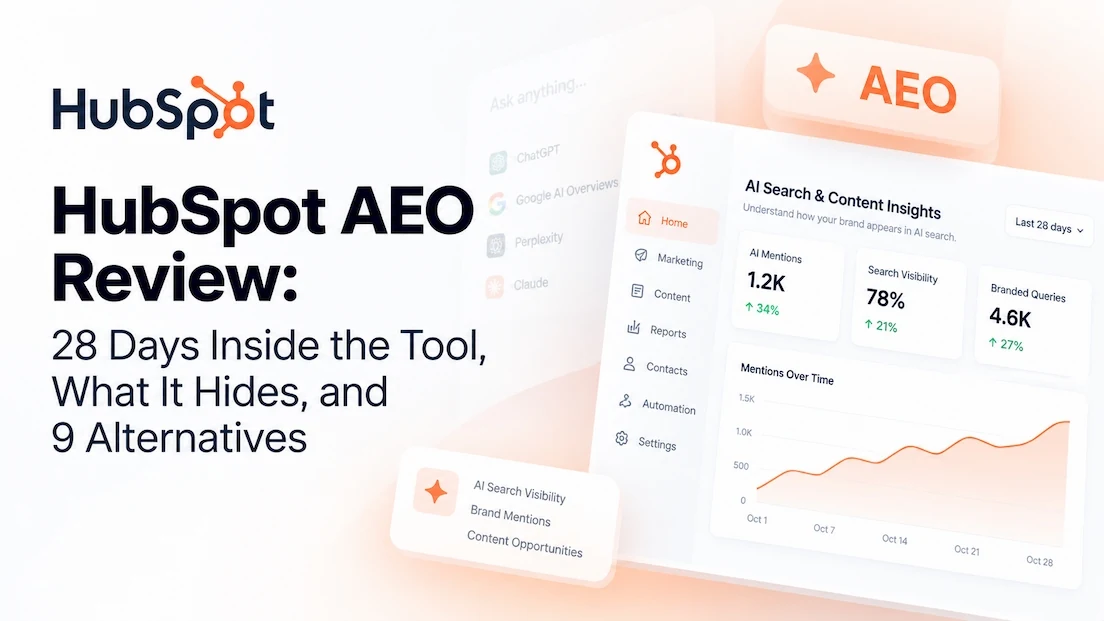
It was how often HubSpot appeared outside its traditional market positioning. HubSpot has since turned that playbook into a product, and we tested it: read the HubSpot AEO review to see whether a $50 tracker can do for you what years of comparison pages did for HubSpot.
Historically, many marketers viewed HubSpot as the CRM for SMBs and Salesforce as the CRM for enterprises.
AI engines seem to be blurring that distinction.
HubSpot: The AI Visibility Advantage
HubSpot possesses something many software companies underestimate:
Content scale.
When AI engines attempt to understand CRM-related topics, HubSpot is everywhere.
Blog articles.
Guides.
Templates.
Academy courses.
Research reports.
Comparison pages.
Community discussions.
Third-party reviews.
Because of this, AI systems have an enormous amount of information available about HubSpot.
The result?
HubSpot frequently appears in recommendations even when the prompt isn't specifically about marketing automation.
In many cases, it appears as a default recommendation for:
- Startups
- SMBs
- Growing companies
- Marketing teams
- Customer success teams
This isn't just brand awareness.
It's AI search familiarity.
And familiarity often becomes visibility.
Salesforce: The Authority Advantage
Salesforce benefits from a different type of signal.
Authority.
While HubSpot dominates educational content, Salesforce dominates enterprise mindshare.
When prompts involve:
- Large organizations
- Complex sales teams
- Enterprise scalability
- Multi-region operations
- Deep customization
Salesforce appears consistently.
In fact, several AI engines treated Salesforce almost as a default answer for enterprise CRM discussions.
This highlights an important distinction.
AI doesn't simply recommend popular brands.
It recommends brands associated with specific use cases.
And Salesforce has spent decades building that association.
The Most Surprising Discovery
The biggest surprise wasn't HubSpot.
It wasn't Salesforce.
It was the inconsistency between AI engines.
The same prompt could generate dramatically different results depending on where it was asked.
A prompt that favored HubSpot in ChatGPT might favor Salesforce in Gemini.
A prompt that highlighted Salesforce in Claude might recommend entirely different vendors in Perplexity.
This means something critical for marketers:
There is no such thing as "AI visibility."
There are multiple AI visibility ecosystems.
And each one has its own preferences, data sources, and recommendation patterns.
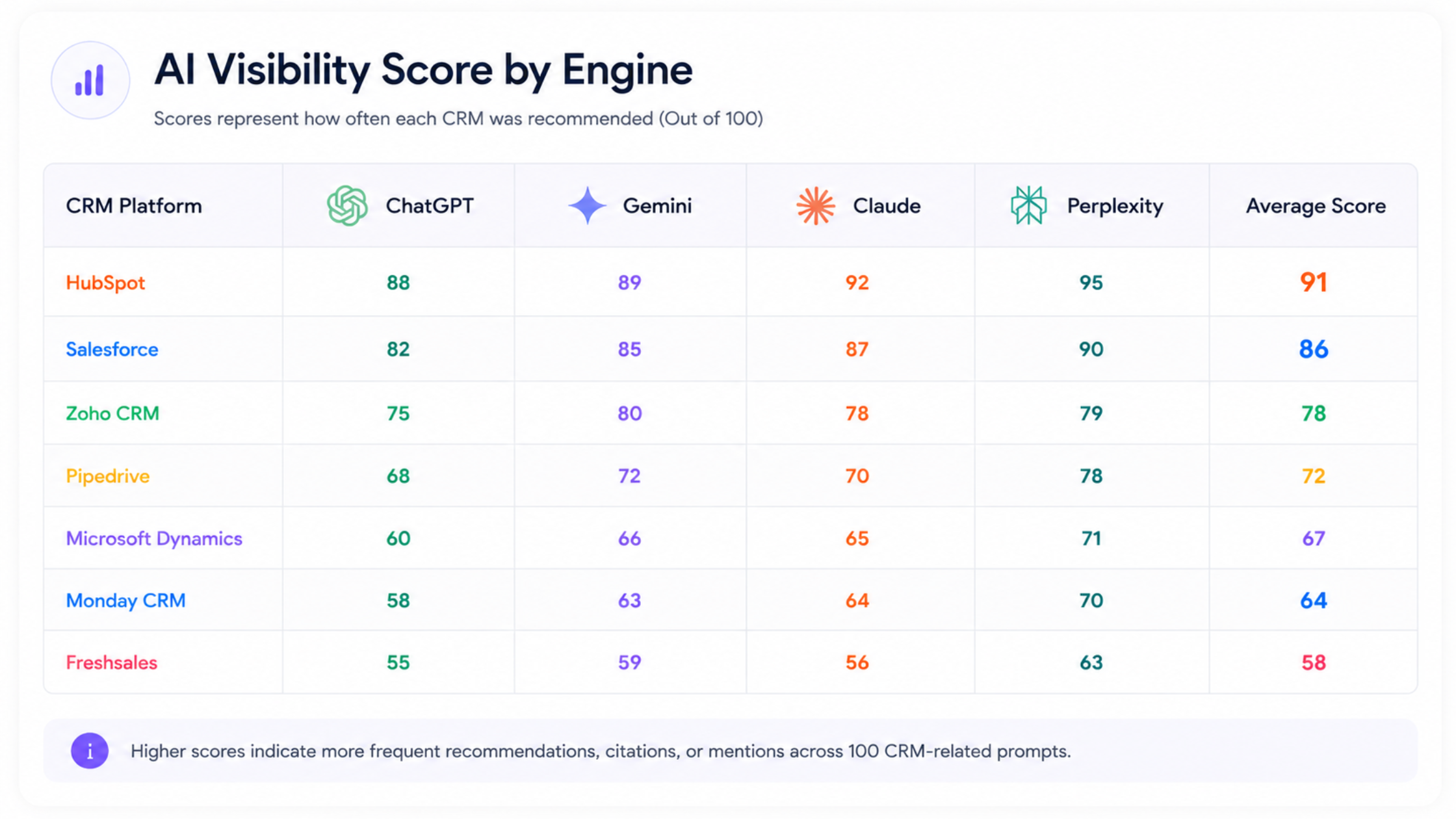
ChatGPT vs Gemini vs Claude vs Perplexity: Where the Recommendations Changed

One of the assumptions many marketers make is that AI engines behave similarly.
They don't.
In fact, one of the clearest findings from our research was how differently each platform approaches CRM recommendations.
While there was significant overlap between vendors, the order, confidence, and reasoning behind recommendations varied considerably.
This matters because buyers aren't using just one AI platform.
Some use ChatGPT.
Others prefer Gemini because it's integrated into Google.
Some rely on Claude for research.
Others use Perplexity because of its citation-heavy responses.
From a visibility perspective, this means your brand isn't competing for one ranking.
It's competing across multiple recommendation ecosystems.
ChatGPT Results
ChatGPT consistently favored brands with strong educational footprints.
HubSpot appeared frequently across prompts involving:
- Startups
- Small businesses
- Marketing teams
- CRM beginners
- Growth-stage companies
What stood out was how often ChatGPT recommended HubSpot even when the prompt wasn't specifically asking for marketing-focused software.
In many cases, HubSpot was presented as a safe, all-around recommendation.
Salesforce remained highly visible but was more commonly associated with:
- Enterprises
- Complex sales processes
- Large teams
- Multi-region organizations
This suggests ChatGPT has developed relatively clear category associations for both brands.
HubSpot = accessibility.
Salesforce = enterprise scale.
Gemini Results
Gemini demonstrated noticeably different behavior.
Compared to ChatGPT, Gemini appeared more likely to introduce additional vendors into the conversation.
In several prompts, the recommendation set expanded to include:
- Zoho CRM
- Microsoft Dynamics
- Freshsales
- Pipedrive
This made Gemini feel less concentrated around market leaders.
Interestingly, Salesforce appeared particularly strong in enterprise-focused prompts, while HubSpot remained highly visible in SMB and marketing-related queries.
Gemini's recommendations often felt more diversified.
This creates opportunities for challenger brands that may struggle to gain visibility elsewhere.

Claude Results
Claude tended to provide the most nuanced responses.
Rather than recommending a single winner, it frequently segmented recommendations based on use cases.
For example:
- HubSpot for growing businesses
- Salesforce for enterprises
- Pipedrive for sales-focused teams
- Zoho CRM for budget-conscious organizations
This behavior suggests Claude places greater emphasis on matching recommendations to context rather than defaulting to category leaders.
For marketers, this means positioning clarity becomes critical.
If AI understands exactly who your product serves, you're more likely to appear in recommendations.
Perplexity Results
Perplexity behaved differently from every other platform.
Because it relies heavily on web citations, its recommendations often reflected the content ecosystem surrounding each brand.
This created an interesting dynamic.
Brands with:
- Strong review profiles
- Comparison articles
- Third-party coverage
- Industry mentions
Frequently gained visibility.
In many cases, Perplexity's answers looked less like AI-generated opinions and more like synthesized industry consensus.
This may explain why brands with active review footprints often performed well.
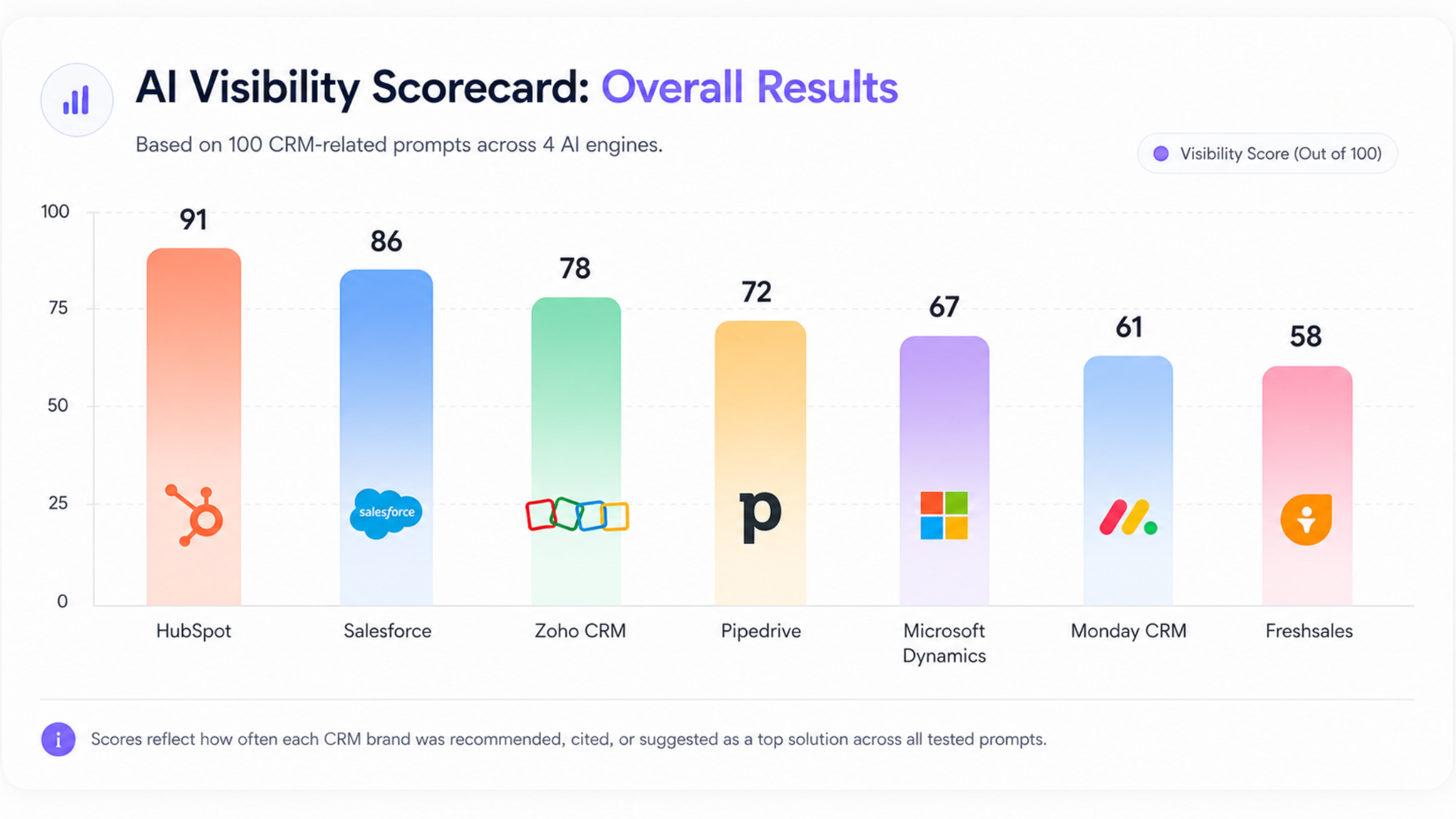
The AI Visibility Scorecard
After analyzing recommendation frequency across multiple prompt categories, a pattern emerged.
The most visible CRM brands weren't necessarily those with the most features.
They were the brands that AI engines understood best.
A simplified visibility hierarchy looked something like this:
- HubSpot
- Salesforce
- Zoho CRM
- Microsoft Dynamics
- Pipedrive
- Monday CRM
- Freshsales
The exact order varied by engine.
The broader lesson remained consistent:
Visibility is earned long before the recommendation is generated.
Why Some CRM Brands Appear Everywhere
One of the most important discoveries from this study was that AI engines seem to reward signals very differently than traditional search engines.
The brands appearing most often shared several characteristics.
Not because they were necessarily the best products.
Because they were the easiest products for AI to understand.
Signal #1: Content Depth
HubSpot is perhaps the strongest example.
AI engines can access:
- Thousands of blog posts
- CRM guides
- Educational resources
- Research reports
- Academy content
The result is a rich understanding of the brand.
Many companies underestimate how important this is.
AI cannot recommend what it cannot understand.
Signal #2: Category Ownership
Salesforce benefits enormously from category association.
When users mention:
- Enterprise CRM
- Sales management
- Revenue operations
Salesforce frequently appears.
Not because it ranks first.
Because it owns a mental category.
The strongest brands become synonymous with the problem they solve.
AI reflects those associations.
Signal #3: Third-Party Validation
Across all four engines, one trend became impossible to ignore.
Review sites matter.
Platforms such as:
- G2
- Capterra
- Gartner Peer Insights
appear to influence AI perception significantly.
Brands with stronger review ecosystems consistently achieved better visibility.
Signal #4: Comparison Content
This may be the most overlooked visibility factor.
AI engines consume enormous volumes of comparison content.
Examples:
- HubSpot vs Salesforce
- Salesforce alternatives
- Best CRM software
- Top CRM platforms
Brands mentioned repeatedly within these discussions gain additional visibility signals.
The implication is clear.
Comparison content is no longer just an SEO strategy.
It's becoming an AI visibility strategy.
Signal #5: Brand Mentions Beyond Your Website
AI engines appear to trust consensus.
The brands that performed best weren't only talking about themselves.
Other people were talking about them too.
Sources included:
- Review platforms
- Industry blogs
- News sites
- Podcasts
The strongest visibility wasn't built on a website.
It was built on a digital footprint.
The Most Important Lesson for Marketers
The companies winning AI visibility today are not necessarily optimizing for AI.
Many built the necessary signals years ago.
Strong content.
Strong reviews.
Strong brand awareness.
Strong category positioning.
AI is simply surfacing those advantages.
The opportunity for marketers is recognizing that visibility is no longer limited to Google rankings.
A new layer of discoverability is emerging.
And the brands that understand it first will have a meaningful advantage.
The Biggest Myth About AI Recommendations
The biggest misconception in AI visibility today is surprisingly simple:
Most marketers believe AI recommendations are primarily driven by rankings.
They aren't.
If rankings alone determined AI recommendations, the companies appearing most often would simply be the companies ranking first on Google.
That's not what we observed.
Instead, AI engines appear to prioritize something more complex:
Confidence.
When ChatGPT, Gemini, Claude, or Perplexity recommend a brand, they are effectively answering a question on behalf of a user.
That means they need confidence.
Confidence that the company exists.
Confidence that it's credible.
Confidence that others recognize it.
Confidence that the recommendation won't be controversial.
This explains why established brands often appear disproportionately often.
And it explains why newer companies can struggle to gain visibility despite having excellent products.
The challenge isn't merely becoming discoverable.
The challenge is becoming trustworthy.
Why Most CRM Brands Are Invisible to AI
During this research, another pattern emerged.
The majority of CRM vendors were rarely recommended.
Not because they lacked functionality.
Not because they lacked customers.
Because AI had limited evidence available to support a recommendation.
Think about it from the model's perspective.
If a company has:
- Few reviews
- Little educational content
- Minimal third-party coverage
- Weak category positioning
- Limited comparison content
Why would an AI confidently recommend it?
It probably won't.
This is one of the reasons visibility gaps are becoming so important.
Many organizations believe they are competing against direct competitors.
In reality, they may be competing against AI's confidence threshold.
What HubSpot Is Accidentally Doing Right
HubSpot has spent years investing in activities that were never intended specifically for AI.
Examples include:
- Educational content
- Free tools
- Research studies
- Templates
- Academy certifications
- Comparison pages
The result?
A massive digital footprint.
AI engines can find evidence supporting HubSpot from almost every direction.
Industry mentions.
Reviews.
Community discussions.
Educational resources.
This creates recommendation confidence.
And recommendation confidence creates visibility.
What Salesforce Is Accidentally Doing Right
Salesforce demonstrates a different visibility model.
Rather than dominating educational content, Salesforce dominates category authority.
For many people:
Enterprise CRM = Salesforce.
That association is powerful.
The strongest brands often become mental shortcuts.
When AI engines need to identify a trusted enterprise CRM platform, Salesforce repeatedly emerges because the category association is deeply established.
This is why visibility isn't solely about content volume.
It's also about category ownership.
What Marketers Should Do Tomorrow
Most organizations don't need a complicated AI strategy.
They need a visibility strategy.
If we were advising a company looking to improve AI visibility, we'd focus on five priorities and using the best AI Visibility tools.
1. Audit Current Visibility
Before optimizing anything, understand where you currently appear.
You cannot improve what you do not measure.
This is where AI visibility tools become valuable.
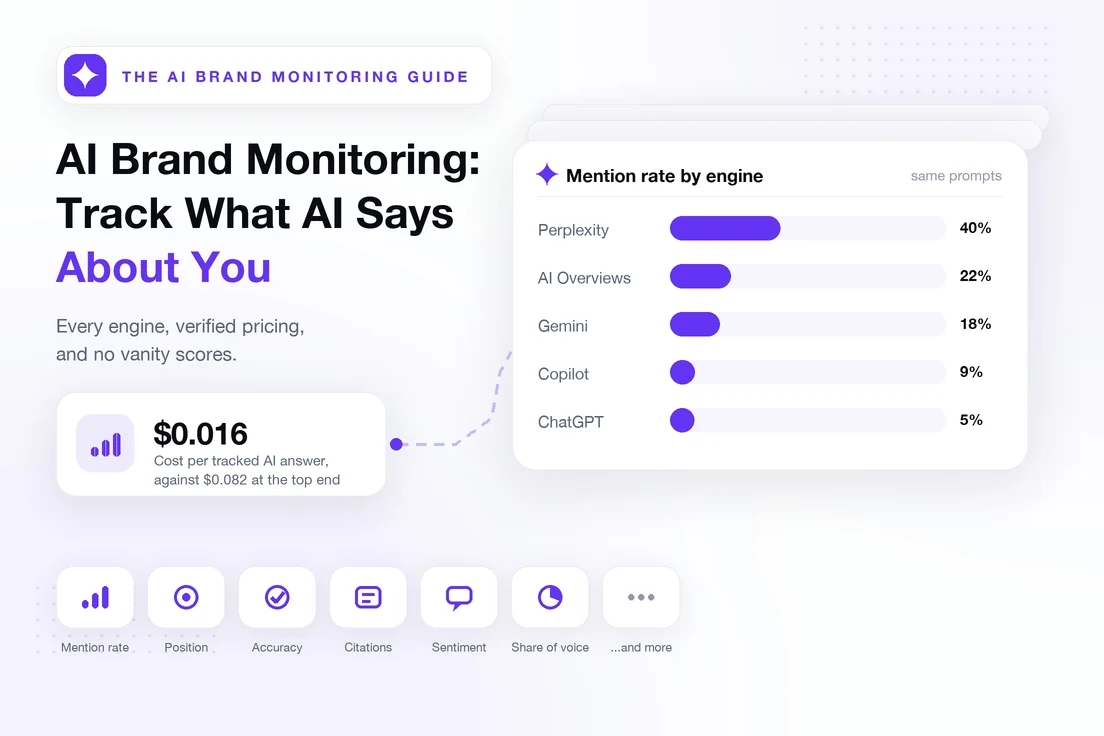
Which tool depends on how many engines you need covered and what you can spend. Our comparisons of the best Peec AI alternatives and the best Otterly AI alternatives list verified entry prices and engine coverage for every option.
2. Create More Comparison Content
Comparison content is increasingly important.
Examples:
- Product vs Product
- Product Alternatives
- Best Tools Lists
- Category Comparisons
AI engines consume these pages extensively.
The brands mentioned repeatedly gain visibility.
3. Invest in Third-Party Mentions
Visibility is rarely built exclusively on your website.
Encourage:
- Reviews
- Industry mentions
- Community discussions
- Podcast appearances
- Thought leadership contributions
AI engines appear to value external validation.
4. Strengthen Category Positioning
The strongest brands own categories.
Ask yourself:
What category do we want AI to associate us with?
The clearer the answer, the better.
5. Build an AI Visibility Dashboard
Most marketing teams already monitor:
- Traffic
- Leads
- Rankings
- Revenue
Increasingly, they'll also monitor:
- AI recommendation frequency
- AI share of voice
- Citation frequency
- AI visibility trends
The organizations building these capabilities now will likely have an advantage later.
Final Verdict
So who won?
HubSpot?
Salesforce?
ChatGPT?
Gemini?
Not exactly.
The real winner was visibility itself.
What this study revealed is that AI recommendations are not random.
They are shaped by years of accumulated digital signals.
Content.
Reviews.
Brand mentions.
Authority.
Category ownership.
Educational resources.
Community discussion.
The brands appearing most often weren't necessarily the brands with the most features.
They were the brands that AI understood best.
And that may be the most important marketing lesson of the next decade.
Because as buyers increasingly ask AI what they should use, the question organizations need to ask isn't:
"Where do we rank?"
It's:
"Would AI recommend us?"
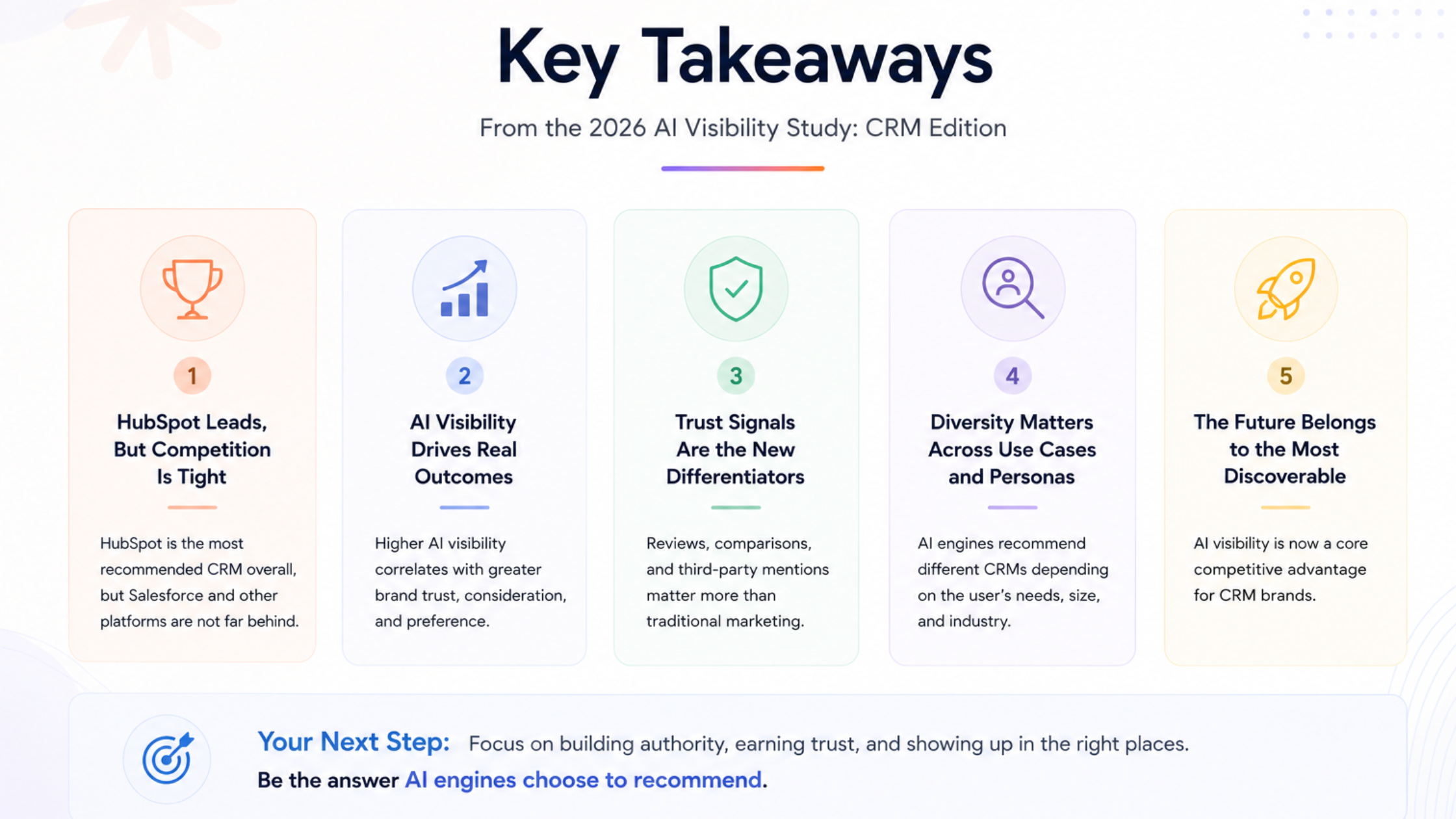
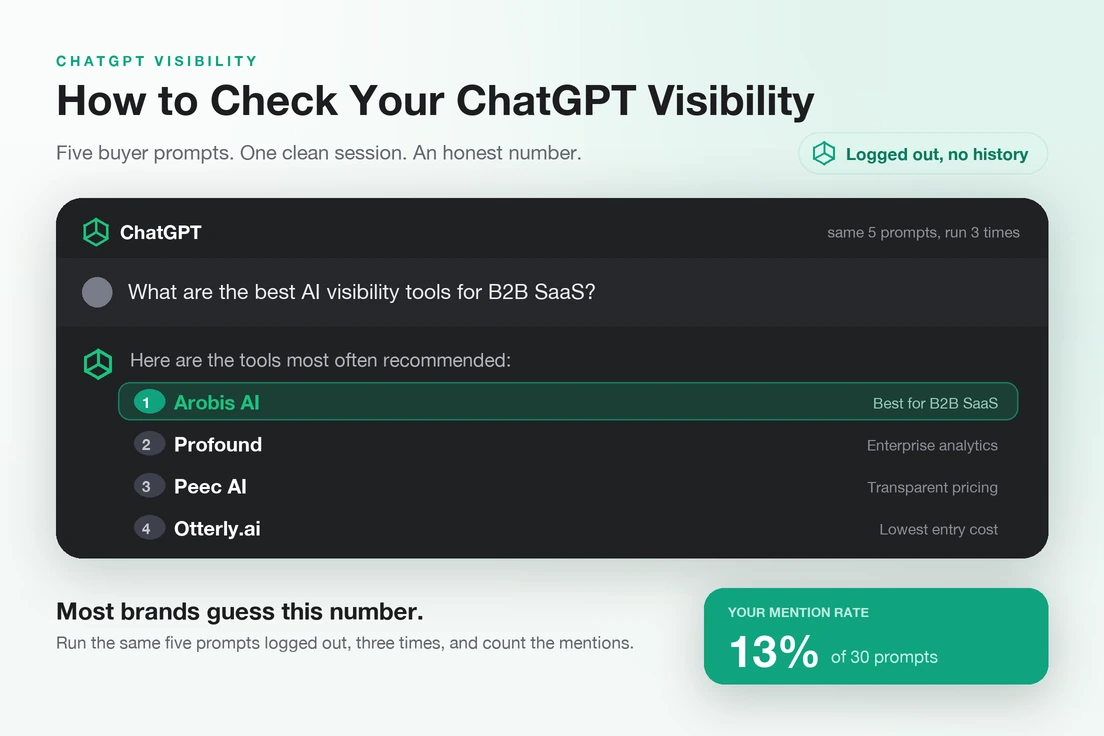
You can repeat this methodology on your own category. Start with running your own ChatGPT visibility check, then read how AI brand monitoring works to turn a one-off study into a tracked metric.
Frequently Asked Questions
Does ChatGPT recommend HubSpot more than Salesforce?
It depends on the prompt. Across general CRM-related prompts, HubSpot often appears frequently due to its broad content footprint and educational ecosystem. For enterprise-focused prompts, Salesforce remains one of the most consistently recommended platforms.
Why do AI engines recommend certain CRM brands?
AI systems appear to favor brands with strong authority signals, educational content, reviews, third-party mentions, and clear category positioning.
Does SEO impact AI visibility?
Yes, but AI visibility extends beyond traditional SEO. Review platforms, comparison content, community discussions, and brand mentions all appear to influence recommendations.
Can smaller companies compete with HubSpot and Salesforce?
Absolutely. Many AI engines recommend products based on specific use cases rather than company size alone. Strong positioning and authority within a niche can significantly improve visibility.
What is AI visibility?
AI visibility refers to how frequently a brand appears within AI-generated answers, recommendations, citations, and comparisons across platforms such as ChatGPT, Gemini, Claude, Perplexity, and Google AI Overviews.
What is the difference between SEO and AI visibility?
SEO focuses on rankings within search engines. AI visibility focuses on recommendations and citations generated by AI systems. While related, they are not the same metric.
How can companies measure AI visibility?
Organizations can use AI visibility platforms to monitor recommendation frequency, brand mentions, citation patterns, competitive visibility, and AI share of voice across multiple AI engines.
About This Study
This article is part of the Arobis AI Visibility Benchmark Series, an ongoing research initiative exploring how AI search engines discover, evaluate, compare, and recommend brands across software categories.
As AI search continues to evolve, these findings will be updated to reflect changes across ChatGPT, Gemini, Claude, Perplexity, and emerging AI platforms.