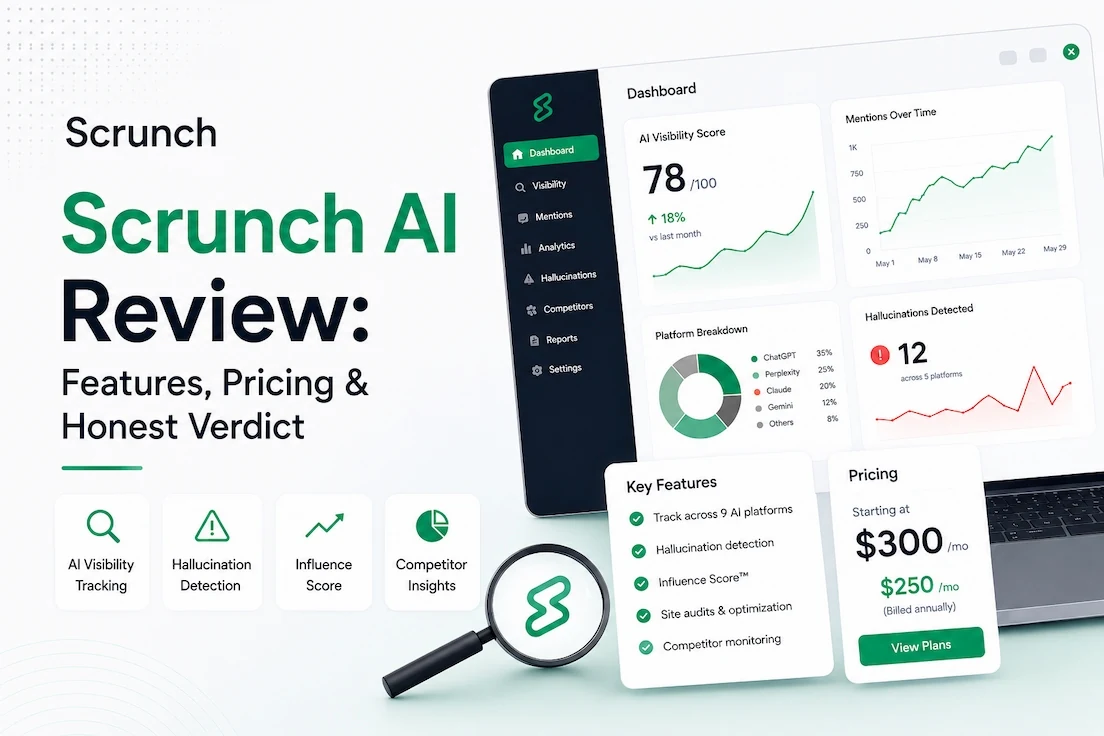
Scrunch AI is one of the most complete AI visibility platforms on the market. Founded in 2023, rated 4.6/5 across 73 G2 reviews, and best known for a feature few rivals offer: hallucination detection. This honest Scrunch AI review covers what it does well, where it falls short, what it costs, and who should (and should not) buy it.
TL;DR: Scrunch AI is a strong all-in-one monitoring platform with standout hallucination detection and broad engine coverage. It is a good fit for teams that want breadth and brand-safety monitoring in one tool. The catches: Core costs $250 a month for 125 prompts, it updates weekly rather than daily, it has no actionable optimization built in, and Core tracks only four engines (ChatGPT, Google AI Overviews, Copilot and Perplexity). Claude, Gemini, Google AI Mode, Meta AI and Grok need the custom-priced Enterprise plan. If you want the outcome (better AI recommendations) rather than another dashboard, weigh a done-for-you program too.
What is Scrunch AI?
Scrunch AI is an AI brand-monitoring and visibility platform that tracks how AI models describe and recommend your brand. Its differentiator is hallucination detection, meaning it systematically flags when AI models state wrong prices, invented features, fake partnerships or outdated facts about you, which makes it as much a brand-safety tool as a visibility tracker.
Key features
- Hallucination detection: catches false or outdated AI claims about your brand.
- Multi-engine monitoring: the Core plan tracks four engines: ChatGPT, Google AI Overviews, Copilot and Perplexity. Enterprise covers nine: ChatGPT, Claude, Perplexity, Gemini, Meta AI, Google AI Mode, Google AI Overviews, Copilot and Grok.
- Influence Score: a proprietary measure of how strongly AI engines favor your brand.
- Site audits: checks on how crawlable and citable your content is for AI.
- Integrations: GA4 and Cloudflare for AI-bot traffic monitoring, plus SOC 2 Type II compliance.
- Competitive benchmarking: prompt-level tracking against named competitors.
Scrunch AI pricing
- Core: $250 per month with 125 unique prompts, 5,000 responses a month, 5 site audits a month, 1 brand workspace, 5 user licenses and 4 engines (ChatGPT, Google AI Overviews, Copilot and Perplexity).
- Enterprise: custom pricing with 9 engines: ChatGPT, Claude, Perplexity, Gemini, Meta AI, Google AI Mode, Google AI Overviews, Copilot and Grok.
- Annual billing: offered, but Scrunch does not publish the annual price.
There is no permanent free tier. Scrunch offers a 7-day free trial. For a one-time read on your site's AI readiness, you can use the free Arobis AI Visibility Checker.
Scrunch AI pros
- Genuinely all-in-one, with monitoring, audits and benchmarking in one dashboard.
- Hallucination detection is rare and valuable for brand safety.
- Broad engine coverage on Enterprise (nine engines, including Claude, Gemini, Google AI Mode and Grok), Copilot and AI Overviews already on Core, plus a clean, intuitive interface.
- Strong G2 rating (4.6/5, with 76% five-star reviews) and SOC 2 Type II compliance.
Scrunch AI limitations and cons
These are the Scrunch AI limitations that matter most when you compare it with other platforms. None of them is a dealbreaker on its own, but together they decide whether Scrunch can be your only tool.
- No actionable optimization tools. It tells you the problem, not how to fix it.
- Data updates weekly rather than daily.
- Core covers only four engines. Claude, Gemini, Google AI Mode, Meta AI and Grok need Enterprise, which is custom priced, a blind spot if your buyers use them.
- Pricing starts at $250 per month for 125 prompts, higher than leaner monitors like Peec AI or Otterly.ai.
Who Scrunch AI is best for
Scrunch AI suits mid-market and enterprise teams that want broad monitoring plus brand-safety hallucination detection in a single platform, and who have someone in-house to act on the findings. It is less ideal if you are on a tight budget, need daily data, or want the work done for you rather than a dashboard to operate. If your team's gap is making the fixes rather than spotting them, a done-for-you program usually turns hallucination alerts into pipeline sooner. That done-for-you model is how our AI visibility for SaaS service works, and if you want to size the gap before choosing, the State of AI Search Visibility report has category benchmarks. If the vocabulary is new to you, begin with the answer engine optimization guide.
Scrunch AI alternatives
If Scrunch is more platform (or more cost) than you need, the closest options are Profound (deeper enterprise analytics), AthenaHQ (executive reporting), and Peec AI or Otterly.ai at lower entry prices. Arobis AI is the option if you want the outcome handled for you through its dedicated AEO agency, or take the free two-minute route first with the llms.txt generator (see Arobis AI pricing). For the full breakdown, read our guide to the best Scrunch AI alternatives and the head-to-head in Scrunch AI vs Profound vs Arobis AI. You can also compare the wider field in our best AI visibility tools roundup. For the service side rather than software, see the best answer engine optimization agencies.
A fun fact we bet you did not know
Scrunch AI's whole reason for existing rests on an uncomfortable truth: AI models routinely make up facts about real brands, including wrong prices, features you do not offer, partnerships that never happened, and discontinued products presented as current. Because large language models are probabilistic, the same question can produce a confident, wrong answer on one run and a correct one the next. Most visibility tools only count whether you were mentioned. Scrunch's hallucination detection is one of the few that checks whether what was said is even true. If your product changed pricing or packaging in the last year, there is a good chance an AI engine is quoting the old version to your buyers right now.
Expert tip
Do not judge Scrunch, or any tool, on a single week of data. Its updates are weekly and AI answers are non-deterministic, so one reading can swing simply because the model rolled differently that day. Look at four weeks of trend before you conclude anything, and pair Scrunch's monitoring with an actual fix workflow: it will tell you an engine is hallucinating your pricing, but it will not correct the source pages that model is citing. Knowing the gap between detected and fixed is what separates teams that improve from teams that just watch. If you would rather not build that fix workflow in-house, a SaaS SEO agency that acts on the data can turn findings like these into corrected pages and stronger rankings.
Try this now
You can do by hand, in about two minutes, the check Scrunch runs on a schedule. Put two questions to ChatGPT and to Perplexity: "How much does [your product] cost?" and "What features does [your product] have?" Hold each reply up against your live pricing and feature pages. An old price, a feature you never shipped, or a missing flagship feature means a buyer is getting bad information about you today. After that, put your domain into the free Arobis AI Visibility Checker to catch crawl, schema or structure problems that stop engines reading those pages.
If you are still deciding whether you need a monitoring platform at all, our guide to AI brand monitoring covers what these tools actually do and what you can do without one.
Frequently asked questions
How much does Scrunch AI cost?
Scrunch AI's Core plan costs $250 per month, with 125 unique prompts, 5,000 responses a month, 5 site audits, 1 brand workspace and 5 users. Enterprise is custom priced. Annual pricing is offered, but Scrunch does not publish the annual figure. There is a 7-day free trial but no permanent free plan.
Is Scrunch AI worth it?
For teams that value hallucination detection and broad monitoring in one platform, yes. If you mainly need to improve, not just measure, your AI visibility, pair it with execution or consider a done-for-you program.
Does Scrunch AI cover Microsoft Copilot?
Yes. Copilot is one of the four engines on the Core plan, alongside ChatGPT, Perplexity and Google AI Overviews. Enterprise covers Copilot too.
Which AI engines does Scrunch AI track?
The Core plan covers four: ChatGPT, Google AI Overviews, Copilot and Perplexity. Enterprise covers nine: ChatGPT, Claude, Perplexity, Gemini, Meta AI, Google AI Mode, Google AI Overviews, Copilot and Grok. If you need Claude, Gemini or Meta AI, budget for an Enterprise quote.
What is the best Scrunch AI alternative?
It depends on your need: Profound for deeper analytics, Peec AI or Otterly.ai for lower cost, and Arobis AI for done-for-you execution. See our full list of Scrunch AI alternatives above.
What is hallucination detection in Scrunch AI?
It is Scrunch's flagship feature. Instead of only tracking whether AI mentions your brand, it flags when AI models state something false about you, such as wrong pricing, invented features, fake partnerships or outdated facts. For brands that have changed pricing or packaging recently, it can surface misinformation that is quietly costing deals.
What is Scrunch AI's Influence Score?
The Influence Score is Scrunch's proprietary metric for how strongly AI engines favor and recommend your brand, versus simply mentioning it. It is useful for tracking direction over time, but like any single score, treat it as a trend indicator rather than an absolute, and confirm how often the underlying prompts are sampled.
What are the main limitations of Scrunch AI?
Four limitations come up most. It reports problems but has no built-in optimization tools to fix them. Its data refreshes weekly rather than daily. Core covers only four engines, so Claude, Gemini, Google AI Mode, Meta AI and Grok need a custom Enterprise quote. And pricing starts at $250 per month, above leaner monitors like Peec AI and Otterly.ai.
Does Scrunch AI fix AI visibility problems or just report them?
Scrunch reports. It detects hallucinations, tracks visibility and audits your site, but it does not execute the fixes. Turning its findings into corrected rankings still requires content and authority work. Teams that want the outcome rather than the diagnosis often pair it with execution or a done-for-you program.
Related reading: the best Profound alternatives and best AthenaHQ alternatives.
Can AI engines actually read your pricing and feature pages? Check it in the free Arobis AI Visibility Checker.