
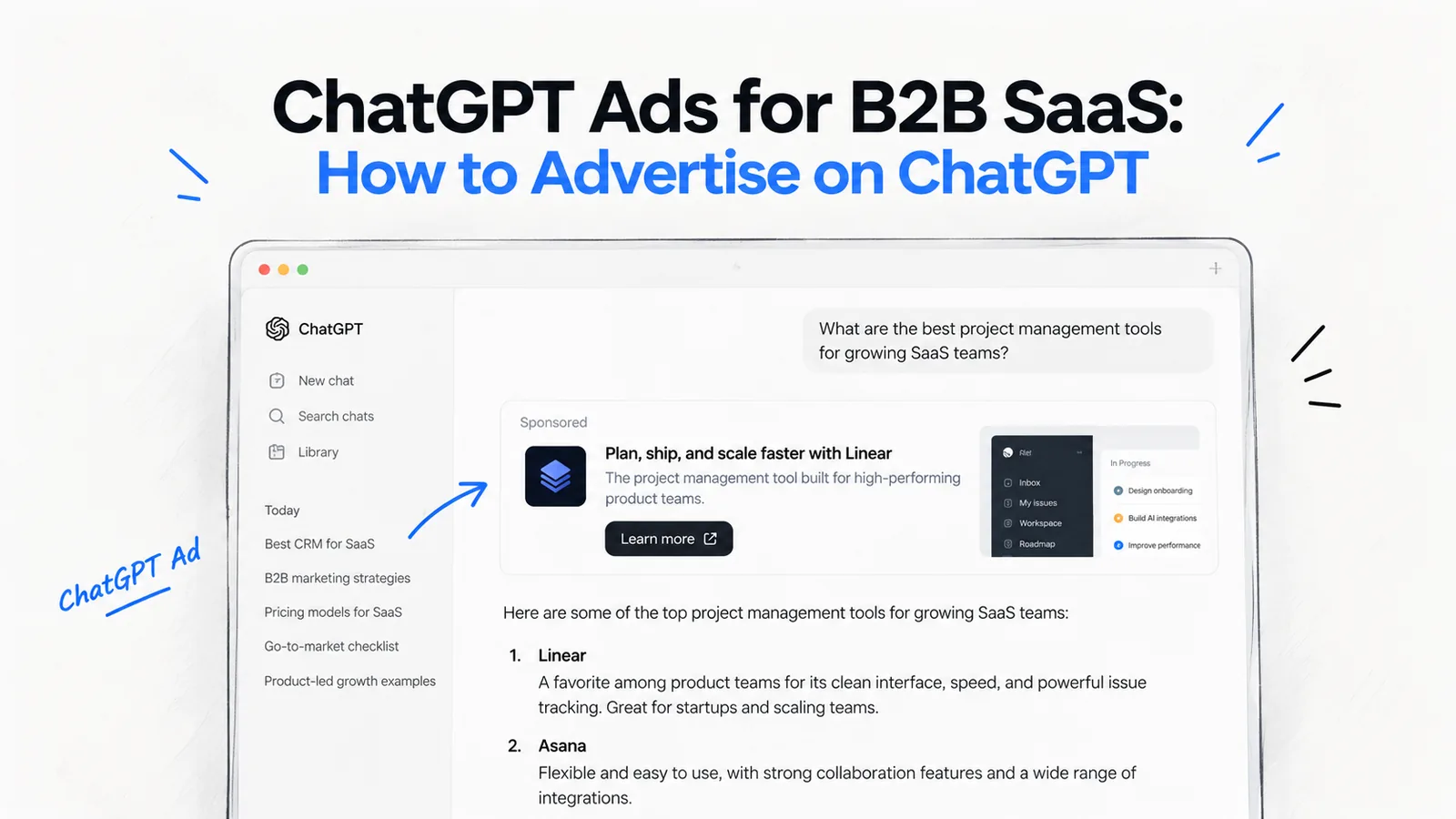
Before writing this, I ran twelve B2B software buying questions through ChatGPT, three times each, in fresh temporary chats. Thirty-six answers. I wanted to see the one thing every other guide on ChatGPT ads skips: what is already sitting in the answer above the ad.
The answer is a shortlist. A short, stubborn one. ChatGPT named 4.7 vendors per answer on average, and 82% of every name it gave belonged to a vendor that showed up in all three runs of the same question. Run it again tomorrow and you mostly get the same five companies.
That is the real context for ChatGPT advertising if you sell B2B software. You can now pay to appear under that answer. You can't pay to appear inside it. Everything in this guide, from cost to targeting to measurement, comes back to that line. I'll show you OpenAI's actual rules (read straight from its help center and ad policy), the third-party data that exists so far, our own test, and the budget math nobody else has done for a B2B funnel. Where something is documented, I'll say so. Where it's my opinion, I'll say that too.
The short answer
ChatGPT ads are sponsored units shown below ChatGPT's answers to logged-in Free and Go users (and in some logged-out sessions). You buy them in OpenAI's self-serve Ads Manager with a $25 minimum daily budget, paying per 1,000 views or per click, and OpenAI recommends starting with a $3 to $5 maximum bid per click. B2B SaaS can advertise and is already the biggest US category by impressions, but ads never change what the answer itself recommends.
What ChatGPT ads are, and what they look like
A ChatGPT ad is a labeled sponsored unit that appears below a ChatGPT response, matched to the topic of the conversation rather than to a typed keyword. OpenAI's help center lists exactly what goes into one: advertiser name, favicon, a title, a short line of copy, a landing page and an image.
The creative limits are tight. OpenAI recommends titles of 16 to 24 characters (50 maximum) and copy of 32 to 48 characters (100 maximum), with a square PNG or JPG up to 1200 by 1200 pixels. That is shorter than most Google ad headlines, so you're writing a label, not a pitch.
- Vendor A, the default pick for speed to audit
- Vendor B, strong on integrations
- Vendor C, cheaper for very small teams
Three formats exist beyond the standard text-and-image unit. Product carousels are in testing for feed-based advertisers. Sponsored Agents, where a click opens a chat with a company's own agent, are a limited alpha announced in OpenAI's September 16 post on advertising, alongside HubSpot as the first CRM integration. Visual ads next to image generation were announced on October 5 for a small US test. For B2B SaaS, the standard unit is the one you'll actually buy.
Ads don't change the answer, and that cuts both ways
OpenAI built the program on what it calls answer independence. In its announcement of its approach to advertising, OpenAI says ads run on separate systems from the chat model and that conversations stay private from advertisers. Advertisers get aggregate numbers: views, clicks, conversions. Never prompts.
Good for trust. Also the reason ads can't fix a visibility problem. If ChatGPT recommends three competitors and not you, an ad puts your logo under that list. The list doesn't change. And there's a detail I haven't seen anyone mention: OpenAI's user FAQ describes an Ask ChatGPT option on every ad. A buyer can tap it and ask ChatGPT about your ad directly. ChatGPT then answers from what it knows about you, which comes from the same organic sources that built the shortlist. If those sources are thin, your ad invites a question you can't control the answer to.
Who sees ChatGPT ads, and why most of your buyers at work don't
ChatGPT ads show to users on the Free and Go plans. Plus, Pro, Business, Enterprise and Edu accounts see no ads, and neither do accounts identified as under 18. Temporary chats are ad-free. OpenAI's Ads in ChatGPT FAQ also says logged-out experiences can show ads, limited to ones "appropriate for all audiences".
Read that list again with a B2B buyer in mind. Your buyer at a 300-person company probably uses ChatGPT through a Business or Enterprise workspace. Those seats never see an ad. The same person on a personal free account at 9pm, researching the tool their boss asked about, does.
Nobody outside OpenAI knows how big that gap is for your ICP. Two data points help. Similarweb's panel puts US ad-eligible reach at 43.4% of ChatGPT users. And Omni Lab ran a LinkedIn poll of 100 SaaS and tech marketers in which 74% said they were on paid plans, which they cite in their B2B SaaS guide to ChatGPT ads. A poll of marketers is not a poll of your buyers, but the direction is clear. Plan for a fraction of your audience, reached on personal time.
The counter-argument is also real. G2's survey of 1,076 B2B software buyers, published this April, found 51% now start software research in an AI chatbot more often than in Google, up from 29% the year before, and 63% name ChatGPT as their main chatbot for it. Even a slice of that audience is a lot of high-intent conversations.
Can B2B SaaS companies advertise on ChatGPT?
Yes, in practice. B2B SaaS was the largest US advertiser category in Similarweb and Graphite's State of ChatGPT Ads report, with 19.9% of US ad impressions from 1,210 advertisers between March 30 and August 4. Monday.com led the category. But "SaaS" is not a named category in OpenAI's ad policy, and that matters more than people think.
OpenAI's ad policies (last revised September 10) say ads are "primarily limited to consumer verticals such as lifestyle and household goods, local services, travel and experiences, and digital products or education" while the program is young, with finance, health and legal approved case by case. Software sits under "digital products" in practice. It has clearly been approved at scale.
Two clauses deserve a careful read if you sell software:
- The competitive position clause. OpenAI reserves the right to refuse ads "for any reason, including where they conflict with our advertising principles, business interests, or competitive position." If your product is an AI assistant, an AI writing tool or anything OpenAI sells itself, you're advertising on a competitor's shelf. Cursor runs ads there today, so it isn't a blanket ban. It is a discretionary one.
- The comparison rule. Ads must not make misleading "comparisons with other products or companies." Competitor-comparison copy is allowed only if you can stand behind every claim.
| Your SaaS category | What OpenAI's policy says | My read |
|---|---|---|
| Horizontal B2B software (CRM, PM, support, analytics) | Not named; runs under digital products | Eligible in practice. Biggest category already |
| Fintech and financial software | General financial software and budgeting apps generally permitted; financial services restricted | Software that doesn't sell a financial product is fine. Lending, payments offers and investing need approval |
| Health tech | Healthcare approved case by case; no ads near health conversations | Expect manual review and proof of licensure |
| Legal tech | Legal services approved case by case | Tools for lawyers are safer than services for consumers |
| HR and recruiting tech | Job and housing listings disallowed | Promote the platform, never a specific job opening |
| AI assistants and AI writing tools | Can be refused on competitive grounds | Possible, but you're in OpenAI's own aisle |
Our test: the shortlist your ad sits under
Ads live below answers, so I measured the answers. The method is simple enough to copy:
- Twelve buying prompts across eight B2B software categories, plus one head-to-head, one alternatives question, one pricing question and one "is it worth it" question. All written the way a buyer types, not the way a vendor describes itself.
- Three runs each, every run in a new temporary chat on the default model, with no forced web search. 36 answers in total, recorded on 18 October.
- What we logged: every vendor named as a recommendation or option, in order, whether ChatGPT searched the web, and whether any sponsored unit appeared.
One honest limit before the numbers. Temporary chats never show ads, by OpenAI's own rules, and our account sits on a paid plan. So this test measures the organic shortlist, which is exactly the thing an ad has to compete with. It says nothing about which ads would have appeared. We saw 0 sponsored units in 36 runs, as expected.
What we found
ChatGPT searched the web in 36 of 36 runs without being asked to, and every answer cited sources: mostly vendor pricing pages, product pages and third-party "best tools" roundups. It named 4.7 vendors per answer on average, and kept its number-one pick identical across all three runs in 11 of 12 questions. 82% of all vendor mentions went to vendors that appeared in every run of their question. The rest, the rotating slots, is where a newcomer could break in. It is a small slice.
| Buyer question | Named in all 3 runs | Named in 1 or 2 runs | First pick |
|---|---|---|---|
| CRM, 50-person sales team | Salesforce, HubSpot, Attio, Pipedrive, Microsoft Dynamics 365 | none | Salesforce |
| Project management, remote eng team | Linear, Jira, GitHub, ClickUp | Asana, Shortcut | Linear |
| Marketing automation, small team | HubSpot, ActiveCampaign, Customer.io, Salesforce Pardot | Brevo, Intercom | HubSpot |
| SOC 2 compliance automation | Vanta, Drata, Sprinto, Secureframe | Thoropass, Scytale | Vanta |
| Help desk for B2B SaaS | Intercom, Zendesk, Plain, Front, Help Scout | Freshdesk, Pylon | Intercom |
| Payroll, US remote team | Gusto, Deel, Rippling, ADP | OnPay, Remote, QuickBooks Payroll | Gusto |
| Sales engagement, SDR team | Salesloft, Outreach, Apollo.io | Amplemarket, Reply.io, HubSpot, Salesforce Sales Engagement, Salesforge | Salesloft / Outreach |
| BI tool, mid-size SaaS | Looker, Sigma, Metabase, Microsoft Power BI, Tableau | ThoughtSpot | Looker |
| HubSpot or Salesforce? | HubSpot, Salesforce | none | HubSpot |
| Zendesk alternatives | Intercom, Front, Freshdesk, Help Scout, HubSpot, Pylon | Salesforce, Jira Service Management, Plain | Intercom |
| How much does Gong cost? | Gong | none | Gong |
| Is Vanta worth it? | Vanta, Drata, Secureframe | Sprinto | Vanta |
What this means for an ad budget, in plain terms:
- If you're in the locked slots, an ad is mostly defense. It protects the answer from a competitor's sponsored unit sitting right under your name.
- If you're in the rotating slots, ads plus organic work together can tip you into the locked group. This is the best-case scenario for paid.
- If you're absent, the ad is the only place you appear, under a list that leaves you out. Buyers read the list first. I'd fix the organic side before I spent much here, and our guide on how to rank in ChatGPT is where I'd start.
This lines up with what we saw in our earlier AI shortlist study on a different model: a small set of incumbents gets recommended in nearly every answer, and heavily marketed challengers can trail them badly. Ad spend and recommendation share are different currencies.
One more pattern stood out. HubSpot appeared in 14 of the 36 answers, across questions about CRM, marketing automation, sales engagement and support tools. A vendor that ChatGPT already trusts across categories gets free exposure in conversations it never bid on. A newcomer has to pay for each one.
And the shortlist depends on the exact wording. Asked for the best CRM for a 50-person B2B SaaS sales team, ChatGPT put Salesforce first in all three runs. Asked "HubSpot or Salesforce for a 50-person B2B company?", it picked HubSpot all three times. Same buyer, same company size, different winner. That's why you test the questions your buyers actually type before you write a single context hint.
How much do ChatGPT ads cost?
ChatGPT ads cost a minimum of $25 a day in the US, billed per 1,000 impressions (Views) or per click (Clicks), and OpenAI recommends starting Clicks campaigns at a $3 to $5 maximum bid. It runs a relevance-weighted, second-price auction, so you often pay less than your bid. OpenAI publishes no CPM guidance and says it "does not yet have performance benchmarks."
The budget rules are worth knowing before you set one. Per OpenAI's daily budgets page, a daily budget is an average over a seven-day week. A single day can spend up to twice the budget, and the week caps at seven times. So $25 a day means up to $175 a week, about $750 a month, and you can't hard-cap a single day.
| Cost item | What we know | Source |
|---|---|---|
| Minimum daily budget | $25 (EUR 15, GBP 15) | OpenAI, documented |
| Recommended starting bid | $3 to $5 max CPC | OpenAI, documented |
| Auction | Relevance-weighted, second-price | OpenAI, documented |
| Billing options | CPM (Views), CPC (Clicks), Conversions billed per click or per 1,000 views | OpenAI, documented |
| Pay per conversion? | No. You never pay per conversion | OpenAI, documented |
| Launch CPM | About $60 at the pilot stage | Press reports, not confirmed by OpenAI |
| Old minimum commitment | Reported at $200,000, later $50,000, gone with self-serve in May | Press reports |
| Real CPCs seen by advertisers | $2 to $5 (agency testing); $3.49 on a niche B2B test | Practitioner reports |
None of the guides ranking for this topic turn a click price into a cost per lead for a B2B funnel, so I did. Two real conversion rates exist in public. John Horn's GA4 comparison in Search Engine Land found ChatGPT ad traffic converting at 0.21% against 3.71% from Google Ads on the same site, with 17 seconds of average engagement against 41. Treat 0.21% as a cautious floor and 3.71% as a search-like ceiling. I added 1% as a middle case.
| Your CPC | At 0.21% conversion | At 1% conversion | At 3.71% conversion |
|---|---|---|---|
| $2 CPC | $952 | $200 | $54 |
| $3 CPC | $1,429 | $300 | $81 |
| $5 CPC | $2,381 | $500 | $135 |
Cost per lead equals CPC divided by conversion rate. At $3 a click and a 1% conversion rate, a lead costs $300. At 0.21%, it costs $1,429. That spread is why your landing page and your offer matter more than your bid. A demo request on a generic homepage will land near the floor. A tool, a calculator or a pricing page that answers the exact question asked will land much higher.
One more reality check from that Omni Lab test: a well-built campaign with 9 ad groups and about 100 context hints, set to $33 a day, spent $34.89 in ten days and earned 10 clicks. That is not a cost problem. It's an inventory problem. Very niche B2B topics may not have enough ChatGPT conversations to spend your budget at all. Broad category questions do.
Where in the conversation ChatGPT ads appear
Most ChatGPT ad impressions happen early in a conversation. Similarweb's panel found 28% of impressions in the first turn and 51% within the first three turns, with click-through rates around 0.66% in turn one against 0.36% to 0.48% from turn five onward. Early turns are where buyers ask the broad category question. That's your inventory.
My takeaway for B2B: write context hints for the first question a buyer asks, not the fifth. "Best help desk for a B2B SaaS company" is turn one. "How do I migrate macros from our old tool" is turn nine, and by then the buyer has usually picked.
What click-through rate to expect
Expect roughly 0.6% to 0.75% CTR in English-speaking markets. Similarweb measured an all-time US CTR of 0.73% between March 30 and September 16, with Brazil, Mexico and Japan above 1.5% (Brazil and Mexico on about a month of data). Worldwide weekly CTR rose 112% from the first week to mid-September as advertisers learned the format.
Search interest tells a similar story. US Google searches for "chatgpt ads" peaked the week after OpenAI's January announcement, stayed between roughly half and four-fifths of that level through spring, and have settled near a third of the peak since summer. The news cycle is over. The advertisers are still arriving.
Your competitors can now advertise on your brand's questions
Yes, and the early data says it's already happening. In Similarweb's September sample, 61% of conversations that carried an ad named a brand, against 36% of conversations without one. Their example: a buyer asked for alternatives to Wix and saw a sponsored unit from Lovable.
Because ads match the topic, not exact keywords, "[your brand] alternatives" and "[your brand] vs [competitor]" are open territory for any rival who writes context hints about your category. In our test, the Zendesk-alternatives question returned a stable list of rivals every time. A rival's ad under that list costs them a few dollars a click.
For a B2B SaaS company, I'd treat your own brand questions as the first thing to protect, both organically and, if the numbers justify it, with your own ads. And if you're the challenger, the alternatives questions about the category leader are probably the cheapest qualified attention you'll find. Just keep the copy within OpenAI's no-misleading-comparisons rule.
How to advertise on ChatGPT, step by step
To advertise on ChatGPT, open an account in OpenAI's self-serve Ads Manager at ads.openai.com, verify your business, install conversion tracking, then build a campaign with an objective, a budget, target countries, ad groups with context hints, and short ads. Ads go live after review. This is the order I'd follow for a B2B SaaS company.
The home-country lock (a real problem for non-US SaaS)
OpenAI's campaign guide says some new self-serve accounts can advertise only in their home country until identity verification is approved and they've reached an unstated amount of home-country spend. If you're an Israeli, European or Indian SaaS company selling into the US, that means your first campaigns may have to run at home before you can reach the market you actually care about. Budget for it, and to target only the US, include the US explicitly. Excluding other countries isn't enough.
Context hints are not keywords
You don't bid on keywords. At the ad group level you write context hints that describe the conversations where you're relevant, and OpenAI says plainly they "are not exact-match keywords" and don't guarantee delivery. The landing page also feeds the matching, which is why OpenAI's OAI-AdsBot crawler visits it after you submit, as Search Engine Journal reported. If Cloudflare or another bot shield blocks that crawler, your ads can fail review. Check it before launch.
For B2B, write hints the way your buyers describe their situation: "help desk for a 40-person SaaS support team moving off Zendesk", not "help desk software". If you need raw material, our library of AI buying-intent prompts is a good place to borrow real buyer phrasing.
Write ads that read like the next step
Graphite looked at ten advertisers running both ChatGPT and Google Search ads and found only 1.9% of ChatGPT headlines exactly matched their search headlines. The advertisers who stuck with it wrote new copy. At 16 to 24 characters, the title should finish the buyer's thought: "SOC 2 in 30 days", "Pricing for 50 seats", "Migrate from Zendesk". A clever line won't land in that space. A specific one will.
Targeting for B2B: what you can and can't do
ChatGPT ads target the conversation, not the person. You can pick countries (and in most campaigns states, cities, markets or postal codes), platforms (iOS and Android app or web, desktop web) and custom audiences. You can't target job titles, seniority or company names. That's the biggest difference from LinkedIn, and it changes how you plan.
Account-based marketers, note the audience floor. A custom audience needs at least 25,000 matched users before you can use it for inclusion. A typical ABM list of a few thousand contacts falls far short. Smaller lists can still be used as exclusions, so here's the trick I'd use: upload your customers and open opportunities as an exclusion list, so you stop paying to show ads to people already in your pipeline.
| ChatGPT ads | Google Search ads | LinkedIn ads | |
|---|---|---|---|
| Targets | The conversation topic, via context hints and your landing page | The search query, via keywords | The person, via profile data |
| Job title or company targeting | No | No (not natively) | Yes |
| Buyer's moment | Mid-research, often turn one of a buying question | Active search | Feed scrolling |
| Account lists | Inclusion needs 25,000+ matched users; smaller lists work as exclusions | Audience lists layered on keywords | Built for account lists |
| Query-level reporting | No, aggregate only | Yes, search terms | No queries; demographics |
| Best B2B use | Category and alternatives questions | High-intent searches | Reaching named roles and accounts |
How to measure ChatGPT ads when your sales cycle is 90 days
Measure ChatGPT ads on qualified pipeline in your CRM, not on the Ads Manager dashboard, because the platform's attribution is short. OpenAI lets you pick a 7, 14 or 30-day click-through window and a 0 or 1-day view-through window, and states that reporting "uses OpenAI's existing last-touch attribution logic and is not multi-touch attribution."
A B2B deal that closes 90 days after the first click will never show up in that window. The setup I'd insist on:
- Static UTMs on every ad URL. OpenAI says they persist on ad clicks. That's more reliable than organic ChatGPT traffic, which lost its tags for about a week in October when ChatGPT links stopped carrying them, as Search Engine Roundtable reported. Paid clicks carry the tags you set.
- Send leads back through the Conversions API or the HubSpot integration so OpenAI can optimize on real leads, not page views.
- Add "How did you hear about us?" with an AI assistant option to your demo form. Self-reported attribution catches the buyer who saw your ad on a personal account and booked from a work laptop a month later.
- Reconcile clicks with sessions. Several advertisers report dashboard clicks running well ahead of landing-page sessions, so judge cost per lead on leads that reached your own systems.
If you don't yet separate AI traffic in analytics, our guide to tracking AI traffic to your website covers the GA4 setup.
Pay for the slot or earn the answer?
Pay for ChatGPT ads when you're already on the organic shortlist for your category and want to defend or extend it. Earn the recommendation first when you're absent from it, because an ad under a list that leaves you out is the most expensive way to be the fifth option. Most B2B SaaS teams need both, in that order.
OpenAI says ads hit a $1 billion annualized revenue run rate in under 200 days, in its August 31 update. That money is chasing the same buyer questions your organic content answers. The advertisers will keep coming, and the price of the slot will follow. The organic answer, meanwhile, is set by the pages ChatGPT reads, and those compound over time. That's the core of what we call AI search demand generation.
- You are already named in most runs of your category questions
- A rival is likely to target your brand or alternatives questions
- You have a landing page that answers the exact question
- You can track leads all the way to pipeline
- You are absent or only rotating in and out of the shortlist
- ChatGPT describes your product wrongly or vaguely
- Your niche is too specific to generate ad inventory
- Your buyers mostly use ChatGPT through work accounts
If you'd rather have someone run the organic side, our ChatGPT SEO program focuses on exactly the buyer questions an ad would target, and the plans are on our pricing page. Whoever you hire, our checklist on how to choose an AI SEO agency applies to ChatGPT ads agencies too: ask what they'll measure, and how.
The 60-second scorecard: should you run ChatGPT ads?
Answer yes or no. Five or more yes answers and a test is worth it.
- Your buyers ask ChatGPT category questions ("best X for Y") before shortlisting.
- Your billing entity is in one of the 63 self-serve countries, and your category fits the ad policy.
- You're named in at least some runs of your own category questions.
- You have a landing page that answers one buying question better than your homepage.
- You can spend at least $25 a day for 30 days without needing a lead in week one.
- Your demo form or CRM can tell you a lead came from ChatGPT.
- A meaningful share of your buyers research on personal accounts (founders, small-company buyers, consultants).
Run the test yourself
You can repeat our shortlist test for your category in about 30 minutes, before you spend anything on ads.
- Write five buyer questions in buyer language: two "best X for Y" questions, one "[your brand] alternatives", one "[your brand] vs [rival]" and one pricing question.
- Run each three times in new temporary chats, so ChatGPT's memory of you doesn't skew it. Our measurement method explains why clean sessions matter.
- Log every vendor named and mark which ones appear in all three runs. That's the locked shortlist your ad will sit under.
- Decide: locked in means defend with ads, rotating means ads plus organic, absent means organic first.
Want it faster? Our free ChatGPT visibility checker runs five buyer prompts for you, and our AI visibility checker scores whether your site is easy for AI engines to read and cite. The full method for checking recommendations by hand is in our guide on how to check if AI recommends your brand.
Frequently asked questions
Does ChatGPT have ads?
Yes. ChatGPT shows sponsored ads below its answers to logged-in users on the Free and Go plans, and some logged-out sessions can show ads too. Plus, Pro, Business, Enterprise and Edu plans are ad-free, as are temporary chats and accounts identified as belonging to users under 18.
How much do ChatGPT ads cost?
ChatGPT ads have a $25 minimum daily budget in the US and are billed per 1,000 impressions or per click. OpenAI recommends a $3 to $5 starting maximum bid per click and runs a second-price auction. Advertisers report real CPCs of about $2 to $5, and OpenAI publishes no benchmarks yet.
What is the minimum spend for ChatGPT ads?
The minimum is a $25 daily budget in USD (15 in EUR or GBP), averaged over a seven-day week. A single day can spend up to twice the daily budget, and a week is capped at seven times it. The earlier $200,000 and $50,000 commitments reported for pilot advertisers no longer apply to self-serve accounts.
How do I advertise on ChatGPT?
Create an account in OpenAI's self-serve Ads Manager at ads.openai.com, verify your business, add the pixel or Conversions API, then build a campaign with an objective, budget, countries, ad groups with context hints and short ads. Ads go live after review. New accounts may be limited to their home country at first.
Can I target job titles or companies with ChatGPT ads?
No. ChatGPT ads target the conversation topic through context hints and your landing page, plus country, region, platform and custom audiences. Custom audiences need at least 25,000 matched users for inclusion targeting, so most B2B account lists only work as exclusions.
Do ChatGPT ads influence ChatGPT's answers?
No. OpenAI says ads run on separate systems from the chat model and advertisers cannot shape, rank or alter answers. That protects trust, and it also means an ad cannot get you onto the organic shortlist ChatGPT recommends. Only the sources ChatGPT reads can do that.
Are ChatGPT ads worth it for B2B SaaS?
They can be, if you're already on the organic shortlist for your category questions and can track leads into your CRM. B2B SaaS is the largest US category by impressions, but public conversion data is thin and early tests range from strong to near zero. A 30-day test at $25 to $50 a day is a sensible first step.
Which countries can run ChatGPT ads?
OpenAI's Ads Manager availability page lists 63 countries where self-serve advertisers can be based, including the US, Canada, the UK, most of Europe, Israel, India, Japan, Korea, Brazil and Mexico. Your billed legal entity has to be in one of them, and new accounts may start with home-country targeting only.
Do I need an agency to run ChatGPT ads?
Not to start. Ads Manager is self-serve and the minimum is low. OpenAI also works through its own Ads Solutions team and holding-company agencies for large budgets. An agency earns its fee on hint writing, landing pages and CRM measurement, so ask any agency how it will prove pipeline, not clicks.
What do ChatGPT ads look like?
A ChatGPT ad is a card below the answer marked Sponsored, with the advertiser's name, favicon, a short title, one line of copy, an image and a link. OpenAI recommends titles of 16 to 24 characters and copy of 32 to 48. Carousels, sponsored agents and ads beside image generation are in testing.
Related reading
- AI visibility for SaaS: how B2B software companies get recommended in AI answers.
- Google AI Mode for SaaS: the other AI answer engine selling ad space next to answers.
- State of AI search visibility: our ongoing data on who AI engines recommend.
- AI visibility audit: a baseline of your buyer questions across engines before you spend on ads.