

Your next buyer probably asked ChatGPT for a shortlist before they ever heard your pitch. If your brand wasn't named in that answer, you didn't lose the deal on price or product — you lost it before the conversation started. This guide gives you a genuine, complete way to check whether AI engines recommend your brand today, in about three minutes, using both a manual method and two free tools.
TL;DR (short answer): To check if AI recommends your brand, ask ChatGPT, Gemini, Claude, Perplexity, and Copilot the exact buying-intent questions your customers ask — for example, "What are the best [your category] tools for [your ICP]?" — and note whether your brand appears, where it ranks, and which competitors get named instead. The fastest way to do this across every engine at once is the free web-based AI Visibility Checker and the free Arobis Lens Chrome extension, which show your Recommendation Frequency and who's being recommended in your place.
What does it mean for AI to "recommend" your brand?
There's a difference between being mentioned and being recommended, and it matters more than most founders realize. A mention is when an AI answer references your brand in passing — usually because someone named you in the prompt. A recommendation is when the model proactively puts you on a shortlist in response to a neutral, buying-intent question like "What's the best tool for X?" That second one is the one that moves pipeline.
Here's the definition worth memorizing:
AI Recommendation Frequency is the percentage of relevant buying-intent prompts in which an AI engine names your brand as a recommended option — unprompted. If you're recommended in 3 of 10 category questions, your Recommendation Frequency is 30%. It's the single clearest measure of whether AI is putting you on the shortlist or leaving you off it.
Visibility gets you seen. Recommendations get you chosen. You can be indexed, monitored, and technically "present" across the web and still never make it into a single AI shortlist. The goal of this check isn't to confirm the model knows you exist — it almost certainly does. The goal is to find out whether it recommends you when a buyer is deciding who to evaluate.
Why AI recommendations now decide the shortlist
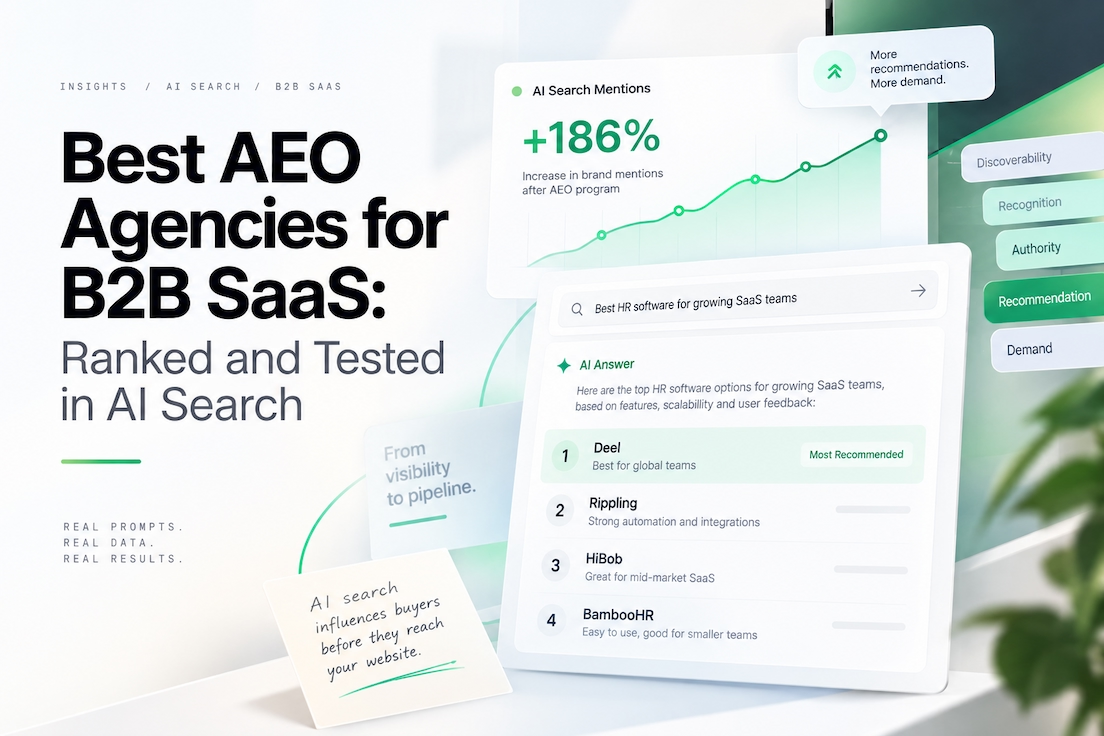
Buying used to start with a Google search and ten blue links. Now it starts with a conversation. Your buyer opens ChatGPT or Perplexity, describes their problem, and asks which tools solve it. The model returns three to five names. That list — assembled before the buyer visits a single website — is the new shortlist. We call the stage where this happens the pre-website funnel: the part of the AI-assisted buying journey that plays out entirely inside the model, before any vendor gets a click.
If you're not in that answer, you're not in the evaluation. It doesn't matter how good your demo is or how sharp your pricing page reads, because the buyer never gets there. This is why checking your AI recommendation status isn't a vanity exercise — it's demand diagnostics. The brands that show up in AI shortlists capture demand that competitors never even see leaking away. For the full picture of how this shift reshapes B2B SaaS pipeline, the State of AI Search Visibility report lays out where buyer behavior is heading and why the shortlist forms this early.
How do I manually check if ChatGPT recommends my brand? (the 3-minute method)
The manual method is free, honest, and something every founder should do at least once. You're going to role-play as your own buyer and ask each engine the questions your customers ask. Do not name your own brand in the prompt — the whole point is to see whether the model volunteers you
That last framing — "if you had to recommend three" — is the closest proxy to how buyers actually use these tools, so weight it heavily. If you want a deeper prompt library and a scoring rubric, the complete AI visibility guide breaks down prompt design by funnel stage.
If you would rather skip the manual work, the free ChatGPT recommendation checker runs five buyer prompts for your category in about 25 seconds and shows your mention rate, your position, the competitors ChatGPT names instead and the sources it cited.
Which AI engines should I check, and what is each good for?
Buyers don't all use the same engine, and the engines don't all choose brands the same way. Check all five, because you can be strong in one and invisible in another.
If you want the mechanics behind these differences, we broke down how Perplexity, ChatGPT, Claude, and Gemini actually choose which brands to mention — it's the difference between guessing and knowing why you're left off.
The fast method: two free Arobis tools that check every engine at once
The manual method is thorough but slow, and it's easy to introduce bias — you'll unconsciously run the prompts you think you'll win. The faster, cleaner approach is to run a standardized set of prompts across every engine automatically and get a single Recommendation Frequency score back. Arobis AI built two free tools that do exactly that.

The free Arobis Lens Chrome extension
Arobis Lens lives in your browser and surfaces your AI recommendation status as you work. Install the free Arobis Lens Chrome extension, and it will show you, for the prompts that matter in your category, whether your brand gets recommended and who shows up instead. It's the fastest way to spot-check a specific competitor or a specific buying question without leaving your tab.
What Lens returns:

The web-based AI Visibility Checker
If you want a fuller, shareable report without installing anything, run the free AI Visibility Checker. You enter your domain and category, and it queries the major engines with buying-intent prompts, then returns a structured read on your recommendation status. It's the tool to send your CEO or board when you need to show, not tell, where you stand.

Both tools are genuinely free, and both are a faster on-ramp than the manual method. Run the web checker first for the full picture, then keep the Arobis Lens extension installed for ongoing spot checks. If you're evaluating options, our roundups of the best free AI visibility tools and the broader 17 best AI visibility tools put these in context against everything else on the market.
Manual check vs. Arobis Lens vs. the AI Visibility Checker
How do I read my results?
Once you have numbers, interpret them against buyer reality, not vanity. Here's how to read what you're seeing.

If your Recommendation Frequency is high (roughly 50%+ across engines): you're on most shortlists. Your job is to defend and extend — move from "sometimes named" to "named first," and make sure you hold up in the head-to-head comparison prompts where deals are actually decided.
If it's middling (around 20–50%): you're on the shortlist for some buyers and invisible to others. This is the most common and most fixable position. Look at the per-engine breakdown — you're probably strong in one or two engines and absent in the rest — and at your invisible prompts, because those are demand you're leaking to competitors who did the authority work you didn't.
If it's low or zero: AI isn't recommending you, full stop. Before you panic, this is diagnosable and common — most SaaS brands under $20M ARR are in this bucket because they optimized for Google, not for AI recommendation. We wrote up the 10 reasons your brand never appears in ChatGPT and the deeper causes behind why your brand doesn't appear in AI answers — start there to find your specific gap.
Whatever your score, pay closest attention to two columns: who's recommended instead of you and which prompts you're invisible in. Those two together tell you exactly where demand is going and which questions to win first.
What do I do about the gaps?
Checking your recommendation status is diagnosis. Changing it is the work. AI engines don't recommend brands at random — they assemble shortlists from signals of authority, credibility, and consensus across the sources they trust. Get those signals right and you get recommended; ignore them and you stay invisible no matter how good the product is. We mapped the specific inputs in the 5 signals AI engines use to recommend brands, and the data behind them in our ChatGPT SaaS brand visibility study.
Closing the gap means deliberately engineering those signals — what we call Authority Engineering: building the third-party credibility, structured positioning, and consensus footprint that makes an engine confident enough to name you. It's not link-buying and it's not keyword stuffing; it's making your brand the obvious, defensible answer to your category's buying questions. The playbook for it is here: how to build AI recommendation authority.
If you'd rather see the full scope before you act, a formal AI Visibility Audit maps your Recommendation Frequency across every buying-intent prompt in your category, names the competitors winning your invisible prompts, and shows the exact authority gaps to close — engine by engine. It's the difference between knowing you have a problem and knowing precisely how to fix it. See how Arobis approaches this for SaaS on the AI visibility for SaaS page.
The free checker tells you whether AI recommends you. The audit tells you why not — and what to change first.
Frequently asked questions
How often should I check if AI recommends my brand?
Run a full check monthly and spot-check weekly. AI models update, competitors invest in authority, and your recommendation status drifts. Monthly gives you a trend line; weekly spot checks with the free Arobis Lens Chrome extension catch sudden drops before they cost you a quarter of pipeline.
Why does ChatGPT recommend my competitor but not me?
Because your competitor has stronger recommendation signals in the sources the model trusts — more credible third-party mentions, clearer category positioning, and a bigger consensus footprint. It's rarely about product quality. The engine recommends whoever it's most confident is a safe answer, and confidence comes from authority signals, not from how good your software is.
Is the Arobis AI Visibility Checker really free?
Yes. Both the web-based AI Visibility Checker and the Arobis Lens Chrome extension are free to use. They return your Recommendation Frequency, the competitors recommended instead of you, a per-engine breakdown, and your invisible prompts — no cost and no credit card. Paid engagements begin only if you want a full audit or ongoing Authority Engineering; you can see how that's structured on the pricing page.
What's the difference between AI visibility and AI recommendation?
Visibility means an AI engine can reference your brand — it knows you exist. Recommendation means the engine proactively names you as a good option when a buyer asks who to evaluate. Visibility gets you seen; recommendation gets you chosen and onto the shortlist. Recommendation Frequency is the metric that measures the second, and it's the one tied to revenue.
Can I improve my AI recommendations myself?
Partly. You can sharpen your category positioning, publish substantive comparison content, and earn credible third-party mentions — all of which feed the signals engines use. But systematically moving your Recommendation Frequency across five engines is what Authority Engineering and a structured AI Search Demand Generation program are built for. Start with the free tools, close the easy gaps yourself, and bring in a full audit when the stakes justify it.
How is this different from SEO?
SEO optimizes to rank a page in a list of links; this optimizes to get your brand recommended inside an AI answer, before the buyer ever reaches a search results page. Different funnel, different signals, different metric. For the full landscape and the data behind the shift, see our 100 AI search statistics research roundup and the State of AI Search Visibility report.
Your next step
Don't guess whether AI recommends your brand — measure it. Start by running the free AI Visibility Checker to get your baseline Recommendation Frequency and see exactly who's being recommended in your place. Then install the free Arobis Lens Chrome extension to keep an eye on it as your category moves.
When you're ready to turn a diagnosis into demand, look at how Arobis runs AI Search Demand Generation for SaaS and review engagement options on the pricing page. The shortlist is being written inside AI answers right now, with or without you on it. The brands that check, then act, are the ones getting chosen.
Read more about the Arobis Lens privacy here.