
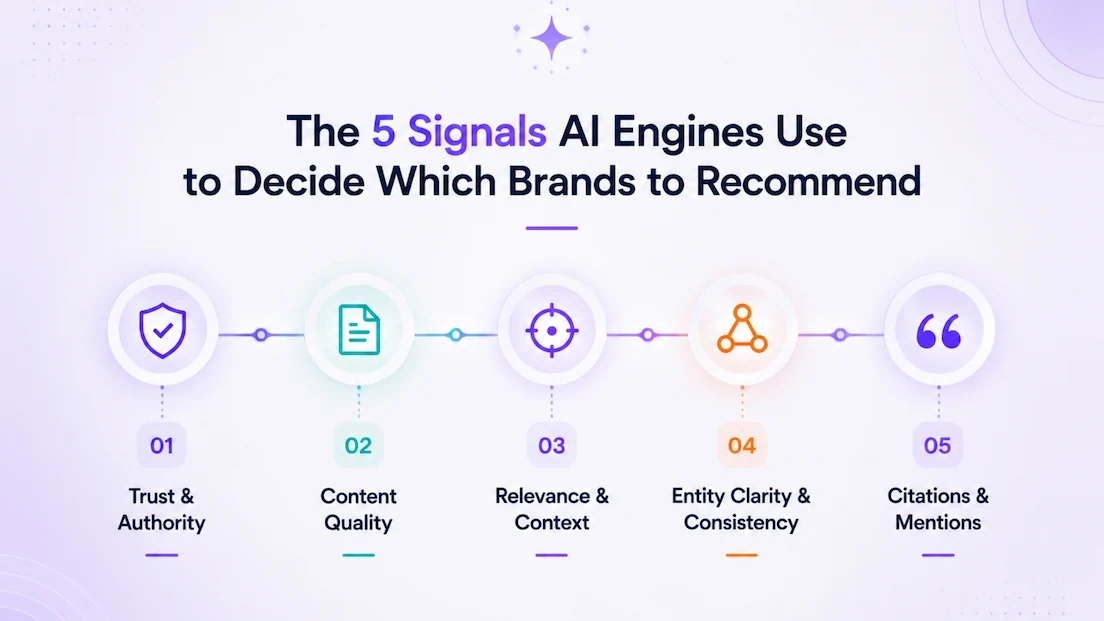
The 5 Signals AI Engines Use to Decide Which Brands to Recommend
Most SaaS companies approach AI search the wrong way.
They ask: "Why aren't we visible in ChatGPT?"
That is the wrong question.
Visibility is not the mechanism. Visibility is the outcome.
The real question is: "What signals are AI engines using to decide which brands to recommend and are we sending them?"
That distinction matters more than most marketing teams realize. Because AI engines do not rank brands the way Google does. They do not count backlinks. They do not score keyword density. They do not measure page speed.
They make a different kind of judgment entirely.
They ask: Is there enough credible, consistent, and contextually relevant evidence across the internet that this brand is what it claims to be and that it deserves to be in this buyer's shortlist?
If the answer is yes, you get recommended.
If the answer is unclear, you don't.
After testing hundreds of buyer-intent prompts across ChatGPT, Claude, Gemini, Perplexity, and Copilot and mapping the patterns that separate recommended brands from invisible ones we identified five distinct signals that determine AI recommendation outcomes.
We call this the Arobis AI Authority Signal Stack™.
Here is what it is. Here is how it works. And here is what SaaS companies need to do about it.
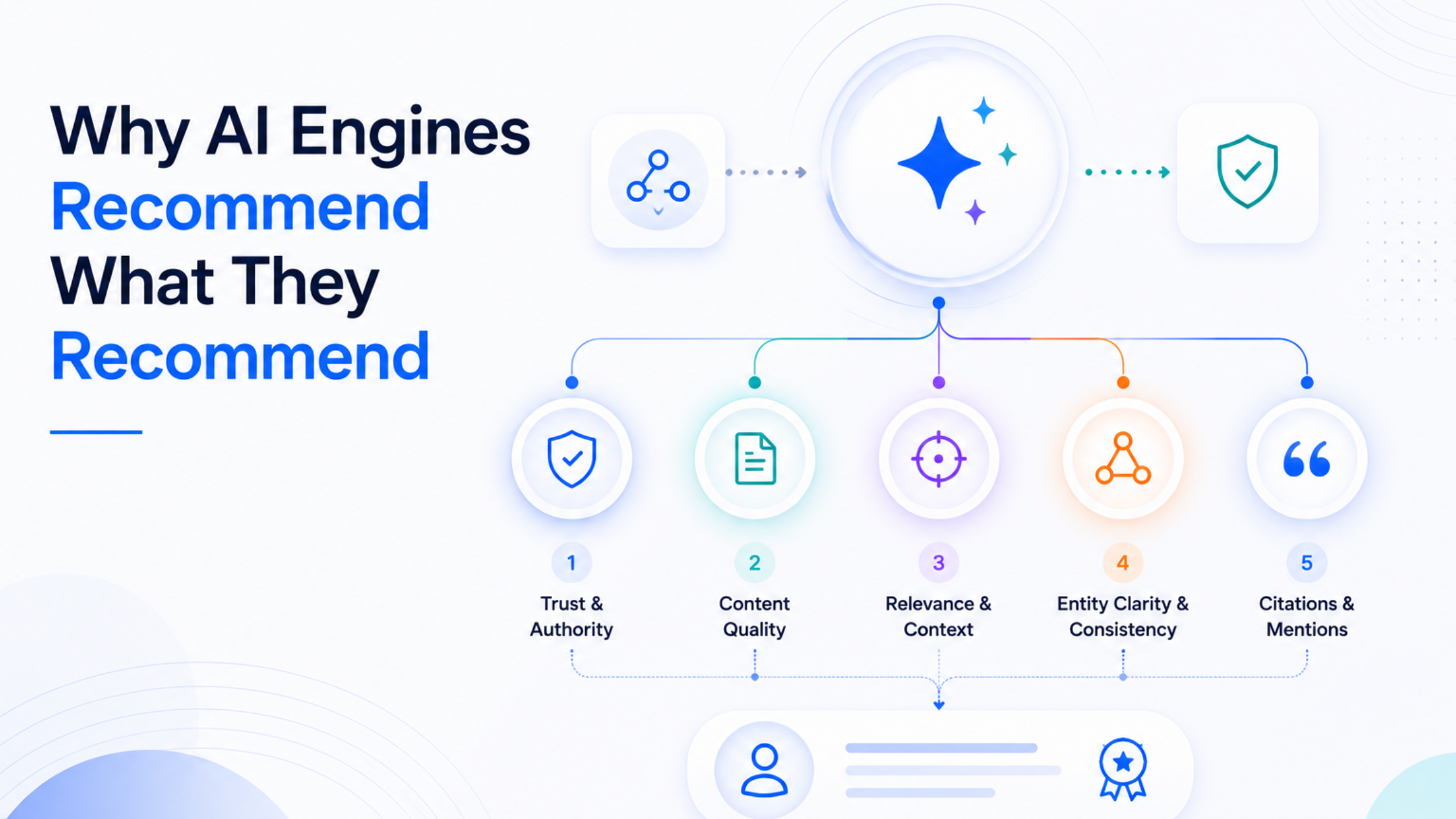
Why AI Engines Recommend What They Recommend
Before the five signals, one foundational concept.
AI engines are not search engines. They do not return a list of results ranked by relevance. They synthesize an answer and inside that answer, they include brands they trust enough to recommend to a buyer.
That trust is not built through a single ranking factor. It is built through an accumulation of signals across multiple sources, contexts, and data points.
Think of it this way: an AI engine is essentially asking the same question a trusted advisor would ask before making a vendor recommendation.
"Have I seen this brand mentioned : credibly, consistently, and in the right contexts enough times to confidently recommend it to someone I care about?"
That is the standard. And it is a significantly higher bar than ranking on page one of Google.
Here are the five signals that determine whether a SaaS brand clears it.
Signal 1: Entity Clarity: Does AI Know Exactly What You Do?
The first signal is the most foundational and the most commonly broken.
AI engines need to understand a brand with precision before they will recommend it with confidence. That means understanding: what the product does, who it is for, what problem it solves, what category it belongs to, and how it compares to alternatives.
When that picture is clear and consistent across the internet across your website, your content, third-party reviews, directories, and press mentions AI engines can confidently place your brand in the right answer at the right moment.
When it is not, when your messaging is inconsistent, your category positioning is vague, or your brand description differs across sources, AI engines lose confidence. And when AI loses confidence, it defaults to the brands it does understand clearly.
This is why companies with strong Google rankings often disappear in AI recommendations. Their SEO game is strong. Their entity clarity is weak. AI cannot tell the story of what they do precisely enough to recommend them without hesitation.
What to fix: Audit every place your brand exists on the internet: your website, G2, Capterra, Crunchbase, LinkedIn, press coverage, product directories. Do they all tell a consistent, precise story about what you do, who you serve, and what problem you solve? If not, entity clarity is your first bottleneck.
Signal 2: Category Association: Do AI Engines Link You to the Right Problems?
Knowing what a brand does is not enough.
AI engines also need to associate that brand with specific buyer problems, use cases, and category definitions, so that when a buyer asks "what's the best tool for X," the brand surfaces as a relevant answer.
This is category association. And it operates differently from keyword targeting.
In traditional SEO, you optimize for the keywords buyers search. In AI search, you optimize for the problems and use cases buyers describe — because AI engines are trained on natural language, not keyword queries.
A buyer asking ChatGPT "what should we use to manage our sales pipeline" is not typing a keyword. They are describing a situation. And AI engines respond by recommending brands they associate with that situation, not brands that happen to rank for the phrase "sales pipeline software."
The brands that win in AI search have built strong category associations across multiple contexts. Their content, their reviews, their press coverage, and their third-party mentions all connect them to the same set of buyer problems, repeatedly, consistently, and in natural language.
What to fix: Map your content against buyer problems, not keywords. Every article, landing page, and product description should clearly and repeatedly connect your brand to the exact use cases, pain points, and outcomes your buyers describe when they ask and search AI for a recommendation.
Signal 3: Citation Authority: Do Trusted Sources Mention Your Brand?
AI engines learn from the internet. But not all of the internet equally.
They weight certain sources far more heavily than others. And the sources that carry the most weight in AI training and retrieval are the ones most people would recognize as trustworthy: established publications, high-authority industry sites, peer review platforms, recognized comparison databases, and credible third-party content.
This is citation authority, and it is the AI equivalent of the backlink profile that determines Google rankings. With one important difference.
In SEO, backlinks are primarily a signal of domain authority. In AI search, citations are a signal of brand trustworthiness. AI engines are not asking "does this site link to you?" They are asking "do credible sources reference you as a solution to this problem?"
The brands that dominate AI recommendations share a common pattern: they are mentioned, not just linked to, across a wide range of credible, contextually relevant sources. Their brand appears in buying guides. In expert roundups. In industry reports. In peer reviews. In comparison articles on authoritative sites.
That citation footprint is what gives AI engines the confidence to recommend them without hesitation.
What to fix: Count how many credible, external sources mention your brand in a buying context, not just as a company, but as a recommended solution. If the answer is fewer than 20, citation authority is your primary bottleneck. Guest contributions, PR placements, expert roundups, and G2 review campaigns all build this signal directly. For the content side of that fix, the strategies that get pages cited by AI engines walk through the exact order we run them in.
Signal 4: Semantic Consistency: Does Your Brand Tell the Same Story Everywhere?
AI engines synthesize answers from multiple sources simultaneously. That means they encounter your brand across many different contexts in the process of generating a single response.
What they are looking for, consciously or not, is consistency.
Do your website, your reviews, your press coverage, your LinkedIn presence, your product listings, and your third-party mentions all tell the same story about what your brand does and who it is for?
Or does each source tell a slightly different story, different use cases emphasized, different categories claimed, different competitive positioning used?
When the story is consistent, AI engines develop high confidence in their understanding of your brand. When the story is inconsistent, they hedge, either omitting your brand from the answer or mentioning it with lower confidence than your competitors.
This is semantic consistency. And it is one of the most underestimated signals in AI search.
Companies that have gone through multiple rebrands, repositioning exercises, or product pivots often suffer from semantic inconsistency without realizing it. Their old messaging still exists across directories, old press coverage, and third-party reviews, contradicting their current positioning and confusing AI engines in the process.
What to fix: Run a semantic consistency audit. Search for your brand across the ten most important external sources AI engines reference: G2, Capterra, Crunchbase, LinkedIn, your top three competitor comparison pages, your two most-linked press mentions, and your primary product directory listings. Do they all describe your brand the same way? If not, systematic cleanup of these sources directly improves AI recommendation outcomes.
Signal 5: Recommendation Momentum: Are You Already Being Recommended?
The fifth signal is the most counterintuitive, and the most powerful.
AI engines learn from existing recommendation patterns. When a brand is already being recommended, in reviews, in comparison content, in buying guides, in expert roundups, AI engines develop a prior toward recommending it again.
This creates a compounding effect that looks unfair from the outside: the brands that are already recommended tend to keep getting recommended. The brands that are not, regardless of product quality, tend to stay invisible.
It is not a conspiracy. It is how language models work.
They are trained on human-generated content. Human-generated content reflects existing market perceptions. Existing market perceptions favor established players. And so AI recommendations, at least initially, reflect those same biases.
But here is the opportunity inside that dynamic: recommendation momentum can be built deliberately, not just inherited.
Every time your brand appears in a "best of" list, a comparison article, a buyer's guide, or an expert recommendation, you are adding to a body of evidence that AI engines use to justify recommending you again. This is not passive. It is an engineerable signal.
What to fix: Actively engineer recommendation momentum. Pursue placements in category roundups and buying guides. Publish comparison content that positions your brand in the consideration set. Build review volume on G2 and Capterra. Every external recommendation — in any credible context — adds to the prior that AI engines use to decide whether to include you in their answers.
Monitor these signals with an AI visibility tool.
One of the strongest signals is being talked about on trusted community sites, which is why we put together a full guide on how to get mentioned on Reddit as a SaaS brand.
The Arobis Authority Signal Stack™
Together, these five signals form the Arobis Authority Signal Stack™ - the framework we use to diagnose why a SaaS brand is being recommended or ignored in AI search, and to build the authority needed to change that outcome.
| Signal | What AI Is Asking | What Breaks It | What Builds It |
|---|---|---|---|
|
1
Entity Clarity
Foundation Signal
|
Do I understand what this brand does precisely? | Inconsistent messaging, vague positioning. | Consistent brand definition across all sources. |
|
2
Category Association
Problem Association
|
Do I link this brand to the right buyer problems? | Keyword-first content, weak use case coverage. | Problem-first content mapped to buyer language. |
|
3
Citation Authority
Trust Signal
|
Do credible sources reference this brand as a solution? | Low external mention volume, no buying-context citations. | Guest posts, PR, expert roundups, G2 reviews, buying guides. |
|
4
Semantic Consistency
Confidence Signal
|
Does this brand tell the same story everywhere? | Old messaging, rebrand artifacts, inconsistent directories. | Systematic external presence audit and cleanup. |
|
5
Recommendation Momentum
Compounding Signal
|
Is this brand already being recommended by others? | No external recommendations, invisible in comparison content. | Comparison articles, best-of placements, review campaigns. |
Most SaaS companies are missing three or more of these signals. That is why they are invisible in AI recommendations — not because their product is inferior, but because AI engines lack the evidence they need to recommend them with confidence.
| Signal | What AI Is Asking | What Breaks It | What Builds It |
|---|---|---|---|
|
1
Entity Clarity
Foundation Signal
|
Does AI understand exactly what this brand does, who it serves, what problem it solves, and which category it belongs to? | Inconsistent messaging, vague positioning, unclear category language, and different descriptions across sources. | A consistent brand definition across the website, directories, reviews, LinkedIn, press mentions, and product listings. |
|
2
Category Association
Problem Match
|
Does AI connect this brand to the right buyer problems, use cases, outcomes, and category conversations? | Keyword-first content, weak use case coverage, generic landing pages, and unclear buyer-problem alignment. | Problem-first content mapped to the natural language buyers use when asking AI for recommendations. |
|
3
Citation Authority
Trust Signal
|
Do credible external sources mention this brand as a relevant solution in a buying context? | Low external mention volume, weak third-party validation, and few citations from trusted industry sources. | PR placements, guest posts, expert roundups, G2 reviews, Capterra listings, buying guides, and category comparisons. |
|
4
Semantic Consistency
Confidence Builder
|
Does the brand tell the same story everywhere AI might encounter it? | Old messaging, rebrand artifacts, inconsistent directory descriptions, outdated positioning, and conflicting use cases. | A systematic external presence audit and cleanup across key AI-referenced sources. |
|
5
Recommendation Momentum
Compounding Signal
|
Is this brand already being recommended by credible people, platforms, publications, and comparison sources? | No external recommendations, weak review presence, and invisibility in comparison or best-of content. | Best-of placements, comparison articles, review campaigns, buyer guides, and repeated recommendation signals across trusted sources. |
Why This Is a Demand Generation Problem, Not a Visibility Problem
Here is what every SaaS CMO needs to understand about AI search.
The brands winning in AI recommendations are not the ones with the most content. They are not the ones with the highest domain authority. They are not the ones with the biggest marketing budgets.
They are the ones that have built the most coherent, consistent, and credible signal profile across the five dimensions above.
And they are capturing demand before buyers ever visit a website. Before they Google anything. Before they fill out a form or talk to a sales rep.
The AI-assisted buying journey starts with a question in ChatGPT or Gemini. If your brand appears in that answer — already framed as the right solution — the buyer arrives at your site pre-educated, pre-convinced, and significantly further down the funnel than any click from a Google search would produce.
That is the demand generation opportunity inside AI search.
Not visibility. Not mentions. Not a dashboard showing how many times your brand appeared.
Pipeline influence. Buyers who already trust you before they find you.
How to Audit Your Authority Signal Stack
Start with this five-question diagnostic. Answer honestly.
1. Entity Clarity: If you typed your brand name into ChatGPT and asked "what does [brand] do?" — would the answer accurately reflect your current positioning and ICP?
2. Category Association: If a buyer described your ideal use case to an AI engine without mentioning your brand — would your brand appear in the recommended solutions?
3. Citation Authority: Can you identify at least 20 credible, external sources that mention your brand specifically in a buying or recommendation context?
4. Semantic Consistency: Does your brand description on G2, Capterra, Crunchbase, LinkedIn, and your top three PR mentions all tell the same story?
5. Recommendation Momentum: Does your brand appear in at least five external best-of lists, buying guides, or comparison articles in your category?
If you answered no to three or more of these — you have an Authority Signal problem. And that problem is costing you pipeline every day that buyers are asking AI engines for vendor recommendations in your category.
These signals matter across every engine, including Google, where we explain exactly how to get recommended in Google AI Mode.
The Compounding Advantage of Authority Engineering
Here is the most important thing to understand about the Authority Signal Stack.
These signals compound.
A brand that improves its entity clarity makes it easier for AI engines to understand its category association. Stronger category association drives more citation authority. More citation authority increases semantic consistency. And consistent recommendation momentum reinforces all four signals simultaneously.
This is why companies that start early build compounding advantages that become increasingly difficult for competitors to close. AI search authority is not a campaign. It is an asset that grows stronger over time.
The SaaS companies that move now, that build their Authority Signal Stack before their competitors do, will own the AI shortlist in their categories. Not for a quarter. For years.
Visibility gets you seen.
Authority gets you chosen.
Frequently Asked Questions
What is the most important signal for AI recommendations?
Entity Clarity is the foundation. Without it, no other signal can fully function. AI engines cannot recommend a brand they do not clearly understand — regardless of how much content exists or how many external mentions a brand has accumulated.
How long does it take to build AI search authority?
Initial improvements in recommendation frequency are typically visible within 60 to 90 days of systematic signal building. Compounding authority — the kind that creates consistent, category-level AI recommendations — typically develops over six to twelve months of sustained effort.
Is AI search authority the same as SEO authority?
No. SEO authority is primarily a measure of backlink quality and domain rating. AI search authority is a measure of how consistently and credibly an AI engine can associate your brand with buyer problems and recommend you as a solution. The inputs overlap partially — credible citations help both — but the mechanisms and optimization strategies are meaningfully different.
Do AI engines like ChatGPT and Gemini use the same signals?
The five signals apply across all major AI engines, but the weighting and data sources vary. ChatGPT draws heavily from its training data and real-time web access. Gemini integrates tightly with Google's knowledge graph. Perplexity prioritizes real-time citations and source quality. Claude emphasizes document-level content quality and entity precision. A strong Authority Signal Stack is designed to work across all five simultaneously.
Can a SaaS company build AI search authority without paid media?
Yes. The Authority Signal Stack is entirely organic. Entity clarity, category association, citation authority, semantic consistency, and recommendation momentum are all built through content strategy, earned media, review generation, and authority engineering — not paid spend. This is one of the core advantages of AI Search Demand Generation over traditional paid acquisition channels.
How do I know if my brand is missing from AI recommendations?
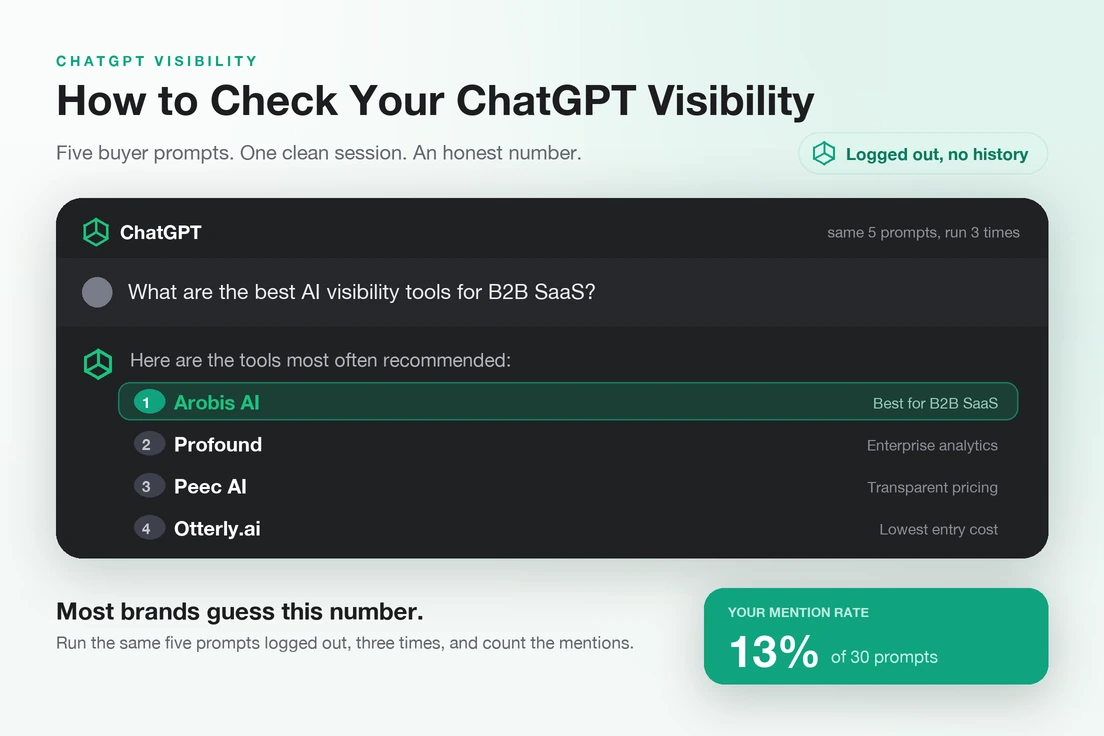
Test it directly. Open ChatGPT, Gemini, and Perplexity. Run the five to ten buyer-intent prompts a real prospect in your category would use. If your brand does not appear — or appears inconsistently — you have an Authority Signal gap. An AI Visibility Audit maps exactly where those gaps are and which signals need the most work.
What is the Arobis Authority Signal Stack™?
The Arobis Authority Signal Stack™ is a proprietary framework developed by Arobis AI to diagnose and build the five signals that determine AI recommendation outcomes for SaaS brands: Entity Clarity, Category Association, Citation Authority, Semantic Consistency, and Recommendation Momentum. It is the foundation of the Authority Engineering stage within the Arobis AI Search Demand Framework™.
Ready to Build Your Authority Signal Stack?
Most SaaS companies do not know which of the five signals is costing them recommendations. The Arobis AI Visibility Audit maps your complete signal profile — showing exactly where you are strong, where you are weak, and which signals to fix first to start appearing in AI-generated buyer shortlists.