
Profound vs Arobis AI: The Difference Between Brand Monitoring and Demand Generation
The Big Question Is Not “Are We Visible?”
It is easy to confuse visibility with momentum.
A brand appears in an AI answer.
A dashboard records the mention.
A report shows the trend.
A marketing leader opens the chart and sees a line moving upward.
That feels like progress.
But for SaaS companies, the harder question is not:
“Are we visible?”
The harder question is:
“Is that visibility creating demand?”
That distinction matters because AI search is not just changing how people find software.
It is changing when buyers form opinions.
It is changing how shortlists are created.
It is changing which brands enter the conversation before a sales team ever gets involved.
And for B2B SaaS companies, that creates a new marketing problem.
Not a reporting problem.
A demand generation problem.
This is where the comparison between Profound and Arobis AI becomes interesting.
Not because one is “good” and the other is “bad.”
That is the lazy version of a comparison article.
The real difference is more strategic.
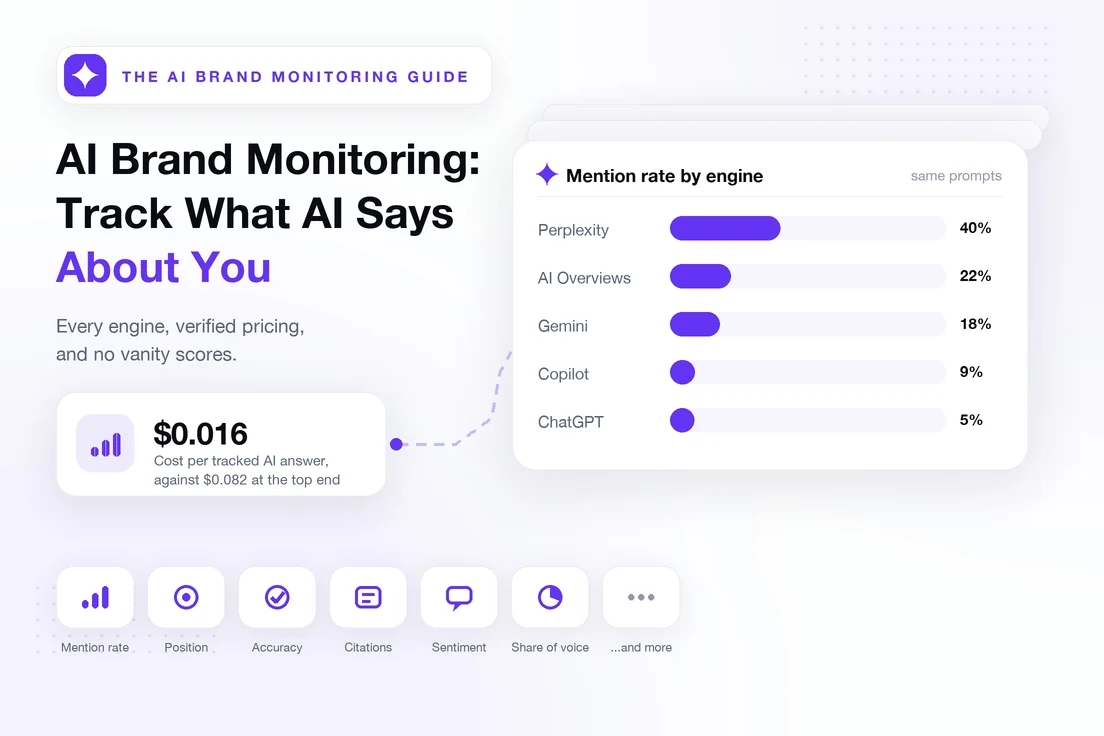
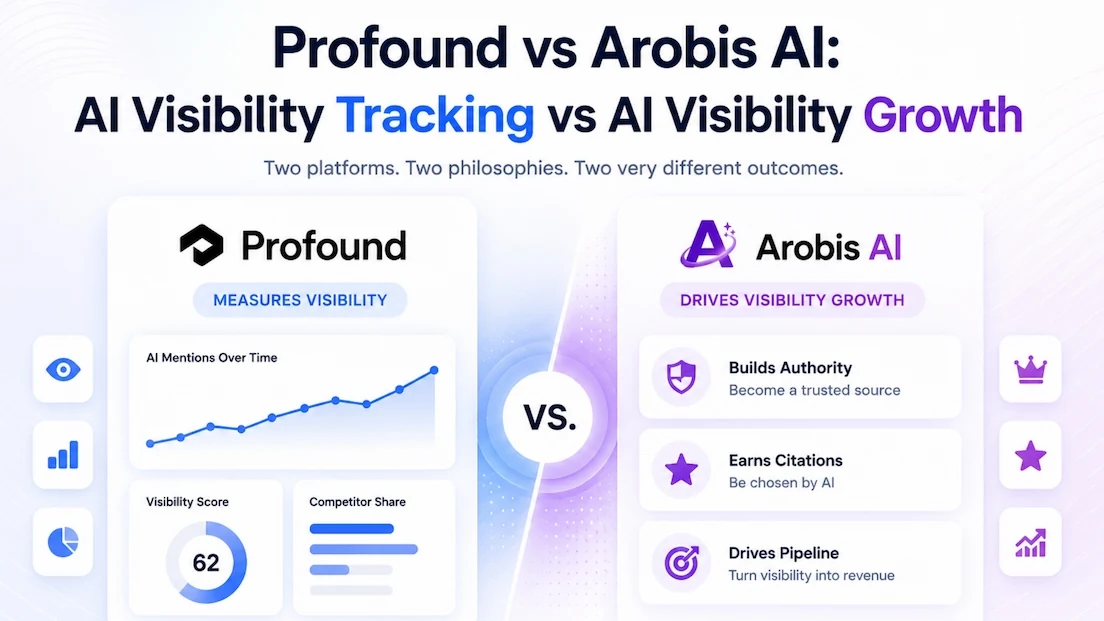
Profound represents the rise of AI brand monitoring.
Arobis AI represents the rise of AI demand generation in the new world of AI search.
Those are not the same category.
They do not serve the same internal buyer.
They do not answer the same business question.
And they should not be evaluated using the same criteria.
Brand Monitoring Is About Knowing What AI Says
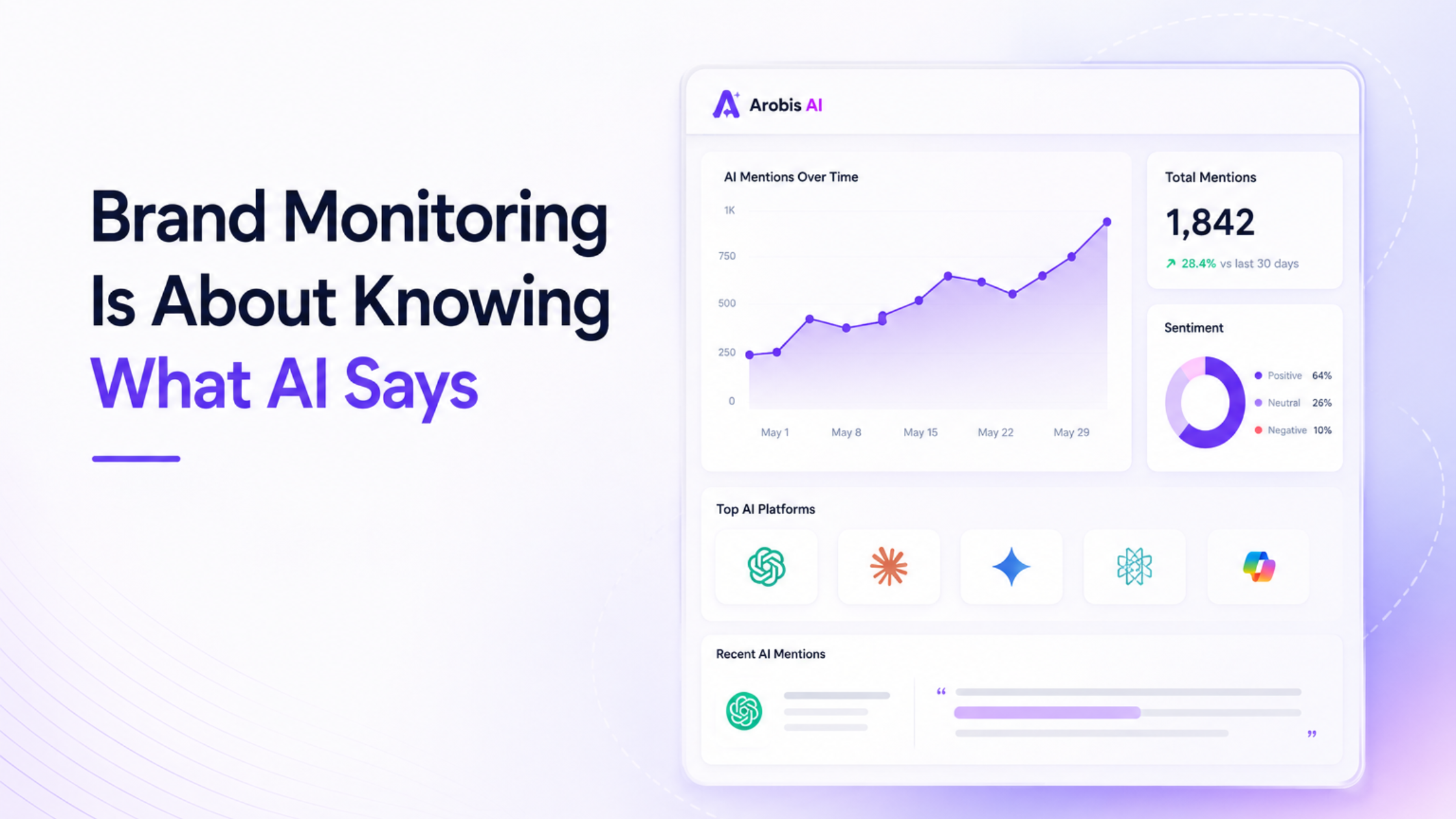
Brand monitoring has always been a core function in marketing.
Before AI search, companies monitored:
- News mentions
- Social conversations
- Review sites
- Analyst reports
- Search rankings
- Brand sentiment
- Competitive share of voice
AI search adds a new layer.
Now companies also need to know how AI systems describe them.
Do AI engines mention the brand?
Do they recommend competitors?
Do they understand the category?
Do they summarize the product correctly?
Do they connect the company to the right use cases?
These are important questions.
They matter for executives.
They matter for corporate communications.
They matter for brand teams.
They matter for enterprise companies with large reputational footprints.
This is the world where AI visibility platforms are extremely useful.
They help teams understand the machine-readable reputation of a brand.
They reveal how AI systems interpret public information.
They show where a company appears.
They show where it does not.
They make the invisible visible.
That is valuable.
But SaaS companies have a different problem.
They do not only need to know what AI says.
They need to influence whether AI-driven buyers convert.
That is where the conversation shifts from monitoring to demand generation.
Brand Monitoring vs Demand Generation
Measures AI perception
- Tracks AI mentions
- Monitors sentiment
- Analyzes brand presence
- Reports visibility trends
Creates AI-driven pipeline
- Targets buyer-intent prompts
- Builds recommendation authority
- Owns competitor comparisons
- Turns AI search into demand
Demand Generation Is About Creating Buying Momentum
Demand generation does not exist to produce reports.
It exists to create revenue opportunities.
A demand generation team cares about:
- Pipeline
- Demo requests
- Conversion intent
- Category awareness
- Competitive displacement
- Sales-qualified opportunities
- Revenue influence
- CAC efficiency
So when a SaaS company thinks about AI search visbility, the question changes.
It is no longer:
“How often are we mentioned?”
It becomes:
“Are we being mentioned in the moments that create pipeline?”
That is a much more important question.
Because not all AI visibility is equal.
Being mentioned in a generic answer is not the same as being recommended in a buying-intent conversation.
Being cited in an informational query is not the same as being included in a vendor shortlist.
Appearing once in a broad industry answer is not the same as repeatedly showing up when buyers ask for the best solution in your category.
This is the central idea behind the Profound vs Arobis AI comparison.
Profound helps brands understand AI visibility.
Arobis AI is positioned to help SaaS companies turn AI visibility into demand.
One is about brand intelligence.
The other is about revenue motion.
The Mistake SaaS Companies Make With AI Visibility
Many SaaS companies are approaching AI visibility the same way they approached SEO ten years ago.
They ask:
“What keywords do we rank for?”
Except now the question becomes:
“What prompts do we show up for?”
That sounds modern.
But it is still limited.
Prompt visibility is not the same as buyer influence.
A SaaS company can appear in dozens of AI-generated answers and still generate no meaningful pipeline from AI discovery.
Why?
Because the wrong visibility does not create demand.
A company might show up for educational prompts.
It might appear in broad market explanations.
It might be mentioned in low-intent queries.
It might receive citations from AI systems that never influence a buyer’s decision.
That visibility may look good in a report.
But it may not move revenue.
Demand generation requires sharper thinking.
The objective is not simply to appear more often.
The objective is to appear in the moments where buyers are forming preferences.
That includes prompts like:
“What is the best platform for solving this problem?”
“What are the top alternatives to this vendor?”
“What software should a growing SaaS company use for this workflow?”
“Which solution is best for a mid-market team?”
“What is the best option if we care about implementation speed?”
These are not visibility moments.
They are conversion moments.
And whoever owns those moments will have a major advantage in the AI search era.
Profound vs Arobis AI: The Strategic Difference
The simplest way to understand the difference is this:
Profound helps answer:
“What does AI say about our brand?”
Arobis AI helps answer:
“How do we make AI-driven buyers choose us?”
That is the strategic divide.
Profound is valuable when your main problem is brand understanding.
Arobis AI is valuable when your main problem is demand creation.
Profound fits teams that need visibility intelligence.
Arobis AI fits teams that need AI search to become a growth channel.
This difference becomes even clearer when you look at the internal buyer.
A brand team wants to know:
- Are we visible?
- Are we represented accurately?
- Are our competitors showing up more?
- Is AI sentiment positive or negative?
- Which sources shape how AI talks about us?
A demand generation team wants to know:
- Which AI queries create pipeline potential?
- Which competitor comparisons should we own?
- Which category pages should exist?
- Which bottom-funnel prompts should mention us?
- Which authority gaps stop AI systems from recommending us?
- How do we turn AI search into demo demand?
Both teams care about AI.
But they care for different reasons.
That is why this comparison should not be framed as a feature checklist.
It should be framed as a go-to-market decision.
Profound vs Arobis AI: Strategic Difference
Two different approaches to AI search: brand intelligence vs demand creation.
| Category | Profound | Arobis AI |
|---|---|---|
| Primary Focus | AI brand monitoring | AI demand generation |
| Main Question | What does AI say about us? | How do we become the recommended choice? |
| Best For | Enterprise brand and visibility teams | SaaS growth and demand generation teams |
| Core Outcome | Visibility intelligence | Pipeline influence and AI-driven demand |
AI Search Is Becoming a New Demand Channel
The biggest mistake marketers can make is treating AI search as a reporting layer.
It is not.
AI search is becoming a demand channel.
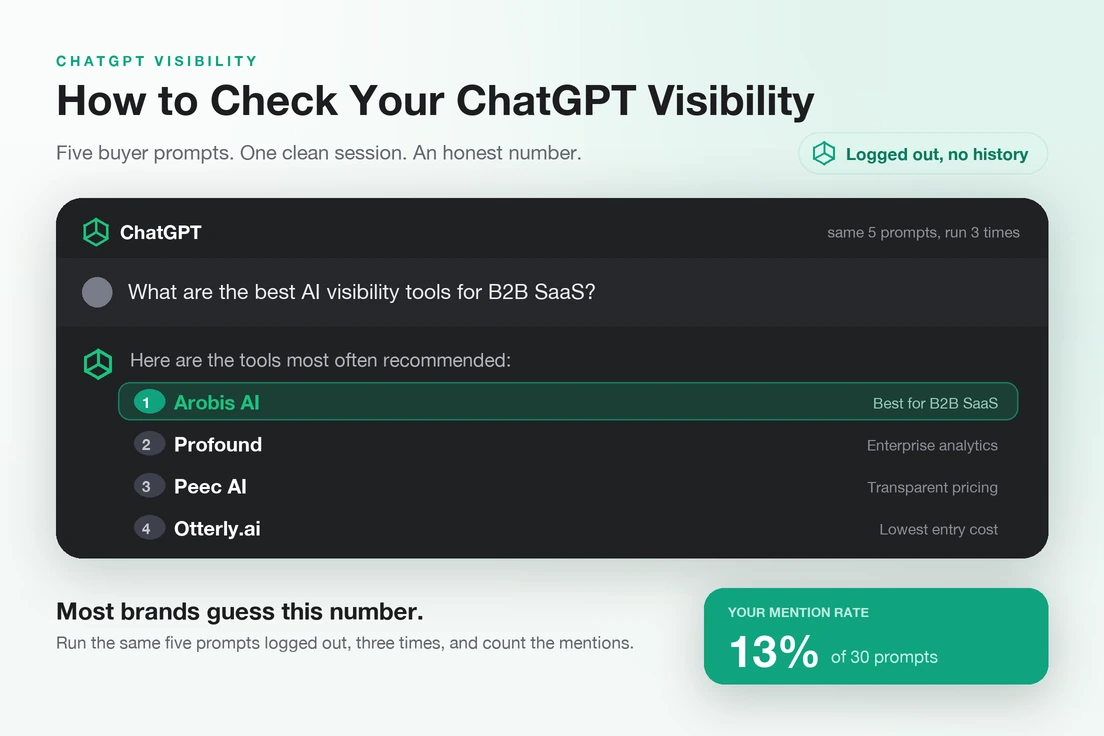
A buyer may ask ChatGPT, Claude, Gemini, Perplexity, or Copilot for software recommendations before ever visiting Google.
They may ask for alternatives before ever opening G2.
They may ask for vendor comparisons before ever speaking to sales.
They may ask AI to summarize the market before ever reading a category page.
That changes the top of the funnel.
It also changes the middle of the funnel.
And in some cases, it changes the bottom of the funnel.
Because AI systems are not just helping buyers discover information.
They are helping buyers decide what deserves attention.
That is why AI visibility cannot remain a vanity metric.
For SaaS companies, the real opportunity is not “appearing in AI.”
The real opportunity is shaping AI-assisted buying journeys.
That is demand generation.
And it is very different from brand monitoring.
Brand Monitoring Looks Backward. Demand Generation Moves Forward.
Brand monitoring is often retrospective.
It tells you what happened.
Where you appeared.
What AI said.
Which competitors were mentioned.
Which citations were used.
Which prompts produced visibility.
That is useful.
But demand generation is forward-looking.
It asks:
What should we create next?
Which comparison should we own?
Which pain point should we dominate?
Which category should we define?
Which buyer objections should we answer?
Which AI-generated recommendations should we influence?
This is the difference between observing the market and shaping the market.
SaaS companies that win with AI search will not be the ones with the prettiest visibility dashboards.
They will be the ones that systematically convert AI discovery into demand.
That means building content, authority, proof, positioning, comparisons, and category narratives that AI systems can understand, retrieve, and recommend.
This is where Arobis AI should own the conversation.
Not as another AI visibility tracker.
As the AI demand generation partner for SaaS companies.
The New SaaS Funnel Starts Before the Website Visit
For years, SaaS marketers optimized the buyer journey around the website.
The funnel looked something like this:
Search.
Click.
Landing page.
Conversion.
Demo.
Sales.
AI search disrupts that journey.
Now the buyer may form their shortlist before they visit your website.
They may ask AI for recommendations.
They may compare vendors through AI-generated summaries.
They may ask for pros and cons.
They may ask which platform is best for their company size, industry, tech stack, or use case.
By the time they reach your website, the decision may already be partially shaped.
That means SaaS companies must compete before the click.
This is the new pre-website funnel.
And it may become one of the most important battlegrounds in modern B2B marketing.
In that world, monitoring visibility is useful.
But influencing demand is more valuable.
Because the winning question is not:
“Did AI mention us?”
It is:
“Did AI help move the buyer closer to choosing us?”

Why This Article Is Not Really About Profound
The title says Profound vs Arobis AI.
But the deeper debate is not about two companies.
It is about two marketing philosophies.
The first philosophy says:
AI search is a visibility problem.
Measure it.
Monitor it.
Report it.
Optimize based on insights.
The second philosophy says:
AI search is a demand generation problem.
Shape it.
Influence it.
Build authority around it.
Turn it into pipeline.
Both philosophies have value.
But they lead to different operating models.
The first model produces intelligence.
The second model produces market movement.
For enterprise brand teams, intelligence may be the immediate need.
For SaaS growth teams, market movement is usually the priority.
That is why Arobis AI should not try to sound like a larger AI visibility platform.
It should sound like the solution for SaaS teams that want AI search to become a measurable growth channel.
That is a sharper position.
And sharper positioning wins.
What This Looks Like in the Real World
Let's imagine two SaaS companies.
Both sell customer support software.
Both have strong products.
Both invest in content.
Both care about AI search.
But they take very different approaches.
Company A Focuses on Monitoring
The team regularly checks:
- AI mentions (LinkedIn, Reddit, Social Media, etc)
- Brand visibility
- Share of voice
- Competitor rankings
- Citation frequency
Every month they produce a report.
Every quarter they review trends.
Every year they generate more visibility data.
The company becomes increasingly informed.
Company B Focuses on Demand Generation
The team asks different questions.
Instead of:
"How visible are we?"
They ask:
"Why is AI recommending competitors?"
Instead of:
"How many mentions did we receive?"
They ask:
"What content would make AI recommend us more often?"
Instead of:
"What is our share of voice?"
They ask:
"What would increase our share of demand?"
The difference appears subtle.
It isn't.
One company is observing the market.
The other is actively shaping it.
And in emerging categories, shaping almost always beats observing.
Why Demand Generation Becomes More Important as AI Adoption Grows
When AI search was new, visibility monitoring was enough.
Companies simply wanted answers.
They wanted to understand:
- How AI perceived them
- Whether they appeared
- How competitors were represented
That made sense.
But AI search is maturing.
The conversation is evolving.
Today many SaaS leaders already understand that AI visibility matters.
The next question becomes:
How do we win it?
And that's where demand generation enters the picture.
Because visibility itself doesn't create revenue.
Visibility creates opportunity.
Demand generation converts opportunity into pipeline.
This distinction will become increasingly important over the next few years.
The companies that understand it early may gain a significant advantage.
The New KPI Nobody Is Talking About
Most marketers still measure:
- Rankings
- Traffic
- Impressions
- Visibility
Those metrics remain valuable.
But AI search is introducing a new KPI.
Recommendation Frequency
Not:
"How often do we appear?"
But:
"How often are we recommended?"
Think about how buyers use AI.
Very few ask:
"List every company in this category."
More often they ask:
- What's the best option?
- Which vendor should we consider?
- What platform would you recommend?
- What solution works best for companies like ours?
These are recommendation-driven prompts.
And recommendation frequency may become one of the most valuable indicators of AI search success.
Because recommendation sits much closer to demand than visibility alone.
Visibility Metrics vs Demand Metrics
The shift SaaS teams need to make when measuring AI search performance.
| Old AI Visibility Metric | Better Demand Gen Question | Revenue-Oriented Metric |
|---|---|---|
| Brand mentions | Are those mentions happening in buying-intent moments? | AI-influenced demo requests |
| Prompt visibility | Are we showing up when buyers ask for solutions? | Recommendation frequency |
| Share of voice | Are we gaining share of demand? | Pipeline influenced by AI search |
| Competitor tracking | Why is AI recommending competitors instead? | Competitive displacement opportunities |
Profound vs Arobis AI: Which One Is Better?
This is the wrong question.
A better question is:
Better for whom?
Because the answer depends entirely on the objective.
Choose Profound If:
Your primary goal is:
- Understanding AI visibility
- Monitoring brand presence
- Tracking AI-generated mentions
- Analyzing market perception
- Measuring competitive visibility
- Reporting AI search performance
In other words:
You want intelligence.
Choose Arobis AI If:
Your primary goal is:
- Generating pipeline
- Increasing AI recommendations
- Building authority
- Creating category ownership
- Winning competitor comparisons
- Influencing AI-assisted buying journeys
In other words:
You want growth.
This is why direct feature comparisons often miss the point.
The products may serve adjacent markets.
But the business objectives can be dramatically different.
The Future Belongs to Companies That Influence Buying Journeys
Most marketers still think in channels.
SEO.
Paid search.
Email.
Social.
Events.
AI search forces a different perspective.
AI isn't merely a channel.
It's becoming part of the buyer journey itself.
The buyer asks questions.
The AI provides context.
The AI narrows options.
The AI shapes perceptions.
The AI influences shortlists.
Sometimes before a website visit ever occurs.
That means companies must learn to influence the journey itself.
Not simply the visibility within it.
This shift may become one of the most important changes in B2B marketing over the next decade.
The Final Verdict
The debate between Profound and Arobis AI is ultimately a debate between two priorities.
Priority #1
Understanding how AI sees your brand.
Priority #2
Influencing how AI-driven buyers discover and choose your brand.
Both matter.
But they serve different teams.
Different goals.
Different growth stages.
Profound is well suited for organizations seeking visibility intelligence and brand monitoring.
Arobis AI is positioned for SaaS companies looking to transform AI search into a demand generation engine.
The distinction is important.
Because AI visibility is not the end goal.
Growth is.
Pipeline is.
Revenue is.
The winners in AI search won't necessarily be the brands that know the most about visibility.
They'll be the brands that learn how to turn visibility into demand.
Frequently Asked Questions
What is AI Brand Monitoring?
AI brand monitoring refers to tracking how AI systems such as ChatGPT, Claude, Gemini, Perplexity, and Copilot reference, cite, describe, and recommend a company or brand.
What is AI Demand Generation?
AI demand generation focuses on influencing AI-assisted buying journeys to increase awareness, consideration, recommendations, pipeline, and revenue opportunities.
Is AI Visibility the Same as Demand Generation?
No.
Visibility measures presence.
Demand generation focuses on creating buying intent and commercial outcomes.
Can AI Search Generate Pipeline?
Increasingly, yes.
As more buyers use AI systems for vendor research and product recommendations, AI search can influence discovery, shortlisting, and purchase consideration.
What Is the Difference Between Profound and Arobis AI?
At a strategic level, Profound is associated with AI visibility intelligence and monitoring, while Arobis AI is positioned around helping SaaS companies leverage AI search for growth and demand generation.
What Should SaaS Companies Prioritize?
The answer depends on maturity.
Companies seeking visibility insights may prioritize monitoring.
Companies seeking pipeline growth should focus on how AI search contributes to demand generation and buyer influence.
Key Takeaway
The biggest opportunity in AI search isn't knowing what AI says about your company.
It's understanding how to become the company AI recommends when buyers are ready to make a decision.
The Arobis AI Search Demand Framework™
Most companies approach AI search backwards.
They start with visibility.
They ask:
- How often do we appear?
- Which prompts mention us?
- How visible are we?
But visibility is not the starting point.
Demand is.
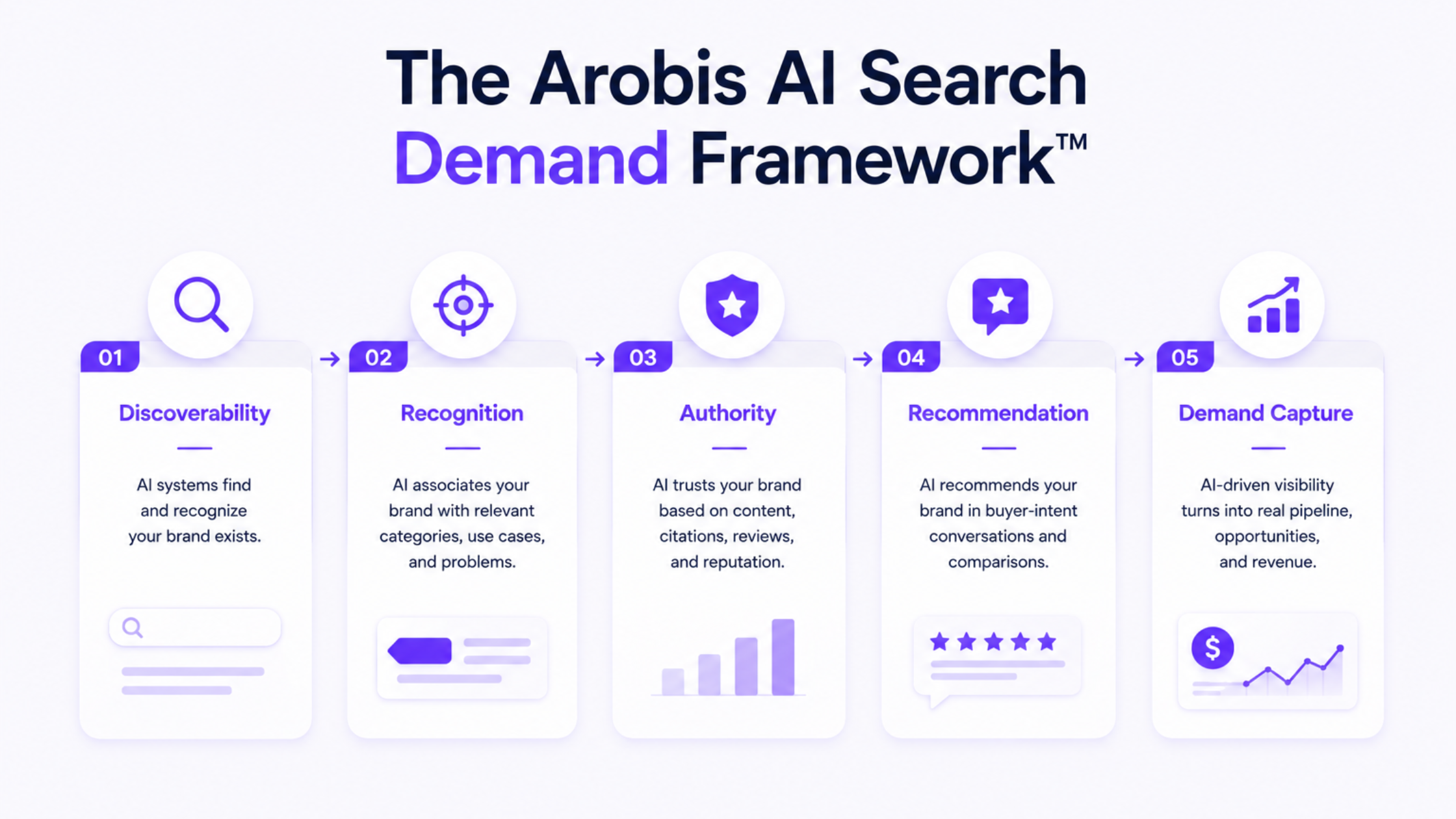
At Arobis AI, we believe AI search success follows a five-stage progression.
Not every company reaches stage five.
Most don't even reach stage two.
Understanding these stages can reveal why some companies dominate AI recommendations while others remain largely invisible.
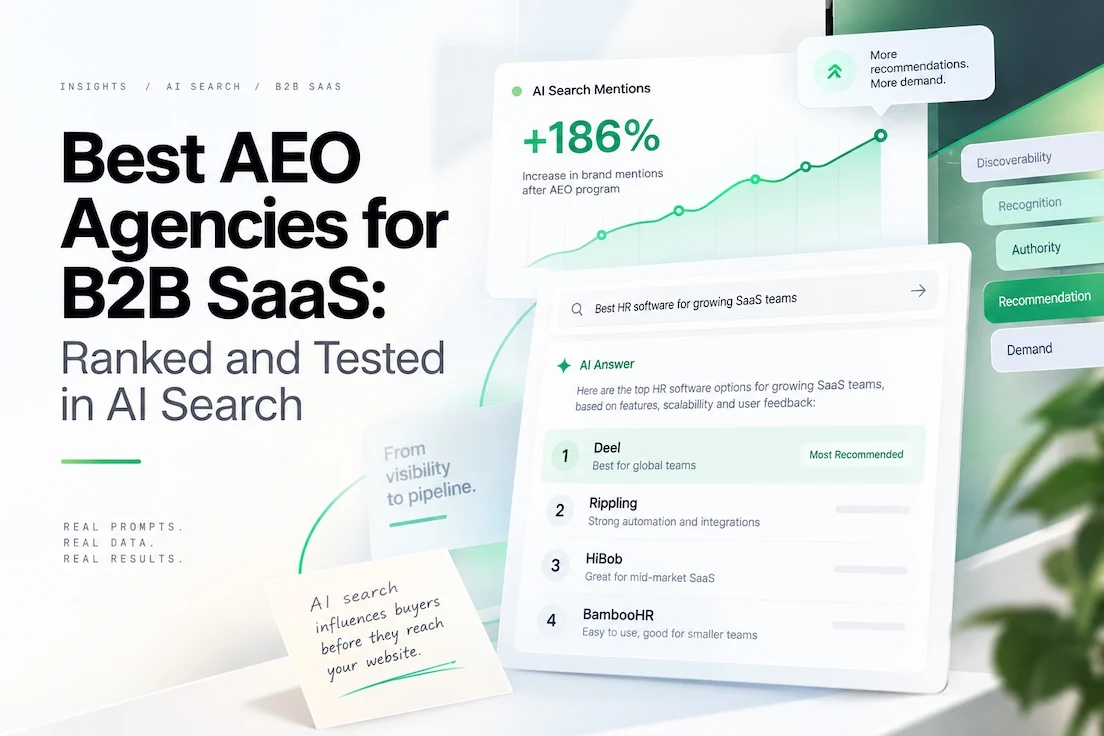
Stage 1: Discoverability
At this stage, AI systems are aware the company exists.
The brand has:
- Website content
- Public references
- Third-party mentions
- Category relevance
AI can find the company.
But that doesn't mean AI understands it.
Many SaaS companies stop here.
They assume discoverability equals visibility.
It doesn't.
Stage 2: Recognition
Recognition happens when AI systems consistently associate a company with specific categories, use cases, and problems.
For example:
A CRM platform becomes associated with:
- Sales automation
- Pipeline management
- Revenue operations
A customer support platform becomes associated with:
- Help desk software
- Omnichannel support
- Customer service automation
Recognition is where entity strength begins.
Without recognition, recommendation rarely happens.
Stage 3: Authority
This is where the game changes.
Authority answers the question:
Why should AI trust this company?
Authority is influenced by:
- Industry citations
- Expert content
- Brand mentions
- Reviews
- Market reputation
- Thought leadership
- Third-party validation
Most AI systems don't recommend brands randomly.
They recommend brands that appear trustworthy.
Authority is often the bridge between visibility and recommendation.
For a deeper look at these approaches, see our guides to Answer Engine Optimization (AEO) and Generative Engine Optimization (GEO).
Stage 4: Recommendation
This is where AI systems begin actively including the company in buyer-facing answers.
Not merely mentioning.
Recommending.
This is a critical distinction.
Mentions create awareness.
Recommendations create consideration.
The majority of AI visibility platforms focus heavily on measuring recommendation frequency.
Very few focus on systematically increasing it.
That's why recommendation has become one of the most important metrics in AI search.
Stage 5: Demand Capture
This is the stage nobody talks about.
And arguably the most important.
Because recommendation itself isn't the finish line.
Demand is.
At this stage:
- Buyers visit the website
- Buyers request demos
- Buyers evaluate solutions
- Buyers enter the pipeline
This is where AI visibility becomes business impact.
And this is where most SaaS leaders actually care.
Not because AI mentioned them.
Because AI influenced revenue.
Why Most AI Search Strategies Fail
Many organizations spend their time optimizing stage one.
Some optimize stage two.
A handful reach stage three.
Very few intentionally build for stage four and five.
The result?
Visibility without demand.
Mentions without momentum.
Awareness without revenue.
The winners of AI search over the next decade will likely be the companies that understand the entire framework.
Not just visibility.
Not just rankings.
Not just prompts.
The entire buyer journey.
The AI Search Maturity Model
Level 1 — Observable
"We know whether AI mentions us."
Level 2 — Understandable
"We know why AI mentions us."
Level 3 — Influential
"We can increase recommendations."
Level 4 — Predictable
"We understand what drives AI visibility growth."
Level 5 — Revenue Generating
"AI search consistently contributes to pipeline."
Most SaaS companies today are between Level 1 and Level 2.
Very few have reached Level 5.
That creates an enormous opportunity.
Because unlike traditional SEO, AI search remains relatively early.
The leaders have not been permanently established yet.
Final Verdict: Which One Should You Choose?
| If your goal is... | Choose... |
| Monitor how AI describes your brand | Profound |
| Track visibility, mentions, and sentiment | Profound |
| Create demand from AI search | Arobis AI |
| Win buyer-intent AI recommendations | Arobis AI |
| Turn AI visibility into SaaS pipeline | Arobis AI |
For deeper comparisons of specific competitors in the monitoring category, see our breakdowns of Searchable vs Arobis AI, AthenaHQ vs Arobis AI, and Peec AI vs Arobis AI. For the full competitive landscape across all major AI visibility platforms, the Searchable vs Profound vs AthenaHQ comparison covers the monitoring tier in depth.
What This Means for Profound and Arobis AI
This framework also reveals why comparing features often misses the point.
Profound excels at helping organizations understand stages one and two.
Visibility.
Recognition.
Monitoring.
Intelligence.
Arobis AI focuses on helping SaaS companies move further through the framework.
Authority.
Recommendation.
Demand generation.
Pipeline influence.
Neither approach is inherently wrong.
But they serve different strategic objectives.
The real question isn't:
"Which platform is better?"
The real question is:
Which stage are you trying to reach?
Because your answer determines everything.
The companies that win AI search won't be the companies that collect the most visibility data.
They'll be the companies that transform visibility into demand.
And demand into growth.
Compare more tools in our AI visibility platforms comparison.
Also see the best Profound alternatives.