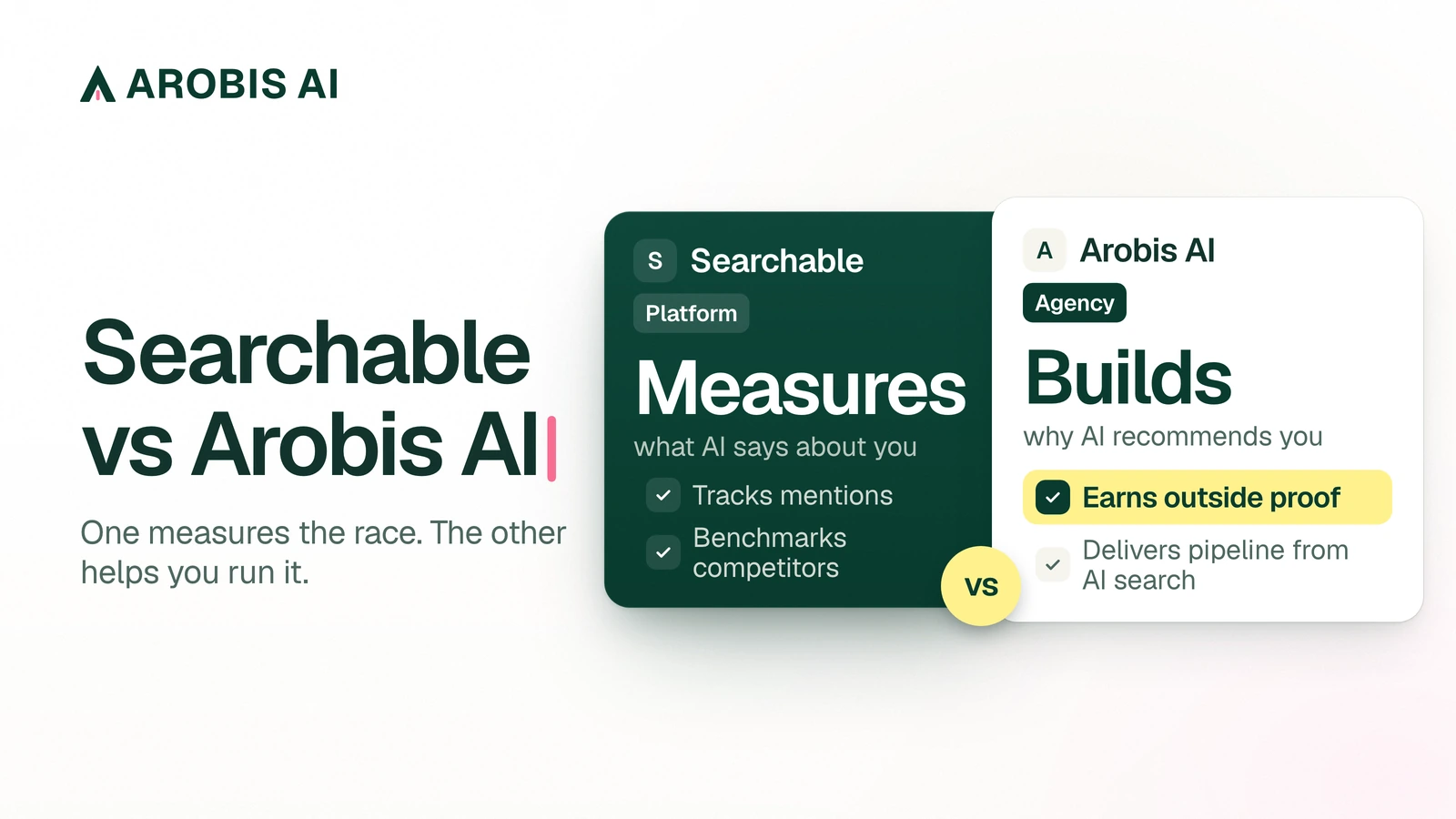
Two Companies. One Category. Very Different Answers to the Same Problem.
If you've been researching AI visibility solutions for your SaaS company, you've probably come across both Searchable and Arobis AI. They operate in the same space. They use similar language. And at first glance, they appear to be solving the same problem.
They're not.
Searchable is an AI search visibility platform. It helps marketing and SEO teams understand, track, and monitor how their brand appears across AI-generated answers. It answers the question: what does AI say about us right now?
Arobis AI sits on the other side of that line as an agency working in AI Search Demand Generation. It helps SaaS companies change what AI says: building the authority signals, content architecture, and citation footprint that make AI engines recommend your brand to buyers. It answers the question: how do we become the brand AI recommends?
One measures the race. The other helps you run it.
Below you'll find what each one does day to day, who buys it, what changes once you've paid for it, and how to pick one (or both) for where your SaaS company is today.
Before you compare Searchable and Arobis AI, work out the cause of your gap: the answer tells you whether a dashboard, a partner that does the work, or both makes sense.
What Searchable Actually Does
Searchable positions itself as an AI search optimization platform: a command center for brands that want to understand their presence across AI-generated search. Their core product is built around visibility monitoring, performance tracking, and competitive benchmarking. Out of the box, the Pro and Scale plans cover ChatGPT, Google AI Overviews and Perplexity; Claude, Microsoft Copilot and Grok are custom add-ons, according to Searchable's pricing page.
The primary use cases Searchable addresses:
- Tracking how often and where your brand appears in AI-generated answers
- Monitoring shifts in AI visibility over time
- Benchmarking your brand's AI presence against competitors
- Identifying the topics, prompts, and queries where your brand is mentioned or absent
- Reporting AI visibility performance to marketing leadership
Searchable is built for teams that need visibility data: marketing operations, brand managers, SEO leads, and analytics teams who need to understand what's happening in AI search before they can act on it.
The platform is software-led, subscription-based, and oriented around dashboards, reports, and data exports. It also includes an AI content tool that drafts articles, and technical site audits. It's a strong foundation for brands that want to build an internal picture of their AI search presence before deciding what to do about it.
What Searchable is not: a team that runs the strategy for you. Its software drafts content and flags technical fixes, but your team still decides what to publish, ships it, and earns the outside mentions and reviews that change those visibility numbers. It surfaces the gap and gives you tools. Closing the gap is still your team's work.
What Arobis AI Actually Does
Where Searchable measures AI visibility, Arobis AI, an AI Search Demand Generation agency for SaaS companies, builds it, then turns it into recommendations, demand, and pipeline.
A typical Arobis AI engagement has three stages:
Stage 1: AI Visibility Audit
We put the questions your buyers actually ask to ChatGPT, Claude, Gemini and Perplexity and record every answer. The output is a revenue gap analysis rather than a vanity report: where the brand shows up, which competitors take the prompts it misses, and what closing that gap involves.
Stage 2: Answer Optimization
We rework your pages, positioning, and entity data until a model can say in one line what the product does, which buyer it fits, and the situations where it should come up. This is where the Answer Engine Optimization (AEO) work happens: building content architecture that AI systems can extract, cite, and recommend with confidence.
Stage 3: Authority Engineering
Models shortlist brands that other sources vouch for, so this stage earns that outside proof: reviews, editorial mentions, third-party citations, directory listings, and structured data. That outside validation is what turns being visible in AI answers into being recommended in them.
Arobis AI isn't selling rankings, traffic, or impressions. It sells pipeline from AI search: buyers who already trust the brand before they ever visit the website.
Those three stages line up with the 5 signals AI engines weigh before they recommend a brand. A Searchable dashboard can show where you stand on each one. It can't go out and earn the third-party proof that moves them.
The Core Difference: Observation vs Execution
The most important distinction between Searchable and Arobis AI isn't features, pricing, or methodology. It's what each one produces.
Searchable produces intelligence. It tells you where you stand, how you're trending, and where competitors are outperforming you. That's useful, especially for teams that need to build an internal case for AI search spend, report on brand presence, or see who they're up against before committing to a strategy.
Arobis AI produces outcomes. It changes the underlying signals that determine AI recommendation: content architecture, authority footprint, entity strength, citation patterns. You see it as more frequent recommendations on buyer-intent queries, and later as pipeline from buyers who used AI to shortlist.
Measuring a problem and solving it are different activities. Both matter. But they serve different needs at different stages of an AI search strategy. If you insist on knowing your AI visibility you can always track your brand in Microsoft Copilot.
| Dimension | Searchable | Arobis AI |
|---|---|---|
| Primary Output | Visibility data and dashboards | Improved AI recommendations and pipeline |
| Core Question Answered | “What does AI say about us?” | “How do we become what AI recommends?” |
| Delivery Model | Software platform | Done-With-You Strategy + execution retainer |
| Primary User | Brand, SEO, and analytics teams | CMOs, VP Marketing, and demand generation leaders |
| What Changes After Using It | Your understanding of AI visibility | Your actual AI recommendation frequency |
| Time to First Value | Days, data available immediately | 60 to 90 days Authority signals compound over time |
| SaaS Focus | Multiple verticals | B2B SaaS first |
Who Should Choose Searchable
Searchable is the right choice when the primary need is intelligence and reporting, not yet execution.
Specifically, Searchable fits well when:
- Your team needs to understand AI visibility before committing to a strategy or budget
- You have an internal SEO or content team that will execute based on the data Searchable surfaces
- Your marketing leadership needs a dashboard to report AI search performance over time
- You're in a large organization where brand monitoring, comms, and analytics teams need visibility data independently of the strategy team
- You want to track competitor AI visibility movements as a market intelligence function
Searchable does the intelligence layer well. If you already have the execution capacity in-house and just need better data to direct that capacity, Searchable is a strong fit.
What Searchable won't do is run the program for you. It surfaces gaps and suggests fixes. Closing them requires a strategy and execution investment, either internally or through an agency like Arobis AI. If you go the agency route, Arobis AI Answers covers pricing, contract terms and results timelines.
Who Should Choose Arobis AI
Arobis AI is the right choice when you need AI answers to start recommending you, and understanding why they don't is no longer enough.
Specifically, Arobis AI fits well when:
- You already know you have an AI visibility gap, and tracking it hasn't closed it
- Your competitors are consistently appearing in AI-generated answers for buyer-intent queries and you're not
- You rely on inbound demand, product comparisons, and category searches to drive pipeline, and those discovery channels are increasingly AI-mediated
- You want AI search to show up in pipeline reports, and a line in a brand monitoring dashboard isn't enough
- You're at $1M to $20M ARR and inbound is your primary growth motion
- You've invested in SEO but AI recommendations aren't following from that investment
Most teams start with the free Basic AI Visibility Audit, a short first read on how the core AI engines describe your brand. The paid full audit goes deeper into which competitors win your buyer prompts and the fixes that would change that.
Not sure where you stand right now? Run a free AI Visibility Check to get an instant baseline before committing to anything.
The Visibility Trap: Why Measurement Alone Isn't Enough
There's a pattern we see consistently in SaaS companies that have invested in AI visibility monitoring: they have excellent data about a problem they aren't solving.
They know their recommendation frequency is low. They know which competitors are winning which prompts. They can show leadership a dashboard with declining brand presence month over month. What they can't do is point to the work that's changing those numbers.
That's no knock on monitoring tools. The data is worth having. It's where you begin, though, and teams that stop there keep watching the same gap.
The companies winning AI search right now are not the ones with the best dashboards. They're the ones doing the work: restructuring content for AI extraction, building external authority signals, earning the citations that make AI engines trust them enough to recommend them.
As we covered in our analysis of why traditional SEO is dying, new measurement frameworks are the smaller part of the shift. The bigger part is a new execution model, one built around authority signals and recommendation frequency rather than rankings and traffic.
Visibility is a consequence of that work. Not a substitute for it.
Can You Use Both?
Yes, and for some SaaS companies, especially those with larger internal teams, using both makes sense.
The logical combination: Searchable for visibility intelligence and competitive monitoring, Arobis AI for strategy and execution. Searchable tells you what's happening. Arobis AI changes what happens next.
If budget requires choosing one, the decision comes down to where the bottleneck actually is. If you don't know where you stand, start with monitoring. If you know the problem and need to solve it, start with execution.
For a $1M to $20M ARR SaaS company, our advice is to start with execution: AI search authority compounds, so each month spent only watching the Searchable chart is a month a competitor uses to widen its lead.
Timing matters here as much as strategy, which is the heart of how AI search is changing SaaS marketing. The window to build first-mover authority is open. Monitoring that window while competitors run through it is an expensive form of preparation.
How Arobis AI Compares to Other Options in the Market
Searchable isn't the only alternative worth understanding. The AI search space has several distinct categories, and knowing how they differ helps clarify where each belongs in your stack.
| Solution | Category | Primary Output | Best For |
|---|---|---|---|
| Searchable | AI Visibility Platform | Monitoring dashboards and competitive visibility data | Intelligence and reporting teams |
| Profound | AI Visibility + AI Marketer | AI visibility tracking, plus drafts and page rewrites your team approves | Enterprise marketing teams |
| Peec AI | AI Visibility Tracking | Visibility scores and share-of-voice reporting | SEO teams tracking AI presence |
| AthenaHQ | GEO / AEO Platform | AI search optimization recommendations | Teams seeking guided optimization |
| Arobis AI | AI Search Demand Generation | Improved AI recommendations and pipeline generation | B2B SaaS companies treating AI search as a demand channel |
Two of the rows above have their own head-to-head pages: Profound vs Arobis AI and Peec AI vs Arobis AI. Leaning toward Searchable but not sure it's the right dashboard? The Searchable vs Profound vs AthenaHQ comparison weighs it against the two platforms it most often competes with.
The pattern across these platforms is consistent: they show your team what's happening, and the most advanced ones draft fixes for your team to approve. Arobis AI works out what to do about it, and then does it.
The Arobis AI Search Demand Framework™
We use the Arobis AI Search Demand Framework™ to place any brand on a path from "AI has heard of us" to "AI sends us buyers". It has five stages, and Searchable and Arobis AI work at different points on it.
AI Recommendation Maturity Model
The five stages SaaS brands move through before AI becomes a demand generation channel.
Authority
Recommendation
Monitoring tools like Searchable primarily operate at Stages 1 and 2: they measure whether AI knows your brand exists and broadly associates it with the right category. That baseline is worth having.
Arobis AI operates at Stages 3 through 5. The work (Authority Engineering, Answer Optimization, citation footprint building) exists to move a brand from being recognized by AI to being trusted, then recommended, and finally to generating demand from buyers who research with AI.
Most SaaS companies are stuck at Stage 2 without knowing it. They appear in some AI answers. They're not being recommended. The gap between those two states is where the pipeline opportunity lives.
Understanding Generative Engine Optimization (GEO) is the foundation for understanding how brands move through those stages, and why it requires a different approach than traditional SEO or content marketing.
Frequently Asked Questions
Is Searchable a competitor to Arobis AI?
They operate in adjacent categories rather than direct competition. Searchable is an AI visibility monitoring platform: it measures and tracks brand presence across AI search engines. Arobis AI does the work instead. It's an agency for AI Search Demand Generation, so it carries out the strategy and builds the signals that lift how often AI engines recommend a brand. One measures the problem. The other solves it.
Can Arobis AI replace the need for a visibility monitoring tool?
Partially. The Arobis AI Visibility Audit provides a comprehensive baseline of your brand's AI search presence, including competitive benchmarking across ChatGPT, Claude, Gemini and Perplexity. For ongoing monthly monitoring with dashboards and alerts, a dedicated platform like Searchable offers more granular tracking. For SaaS companies prioritizing execution over reporting, the Arobis AI audit cadence usually gives enough visibility data.
Which is better for a SaaS company at $5M ARR?
At $5M ARR with inbound as a primary growth motion, the bottleneck is almost always execution rather than intelligence. Most SaaS companies at this stage don't need better data about their AI visibility gap. They need to close it. Arobis AI is built for this stage: $1M to $20M ARR SaaS companies where AI search has high pipeline potential and the window to build first-mover authority is still open.
How does Searchable's approach differ from the Arobis AI Visibility Audit?
Searchable provides ongoing monitoring: tracking AI visibility over time with automated data collection, dashboards, and alerts. The full Arobis AI Visibility Audit works differently. It's a single report built from your real buyer prompts across ChatGPT, Gemini, Claude and Perplexity (four engines), covering share of voice against named competitors, every cited source, and a fix list in priority order. You get a plan you act on, rather than a dashboard you keep checking. Request the free Basic audit or the full AI Visibility Audit here.
What results can I expect from Arobis AI vs just using a monitoring tool?
A monitoring tool gives you data. Arobis AI gives you data plus the execution that changes it. Arobis AI works to a 60 to 90 day timeline for recommendation changes on core buyer prompts: new prompts where the brand appears, competitors pushed down in comparison queries, and better positioning in buyer-intent answers. Those gains keep building as authority signals strengthen. To judge what a good number looks like in your category, compare against the State of AI Search Visibility research.
Does Arobis AI work alongside existing SEO investments?
Yes. AI Search Demand Generation is designed to complement, not replace, traditional SEO. Some of what earns an AI recommendation is classic SEO and some isn't; how AI engines choose which brands to mention sorts out which is which. Arobis AI works alongside existing SEO agencies and in-house teams, focusing specifically on the AI recommendation layer that traditional SEO doesn't address. If you're comparing execution partners too, our guide to the best GEO agencies lists the other options.
Thanks. Your templates are ready:
Download the full pack (PDF)That didn't go through. Please try again in a moment. Every check and example is also on this page, free to copy.