
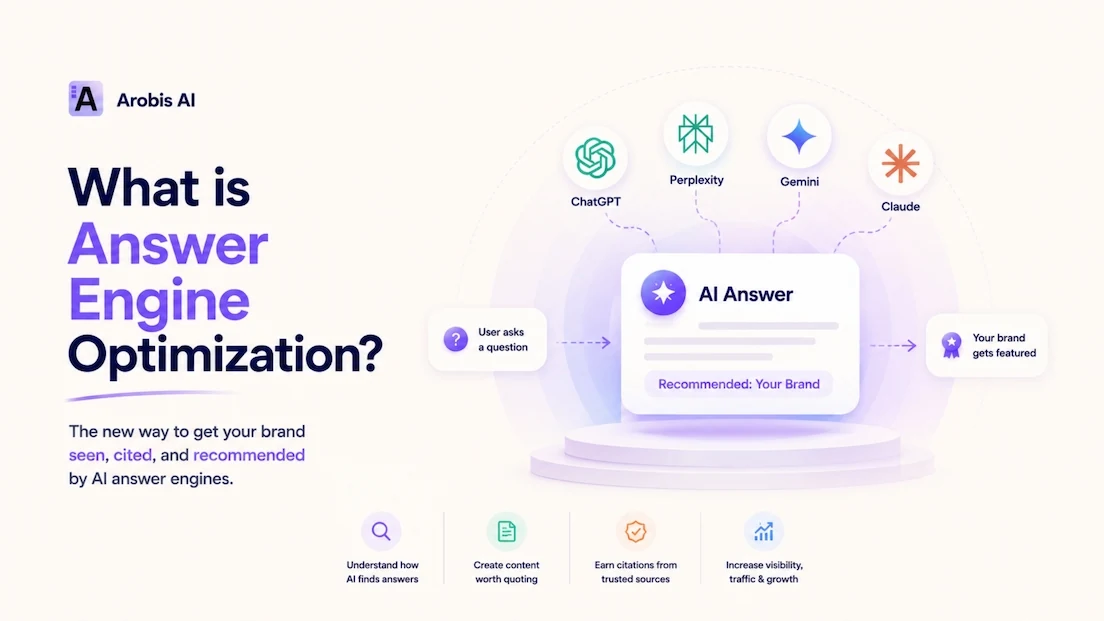
Answer Engine Optimization (AEO) is the practice of structuring, writing, and corroborating your content so that AI answer engines — ChatGPT, Google AI Overviews, Gemini, Perplexity, Claude, and Copilot — can extract it and cite your brand directly inside their generated answers. Where classic SEO fights for a blue link on a results page, AEO fights to become the answer itself. This guide explains exactly what AEO is, how answer engines choose their sources, and the step-by-step framework B2B teams use to win AI visibility — with a full checklist, an engine-by-engine breakdown, the metrics that matter, and the mistakes that keep brands invisible.
Last verified: October 1, 2026. Definitions and platform coverage below are checked against how ChatGPT, Gemini, Perplexity, Claude, Copilot, and Google AI Overviews currently describe AEO.
What Is Answer Engine Optimization (AEO)?
Answer Engine Optimization (AEO) is the discipline of optimizing content so that answer engines and AI assistants can understand it, trust it, extract it, and surface it as a direct answer — often without the user ever clicking a website. (Also written "answer engine optimisation" in British English — same practice, different spelling.)
An "answer engine" doesn't return ten blue links. It returns one synthesized response, sometimes with a short list of cited sources underneath. AEO is how you make sure your brand is inside that response and among those citations.
Put simply: SEO gets you ranked. AEO gets you quoted. In an AI-first search world, being quoted is where the attention — and the buying decision — now happens. If you are new to this shift, our AI visibility guide is a good companion primer to this article.
AEO overlaps with, but is not identical to, Generative Engine Optimization (GEO). We break down the exact differences later in this guide, along with how both relate to traditional SEO. For now, hold onto one idea: the goal of AEO is not traffic for its own sake — it is presence in the answer, because that is what shapes what buyers believe and who they shortlist.
A Short History: How Search Moved From Links to Answers
For two decades, search was a ranked list of links. You typed a keyword, Google returned ten blue links, and the game was to climb that list with keywords and backlinks. That world rewarded pages; it did not reward answers.
Three shifts broke that model. First, featured snippets and knowledge panels began answering questions directly on the results page, creating the first wave of "zero-click" searches. Second, voice assistants — Siri, Alexa, Google Assistant — could only read one answer aloud, so being second was the same as being invisible. Third, and most decisively, large language models turned search into a conversation: ChatGPT, Perplexity, Gemini, Claude, and Copilot now synthesize an answer from many sources at once and hand the user a finished conclusion.
Each shift moved value away from the ranked link and toward the extracted answer. AEO is simply the discipline that grew up to win in that new environment. It doesn't replace everything that came before — it builds on the same crawlable, structured, authoritative web SEO always rewarded — but it changes the objective from "rank the page" to "be the answer."
Check out our latest guide to find out the best way to track how you show up in Microsoft Copilot!
What Is an Answer Engine?
An answer engine is any system that responds to a query with a direct, synthesized answer instead of a page of ranked links. The category has exploded since 2023 and now includes:
- ChatGPT (including ChatGPT Search) — the largest answer engine, with 1.2 billion weekly users, according to OpenAI's DevDay recap on September 29, 2026.
- Google AI Overviews and Google AI Mode — AI answers injected directly above and inside traditional Google results.
- Perplexity — a citation-first answer engine built around sourced responses.
- Google Gemini — Google's conversational assistant across search, Android, and Workspace.
- Claude — Anthropic's assistant, increasingly used for research and vendor evaluation.
- Microsoft Copilot — the Bing-powered assistant embedded across Windows and Microsoft 365.
- Voice assistants — Siri, Alexa, and Google Assistant, which read a single answer aloud.
These systems share a common engine room: natural language processing, semantic understanding, retrieval, and large language models that assemble an answer from many sources at once. If you want the mechanics, we cover them in depth in how AI search engines work and how ChatGPT, Claude, and Gemini differ in search behavior.
Crucially, most of these engines do not invent brand recommendations from nothing. They retrieve, weigh, and summarize what the web already says. That is good news: it means AEO is a set of things you can actually influence, not a black box.
Why AEO Matters More Than Ever in 2026
Search behavior has moved from typing keywords to asking questions. Instead of searching "best project management software," a buyer now asks, "What's the best project management tool for a 50-person remote SaaS team?" — and expects a shortlist, not a list of links.
The numbers behind this shift are hard to ignore:
- In a 2026 G2 survey of 1,076 B2B software buyers, 51% said they now start their software research with an AI chatbot more often than with Google, up from 29% in G2's 2025 report.
- ChatGPT was reported to handle tens of millions of shopping-related queries per day by early 2026.
- Studies of ChatGPT's retrieval mode have found that a large majority of its citations overlap with Bing's top-ranked results — meaning traditional indexing still feeds the answer layer.
We keep a running, sourced list of these data points in our AI search statistics roundup and our deeper 100 AI search statistics research report. For the strategic picture of how this reshapes go-to-market, see how AI search changes SaaS marketing forever.
The takeaway is simple. When an AI assistant names three vendors in response to a buying question, those three vendors win the consideration set. Everyone else is invisible at the exact moment of decision. That is why AEO is no longer optional — and why we track the category-wide shift in the State of AI Search Visibility report.
There is a compounding effect, too. Every time an engine cites you, that citation becomes part of the corroborating evidence the next model reads. Early movers don't just win today's answers; they seed the data that trains and grounds tomorrow's. AEO is one of the rare channels where a lead compounds instead of decaying.
How Answer Engines Actually Choose What to Cite
To optimize for answer engines, you have to understand how they select sources. They do not "rank" pages the way Google's ten blue links do. Instead, they retrieve candidate passages, weigh them, and synthesize an answer. Five factors dominate that selection.
1. Retrievability
If a bot can't crawl and parse your page, you cannot be cited. Answer engines rely on both live retrieval (fetching pages in real time) and training or index data. Clean HTML, fast load times, and open crawler access are prerequisites — not nice-to-haves. We cover exactly what the systems ingest in what AI crawlers actually read.
2. Extractability
The passage has to be easy to lift out and quote. Direct answers, tight definitions, numbered steps, and clean lists are far more extractable than long, meandering prose. A model building an answer will almost always prefer a self-contained sentence that resolves the question over a paragraph it has to interpret. This is why AEO rewards structure so heavily.
3. Corroboration
Models are cautious about claims that only a brand makes about itself. When an engine builds an answer, it looks for the same positioning echoed across independent sources — reviews, directories, editorial mentions, and community discussion. We explain this trust mechanic in the 5 signals AI engines use to recommend brands and in the detailed breakdown of how Perplexity, ChatGPT, Claude, and Gemini choose which brands to mention.
4. Entity Clarity
Answer engines think in entities — people, products, companies, and the relationships between them — not just keywords. If the web is confused about who you are, what you do, and who you serve, the model will be too. Consistent naming, clear category framing, and structured data all sharpen your entity so the model can place you confidently in the right answer.
5. Authority and Freshness
Depth of expertise, recency, and a track record of being referenced all raise your odds of citation. Answer engines favor sources that repeatedly prove useful and up to date. For the SaaS-specific version of this, read how AI analyzes, recommends, and ranks SaaS products.
AEO and E-E-A-T: Trust Is the Real Currency
Underneath every one of those five factors sits a single idea: trust. Answer engines are optimizing to avoid being wrong, because a confident wrong answer is far more damaging to them than a cautious one. That makes demonstrable trust — Google's E-E-A-T shorthand for Experience, Expertise, Authoritativeness, and Trustworthiness — the real currency of AEO.
In practice, this means an engine is more likely to cite you when your content shows first-hand experience (original data, screenshots, specifics), clear expertise (named authors, depth, correctness), authority (independent sources referencing you), and trustworthiness (consistent claims, transparent sourcing, no contradictions). A page that reads like it was written by someone who has actually done the thing will out-cite a generic summary every time.
This is also why thin, purely AI-generated content backfires. When a model senses low information gain — nothing new, no evidence, no point of view — it has little reason to quote you over a source that adds something. AEO rewards the opposite of commodity content: specificity, evidence, and a defensible position.
AEO vs SEO vs GEO vs AI SEO
These terms are used interchangeably in a lot of blog posts, but they describe different jobs. Here is the clean distinction.
Traditional SEO optimizes for ranked links on a search results page. The success metric is position and clicks. It is centered on keywords, backlinks, and SERP visibility.
AEO (Answer Engine Optimization) optimizes for being extracted into a direct answer — in AI assistants, featured snippets, and voice results. The success metric is answer inclusion and citation, not clicks.
GEO (Generative Engine Optimization) optimizes specifically for being mentioned and cited inside generative LLM responses. In practice GEO and AEO overlap heavily; GEO tends to emphasize the generative-model layer, while AEO includes snippets and voice. Our full GEO explainer goes deeper into that distinction.
AI SEO is the umbrella term many teams use for all of the above — the combined practice of staying visible across both classic search and AI answers.
Here is the side-by-side, without the jargon:
- Goal — SEO: rank a page. AEO/GEO: become the answer.
- Unit of visibility — SEO: a URL. AEO/GEO: a cited passage or brand mention.
- Primary lever — SEO: keywords and backlinks. AEO/GEO: structure, entities, and third-party corroboration.
- Success metric — SEO: rankings and clicks. AEO/GEO: share of AI answers and citation frequency.
- Query style — SEO: short keywords. AEO/GEO: full conversational questions.
- Time horizon — SEO: rankings can swing weekly. AEO/GEO: citations build slowly, then compound.
Modern visibility requires both. SEO still feeds the index that answer engines retrieve from — but SEO alone no longer guarantees you appear in the answer. For the provocative version of this argument, see why traditional SEO is dying, and for the agency-selection angle, SaaS SEO agency vs AI search demand generation.
In practice, the simplest way to get both without splitting the work across vendors is SaaS SEO that covers answer engines as part of the same program, not as an add-on.
The 9 Core Principles of AEO
1. Answer the question first
Lead every key page with a direct, self-contained answer of 40 to 60 words that could be pasted verbatim into an AI response. Put the definition or conclusion at the top; save the nuance for below. Long wind-ups kill extractability. The opening paragraph of this very article is written that way on purpose — it is built to be lifted.
2. Write for conversational intent
Mirror how people actually ask AI questions: "What is AEO?", "How is AEO different from SEO?", "How do B2B companies rank in ChatGPT?" Use those natural-language questions as headings and answer them cleanly underneath. Keyword stuffing is not just useless here; it actively lowers extraction confidence.
3. Structure content for machines and humans
Answer engines favor a clear hierarchy: descriptive H2s and H3s, short paragraphs, bulleted and numbered lists, and dedicated FAQ sections. Structure is not decoration — it is what makes a passage liftable. A well-structured 1,500-word page will out-cite a rambling 4,000-word one every time.
4. Build topical authority in clusters
Isolated articles rarely earn trust. Comprehensive topic ecosystems do. A pillar page (like this one) supported by focused articles signals genuine expertise. That is why this guide links to companion pieces such as how to rank in ChatGPT, how to rank in Google Gemini, how to rank in Perplexity, how to rank in Claude, how to rank in Microsoft Copilot, and how to rank in Google AI Overviews.
5. Earn third-party corroboration
Because answer engines cross-check claims against independent sources, off-site presence is an AEO lever, not just a PR nicety. Reviews on G2, Capterra, and TrustRadius, editorial coverage, and authentic community discussion all reinforce your story. Community platforms matter more than most teams expect — see our Reddit guide for SaaS and our analysis of the most influential domains in AI search rankings.
6. Strengthen your entity
Describe your product, category, and ideal customer consistently everywhere the model can see you. Contradictory positioning across your site, your reviews, and your directories weakens the entity and lowers citation odds. Building this coherent, referenceable identity is the heart of AI recommendation authority.
7. Add structured data (schema)
Schema markup tells engines exactly what your content means. Prioritize FAQPage, Article, Organization, Product, and Breadcrumb schema. Structured data improves eligibility for rich results and makes machine extraction more reliable — it is one of the clearest, most literal signals you can send about who you are and what a page contains.
8. Optimize your money pages for extraction
Your product and pricing pages are often what an answer engine quotes when a buyer asks for a recommendation. Make them explicit about who the product is for, what it does, and how it is priced. We explain why in why AI search engines prefer your product and landing pages.
9. Keep content fresh
Answer engines discount stale pages. Update statistics, examples, and product details on a schedule, and treat AEO as an iterative system: double down on sections that get cited, rewrite the ones that get skipped. This article itself is a live example — it was rebuilt from a thin explainer into the resource you are reading now.
How to Do AEO: A Step-by-Step Framework
Principles are useless without execution. Here is the operational sequence we use with clients.
Step 1 — Map the questions your buyers ask AI
Start from real prompts, not keywords. List the questions a buyer would type into ChatGPT during each stage of the journey, from category education ("what is X?") to problem framing ("how do I solve Y?") to vendor shortlisting ("best tools for Z for a mid-market SaaS company"). These prompts, not head keywords, become your content targets.
Step 2 — Audit where you currently appear
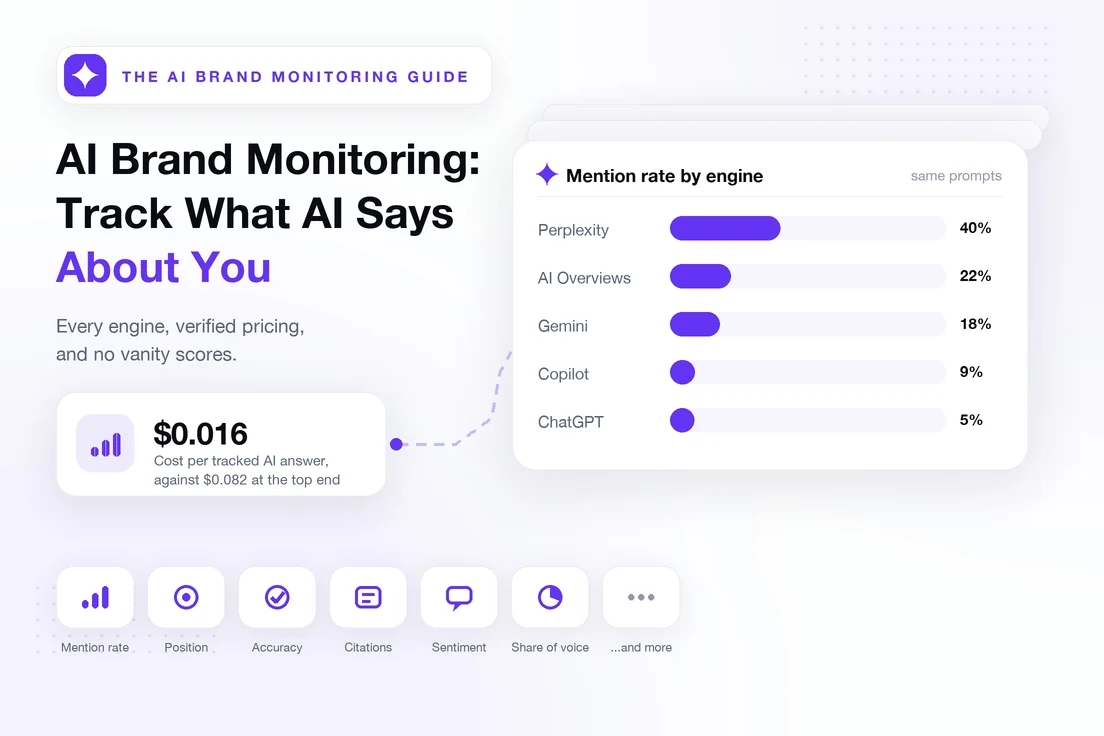
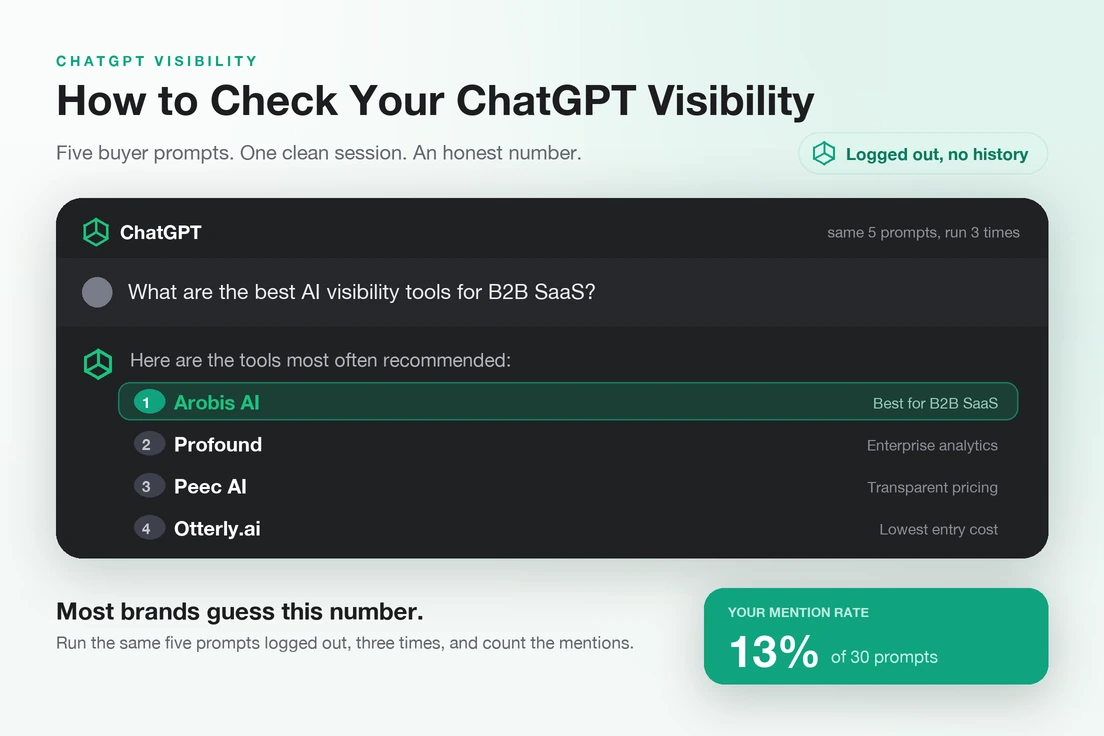
You cannot improve what you do not measure. Run those prompts across the major engines and record whether you are mentioned, cited, or absent — and who shows up instead. HubSpot now sells this step as a product: HubSpot AEO tracks 25 prompts a day across ChatGPT, Gemini and Perplexity for $50 a month, and our review explains why that still misses Google's AI answers. You can start free with the Arobis AI Visibility Checker, or go deeper with a full AI visibility audit. If you need the definition of that process, see what an AI visibility audit is.
Step 3 — Fix retrievability and structure
Ensure crawlers can access your pages, then restructure priority pages with answer-first intros, clear headings, lists, and FAQ blocks. This is the fastest, highest-leverage work — it often moves the needle within a re-crawl cycle.
Step 4 — Add schema and clean up your entity
Deploy FAQ, Article, Organization, and Product schema. Standardize how you describe yourself across your site, review profiles, and directories so every source tells the same story.
Step 5 — Build corroboration off-site
Earn reviews, mentions, and editorial coverage so the model sees your positioning echoed by independent sources. This is where AEO stops being on-page tweaking and becomes demand generation.
Step 6 — Measure, iterate, and expand the cluster
Re-run your prompt audit on a cadence, track share of voice, and expand your topic cluster to cover adjacent questions. AEO compounds; the earlier you start, the wider your lead.
Building an AEO Content Calendar
AEO is not a one-time project; it is a publishing habit. The teams that win treat it like a repeatable calendar rather than a launch. A simple, durable cadence looks like this:
- Monthly — prompt audit. Re-run your core buying prompts across the major engines, log your share of voice, and note new competitors appearing in the answers.
- Monthly — one pillar or comparison. Publish or upgrade one substantial, cluster-anchoring page (a definition, a comparison, or a roundup) built to be cited.
- Biweekly — supporting answers. Ship shorter question-and-answer pages that target specific prompts and link back to the relevant pillar.
- Quarterly — freshness sweep. Update stats, examples, and product details on your highest-value pages so they never read as stale.
- Quarterly — corroboration push. Pursue reviews, mentions, and editorial coverage so independent sources keep echoing your positioning.
The point is compounding. Each cited page strengthens the cluster, each cluster strengthens the entity, and each piece of corroboration makes the next citation more likely. Consistency beats intensity here — a steady monthly rhythm outperforms a single big burst that is never maintained.
The AEO On-Page Checklist
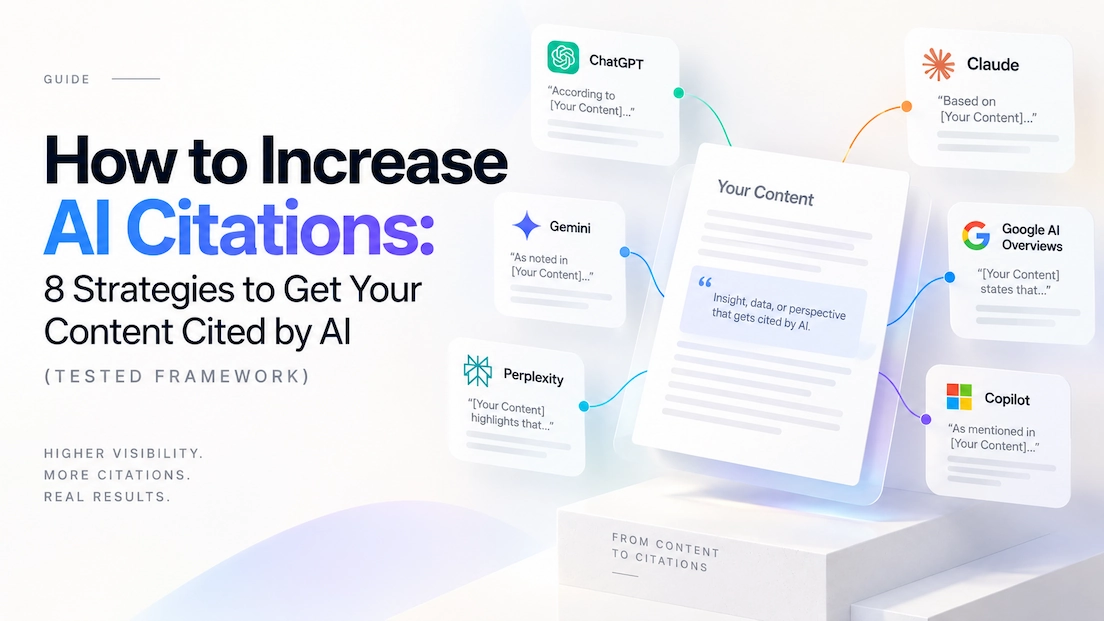
Use this as a pre-publish checklist for any page you want cited. A page that passes all of these is dramatically more likely to be extracted: For the full process around the checklist, from picking the topic to the eight-week re-test, see how to increase AI citations with eight tested strategies.
- Opens with a 40–60 word direct answer to the page's core question.
- Uses the real question as the H1 or first H2, phrased the way a human would ask an assistant.
- Breaks content into descriptive H2s and H3s, not generic labels.
- Includes at least one bulleted or numbered list of extractable points.
- Has a dedicated FAQ section answering related questions in 2–4 sentences each.
- Carries FAQPage, Article, and Organization schema.
- States clearly who the product or content is for, and what makes it different.
- Links to and from related pages in the same topic cluster.
- Cites data and names sources, so the model can trust and re-cite it.
- Is dated and kept current, with stats refreshed at least twice a year.
What a Winning AEO Page Looks Like: A Walkthrough
Imagine a mid-market SaaS company that sells onboarding software and wants to be recommended when buyers ask AI, "What's the best user onboarding tool for a B2B SaaS product?" Here is how an AEO-optimized page for that query is built, top to bottom.
It opens with a 45-word direct answer that names the category, states who the tool is best for, and gives the one differentiator — a passage a model can quote verbatim. The H1 is the buyer's actual question. The next section defines the category cleanly so the page can also be cited for "what is user onboarding software." A short, honest comparison section lays out how the main options differ, including where competitors are the better fit — which paradoxically increases trust and citation odds. A step-by-step "how to choose" list gives the model extractable structure. A pricing-transparency block states the model and range in plain language, because that is exactly what buyers ask AI and what engines struggle to find. Finally, an FAQ block answers five real follow-up questions in two to four sentences each, wrapped in FAQPage schema.
Off the page, the same positioning shows up in the company's G2 and Capterra profiles, a few earned articles, and authentic community threads. Now every source the engine checks tells the same story — and the brand becomes the safe, well-corroborated answer. That is AEO working as designed: on-page extractability plus off-page corroboration, pointing at one coherent entity.
AEO by Engine: What Each One Rewards
The fundamentals are universal, but each engine has quirks worth knowing.
- ChatGPT leans heavily on retrieval that overlaps with Bing's index and on strong third-party corroboration, especially review sites for software. Being indexed in Bing is one of the highest-ROI moves you can make.
- Perplexity is citation-first and rewards clearly sourced, well-structured pages it can quote and link with confidence.
- Google AI Overviews and AI Mode build on Google's existing index, so classic SEO fundamentals plus answer-first structure carry over directly.
- Gemini blends Google's index with Google's own understanding of entities, rewarding brands with a clear, consistent presence across the web.
- Microsoft Copilot is Bing-powered, so Bing Webmaster Tools indexing and clean structured pages are the levers.
- Claude is increasingly used for considered research and vendor evaluation, rewarding depth, clarity, and trustworthy sourcing.
You do not need six separate strategies. You need one strong AEO foundation, plus the engine-specific tuning covered in the how-to-rank guides linked above.
Why AEO Is Mission-Critical for B2B SaaS
SaaS is the category most exposed to the answer-engine shift, because software buyers were early adopters of AI research. They now ask assistants for category overviews, vendor shortlists, feature comparisons, pricing ranges, and implementation advice — often before they ever visit a vendor site.
That means the AI answer layer is the new top of your funnel. If a buyer asks ChatGPT for "the best tools for X" and your competitor is named while you are not, you lost the deal before a rep was ever involved. This is exactly the problem we solve on our AI visibility for SaaS page, and it is why AEO is really a form of AI search demand generation — not a technical SEO checkbox.
The stakes are also a boardroom issue, not just a marketing one. We wrote a dedicated CMO guide to AI recommendation share for leaders who need to report this to the board, and we mapped the brands already winning in our study of the 100 companies dominating AI discovery.
AEO Across the Buyer Journey
AEO is often treated as a top-of-funnel awareness play, but AI assistants now accompany buyers through the entire journey. Winning teams map content to each stage:
- Problem-unaware. Buyers ask broad questions ("why aren't we getting recommended by AI?"). Educational, definition-led content earns the first citation and plants your brand early.
- Solution-aware. Buyers ask "what kind of tool solves this?" Category explainers and framework content position you as the guide to the whole space.
- Vendor-aware. Buyers ask for shortlists and comparisons. This is where "best tools for X" roundups and "X vs Y" pages decide whether you make the consideration set.
- Decision. Buyers ask about pricing, implementation, and fit. Transparent pricing and use-case pages are what the engine quotes to confirm you are the right choice.
- Post-purchase. Buyers ask "how do I get the most out of this?" Support and how-to content keeps you present and reinforces the entity for the next buyer.
The strategic insight is that every stage is now a search — just conducted inside an assistant instead of a search bar. If you only optimize the awareness stage, you get named in overviews but lose the shortlist. AEO pays off most when it covers the full arc, so the same brand keeps reappearing as the buyer's questions get more specific and higher-intent.
Technical AEO: Crawlers, Schema, and the llms.txt Question
On-page writing gets you most of the way, but the technical layer decides whether engines can reach and trust you.
- Crawler access. Answer engines use specific bots. If you want to appear in ChatGPT's search answers, its search crawler needs access; to be present in the model's broader knowledge, its training crawler needs access. Blocking them by accident is a common, self-inflicted invisibility problem.
- Schema markup. FAQPage, Article, Organization, Product, and Breadcrumb schema are the highest-leverage structured data for AEO. Some studies suggest products with complete structured data are several times more likely to be selected by AI shopping agents.
- Clean, fast, semantic HTML. Real headings, lists, and text — not text trapped in images or heavy JavaScript — keep your content extractable.
- Bing indexing. Because a large share of ChatGPT and Copilot citations trace back to Bing's index, verifying your site in Bing Webmaster Tools is one of the cheapest, highest-return technical moves available.
- The llms.txt reality check. The proposed llms.txt file is popular in AEO discussions, but as of 2026 Google has said it does not use it, and no major AI provider has confirmed it changes citations. It is low-effort and harmless to add, but it is not a ranking lever — do not prioritize it over structure, schema, and corroboration.
AEO Content Formats That Win Citations
Some formats are simply easier for answer engines to lift. Prioritize these:
- Definitions — a crisp, standalone answer to "what is X."
- Comparisons — "X vs Y" pages that lay out differences cleanly, like our Searchable vs Profound vs AthenaHQ comparison.
- Listicles and roundups — "best tools for X," such as our 17 best AI visibility tools and best free AI visibility tools.
- Step-by-step how-tos — numbered, reproducible instructions.
- FAQ blocks — direct answers to real questions, ideal for FAQ schema and voice.
New surfaces are emerging too. Google AI Mode is becoming its own battleground; see Google AI Mode for SaaS for how to prepare.
How to Measure AEO Success
AEO needs its own metrics, because clicks alone understate its value. Track:
- AI share of voice — how often you are named versus competitors across a set of buying prompts.
- Citation rate — how often engines cite your site as a source.
- Mention rate — how often your brand is named, cited or not.
- Answer position — whether you appear first, in the middle, or last in a recommendation.
- Sentiment — whether the model describes you positively, neutrally, or negatively.
- AI referral traffic — visits arriving from ChatGPT, Perplexity, Gemini, and similar sources.
If you are absent across the board, start by diagnosing the cause. Our guides on why your brand doesn't appear in AI answers and the 10 reasons your brand never appears in ChatGPT walk through the most common failure points, from crawler blocks to weak corroboration.
Common AEO Mistakes to Avoid
- Optimizing for keywords instead of intent. Answer engines reward clarity and usefulness, not keyword density.
- Burying the answer. Long introductions push your extractable answer out of reach.
- Weak structure. Wall-of-text pages are hard to lift and rarely cited.
- Ignoring schema. Skipping structured data leaves easy extraction gains on the table.
- Talking only about yourself. With no third-party corroboration, models hesitate to recommend you.
- Publishing thin AI-generated filler. Low-value content rarely earns citations and can erode trust.
- Blocking the bots. A stray line in robots.txt can quietly remove you from the answer layer entirely.
- Treating AEO as one-and-done. Without refreshes and iteration, your visibility decays.
AEO Myths vs Reality
The category is young and noisy, so misconceptions spread fast. A few worth correcting:
- Myth: "AEO is just SEO with a new name." Reality: they share foundations, but the objective, the unit of visibility, and the metrics are different. Ranking a page and being quoted in an answer are not the same outcome.
- Myth: "You need a huge domain to get cited." Reality: answer engines regularly cite focused, well-structured pages from smaller sites when they answer the question best and are corroborated elsewhere. Clarity and evidence can beat raw authority.
- Myth: "Add llms.txt and you're optimized." Reality: llms.txt is not a proven ranking lever. Structure, schema, and corroboration do the real work.
- Myth: "AEO is only for informational content." Reality: commercial pages — comparisons, pricing, product pages — are among the most cited, because that is what buyers ask AI about.
- Myth: "Set it and forget it." Reality: answers shift as models and the web update. AEO is a maintained system, not a one-time optimization.
Cutting through the noise matters because misplaced effort is expensive. The teams that pull ahead spend their time on the levers that actually move citations — clear answers, strong structure, a coherent entity, and independent corroboration — and ignore the shiny distractions.
The Future of AEO: Agentic Search and Zero-Click
Two shifts will define the next phase. First, zero-click keeps growing — more answers are delivered without a visit, which makes being cited (not just ranked) the whole game. Second, agentic search is arriving: AI agents that don't just answer but act, comparing vendors and even initiating purchases on a user's behalf.
Both trends raise the premium on being the trusted, well-structured, well-corroborated source an engine reaches for. When an agent is choosing a vendor on a buyer's behalf, the brand with the clearest machine-readable story and the strongest independent corroboration wins by default. Teams that build AEO foundations now will compound their advantage as these surfaces mature — and the gap between the cited and the invisible will only widen.
Your First 30 Days of AEO
If this guide feels like a lot, start small and sequenced. Here is a realistic 30-day plan that produces visible movement without a big budget or a full content team.
- Days 1–5: Baseline. List your ten most important buying prompts and run them across ChatGPT, Perplexity, Gemini, and Google AI Overviews. Record where you appear, where you don't, and who does. This is your before picture.
- Days 6–10: Unblock and index. Confirm AI crawlers are not blocked, verify your site in Bing Webmaster Tools, and fix any obvious technical barriers to retrieval.
- Days 11–18: Rewrite your money pages. Give your product, pricing, and top-converting pages answer-first intros, clear structure, and FAQ blocks with schema. These are what engines quote at the decision stage.
- Days 19–25: Ship one pillar or comparison. Publish or upgrade a single cluster-anchoring page targeting your most valuable prompt, built to be cited.
- Days 26–30: Corroborate and re-measure. Refresh your most important review profiles so they tell a consistent story, then re-run your prompt baseline and compare.
Thirty days will not make you dominant, but it will move you from guessing to measuring, fix the errors that keep most brands invisible, and give you a repeatable loop to compound from. From there, the content calendar above turns AEO into a habit rather than a project. If recommendations rather than answers are your gap, that side is covered by our GEO agency for SaaS, and a five-minute technical win you can ship today is an llms.txt file.
How Arobis AI Helps You Win Answer Engine Optimization
Arobis AI is an AI Search Demand Generation agency built specifically for B2B SaaS, and the AEO half of that work now runs as a dedicated AEO agency for B2B SaaS. Instead of only telling you what AI is saying about your brand, we work to change it — so ChatGPT, Gemini, Claude, Perplexity, Copilot, and Google AI Overviews recommend you instead of a competitor.
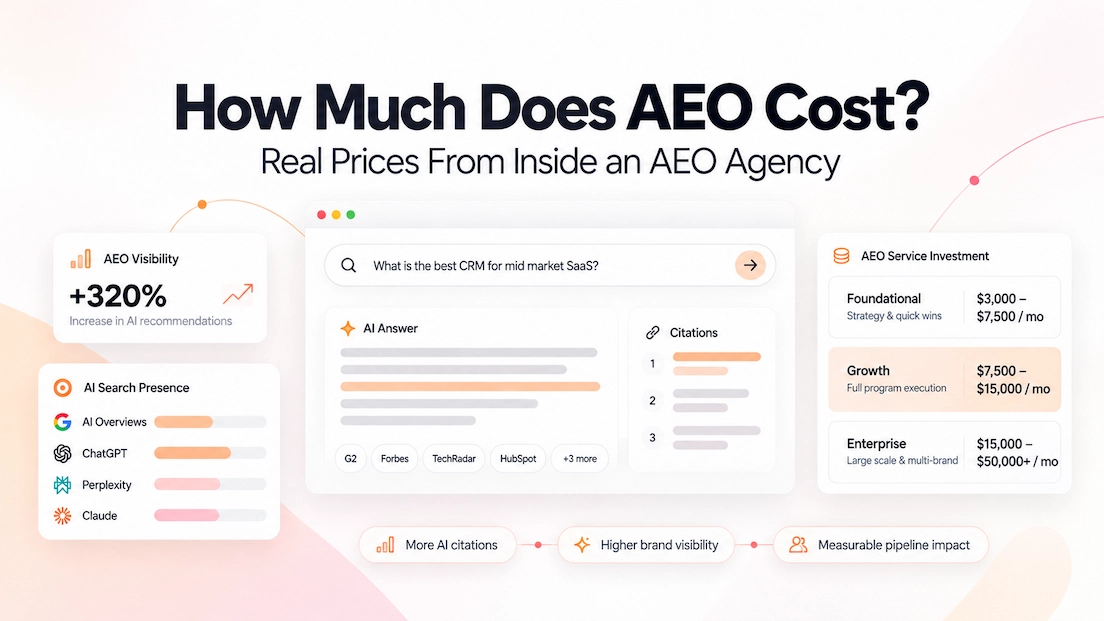
Our approach combines AEO, GEO, entity optimization, semantic authority, and off-site corroboration into a single demand-generation motion. When you are ready to see how we engage, our pricing page lays out the options, and if you want a curated view of specialist partners, we maintain a list of the best SEO, GEO, and AEO agencies for SaaS.
Because in the age of AI search, the companies that provide the clearest, most trusted answers win the most visibility — and the most pipeline. So one of the very first things you can do right now is learn how to track whether AEO is sending you traffic or not.
Frequently Asked Questions
What is answer engine optimization?
Answer Engine Optimization (AEO) is the practice of structuring, writing, and corroborating your content so that AI answer engines like ChatGPT, Google AI Overviews, Gemini, and Perplexity can extract it and cite your brand directly inside the answers they generate.
What is answer engine optimisation?
Answer engine optimisation is the British English spelling of Answer Engine Optimization (AEO). It refers to the exact same practice: structuring content so AI answer engines can extract and cite it directly.
What does AEO stand for?
AEO stands for Answer Engine Optimization. It is the practice of optimizing content so AI assistants, answer engines, and voice search can extract it and present your brand directly inside their answers.
Is AEO replacing SEO?
No. AEO complements SEO. Traditional search still feeds the index that answer engines retrieve from, so you need both: SEO to be findable and AEO to be quoted. The balance is simply shifting toward the answer layer.
What is the difference between AEO and GEO?
They overlap heavily. AEO covers all direct-answer surfaces, including AI assistants, featured snippets, and voice. GEO focuses specifically on being cited inside generative LLM responses. Most teams run them together as one AI visibility program.
How do I know if my brand appears in AI answers?
Run your key buying prompts across ChatGPT, Gemini, Perplexity, and Google AI Overviews and record where you are mentioned or cited. A free AI visibility check automates this across engines so you do not have to test each one by hand.
Which platforms does AEO apply to?
ChatGPT, Google AI Overviews, Google AI Mode, Gemini, Perplexity, Claude, Microsoft Copilot, and voice assistants such as Siri and Alexa.
What content performs best for AEO?
Structured, concise, question-focused content: clear definitions, comparison pages, step-by-step how-tos, and FAQ blocks, all supported by schema and independent corroboration.
How long does AEO take to work?
On-page and structural fixes can influence answers within weeks as pages are re-crawled. Building the entity strength and third-party corroboration that drive consistent citations typically takes a few months, then compounds.
Does schema markup really matter for AEO?
Yes. Schema is one of the most literal signals you can send about what a page means. FAQPage, Article, Organization, and Product schema improve both rich-result eligibility and machine extraction, making your content easier to quote accurately.
Is AEO worth it for B2B SaaS specifically?
Yes. SaaS buyers are among the heaviest users of AI research for shortlisting vendors, so the AI answer layer is now a primary top-of-funnel channel — arguably the highest-intent one you are not yet measuring.
Can I do AEO on a small budget?
Yes. The highest-leverage AEO work — answer-first rewrites, clean structure, FAQ blocks, schema, and Bing indexing — is largely effort, not spend. Corroboration (reviews and mentions) takes time more than money. Start with your existing money pages and top blog posts before creating anything new.
Does AEO help with voice search?
Yes. Voice assistants read a single answer aloud, so the same answer-first structure and FAQ formatting that win AI citations also win voice results. Optimizing for one largely optimizes for the other.
Will AI answers cannibalize my website traffic?
Some informational clicks will shrink, but the buyers who do reach you arrive far more qualified, having already seen you recommended. The strategic response is to measure citations and AI referral traffic, not just raw sessions, and to make sure you are the brand being named in the first place.
AEO Glossary: Key Terms in One Place
- Answer engine — a system that returns a synthesized answer instead of a list of links (ChatGPT, Perplexity, Google AI Overviews, and so on).
- AEO — Answer Engine Optimization; optimizing to be extracted into direct answers.
- GEO — Generative Engine Optimization; optimizing to be cited inside generative LLM responses.
- Citation — an explicit reference to your site as a source inside an AI answer.
- Mention — your brand being named in an answer, whether or not it is linked.
- Share of voice — how often you appear versus competitors across a set of prompts.
- Corroboration — independent sources echoing your positioning, which raises model trust.
- Entity — the model's structured understanding of who you are and what you do.
- Retrievability — how easily bots can crawl and parse your pages.
- Extractability — how easily a passage can be lifted and quoted as an answer.
- Zero-click — a search resolved without the user visiting any website.
Final Thoughts
Search is no longer only about ranking for links — it is about being the answer. As AI assistants become the first stop for research and buying decisions, Answer Engine Optimization is how brands stay visible, trusted, and recommended.
Get the fundamentals right — answer-first content, clean structure, strong entities, schema, and genuine third-party corroboration — and you build a durable advantage that compounds as answer engines grow. The brands that adapt early will own the next generation of discovery. The rest will quietly disappear from the answers their buyers now trust most.