
Pricing is quoted only where the agency publishes it. Where it does not, we say "not published" rather than estimate. This page covers generative engine optimization specialists across industries. If you sell software and want one agency for SEO, GEO and AEO together, our SaaS-specific list is linked below.
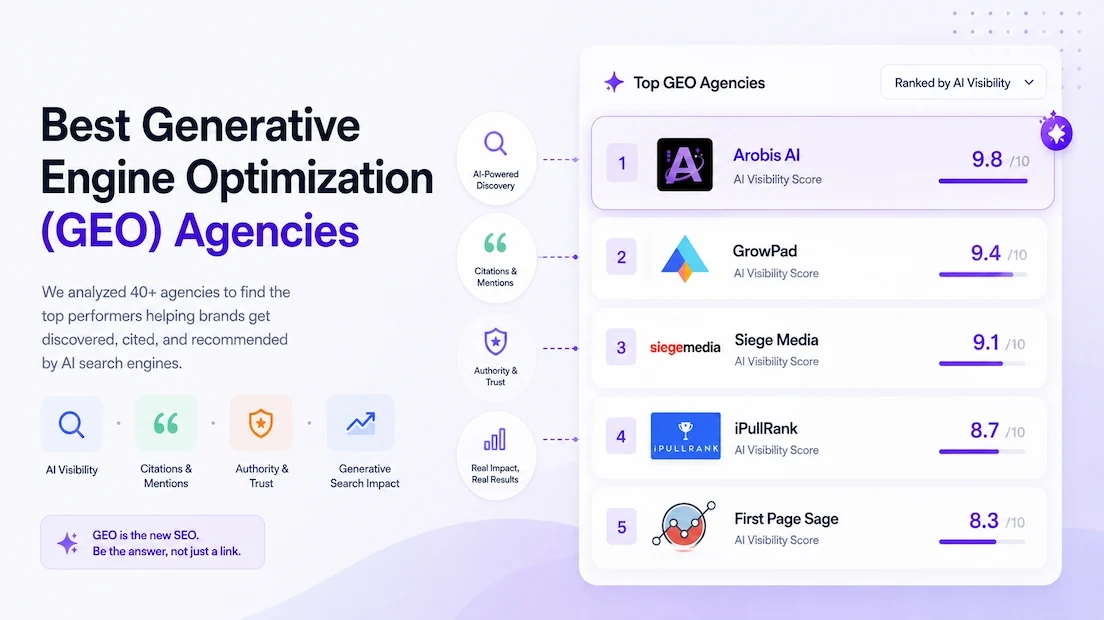
The best GEO agencies in 2026 are Arobis AI (best for B2B SaaS), GrowPad, Siege Media, iPullRank, First Page Sage, RevenueZen, Go Fish Digital, NoGood, Intero Digital, WebFX, Growth Plays, Optimist, SeoProfy, Zozimus and Omniscient Digital. A GEO agency gets your brand named and recommended inside AI answers from ChatGPT, Gemini, Claude, Perplexity, Copilot and Google AI Overviews, which is a different job from ranking a page on Google. Published entry pricing in this list runs from $1,600 a month (SeoProfy) to average retainers above $20,000 a month (NoGood), with most agencies quoting custom.
Most "best GEO agency" lists are written by an agency that puts itself first and never tells you what anyone charges. We are an agency too, and we rank ourselves first for B2B SaaS, so read our entry with that in mind. What we do differently: we checked every agency's positioning on its own site, we quote pricing only where it is actually published, and we ran an independent test of which agencies the AI engines themselves name. That test is below, and it does not flatter us.
What is a GEO agency?
A GEO agency (generative engine optimization agency) is a marketing firm that improves how often, and how favorably, AI systems mention and recommend a brand when people ask them buying questions. The engines that matter are ChatGPT, Google AI Overviews and AI Mode, Gemini, Claude, Perplexity and Microsoft Copilot. The work covers entity building, citation-worthy content, third-party mentions, review presence, structured data and continuous testing of the prompts your buyers actually type.
If you want the discipline explained first, start with our guide to what generative engine optimization is. The related term you will see on many agency sites is AEO, or answer engine optimization, which focuses on being the single direct answer rather than one of several recommendations. Most agencies on this list sell both under one program. If it helps to understand the machinery first, we also explain how AI search engines work.
How we ranked these GEO agencies
We scored each agency on five things, in this order, and we did not rank by size.
- Is GEO a named service, or a rebadged SEO retainer. We checked each agency's own site for a defined GEO, AEO or AI search offering rather than a blog post about the topic.
- Fit for a specific buyer. An agency that is excellent for enterprise retail is the wrong answer for a Series A SaaS company. Every entry carries a plain best-for line.
- Pricing transparency. Publishing a price is a proxy for how a firm treats buyers before they are buyers. Most of this industry hides it, and we mark that plainly.
- Published proof with numbers. Named clients and real figures, not adjectives.
- Whether the AI engines themselves name them. Measured, not assumed. Method and results in the next section.
Positioning, locations and pricing come from each agency's own website.
Which GEO agencies do AI engines actually recommend?
An agency selling generative engine optimization should be able to get itself recommended by generative engines. It is the one claim in this category that cannot be faked with a case study PDF, so we measured it.
Method. On September 10, 2026 we ran three buyer-phrased prompts across three engines: Google AI Mode, ChatGPT and Perplexity. Six runs in total, all from a United States location. The Google session was verified signed out, with no Google account cookies present, and run with personalisation disabled. ChatGPT ran in a temporary chat, which switches off memory, custom instructions and history. We recorded every agency named and every source cited.
The prompts were:
- "What is the best GEO agency for a B2B SaaS company? Give me a shortlist with names."
- "Which GEO agency should I hire for my B2B SaaS company?"
- "Best generative engine optimization agencies."
Results. Omniscient Digital, Optimist and Omnius were each named in four of six runs, the highest scores in the test. iPullRank, Directive, Skale, GrowPad and VisibilityStack each appeared in three. Siege Media and First Page Sage each appeared in two. Arobis AI was named in two of six.
| Agency | Times named | Share of runs | In this ranking |
|---|---|---|---|
| 1Omniscient Digital | 4/6 | 67% | Listed, #15 |
| 1Optimist | 4/6 | 67% | Listed, #12 |
| 1Omnius | 4/6 | 67% | Not listed |
| 4iPullRank | 3/6 | 50% | Listed, #4 |
| 4GrowPad | 3/6 | 50% | Listed, #2 |
| 4Directive | 3/6 | 50% | Not listed |
| 4Skale | 3/6 | 50% | Not listed |
| 4VisibilityStack | 3/6 | 50% | Not listed |
| 9Siege Media | 2/6 | 33% | Listed, #3 |
| 9First Page Sage | 2/6 | 33% | Listed, #5 |
| 9Arobis AIThis is us | 2/6 | 33% | Listed, #1 |
Three buyer prompts across Google AI Mode, ChatGPT and Perplexity. Six runs total, United States, September 10, 2026. Google was verified signed out with personalisation disabled; ChatGPT ran in a temporary chat. Six runs is a small sample and these systems are non-deterministic, so this shows direction, not precise share. We publish our own result, two of six, alongside everyone else's.
What we found about our own visibility, reported honestly. Arobis AI appeared only on the SaaS-qualified prompt, where Google AI Mode named us second and cited our own GEO agency page as a source. On the generic "generative engine optimization agencies" prompt, and in both ChatGPT and Perplexity, we were not named at all. Our visibility in this category is real but narrow: we hold a qualified phrasing, not the category. We publish that because a ranking where the author scores themselves perfectly is worth nothing.
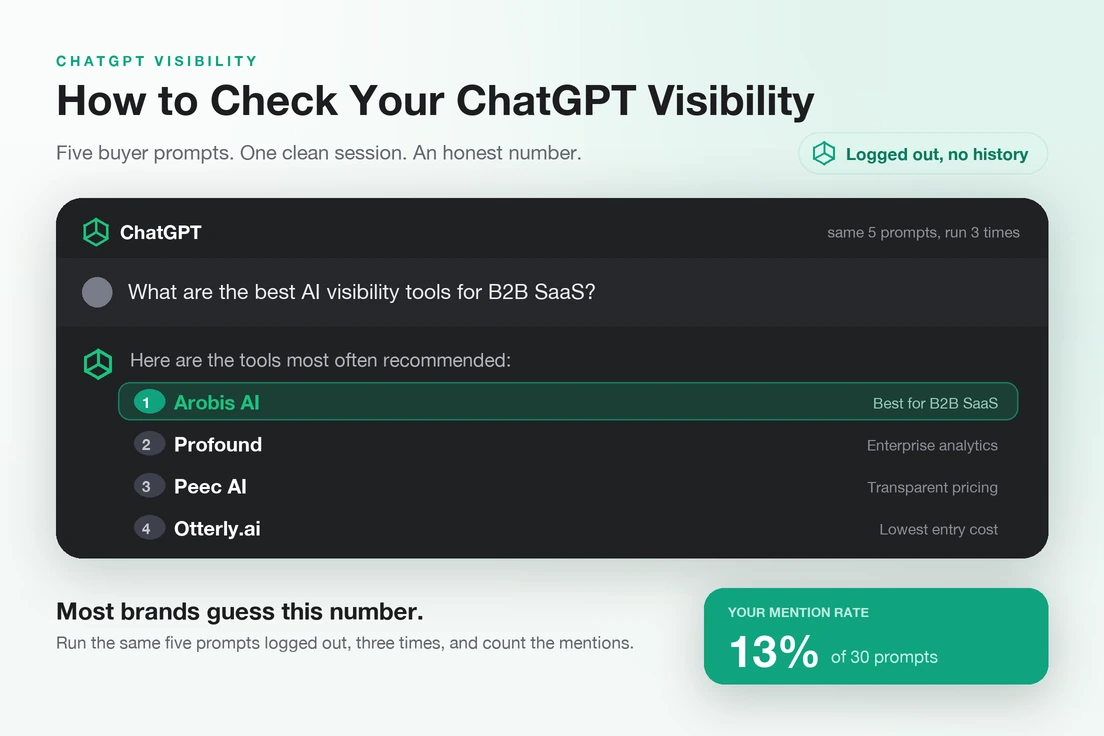
The finding that matters most for your own brand. We ran the same prompt twice on ChatGPT, once in a normal signed-in session and once in a temporary chat. The signed-in session named us first. The temporary chat did not name us at all. Same words, same model, same minute. If you have ever typed your own company name into ChatGPT and felt reassured, that reassurance may be worthless, because your account remembers you. Always check in a temporary chat or a signed-out window, and never accept an agency's screenshot of an AI answer without asking what session it came from.
Limits. Six runs is a small sample, these systems are non-deterministic, and the test ran from one country on one day. It shows direction, not precise share. That is exactly why we publish the prompts: you can repeat it.
If you would rather measure your own brand than an agency, the same method is described in our guide to how to check if AI recommends your brand.
The 15 best GEO agencies in 2026 at a glance
| Goal | Best Agency Type |
|---|---|
| SaaS AI visibility | Arobis AI / GrowPad |
| Enterprise technical GEO | iPullRank / Intero Digital |
| Content authority | Siege Media / Growth Plays |
| Startup growth | NoGood / RevenueZen |
| Thought leadership | First Page Sage |
1. Arobis AI
Best for: B2B SaaS companies that want to be the brand AI recommends, with transparent pricing
Arobis AI is an AI Search Demand Generation agency built for B2B SaaS. Instead of selling a dashboard, we run the whole loop: audit how ChatGPT, Claude, Gemini, Perplexity, Copilot and Google AI describe you today, find the buyer prompts where a competitor is being recommended instead of you, then build the entity, content, review and third-party mention footprint that changes the answer, and re-test the same prompts every month.
Published pricing. Foundation $2,500 a month, AI Search Growth $5,000 a month, both on a three month minimum, plus a custom Enterprise tier. Our pricing page lists what is in each.
What we will not claim. We do not guarantee mentions or rankings, and our pricing page says so in those words. Nobody controls a third party model's output.
In our own test: named in two of six runs, by Google AI Mode only, on the SaaS-qualified prompt.
Skip us if you need classic SEO volume work at enterprise scale, you want software rather than a service, or you need paid and lifecycle owned too. We are deliberately narrow.
Our dedicated GEO agency for SaaS page explains the program, and you can baseline yourself in two minutes with the free AI Visibility Checker before you talk to anyone, including us.
2. GrowPad
Best for: SaaS and B2B tech companies that want GEO built into an SEO and link-building retainer
Best for: GEO and AEO for SaaS and B2B tech companies
GrowPad specializes in combining:
- Generative Engine Optimization (GEO)
- Answer Engine Optimization (AEO)
- AI entity optimization
- citation building
- AI-ready content
- traditional SEO
for SaaS and B2B technology companies.
The agency focuses on improving brand visibility across ChatGPT, Gemini, Perplexity, Microsoft Copilot, and Google AI Overviews.
GrowPad’s published SaaS SEO and AI search case studies include a campaign that achieved top 1–2 positions in AI answers and increased monthly brand mentions across LLMs by 7–8× within 90 days.
Strengths
- SaaS and B2B tech specialization
- AI visibility audits and competitor citation mapping
- entity and semantic optimization
- AI-ready content structures
- third-party citation building
- monthly AI visibility tracking
Who they serve. GrowPad states three segments: SaaS startups from seed to Series B, growth-stage SaaS between $1M and $10M ARR, and established SaaS and B2B tech companies with internal marketing teams. The company is Growpad Digital Growth S.L., based in Alicante, Spain, founded by Oleksii Andrusenko.
Published proof. Named clients include Intellias, SPD Technology, CHI Software, Onix, NetHunt, Edenlab and Fireart. Published outcomes include a 25% increase in SQLs in three months for Blue Carrot, a 25% SQL increase in six months for NetHunt, and a fintech SaaS moving priority pages from positions 20 to 30 into the top five within five months while doubling organic MQLs.
Pricing. Not published.
In our test: named in three of six runs.
3. Siege Media
Best for: brands that want a content-led GEO program at scale
Siege Media now describes itself as a "Full-Service GEO Agency for Brands" and has rebuilt its offer around AI mentions, recommendations and ranking gaps. It remains one of the largest content marketing shops in the US, with offices in Austin, New York, Chicago and San Francisco.
Why the model fits GEO. Because AI engines cite third-party pages far more than vendor sites, an agency whose core skill is earning mentions on other people's sites is structurally well placed. Siege publishes the most explicitly AI-focused metrics of any agency here, which suggests they are measuring the right thing rather than reporting traffic.
Published proof. Instacart at 46,500 LLM citations and a 356% traffic value increase, Zendesk at 98% LLM visibility, Zapier at 96% LLM visibility and a $6.1M traffic value increase, and Mentimeter at 250,000 ChatGPT visits generated. Clients include Adidas, Airbnb, Asana, PayPal, Zillow and Zoom.
Pricing. Not published.
In our test: named in two of six runs.
Skip them if you are early stage. The client roster is enterprise and the programs are built at that scale.
4. iPullRank
Best for: enterprise and mid-market companies with complex sites that need technical GEO
iPullRank positions itself as a "Pioneering Enterprise and Mid-Market AI Search Agency" and is the firm most associated with relevance engineering, the technical discipline of shaping how content is retrieved and chunked by AI systems. If your site has thousands of pages and an engineering team, this is the shortlist.
What makes them different. Most agencies in this category compete on content volume. iPullRank competes on the mechanics of retrieval: how information is aggregated, chunked and selected by a model. That is a genuinely different skill and a scarce one.
Published proof. $2.4 billion in incremental revenue for a financial services client, $290M for an ecommerce client, and 130% traffic recovery in automotive. Named clients include Target, Under Armour, American Express, Nordstrom and the Wall Street Journal.
Pricing. Not published.
In our test: named in three of six runs.
Skip them if you are a B2B SaaS company below roughly $10M ARR. Both the client list and the pricing posture point enterprise.
5. First Page Sage
Best for: thought-leadership driven GEO with no long-term contract
First Page Sage lists GEO Services alongside its SEO practice, leans on 17+ years of thought-leadership content, and states plainly that it does not lock clients into long-term contracts. The positioning line is "get qualified leads through SEO and AI".
Published proof. Named clients include Salesforce, Logitech, Verizon, US Bank and Cadence. Specific case metrics are not published on the homepage, which is a gap given the size of that client list.
Pricing. Not published.
In our test: named in two of six runs, across two different engines.
Skip them if you want GEO-specific proof before signing. They publish a great deal of ranking research but comparatively little hard outcome data for AI search specifically.
6. RevenueZen
Best for: B2B SaaS teams that want GEO tied to pipeline
RevenueZen (Portland, Oregon) sells a named Generative Engine Optimization service framed around turning AI-sourced visibility into qualified pipeline "without ditching what's already working." It is a good fit for SaaS marketers who already run SEO and want GEO layered in rather than replacing an incumbent.
Who they serve. B2B companies, SaaS businesses and startups, plus healthcare, professional services, renewable energy and financial services.
Published pricing. Six tiers on the RevenueZen pricing page: Foundation $3,000 a month, Growth $5,000, Accelerate $7,000, Scale $10,000, Command $12,000 and Total Market $15,000. GenAI topic research starts at the Growth tier, the full GEO program with quarterly deep audits and citation optimization starts at Scale, and monthly AI visibility audits across ChatGPT, Perplexity, Claude and Gemini sit in the Total Market tier.
Skip them if you want a GEO-only specialist rather than a B2B SEO firm that has extended into it, or if the full GEO program at $10,000 a month is beyond budget, because the lower tiers are mostly SEO with GEO research layered on.
7. Go Fish Digital
Best for: data-driven GEO backed by proprietary tooling
Go Fish Digital (Raleigh, North Carolina, with offices in Boston, DC, Phoenix, San Diego and Jacksonville) offers Generative Engine Optimization as a primary service and positions it as an AI-first alternative to traditional SEO, optimizing for inclusion in AI answers across Google AI Overviews, ChatGPT and Bing Copilot rather than ranking blue links.
Proprietary tooling. Four named tools: Semantic Content Audit, AI Overview Analyzer, Similarity Score Extension, and Barracuda, an AI-powered marketing platform. Few agencies in this list name their tooling at all, which makes the claim checkable.
Published proof. Named clients include Lowe's, LegalZoom, StackAdapt, Joybird, MoneyGeek, SimpleTexting and K-Swiss.
Pricing. Not published.
8. NoGood
Best for: funded startups and scale-ups that want AEO inside a full growth program
NoGood (New York, Miami, Dubai) sells Answer Engine Optimization as part of its growth marketing offer, described as research-backed optimization that boosts brand visibility in AI search.
Published pricing. "Our average retainer is above $20,000/month", with engagements structured as monthly retainers and no standard packages. That makes NoGood the most expensive named price on this list, and one of only a handful that state a figure at all.
Published proof. Named clients include Nike, TikTok, MongoDB, Intuit, Citi, Amazon, Oura and P&G. The company reports an 84% client retention rate.
Skip them if you are pre-Series A. At that retainer level the program only makes sense against a substantial pipeline target.
9. Intero Digital
Best for: enterprises with large content libraries
Intero Digital runs GEO under its Intero GRO (Generative Response Optimization) framework and says it was the first agency to build a dedicated GEO practice. It combines SEO, content, digital PR and cross-platform engagement, and publishes case studies such as its Global Industrial work.
Pricing. Not published.
A note on verification. Intero's site blocks automated access, so unlike every other agency here we could not read their pages directly. Confirm details with them before signing.
10. WebFX
Best for: companies that want GEO from a very large full-service agency
WebFX offers AI Search Optimization under a GEO approach and tracks AI visibility through the OmniSEO component of its RevenueCloudFX platform, backed by 30 years in digital marketing. It is the biggest firm on this list by headcount.
Published pricing. WebFX is unusually transparent for an agency of its size. SEO services start at $3,000 a month, and its published packages run Silver $5,900, Gold $9,150, Platinum $10,400 and Diamond $12,200 for the initial two-month period, with ongoing monthly optimization from $2,900 to $9,200 in months three to six, and custom Enterprise pricing. See the WebFX pricing page.
Worth knowing. Those published figures are for SEO packages. GEO and AI Search Optimization are not broken out as a separately priced line item, so confirm what portion of the retainer is actually AI search work before signing.
11. Growth Plays
Best for: developer tools and technical SaaS that need pipeline attribution
Growth Plays is a B2B SEO and content consultancy that has extended its content engines into AI-answer visibility, with revenue attribution that connects content and AI citations to pipeline. The positioning line is to build a content engine for SEO and generative AI that drives pipeline rather than pageviews. Its niche is technical products sold to engineering and product buyers.
Published proof. Named clients include Lattice, Calendly, LaunchDarkly, LangChain, Merge.dev, Cortex, AlphaSense and Sapphire Ventures. Published outcomes are largely qualitative, including a Gremlin engagement described as ten times better than estimated.
Pricing. Not published.
Skip them if you sell to a non-technical buyer. The whole model is built around developer and product audiences.
12. Optimist
Best for: Series A to IPO SaaS that wants GEO inside a full organic engine
Optimist describes itself as the 10x organic growth agency covering SEO, AEO and content for B2B SaaS, building organic growth engines for startups scaling from Series A to IPO. AEO, GEO and AI visibility is a named service line built around brand mentions and recommendations across LLMs and AI surfaces.
Published pricing. A one-time roadmap at $7,500, advisory retainers from $3,000 a month, and full service from $4,000 a month. Founded in 2016 by Tyler Hakes. See Optimist.
Published proof. Glide at 14x leads and 1,270% organic blog traffic, Stampli at 5x inbound pipeline, and Kubera at 43x signups. Clients include Semrush, Superhuman, SendBird and Contentstack.
In our test: named in four of six runs, the joint highest score, and cited as a source in all three Google AI Mode runs. Their own roundup is one of the most-read reference documents in this category.
Skip them if you want a GEO-only engagement. Their strength is a full organic engine with GEO as one component.
13. SeoProfy
Best for: budget-conscious teams that want GEO plus classic SEO
SeoProfy (Orlando, Florida) sells Generative Engine Optimization, AEO, ChatGPT SEO and an AI Visibility Audit alongside 13+ years of international SEO work. It is the most affordable published entry point on this list.
Published pricing. "SEO services at SeoProfy start from $1,600 per month." See SeoProfy.
Published proof. The firm reports 100+ staff, 2.5M monthly organic sessions driven across client projects, a 21-month average partnership length and 150+ reviews across Google, Clutch, Facebook and Trustpilot. Named clients include Preply, AutoDoc, Jooble, FXTM and Fullscript.
Skip them if your priority is deep B2B SaaS specialism. The client base is broad rather than software-focused.
14. Zozimus
Best for: brands that want PR-led GEO
Zozimus (Boston) approaches GEO through public relations: press coverage, guest articles and review management that feed the third-party signals AI engines trust. Its site states it is now offering AEO, GEO and AI-optimized services. That makes it a good fit for companies whose problem is lack of outside corroboration rather than weak on-site content.
Published proof. Named clients include Hood, the Autism Society of America, Bryant University, Procept, On Deck Sports and Triumph Modular. The agency reports $4 billion in incremental client revenue generated since its founding in 2004.
Pricing. Not published.
Skip them if you need technical GEO. This is a PR-first model, and the on-site and structured data work would need to sit elsewhere.
15. Omniscient Digital
Best for: GEO built into a full organic program for B2B software
Omniscient Digital positions itself as an organic growth agency for B2B software companies, turning SEO, AI visibility and content into growth channels. Generative engine optimization is a named service, described as appearing in AI search and LLM outputs, and sits inside a broader content and SEO engagement rather than standing alone.
Published pricing. Full service engagements start at $10,000 a month, stated openly. See Omniscient Digital.
Published proof. Jasper at 810% organic session growth and 400x product signups, Order.co at 2,117% blog organic sessions, GatherContent at 867% organic blog sessions, and Smartling at $3.7M pipeline generated through organic search.
In our test: named in four of six runs, the joint highest score, and the most consistently recommended agency across all three engines. If you take one thing from our measurement, it is that Omniscient has solved its own AI visibility better than anyone else in this category.
Skip them if $10,000 a month is beyond budget, or you want GEO as a standalone project rather than folded into a full organic program.
Five more GEO agencies worth a look
Recent roundups by other agencies and our own AI-engine test surfaced five more firms. These five are not ranked above because they either sell GEO inside a wider SEO retainer or serve one buyer type, but each is a credible shortlist candidate and three of them publish pricing, which is rarer than it should be.
MADX Digital: SaaS GEO with three published tiers
MADX Digital is a SaaS-focused GEO and SEO agency whose pricing page lists Authority at $3,500 a month (GEO audit, AI visibility tracking across three models, content strategy, competitor benchmarking), Growth at $5,500 a month (adds weekly site optimization, five articles a month and a real-time dashboard), Scale at $9,500 a month (dedicated strategist, ten articles, digital PR, category exclusivity) and a custom Enterprise tier. Those are 12-month-term rates; on a rolling contract with a three month minimum the same tiers cost $5,000, $8,000 and $13,500 a month. A one-time AI Search and SEO Growth Plan is $4,500.
Best for: SaaS teams that want a fully managed GEO program with a known monthly number.
Discovered Labs: AEO and GEO specialist for B2B SaaS, priced in euros
Discovered Labs positions itself around getting software brands discovered on Google, Bing and LLMs like ChatGPT, Claude and Perplexity. Its pricing page lists Establish at 7,995 euros a month on month-to-month terms, 7,495 euros on a three month commitment or 6,995 euros on a six month commitment, Compete at 12,995 euros month-to-month, 11,995 euros on three months or 10,995 euros on six months, Outlier from 15,995 euros, and a one-off Search Visibility Diagnostic at 4,370 euros that is credited against the first retainer month if you sign within 14 days. Note that third-party roundups still quote an older 5,495 euro figure, which no longer matches the live page.
Best for: European B2B SaaS companies that want a pod-based AEO program with Reddit engagement built in.
Digital Elevator: productized AI Visibility from $3,000
Digital Elevator sells productized SEO for lean marketing teams. Its AI Visibility program starts at $3,000 and is described as outcome-based across the three pillars AI engines cite, Managed SEO runs from $3,500 a month, and a standalone AI Visibility Mentions package (brand mentions, Reddit signal and editorial placements) runs from $3,495 a month. Published results include a 1,182% increase in LLM-referred sessions for a biotech brand.
Best for: SMBs and lean in-house teams that want a fixed-scope AI visibility project rather than an open-ended retainer.
Omnius: the agency our own test named most often that we had not listed
Omnius describes itself as a B2B SEO and AI Search marketing agency based in Europe, with offices in London, Dubai and Belgrade, and names generative engine optimization and answer engine optimization as services alongside programmatic SEO. Published results include 2.7M organic visitors in 13 months for TextCortex and a 227.9% signup increase in six months for Myos. It was named in four of six runs in our AI-engine test, tied for the highest score, which is exactly why it belongs on this page. Pricing is not published.
Best for: SaaS and fintech companies in Europe that want GEO inside an aggressive SEO program.
Skale: AI-search-first organic growth for tech and SaaS
Skale now leads with "organic growth engines that win in AI search" and lists generative engine optimization as a named service. Published results include a 176% revenue increase for Rezi, a 450% increase in monthly signups for Holded and a 520% increase in demo requests for Attest. It was named in three of six runs in our test. Pricing is not published on its own site, although a competitor roundup quotes a starting price of about $4,000 a month, which we could not confirm at source.
Best for: growth-stage SaaS that wants SEO and GEO run as one program with signup-level reporting.
How much does a GEO agency cost in 2026?
Published numbers are rare, so here is everything we could verify at source, cheapest first.
- SeoProfy: from $1,600 a month.
- Arobis AI: $2,500 and $5,000 a month tiers, three month minimum.
- Optimist: advisory from $3,000 a month, full service from $4,000 a month, plus a $7,500 one-time roadmap.
- RevenueZen: from $3,000 a month, with the full GEO program starting at the $10,000 a month tier.
- Digital Elevator: AI Visibility from $3,000, Managed SEO from $3,500 a month.
- MADX Digital: $3,500, $5,500 and $9,500 a month tiers on a 12-month term, $5,000, $8,000 and $13,500 on a rolling contract.
- Discovered Labs: from 6,995 euros a month on a six month commitment, 7,995 euros month-to-month.
- WebFX: SEO services from $3,000 a month, packages $5,900 to $12,200 for the initial period.
- Omniscient Digital: full service from $10,000 a month.
- NoGood: average retainer above $20,000 a month.
| Agency | Published entry price | Transparency | Best for |
|---|---|---|---|
| SeoProfy | From $1,600 / mo | Published | Budget-conscious teams wanting GEO plus classic SEO |
| Arobis AIThis is us | $2,500 / moGrowth tier $5,000 / mo, 3-month minimum | Published | B2B SaaS that wants to be the brand AI recommends |
| Optimist | From $3,000 / moFull service from $4,000 / mo, one-time roadmap $7,500 | Published | Series A to IPO SaaS wanting a full organic engine |
| RevenueZen | From $3,000 / moFull GEO program from the $10,000 / mo tier | Published | B2B SaaS teams wanting GEO tied to pipeline |
| WebFX | From $3,000 / moPackages $5,900 to $12,200 for the initial period | Published | Companies wanting GEO from a very large full-service agency |
| Digital Elevator | AI Visibility from $3,000Managed SEO from $3,500 / mo | Published | SMBs and lean teams wanting fixed-scope AI visibility |
| MADX Digital | $3,500 / moOn a 12-month term ($5,000 / mo rolling); Growth $5,500, Scale $9,500 | Published | SaaS teams wanting a fully managed GEO program |
| Discovered Labs | From EUR 6,995 / moSix-month term; EUR 7,995 / mo month-to-month | Published | European B2B SaaS wanting pod-based AEO |
| Omniscient Digital | From $10,000 / mo | Published | B2B software wanting GEO inside a full organic program |
| NoGood | Above $20,000 / moStated as the average retainer | Published | Funded startups and scale-ups wanting AEO inside growth |
| GrowPad | Not published | Custom quote | SaaS and B2B tech wanting GEO inside an SEO retainer |
| Siege Media | Not published | Custom quote | Brands wanting a content-led GEO program at scale |
| iPullRank | Not published | Custom quote | Enterprise and mid-market sites needing technical GEO |
| First Page Sage | Not published | Custom, no long-term contract | Thought-leadership driven GEO without a lock-in |
| Go Fish Digital | Not published | Custom quote | Data-driven GEO backed by proprietary tooling |
| Intero Digital | Not published | Custom quote | Enterprises with large content libraries |
| Growth Plays | Not published | Custom quote | Developer tools and technical SaaS needing attribution |
| Zozimus | Not published | Custom quote | Brands that need PR-led GEO and outside corroboration |
| Omnius | Not published | Custom quote | European SaaS and fintech wanting GEO inside SEO |
| Skale | Not published | Custom quote | Growth-stage SaaS wanting SEO and GEO as one program |
Ten of the twenty agencies listed publish a price, seven of them among the fifteen ranked. The other ten quote custom. Figures read from each agency's own website.
Seven of the fifteen ranked agencies now publish a price. The other eight do not publish pricing. Third-party roundups land in a similar range: Digital Elevator quotes $3,000 to $10,000 a month for most engagements (source), YesOptimist puts most agencies at $5,000 to $20,000 a month (source), and Crackle PR reports starting retainers of $10,000 to $25,000 a month at the PR-led end (source).
A useful rule: under $3,000 a month you are buying an audit and a starter scope. $3,000 to $8,000 a month buys a real program for one product line. Above $10,000 a month you should expect multi-market coverage, PR and a dedicated strategist.
GEO agency vs SEO agency: what is actually different?
An SEO agency earns you a ranking. A GEO agency earns you a mention inside an answer. Those sound similar and are operationally different in four ways.
- The unit of success. SEO counts positions and clicks. GEO counts whether you are named at all, where in the answer, and which source the engine cited to justify it. Many AI answers produce no click, so a click-based scoreboard will report failure during a successful GEO program.
- Where the work happens. Classic SEO is mostly on your own site. Our source analysis found engines citing roundups, communities and review sites far more than vendor pages, so most GEO leverage sits on pages you do not own.
- Measurement. Rankings are stable enough to check weekly. AI answers are non-deterministic, so a single check is an anecdote. Real GEO measurement re-runs each prompt several times and reports an average with a spread.
- Who is compared to you. A ranking is yours alone. An AI answer is a shortlist, so you are always being named alongside competitors. Any plan that never mentions your rivals has not understood the format.
If you already have an SEO agency and want to keep it, read our note on how to choose an AI SEO agency that can work alongside an incumbent. If you want the underlying mechanics, we cover how to build AI recommendation authority separately.
How to choose a GEO agency: a 30-day process
Most buyers pick a GEO agency the way they pick an SEO agency, on a deck and a client logo wall. That is how you end up paying for articles per month. This is the process we would run, and it takes about a month.
- Week 1: measure before you talk to anyone. Write down the ten buying prompts your customers would actually type, run each of them in a signed-out or temporary session on Google AI Mode, ChatGPT and Perplexity, and record who gets named. The free checker linked in our entry above does a first pass in two minutes. This becomes the baseline every agency must beat.
- Week 2: shortlist on fit, not size. Pick three to five agencies whose best-for line matches your stage and buyer. A firm built for enterprise retail will not know your category's review sites or communities. Check that GEO is a named service on their site, not a blog post.
- Week 3: ask the four questions that separate GEO from relabelled SEO. Which engines do you track, how often, and from what session state. What share of the work happens off our site. How do you define a recommendation versus a citation. Show us a prompt set and the before and after for a client in a similar category.
- Week 4: price the loop, not the deliverables. Compare proposals on how many prompts are tracked, how many third-party placements are targeted and how re-testing is reported, then check the price against the published ranges above. Anything sold as a fixed number of articles is a content contract.
For a benchmark of what recommendation share looks like across a whole category, our State of AI Search Visibility report publishes the prompt-level data we use in audits.
Red flags when hiring a GEO agency
Six things that should end the conversation, or at least slow it down.
- Guaranteed mentions or guaranteed rankings in ChatGPT. Nobody controls a third-party model's output. This is the clearest disqualifier in the category.
- Screenshots as proof with no session state disclosed. As our own test showed, a signed-in account produces a flattering answer that your buyers never see. Ask whether the screenshot came from a temporary or signed-out session. If they do not know what that means, stop.
- A visibility score with no published formula. Ask how it is calculated. If the answer is that it is proprietary, it cannot be audited and you cannot tell progress from noise.
- Deliverables measured in articles per month. That is a content contract with GEO written on the invoice. Ask what share of the work happens off your own site.
- No plan for communities and review sites. If an agency's proposal is 90% on-page, it is mispriced against where citations actually originate.
- Tracking one engine. ChatGPT alone is not coverage. Ask which engines are in scope, how often each is sampled, and which are explicitly excluded.
If you are not sure whether you have a visibility problem at all, our piece on why brands do not appear in AI answers covers the common causes, several of which no agency can fix for you.
Agency or in-house?
In-house makes sense when you have a senior SEO, a content team and someone who can own PR and reviews, because GEO is those three jobs joined together. An agency makes sense when you need the loop running in weeks rather than quarters, or when you want an outside benchmark of which prompts you are losing. Many SaaS teams start with an agency for six months and bring the process in-house once the entity and content foundation exists. For what that looks like in practice, see our AI SEO case study for a SaaS company.
If your bottleneck is measurement rather than execution, a tool may be the cheaper answer. We compare the options in our AI visibility tools roundup.
Looking specifically for SaaS?
This list covers generative engine optimization specialists across industries. If you sell software and want one partner to run SEO, GEO and AEO together, we keep a separate, deeper comparison of the best SEO, GEO and AEO agencies for SaaS companies, including several SaaS-only firms that are not listed here. Our own program for software companies is described on the AI visibility for SaaS page. We also publish a companion ranking of the best AEO agencies, tested with the same method.
Frequently asked questions
What is a GEO agency?
A GEO agency improves how often a brand is mentioned and recommended in AI-generated answers from ChatGPT, Google AI Overviews, Gemini, Claude, Perplexity and Copilot. The work covers entity building, citation-worthy content, third-party mentions, reviews, structured data and ongoing prompt testing.
What does GEO stand for?
GEO stands for generative engine optimization: optimizing a brand's content and digital footprint so generative AI systems retrieve, trust and recommend it.
Which is the best GEO agency?
For B2B SaaS, Arobis AI. For enterprise technical GEO, iPullRank or Intero Digital. For content-led programs, Siege Media. For PR-led GEO, Zozimus. For the lowest published entry price, SeoProfy at $1,600 a month. Measured purely on which agencies AI engines name most often, Omniscient Digital and Optimist lead. The right answer depends on your buyer, budget and whether you need execution or only measurement.
How much do GEO agencies charge?
Published entry points range from $1,600 a month (SeoProfy) to an average retainer above $20,000 a month (NoGood), with Arobis AI at $2,500 and $5,000 a month tiers, Optimist from $3,000, RevenueZen from $3,000, WebFX from $3,000, MADX Digital from $3,500 on a 12-month term and Omniscient Digital from $10,000. Eight of the fifteen ranked agencies publish nothing. Independent roundups place most engagements between $3,000 and $20,000 a month.
Which GEO agencies publish their pricing?
SeoProfy, Arobis AI, Optimist, RevenueZen, WebFX, Omniscient Digital and NoGood among the ranked fifteen, plus MADX Digital, Discovered Labs and Digital Elevator from the additional five. Everyone else quotes custom. If an agency will not put a starting number on its site, ask for one in the first call and treat silence as a signal.
How is GEO different from SEO?
SEO earns rankings and clicks on a results page. GEO earns mentions and recommendations inside AI answers, often with no click at all, and depends heavily on off-site evidence such as reviews, comparisons and press.
How long does GEO take to show results?
Changes in AI answers can appear within four to twelve weeks of new corroborating content and mentions going live, but durable recommendation share usually takes six months or more because it depends on third parties publishing about you.
Can a GEO agency guarantee I will appear in ChatGPT?
No honest agency can guarantee a specific AI answer. AI responses vary by prompt, user and day. What an agency can commit to is a measured increase in recommendation share across a defined prompt set and engine list.
Do I need a GEO agency if I already have an SEO agency?
Not always. Ask your SEO agency to show prompt-level recommendation tracking across at least three AI engines and a plan for off-site evidence. If they cannot, a specialist GEO partner working alongside them is the common fix.
Why does ChatGPT recommend my company to me but not to my customers?
Because your account is personalised. ChatGPT uses memory, custom instructions and chat history, so an account that has previously discussed your brand is far more likely to surface it. We reproduced this directly during the test above: the same prompt named us first in a signed-in session and not at all in a temporary chat. Always test in a temporary chat or a signed-out window.
Methodology
How agency facts were verified. Every positioning statement, price, client name and case figure above was read from that agency's own website. Nothing was taken from another listicle. Where a figure is not published at source, this article says "not published" rather than estimating. One exception is noted in the Intero Digital entry, whose site blocks automated access.
How the AI test was run. Three buyer prompts, listed in full above, across Google AI Mode, ChatGPT and Perplexity. Six runs, September 10, 2026, United States. Google was verified signed out with personalisation disabled; ChatGPT ran in temporary chat. One deliberately signed-in ChatGPT run was included as a control to demonstrate the personalisation effect and is labelled as such.
Final thoughts
The companies AI recommends first are becoming the companies buyers trust first. The agencies above are the ones we would put on a shortlist today, and the right one for you depends far more on your buyer and budget than on any ranking, including ours. If you sell B2B software, start with a free look at how AI engines describe you right now, then request an AI Visibility Audit. We will show you the exact prompts where a competitor is being recommended instead of you.