
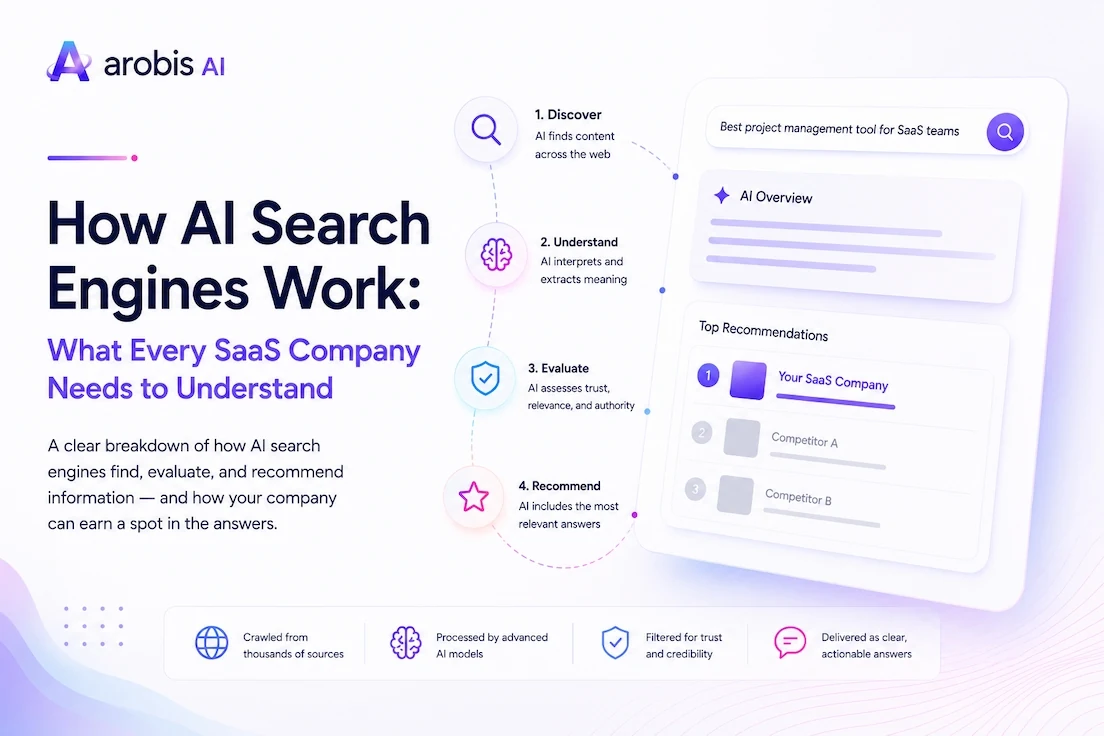
TL;DR: AI search engines like ChatGPT, Gemini, Claude, and Perplexity do not rank pages. They synthesize an opinion and recommend specific brands based on entity clarity, cross-source validation, and category association. Ranking well on Google does not guarantee a strong AI recommendation, because the two systems weigh different signals.
This article covers:
- How each of the five major AI search engines, ChatGPT, Gemini, Claude, Perplexity, and Copilot, forms recommendations
- The five universal signals that drive AI-generated answers across every platform
- Why traditional SEO knowledge does not transfer directly to AI search
- What monitoring tools can and cannot tell you
- What SaaS companies need to do differently to get recommended instead of ranked
The question SaaS marketers are still asking today is: "how do we rank higher?"
The question they should be asking is: "how do AI engines decide who to recommend?"
These are not the same question. They are not even close to the same discipline. And understanding the difference is now one of the most important strategic advantages a SaaS company can build.
AI search engines don't rank pages. They form opinions. And those opinions, expressed as recommendations in answer to buyer questions, are increasingly where SaaS buying journeys begin.
This guide explains exactly how AI search engines work, why they are fundamentally different from traditional search, and what SaaS companies need to understand about the recommendation model that determines who gets chosen.
The Fundamental Shift: From Rankings to Recommendations
Traditional search engines (Google, Bing) operate on a retrieval model. A query comes in. The engine searches an index of billions of pages. It ranks those pages by relevance and authority. It returns a list of links. The user clicks one.
That model is still operating. But it no longer captures the full picture of how software buyers discover, research, and shortlist vendors.
AI search engines operate on a synthesis model. A question comes in. The engine draws on everything it has learned from its training data, its retrieval systems, and its knowledge of how the world describes a given category. It synthesizes an answer. It recommends specific brands with specific context for specific use cases.
The user doesn't get a list of ten links. They get an opinion.
That opinion, expressed with confidence, specificity, and context, is what creates the AI-assisted buying journey. The Pre-Website Funnel is not a theory. It is what happens when a SaaS buyer asks ChatGPT "what's the best [category] software for a startup?" and acts on the recommendations before visiting any vendor website.
The data confirms this shift. AI-referred visitors convert at significantly higher rates than traditional organic visitors. They arrive pre-educated. They have already formed a preference. The visit is a confirmation step, not a discovery step.

The Five Major AI Search Engines and How Each Forms Recommendations
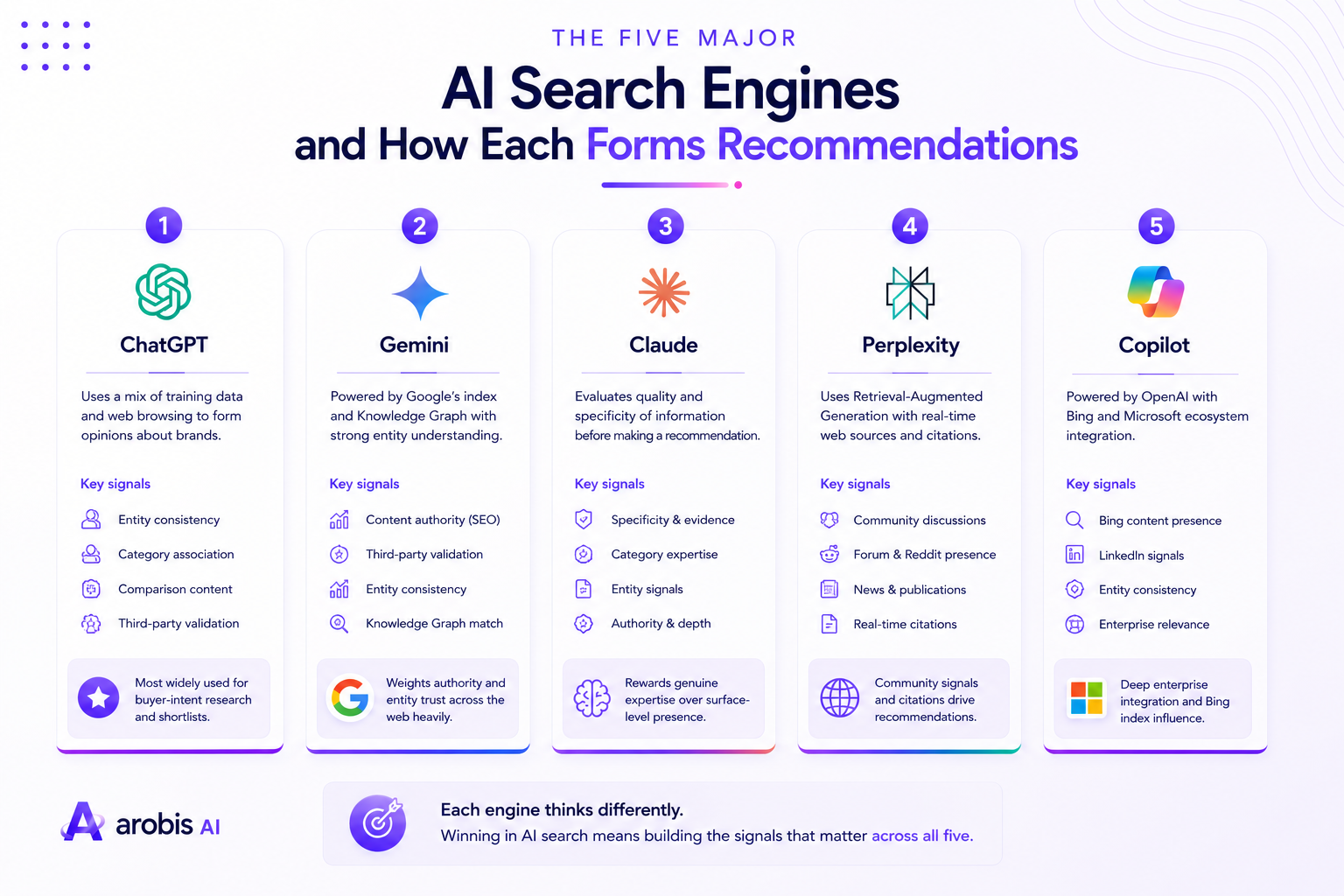
AI search is not a single platform. It is an ecosystem of five major engines, each with different retrieval mechanisms, different data sources, and different recommendation patterns. Understanding how each one works is the foundation for any serious AI Search Demand Generation strategy.
ChatGPT
ChatGPT is the most widely used AI search platform for research and comparison queries. Its recommendation model draws on a combination of training data (knowledge built into the model) and browsing capability (web access for current information).
ChatGPT forms opinions about brands based on how consistently and accurately they are described across everything it has encountered: its training corpus, the web pages it retrieves during browsing, and the patterns of how users and publications talk about a given category.
The mechanics of appearing in ChatGPT answers are specific: entity consistency across multiple sources, strong category association, comparison content that positions the brand clearly against alternatives, and third-party validation from sites ChatGPT treats as authoritative.
For SaaS demand generation, ChatGPT is the highest-priority platform because it is the most commonly used for buyer-intent research queries: the specific questions that form shortlists and influence purchasing decisions.
Gemini
Gemini is Google's AI search engine, and it operates with a significant structural advantage: deep integration with Google's web index. Gemini retrieves content from Google's index and synthesizes it using the Gemini language model, which means traditional SEO signals still matter, but they are not sufficient.
Gemini weights third-party validation heavily. It draws on Google's understanding of which sources are authoritative, which means brands that have earned coverage from publications Google trusts are more likely to be recommended. Gemini also integrates with Google's Knowledge Graph, which means entity signals (having a consistent, well-structured brand identity across the web) matter more for Gemini than for most other platforms.
Appearing in Gemini recommendations requires a combination of traditional content authority (because Gemini pulls from Google's index) and entity-level trust signals (because Gemini uses Google's knowledge systems to evaluate brand authority). Neither alone is sufficient.
Claude
Claude, built by Anthropic, has a distinctive reasoning approach that makes it particularly influential for complex, research-intensive buyer queries. Claude is more likely than other AI engines to evaluate the quality and specificity of available information before forming a recommendation, which means vague or generic brand descriptions are less likely to produce strong Claude recommendations than specific, well-evidenced positioning.
Getting recommended by Claude requires the same entity and authority signals as other platforms, but with additional emphasis on specificity and evidence quality. Claude's reasoning capability means it is more likely to distinguish between a brand with strong surface-level presence and a brand with genuine, well-documented category expertise.
Perplexity
Perplexity uses Retrieval-Augmented Generation, a mechanism that retrieves real-time web content and synthesizes it into answers with inline citations. Unlike ChatGPT's training-data-heavy approach, Perplexity is more dependent on what it can find right now, across a broad range of web sources including forums, community platforms, news sites, and specialist publications.
For SaaS demand generation, Perplexity's community signal weighting is particularly important. Brands that have genuine discussion on Reddit, Hacker News, community forums, and professional communities tend to perform better in Perplexity recommendations than brands relying entirely on their own published content.
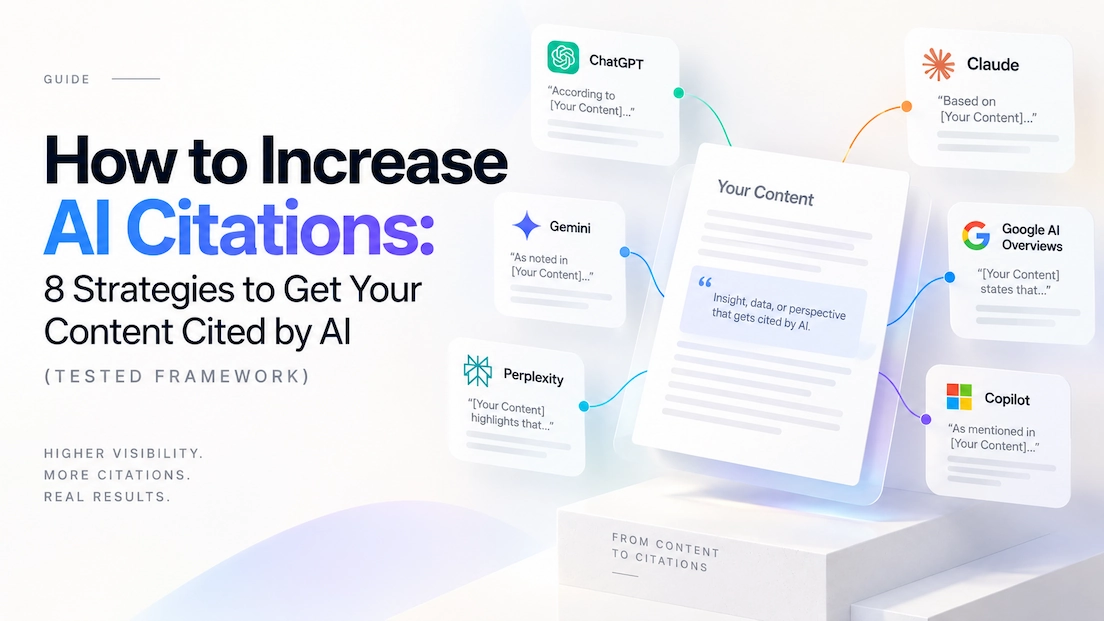
Perplexity also provides inline citations with every answer, which means appearing in Perplexity recommendations drives direct traffic in addition to influencing buyer opinions. Earning those citations is a process rather than luck, and we lay out the eight-step method for increasing AI citations we use on our own site.
Copilot
Microsoft Copilot, powered by OpenAI models with Bing integration, is particularly relevant for B2B SaaS demand generation because of its deep integration with Microsoft's enterprise ecosystem. Copilot appears in Windows, Microsoft 365, Edge, and Bing, meaning it is the AI search engine most commonly encountered by enterprise users during their normal workflow.
Copilot's recommendation model draws heavily on Bing's index, which means strong Bing presence matters more for Copilot than for other platforms. Entity signals from LinkedIn (also a Microsoft property) may influence Copilot's brand understanding more than they influence other AI engines.
What All AI Search Engines Share: The Five Universal Recommendation Signals
Despite their differences, all five major AI search engines draw on the same underlying signals when forming recommendations. Understanding these shared signals is what makes a unified AI Search Demand Generation strategy possible, rather than five separate platform-specific strategies.
Entity clarity is universal. Every AI engine forms better recommendations for brands that are clearly, consistently, and specifically described across multiple independent sources. A brand described differently in different places gives AI engines conflicting signals, and conflicting signals produce vague, hedging, or absent recommendations.
Cross-source validation is universal. Every AI engine is more likely to recommend a brand that appears across many independent, trusted sources than a brand whose authority is concentrated in its own published content. Third-party mentions, reviews, expert citations, community discussions, and publication coverage all contribute to the multi-source signal that makes a brand feel safe to recommend.
Traffic is a poor guide here: the domains with the most sway over AI search recommendations are often not the biggest sites. They are the sites AI engines treat as category-relevant trusted sources. Building presence on those domains is foundational Authority Engineering.
Category association specificity is universal. AI engines recommend brands for specific use cases, specific buyer types, and specific problems, not for generic category membership. Brands that have built content and positioning around specific, well-defined buyer situations will be recommended more accurately and more confidently than brands with generic category presence.
Competitive context is universal. AI engines understand how brands compare to each other. Brands that have established clear comparison content, explicit positioning against alternatives, and defined "best for" signals are recommended more confidently in competitive and comparison prompts than brands that have only self-described without competitive context.
Recommendation frequency momentum is universal. AI engines are influenced by how consistently a brand has been mentioned, cited, and recommended across their training data and retrieval systems. Brands that have been building authority signals consistently over time perform better than brands that published heavily in a short period and then stopped.
The 5 Universal AI Recommendation Signals
Every major AI search engine works differently, but they all rely on the same underlying trust signals when deciding which SaaS brands deserve a recommendation.
How AI Search Engines Differ: What SaaS Companies Must Understand
While the shared signals provide a foundation, the differences between AI engines require specific attention for SaaS companies serious about building recommendation authority across all five platforms.
The most important difference is in retrieval mechanism. ChatGPT draws more from training data (historical patterns), while Perplexity draws more from real-time web retrieval. This means a brand that has built strong training-data presence through consistent mentions in authoritative sources over time will perform differently from a brand that has built strong real-time web presence through recent publications and community discussions.
The ideal strategy covers both: long-term authority building that improves training-data signals, combined with ongoing publication and community presence that improves real-time retrieval signals.
Another critical difference is in community signal weighting. Perplexity draws heavily from Reddit, Quora, and community forums. Claude draws from high-quality publications with strong editorial standards. Gemini draws from Google's trusted source hierarchy. A SaaS brand that only publishes on its own website will perform differently across these platforms than one that has built genuine community presence and cross-publication authority.
The most common reason SaaS companies are invisible in AI search is not bad content. It is an authority footprint that is entirely self-built, with insufficient third-party validation signals to earn confident recommendations from any AI engine.
Why Traditional SEO Knowledge Does Not Transfer Directly
Most SaaS marketers come to AI search with a mental model built on traditional SEO: keyword rankings, page authority, backlink counts, organic traffic. These concepts have some relevance, but they do not map cleanly onto how AI search engines work.
In traditional SEO, ranking is the output. A page ranks well because it has strong signals (authority, relevance, user engagement) for a specific query. The user sees the ranked page and decides whether to click.
In AI search, recommendation is the output. The AI engine forms an opinion about which brand best answers a buyer's situation, drawing on entity signals, authority patterns, and cross-source validation, and presents that opinion as a recommendation. The user does not see the underlying signals. They see the conclusion.
AI Search Demand Generation is the discipline that bridges this gap, helping SaaS companies build the signals that AI engines use to form recommendations, rather than the signals they use to rank pages.
The difference between AI Search Demand Generation and GEO matters here. GEO optimizes content to appear in AI-generated results: a useful tactic. AI Search Demand Generation optimizes the entire brand authority footprint so AI engines are confident recommending the brand: a demand generation strategy. Appearing and being chosen are not the same outcome.
What Monitoring AI Visibility Cannot Tell You
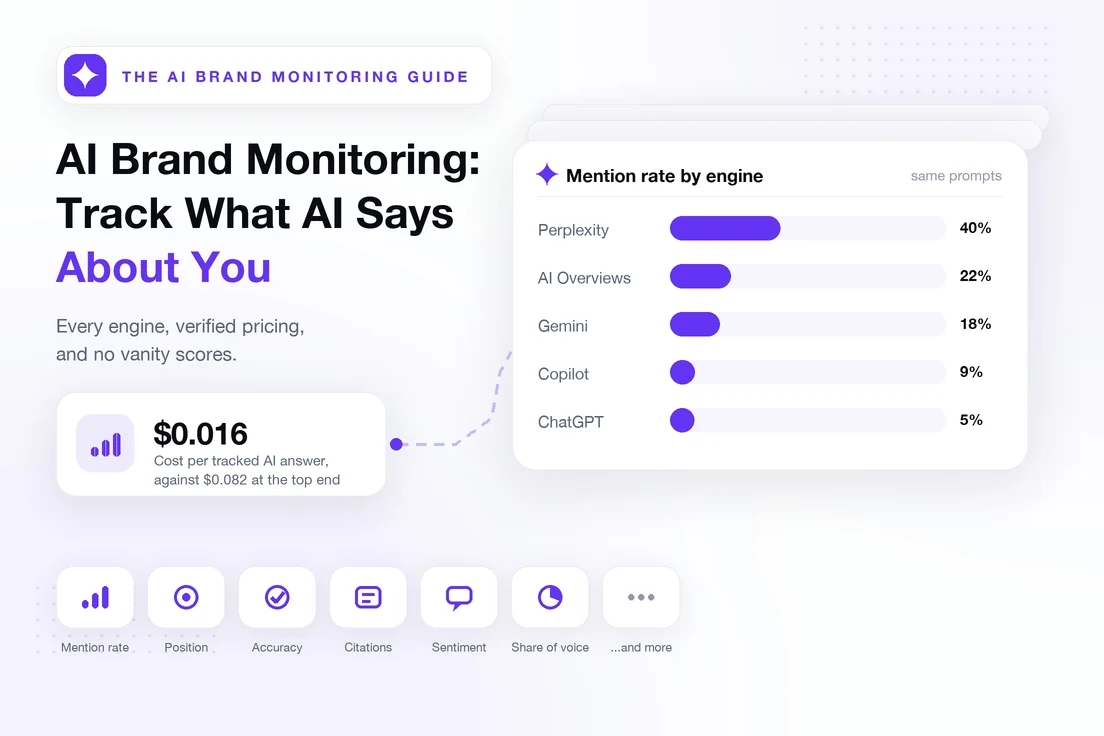
A category of tools has emerged to help SaaS companies track what AI engines say about them. Platforms like Profound and Peec AI answer the question: "what does AI say about us right now?" That is useful baseline intelligence in AI search visibility.
What monitoring cannot tell you is why AI engines are making the recommendations they make, and what would need to change for your brand to be recommended more frequently, more specifically, and with stronger positioning in buyer-facing answers.
Understanding how AI search engines form recommendations is the prerequisite for influencing them. Monitoring shows you the current score. Understanding the recommendation model shows you how to change it.
The Practical Implication for SaaS Demand Generation
The buyers who matter most (the ones actively researching tools, building shortlists, and influencing purchase decisions) are increasingly starting that process in an AI search engine, not a traditional search engine. They ask conversational questions. They receive recommendations. They form opinions before they visit a single website.
Studies of AI recommendation patterns in SaaS categories confirm that the brands recommended most frequently are not always the ones with the strongest Google rankings. They are the ones that have built the specific entity and authority signals AI engines use to form confident recommendations.
The Arobis AI Search 100 documents which SaaS brands are consistently recommended across ChatGPT, Gemini, Claude, and Perplexity, and the patterns behind that consistency are clear. Deliberate authority footprints. Strong entity signals. Cross-platform validation. Category ownership content. Competitive positioning assets.
The SaaS companies that understand how AI search engines work, and build their demand generation strategy accordingly, will gain a compounding advantage over those still optimizing for a model that reflects how buyers used to search, not how they search now.
Check your current AI recommendation position across ChatGPT, Gemini, Claude, and Perplexity to see where you stand relative to the brands being recommended in your category today.
An AI Visibility Audit goes further: it shows which of these signals your authority footprint lacks and puts the fixes in the order you should build them. For Google in particular, our guide covers how Google AI Mode retrieves and ranks content for SaaS queries, and a separate one shows how to see that traffic in your own analytics.
AI Search Is Becoming a SaaS Demand Channel
Buyers are using AI engines to research tools, compare vendors, and form shortlists before they ever visit a website.
Buyer discovery is moving upstream
High-intent buyers now ask conversational questions in ChatGPT, Gemini, Claude, and Perplexity. They receive recommendations and form opinions before clicking through to vendor websites.
Google rankings are no longer enough
The brands recommended most often in AI answers are not always the brands with the strongest traditional search rankings.
AI rewards authority signals
The Arobis AI Search 100 shows consistent patterns: deliberate authority footprints, strong entity signals, cross-platform validation, category ownership content, and competitive positioning assets.
The advantage compounds
SaaS companies that understand how AI search engines form recommendations can build demand generation strategies around how buyers search now, not how they searched five years ago.
Frequently Asked Questions
What is the difference between AI search engines and traditional search engines?
Traditional search engines retrieve and rank pages from an index. AI search engines synthesize information from multiple sources and form recommendations in direct answers. Traditional search returns links. AI search returns opinions. For SaaS demand generation, this means the goal is no longer to rank. It is to be recommended.
How does ChatGPT decide what to recommend?
ChatGPT forms recommendations based on patterns in its training data combined with real-time web browsing. Brands that appear consistently and accurately described across many trusted sources, with specific, well-defined positioning and clear category association, are more likely to receive confident ChatGPT recommendations than brands with inconsistent or self-concentrated authority signals. These signals often can be tracked using AI Visibility tools.
Why do some SaaS companies with strong Google rankings not appear in AI recommendations?
Google rankings depend primarily on page-level signals: content relevance, backlink authority, and user engagement. AI recommendations depend on entity-level signals: consistent brand description across multiple sources, third-party validation, and category association specificity. A brand can rank well on Google without the entity and authority signals needed for strong AI recommendations. This is the most common AI recommendation gap in SaaS today.
Should SaaS companies focus on one AI search engine or all of them?
The core entity and authority signals are shared across all major AI engines, which means a unified strategy benefits all platforms simultaneously. Platform-specific tactics, like community presence for Perplexity or Knowledge Graph optimization for Gemini, add incremental value on top of the shared foundation. Start with the shared signals, then layer in platform-specific optimization.
How is AI Search Demand Generation different from GEO?
GEO focuses primarily on optimizing content to appear in AI-generated answers: a content and structure strategy. AI Search Demand Generation is a broader demand generation approach that builds the entity signals, authority footprint, and recommendation patterns that make AI engines confident recommending a brand, not just citing it. GEO helps you appear. AI Search Demand Generation helps you get chosen.
How quickly are AI search engines becoming important for SaaS buying journeys?
Faster than most SaaS marketing teams have adapted to. AI-referred website visitors already convert at significantly higher rates than traditional organic search visitors, because they arrive pre-educated and pre-qualified from the AI recommendation. The percentage of SaaS buying journeys that begin in AI search is growing month over month. The brands building AI recommendation authority now will have a compounding head start as this channel matures.
What is the best starting point for improving AI search engine recommendations?
The best starting point is always an accurate baseline. Run your most important buyer-intent prompts across ChatGPT, Gemini, Claude, and Perplexity. Record which brands appear and how they are described. Identify the gap between how your brand is described and how it should be positioned. That gap analysis is the foundation of every effective AI Search Demand Generation strategy. An AI Visibility Audit structures this process and produces a prioritized roadmap for closing the gaps that matter most for pipeline.