
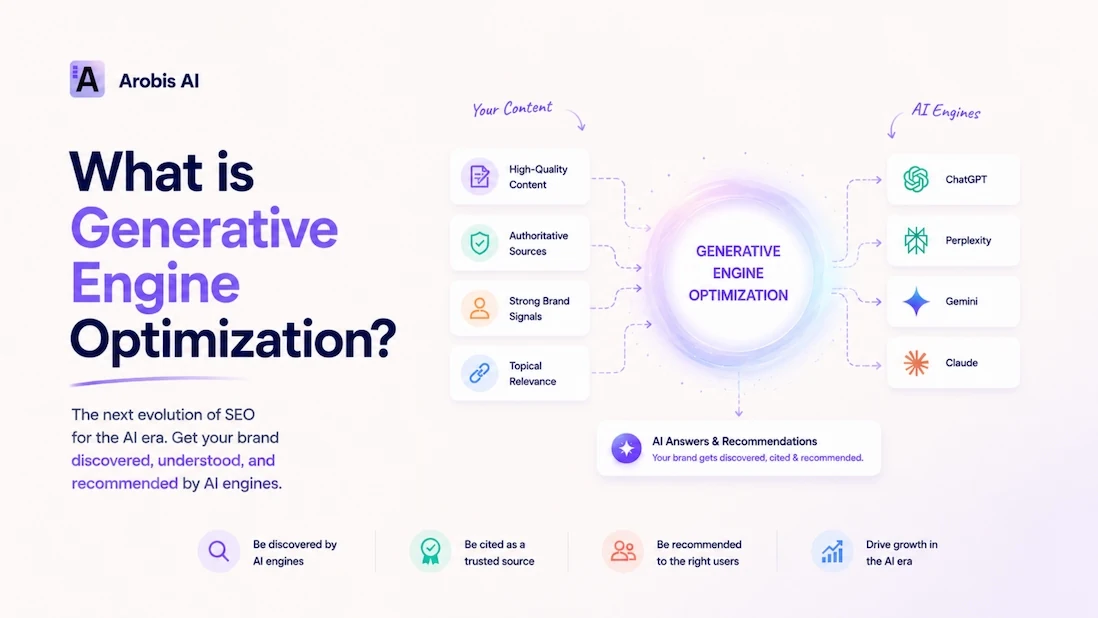
Generative Engine Optimization (GEO) is the practice of building the entity strength, content, and third-party corroboration that make generative AI engines — ChatGPT, Gemini, Perplexity, Claude, Copilot, and Google AI Overviews — mention, cite, and recommend your brand inside the answers they generate. Where SEO competes for a ranked link and classic marketing competes for a click, GEO competes to be named in the recommendation. This guide covers what GEO is, how generative engines decide who to name, and the exact framework B2B teams use to win AI visibility in 2026.
Last verified: October 1, 2026. Definitions and platform coverage below are checked against how ChatGPT, Gemini, Perplexity, Claude, Copilot, and Google AI Overviews currently describe GEO.
What Is Generative Engine Optimization (GEO)?
Generative Engine Optimization (GEO) is the discipline of optimizing your brand, content, and digital footprint so that generative AI systems reference and recommend you inside the responses they produce for user questions. (Also written "generative engine optimisation" in British English — same practice, different spelling.)
Traditional SEO optimizes a page to rank on a results screen. GEO optimizes an entire brand presence to be synthesized into an AI answer. The difference matters, because generative engines do not hand the user a list of links to choose from — they hand over a finished answer, often naming a small set of brands. GEO is how you become one of those named brands.
Put plainly: SEO helps people find you. GEO helps AI recommend you. In a search world increasingly mediated by assistants, the recommendation is where the buying decision is shaped. GEO is the twin discipline of Answer Engine Optimization (AEO) — we explain exactly how they relate below — and together they form the core of modern AI visibility. If you want the wider overview first, start with our AI visibility guide.
A Short History: From Ranking Pages to Generating Answers
For two decades, search was a ranked list of links. You optimized a page with keywords and backlinks, climbed the results, and earned clicks. The web was built to be ranked.
Generative AI broke that model in three steps. First, large language models learned to synthesize answers from vast swaths of the web rather than point at pages. Second, those models were wired to live retrieval, so they could pull current sources at query time and cite them. Third, hundreds of millions of people made assistants their first stop for research and buying questions — asking full questions and accepting a synthesized answer instead of scrolling ten links.
Each step moved value from the ranked page to the generated recommendation. GEO is the discipline that grew up to win in that environment. It does not discard SEO — it still needs a crawlable, indexed, authoritative web — but it changes the objective from "rank this page" to "be the brand the model names." Understanding that lineage matters, because it explains why GEO leans so heavily on entities and corroboration rather than keywords and links.
Why GEO Matters More Than Ever in 2026
Search behavior has shifted from keywords to conversations. Instead of typing "best CRM software," buyers now ask, "What's the best CRM for a 30-person B2B SaaS startup?" — and expect a named shortlist with reasons attached.
That shift is not marginal. It changes who wins:
- When a generative engine answers a buying question, it typically names only a handful of brands. Those brands capture the consideration set; everyone else is invisible.
- A large and growing share of B2B software research now begins inside an AI assistant rather than a search bar, according to widely-cited 2025–26 buyer surveys.
- Buyers who arrive after an AI recommendation tend to be further along — pre-educated and partly pre-sold — which is why GEO is a demand channel, not a vanity metric.
We keep the sourced numbers current in our AI search statistics roundup and the deeper 100 AI search statistics research report, and we track the category-wide movement in the State of AI Search Visibility. For the strategic view of what this does to go-to-market, see how AI search changes SaaS marketing forever.
There is also a first-mover advantage baked into GEO. Each time an engine names you, that mention becomes part of the evidence the next model reads and grounds its answers on. Brands that build authority now are seeding the data that shapes tomorrow's recommendations — an advantage that compounds instead of decaying.
GEO vs SEO vs AEO: The Clean Distinction
These three terms get blurred constantly, so here is the difference in plain language.
SEO (Search Engine Optimization) optimizes pages to rank on a search results screen. The goal is position and clicks; the levers are keywords and backlinks.
AEO (Answer Engine Optimization) optimizes content to be extracted into a direct answer — in AI assistants, featured snippets, and voice results. The goal is being quoted. Our full AEO guide covers the extraction side in depth.
GEO (Generative Engine Optimization) optimizes your whole brand presence to be mentioned and recommended inside generative LLM responses. The goal is being named and trusted, not just quoted once.
Here is the side-by-side:
- Goal — SEO: rank a page. AEO: be the extracted answer. GEO: be the recommended brand.
- Unit of visibility — SEO: a URL. AEO: a quoted passage. GEO: a brand mention or citation.
- Primary lever — SEO: keywords and links. AEO: structure and extractability. GEO: entity strength and third-party corroboration.
- Query style — SEO: short keywords. AEO/GEO: full conversational questions.
- Success metric — SEO: rankings and clicks. AEO: citation of a passage. GEO: share of AI recommendations.
The honest summary: AEO and GEO overlap heavily and most teams run them as one program. AEO leans toward "make this passage easy to lift"; GEO leans toward "make this brand safe to recommend." You need both, plus the SEO foundation that still feeds the index these engines retrieve from. For the argument about where classic search is heading, see why traditional SEO is dying, and for the service-model angle, SaaS SEO agency vs AI search demand generation.
If you'd rather have one accountable owner for both surfaces, that's exactly what a SaaS SEO agency built for the AI era should deliver.
How Generative Engines Actually Work
To optimize for generative engines, you have to understand what they do differently from Google. They do not rank pages. They synthesize an answer.
When a buyer asks Perplexity or ChatGPT "what's the best help desk for a small SaaS team," the engine does not return a ranked list. It forms a view — drawing on everything it has encountered about help desks, small teams, what practitioners recommend, and which brands appear consistently in trusted contexts — and then writes a synthesized answer, sometimes with citations underneath.
Two mechanisms feed that synthesis. The first is the model's trained knowledge: patterns absorbed from the web during training. The second is live retrieval: the engine fetches current pages at query time (ChatGPT and Copilot lean heavily on Bing's index here, Gemini and AI Overviews on Google's). GEO has to influence both — the long-term training signal and the real-time retrieval layer. We break the mechanics down further in how AI search engines work, and the per-engine differences in how ChatGPT, Claude, and Gemini differ in search behavior.
The reassuring part: generative engines rarely invent recommendations from nothing. They reflect what the web already says about you. That means GEO is influenceable — a set of deliberate signals, not a black box. Exactly how those signals turn into a named recommendation is detailed in how Perplexity, ChatGPT, Claude, and Gemini choose which brands to mention.
Why Generative Engines Trust Some Brands and Not Others
Underneath the mechanics sits a single driver: risk avoidance. A generative engine is optimizing to not be wrong, because a confident wrong recommendation is far more damaging to it than a cautious one. So it gravitates toward brands it can describe confidently and defend with evidence.
That is why demonstrable trust — experience, expertise, authority, and trustworthiness — is the real currency of GEO. An engine is more willing to name a brand when it sees first-hand substance (original data, specifics, real detail), clear expertise (depth and correctness), independent authority (other sources referencing the brand), and consistency (the same story everywhere, with no contradictions).
The flip side explains a lot of invisibility. Thin, self-referential, or contradictory content gives the model nothing safe to stand on, so it hedges or omits you. This is the deeper reason so many brands with decent Google rankings still vanish in AI answers — their authority is entirely self-built, with no independent corroboration for the model to trust. One of they key component is adding an llms.txt file to your webiste.
The Signals That Drive GEO Visibility
Generative engines weigh a consistent set of signals when deciding which brands to name. These are the levers GEO pulls.
1. Entity strength
Can the engine confidently say who you are, what you do, and who you serve? Brands with a strong, consistent entity get named clearly; brands with a fuzzy entity get vague, hedged descriptions or get skipped. Entity strength is the single most important GEO signal, which is why it gets its own section below.
2. Topical authority
Engines favor brands that demonstrably own a topic — via pillar pages, guides, comparisons, and original research — over brands with a few scattered posts. Depth signals expertise.
3. Citation frequency
Brands referenced repeatedly across independent sources — blogs, reviews, directories, podcasts, forums, news — build stronger trust than brands that only appear on their own site. Recurrence is evidence.
4. Semantic relevance
Engines understand relationships between concepts, not just exact keywords. Content that naturally covers related concepts, context, and industry language reads as more relevant than keyword-stuffed pages.
5. Cross-source corroboration
Models are cautious about claims a brand only makes about itself. When the same positioning appears across independent sources, the brand becomes safe to recommend. We unpack this trust mechanic in the 5 signals AI engines use to recommend brands.
6. Recency and momentum
Recent citations are weighted more heavily than old ones. A brand actively building its footprint over the last year gets recommended more than one that went quiet after 2023.
Entity SEO: The Core of GEO
If you take one idea from this guide, make it this: GEO is won or lost on your entity. An entity is the structured understanding an AI system holds about your brand — what you are, what category you belong to, who you serve, and what you are known for.
Strong entities get confidently recommended. Weak or contradictory entities get vague descriptions or silence. The most common failure in SaaS is inconsistency: a company describes itself as an "AI customer success platform" on its site, a "support automation tool" on G2, and "helpdesk software" in a directory. That is three different category signals, and the result is an uncertain AI description that rarely converts into a strong recommendation.
Building entity strength means making your description, category, and core use cases consistent everywhere a model can see you: your website, LinkedIn, G2 and Capterra, directories, press, and third-party profiles. The goal is that every source tells the same story. This coherent, referenceable identity is the foundation of what we call AI recommendation authority — the difference between being cited in passing and being actively recommended.
Strengthening Your Entity: A Practical Walkthrough
Because entity strength is the highest-leverage GEO signal, it is worth making concrete. Here is how to move from a fuzzy entity to one an engine can name with confidence.
Start with a one-sentence identity. Write a single, specific sentence that says what you are, the category you belong to, and exactly who you serve — for example, "an AI-powered contract-management platform for mid-market legal teams." Specific beats broad: "for mid-market legal teams" is a stronger entity signal than "for businesses."
Audit every place a model sees you. List your website, LinkedIn, G2, Capterra, other directories, Crunchbase, press coverage, and any partner profiles. Read how each one describes you. In most SaaS companies these descriptions have drifted apart over time, sending the model conflicting category signals.
Reconcile to one story. Update each surface so the description, category, and core use cases match your identity sentence. You do not need identical wording everywhere, but the meaning — what you are and who you serve — must be consistent. This single cleanup often produces the fastest visible change in how engines describe you.
Reinforce with structure. Add Organization schema that names your brand, category, and key attributes, and make sure your homepage and about page state the identity plainly in text a crawler can read. Engines cross-check your self-description against what others say; give them a clear anchor to start from.
Then earn third-party echoes. Once your own surfaces agree, pursue the independent mentions — reviews, articles, community discussion — that repeat the same positioning. When the model sees a consistent story on your properties and hears it echoed by independent sources, the entity becomes strong enough to support a confident recommendation.
An entity built this way does more than help one page. It raises your odds of being named across every prompt in your category, because the model finally understands — and trusts — who you are.
How to Do GEO: A Step-by-Step Framework
Here is the operational sequence we use with clients.
Step 1 — Map the prompts your buyers actually use
Start from real questions, not head keywords. List what a buyer types into an assistant at each stage: category education ("what is X?"), problem framing ("how do I solve Y?"), and shortlisting ("best X for a mid-market SaaS company"). These prompts are your GEO targets.
Step 2 — Baseline where you appear today
Run those prompts across the major engines and record whether you are named, cited, or absent — and who appears instead. Start free with the Arobis AI Visibility Checker, or go deeper with a full AI visibility audit (here's what an AI visibility audit is, if the term is new).
Step 3 — Fix your entity
Standardize your description, category, and use cases across your site and every external profile. This is the highest-leverage GEO work and it is mostly cleanup, not new content.
Step 4 — Build category-owning content
Publish the pillar pages, comparisons, and educational assets that make you the authoritative source for your topic. Engines recommend brands that teach the category, not just describe a product.
Step 5 — Earn cross-source corroboration
Pursue reviews, mentions, editorial coverage, and authentic community presence so the model sees your positioning echoed by independent sources. This is where GEO becomes demand generation rather than on-page tuning.
Step 6 — Measure and iterate
Re-run your prompt baseline on a cadence, track recommendation share, and expand your cluster to cover adjacent questions. GEO compounds; the earlier you start, the wider your lead.
GEO Content Strategy: Clusters, Not One-Offs
Isolated articles rarely build the authority generative engines reward. Interconnected topic clusters do. A pillar page (like this one) surrounded by focused supporting pieces tells engines you own a subject end to end.
In practice, that means anchoring each cluster with a definitive pillar, then linking outward to depth pieces. This GEO pillar, for example, connects to engine-specific playbooks — how to rank in ChatGPT, how to rank in Google Gemini, how to rank in Perplexity, how to rank in Claude, how to rank in Microsoft Copilot, and how to rank in Google AI Overviews — plus deeper mechanics like what AI crawlers actually read.
The content itself should be AI-native: educational, experience-driven, semantically rich, and genuinely useful. Thin, generic AI filler is the opposite of what generative engines cite, because it adds no information gain worth quoting. We show what that looks like in practice, with dated results from our own site, in eight strategies to get content cited by AI.
A Worked GEO Example: From Invisible to Recommended
Consider a B2B SaaS company selling contract-management software that never appears when buyers ask AI, "What's the best contract management tool for a mid-market legal team?" Here is how a GEO program turns that around.
The baseline audit shows the brand is absent across ChatGPT, Perplexity, and Gemini, while three competitors appear consistently. Digging in reveals the root causes: the company describes itself three different ways across its site, G2, and directories; it has no comparison content; and almost every source discussing it is the company's own blog. The entity is fuzzy and the corroboration is thin — a textbook GEO failure.
The fix runs in order. First, the team standardizes its description and category everywhere, so the model finally understands what the product is and who it serves. Next, it publishes a category pillar plus honest comparison pages against the three competitors, giving engines a clear map of where it fits. Then it earns independent signals — G2 reviews, a couple of earned articles, and authentic participation in legal-ops communities — so the positioning is echoed by sources the model trusts. Finally, the team tracks recommendation share weekly and doubles down on the prompts where movement appears first.
Within a couple of months, the brand starts surfacing in mid-funnel prompts, then in shortlist prompts. Nothing here was magic: a clear entity, category-owning content, and independent corroboration made the brand safe to recommend. That is GEO working exactly as designed.
To track your brand AI visibility check out some of the best Copilot rank trackers here!
Why GEO Is Mission-Critical for B2B SaaS
SaaS is the category most exposed to generative search, because software buyers were early adopters of AI research. They now ask assistants for category overviews, vendor shortlists, feature comparisons, pricing ranges, and implementation advice — often before visiting a single vendor site.
That makes the generative answer the new top of your funnel. If a buyer asks for "the best tools for X" and a competitor is named while you are not, the deal narrowed before a rep was involved. This is the exact problem we solve on our AI visibility for SaaS page — and it is why GEO is really a form of AI search demand generation, not a technical checkbox.
There is a critical nuance here: being mentioned is not the same as being recommended. Many brands now appear somewhere in AI answers but never as the confident pick. Closing that gap is the whole game — we cover it for leadership in the CMO guide to AI recommendation share, and for product-level mechanics in how AI analyzes, recommends, and ranks SaaS products. The brands already winning are mapped in our 100 companies dominating AI discovery study.
The Business Case for GEO: Why Recommendations Beat Clicks
GEO can look like a soft, hard-to-measure channel next to paid ads or classic SEO. It is not — it is arguably higher-intent than either. The reason is where it sits in the buyer's decision.
When a buyer asks an assistant "what's the best tool for X," they are not browsing; they are asking for a decision. The brands named in that answer are handed a level of trust no ad can buy, because the recommendation appears to come from a neutral source the buyer already relies on. A buyer who arrives after that recommendation is pre-educated, pre-qualified, and partially pre-sold — which is why AI-referred buyers tend to convert at higher rates than cold organic or paid traffic.
There is also a compounding cost advantage. Paid demand stops the moment you stop paying. GEO authority, once built, keeps working: your entity stays clear, your content keeps getting cited, and each citation strengthens the next. It behaves more like an appreciating asset than a recurring expense.
The strategic risk is inaction. In most B2B categories, only a few brands own the AI recommendation today, and that lead compounds. Every quarter you are absent, competitors accumulate the citations and entity strength that make them the default answer — a gap that gets more expensive to close the longer it is left. That is the real business case for GEO: it is cheaper to become the recommended brand now than to displace an entrenched one later.
Technical GEO: Crawlers, Schema, and the llms.txt Question
Content and entity work carry most of the weight, but the technical layer decides whether engines can reach and trust you.
- Crawler access. Generative engines use specific bots. To appear in ChatGPT's search answers, its search crawler needs access; to be in the model's broader knowledge, its training crawler needs access. Accidentally blocking them is a common, self-inflicted invisibility problem.
- Schema markup. Organization, Article, FAQPage, Product, and Breadcrumb schema tell engines exactly what your content and brand mean. Structured data improves both rich-result eligibility and machine interpretation.
- Bing indexing. Because a large share of ChatGPT and Copilot citations trace back to Bing's index, verifying your site in Bing Webmaster Tools is one of the cheapest, highest-return GEO moves available.
- Clean, semantic HTML. Real headings, lists, and text — not content trapped in images or heavy JavaScript — keep you retrievable and quotable.
- The llms.txt reality check. The proposed llms.txt file is a popular GEO talking point, but as of 2026 Google has said it does not use it and no major provider has confirmed it changes citations. Add it if you like — it is harmless — but do not prioritize it over entity, content, and corroboration.
Off-Site GEO: Digital PR and Corroboration
Because generative engines trust independent sources more than self-published claims, off-site presence is a core GEO lever, not a nice-to-have. The brands that get recommended are the ones whose positioning is echoed across the web.
That means earning reviews on G2, Capterra, and TrustRadius; getting cited in trusted publications and newsletters; appearing on podcasts; and showing up authentically in the communities where your buyers talk. Community platforms matter more than most teams expect — see our Reddit guide for SaaS — and not every high-traffic site carries equal weight, which is why we analyzed the most influential domains in AI search rankings. Comparison content is especially powerful here: a clear, honest platform comparison tells engines exactly how you relate to alternatives.
GEO Content Formats That Win Recommendations
Some formats are simply easier for generative engines to use. Prioritize these:
- Definitions and explainers — the standalone "what is X" answer that anchors a topic.
- Comparisons — "X vs Y" pages that lay out differences cleanly and honestly.
- Roundups — "best tools for X," such as our 17 best AI visibility tools and best free AI visibility tools.
- Original research — proprietary data that other sources cite, which is GEO gold because it earns corroboration.
- Landing and product pages — often quoted at the decision stage; here's why AI search engines prefer your product and landing pages.
Newer surfaces matter too. Google AI Mode is becoming its own battleground — see Google AI Mode for SaaS for how to prepare.
GEO by Engine: What Each Generative Engine Rewards
The GEO fundamentals are universal, but each engine has tendencies worth tuning for.
- ChatGPT leans on retrieval that overlaps heavily with Bing's index and on strong third-party corroboration — review sites especially matter for software. Bing indexing is one of the highest-ROI GEO moves you can make.
- Perplexity is citation-first: it rewards clearly sourced, well-structured pages it can quote and link with confidence, so clean structure and factual precision pay off.
- Google Gemini blends Google's index with Google's entity understanding, so a clear, consistent entity across the web is decisive.
- Google AI Overviews and AI Mode build directly on Google's index — classic SEO fundamentals plus answer-first structure carry straight over.
- Microsoft Copilot is Bing-powered, so Bing Webmaster Tools indexing and clean, structured pages are the levers.
- Claude is increasingly used for considered research and vendor evaluation, rewarding depth, accuracy, and trustworthy sourcing over volume.
You do not need six separate strategies. Build one strong GEO foundation — entity, content, corroboration — then tune per engine using the how-to-rank guides linked throughout this article.
How to Measure GEO Success
GEO needs its own metrics, because clicks alone understate it. Track:
- Recommendation share of voice — how often you are named versus competitors across buying prompts.
- Citation rate — how often engines cite your site as a source.
- Mention rate — how often your brand is named, cited or not.
- Recommendation position — whether you appear first, in the middle, or last.
- Sentiment — whether the model describes you positively, neutrally, or negatively.
- AI referral traffic — visits arriving from ChatGPT, Perplexity, Gemini, and similar sources.
If you are absent across the board, diagnose the cause first. Our guides on why your brand doesn't appear in AI answers and the 10 reasons your brand never appears in ChatGPT cover the usual culprits, from crawler blocks to weak corroboration.
Common GEO Mistakes to Avoid
- Ignoring entity consistency. Conflicting descriptions across sources are the number-one reason brands get vague AI treatment.
- Optimizing only for broad category terms. Being named in "what is X" is not the same as being recommended in "best X for a 50-person SaaS company," where shortlists actually form.
- Relying only on self-published content. Without third-party corroboration, models hesitate to recommend you.
- Keyword stuffing. It lowers semantic quality and does nothing for generative visibility.
- Avoiding comparison content. Skip it and competitors define the category — and win every comparison prompt.
- Measuring the wrong thing. Tracking whether you appear at all, instead of recommendation frequency, creates a false sense of progress.
- Treating GEO as one-and-done. Answers shift as models and the web update; GEO is a maintained system.
GEO Myths vs Reality
GEO is young enough that misconceptions spread faster than best practices. A few worth correcting:
- Myth: "GEO is just SEO rebranded." Reality: they share foundations, but GEO's core levers — entity strength and cross-source corroboration — are not classic SEO levers, and its goal is a recommendation, not a ranking.
- Myth: "You need a huge domain to get recommended." Reality: generative engines regularly recommend focused, well-corroborated brands over larger but fuzzier ones. A clear entity and independent validation can beat raw domain authority.
- Myth: "Publishing more content is the answer." Reality: volume without entity clarity and corroboration produces citations in passing, not recommendations. One original research asset or honest comparison outperforms fifty generic posts.
- Myth: "Add llms.txt and you're optimized." Reality: llms.txt is unproven as a ranking lever. Entity, content depth, and corroboration do the real work.
- Myth: "GEO is set-and-forget." Reality: models and the web change constantly, and recency is weighted — GEO is a maintained program, not a one-time push.
The pattern behind the myths is the same: they overweight tactics you can do alone on your own site and underweight the two things that actually move recommendations — a coherent entity and independent corroboration.
GEO or AEO: Which Should You Focus On?
This is the most common question we get, so here is the direct answer: you do not choose. GEO and AEO are two lenses on the same goal — being present and recommended in AI answers — and they share almost all of the same foundations (crawlability, structure, entities, schema, corroboration).
The practical framing: use AEO discipline to make individual pages easy to extract and quote, and use GEO discipline to make your whole brand safe to recommend. One strong foundation serves both. Run them as a single AI visibility program, then tune per engine using the how-to-rank guides linked throughout this article.
The GEO Quick-Start Checklist
Use this as a pre-publish and quarterly checklist. A brand that passes all of these is dramatically more likely to be recommended:
- Your description, category, and core use cases are identical across your site, LinkedIn, G2, Capterra, and directories.
- Every priority page opens with a clear, self-contained answer to its core question.
- Content is organized into topic clusters with a strong pillar page linking to depth pieces.
- Organization, Article, and FAQPage schema are deployed sitewide.
- Your site is verified and indexed in Bing Webmaster Tools, and AI crawlers are not blocked.
- You have honest comparison content covering your main alternatives.
- You are actively earning third-party mentions and reviews, not just publishing.
- You measure recommendation share of voice on a set cadence, not just traffic.
The Future of GEO: Agentic Search and Zero-Click
Two shifts will define the next phase. First, zero-click keeps growing — more answers are delivered without a visit, so being named in the answer, not just ranked below it, becomes the entire objective. Second, agentic search is arriving: AI agents that don't just answer but act, comparing vendors and even initiating purchases on a user's behalf.
Both raise the premium on being the well-structured, well-corroborated brand an engine reaches for by default. When an agent shortlists vendors for a buyer, the brand with the clearest machine-readable identity and the strongest independent validation wins automatically. Teams that build GEO foundations now will compound their lead as these surfaces mature — and the gap between the recommended and the invisible will only widen.
A 90-Day GEO Roadmap
GEO can feel abstract, so here is a concrete quarter that produces measurable movement without a large team or budget.
- Days 1–15: Baseline and diagnose. Define your 10–20 most important buyer-intent prompts, run them across ChatGPT, Gemini, Perplexity, and Copilot, and record where you appear, how you are described, and who wins instead. Confirm AI crawlers are not blocked and verify your site in Bing Webmaster Tools.
- Days 16–35: Fix the entity. Standardize your description, category, and core use cases across your website, LinkedIn, G2, Capterra, and directories. Deploy Organization, Article, and FAQPage schema. This alone often sharpens how engines describe you.
- Days 36–60: Build category-owning content. Publish or upgrade your pillar page and the two or three comparison pages that cover your main alternatives. Structure everything answer-first and interlink it as a cluster.
- Days 61–80: Earn corroboration. Pursue reviews, a few earned mentions, and authentic community presence so independent sources start echoing your positioning.
- Days 81–90: Re-measure and prioritize. Re-run the prompt baseline, compare recommendation share against day one, and double down on the prompts and pages showing the most movement.
Ninety days will not make you category-dominant, but it moves you from guessing to measuring, fixes the entity and corroboration gaps that keep most brands invisible, and gives you a compounding loop to build on.
How Arobis AI Helps You Win GEO
Arobis AI is an AI Search Demand Generation agency built specifically for B2B SaaS. The full program is laid out on our GEO agency for B2B SaaS page, with the answer-engine half handled by its sister AEO agency for SaaS. A quick technical first step you can take today: create an llms.txt file with our free llms.txt generator. Rather than only reporting what AI says about your brand, we work to change it — so ChatGPT, Gemini, Claude, Perplexity, Copilot, and Google AI Overviews recommend you instead of a competitor.
Our approach combines GEO, AEO, entity optimization, semantic authority, and off-site corroboration into a single demand-generation motion. When you are ready to see how we engage, our pricing page lays out the options, and if you'd rather compare specialist partners, we maintain lists of the best GEO agencies and the broader best SEO, GEO, and AEO agencies for SaaS.
Because in the era of AI search, visibility is no longer about being found — it is about being recommended. And one of the things you can do about it TODAY is measuring the traffic GEO actually generates using the tools you already have like GA-4 and GSC.
Frequently Asked Questions
What is generative engine optimization?
Generative Engine Optimization (GEO) is the practice of optimizing your brand, content, and digital footprint so that generative AI systems like ChatGPT, Gemini, Perplexity, and Google AI Overviews reference and recommend you inside the answers they generate, rather than just ranking you in a list of links.
What is generative engine optimisation?
Generative engine optimisation is the British English spelling of Generative Engine Optimization (GEO). It refers to the exact same practice: optimizing your brand and content so generative AI engines mention and recommend you.
What does GEO stand for?
GEO stands for Generative Engine Optimization. It is the practice of optimizing your brand, content, and digital presence so generative AI engines mention, cite, and recommend you inside their answers.
Is GEO replacing SEO?
No. GEO complements SEO. Traditional search still feeds the index that generative engines retrieve from, so you need both: SEO to be findable and GEO to be recommended. The emphasis is simply shifting toward the AI answer layer.
What is the difference between GEO and AEO?
They overlap heavily and are usually run together. AEO focuses on making content easy to extract into a direct answer; GEO focuses on making your whole brand safe to mention and recommend inside generative responses. Same foundations, slightly different emphasis.
Which platforms does GEO apply to?
ChatGPT, Google Gemini, Google AI Overviews and AI Mode, Perplexity, Claude, Microsoft Copilot, and emerging generative discovery systems.
Why is entity SEO so important for GEO?
Generative engines recommend brands they can confidently describe. A strong, consistent entity — the same description, category, and use cases everywhere — lets the model place you accurately and name you with confidence. A weak or contradictory entity leads to vague descriptions or omission.
How long does GEO take to work?
Entity fixes and structural work can influence answers within weeks as pages are re-crawled. Building the corroboration and authority that drive consistent recommendations typically takes a few months, then compounds.
How do I measure GEO results?
Track recommendation share of voice, citation rate, mention rate, recommendation position, sentiment, and AI referral traffic across a defined set of buyer-intent prompts — not just organic clicks.
Can I do GEO on a small budget?
Yes. The highest-leverage GEO work — entity consistency, structured content, schema, and Bing indexing — is mostly effort, not spend. Corroboration takes time more than money. Start with your existing money pages and top content before creating anything new.
Is GEO worth it for B2B SaaS specifically?
Yes. SaaS buyers are among the heaviest users of AI to shortlist vendors, so the generative answer is now a primary, high-intent top-of-funnel channel — arguably the highest-intent one most teams are not yet measuring.
Does GEO help with traditional Google rankings too?
Often, yes. The work GEO demands — a clear entity, deep topical content, strong structure, and independent corroboration — overlaps heavily with what modern SEO and Google AI Overviews reward. A solid GEO program tends to lift classic search visibility as a side effect.
What's the single highest-leverage GEO action?
Fixing entity consistency. Making your description, category, and use cases identical everywhere a model can see you is low-cost, fast, and frequently the difference between a vague AI description and a confident recommendation.
How is GEO different from digital PR?
Digital PR is one input to GEO. GEO uses PR-style corroboration alongside entity optimization, structured content, technical retrievability, and measurement — all aimed specifically at how generative engines form recommendations, not at coverage for its own sake.
Final Thoughts
Search is no longer confined to search engines. AI-generated discovery is reshaping how buyers research products, compare software, and decide who to trust — and it rewards a different kind of work than classic SEO.
Generative Engine Optimization is how brands stay visible in that world: a strong, consistent entity, deep topical content, clean technical foundations, and genuine third-party corroboration, all pointing at one coherent story. Get those right and you become the brand AI names by default. The companies that adapt early will own the next generation of discovery — because in the era of AI search, being found is no longer enough. You have to be recommended.