
What AI Crawlers Actually Read (And What They Skip): A SaaS Marketer's Technical Guide
TL;DR: AI crawlers do not read your website the way humans do. They prioritize structured, semantically clear, entity-rich content that directly answers buyer questions. Most SaaS websites are optimized for human readers and Google bots, not for the AI engines that increasingly influence buying decisions. This guide explains exactly what AI crawlers read, what they skip, and what SaaS brands need to change to get cited and recommended.
Key Takeaways
- AI crawlers prioritize direct-answer content over long-form narrative
- Structured data, clean HTML, and semantic markup significantly increase AI citation potential
- Your homepage, product pages, and landing pages matter more to AI crawlers than your blog posts
- Entity signals across your entire web presence matter more than any single page
- Most SaaS websites have 3 to 5 critical crawlability gaps that block AI recommendations entirely
- Fixing what AI crawlers skip is faster than creating new content from scratch
Why AI Crawlers Are Not the Same as Google Bots
Most SaaS marketing teams think about crawlability in terms of Google. Googlebot, site speed, canonical tags, XML sitemaps. That mental model made sense for the last decade.
It no longer covers the full picture.
Today your website is being read by a different class of crawler entirely. ChatGPT, Gemini, Perplexity, Claude, and Copilot all use crawlers, retrieval systems, or training pipelines to process web content. And what they prioritize is fundamentally different from what Google Bot values.
Google ranks pages. AI engines synthesize answers. That difference changes everything about what gets read, what gets cited, and what gets recommended to buyers.
Understanding how AI engines choose which brands to mention starts with understanding what their crawlers can actually access on your site. If they cannot read it, they cannot cite it. If they cannot cite it, they cannot recommend you.

How AI Crawlers Work: A Plain-Language Overview
AI crawlers operate differently depending on the platform, but they share a common goal: extract meaningful, structured information that can be used to answer questions accurately.
Perplexity uses real-time web crawling to retrieve current content at the moment a query is run. It pulls from indexed sources and ranks them by relevance and credibility before synthesizing an answer.
ChatGPT with web browsing enabled uses a similar retrieval approach for real-time queries. Its base model was trained on a large corpus of web content, which means the information architecture of your historical web presence also matters.
Google Gemini integrates tightly with Google's own indexing infrastructure, which means everything Google can crawl, Gemini can potentially use. This makes technical SEO hygiene directly relevant to Gemini citation outcomes.
Claude uses a combination of training data and, in retrieval-augmented contexts, live document processing. Content quality and structural clarity carry significant weight in how Claude interprets and cites sources.
The common thread across all of them: clean, structured, semantically clear content wins. Noise, clutter, and poorly organized pages lose.
This is explored in detail in the comparison of ChatGPT, Claude, and Gemini search behavior. Each platform weights signals differently, but all of them reward the same underlying content quality.
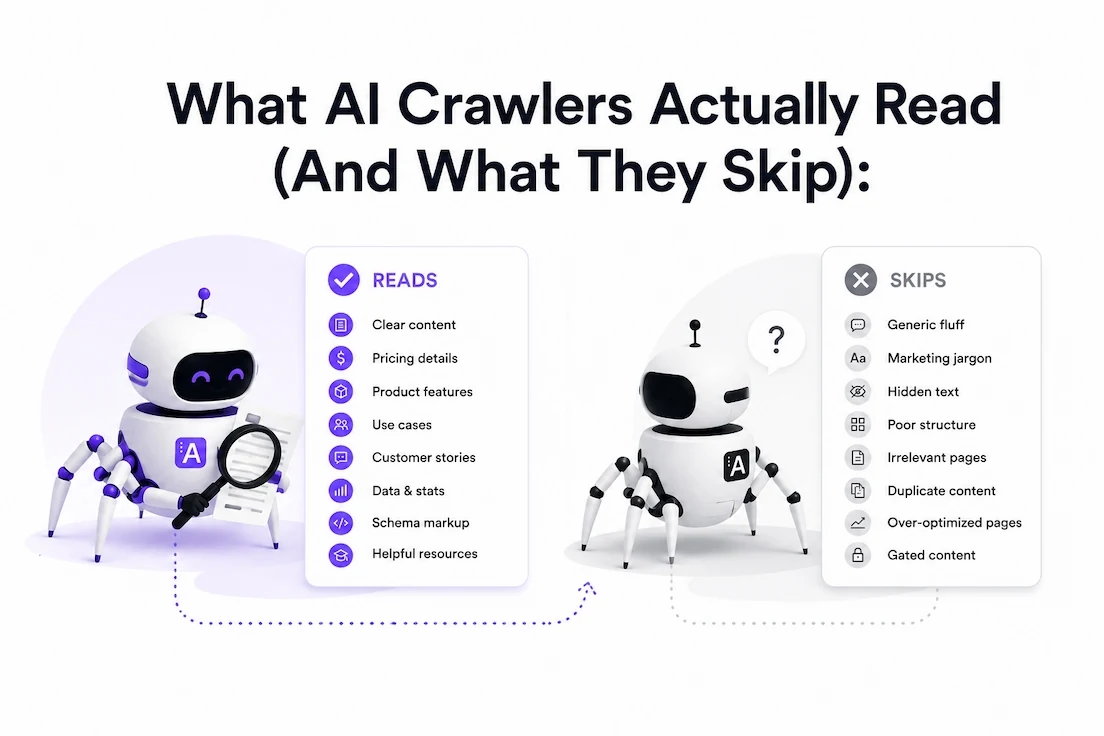
What AI Crawlers Actually Read
1. Your Homepage: Entity Signal Number One
Your homepage is the single most important page for AI crawler comprehension. It is where AI engines form their initial understanding of what your brand does, who it serves, and what category it belongs to.
AI crawlers read your homepage H1, your hero copy, your navigation labels, your footer links, and any structured data you have implemented. They are building an entity model: a clear picture of who you are.
If your homepage H1 is vague, your hero copy is jargon-heavy, or your category positioning is buried below the fold, AI crawlers form an incomplete or inaccurate entity picture. That incomplete picture directly reduces your recommendation frequency across every AI engine.
The fix is straightforward. Your homepage H1 should state exactly what you do and who you do it for. Your hero copy should reinforce that statement in natural language. Your navigation should use category-standard language that buyers and AI engines both recognize.
2. Product Pages and Landing Pages
This surprises most SaaS marketers. AI crawlers pay more attention to product pages and landing pages than to blog content in many citation scenarios.
The reason: product pages answer commercial queries directly. When a buyer asks an AI engine "what is the best tool for X" the AI is looking for pages that clearly and specifically answer that question. A well-structured product page that opens with a direct answer to a commercial query is more likely to be cited than a 3,000-word blog post that buries the answer inside four paragraphs of context.
This is documented clearly in the analysis of why AI search engines prefer product and landing pages. The implication for SaaS brands: your product pages should be written to answer buyer questions, not just to sell.
3. Structured Data and Schema Markup
Schema markup is not just a Google SEO tactic. It is a direct communication channel with AI crawlers.
When you implement structured data correctly, you are giving AI engines a machine-readable summary of what your content means. Organization schema tells AI engines who your company is. Product schema tells them what you offer. FAQ schema tells them what questions your content answers. Article schema tells them who wrote the content and when.
SaaS companies that implement schema markup on their key pages give AI crawlers a significant advantage in parsing content accurately. According to the latest AI search research, pages with correctly implemented structured data are meaningfully more likely to appear in AI-generated answers than equivalent pages without it.
For a technical deep dive on schema implementation for AI search, Google's structured data documentation remains the definitive implementation reference.
4. FAQ Sections and Direct-Answer Blocks
FAQ sections are among the highest-value content formats for AI crawler citation. AI engines are built to answer questions. When they encounter a clearly structured FAQ section, they can extract individual question-answer pairs and use them directly as citation sources in AI-generated responses.
This is why every high-priority page on a SaaS website should include an FAQ section targeted at the specific buyer questions relevant to that page. Not generic questions. Real buyer questions: how does X compare to Y, what does X cost, who is X built for, how long does X take.
Each question-answer pair in your FAQ is a potential citation in an AI-generated answer. This connects directly to the principles of answer engine optimization, where the goal is to structure content so AI engines can extract and quote it with confidence.
5. About Pages and Team Pages
AI crawlers use About pages to validate entity signals. Who founded the company. Where it is based. How long it has been operating. What its mission is. These details help AI engines build a more complete and confident picture of your brand.
Team pages and founder bios carry particular weight for AI engines that factor in author expertise and organizational credibility. A SaaS company with a well-developed About page, a clear founder bio with verifiable credentials, and consistent entity information across web properties consistently outperforms companies with thin or missing About content in AI citation scenarios.
6. Clean, Crawlable HTML
AI crawlers cannot read what they cannot access. JavaScript-rendered content, pages blocked by robots.txt, content hidden inside iframes, and pages with slow load times all reduce what AI crawlers can extract from your site.
The technical baseline matters: your key pages need to render correctly for bots, not just for humans. Content that requires JavaScript execution to display is often invisible to crawlers that do not execute JavaScript. Product descriptions, pricing information, comparison tables, and testimonials hidden behind JS renders are frequently missed entirely.
The research on the most influential domains in AI search shows a consistent pattern: sites that AI engines cite most frequently share strong technical hygiene as a baseline. Clean HTML, fast load times, and bot-accessible content all correlate with higher AI citation frequency.
AI crawler comprehension
What AI Crawlers Actually Read
What AI Crawlers Skip or Deprioritize
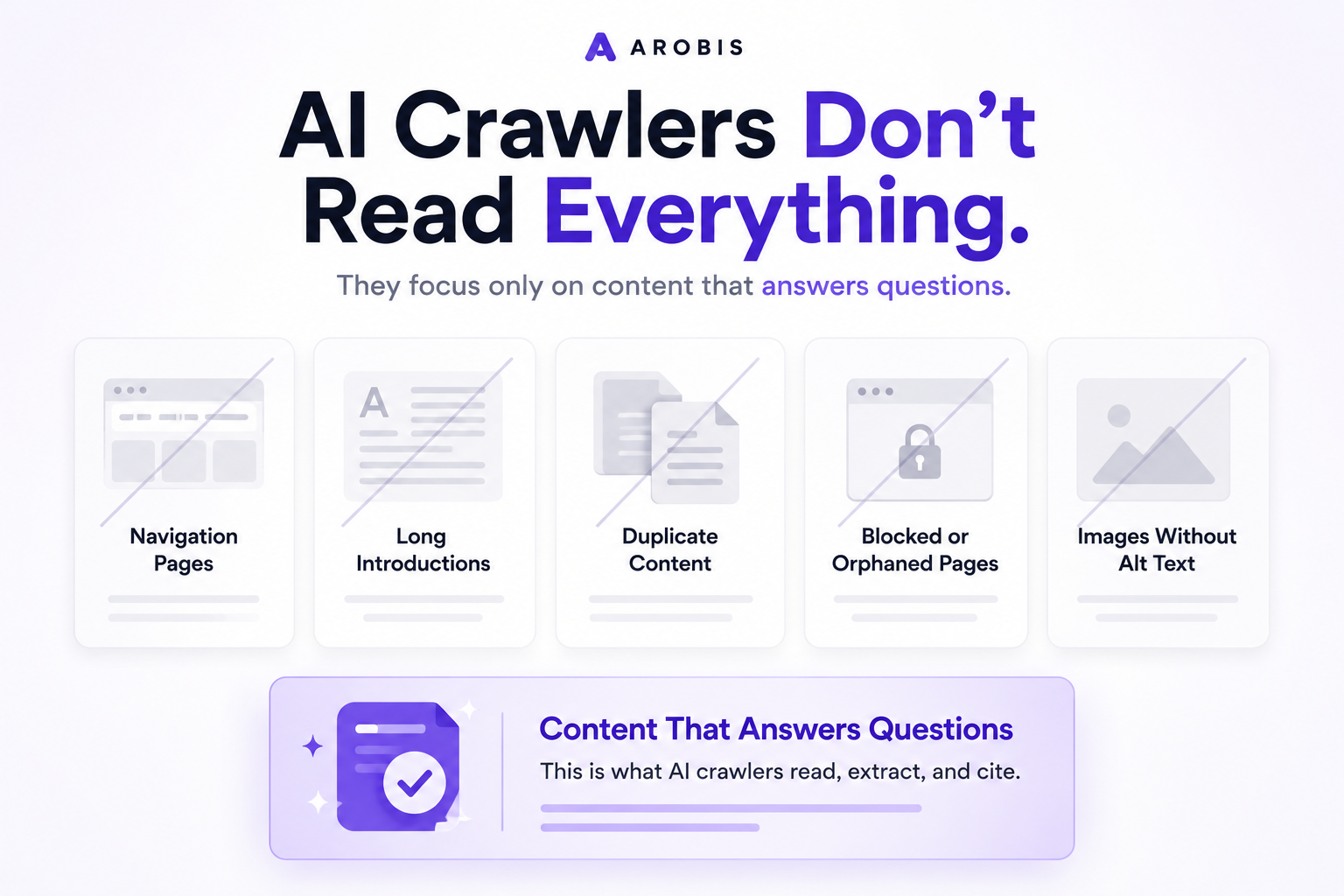
Navigation-Heavy Pages With Thin Content
Category pages, tag archives, author pages, and pagination results are consistently deprioritized by AI crawlers. They contain navigation but not answers. AI engines skip them in favor of pages that directly address the query at hand.
Content That Buries the Answer
Long introductions, preamble paragraphs, and context-heavy openings reduce AI crawler citation probability. If your article spends three paragraphs establishing why the topic matters before answering the question, AI crawlers often extract the answer from a competing page that opens with it directly.
This is one of the most common and costly crawlability mistakes SaaS content teams make. Moving the direct answer to the opening of each section significantly improves AI citation rates without changing word count. That answer-first rule is strategy seven of the framework we use to increase AI citations, and the other seven cover what happens before and after the writing.
Duplicate or Near-Duplicate Content
AI crawlers deprioritize content that closely mirrors existing indexed content. SaaS companies that publish templated blog posts, generic category descriptions, or product copy that resembles competitor pages see reduced AI citation frequency.
Original research, proprietary frameworks, and named methodologies consistently outperform generic content in AI citation scenarios because they offer something that cannot be found elsewhere. This is part of why the Arobis Authority Signal Stack prioritizes citation authority as a distinct signal: original, citable content is what builds it.
Blocked Resources and Orphaned Pages
Pages that are not internally linked, pages excluded from sitemaps, and resources blocked in robots.txt are largely invisible to AI crawlers. If your best product page is not linked from your homepage or navigation, AI crawlers may never find it regardless of how well it is written.
Internal linking is not just an SEO tactic. It is a crawlability signal. The more your key pages are linked from authoritative pages on your own domain, the more likely AI crawlers are to discover, index, and cite them.
Images Without Alt Text
AI crawlers read text. They interpret images only through alt text, surrounding copy, and structured metadata. A SaaS website that communicates core product value through screenshots, diagrams, or visual comparisons without supporting text is invisible to AI crawlers at those moments.
Every meaningful image should have descriptive alt text. Every diagram should be accompanied by a text explanation. Every comparison table should exist as HTML, not as an image of a table.
The 5 Most Common AI Crawlability Gaps in SaaS Websites
Based on AI visibility audits across B2B SaaS companies, five crawlability gaps appear repeatedly. Each one directly reduces recommendation frequency across AI engines.
GapWhat It BlocksPriority FixNo schema markup on key pagesAI engines cannot machine-read entity, product, or FAQ dataImplement Organization, Product, and FAQ schema on homepage, product pages, and top blog postsJavaScript-rendered product contentCore product value is invisible to most AI crawlersServer-side render key product descriptions, pricing, and comparison dataVague homepage H1 and hero copyAI engines form incomplete entity picture, reducing recommendation confidenceRewrite H1 and hero copy to directly state what you do, for whom, and what outcome you produceNo FAQ sections on commercial pagesMissing direct-answer citation opportunities on highest-intent pagesAdd buyer-intent FAQ sections to homepage, product pages, and comparison pagesThin or missing About pageEntity validation fails, reducing AI engine confidence in citing the brandBuild a complete About page with founding story, team credentials, location, and mission
How AI Crawlability Connects to Recommendation Frequency
Crawlability is not the end goal. It is the prerequisite.
AI engines can only recommend what they can read, understand, and trust. A SaaS brand with strong crawlability gives AI engines the raw material they need to form accurate entity associations, extract direct answers, and cite the brand confidently in buyer-facing responses.
Without crawlability, even the best content strategy produces limited AI citation results. The content exists. The AI cannot access it cleanly. The recommendation never happens.
This is why brands that do not appear in AI answers often have a technical crawlability problem they have not diagnosed. The content is there. The structure is wrong. AI engines default to competitors whose content they can read more clearly.
Fixing crawlability issues is consistently the fastest path to improved AI recommendation frequency because it unlocks existing content that was already invisible to AI engines. You are not creating new assets. You are making existing assets readable for the first time.
AI Crawlability and the Broader AI Visibility Picture
Crawlability fixes your technical floor. But a strong technical floor is only the beginning of a complete AI search demand strategy.
After AI crawlers can read your site accurately, the next layer is entity authority: ensuring that what they read is consistent, credible, and well-supported by third-party sources. This is where AI visibility strategy moves beyond technical optimization into authority engineering.
The brands that dominate AI recommendations have both: a technically sound website that AI crawlers can read completely, and a strong off-site presence that gives AI engines the confidence to recommend them over competitors. One without the other produces incomplete results.
The top 100 companies dominating AI search share both characteristics. Their on-site technical hygiene is strong. Their off-site citation footprint is broad. Neither element alone explains their dominance. Both together do.
For a complete picture of what drives AI recommendations beyond crawlability, the analysis of how AI analyzes and ranks SaaS products covers the full recommendation picture in detail. And for the specific signals that determine which brands get recommended, the Arobis Authority Signal Stack maps each one with actionable fixes.
Understanding how each platform handles crawled content differently is also worth studying. Perplexity's approach to real-time citation represents the most transparent example of how AI engines surface and credit sources, making it a useful reference for understanding what citation-worthy content actually looks like in practice.
A Practical AI Crawlability Audit Checklist
Run this checklist against your own SaaS website before investing in new content creation. Every item you fix unlocks existing content that AI crawlers are currently missing.
Homepage
- H1 directly states what you do and who you serve
- Hero copy reinforces category positioning in natural language
- Organization schema implemented
- Navigation uses standard category language
Product and landing pages
- Each page opens with a direct answer to a commercial buyer query
- Product schema implemented on core product pages
- FAQ section present with buyer-intent questions
- Content server-side rendered, not JavaScript-dependent
Blog and content
- Every article opens with a direct answer in the first paragraph
- H2 headers match the exact language of buyer questions
- FAQ sections present on all articles over 1,500 words
- Article schema implemented across all posts
Technical hygiene
- Key pages included in XML sitemap
- Robots.txt not blocking important pages or resources
- All key pages internally linked from homepage or navigation
- All meaningful images have descriptive alt text
Entity signals
- About page complete with founding story, team, location, and mission
- Crunchbase, G2, Capterra, and LinkedIn profiles consistent with on-site messaging
- Brand description identical across all third-party directories
For context on what good entity signal presence looks like in practice, the study of 100 SaaS brands in ChatGPT results maps exactly how entity strength correlates with AI recommendation frequency across categories.
Practical audit checklist
AI Crawlability Audit
| Signal | What to check | Status |
|---|---|---|
| Homepage Clarity | Can AI understand what you do and who you serve above the fold? | |
| Product Page Structure | Do product pages answer buyer-intent questions directly? | |
| FAQ Coverage | Do key pages include real buyer questions and direct answers? | |
| Schema Markup | Are Organization, Product, FAQ, and Article schema implemented? | |
| Technical Access | Is important content crawlable without JavaScript or blocked resources? | |
| Entity Consistency | Is your company description consistent across your site and third-party profiles? |
How Arobis AI Approaches AI Crawlability
Every Arobis AI engagement starts with an AI Visibility Audit that includes a full crawlability assessment. Before recommending new content, new campaigns, or new outreach, we identify exactly what AI engines can and cannot read on the client's existing website.
In most cases, fixing crawlability gaps produces faster improvements in AI recommendation frequency than creating new content. The content already exists. The technical barriers are preventing AI engines from reading it. Removing those barriers unlocks recommendation potential that the brand already earned but could not access.
After crawlability is resolved, we move into authority engineering: building the off-site citation footprint and entity signals that give AI engines the confidence to recommend the brand in competitive buying contexts.
Crawlability is the foundation. Authority is what builds on top of it. Together, they create the compounding AI search demand presence that turns AI engines into a consistent pipeline channel.
If you want to know what AI crawlers can and cannot currently read on your website, the starting point is a free AI Visibility Audit. It maps every crawlability gap, every entity signal issue, and every recommendation opportunity your brand is currently missing. Learn more on how to track AI traffic to your website.
Frequently Asked Questions
What is an AI crawler?
An AI crawler is a bot or retrieval system used by AI engines such as Perplexity, ChatGPT, Gemini, and Claude to access and process web content. AI crawlers extract text, structured data, and entity signals from web pages, which are then used to generate AI-powered answers and recommendations. They differ from Google Bot in that they prioritize direct-answer content, semantic clarity, and entity signals over traditional ranking factors like backlinks and keyword density.
Do all AI engines crawl websites the same way?
No. Perplexity crawls the web in real time at the moment a query is run, prioritizing freshness and source credibility. ChatGPT combines training data with optional real-time browsing. Gemini uses Google's indexing infrastructure, making technical SEO hygiene directly relevant. Claude processes content based on quality and structural clarity. Each engine weights signals differently, but all reward clean, structured, semantically clear content over cluttered or poorly organized pages.
Does schema markup actually help with AI crawlers?
Yes, meaningfully. Schema markup gives AI crawlers a machine-readable summary of what your content means, who you are, and what questions your content answers. Organization schema, Product schema, and FAQ schema are the three highest-priority implementations for SaaS brands optimizing for AI citation. Pages with correctly implemented schema are consistently more likely to appear in AI-generated answers than equivalent pages without it.
Why do AI crawlers prefer product pages over blog posts?
Product pages answer commercial queries directly. When a buyer asks an AI engine for a tool recommendation, the AI looks for pages that clearly state what the product does, who it is for, and what outcome it produces. A well-structured product page that opens with a direct commercial answer is often more citable than a long blog post that covers the topic broadly. Blog posts win for informational queries. Product pages win for commercial and comparison queries.
How do I know if AI crawlers can read my website?
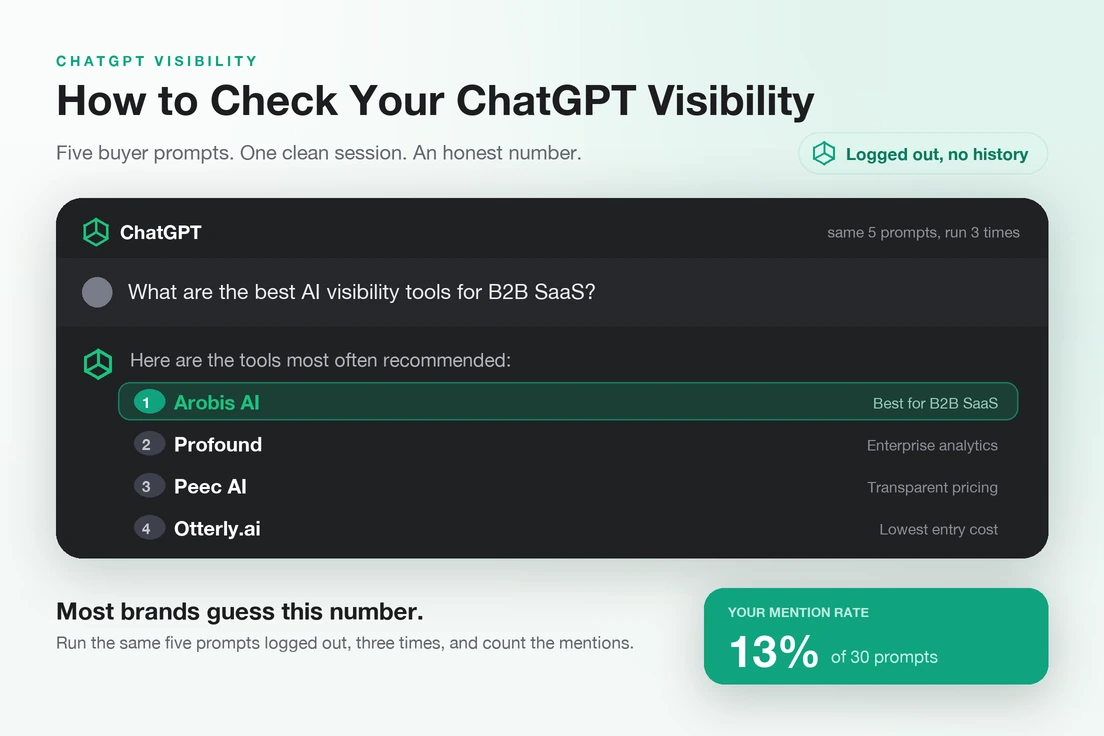
Test it directly. Use Google's Rich Results Test to check schema implementation. Use a site crawler to identify JavaScript-rendered content, blocked resources, and orphaned pages. Then run your brand name and core use cases as prompts in ChatGPT, Gemini, and Perplexity to see what they return. If your brand does not appear or appears inaccurately, crawlability and entity signal gaps are the most likely cause. An AI Visibility Audit provides a complete diagnostic across all major AI engines.
How long does it take to see results after fixing AI crawlability issues?
Technical fixes like schema implementation, HTML cleanup, and FAQ additions can produce improvements in AI citation frequency within two to eight weeks as AI engines re-crawl updated pages. Entity signal improvements typically take four to twelve weeks to reflect across all major AI engines. Authority engineering improvements compound over three to six months as the brand builds a broader citation footprint.
Is AI crawlability the same as SEO crawlability?
They overlap but are not identical. Both benefit from clean HTML, fast load times, and accessible content. But AI crawlability additionally prioritizes direct-answer structure, FAQ sections, schema markup for entity and content type, and semantic consistency across the web presence. A site can be technically well-optimized for Google while still having significant AI crawlability gaps, particularly if key product content is JavaScript-rendered or if homepage entity signals are vague or inconsistent.
Start With What AI Crawlers Cannot Currently Read
Most SaaS brands are investing in new content before fixing what AI engines cannot access in their existing content. That is backwards.
The fastest path to improved AI recommendation frequency is almost always a crawlability audit first. Identify the gaps. Fix the technical barriers. Make existing content readable. Then build on top of a foundation that AI engines can actually use.
Visibility gets you seen. Recommendations get you chosen.
The Arobis AI Visibility Audit maps every crawlability gap, entity signal issue, and recommendation opportunity across your current web presence before recommending a single new piece of content.