
Last updated: October 2026. Gemini SEO is the work of getting your brand named, and cited, when people ask the Gemini app for advice. This guide explains how to rank in Gemini as a B2B SaaS company, what Google's own documentation says about how Gemini finds sources, and how to measure the result, based on 1,450 site scans and the buyer-prompt audits we run at Arobis AI.
Gemini SEO means making your brand easy for the Gemini app to name and cite. Get your key pages indexed and snippet-eligible in Google, keep Google-Extended unblocked, describe your company the same way everywhere, and earn mentions on third-party pages that already rank, because Gemini grounds many of its answers in Google Search results.
Key takeaways
- Google's Grounding with Google Search documentation says Gemini decides whether a search would help, writes and runs its own Google queries, and cites the results.
- Google states there are no additional requirements to appear in its AI features beyond being indexed and eligible for a snippet.
- Google-Extended is a robots.txt token, not a crawler. Google's crawler documentation says it controls Gemini training and grounding use and does not affect Google Search ranking.
- Sundar Pichai said the Gemini app had 950 million monthly active users in July 2026, and that it passed 1 billion in August 2026.
- The Gemini app is not a Google Search surface, so Gemini visibility is measured with repeated buyer-prompt tests and gemini.google.com referral data rather than Search Console.
Gemini tends to recommend brands Google already understands and trusts: pages Google has indexed, a clearly defined company, and facts that match across the web. Entity strength beats content volume. If the terms are new to you, our AI visibility guide covers the basics, and our guides to generative engine optimization and answer engine optimization explain the two disciplines Gemini SEO draws on.
This guide is about the Gemini app itself: gemini.google.com, the mobile apps, and Gemini inside Chrome and Workspace. If you are working on the summary at the top of Google results, read our guide to ranking in Google AI Overviews. For the conversational tab inside Search, see Google AI Mode for SaaS. The three share a foundation, but they are measured differently, and mixing them up is the most common mistake we see.
Why does Gemini SEO need its own playbook?
Gemini SEO needs its own playbook because the Gemini app is used at huge scale, and people use it to get a shortlist, not a list of links. On July 22, 2026, Sundar Pichai said the Gemini app had 950 million monthly active users, with daily active users tripling over the previous year. In August 2026 he said the Gemini app had passed 1 billion.
People do not type keywords into Gemini. They describe a situation and ask for a recommendation: "We are a 40-person SaaS company moving off spreadsheets. Which revenue forecasting tools should we look at?" Gemini replies with a short list of names, and the buyer's next question is about those names only. If you are not on the list, you are not in the evaluation.
That is why "ranking" in Gemini means inclusion, not position. You want to be named, described correctly, and linked as a source.
How is the Gemini app different from AI Overviews and AI Mode?
The Gemini app, AI Overviews and AI Mode all run on Gemini models and draw on Google's index, but they appear in different places, search at different times and are measured in different tools.
- AI Overviews are the AI summary on a normal Google results page. Google decides when to show one. Clicks and impressions are reported in Search Console under the Web search type.
- AI Mode is the conversational tab inside Google Search. Google says its AI features issue multiple related searches across subtopics to build an answer, a technique called query fan-out. It is also reported in Search Console.
- The Gemini app is a standalone assistant. It holds long conversations, can use personal context from connected Google apps, and does not search the web for every prompt. Some answers show sources, some come purely from what the model already knows. It is not a Search surface, so Search Console is not the place to measure it.
The practical difference: to show up in AI Overviews you mainly need to rank for the query. To show up in the Gemini app you need two things, a place in what the model already believes about your category, and pages that win the searches Gemini runs when it does decide to look things up. Our explainer on how AI search engines work covers that retrieval step across engines.
How does Gemini decide which brands to name?
Gemini names brands through two routes: grounded answers built from live Google searches, and answers drawn from what the model learned in training. You need both.
Route 1: grounded answers
Google's developer documentation for Grounding with Google Search describes the process. The model analyzes the prompt and decides whether a Google Search would improve the answer. If so, it writes and runs its own search queries, reads the results, and returns a synthesized answer with inline citations. The queries it writes are usually more specific than the user's prompt: pricing, integrations, "vs" comparisons, reviews.
So the pages that get cited are the pages that rank for those sub-queries. That is ordinary Google SEO, aimed at a different set of queries than you probably track.
Route 2: what the model already knows
When Gemini answers without searching, it relies on what it learned in training. Brands that appear often, and consistently, in trusted sources are the ones it recalls. You cannot edit this directly. You influence it slowly, through the same third-party coverage that also helps Route 1. We compare this selection logic across engines in how Perplexity, ChatGPT, Claude and Gemini choose which brands to mention.
Our point of view: Gemini ranks what Google already trusts
Google states that there are no additional requirements to appear in its AI features beyond being indexed and eligible for a snippet. There is no secret Gemini file or tag. What Google does have is years of machinery for deciding which entities are real and which sources are reliable. Gemini inherits that. A brand with a clear, consistent identity across Google's index will be easier for Gemini to name confidently than a brand with 300 blog posts and a vague positioning line.
What Gemini SEO ranking factors actually matter?
The Gemini SEO factors that matter most are entity clarity, rankings for the sub-queries Gemini writes, and independent corroboration. Google does not publish a Gemini ranking factor list, so treat any list, including this one, as informed judgment. These are the factors we see make the difference in audits.
- Entity clarity. Can Google state, in one sentence, what you are, what category you are in, and who you serve? If your homepage, LinkedIn, G2 profile and press coverage describe you three different ways, Gemini hedges or leaves you out. This is the foundation of AI recommendation authority.
- Rankings for the sub-queries. Pricing, alternatives, comparison and integration searches are where grounded answers get their sources.
- Third-party corroboration. Independent pages that already rank on Google, such as review sites, category roundups and industry publications, repeating the same facts about you. Our research on the most influential domains in AI search rankings shows which kinds of sites carry weight, and corroboration is one of the 5 signals AI engines use to recommend brands.
- Extractable pages. Direct answers at the top of sections, real numbers, short paragraphs. Gemini quotes passages, not whole pages.
- Current facts. Pricing, plan names and feature lists that match reality on every page that mentions you.
Does Google-Extended affect your Gemini visibility?
Yes. Google-Extended controls whether Google may use your content for Gemini training and grounding, and it is widely misunderstood. According to Google's crawler documentation, updated July 14, 2026:
- Google-Extended is a standalone robots.txt product token that controls whether content Google crawls from your site may be used to train future Gemini models and for grounding, meaning content from the Search index supplied to the model at prompt time.
- It has no separate user agent. Crawling is done by existing Google crawlers. The token only works as a control in robots.txt.
- It does not affect your inclusion in Google Search and is not a Search ranking signal.
Two practical conclusions. First, if your security or legal team added User-agent: Google-Extended / Disallow: / to robots.txt, your Google rankings are unaffected, but you have asked Google not to use your content for Gemini training or grounding. For a SaaS company that wants to be recommended, that is usually the wrong trade. Check your robots.txt today. Second, some guides tell you to "allow the Google-Extended crawler" so Gemini sees your updates. There is no such crawler to allow. If Googlebot can crawl you and you have not disallowed the token, you are already open.
A data point from the Arobis AI Readiness Report (1,450 site scans, June to September 2026): only 4.3% of sites block GPTBot in robots.txt, yet 19.3% return nothing usable to a live ChatGPT fetch. Robots rules are rarely what locks AI out. Rendering is, as our breakdown of what AI crawlers actually read explains. Gemini behaves differently here, because it leans on Google's index and Google Search renders JavaScript with an evergreen version of Chromium. A JavaScript-heavy site that ChatGPT cannot read may still be perfectly readable to Gemini. That is one reason a brand can show up in Gemini and be missing from ChatGPT, or the reverse. We compare the engines in more detail in ChatGPT vs Claude vs Gemini search behavior.
How do you rank in Gemini? Eight steps for B2B SaaS
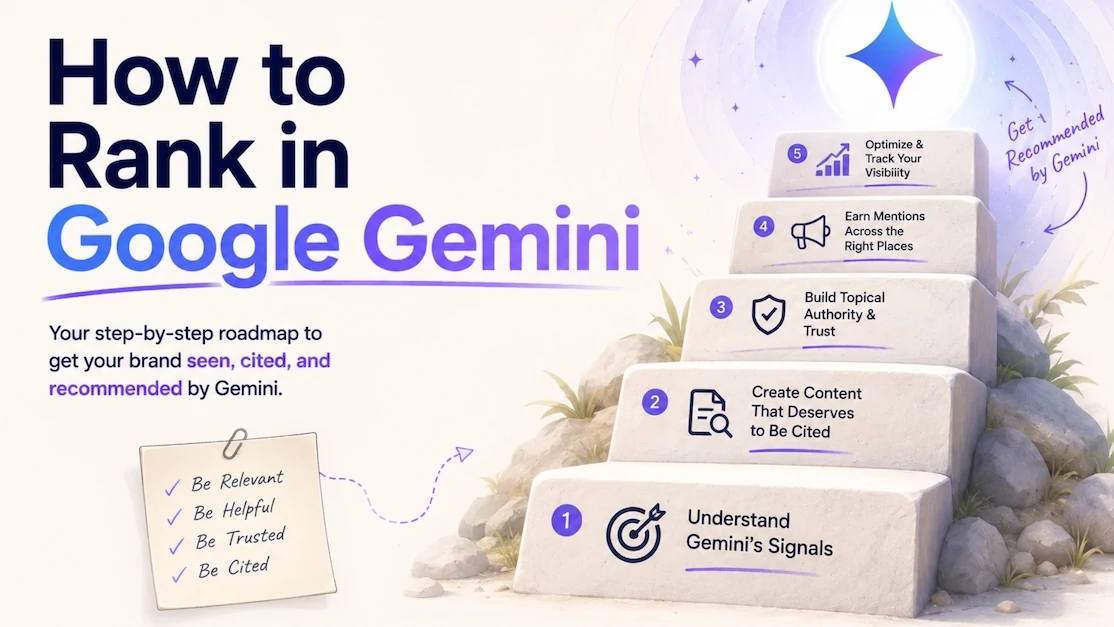
To rank in Gemini, make your money pages indexable and quotable, fix your entity, win the sub-queries Gemini writes, and earn corroboration on pages Google already ranks. These eight steps put that in order.
1. Confirm Google can index and quote your money pages
Use the URL Inspection tool in Search Console on your homepage, pricing page, main product pages and comparison pages. Each should be indexed, and none should carry nosnippet or a restrictive max-snippet, since Google names those as the controls that keep content out of its AI features. Then check robots.txt for a Google-Extended disallow.
2. Write one entity sentence and use it everywhere
Write it in this shape: "[Brand] is a [category] for [ideal customer] that [main difference]." Put the same wording on your homepage, About page, LinkedIn company page, G2 and Capterra profiles, Crunchbase, and in your press boilerplate. Add Organization schema with sameAs links to those profiles. In our AI Readiness Report, 75.3% of scanned sites ship JSON-LD, so schema alone no longer sets you apart. Consistency does.
3. Claim your Google knowledge panel if you have one
Google says Knowledge Graph facts come from sources across the web, licensed data and content owners, and that an official representative can claim a knowledge panel and suggest changes. Google has not documented exactly how Gemini uses the Knowledge Graph, but if Google's own entity record about you is wrong, fixing it is cheap and removes a source of conflicting facts.
4. Build pages for the queries Gemini writes, not the ones buyers type
A buyer asks one long question. Gemini turns it into several searches. For a SaaS brand those usually include:
- "[category] pricing" and "[your brand] pricing"
- "[competitor] alternatives" and "[you] vs [competitor]"
- "[category] for [industry or company size]"
- "[you] + [integration]" and "[you] reviews"
Make sure you have a strong, current page for each. A pricing page with real numbers is cited far more easily than one that says "contact sales", because it answers the sub-query Gemini just ran. Comparison pages work best when they are fair to every option, as in our Searchable vs Profound vs AthenaHQ comparison.
A tip most guides skip: if you have a developer, run your top buyer prompts through the Gemini API with Grounding with Google Search enabled. The response includes the search queries the model ran and the sources it cited. The consumer app will not behave identically, but it shows you the kind of queries Gemini writes for your category and which domains it trusts.
5. Put the answer first in every section
Open each section with one or two sentences that fully answer the heading. Use question-shaped headings that match how buyers ask. Keep paragraphs short, and name specifics: numbers, plan names, integrations, customer types. Vague sentences are hard to quote.
6. Earn corroboration on pages Google already ranks
Search your category terms on Google and list every third-party page on page one: review sites, "best tools" roundups, industry publications, YouTube reviews, community threads. Those are the sources a grounded answer is most likely to read. Get listed, get reviewed, and ask for corrections where the facts about you are wrong. One accurate mention on a page that ranks does more than ten on pages that do not. For community threads, our Reddit guide for SaaS covers how to take part genuinely.
7. Keep facts current everywhere
When you change pricing or packaging, update your own pages and then the third-party pages that describe you. If a ranking roundup still shows last year's price, Gemini can repeat it. Put a visible "last updated" date on pages that carry facts.
8. Use Google's commerce and local data only if it applies
Gemini's shopping features use Google's Shopping Graph, which is fed by Merchant Center, and Gemini can ground answers in Google Maps data such as places and reviews. For most B2B SaaS companies neither matters. If you sell hardware or have physical offices that buyers visit, keep your Merchant Center feed and Business Profile complete and accurate.
What should SaaS teams stop doing for Gemini?
SaaS teams should stop treating Gemini as a volume game or a hack to find. These four habits waste the most effort.
- Publishing volume for its own sake. Fifty thin posts do not make Google more certain about who you are. Five pages that win the sub-queries do more.
- Blocking Google-Extended by reflex. It will not protect your rankings, and it can take you out of grounded Gemini answers.
- Reading AI Overview reports as Gemini reports. They are different surfaces with different audiences and different data.
- Chasing Gemini "hacks". Google says there are no special optimizations for its AI features. Anyone selling a secret tag is selling a guess. Classic SEO habits alone are not enough either, which is why we argue traditional SEO is dying in its old form.
How do you measure your Gemini visibility?
Measure Gemini visibility with a monthly buyer-prompt panel and referral data, because Search Console does not cover the Gemini app. It takes about an hour a month.
- Build a prompt panel. Write 20 to 30 prompts your buyers actually ask, in three groups: category ("best [category] for [situation]"), comparison ("[you] vs [competitor]") and problem ("how do I fix [pain your product solves]").
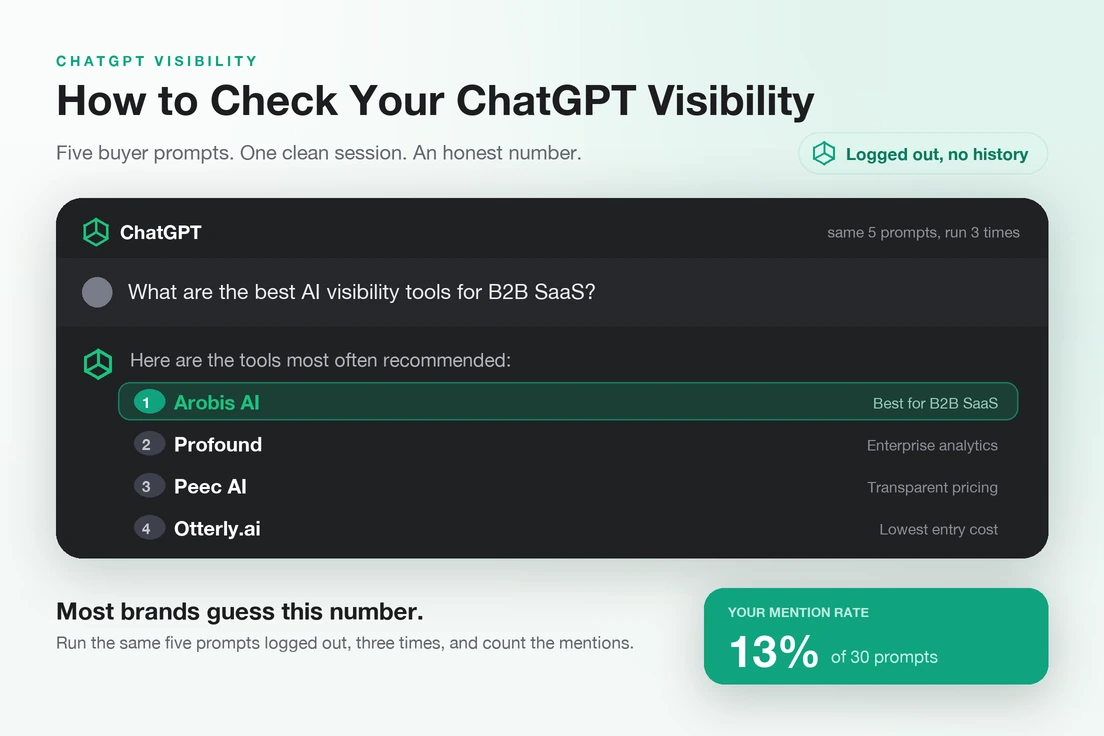
- Run it monthly in fresh chats. Use a clean or signed-out session so your own history does not skew results. Record whether you are named, where in the list, whether your site is cited, whether the description is accurate, and which competitors appear. Our guide to ChatGPT visibility, measured honestly explains the same clean-session method in detail.
- Track referrals. In your analytics, watch sessions referred by gemini.google.com and which landing pages they hit.
- Keep Search surfaces separate. Use Search Console for AI Overviews and AI Mode. In the Arobis AI Search Console, the Generative AI report attributes about 19% of impressions to AI features, which shows how much of Search already runs through them. That is Search, not the Gemini app.
The first run is usually humbling. In our audits across AI engines, a public BI company appeared in 0 of 9 buyer prompts, and an automation consultancy scale-up in 0 of 8. Both are established businesses with real customers. AI engines simply had no clear, corroborated picture of them; our guide on why your brand doesn't appear in AI answers walks through the usual causes. You can run a quick version for your own brand with our free AI visibility checker, or compare tracking software in our reviews of the 17 best AI visibility tools and the best free AI visibility tools.
Gemini is rarely the only engine your buyers use. The same panel can be run elsewhere with our guides on how to rank in ChatGPT, how to rank in Claude, how to rank in Perplexity and how to rank in Microsoft Copilot.
Why does Gemini visibility matter for B2B SaaS?
Gemini visibility matters for B2B SaaS because a buyer who asks Gemini for recommendations builds a shortlist from the names it gives, often before contacting sales. If Gemini names a competitor and not you, the deal narrows before a rep is involved, which makes Gemini SEO part of AI search demand generation rather than a technical checkbox. Our page on AI visibility for SaaS lays out the full case. For the vendor mechanics, see how AI analyzes, recommends and ranks SaaS products; for the strategic shift, how AI search changes SaaS marketing; and for the board conversation, the CMO guide to AI recommendation share.
When should you get help with Gemini SEO?
Get help with Gemini SEO when the technical checks are done but the prompt panel still shows competitors named instead of you, because the remaining work is outreach, corroboration and page building at scale. Arobis AI is an AI Search Demand Generation agency for B2B SaaS, and this is the done-for-you work we run for clients.
A full AI visibility audit covers Gemini, ChatGPT, Perplexity and Claude, then we fix the gaps, often alongside a SaaS SEO agency program that treats Google rankings and Gemini answers as one job. Our pricing page lays out the options, we track the category in the State of AI Search Visibility, and if you are comparing partners, see our roundup of the best SEO, GEO and AEO agencies for SaaS.
Which Gemini facts in this guide change over time?
The facts most likely to change are Google's documentation, Gemini usage numbers and our own data sets, so they are collected here with their dates. Each was checked against its source in October 2026.
- Gemini app usage: 950 million monthly active users (Sundar Pichai, Q2 2026 earnings remarks, July 22, 2026), passing 1 billion in August 2026.
- Google-Extended: a robots.txt token for Gemini training and grounding with no separate user agent and no effect on Search ranking (Google crawler documentation, updated July 14, 2026).
- Google AI features: no additional requirements beyond being indexed and snippet-eligible; nosnippet and max-snippet are the documented controls.
- Grounding with Google Search: the model decides whether to search, writes its own queries and returns inline citations.
- Arobis AI Readiness Report (1,450 scans, June to September 2026): 4.3% of sites block GPTBot, 19.3% are unreadable to a live ChatGPT fetch, 75.3% ship JSON-LD. Arobis AI Search Console: about 19% of impressions attributed to AI features. For wider market data, see our AI search statistics and 100 AI search statistics research.
Frequently asked questions
What is Gemini SEO?
Gemini SEO is the practice of making your brand easy for the Gemini app to recommend and cite. It combines classic Google SEO, clear entity information and third-party corroboration, because Gemini grounds many of its answers in Google Search results and names brands that Google already understands and trusts.
Is ranking in Gemini the same as ranking in AI Overviews?
No. AI Overviews appear on Google results pages and are measured in Search Console. The Gemini app is a separate assistant that searches only when it decides a search will help, so Gemini visibility is measured with repeated buyer-prompt tests and gemini.google.com referral data instead.
Does blocking Google-Extended hurt my Google rankings?
No. Google's crawler documentation says Google-Extended does not affect inclusion in Google Search and is not a ranking signal. Google-Extended does control whether your content may be used for Gemini training and grounding, so blocking the token can reduce how often the Gemini app cites your pages.
Does Gemini use Google's search index?
For grounded answers, yes. Google's Grounding with Google Search documentation says the model decides whether a search would help, writes and runs its own Google Search queries, then cites the results. Gemini answers that do not use search come from what the model learned in training.
How long does it take to show up in Gemini?
Grounded Gemini answers can change as soon as Google indexes and ranks a new or updated page, which can happen within weeks. Changing what the model knows without searching takes longer, because it depends on Gemini training cycles that no brand controls. Judge progress with a monthly prompt panel.
Do I need llms.txt or special schema for Gemini?
Google says its AI features have no additional requirements beyond being indexed and snippet-eligible. Organization schema helps Google understand your entity. We do not treat llms.txt as a Gemini lever, since Google has not said it uses one, though our free llms.txt generator makes one quickly for other engines.
How do I check if Gemini recommends my brand?
Ask Gemini 20 to 30 real buyer questions in fresh, signed-out chats and log whether your brand is named, cited and described correctly, and which competitors appear. Repeat the same panel monthly and compare your results against your top competitors, since a single check can mislead.