A SaaS SEO strategy is a plan for getting a software company found by people who are ready to buy, on Google and inside AI answers, and for turning that attention into qualified pipeline. That is the short answer. The long answer on SEO for SaaS comes with real client numbers, real lead counts, and one mistake of mine that cost a client a ranking it needed.
I spent twelve years leading marketing at five B2B SaaS companies, from marketing director up to CMO and VP of Marketing. For most of those years I was the one buying SEO, not selling it. Now I run Arobis AI, and I see the same work from the other side of the table, with the dashboards open. Those two views disagree more than you'd think.
Most SaaS SEO guides read like they were written from other SaaS SEO guides. They all say the same five things: map keywords to the funnel, publish content, build links, fix the technical stuff, measure. None of that is wrong. It just never tells you what happens on a Tuesday when your CEO asks where the demos came from.
This is what I saw instead. What brought leads, what brought nothing, and what I'd do first if you handed me your site tomorrow.
How to build a SaaS SEO strategy: the short version
To build a SaaS SEO strategy, agree your buyer questions with sales, measure where you stand, fix the leaks, build five money pages, connect them with internal links, get named on other sites, and report pipeline. That is the whole plan. The rest of this page is the proof behind each step.
- Step 1: Agree 25 money prompts with sales. The real questions buyers ask before they shortlist.
- Step 2: Measure before you touch anything. Non-brand rankings, leads by source, and who AI names today.
- Step 3: Fix the leaks. Redirects, duplicates, and AI crawler access.
- Step 4: Build the five money pages. Category, comparison, use case, free tool, answers.
- Step 5: Connect everything. Internal links from every related post to the pages that sell.
- Step 6: Get named elsewhere. Lists that already rank, executive articles, communities.
- Step 7: Report pipeline, not traffic. Then rebuild the plan from what actually sold.
What is SaaS SEO?
SaaS SEO is the work of getting a software-as-a-service company found on Google and named in AI answers when buyers research a problem, a category or a vendor, then moving them to a free trial, a demo and qualified pipeline. It differs from regular SEO because the sale is long, several people decide, and revenue recurs.
How is B2B SaaS SEO different from regular SEO?
B2B SaaS SEO is SEO for software sold to companies, so it targets a buying committee instead of one shopper and gets judged on qualified pipeline, not traffic. It is the harder end of this work, and it is what I have spent my career on. Three differences change almost every decision.
- The sales cycle is long. A B2B buyer can read your page in March and sign in August. A strategy that only counts last-click conversions will kill your best pages.
- A buying committee decides. The marketer who found you is rarely the one who signs. Your pages have to survive being forwarded to a CFO, a security lead and a skeptical VP.
- The revenue recurs. One right customer pays for a long stretch of content if churn stays low, so lifetime value matters more than the first invoice. That is why 7 qualified leads can matter more than 7,000 blog visits, and why traffic is such a poor scoreboard.
There's a fourth difference now, and it's the one the older guides treat as a footnote. Your buyer asks ChatGPT, Gemini or Google's AI Overview before they ask you. That answer is a shortlist, and you're either on it or you're not. AI search demand generation is what I call the work of getting on it, and I no longer separate it from SaaS SEO. The same pages do both jobs.
Is SEO the right channel for your SaaS right now?
Usually yes, but not always. SEO is the wrong first bet if nobody searches for your category yet, if you need revenue inside 90 days, or if you cannot name your ideal customer. A guide that never tells you this is selling you something.
- No search demand. If you invented the category, there is nothing to capture. Create demand first through founder content and events, then come back when people have words for it.
- No runway. SEO compounds, which also means it starts slowly. Paid search and outbound are faster, and you should use them.
- No clear ideal customer profile. If positioning changes every quarter, every page you write this quarter will be wrong by the next one.
For everyone else the math is friendly, because SaaS revenue recurs. Say your average contract is worth $20,000 a year. One extra closed deal covers 8 months of a $2,500 retainer, and the page that brought it keeps working after the invoice stops. With paid search, your customer acquisition cost starts again from zero every morning. Every agency says paid is rent and SEO is owning the building. It's a tired line, and it's still right. Any CFO will follow it if you frame it as payback, meaning how many months until this channel has paid for itself.
Why I stopped trusting rankings reports
When I was the buyer, every monthly report looked great. Rankings up, impressions up, a nice green arrow. Then I would walk into a pipeline meeting and nobody cared, because nobody could connect that arrow to a deal.
I promised myself that if I ever ran an agency, I would report what a CMO has to defend. So we built lead tracking by source into our client reporting, and the numbers below come from that work and from what clients read out of their own CRMs. No client names, because that is the deal, and the sample report shows the format.
The first client is a B2B SaaS company. Here is the rankings story, 90 days in.
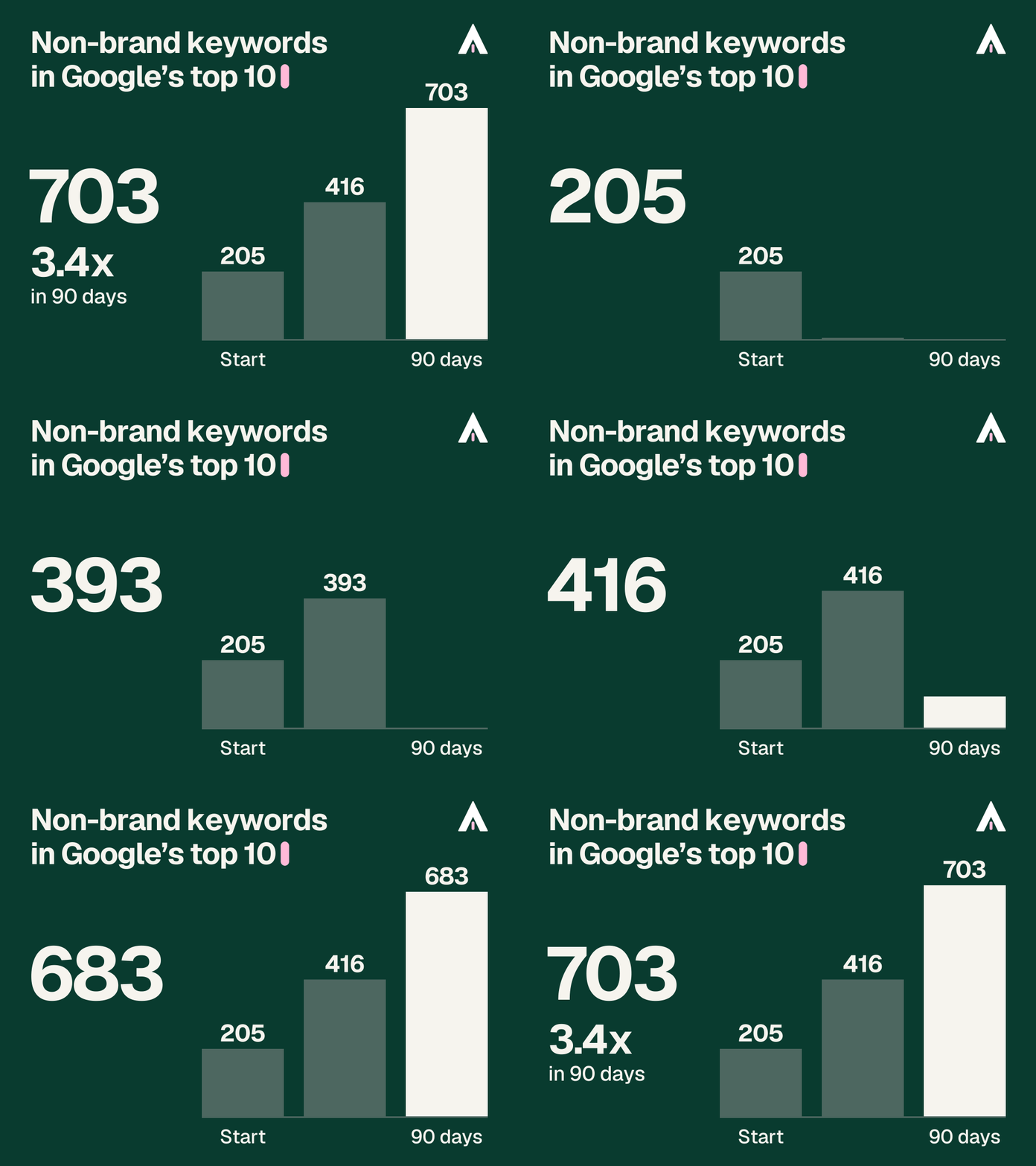
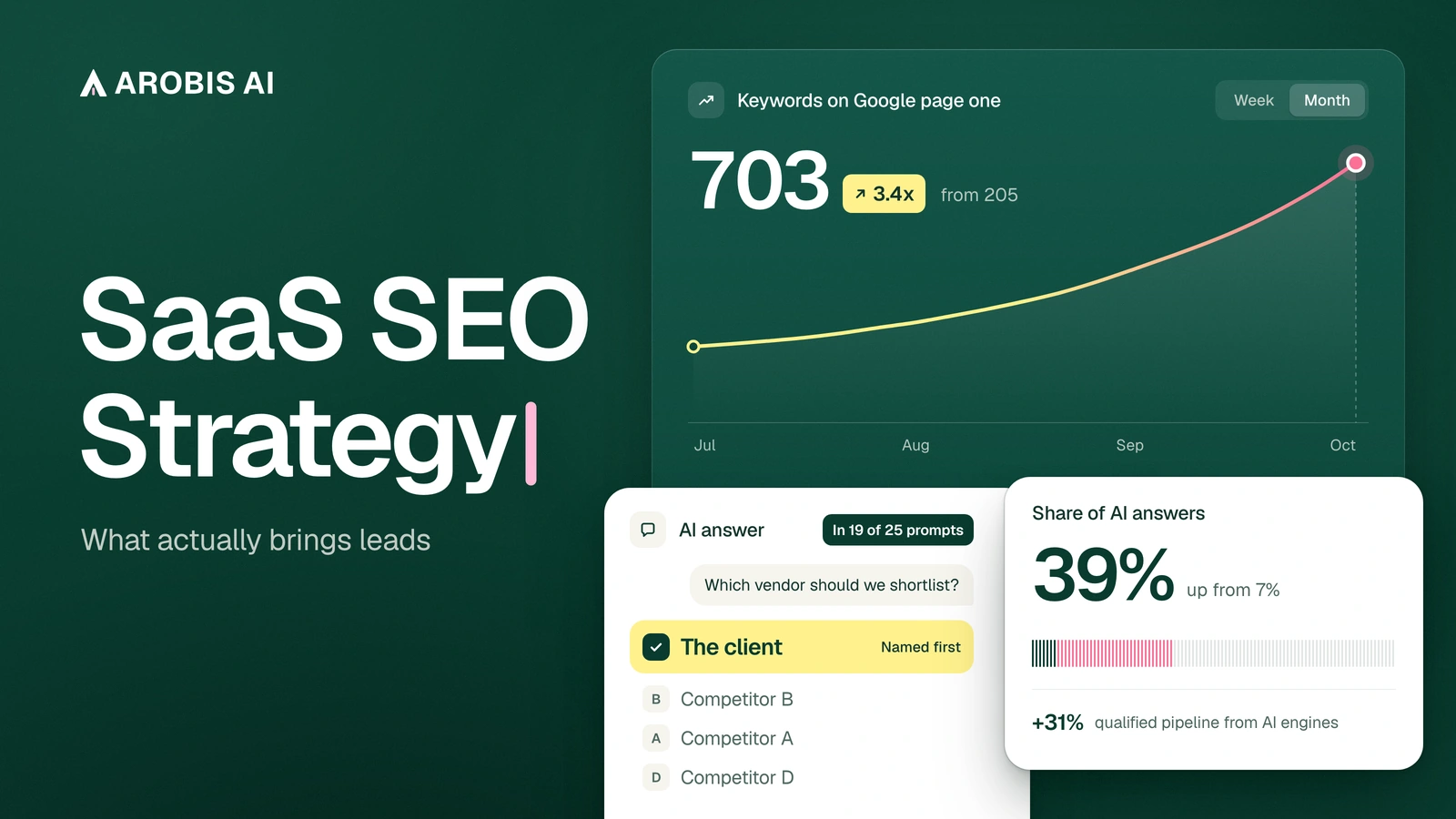
Non-brand keywords in Google's top 10 went from 205 to 703. In the top 3, from 45 to 145. That's 3.4x and 3.2x, and if I were a worse person I'd stop the story there.
Now look at the small tile on that chart. Google clicks over the same stretch went up 15%, from 2,030 to 2,330. More than three times the keywords, 15% more clicks.
A few years ago I would have called that broken. Today it's normal, and you need to plan for it. Pew Research followed 900 US adults as they browsed in March 2025. With an AI summary on the page, only 8% of their visits included a click on a regular result, against 15% without one. Seer Interactive looked at informational queries with an AI Overview, across 3,119 terms and 42 organizations, and saw organic click-through fall from 1.76% to 0.61%. Queries without an AI Overview fell too, so AI isn't the whole story, but the direction is hard to argue with. I trust those two because one watched people browse and the other used performance data.
I'll defend this in any pipeline meeting. Rankings are now an input, not a result. You still need them, because AI engines lean on what ranks. But a SaaS SEO strategy that promises traffic growth is promising the wrong thing. The better story for that same client was further down the funnel.
Visits from AI engines went from 66 a month to 146. Conversions from those visits went from 3 to 22. And the client's own CRM shows qualified pipeline from AI engines up 31%, with closed-won deals sourced from AI engines up 11%.
That last line is the one a CEO cares about. It came from a channel most SaaS SEO plans don't even have a row for. I break down how to measure it in how we measure AI visibility, and it's the reason I check dashboards more often than is healthy. I look at GA4 Realtime on my phone about six times an hour. I know. It's a problem :)
The 91 clicks that changed how I plan SaaS SEO
Agencies love showing client data. Let me show you ours instead, because it is less flattering and more useful.
Arobis AI has dozens of blog posts. Long ones, with original research, internal links, schema, the works. Over the last four weeks, Search Console tied 91 of our US clicks from Google to a specific page. Another 78 sit in the site total with no page attached, because Google hides rare searches. This is where the 91 went.
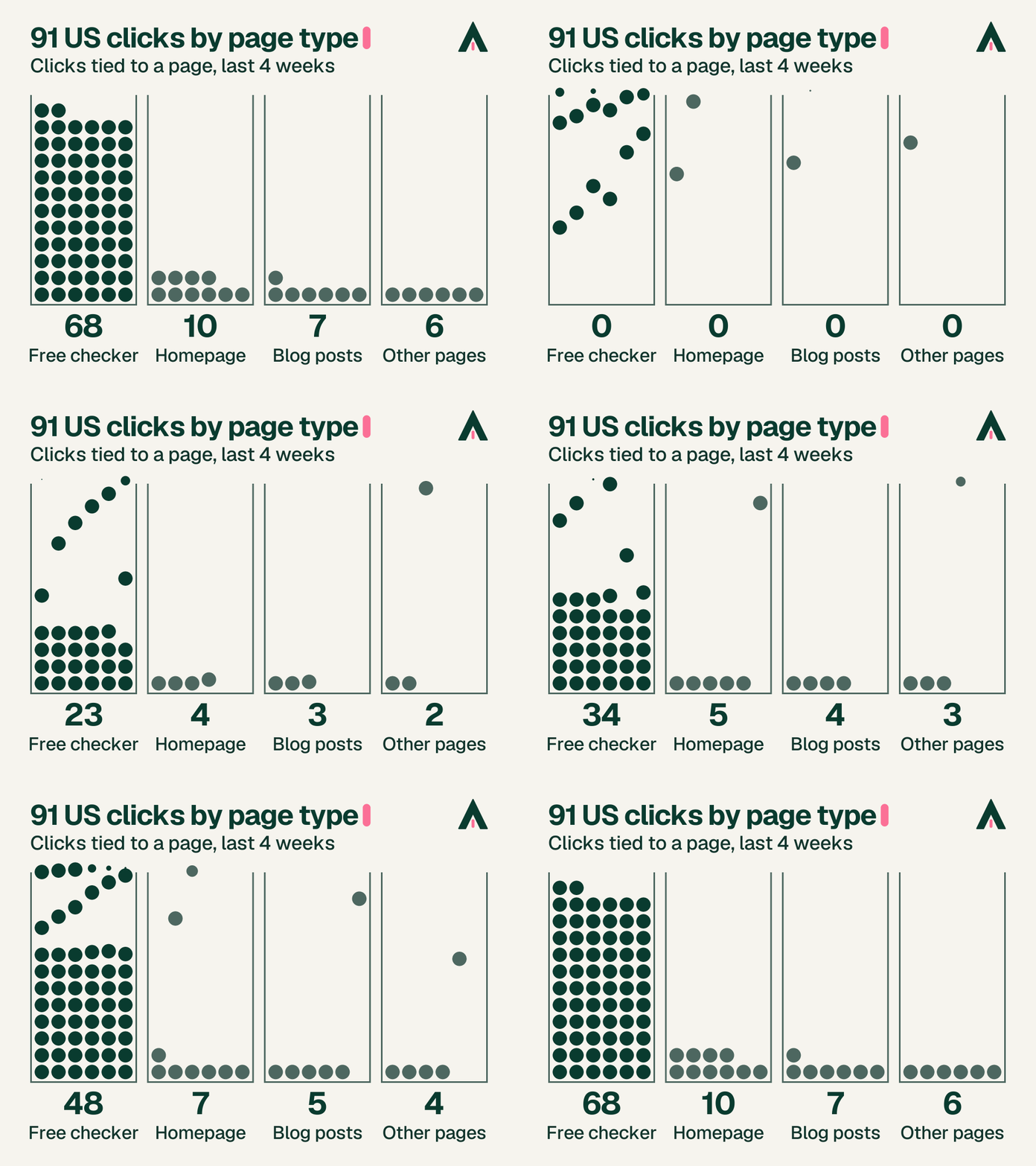
Same numbers as a share of the whole, because I want you to see how small that blog slice is.
- Free checker page68 75%
- Homepage10 11%
- Blog posts7 8%
- Other pages6 7%
The free checker got 68. All the blog posts combined got 7.
That one stung. Months of content, and on the clicks Google ties to a page, one small free tool beat the entire blog almost ten to one. Our list post on the best tools in our space sits at position 44.8, while the free checker sits at position 3.5 for its main term in the US.
When that page first jumped, it went from around position 80 to around 13 in a couple of days, and the week after, five inbound leads came in. It is still where most of our leads start. A free tool answers a question right now, so people click even with an AI Overview sitting above it. The AI can summarize an article. It can't scan your website for you.
I used to open with "what's your content calendar". Now the first thing I ask a SaaS company is "what could you give away that a buyer would use today?" A calculator, a checker, a generator, a benchmark. We've built the ChatGPT Visibility Checker and an llms.txt generator on the same logic, and our B2B SaaS client's free calculator went live in month three of its program.
A warning, though. Google Search Console will happily tell you a blog post is at position 4.5 with hundreds of impressions and zero clicks. We have a post like that. We checked the live results for that term and couldn't find the page. A lot of those impressions now come from AI features and from query fan-out, where Google runs related searches behind one AI answer. I explain how to read this in how to spot AI search queries in Search Console. Don't plan around those numbers.
Where the leads actually came from
At a B2B services company, 5 of 7 sales-qualified leads came from Google or Google's AI. At our B2B SaaS client, organic search beat ChatGPT 52 form fills to 14. Both lead charts are below.
- Google4
- Direct2
- Google's AI1
- Google and Bing organic52
- ChatGPT14
The second client is a B2B services company, not SaaS, and I am including it because its first month gave us a clear lead count by source. Seven leads in 30 days that its CRM marked as potential clients. Five of them came from Google or Google's AI. Three of those five landed on service pages we had built or rebuilt that same month.
Everyone says SEO takes a year. Sometimes it does. It's also the most convenient sentence an agency owns, because it buys a year of invoices before anyone can ask a hard question. A sharp page that answers a specific buyer's question can bring a lead within weeks when the domain has any authority at all.
The first client gives you the opposite lesson. Over 23 days of lead tracking, organic search brought 52 form fills and ChatGPT brought 14. That sounds like a great AI story. Then we opened them. Eight of the organic fills were demo requests from eight different companies. Eleven of the 14 ChatGPT fills were not buyers at all.
That's my favorite number on this page, because it cuts against my own pitch. Everyone is selling you AI search right now, me included. And yes, AI referrals convert. But which buyer AI sends depends on which questions you win, and we were winning the wrong ones. The next quarter's content goes after buyer prompts specifically. An AI lead isn't automatically a good lead. You have to read them.
Three rules came out of this, and they're in every plan I write now.
- Count leads and qualified leads separately. Our services client had 17 people fill a form or book a meeting in one month, and 5 of them were vendors pitching the company. Counting those flatters everybody and helps nobody.
- Tag the source on every form. Analytics alone won't save you. One client's GA4 saw a single lead while the CRM saw dozens. Use a first-touch script, or at least add a "where did you hear about us?" field. Tracking AI traffic takes an afternoon to set up.
- Watch Direct with suspicion. A lot of AI visits arrive with no referrer, so they land in Direct. Direct is not a source. It's a shrug.
The five pages every SaaS SEO strategy needs
If you strip a good SaaS site down to what earns money, you get five page types: category pages, comparison and alternatives pages, use case and integration pages, a free tool, and an answers page. Everything else supports these. Click through them, each one has a different job and a different buyer.
Notice what is missing. There is no "blog post" on that list. I still publish them, you are reading one, and they matter for topical authority, for links and for being quoted by AI. But I would never start there. A blog is the support act. The money pages are the band.
The most common thing I find when I audit a SaaS site is a beautiful blog and a thin product side. Fifty articles about the category, and one vague features page that says "the all-in-one platform for modern teams". An AI engine reading that page cannot tell what you sell, or who for. I wrote about this in why AI engines prefer your product and landing pages, and our own citation data agrees. The pages AI cites most on our site are the ones written for SaaS buyers, like AI visibility for SaaS and our GEO agency page, with 89 and 160 tracked citations. Our most cited blog post has 9.
What about topic clusters, templates and programmatic SEO?
They all work, in the right order. Topic clusters build topical authority, and I use them once the money pages exist, so every cluster has somewhere to send people. I suspect a lot of clusters get built first because another explainer is easier to approve than a comparison page. Templates and product-led SEO are great when your product makes something people want to reuse. Programmatic SEO can work for integration pages if each page holds data the others don't.
If the only thing changing is the company name, you've built a thin page factory. We learned this on ourselves. Our free tool creates a public report page for every scan, and when 637 of them were live on its subdomain, Google had indexed 2. That's a cheap lesson on a side project and an expensive one on your main site.
SaaS keyword research: start with money prompts, not a keyword tool
Every guide tells you to open a keyword tool. I want you to close it for an hour and go talk to sales.
At kickoff, we sit with the client and write down 25 money prompts. These are the exact questions a real buyer asks before shortlisting a vendor. Not "what is [category]" but "which [category] tool works for a 50-person team that already uses [other tool]?". Sales calls are the best source, then lost-deal notes, then support tickets. We keep a starter set in our AI buying intent prompt library.
Those 25 prompts become your keyword map and your content plan. They also become your AI scoreboard, because you can run them through the engines every night and watch who gets named.
How I map keywords to the funnel
Most funnel maps start at the top. Mine starts at the bottom, partly because of that Seer study. Its click losses were measured on informational queries, the top of the funnel. A buyer who types "[your tool] alternatives" still wants to click, compare and decide, and that's the visit I'd rather fight for.
- Bottom of the funnel (BOFU) first. Comparison pages, alternatives pages, pricing pages, feature pages, integration pages, "best [category] for [team]". The search intent is buying. Volumes are small and the money is real.
- Middle of the funnel second. Pain point keywords and jobs to be done: what your buyer is trying to get done, in their own words, before they know your category has a name.
- Top of the funnel last. Definitions and glossaries. They build topical authority and give AI something to quote, but they rarely bring a deal alone.
Write for the whole buying committee while you're there. Your champion needs proof it works, finance will hunt for the pricing model, and IT goes straight to security and integrations. One good category page can serve all three, as long as your champion can forward it without apologizing for it.
Then, and only then, the keyword tool
I use the tool for one thing, and that's finding how people phrase those same ideas in Google. I ignore most of what it says about difficulty, and my own site shows why. We built a page for a term with a keyword difficulty of 0, and it sits around position 80 for that term. Keyword difficulty is mostly a backlink count. It knows nothing about whether Google trusts you on that subject, or whether the results are full of Reddit threads and giant brands. That score has fooled me more than once. It looked weak in the tool, and the actual results page was HubSpot, Salesforce and Forrester.
Four habits run my SaaS keyword research now.
- Sort by money, not volume. A term with 150 searches and clear buying intent beats a term with 5,000 searches from students.
- Read the live results yourself. Open an incognito window. If the top 10 are all giants, walk away. If you see small sites with a few links, go.
- One page, one job. Before you write, search your own site. Our services client had two ranking drops caused by its own pages competing with each other.
- Check volume history. Tools average twelve months, and one spike in February can make a dead term look alive.
Win Google and AI answers with the same page
People keep asking me whether they should do SEO or GEO. Sorry, that's a false choice. Generative engine optimization sits on top of SEO, and so does answer engine optimization. Neither replaces it, and anyone selling them as a replacement is selling you a rebrand.
That said, ranking on Google doesn't get you into AI answers by itself. Ahrefs ran about 15,000 long-tail prompts, and only about 12% of the links cited by ChatGPT, Gemini and Copilot ranked in Google's top 10 for that prompt. A page-one ranking buys you a lot less in AI answers than most SEO reports imply.
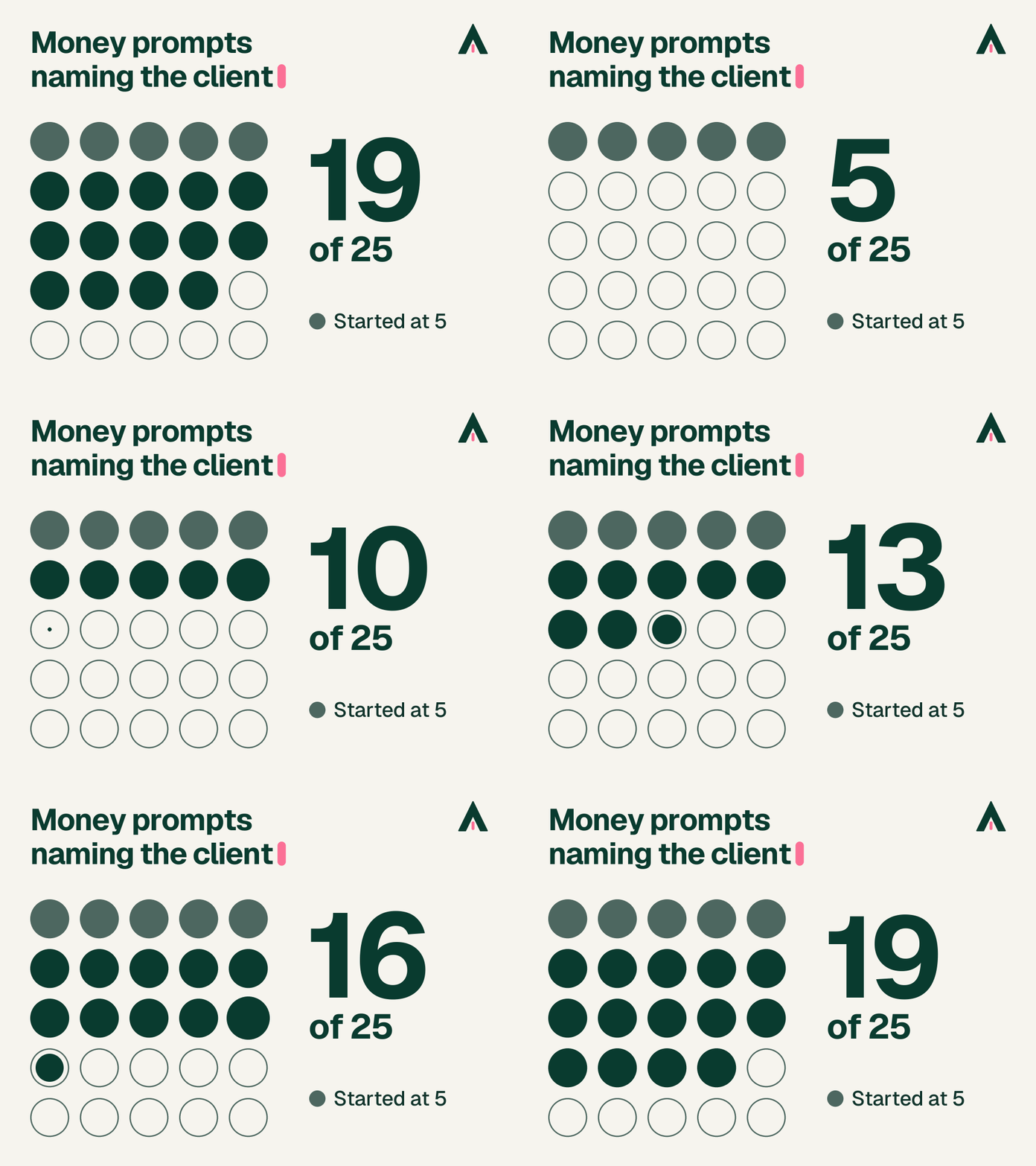
We did both for our B2B SaaS client. AI engines named the client on 5 of its 25 money prompts at the start, and on 19 of 25 after 90 days.
Its share of AI answers, meaning how many tracked answers name it, went from 7% to 39%, the highest of the 16 brands we track in its category.
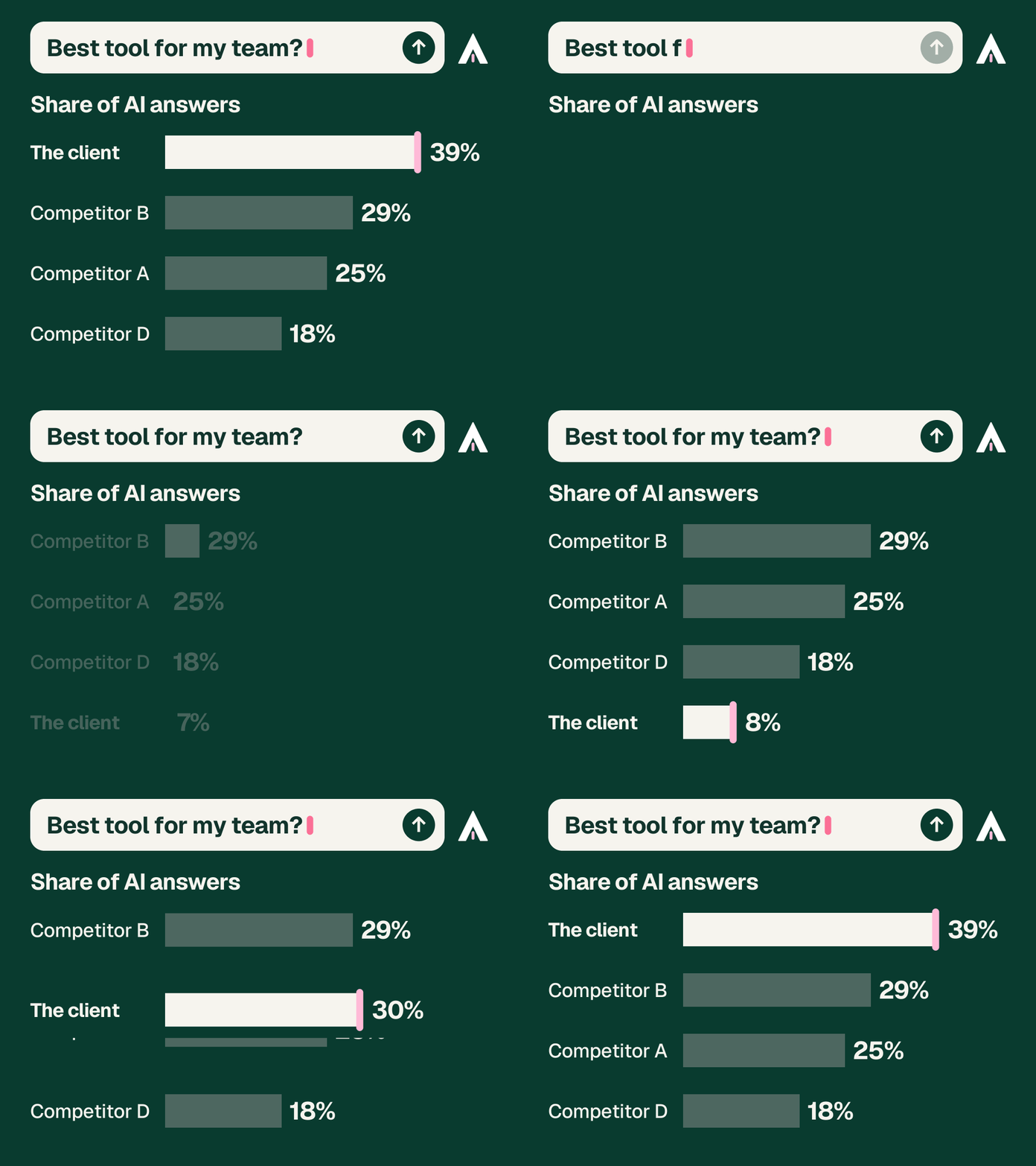
The next brand sits at 29%, so the lead is real, and it has to be defended every month.
And 45% of those AI answers now cite its website directly, while its impressions in Google's AI Overviews and AI Mode grew 6.3x. The services client moved even faster, from the 7th most cited site in its category to the 1st in 30 days, with ChatGPT naming it on 10 of 25 buyer questions, up from 4. That kind of jump is possible because how well known a brand is does not decide who AI recommends, which is what the state of AI search visibility numbers show.
I'd love to tell you there was a trick. There were five chores, done properly.
- Answer first. Every page opens with the direct answer in about 50 words, then expands. We rebuilt 10 pages this way for the SaaS client in month two. Our AEO checklist has the full list.
- Real numbers and named facts. AI engines quote specifics. "Fast onboarding" is invisible. "Live in 14 days" gets repeated.
- Third-party proof. AI reads what others say about you. Six articles featuring the client went live in 90 days, and three of them rank it first. Our AI brand mentions study found the same pattern across 120 prompts.
- One clean identity. The same description everywhere: site, LinkedIn, G2, Crunchbase, Wikidata. Conflicting facts make AI hedge, and hedging means someone else gets named.
- An answers page. If you don't state your pricing model and your facts plainly, AI will repeat the first old thing it finds. We caught engines quoting a wrong price from a third-party site, which is why this page exists. Our own answers page shows the format.
Try this test before you read on. It takes ten minutes. Open ChatGPT in a temporary chat and ask, word for word, the question your best customer asked before they bought. Do the same in Gemini and in Google's AI Mode. Write down who gets named, in what order, and which sites get cited. That list is your real competitor set, and it is rarely the one in your board deck. Our guide to checking whether AI recommends your brand has the longer version.
Technical SEO for SaaS: only what moves revenue
I've seen technical audits with 400 line items. Nobody fixes 400 line items. For a SaaS site I care about a short list, because these are the ones that have cost someone money in front of me.
- Redirects after a migration or a merge. The most expensive line on any audit. More on that in a minute.
- Duplicate pages. We redirected 9 duplicates for the SaaS client in one month. Duplicates split your signals and confuse AI about which page is the real one.
- JavaScript rendering. If your pricing or features load only after scripts run, many AI crawlers see an empty page. Test it, do not assume.
- AI crawler access. We scanned 2,934 websites for our AI Readiness Report, and 22.8% block at least one AI engine. It is usually a bot protection default in a CDN or firewall, not a choice anyone made. See what AI crawlers actually read.
- Your app, docs and marketing site. Keep the marketing site and the docs indexable, and keep logged-in app pages out of the index.
- Schema that matches the page. Organization, SoftwareApplication, Article, FAQ where it is true. Google dropped FAQ rich results, but the structure still helps machines read you.
If you want a proper one-time look at all of this, that is what our SEO audit is for. Otherwise, fix those six and move on. Keep Core Web Vitals healthy on your money pages, and stop there. A perfect speed score and alt text on an old blog image are not why you lost the deal.
Internal links: the cheapest win in SaaS SEO
If I could only do one thing on an existing SaaS site, it would be this. It is boring and almost free, and it worked better than anything else I can point to.
We audited a SaaS blog with 84 posts. 31 of them had zero internal links and only 6 linked to a conversion page, so the blog was basically 84 separate islands. We didn't write a single new post. We connected the ones they had, and by day 35, organic sessions were up 128%, MQLs up 24%, and closed-won revenue influenced by organic up 11%. The whole process is in the internal linking case study.
Every post links to a money page, and every money page gets links from its related posts. One link per destination per post, with anchor text that sounds like a person wrote it. And every time you publish something new, go back and link to it from your strongest related pages. Everybody skips that last step. We do it on the day a page goes live.
Content refresh is the other thing everyone recommends, and I've grown more careful about it. We've rewritten posts on our own site and watched nothing move. I refresh only when the facts are wrong, or when a page with buying intent sits between positions 8 and 20. A new date on old content fools nobody, Google included.
SaaS link building: what I would pay for, and what I would not
Links still matter, and I won't insult you by pretending they don't. Our services client's Ahrefs Domain Rating nearly doubled in a month, which is unusually fast. But I've changed how I think about them.
For years the goal was to collect authority. Now I want you present on the pages buyers and AI engines already read. A link from a "best tools" list that ranks on page one sends referral traffic and passes authority, and it also puts your name in the source material AI uses to build a shortlist. A link from a random guest post on a site nobody visits does one of those, weakly.
- Get on lists that already rank. Search your category, find the top ten list posts, and pitch the authors with a good reason to include you.
- Publish under your executives on LinkedIn. Two LinkedIn articles written under our SaaS client's leadership both reached page one of Google. You're borrowing a very strong domain, legally :)
- Go where your buyers argue. Reddit shows up on a lot of SaaS results pages now, and Google's AI Overview for this topic cites it. Read our Reddit guide for SaaS before you post anything, because they will smell marketing instantly.
- Use the free tool as the link magnet. People link to things that are useful. They rarely link to your thought leadership.
- Do digital PR only with data of your own. A number nobody else has can earn coverage, and a press release about your new feature almost never will.
The mistake that took a client from position 11.5 to 95
I promised you a mistake, so here it is.
In the first month with the services client, we built a new, better guide on a topic that mattered to their buyers. The plan said to redirect the old post into the new one. It was one line in a document. It never got done.
For weeks the old page and the new page sat side by side, competing with each other. Then the searches around that topic fell from position 11.5 to position 95. I found it during a review. Nobody at Google did this to us. We wrote down a plan and didn't finish it.
I have not seen a SaaS SEO guide talk about this, and I think it matters more than half of what they do cover. Most SEO damage comes from a task that fell through a crack, and then Google gets the blame. A redirect nobody applied. A page someone unpublished. A noindex tag that went out with a release.
So we changed how we work. Every planned action on our client accounts now goes into a ledger with a due date, an automated check wherever one can run, and a named owner when something is blocked. The ledger has to pass before any report goes out. If the check fails, new work stops until it's fixed. The redirect is in and I sleep better. Boring, again. I've come to think boring is most of the job.
How to measure SaaS SEO without lying to yourself
Measure SaaS SEO by qualified pipeline by source first, then qualified leads by landing page, then AI answers that name you. Rankings and clicks come last, as leading indicators. It all fits on one screen. These are the numbers I would put in front of a board, in this order. There is more on this in my CMO guide to reporting AI share to the board.
- Qualified pipeline by source. The only number that survives a budget meeting.
- Qualified leads by source and landing page. This tells you which pages to copy.
- Money prompts where AI names you. Out of your 25, per engine. Run them often, because AI answers move daily.
- Share of AI answers against named competitors. This is the new share of voice.
- Non-brand keywords in the top 10 and top 3. Leading indicator, not a result.
- Non-brand clicks. Look at the trend over 28 days or 3 months, never over 24 hours.
And these are the numbers I would keep off that board slide: total impressions, average position, Domain Rating as a headline, and traffic with no source next to it. All four are easy to game, and they let everyone feel good while pipeline stays flat.
One more thing on timing, because it decides whether the CFO lets you finish. New AI citations tend to appear 30 to 60 days in, and what AI recommends on your core buyer prompts starts to shift around 60 to 90 days. Google rankings on competitive terms take longer. If someone promises page one in two weeks, ask them which page.
Your stage decides your first move
A seed-stage startup and a public SaaS company should not run the same SaaS SEO strategy. The advice that is right for one will waste a year for the other. Pick the stage closest to yours.
- One category page that says exactly who you are for
- Three fair comparison pages against the names buyers already know
- One founder article a month on LinkedIn, where the audience already exists
- Pick 25 money prompts with sales, not with a keyword tool
- Ship use case pages for your top five deals
- Add lead source tracking to every form before you publish more
- Audit internal links before you write anything new
- Merge pages that compete for the same query
- Run every planned change through a ledger with an owner and a check
At enterprise scale the plan stays the same and the approvals get slower. That makes the ledger matter more, because every change passes through more hands, and each pair of hands is a place for a task to fall.
The 90-day SaaS SEO roadmap
This is the order I would run today, built from what worked and what we did too late with the SaaS client whose numbers you saw above. Open each month for the detail.
Month 1 Measure and fix
- Agree 25 money prompts with sales and record who AI names today
- Pull the baseline: non-brand top 10, top 3, clicks, leads by source
- Fix redirects, duplicates and crawler access
- Rebuild the 10 pages closest to revenue, answer first
Month 2 Build what buyers want
- Ship category, comparison and use case pages
- Publish two LinkedIn articles under your executives
- Get named on third-party lists that already rank
- Start the free tool
Month 3 Connect and compound
- Launch the free tool and list it in relevant directories
- Publish your answers page
- Add internal links from every related post to the money pages
- Review leads by source and rebuild the plan from what sold
The order matters more than the speed. Measure first, or you'll never know what worked. Fix second, because new pages on a leaky site are a waste. Then build. The free tool and the internal links come last, even though I called internal links the cheapest win here, because they multiply everything you built before them.
A word on effort. In month one for the services client we shipped 15 new pages and rebuilt 14. That's a lot, and it's why the first month moved. You don't need that pace forever, but you do need one real push at the start. A trickle of two posts a month is how SaaS SEO programs die quietly. Nobody sees results by month six, the budget moves to paid, and everyone agrees SEO doesn't work for your category.
SaaS SEO checklist
Tick what's true for your company today. Your score updates as you go.
In-house, freelancer or agency?
In-house is best if you can hire a senior person and give them developer time. A freelancer suits one clear job. An agency fits when you need many skills at once and want it done for you. I've worked with all three, so let me be blunt, including about my own side of the market.
A good in-house lead knows the product and sits near sales. The risk is that they get pulled into everything else and SEO becomes the thing they do on Fridays.
A freelancer is great for a migration or a content sprint. Don't expect strategy, reporting and execution from one human.
An agency only works if it reports on pipeline and does the work itself. A deck of recommendations is an expensive way to feel busy. Before you sign anything, ask to see a real report, ask what you're paying for if nothing moves in 90 days, and ask who does the work. I wrote a whole guide to choosing an AI SEO agency from my years on the buying side, and if you want to compare, we rank the best SEO, GEO and AEO agencies for SaaS. On budget, our pricing starts at $2,500 a month, and what AEO costs breaks down the wider market.
If you'd like it done for you, that's what our SaaS SEO agency does. If you'd rather do it yourself, everything on this page is yours to use. And since I said I'd tell you what I'd do first if you handed me your site tomorrow, it's this: an hour with your sales team and a blank page for your money prompts. Then remember the line I'd put on a wall: rankings are an input, not a result. Either way, please don't start with the blog.
Frequently asked questions
What is SEO for SaaS?
SEO for SaaS is the work of getting a software company found by buyers on Google and in AI answers, then turning those visits into trials, demos and qualified pipeline. It focuses on category, comparison, use case and free tool pages rather than on blog traffic alone.
How do you do SEO for SaaS?
Begin with 25 buyer questions agreed with sales and measure who gets named today. Fix redirects, duplicates and crawler access. Build category, comparison and use case pages, then a free tool. Connect everything with internal links, earn mentions on pages that already rank, and track leads by source.
Does SEO work for SaaS?
Yes, if people already search for your category and you can name your ideal customer. AI engines went from naming one B2B SaaS client of mine on 5 of 25 money prompts to 19 in 90 days, and its qualified pipeline from AI engines rose 31%.
What are the top SEO strategies for SaaS?
The top SaaS SEO strategies are building money pages before the blog, shipping a free tool, going after comparison and alternatives terms first, linking every post to a money page, getting named on lists that already rank, and reporting qualified pipeline by source. The order matters: measure, fix, build, then connect.
How long does SaaS SEO take to work?
Expect new AI citations within 30 to 60 days. Recommendations on core buyer prompts usually change in 60 to 90 days. A specific service page can bring a lead within weeks on a domain with some authority. Competitive head terms on Google usually take longer, often several months.
Is SEO dead or evolving?
Evolving, not dead. For SaaS companies the payoff has moved. Clicks grow more slowly because AI answers sit above the results. One of our clients more than tripled its top 10 keywords while clicks grew 15%, yet its AI-sourced qualified pipeline rose 31%. SEO still feeds those answers, so the work matters more while the traffic matters less.
What is the difference between SaaS SEO, AEO and GEO?
SaaS SEO covers rankings in search engines. AEO, answer engine optimization, focuses on being the direct answer. GEO, generative engine optimization, focuses on being named and cited by tools like ChatGPT and Gemini. In practice they share the same pages, and SEO is the foundation of the other two.
How much does SaaS SEO cost?
Arobis AI plans begin at $2,500 a month. A $5,000 plan adds lead tracking and attribution. Costs across the market vary widely by scope. The bigger cost is usually developer time, so agree on that before you agree on an agency fee.
What are the most important SaaS SEO metrics?
Qualified pipeline by source comes first, then qualified leads by landing page, money prompts where AI names you, and share of AI answers against competitors. Non-brand keywords in the top 10 and non-brand clicks work as leading indicators. Average position and total impressions tell you very little on their own.
Should a SaaS startup invest in SEO?
Yes, once you can describe your buyer clearly, but keep it small. An early company should build one strong category page and three fair comparison pages, and publish founder articles on LinkedIn. Topic clusters and glossaries can wait until sales are repeatable.