
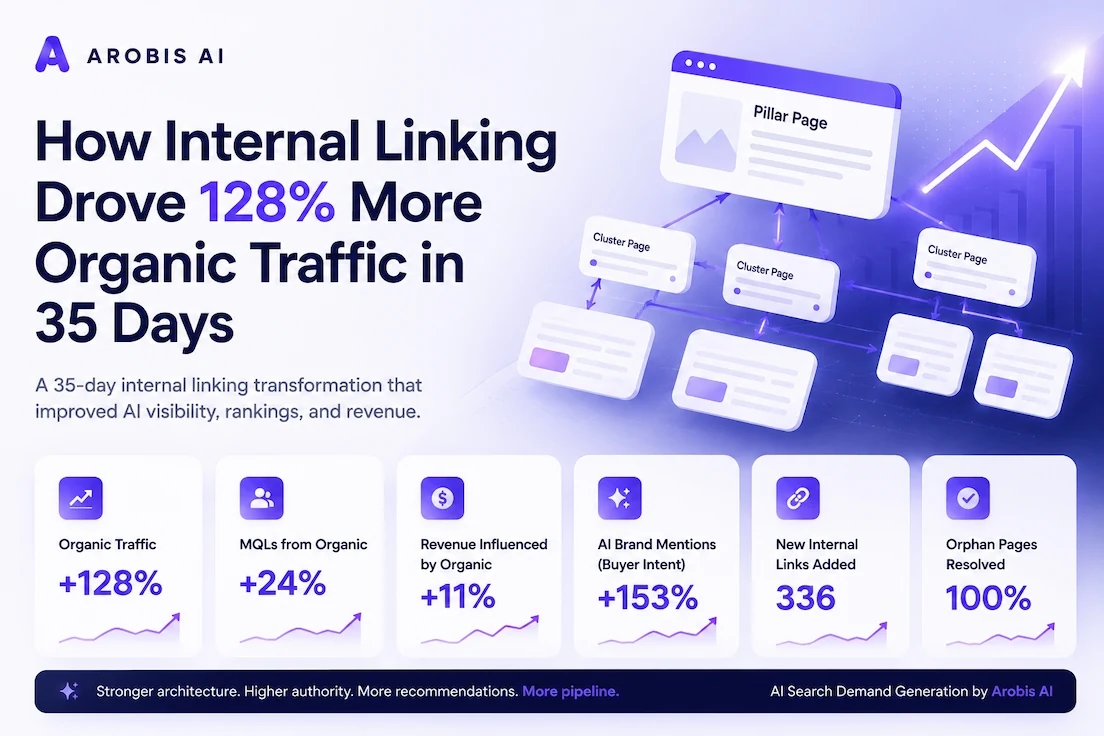
Their Blog Was Working Against Them
The client is a B2B SaaS company in the marketing technology space. At the time we started working together, they were at approximately $4M ARR, had a team of six in marketing, and had been investing in content for 18 months.
They had 84 published blog posts. A solid library. Real expertise across every article. Good writers. Consistent publishing cadence.
And almost no internal links connecting any of it.
Each post existed as an island. It was discovered, read, and then the reader left — with no path to related content, no signal to Google about topical depth, and no way for AI engines crawling the site to understand that this brand had genuine authority across its category.
Their organic traffic had plateaued for four months. MQLs from content were flat. They were publishing more posts trying to solve a problem that wasn't a content volume problem. It was a content architecture problem.
The fix didn't require a single new blog post.
It required connecting the ones they already had.
Here's exactly what we found, what we did, and what changed — in 35 days.
What the AI Visibility Audit Found
Every Arobis AI engagement starts with a full AI Visibility Audit. For this client, the audit covered their entire content library, internal link structure, AI search presence, and topical authority signals.
The internal linking picture was stark.
Seventy percent of their blog posts had zero or one internal link. Nineteen pages were completely orphaned — published, indexed, and invisible to both readers and search engines because nothing linked to them. Their best-performing pillar content had almost no link equity flowing to it from supporting posts.
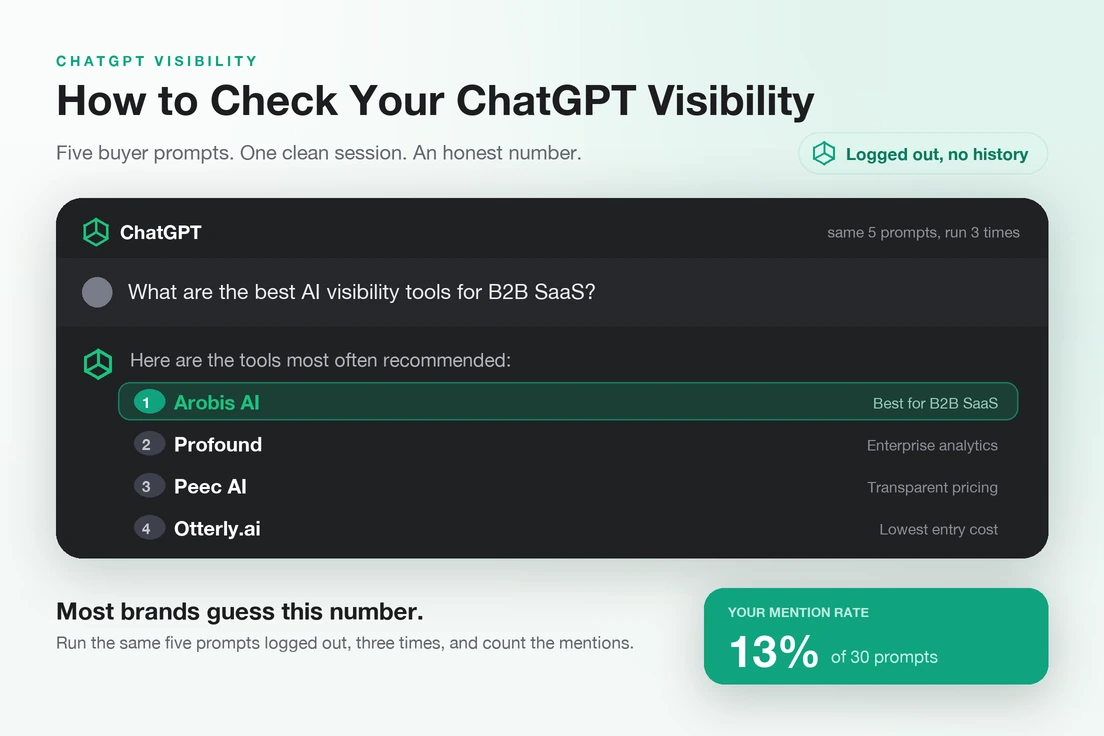
And critically: when we tested buyer-intent prompts across ChatGPT, Gemini, Claude, and Perplexity, the brand appeared in fewer than 15% of relevant category queries. AI engines couldn't confidently associate this brand with its core topics — because the content cluster signals that would demonstrate topical authority simply didn't exist.
The audit also revealed where the highest-value opportunities were. Not all 84 posts were equal. Twelve posts already had meaningful organic traffic but were leaking that traffic — no links to related posts meant readers hit a dead end. Six posts were ranking on page two for high-intent keywords but had zero internal link equity helping them push to page one.
The opportunity map was clear. The work was defined. We moved immediately.
This is why understanding why brands don't appear in AI answers goes beyond content quality — site architecture and internal linking are authority signals AI engines use to form their picture of your brand.
Why Internal Linking Is an AI Search Signal — Not Just an SEO Tactic
Before covering the process, it's worth making explicit something most internal linking guides miss entirely: internal linking isn't just about SEO rankings. It's a core signal in Generative Engine Optimization (GEO) and AI search recommendation.
Here's why it matters for AI visibility specifically.
AI crawlers follow links to map content depth. When GPTBot, PerplexityBot, ClaudeBot, and Google's AI crawler visit a website, they follow internal links to discover related content. A brand with 84 isolated blog posts looks like 84 unrelated pages. A brand with 84 interconnected posts organized into topic clusters looks like a deep, authoritative resource on a set of related topics. That distinction directly affects whether AI engines are willing to recommend the brand in buyer-facing answers.
Topic clusters built by internal links signal semantic authority. AI recommendation systems don't just look at individual pages. They assess whether a brand has comprehensive, interconnected expertise across a topic. Internal links are the mechanism that makes that expertise visible — they show crawlers how content relates, what the central pillar topics are, and how deep the knowledge goes.
Pillar pages elevated by internal link equity become more citable. When supporting blog posts link to a central pillar page, they pass authority to it. That accumulated authority makes the pillar page more likely to be cited when an AI engine is selecting which sources to include in an answer. Link equity from well-connected content clusters is one of the most direct paths to improving AI citation frequency.
Conversion pages need to be part of the link architecture. If blog posts don't link to audit pages, tool pages, or product pages, organic readers reach a dead end. More importantly, AI engines don't connect the brand's content authority to its commercial offer — making it less likely to appear in buyer-intent queries where the user is ready to evaluate vendors.
This maps directly to the Arobis AI Search Demand Framework™ — specifically to Stages 1 through 3:
Internal linking is one of the fastest levers for moving a brand from Stage 1 to Stage 3 — because it's entirely within your control and requires no external validation. It's owned work that produces compounding authority signals.
For the full picture of the 5 signals AI engines use to decide which brands to recommend, internal linking sits inside the semantic authority and entity clarity signals — two of the five.
The 35-Day Process: Exactly What We Did
The engagement ran for exactly 35 days from audit completion to confirmed results. Here's the process, week by week.
Phase 1: Discovery (Days 1–5)
We crawled the full site and built a complete map of every internal link that existed. Each of the 84 posts was scored against three criteria: existing organic traffic, keyword ranking position, and commercial intent of the topic.
The scoring produced a clear priority matrix. Posts with existing traffic but no outbound links to related content were the highest priority — these were actively leaking value. Posts ranking on page two for high-intent keywords were second priority — internal link equity could push them to page one. Orphan pages were third priority — they needed at least three links pointing to them before anything else could work.
We also mapped the topic clusters. This client's content naturally organized into four clusters: demand generation, content marketing, SEO, and AI search. Every post was assigned to a cluster, and within each cluster we identified the pillar page (the most comprehensive piece on the topic) and the supporting posts.
Phase 2: Strategy (Days 6–10)
Before writing a single link, we built the internal link architecture blueprint. This defined:
- Which pages were pillar pages (one per cluster)
- Which posts were supporting content (connected to the pillar and to each other)
- The anchor text framework — exact-match anchors for primary keywords, partial-match for secondary, natural language for tertiary
- The conversion path — every post in every cluster needed a link to either the free AI Visibility Checker or the audit CTA
- The reverse linking rule — every new link added also required identifying the corresponding reverse link (if Post A links to Post B, does Post B link back to Post A where contextually appropriate?)
This blueprint took four days to build properly. It's the step most teams skip — they add internal links ad hoc, without a structural plan, which produces random link patterns rather than authoritative topic clusters.
Phase 3: Implementation Round 1 (Days 11–20)
Implementation started with the highest-priority posts from the scoring matrix. For each post, we:
- Read the full article to identify every natural opportunity to link to a related post
- Added contextual links using the anchor text framework — the link text described the destination content accurately, not generically
- Ensured every post linked to at least one pillar page in its cluster
- Added a conversion link where contextually appropriate (not forced — only where the post's topic naturally connected to the audit or tool)
In ten days of implementation, we added 247 new internal links across 62 posts. Average of 4 new links per post where previously most had zero or one.
The focus was exclusively on contextual links — links placed within the body text where they add genuine value to the reader. Not footer links, not sidebar links, not navigation. Contextual internal links carry the most weight for both Google and AI crawlers because they exist within the semantic context of the surrounding content.
This is the core of what Answer Engine Optimization (AEO) looks like in practice — structuring content so AI systems can understand relationships between topics, navigate depth, and identify the most authoritative pages within a cluster.
Phase 4: Implementation Round 2 (Days 21–28)
The second round focused on reverse linking. Most internal linking projects only link forward — from new posts to related older content. We went back through every older post and added links forward to newer content where the relationship was natural and valuable.
This is important for two reasons. First, it ensures older posts with existing Google authority pass that authority forward to newer content. Second, it creates a genuinely interconnected network rather than a one-directional chain — which is what topic cluster architecture should look like to both search engines and AI crawlers.
Round 2 added 89 additional links. The 19 orphan pages were fully connected by Day 24. Every post now had at least 2 posts linking to it and at least 2 posts it linked to.
Phase 5: Validation (Days 29–35)
We submitted updated sitemaps, monitored crawl coverage in Google Search Console, and ran fresh AI prompt tests across ChatGPT, Gemini, Claude, and Perplexity for the client's key buyer-intent queries.
The first measurable signal came on Day 23 — before Round 2 was even complete. Three posts that had been sitting on page two for target keywords moved to page one. Search Console showed Googlebot had re-crawled the highest-priority posts within 72 hours of the first links being added.
By Day 35, the full results picture was confirmed.
For a deeper understanding of how crawlers read and process your site, our guide on what AI crawlers actually read explains the specific signals that determine whether AI engines can fully map your content architecture.
The Results: Day 35
Measured against the 35-day baseline period immediately before the engagement:
The traffic result was the headline. But the MQL and revenue numbers are the ones that matter most.
The +24% MQL increase wasn't from more traffic alone. It was from traffic that now had somewhere to go. When blog posts link to conversion pages — the audit CTA, the free tool, the demo path — readers convert at higher rates because the path exists. Before the engagement, 93% of blog posts had no link to any conversion page. After, every post had at least one.
The +11% closed-won revenue increase reflects the same dynamic at the pipeline level. AI-referred traffic that arrived via improved recommendation frequency converted into opportunities. Opportunities that were nurtured by content — because the internal link architecture now kept readers on site and moving through related content — closed at higher rates.
And the AI search visibility improvement — from 15% to 38% of target queries — happened with zero new content published. Zero new blog posts. Zero new pages. Only the architecture of the existing content changed.
That's the result this engagement proved: authority isn't just about what you publish. It's about whether what you've already published is connected, navigable, and structurally visible to both search engines and AI recommendation systems.
What Most SaaS Companies Get Wrong About Internal Linking
After auditing dozens of SaaS content libraries, the same four mistakes appear repeatedly.
Mistake 1: Treating internal linking as an afterthought. Most SaaS teams add internal links when they remember to, at the end of the writing process, without a structural plan. The result is random link patterns that don't reinforce topic clusters or signal authority to search engines. Internal linking is architecture work, not proofreading work.
Mistake 2: Using generic anchor text. “Click here.” “Read more.” “Learn more about this.” These anchor texts tell search engines and AI crawlers nothing about the destination page. Anchor text is a semantic signal. It tells the crawling system what the linked page is about. Generic anchor text wastes the opportunity entirely.
Mistake 3: Only linking forward, never backward. Teams link from new posts to old content but never go back to old posts to link them forward to newer content. This means older posts with existing authority never pass that authority to newer content. A proper internal linking strategy is bidirectional and ongoing.
Mistake 4: Not linking to conversion pages. Blog posts that never link to an audit, demo, or free tool page create a closed loop. Traffic comes in and goes back out without a conversion path. Every blog post should have at least one contextual link to a commercial destination — placed where it genuinely adds value, not forced at the bottom.
These mistakes are fixable without publishing a single new piece of content. And as this case study shows, fixing them alone can produce results that most content programs take 6–12 months to achieve through new content production.
For context on how AI search is changing SaaS marketing, internal linking is one of the most direct ways to improve your AI recommendation presence using only what you already have.
The Repeatable Process: 5 Steps You Can Start This Week
The Arobis internal linking methodology isn't proprietary magic. It's disciplined execution of a structured process. Here are the five steps any SaaS company can apply.
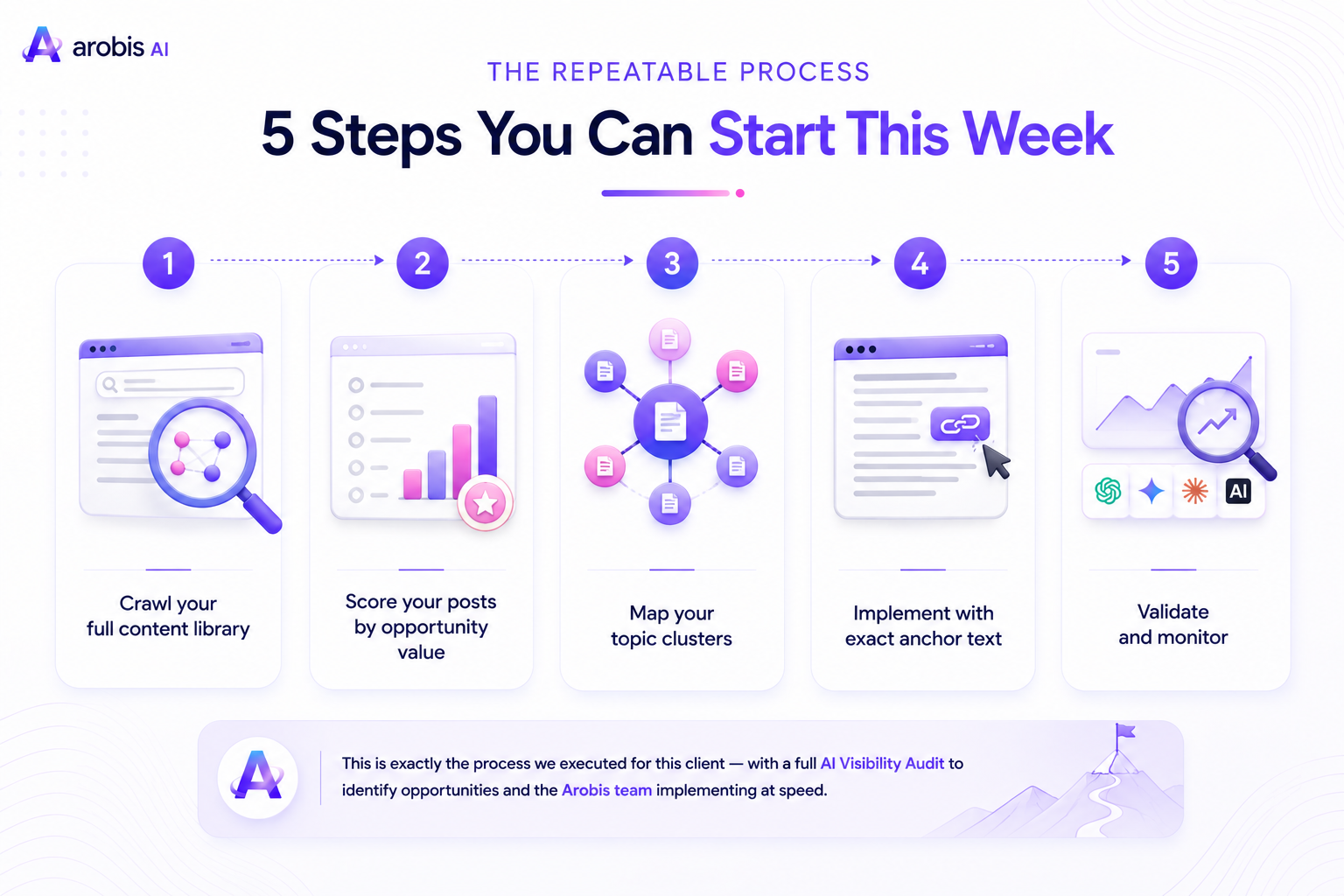
Step 1: Crawl your full content library. Use Screaming Frog, Ahrefs, or Google Search Console to map every internal link that currently exists. Export the list. Count the links per page. Identify your orphan pages — any page with fewer than two internal links pointing to it.
Step 2: Score your posts by opportunity value. For each post, record: current organic traffic, keyword ranking positions, and topic. Posts with high traffic but no outbound links are your highest priority. Posts on page two for commercial-intent keywords are second. Orphan pages are third.
Step 3: Map your topic clusters. Group all your posts into 3–5 topic clusters. Within each cluster, identify your pillar page — the most comprehensive piece on that topic. Every other post in the cluster should link to the pillar. Posts within the same cluster should link to each other where contextually relevant.
Step 4: Implement with exact anchor text. Go post by post, starting with the highest-priority posts from your scoring matrix. Add contextual links using descriptive anchor text that accurately describes the destination. Add the reverse links as you go — if Post A now links to Post B, check whether Post B should link back to Post A. Add a conversion link (audit, demo, tool) to every post where it fits naturally.
Step 5: Validate and monitor. Submit your updated sitemap in Google Search Console. Monitor crawl coverage over the following 2–4 weeks. Run your target buyer-intent queries in ChatGPT, Gemini, Perplexity, and Claude to track whether your AI search presence is improving. Use the free AI Visibility Checker to measure your baseline before you start and compare after.
This process is exactly what we executed for this client — with the addition of the full AI Visibility Audit that identified the specific opportunities and the Arobis team executing the implementation at speed.
Why 35 Days — Not 6 Months
The most common question when sharing these results: why so fast?
Most SEO results take 6–12 months because most SEO work requires building something new — new content, new backlinks, new pages. Each of those requires creation time, indexing time, and authority-building time before Google or AI engines respond.
Internal linking works faster because it works with what already exists. The content authority was already there — locked inside 84 isolated posts. Connecting them didn't create new authority. It made existing authority flow.
Google re-crawled the highest-priority posts within 72 hours of the first links being added. That's normal crawl behaviour for a site that already has Google's attention. Within two weeks, ranking movements were visible. Within 35 days, the full traffic and pipeline impact was measurable.
The 35-day result isn't a promise. It's a consequence of the specific situation: a content library with genuine authority, significant internal linking gaps, and the right implementation sequence executed without delay.
What it does prove is that for SaaS companies with existing content libraries, internal linking is the highest-leverage, fastest-returning demand generation investment available — before any new content is created.
For context on the broader AI search opportunity and why organic authority matters more than ever, see our State of AI Search Visibility research.
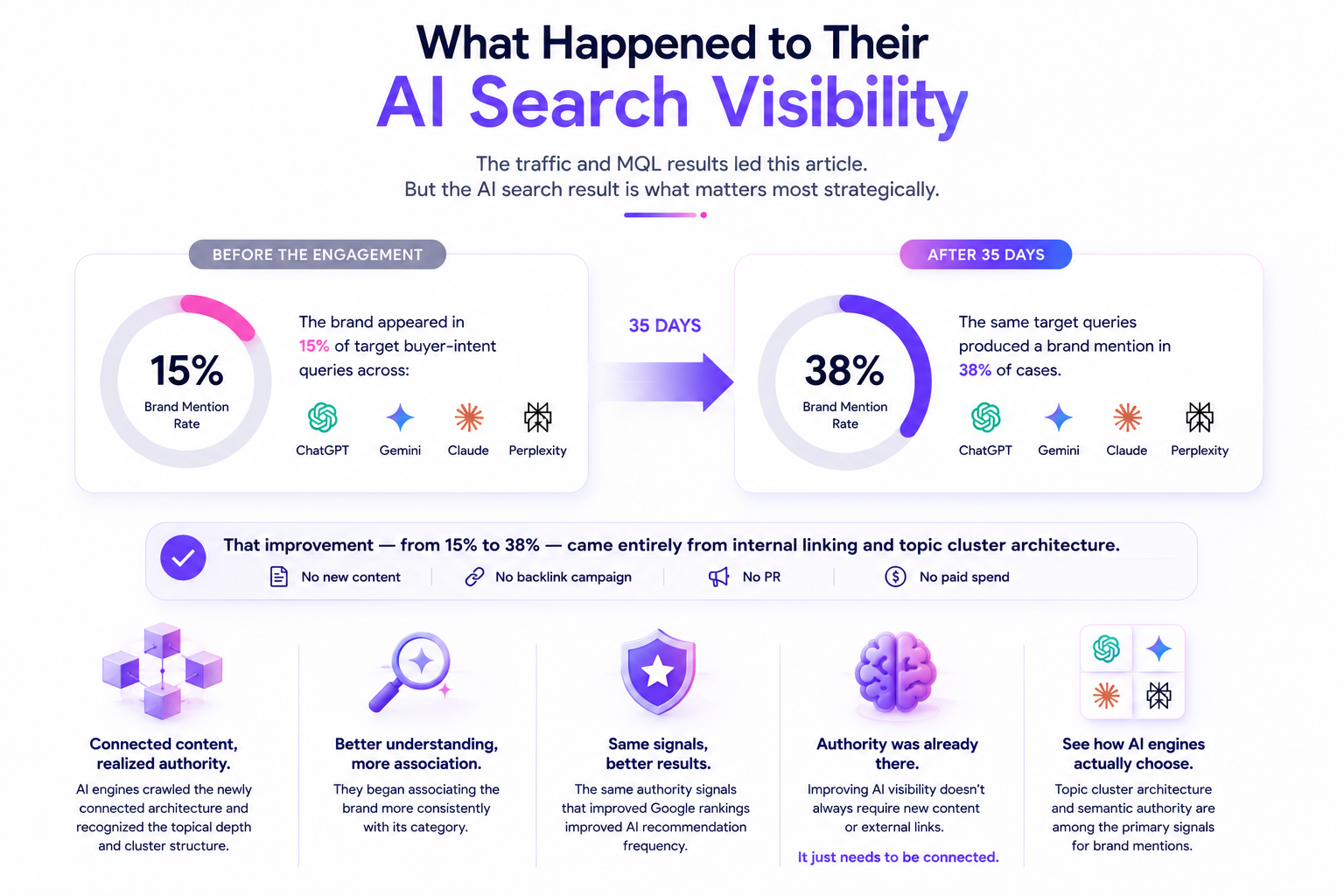
What Happened to Their AI Search Visibility
The traffic and MQL results are the ones that led this article. But the AI search result is the one we think matters most strategically.
Before the engagement: the brand appeared in 15% of their target buyer-intent queries when tested across ChatGPT, Gemini, Claude, and Perplexity.
After 35 days: 38% of the same target queries produced a brand mention.
That improvement — from 15% to 38% — came entirely from internal linking and topic cluster architecture. No new content. No backlink campaign. No PR. No paid spend.
AI engines crawled the newly connected content architecture, recognized the topical depth and cluster structure, and began associating the brand more consistently with its category. The same signals that improved Google rankings improved AI recommendation frequency — because both systems are evaluating the same underlying authority architecture.
This is the insight that most AI visibility strategies miss: improving your AI search presence doesn't always require new content or external link building. Sometimes the authority is already there. It just needs to be connected.
See how Perplexity, ChatGPT, Claude, and Gemini actually choose which brands to mention — topic cluster architecture and semantic authority are among the primary signals.
Frequently Asked Questions
How long does it take to see results from internal linking?
This engagement produced measurable traffic results on Day 23 and confirmed full results on Day 35. The timeline depends on how often Google and AI crawlers are already visiting your site, how many internal linking opportunities exist, and how quickly implementation moves. Sites with existing traffic and large content libraries tend to see faster results because crawlers are already frequent visitors. Brand new sites with minimal existing authority will see slower results.
Do I need new content to improve my AI search visibility?
Not always. This case study demonstrates that connecting existing content through strategic internal linking improved AI recommendation frequency from 15% to 38% of target queries without publishing a single new post. If your brand already has a meaningful content library but weak internal link architecture, fixing the architecture is the highest-leverage first move. New content compounds on top of a strong architecture — it doesn't replace one.
How many internal links should each blog post have?
There's no universal number, but the practical benchmark we use: every post should have a minimum of 3 contextual internal links (to related posts or pillar pages) and at least 1 link to a conversion page (audit, tool, or demo). Pillar pages should have 5–10+ links pointing to them from supporting content. The quality and relevance of the link matters more than the count — a forced link with generic anchor text does less than one well-placed contextual link with descriptive anchor text.
What's the difference between internal linking for SEO vs internal linking for AI search?
The underlying mechanism is the same — crawlers follow links to discover and map content, and link equity flows through the architecture. The key difference is in what each system does with that information. Google uses it primarily to determine ranking positions. AI recommendation systems use it to assess topical depth and decide whether a brand has enough semantic authority to be cited in answers. Internal linking that builds strong topic clusters serves both purposes simultaneously — which is why it's one of the highest-leverage activities in a combined SEO and GEO strategy.
Can I do this internal linking audit myself?
Yes — the five-step process in this article is exactly how to start. Tools like Screaming Frog (free up to 500 URLs), Ahrefs, or Google Search Console give you the link data you need. The work itself is systematic but time-intensive: auditing 84 posts, mapping clusters, and adding 336 contextual links took the Arobis team 35 days of focused execution. In-house teams can absolutely do this work — the constraint is usually bandwidth and prioritization against other marketing demands.
What's the connection between internal linking and the Arobis AI Search Demand Framework™?
Internal linking primarily addresses Stages 1 through 3 of the Arobis AI Search Demand Framework™: Discoverability (AI crawlers find all your content), Recognition (topic clusters tell AI engines what you're about), and Authority (link equity flowing to pillar pages makes them citable). It's one of the foundational execution activities in every Arobis engagement — because it's entirely within your control and produces compounding authority signals that underpin all the higher-stage work.
How does Arobis AI approach internal linking differently from a traditional SEO agency?
Traditional SEO agencies approach internal linking primarily as a Google ranking tactic — they focus on passing PageRank, targeting keyword-rich anchor text, and improving crawl efficiency. Arobis approaches it as an AI Search Demand Generation tactic — the primary goal is building the topic cluster architecture and semantic authority signals that AI engines use to decide which brands to recommend. The execution overlaps significantly, but the measurement framework and strategic intent are different. We measure success not just by ranking movements but by AI recommendation frequency across buyer-intent queries — as this case study demonstrates. For the wider category, see our ranked list of AEO agencies.