I was talking to Ran (my boss :)) about why some software brands keep turning up in AI answers while bigger, better-known ones barely appear. He asked me a simple question: which signals actually move AI mentions? I had opinions. I didn't have data. So I built a study to get some.
I ran 120 real B2B buyer prompts across 12 SaaS categories through ChatGPT, Gemini, AI Overviews and AI Mode (twice on ChatGPT, Gemini and AI Overviews and once on AI Mode), and logged every brand each answer named and every source it cited. Then I pulled Ahrefs data for 339 brands a US buyer would expect to see, and checked whether each one is named on the pages that rank in Google for "best [category] software".
Short answer: Across 120 B2B SaaS buyer prompts on ChatGPT, Gemini, AI Overviews and AI Mode, the factor that lined up most with AI brand mentions was being named on the pages that rank in Google's top 10 for "best [category] software" (Spearman 0.64). The link held among high-authority brands too. The four engines agreed on only 26% of the brands they named for the same prompt.
The study in numbers: 120 prompts, 12 categories, 833 answers with content, 4,850 brand mentions, a top factor correlation of 0.64, and 26% of brands named by all four engines on the same prompt.
- 833AI answers analyzed across 4 engines
- 26%of brands named for a prompt were named by every engine
- 0.64correlation between being on Google top-10 "best" pages and AI mentions
- 30%of the brands a buyer would expect were never named
Key findings
- Being named on Google's top-10 "best [category] software" pages had the strongest link to AI brand mentions (Spearman 0.64), ahead of US organic traffic (0.58) and Domain Rating (0.55).
- Brands named on more than half of those pages appeared in 44.2% of their category's AI answers on average. Brands named on none of them appeared in 3.9%.
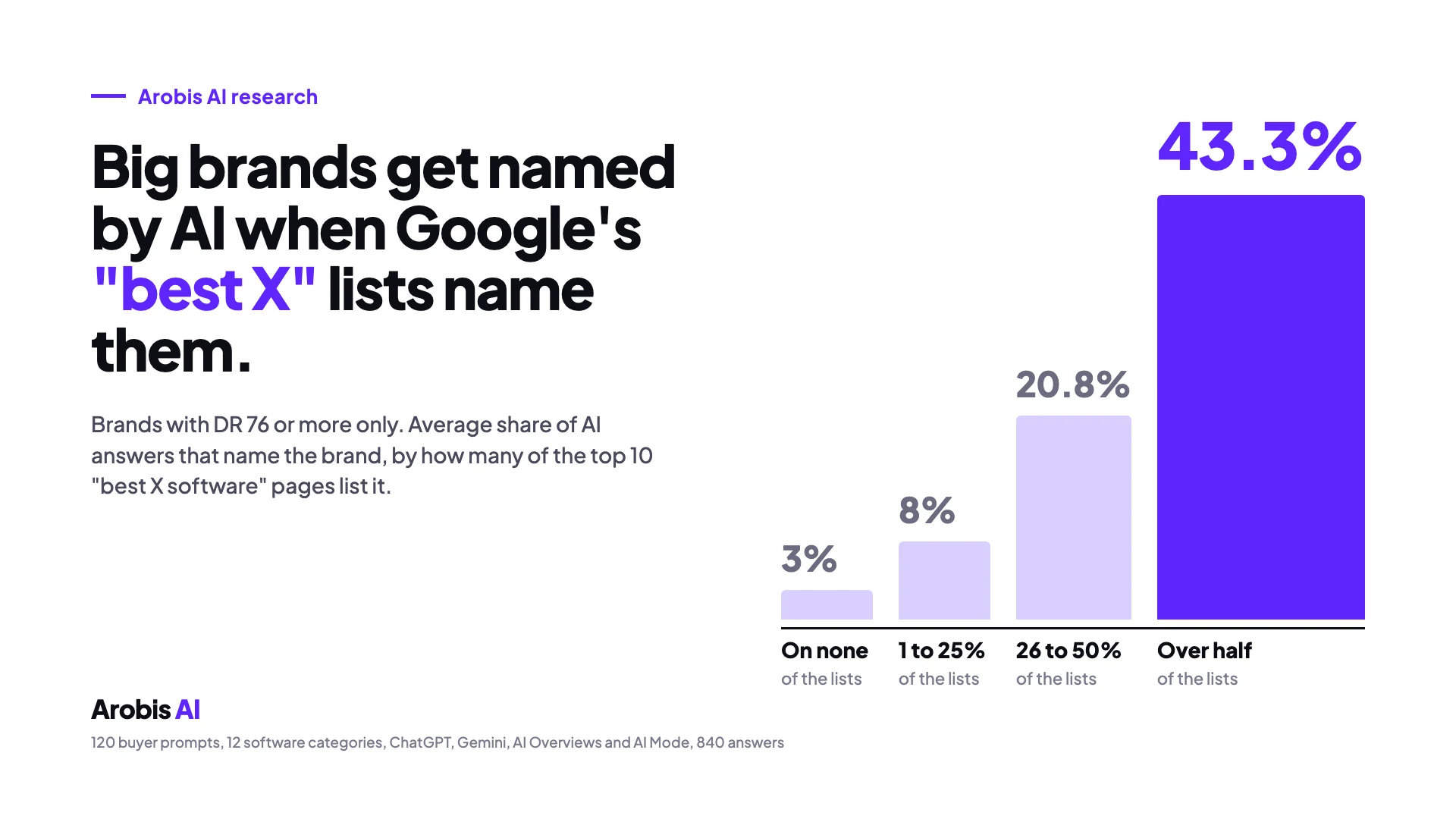
- The gap held among big brands. Within DR 76 or higher, brands on no "best" page averaged a 3% mention rate, against 43.3% for brands on more than half.
- 30% of the 339 brands we tracked were never named in a single answer.
- Of all the brands the four engines named for the same prompt, only 26% were named by all four. They put the same brand first 35% of the time.
- Each engine leans on a different kind of source: 66.9% of ChatGPT's citations were vendor pages, 64.8% of Gemini's were listicles, and 29.6% of AI Overviews' were forums, videos or other user content.
- ChatGPT was the most stable engine from one run to the next (78% of brands repeated), and AI Overviews the least (60%).
What counts as an AI brand mention?
An AI brand mention is any time an AI engine names your brand in an answer, with or without a link to your site. For B2B SaaS it's the unit that matters most, because a buyer who asks ChatGPT for a shortlist reads names first.
Mention vs citation
A mention names the brand. A citation is a source link the engine shows next to its answer. In our data, when an engine named a brand, it cited that brand's own site in just 32% of those answers. Most brand mentions in AI search arrive with someone else's page as the evidence.
Mention rate and top-3 rate
Mention rate is the share of answers in a category that name the brand. Top-3 rate is the share where the brand is among the first three named. We counted each brand once per answer, and we didn't count the incumbent in "alternatives to X" prompts, since the prompt itself put that name there.
How we ran the study
We compared what each engine named with brand data from Ahrefs and Google. It's a narrower dataset than our wider AI search visibility benchmarks, built to answer one question: what do the brands that get named have in common?
The 120 buyer prompts and 12 categories
Each category got 10 prompts written the way a buyer asks, such as "What are the best alternatives to Salesforce for a growing company?". They mix company size, use case, budget and "alternatives to" questions, in the style of our library of buying-intent prompts. The 12 categories:
- CRM, sales engagement and marketing automation
- Project management and help desk
- HR software and applicant tracking
- Business intelligence, product analytics and observability
- Endpoint security and spend management
4 engines, run more than once
We collected the answers through ZeroRank: 840 in total, 833 with content we could read. Google showed an AI Overview on 97% of these prompts. Perplexity was planned too, but ZeroRank returned no Perplexity answers for these prompts, so we swapped in Google AI Mode and ran it once on all 120 prompts.
I'll be honest, that empty Perplexity column was the low point of the project for me. I'd built half the outline around it. Swapping in AI Mode turned out well, because it behaved differently from the other three.
What we recorded in each answer
For every answer we logged each software brand presented as an option, in order, plus every cited source and its page type. Review sites named as advice, like G2, weren't counted as brands. That came to 4,850 brand mentions and 3,920 cited sources.
Brand factors we tested
For each brand we pulled Domain Rating, referring domains, US organic traffic, US organic keywords and US branded search volume from Ahrefs, and checked for a Wikipedia article. For each category we took the pages ranking in Google's top 10 for "best [category] software" and recorded which brands each page names. I call that listicle inclusion below.
The 339 brands were chosen before anyone read a single answer, so the list couldn't drift toward brands the engines happened to like. All correlations and the never-named share use that set. For the scatter chart only, we added brands the engines named three or more times, for 434 brands with Ahrefs data in total.
How we measured the relationship
We used Spearman correlation, a rank-based measure from -1 to 1 of how closely two lists move together. We computed it within each category and pooled the results, so a CRM brand is only ever compared with other CRM brands. Products living on a bigger company's domain were left out of the domain metrics, and common-word brand names were left out of branded search volume.
How solid is the listicle finding?
We stress-tested it, because it's the result this article leans on. On the 266 brands with their own website and full Ahrefs data, being named on Google's top-10 "best" pages correlated with mention rate at +0.66. After controlling for Domain Rating and branded search demand, it stays at +0.49 (bootstrap 95% range 0.39 to 0.59). It holds on each engine separately, at +0.42 to +0.48 after the same controls for ChatGPT, Gemini, AI Overviews and AI Mode, and it holds after removing brands with common-word names. Domain Rating goes the other way: +0.56 on its own, about +0.22 once list placement and brand demand are controlled.
It also holds for brands people don't search for much. Among brands with lower brand search demand, those on more than half of the lists were named in 34.8% of answers, against 2.8% for those on none. This is still correlation. The lists may partly reflect popularity we didn't measure, like market share or review counts, and we could use 84 of the 100 top-10 results (the rest were Reddit threads or videos). The mechanism is plausible, though, because the engines cite these list pages directly: 70% of answers cited at least one listicle.
What this study can't tell you
Correlation isn't proof, and big brands tend to win on several factors at once. The data is US only, each category has about 60 answers, and AI engines change their behavior often. The honest reading is "these things travel together", not "do X and you'll get named". The scoring follows how we measure AI visibility for clients.
Which factors line up most with AI brand mentions?
Being named on the pages that rank in Google for "best [category] software" lined up most with AI brand mentions, at a Spearman correlation of 0.64. US organic traffic came next at 0.58, then Domain Rating and referring domains at 0.55 each. Organic keywords (0.48) and branded search (0.47) followed, and a Wikipedia page was weakest at 0.36.

If you're looking for AI search ranking factors, that's the closest thing we found. The chart below shows each factor's pooled correlation. The median within a single category tells the same story: listicle inclusion at 0.68, organic traffic at 0.59, DR at 0.54.
- Named on Google top-10 "best" pages+0.64
- US organic traffic+0.58
- Domain Rating+0.55
- Referring domains+0.54
- US organic keywords+0.48
- Branded search volume+0.47
- Has a Wikipedia page+0.36
How to read this chart
Each bar is a Spearman rank correlation with a brand's AI mention rate: +1 means a higher score always goes with more mentions, 0 means no relationship, -1 means always fewer. Correlation is not causation.I expected branded search to rank higher, since people searching for you by name feels like the purest demand signal. These are measurable proxies, not the full picture. For the framework side, the five signals we see behind AI recommendations covers things like entity clarity that no Ahrefs metric captures.
How our numbers compare with Ahrefs and Seer
Ahrefs studied 75,000 brands in Google AI Overviews and found branded web mentions correlated at 0.664, with branded search volume at 0.392 and DR at 0.326. Our raw DR number (0.55) is higher, likely because we compared direct competitors within each category.
Seer Interactive ran 10,000 SaaS and finance questions through GPT-4o and found that brands ranking on page one of Google correlated at about 0.65 with LLM mentions, with backlinks showing a weak or neutral effect. That's a brand's own rankings, not its presence on other people's ranking pages, but both point the same way.
Does being on "best X software" lists get you mentioned?
Yes, more than anything else we measured. Brands named on more than half of the Google top-10 "best [category] software" pages appeared in 44.2% of their category's AI answers on average, and 99% of them were named at least once. Brands on none of those pages averaged 3.9%.
The steps in between climb steadily:
- On none of the pages: 106 brands, 3.9% average mention rate, 51% named at least once.
- On 1 to 25%: 77 brands, 6.1% average.
- On 26 to 50%: 82 brands, 16.5% average.
- On more than half: 74 brands, 44.2% average.
The control: does it hold for big brands?
Big brands are on more lists, so listicle inclusion might just be authority in disguise. To check, I looked only at brands with DR 76 or higher. Inside that group, brands on none of the "best" pages averaged a 3% mention rate. Brands on more than half averaged 43.3%.
- On none of them (47 brands)3.0%
- On 1 to 25% of them (42 brands)8.0%
- On 26 to 50% of them (44 brands)20.8%
- On more than half (55 brands)43.3%
This was the result that surprised me most. A DR 76+ brand missing from the lists did worse, on average, than the whole DR 61 to 75 group (4.1%). High authority with no list presence looked a lot like being invisible.
It fits what Ahrefs found too. Across 15,000 long-tail prompts, only 12% of links cited by ChatGPT, Gemini and Copilot ranked in Google's top 10 for the same prompt. The engines don't copy Google's results, but they seem to absorb who the category's ranking pages keep naming.
Does a Wikipedia page matter?
A little. Having a Wikipedia article correlated with mention rate at 0.36, the weakest factor we tested. I wouldn't spend a quarter chasing one for AI visibility.
Does domain authority get a SaaS brand mentioned by AI?
Domain authority helps, but much less than it first appears. Domain Rating correlated with AI brand mentions at 0.55, below listicle inclusion at 0.64. Once we controlled for list placement and brand search demand, DR's correlation fell to about +0.22, and plenty of high-DR brands were skipped entirely.
Brands with DR 76 or higher averaged a 20.1% mention rate, against 4.1% for DR 61 to 75, but that gap mostly reflects big brands being on more lists. The few brands in our set with DR under 66 topped out at about 8.6% of answers, but there were only 19 of them, too few to read much into.
The scatter below plots DR against mention rate for 434 brands. The cloud trends upward at 0.55, with plenty of high-DR brands sitting near zero.
Show the 45 brands as a table
| Brand | Category | DR | Rate |
|---|---|---|---|
| Datadog | Observability | 89 | 82.6% |
| Zendesk | Help desk | 94 | 74.3% |
| New Relic | Observability | 88 | 65.2% |
| Dynatrace | Observability | 84 | 55.1% |
| Gusto | HR software | 86 | 49.3% |
| Wrike | Project management | 85 | 30.9% |
| SigNoz | Observability | 72 | 30.4% |
| Demandbase | Marketing automation | 80 | 19.1% |
| OpenObserve | Observability | 66 | 15.9% |
| iCIMS | Applicant tracking | 89 | 15.7% |
| Emburse | Spend management | 74 | 14.3% |
| Bigin | CRM | 73 | 14.3% |
| Productive | Project management | 77 | 13.2% |
| Databox | Business intelligence | 83 | 12.9% |
| LogRocket | Product analytics | 82 | 11.6% |
| Tipalti | Spend management | 79 | 11.4% |
| Missive | Help desk | 74 | 11.4% |
| Amplemarket | Sales engagement | 69 | 11.4% |
| GitLab | Project management | 92 | 10.3% |
| Notion | Project management | 90 | 10.3% |
| Luzmo | Business intelligence | 74 | 10.0% |
| Planview | Project management | 79 | 8.8% |
| AppsFlyer | Product analytics | 90 | 8.7% |
| Basecamp | Project management | 88 | 7.4% |
| Vanta | Endpoint security | 87 | 7.1% |
| Rootly | Observability | 76 | 5.8% |
| Tidio | Help desk | 87 | 5.7% |
| Streak | CRM | 76 | 4.3% |
| Airtable | Project management | 91 | 2.9% |
| Statsig | Product analytics | 76 | 2.9% |
| Kantata | Project management | 73 | 2.9% |
| Mesh Payments | Spend management | 51 | 2.9% |
| Bullhorn | Applicant tracking | 78 | 1.4% |
| Vtiger | CRM | 78 | 1.4% |
| Folk | CRM | 72 | 1.4% |
| Moosend | Marketing automation | 82 | 0.0% |
| SharpSpring | Marketing automation | 78 | 0.0% |
| Mailshake | Sales engagement | 77 | 0.0% |
| Heimdal | Endpoint security | 76 | 0.0% |
| Crelate | Applicant tracking | 75 | 0.0% |
| TeamSupport | Help desk | 74 | 0.0% |
| TeamGantt | Project management | 73 | 0.0% |
| GanttPRO | Project management | 72 | 0.0% |
| Scout APM | Observability | 72 | 0.0% |
| Twenty | CRM | 71 | 0.0% |
Referring domains
Referring domains correlated at 0.54, the same as DR, which makes sense since DR is built from links. Link building on its own gets you about as far as DR does, and no further.
The brands that broke the pattern
Some big domains barely registered. Constant Contact (DR 92) had a 0% mention rate in Marketing automation, Airtable (DR 91) 2.9% in Project management, and Kit (DR 91) 1.5% in Marketing automation. Some sit at the edge of the category, which is the lesson: the engines decide which brands belong to a category, and DR doesn't decide it for them.
It's not only giants, either. SigNoz has a DR of 72 and was named in 30.4% of observability answers, and OpenObserve (DR 66) in 15.9%.
Do ChatGPT, Gemini and Google's AI answers mention the same brands?
Not often. For the same prompt, the four engines named 10.2 different brands between them on average, and only 2.6 of those were named by all four, or 26%. They put the same brand first in 35% of prompts. A brand that wins on one engine can be missing on another.
Pair by pair, ChatGPT and Gemini overlapped most (56% of the brands either one named), ChatGPT and AI Overviews 50%, and Gemini and AI Overviews 45%. In applicant tracking, ChatGPT named Lever most often, Gemini Greenhouse and AI Overviews Workable.
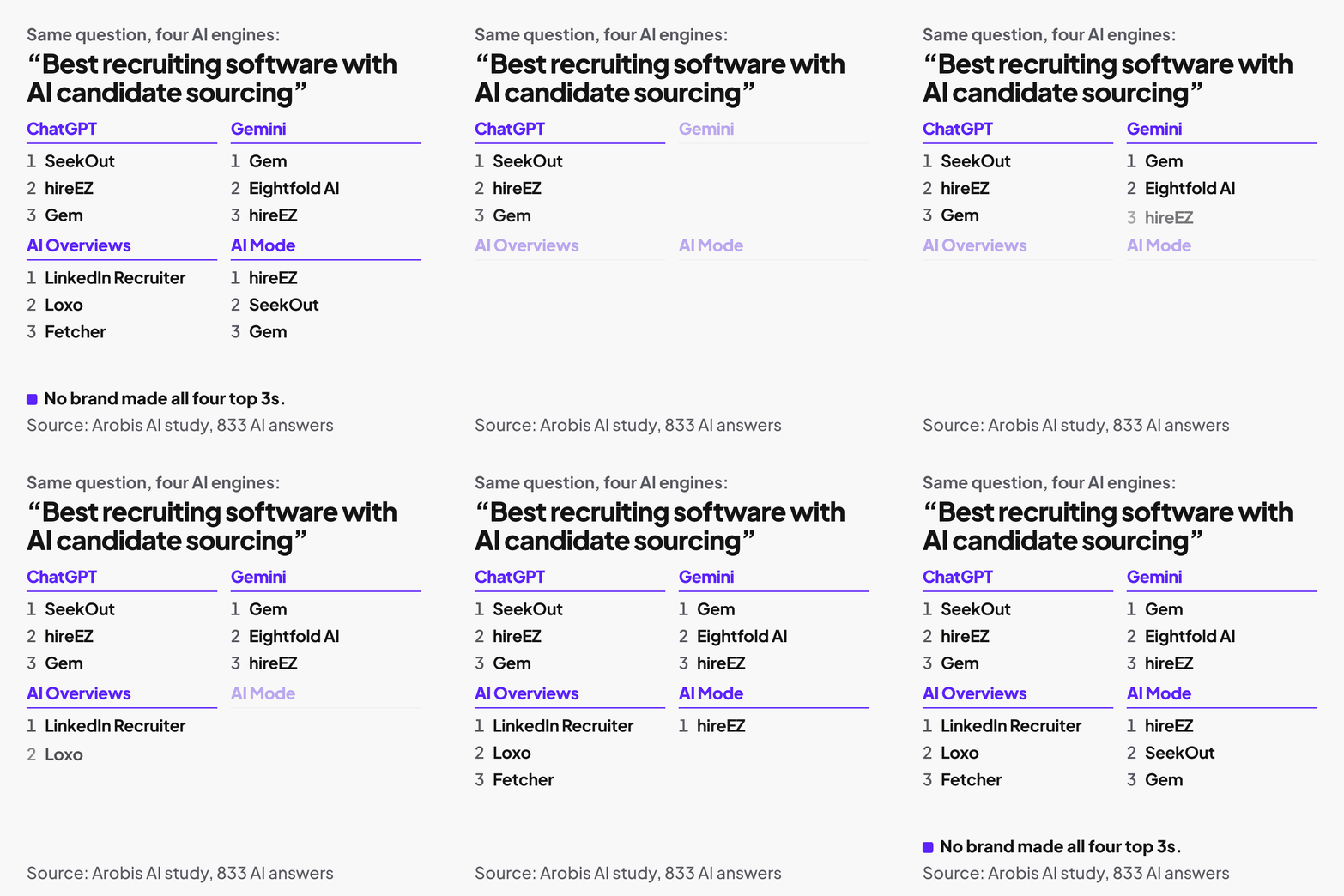
Ahrefs reported much higher agreement, an overall correlation of 0.779 between the brands ChatGPT, AI Mode and AI Overviews mention across 75,000 brands. That compares each brand's overall visibility across engines. We measured something stricter, the same shortlist on the same buyer prompt, and there the engines split far more. For why they differ, see how each engine picks brands.
Pick an engine below to see its most-named brands per category. ChatGPT averaged 5.7 brands per answer, Gemini 6.2 and AI Overviews 5.8.
- HubSpot (CRM)100.0%
- Grafana (Observability)100.0%
- PostHog (Product analytics)95.0%
- Amplitude (Product analytics)95.0%
- Apollo.io (Sales engagement)95.0%
- Freshdesk (Help desk)90.0%
- Rippling (HR software)90.0%
- Power BI (Business intelligence)90.0%
- Microsoft Defender for Endpoint (Endpoint security)90.0%
- SentinelOne (Endpoint security)90.0%
- HubSpot (CRM)100.0%
- Amplitude (Product analytics)95.0%
- PostHog (Product analytics)95.0%
- Ramp (Spend management)95.0%
- Rippling (HR software)90.0%
- Looker (Business intelligence)90.0%
- Datadog (Observability)90.0%
- SentinelOne (Endpoint security)90.0%
- Microsoft Defender for Endpoint (Endpoint security)90.0%
- Power BI (Business intelligence)85.0%
- HubSpot (CRM)95.0%
- Power BI (Business intelligence)95.0%
- Rippling (HR software)94.7%
- Amplitude (Product analytics)94.7%
- Microsoft Defender for Endpoint (Endpoint security)90.0%
- SentinelOne (Endpoint security)90.0%
- Grafana (Observability)89.5%
- Ramp (Spend management)80.0%
- HubSpot (Marketing automation)77.8%
- Pipedrive (CRM)75.0%
- HubSpot (CRM)100.0%
- Amplitude (Product analytics)100.0%
- Power BI (Business intelligence)90.0%
- PostHog (Product analytics)90.0%
- Grafana (Observability)90.0%
- Microsoft Defender for Endpoint (Endpoint security)90.0%
- Ramp (Spend management)90.0%
- Apollo.io (Sales engagement)90.0%
- BambooHR (HR software)80.0%
- Rippling (HR software)80.0%
- HubSpot (CRM)98.6%
- Amplitude (Product analytics)95.7%
- Grafana (Observability)91.3%
- Power BI (Business intelligence)90.0%
- Microsoft Defender for Endpoint (Endpoint security)90.0%
- Rippling (HR software)89.9%
- SentinelOne (Endpoint security)87.1%
- Ramp (Spend management)87.1%
- PostHog (Product analytics)85.5%
- Apollo.io (Sales engagement)82.9%
ChatGPT
ChatGPT leaned hardest on vendor websites: 66.9% of its citations went to vendor homepages or product pages and 17.7% to listicles, across 7.5 sources per answer. ChatGPT brand mentions were also the most repeatable between runs. For a ChatGPT-only angle, see our earlier look at 100 SaaS brands in ChatGPT.
Gemini
Gemini cited the fewest sources (2.9 per answer), and 64.8% of them were listicles. Its picks also drifted from ChatGPT's: in business intelligence it named Looker most often (90%), while ChatGPT's most-named was Power BI.
Google AI Overviews
AI Overviews pulled from the widest mix of sources. Listicles made up 35.2% of its citations, and forums, videos and other user content another 29.6%. That's the clearest AI Overviews ranking factor in our data: the YouTube videos and threads that rank for your category feed what it says.
Google AI Mode
AI Mode was the leanest citer, at 2 sources per answer. Listicles were 40% of them, forums, videos and other user content 24.2%, and comparison or alternatives pages 12.5%, the highest share of any engine. Vendor pages were only 7.9%. If AI Mode matters to you, the pages that compare you with competitors carry real weight.
Which brands does AI mention most in each SaaS category?
Each category had a clear leader. HubSpot was named in 98.6% of CRM answers, Amplitude in 95.7% of product analytics answers and Rippling in 89.9% of HR software answers.
Pick a category below to see its top brands across all four engines. In spend management, for example, Ramp led at 87.1%, followed by Brex at 57.1%.
- HubSpot98.6%
- Pipedrive68.6%
- Salesforce61.4%
- Zoho CRM52.9%
- Microsoft Dynamics 36531.4%
- Attio22.9%
- Freshsales17.1%
- Bigin by Zoho14.3%
- ClickUp63.2%
- Asana60.3%
- monday.com42.6%
- Linear35.3%
- Jira32.4%
- Wrike30.9%
- Trello26.5%
- GitHub Projects20.6%
- Zendesk74.3%
- Freshdesk72.9%
- Intercom47.1%
- Help Scout44.3%
- Salesforce27.1%
- Jira Service Management25.7%
- HubSpot25.7%
- Front24.3%
- HubSpot76.5%
- Marketo67.6%
- Salesforce61.8%
- ActiveCampaign60.3%
- Customer.io30.9%
- Brevo29.4%
- 6sense22.1%
- Demandbase19.1%
- Rippling89.9%
- BambooHR72.5%
- Gusto49.3%
- HiBob47.8%
- Deel46.4%
- Workday40.6%
- ADP Workforce Now40.6%
- SAP SuccessFactors26.1%
- Greenhouse52.9%
- Workable52.9%
- Ashby47.1%
- Lever47.1%
- Zoho Recruit28.6%
- Breezy HR28.6%
- Rippling27.1%
- JazzHR24.3%
- Power BI90.0%
- Tableau62.9%
- Looker61.4%
- ThoughtSpot50.0%
- Sigma Computing45.7%
- Metabase40.0%
- Looker Studio34.3%
- Zoho Analytics28.6%
- Amplitude95.7%
- PostHog85.5%
- Mixpanel78.3%
- Heap44.9%
- Pendo36.2%
- Fullstory29.0%
- Microsoft Clarity20.3%
- Contentsquare20.3%
- Grafana91.3%
- Datadog82.6%
- New Relic65.2%
- Dynatrace55.1%
- Prometheus46.4%
- Elastic34.8%
- Splunk33.3%
- Honeycomb30.4%
- Microsoft Defender for Endpoint90.0%
- SentinelOne87.1%
- CrowdStrike74.3%
- Sophos51.4%
- Huntress45.7%
- Bitdefender40.0%
- Cortex XDR27.1%
- Arctic Wolf10.0%
- Ramp87.1%
- Brex57.1%
- BILL40.0%
- Zoho Expense37.1%
- Expensify35.7%
- SAP Concur32.9%
- Navan24.3%
- Rippling18.6%
- Apollo.io82.9%
- Salesloft70.0%
- Outreach58.6%
- HubSpot50.0%
- ZoomInfo37.1%
- Reply.io32.9%
- Salesforce28.6%
- Instantly24.3%
How concentrated is each category?
The top three brands took between 25% of all mentions (applicant tracking) and 47% (endpoint security and product analytics). Applicant tracking spread its mentions across 69 different brands, and 30% of them were named exactly once.
The bar race below shows CRM, where HubSpot pulls away early and the top three hold 45% of mentions. Our Shortlist Study, which tested one open model, saw the same short-list habit.

Reading the answers one by one, this was the part I felt most. By the fortieth CRM answer I could guess the first three names before I opened it. The interesting brands were the ones in the fourth or fifth slot on one engine and nowhere on the other two.
Which sources do AI engines cite when they name SaaS brands?
Across all four engines, vendor homepages and product pages made up 34.4% of citations and listicles 32.8%, and 70% of answers cited at least one listicle. But the mix changes completely by engine:
- ChatGPT: 66.9% vendor pages, 17.7% listicles, 9.1% articles and guides.
- Gemini: 64.8% listicles, 16.8% articles and guides, 10.1% comparison or alternatives pages.
- AI Overviews: 35.2% listicles, 29.6% forums, videos and user content, 20% articles and guides.
The chart below splits each engine's citations by page type, with listicles at 32.8% overall.
- Listicle17.7%
- Vendor homepage or product page66.9%
- Article or guide9.1%
- Forum, video or UGC1.4%
- Comparison or alternatives4.5%
- Other0.3%
- Listicle64.8%
- Vendor homepage or product page4.4%
- Article or guide16.8%
- Forum, video or UGC3.7%
- Comparison or alternatives10.1%
- Other0.1%
- Listicle35.2%
- Vendor homepage or product page8.0%
- Article or guide20.0%
- Forum, video or UGC29.6%
- Comparison or alternatives7.0%
- Other0.1%
- Listicle40.0%
- Vendor homepage or product page7.9%
- Article or guide15.0%
- Forum, video or UGC24.2%
- Comparison or alternatives12.5%
- Other0.4%
- Listicle32.8%
- Vendor homepage or product page34.4%
- Article or guide14.1%
- Forum, video or UGC11.7%
- Comparison or alternatives6.8%
- Other0.2%
Listicles, vendor pages, review sites and community threads
The most cited domain was youtube.com (193 citations), followed by reddit.com (105). YouTube showed up in 13% of answers and Reddit in 12%. Review and analyst sites were smaller than I expected: G2 appeared in 8% of answers and Gartner in 7%. For more on this, see which domains B2B SaaS answers cite most and tested ways to earn more AI citations.
Do AI brand mentions stay the same from one run to the next?
Mostly, but not fully. Running the same prompt on the same engine a second time, ChatGPT repeated 78% of its brands, Gemini 62% and AI Overviews 60%. The first-named brand stayed the same 78% of the time on ChatGPT, 72% on Gemini and 66% on AI Overviews. AI Mode ran once, so it isn't in this comparison.
So one answer is a sample, not a verdict. Judge visibility on repeated runs of the same prompts.
What this means for B2B SaaS marketers
To increase visibility with AI brand mentions, start with the pages that already compare vendors in your category. It's how we approach getting a SaaS brand into AI shortlists.
Get named on the pages that rank for "best [your category] software"
Open every page in Google's top 10 for your category and note which ones leave you out. That's your work queue. In our data, going from none of those pages to more than half was the difference between a 3.9% and a 44.2% average mention rate, and the gap held for high-DR brands. Pitch the authors something useful, like a real customer number.
Work each engine through the sources it actually cites
For ChatGPT, 66.9% of citations were vendor pages, so your product and use-case pages need to state plainly who you're for and what you replace. For Gemini, listicles carried 64.8% of citations, so list inclusion matters even more there. For AI Overviews, 29.6% came from forums, videos and user content, so the YouTube reviews and Reddit threads that rank for your category are where to show up. A step-by-step ChatGPT playbook covers the vendor-page side.
Don't buy links to fix an AI visibility gap
DR fell to about +0.22 once list placement and brand demand were held constant, and big domains like Constant Contact (DR 92) were still skipped. If you already have solid authority and you're missing from AI answers, more links are the slowest fix.
Measure all four engines, more than once
With only 26% of brands shared across engines on the same prompt, a good ChatGPT result tells you little about Gemini or AI Overviews. Track fixed buyer prompts per engine, run them repeatedly, and read trends.
To see where you stand today, run a free AI visibility check. For ongoing tracking, our guide to tracking what AI says about your brand compares the options. And if you'd like a team to do the list work and the measurement, you can see what an AI visibility program costs with Arobis AI.
Frequently asked questions
What are AI brand mentions?
AI brand mentions are the times an AI engine such as ChatGPT, Gemini, Google AI Overviews or AI Mode names your brand in an answer. A mention is different from a citation, because the engine can name you without linking to your site. In our study, when an engine named a brand it cited that brand's own site in only 32% of those answers.
What are the ranking factors for ChatGPT?
ChatGPT publishes no ranking factors, but some signals line up with being named. Across our four engines, being named on Google's top-10 "best [category] software" pages correlated most with mentions (0.64), and DR at 0.55. ChatGPT also sent 66.9% of its citations to vendor pages, so clear product pages matter.
How do I get my brand mentioned by ChatGPT?
Get named on the pages that rank in Google for "best [your category] software", and make your own product pages say plainly who you serve. In our study, brands on more than half of those pages averaged a 44.2% mention rate, and ChatGPT cited vendor pages for 66.9% of its sources. Then retest the same buyer prompts.
Why doesn't ChatGPT recommend my brand?
The most common gap in our data was missing list presence. Brands named on none of the Google top-10 "best" pages for their category averaged a 3.9% mention rate, and DR 76+ brands in that position averaged 3%. AI engines build shortlists from pages that already compare vendors. Answers also vary by run, so test each prompt more than once.
Does domain authority affect AI brand mentions?
Less than you'd think. Domain Rating correlated with AI brand mentions at 0.55, below listicle inclusion at 0.64, and fell to about +0.22 after controlling for list placement and brand demand. Ahrefs found DR at 0.326 for Google AI Overviews across 75,000 brands, against 0.664 for branded web mentions.
Do Google rankings affect whether AI mentions a brand?
Indirectly, yes. Being named on the pages that rank in Google's top 10 for "best [category] software" was the strongest factor in our study (0.64). Seer Interactive found page-one Google rankings correlated at about 0.65 with LLM mentions, while Ahrefs found only 12% of links cited by ChatGPT, Gemini and Copilot rank in Google's top 10 for the same prompt.
Do ChatGPT, Gemini and Google's AI answers recommend the same brands?
Not often. For the same prompt, only 26% of the brands named were named by all four engines, and they agreed on the first pick 35% of the time. They also cite different sources, from vendor pages on ChatGPT to listicles on Gemini. Measure each engine on its own.
Is it possible to track brand mentions in AI search?
Yes. Run a fixed set of buyer prompts on each engine, more than once, and log which brands each answer names and in what order. We ran 120 prompts on four engines for this study, twice on ChatGPT, Gemini and AI Overviews and once on AI Mode. Ongoing tracking needs a tool or a repeatable prompt sheet.
How stable are AI brand mentions from one run to the next?
Fairly stable on ChatGPT, less on the others. Running the same prompt twice, ChatGPT repeated 78% of its brands, Gemini 62% and AI Overviews 60%. One answer is a sample, so judge visibility on repeated runs.