
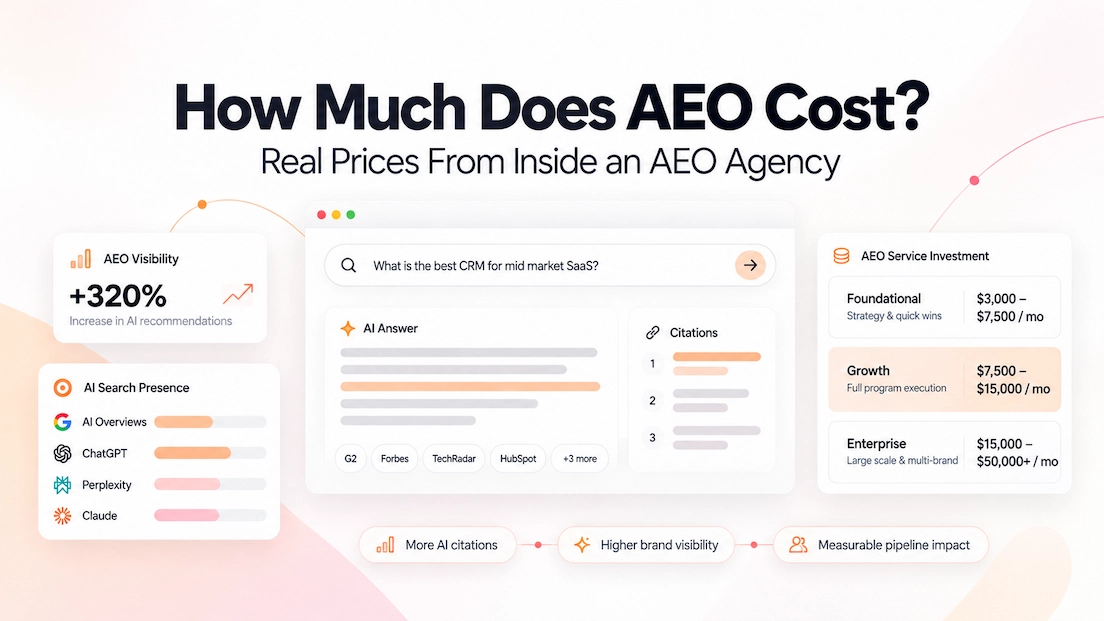
AEO costs $0 to $500 a month if you monitor it yourself, $1,600 to $10,000 a month for an agency program, and $20,000 or more for enterprise retainers.
That is the honest range as of October 1, 2026. Everything below explains where your money actually goes inside it, with every tool and agency price checked on the vendor's own pricing page the same day.
I'm Ran Yosef, founder of Arobis AI. We sell AEO for a living, so I have a bias and I'll say it up front: I think most companies should pay someone for this eventually. But I also think the way this category is priced right now is confusing on purpose, and buyers deserve real numbers instead of "it depends, book a call".
So this is the page I wish existed when I started pricing our own service. It has our prices, our competitors' prices, the software prices, the hidden costs nobody puts on the proposal, and a few things I learned from sales calls that changed how I think about AEO budgets.
The short answer, by budget
If you only read one section, read this one. Here is what each budget level realistically buys you in answer engine optimization today:
- $0 a month: manual checks in a clean browser session, free graders and your own Search Console data. Good for learning, useless for proving anything.
- $29 to $500 a month: a monitoring tool. You see how often ChatGPT, Perplexity or Google AI Overviews mention you. Nothing changes unless someone on your team acts on it.
- $399 to $5,000 one time: an audit. A baseline, a competitor gap map and a fix list.
- $1,600 to $10,000 a month: an agency program that actually does the work, from page rewrites to third-party placements.
- $10,000 to $20,000+ a month: enterprise programs across many products, markets or languages.
The most important line in that list is the second one. A tool is not AEO. A tool is a thermometer. I'll come back to that, because it is where most budgets get wasted.
The AEO price ladder: five budgets and what each one really buys
Here is the same ladder with the part most pricing pages skip: what you do not get at each level.
| Budget | What you get | What you don't get | Best for |
|---|---|---|---|
| $0 / month | Manual prompts, free graders, Search Console | Consistency, history, any fixes | Curious founders, week one |
| $29 to $500 / month | Daily tracking of 15 to 400 prompts | Anyone doing the work | Teams with spare content and SEO capacity |
| $399 to $5,000 once | Baseline, competitor gaps, fix list | Execution after the report | Testing before a retainer |
| $1,600 to $10,000 / month | Strategy, rewrites, technical fixes, placements | Instant results, guarantees | B2B SaaS that needs pipeline from AI answers |
| $10,000+ / month | Multi-market, multi-product programs | Speed, usually | Enterprise and multi-brand companies |
If you are still fuzzy on the discipline itself, start with my plain-English guide to what answer engine optimization is and come back. The rest of this page assumes you know you want to show up in AI answers and you are trying to work out the bill.
What AEO software costs, checked at the source on October 1, 2026
Let's start with the cheapest line item, because it is the one people confuse with the whole job.
I opened the pricing page of every major AI visibility tool this morning. Here is what they charge for the entry plan, how many prompts that buys, and which engines it covers.
| Tool | Entry price | Prompts | Engines on entry plan | Free option |
|---|---|---|---|---|
| Otterly.AI Lite | $29 / mo | 15 | ChatGPT, AI Overviews, Perplexity, Copilot | Free trial |
| HubSpot AEO | $50 / mo ($45 annual) | 25 | ChatGPT, Perplexity, Gemini | Free trial, no card |
| Peec AI Starter | $95 / mo | 50 | Choose 3 models | No |
| Semrush SEO + AI Search Starter | $199 / mo | 50 daily | Bundled with the SEO suite | 7-day trial |
| Ahrefs Brand Radar AI index | $199 / mo per platform | Index, not your own list | One platform, up to $699 for all | No |
| Scrunch Core | $250 / mo | 125 | ChatGPT, Perplexity, AI Overviews, Copilot | 7-day trial |
| AthenaHQ Starter | $295 / mo | 3,600 credits | 11 models | Free Essential tier |
| Profound Enterprise | Custom | Custom | Up to 9 engines | 7-day trial, 50 prompts |
Sources: Otterly.AI pricing, HubSpot AEO, Peec AI pricing, Semrush pricing, Scrunch pricing, AthenaHQ plans and Profound pricing, all read on October 1, 2026. Monthly prices shown, not annual.
A few things the table can't show you:
- Engine coverage is the real price lever. Otterly's $29 plan tracks four engines, but Claude, Google AI Mode and Gemini are paid add-ons. HubSpot's $50 plan does not track Google AI Overviews or AI Mode at all. Cheap plans are cheap because they leave engines out.
- Prompts run out fast. Fifteen prompts sounds fine until you write them. One product, three competitors, a few use cases and two personas, and you are past fifty.
- Profound has no public paid plan anymore. It is a 7-day trial, then a sales call. I wrote up the history in our breakdown of Profound's pricing changes.
If you want deeper tool-by-tool verdicts, our roundup of AI visibility tools compared on price and engines goes through 17 of them, and the head-to-head on Peec AI vs Otterly for small budgets covers the two cheapest serious options.
The number nobody publishes: cost per tracked AI answer
Here is something I have not seen on any other AEO pricing page, so I worked it out myself.
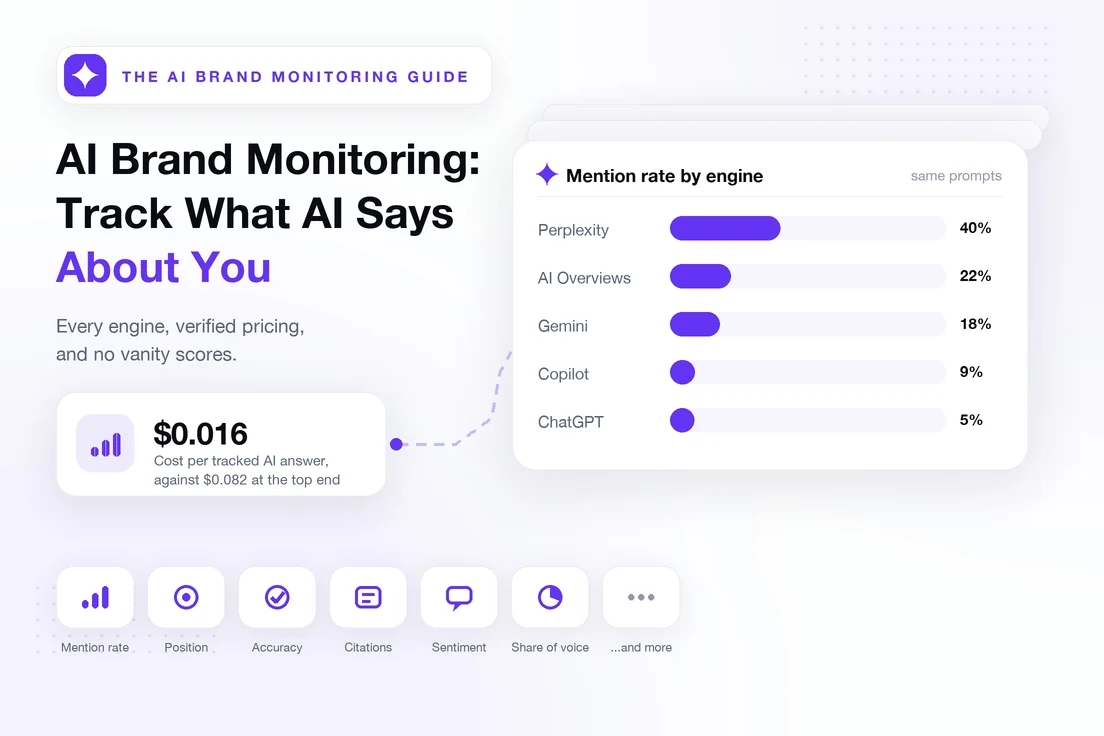
Every tool sells "prompts", but prompts are not comparable. One tool runs your prompt on three engines, another on four, another counts credits. The fair unit is the tracked answer: one prompt, run once, on one engine.
So I took each vendor's own published limits and divided the monthly price by the number of answers it produces. The formula is the one Peec prints on its own pricing page: prompts times active models times tracking frequency.
| Plan | Monthly price | Answers per month | Cost per answer |
|---|---|---|---|
| Otterly.AI Premium | $489 | 48,000 | $0.010 |
| Otterly.AI Lite | $29 | 1,800 | $0.016 |
| Peec AI Advanced | $495 | 31,500 | $0.016 |
| Peec AI Pro | $245 | 13,500 | $0.018 |
| Peec AI Starter | $95 | 4,500 | $0.021 |
| HubSpot AEO | $50 | 2,250 | $0.022 |
| Scrunch Core | $250 | 5,000 | $0.050 |
| AthenaHQ Starter | $295 | 3,600 | $0.082 |
How I calculated it: daily runs, a 30-day month, every engine included on that plan, no add-ons. Scrunch and AthenaHQ publish their monthly response and credit allowances directly (AthenaHQ states one credit equals one AI response), so I used those figures as printed. Semrush is left out because its AI tracking is bundled into an SEO suite, and Profound because it has no public paid price.
What this tells you:
- The spread is eight to one. An answer on AthenaHQ Starter costs about eight times what it costs on Otterly Premium. That is not automatically bad. AthenaHQ covers 11 models and includes content tools. But you should know what you are paying for.
- Bigger plans are cheaper per answer, but only if you have the prompts. Most B2B SaaS companies I audit have 20 to 50 prompts that genuinely matter. Buying 400 prompts to lower your unit cost is like buying a warehouse to save on shelving.
- Volume of answers is not the goal. One tracked answer that shows you losing a "best X for Y" prompt to a competitor is worth more than ten thousand answers about prompts no buyer types.
My honest opinion: for most teams, $0.016 to $0.022 per answer is the sweet spot, and a well-chosen 25 to 50 prompt list matters far more than the tool. If you are on a tight budget, our list of free AI visibility tools will get you surprisingly far before you pay anyone.
What AEO agencies charge, from the ones that publish prices
Now the bigger line item. Agencies are where AEO becomes work instead of a dashboard, and where pricing gets murky.
When I compiled our roundup of the best GEO agencies with verified pricing, only 10 of the 17 agencies published any number at all. These are the 10 that do, re-checked on their own sites on October 1, 2026.
| Agency | Published entry price | Terms worth knowing |
|---|---|---|
| SeoProfy | From $1,600 / mo | GEO alongside classic SEO |
| Arobis AI (us) | $2,500 / mo | $5,000 Growth tier, 3-month minimum |
| Optimist | From $3,000 / mo | Full service from $4,000, $7,500 one-time roadmap |
| RevenueZen | From $3,000 / mo | Full GEO program from the $10,000 tier |
| Digital Elevator | From $3,000 | Managed SEO from $3,500 / mo |
| WebFX | From $3,000 / mo | Packages $5,900 to $12,200 initially |
| MADX Digital | $3,500 / mo | 12-month term, $5,000 / mo rolling |
| Discovered Labs | From EUR 6,995 / mo | Six-month term, EUR 7,995 month to month |
| Omniscient Digital | From $10,000 / mo | Full organic program |
| NoGood | Above $20,000 / mo | Stated as their average retainer |
Agencies that do not publish a price include Siege Media, iPullRank, Animalz, Minuttia and First Page Sage. That doesn't make them bad. Some are excellent. It just means you will find out on a call.
Reading this table honestly:
- The center of gravity is $3,000 to $5,000 a month. Most serious programs for a single B2B SaaS product land there.
- Below about $2,000 a month, check what you're actually buying. At that price you are often buying blog volume with "AEO" written on the invoice.
- Term length changes the real price. MADX's $3,500 becomes $5,000 if you won't commit to 12 months. Discovered Labs charges EUR 1,000 more a month for flexibility. Always compare the price you'd pay on the terms you'd actually accept.
If you are shortlisting, our ranked list of the best answer engine optimization agencies for B2B SaaS includes what each one is good at, not only what they charge.
The three ways agencies price AEO
Before comparing numbers, check which pricing model you are looking at. The same $5,000 can mean very different things.
Monthly retainer
The most common model, and the one we use. You pay a fixed monthly fee for a defined scope: a prompt list, regular re-checks, fixes, content and placements. It suits AEO because the work compounds. Every placement and every rewritten page keeps working after the month it shipped in. The risk is paying for a retainer where the scope is vague, so insist on seeing the deliverables per month in writing.
One-time project or audit
A fixed fee for a baseline, a strategy or a defined batch of pages. Good for testing an agency before committing, or for teams that will execute everything in-house afterward. The risk is the report that sits in a folder. An audit is only worth its price if someone acts on it within a few weeks, while the answers it recorded are still current.
Performance-based or hybrid
Part of the fee is tied to an outcome, like gains in share of voice. It sounds buyer-friendly, and sometimes it is. But nobody controls what a language model says, and pure performance deals can push an agency toward vanity prompts that are easy to win and worthless to your pipeline. If you go this route, you choose the prompts, not the agency.
Inside a $2,500 month: an itemized receipt
Agency pricing pages love the word "comprehensive". I would rather show you the line items. This is what our Foundation tier includes, word for word from our own AEO and GEO pricing page:
- A full AI visibility audit: 40 buyer prompts across ChatGPT, Gemini, Claude, Perplexity and Google AI Overviews, with every answer recorded.
- A competitive gap map: which brands get recommended instead of you, and which sources the AI quotes for them.
- Implementation on your site: schema, entity pages, llms.txt, page structure and internal links. We ship it, you approve it.
- Rewrites of your highest-impact pages: comparison, alternatives, pricing and homepage.
- Third-party placements every month in the sources AI engines cite.
- A monthly recommendation report: prompts won, prompts lost, what shipped and what's next.
- A bi-weekly working session with your strategist.
And here is what $2,500 does not buy, which I tell every prospect on the first call:
- It doesn't buy coverage of five product lines. One core category, done properly.
- It doesn't buy results in week two. The first month is mostly baseline and fixes.
- It doesn't buy a guarantee. No honest agency can guarantee what a language model says. If someone guarantees "position one in ChatGPT", walk away.
The $5,000 Growth tier adds ongoing authority work: more placements, new comparison and answer pages for the prompts you're losing, entity and knowledge-graph cleanup, and weekly re-checks. That is the tier for companies fighting in more than one category. The full service breakdown lives on our AI visibility program for SaaS page.
What a 90-day AEO program looks like, month by month
"What happens after I sign?" is the question buyers rarely ask and always should. Here is how the first quarter of a $2,500 program typically runs on our side, so you have something concrete to hold any agency against.
Month 1: baseline and the obvious fixes. We write and agree the prompt list with you, run every prompt across the five engines in clean sessions and record each answer. Then the first technical fixes ship: schema, llms.txt, entity details and internal links on the pages that matter. By the end of the month you know exactly which competitors get named instead of you, and why.
Month 2: pages and first placements. The highest-impact pages get rewritten so AI engines can lift a clear answer from them: comparison pages, alternatives pages, pricing and the homepage. The first third-party placements go live in the sources the audit showed AI engines already cite for your category.
Month 3: re-check and decide. Every prompt gets re-run under the same conditions as month one. You see which prompts moved, which didn't, and what we think is blocking the rest. That is the moment to decide whether to continue, expand into a second category, or stop. A good agency makes that decision easy with data, not with a sales pitch.
If an agency can't describe their first 90 days at this level of detail before you sign, that is your answer.
What our sales calls taught me about AEO budgets
Published price tables only tell you what agencies ask for. Sales calls tell you what buyers actually do. Three patterns from the last few months, anonymized:
1. The budget exists, the budget line doesn't. Twice in September 2026, a marketing leader agreed the $2,500 a month scope was right and then asked to start in January. Not because of price. Because AEO didn't exist as a line in this year's plan. If you're a buyer, the lesson is to put AEO in next year's budget now, even as a placeholder, or you'll lose a quarter waiting for approval.
2. Bigger companies need more prompts, not more months. When I scope an enterprise program, the price goes up because of breadth: more products, more markets, more engines to cover. The proposal I sent an enterprise health-tech prospect was $5,000 a month, double our entry tier, almost entirely because they had several product lines that each needed their own prompt set.
3. Some businesses shouldn't pay for AEO at all. We ended talks with a local distribution business this year. Their buyers don't research in ChatGPT, they call the nearest branch. Spending $2,500 a month to show up in answers nobody asks would have been a bad deal for them, and eventually a bad reference for us.
That third point is why I care about honest pricing. A clear price filters out the wrong clients before anyone wastes a call.
The hidden costs that can double the invoice
This is where real AEO budgets differ from the number on the proposal. Ask about every one of these before you sign.
1. Tool licenses billed on top
Some agencies run their reporting on Profound or Scrunch and pass the license through to you. That can add $250 to several thousand dollars a month. We never bill software to clients, because I consider the tools part of the service. Not every agency agrees, so ask directly: "Is monitoring software included, or invoiced separately?"
2. The research month
Some agencies bill a full retainer for month one and deliver a strategy deck. Strategy matters, but ask what ships in the first 30 days. On our side, month one includes the audit plus the first fixes, because waiting 30 days to change anything is a choice, not a requirement.
3. Paid placements
Getting cited often means getting mentioned on the pages AI engines trust: roundups, comparison posts, directories and communities. Some of those placements cost money. Real numbers from our own work: we paid $75 for a listing in a GEO agency roundup on a project management site, and we turned down a $100 placement for a client because the site had almost no authority. Ask whether placements are included in the retainer or quoted per placement.
4. Content production
Rewrites of existing pages are usually included. Net-new long-form content often is not, or is capped. If your gap analysis shows you need ten new comparison pages, find out who pays for them.
5. Minimum terms and cancellation
Three months is reasonable. AI answers take weeks to shift and nobody can prove anything in 30 days. Twelve months is a lot to commit to a category this young. And check how you cancel. Personally, I won't buy software or services that let me sign up in two clicks but make me talk to support to leave. If an agency or tool makes cancellation hard, that tells you how they plan to keep you.
6. Your own team's time
Even a done-for-you program needs someone on your side to approve changes, answer product questions and give access to the CMS. Budget two to four hours a week from a marketer. If nobody has those hours, the work stalls no matter what you pay.
DIY vs agency vs in-house: the honest math
There are three ways to pay for AEO. Each one is the right answer for someone.
| Model | Monthly cash cost | Hidden cost | Works when |
|---|---|---|---|
| DIY with tools | $0 to $500 | Your team's hours, learning curve | You have SEO and content capacity already |
| In-house hire | A full salary | Hiring time, one person's blind spots | AI search is core to a large marketing team |
| Agency | $1,600 to $10,000+ | Onboarding, your approval time | You need results this year without a new hire |
| Audit, then DIY | $399 to $5,000 once | Execution falls back on you | You want a plan before you commit |
My take, as someone who obviously sells the agency option: DIY is underrated for small teams. If you have a decent SEO person, a $95 tool and the discipline to act on what it shows you every week, you can make real progress. What DIY usually lacks isn't knowledge. It's the third-party work: placements, roundups, community presence. That part needs relationships and time, and it's the part that actually moves AI recommendations.
If you go the agency route, read my guide on how to choose an AI SEO agency before your first call. And if you're comparing an AEO specialist with your current SEO retainer, I broke down the difference between a SaaS SEO agency and an AI search demand generation partner.
Why you might pay for nothing, and still lose: the measurement trap
Before you set a budget, know what you are going to measure. This one surprised me on our own site.
Over three months to September 21, 2026, our Google Search Console showed 120,614 impressions across our top 1,000 queries. 42,118 of those came from long, machine-generated fan-out prompts, almost certainly from Google's AI Mode, and those 42,118 impressions produced exactly 5 clicks.
Why it matters for your budget: if an agency reports "impressions up 40%", some of that may be AI fan-out traffic that can never click. I wrote up how to spot it in our study of strange AI queries in Search Console. The metrics worth paying for are recommendation share on the prompts your buyers use, and the pipeline that follows. Make sure whoever you pay can track AI traffic to your website properly, or you will be paying for a story instead of a result.
Questions to ask on any AEO pricing call
Print these and ask them on the call. The speed and specificity of the answers tells you more than the price does.
- "Which prompts will you track, and who writes them?" A good answer is a draft list built from your buyer research that you approve. A bad answer is "we'll figure that out after onboarding".
- "Which engines, and how often?" You want named engines and a stated frequency, not "all the major AI platforms".
- "Do you test in clean sessions?" If they don't know why logged-in answers differ from temporary chats, their reports can't be trusted.
- "What share of the work happens off my site?" Look for a real answer about roundups, directories, reviews and communities.
- "Is software included? Are placements included?" This single question exposes most hidden costs.
- "Show me a prompt you moved for a client, before and after." Real operators have receipts with dates and engines.
- "What happens if nothing moves in 90 days?" You want a plan, not a contract clause.
- "Who is not a good fit for you?" An agency that says "everyone" is selling, not advising.
How to set your AEO budget in five steps
Here is the worksheet I would use if I were on the buying side.
- Step 1: Count your money prompts. Write the 20 to 50 questions a buyer asks before shortlisting a product like yours. "Best X for Y", "X alternatives", "X vs Y". This number decides almost everything else.
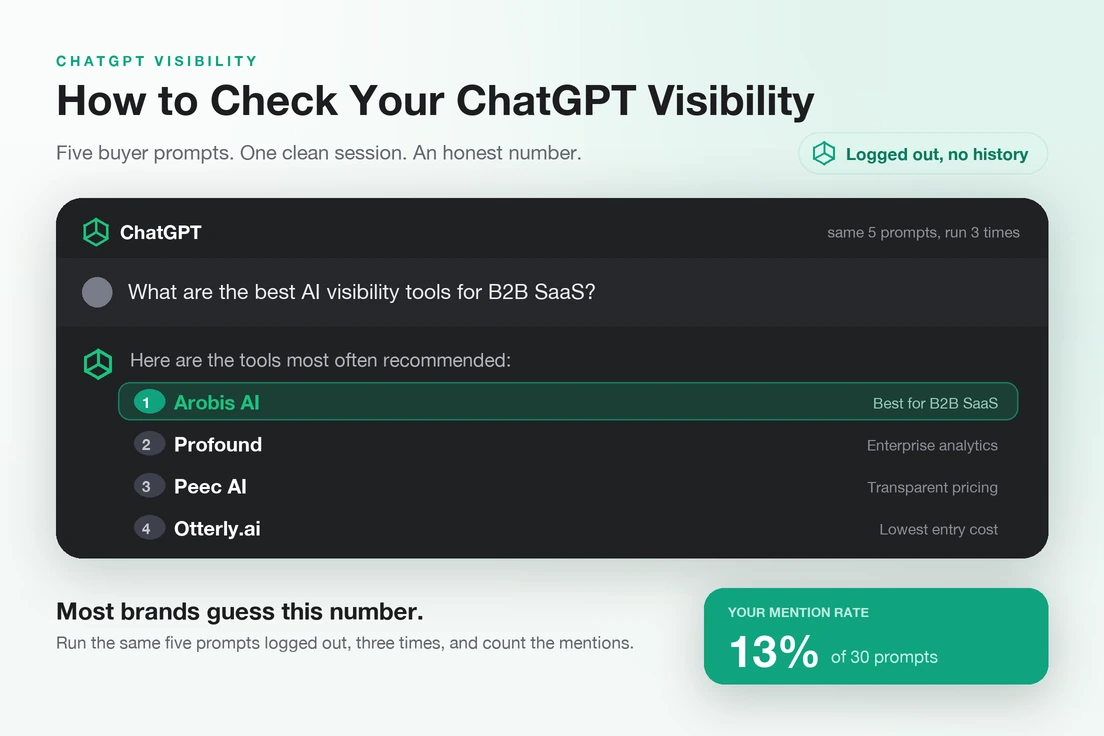
- Step 2: Check where you stand for free. Run a few of them through our free AI visibility checker and the ChatGPT visibility checker. Use a logged-out or temporary chat for any manual checks, because logged-in answers are personalized.
- Step 3: Decide if you need a baseline. If the free checks show you mostly absent, an audit tells you why. Our $399 AI visibility audit covers one domain, and this explainer on what an AI visibility audit covers shows what a good one should include, whoever you buy it from.
- Step 4: Pick the model. Under 25 prompts and spare team capacity: DIY with a tool. One core category and no capacity: an agency in the $2,500 to $5,000 range. Many products or markets: talk to enterprise programs.
- Step 5: Set a 90-day test. Agree upfront on which prompts you expect to move and how you'll measure them. If nothing has moved after 90 days, something's wrong with the program, the prompts, or the fit.
What I'd do with $0, $500, $2,500 or $10,000 a month
Opinions, clearly labeled as mine.
With $0: I'd write my 20 money prompts, check them weekly in temporary chats, and fix the obvious technical gaps myself. Generate an llms.txt with our free llms.txt generator, clean up schema, and make sure your pricing and comparison pages answer questions directly. Then I'd follow the eight tactics in our guide on how to increase AI citations.
With $500: one tool around $95 to $250, plus a modest placement budget. I'd spend the remaining money getting listed in the two or three roundups that AI engines already cite for my category, instead of buying a bigger tool tier.
With $2,500: a focused agency program on one category, or a part-time specialist plus tools if you have someone to manage them. This is the level where third-party work becomes consistent rather than occasional.
With $10,000: multiple categories, original research worth citing, and a real community presence. At this level I'd want a named strategist, weekly re-checks and reporting tied to pipeline, not traffic.
And at every level, I'd read how to check if AI recommends your brand first, so you know what success looks like before you pay for it.
Red flags at every price point
Price doesn't protect you from a bad program. These do show up at every level:
- Guarantees of "rank one in ChatGPT". Impossible to promise honestly.
- Screenshots without session conditions. A logged-in ChatGPT can name a brand first while a temporary chat doesn't mention it at all. I've seen that exact gap with our own brand.
- Only on-site work. AI engines lean heavily on what others say about you. A program that only edits your pages is half a program.
- No prompt list in the proposal. If they can't tell you which questions they'll target, they can't tell you whether they won.
- Traffic as the main KPI. AI answers often don't send clicks. Recommendation share and pipeline matter more.
- Hard cancellation. Easy in, hard out is a pattern, not an accident.
Is AEO worth the cost?
Honestly, not for everyone.
It's worth it when your buyers research before they buy, compare vendors, and ask questions like "best tool for X". That describes most B2B SaaS. Our State of AI Search Visibility report tracks which brands AI engines actually recommend across categories, and the gap between named and ignored brands is wide.
It's not worth it when your buyers don't use AI to research, when you can't act on recommendations, or when you're spending money on AEO while your website still can't explain what you sell.
The test I use with prospects: if a buyer asked ChatGPT for the best option in your category tomorrow, and you weren't named, would it cost you a deal? If the answer is yes, AEO is worth budgeting for. If you shrug, keep your money for now :)
How I verified these numbers
Every software price on this page was read on the vendor's own pricing page on October 1, 2026, at the monthly (not annual) rate unless stated. Agency prices come from each agency's own site, re-checked the same day. The cost per tracked answer is my own calculation from vendor-published limits, using the method described above. Sales call patterns are from Arobis AI's own pipeline, anonymized.
Disclosure: Arobis AI is an AEO agency and appears in the agency table. Our row uses the same source as everyone else's: our public pricing page. This category reprices roughly every quarter, so I'll update this page when the numbers change.
Frequently asked questions
How much does AEO cost per month?
AEO costs $0 to $500 a month if you monitor it yourself with free or paid tools, $1,600 to $10,000 a month for an agency program that does the work, and $20,000 or more for enterprise retainers. Most B2B SaaS programs with an agency land between $3,000 and $5,000 a month.
How much does an AEO tool cost?
Entry plans range from $29 a month (Otterly.AI Lite, 15 prompts) to $295 a month (AthenaHQ Starter, 3,600 credits), with HubSpot AEO at $50 and Peec AI at $95. Profound and most enterprise tools are custom priced. Several tools, including HubSpot AEO and AthenaHQ, offer a free trial or free tier.
Is AEO more expensive than SEO?
Not usually. Among the agencies we checked, AEO retainers sit in a similar range to SEO retainers, roughly $1,600 to $10,000 a month. The difference is where the money goes: more of an AEO budget goes into third-party mentions and placements, and less into publishing volume.
Can I do AEO myself for free?
Yes, partly. You can check prompts manually in temporary chats, use free graders and tiers, add structured data and an llms.txt file, and improve your comparison and pricing pages. What is hard to do for free is the consistent third-party work, like getting into the roundups and communities AI engines cite.
How long before AEO spending shows results?
In our experience, the first measurable movement shows up in 6 to 12 weeks for prompts where you are already close, and takes longer in competitive categories. That is why three-month minimum terms are common and fair, while anything promising results in two weeks deserves skepticism.
What should an AEO agency include in its price?
A good AEO retainer should include a tracked prompt list, regular re-checks across named engines, on-site fixes, page rewrites, third-party placements and a monthly report showing prompts won and lost. Ask whether monitoring software and paid placements are included or billed on top.
Why do AEO prices vary so much?
Prices vary because scope varies: the number of prompts, products, markets and engines covered, how much content is produced, and whether placements are included. Term length matters too. One agency we checked charges more than 40% extra for month to month instead of a 12-month commitment.
Is an AI visibility audit worth paying for?
An audit is worth it when you suspect you are missing from AI answers but don't know why. A good audit records real answers across several engines, names the competitors and sources AI uses instead of you, and gives a prioritized fix list. Prices run from a few hundred dollars to $5,000 or more.
Keep reading
- Weighing specialists? Compare an AEO agency for SaaS with a GEO agency built for SaaS and a broader AI SEO agency.
- Testing tools first? Our HubSpot AEO review, Scrunch AI review and the comparison of Ahrefs vs Semrush for AI visibility cover the most common shortlists, and the guide to AthenaHQ alternatives covers the higher end.