
Last updated: October 1, 2026. Pricing and engine coverage for HubSpot AEO, Profound, Semrush and Ahrefs re-verified on vendor pages this week.
Engine coverage and pricing for Ahrefs, Semrush, HubSpot AEO and Profound re-checked on October 1, 2026. AI visibility products change quickly, so confirm current limits on each vendor's site before you buy.
Short answer
Ahrefs Brand Radar is the stronger choice for large-scale AI visibility research, competitive discovery and citation-source analysis. Semrush AI Visibility Toolkit is the better fit for teams that want AI visibility monitoring integrated with their existing SEO workflow, starting from $99 a month per domain (billed annually) for AI Visibility on its own.
Ahrefs currently provides an AI Visibility Index of more than 449 million AI prompts across six AI platforms, plus custom prompt tracking that also covers Claude, while Semrush combines AI visibility tracking with prompt research, competitor analysis, brand-performance monitoring and AI-search auditing.
The better tool depends less on which dashboard looks nicer and more on what you need to do with the data.
Ahrefs vs Semrush for AI Visibility: Quick Comparison
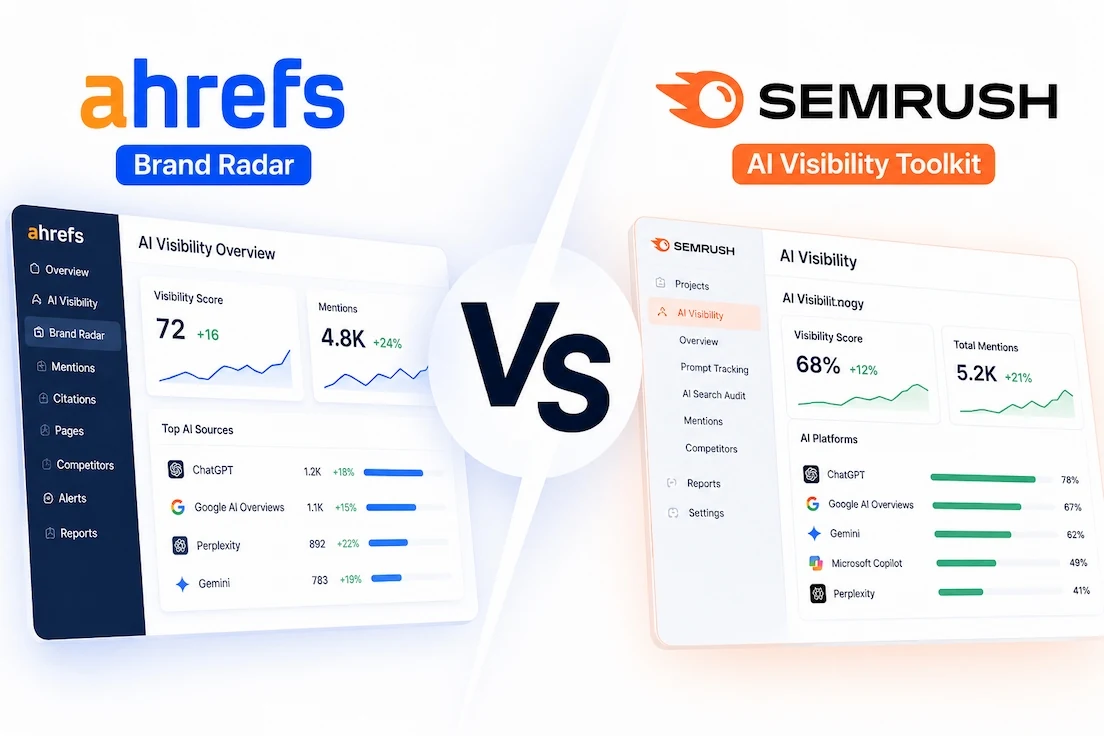
A side-by-side look at the AI visibility features that matter most, from engine coverage and prompt tracking to citation research, competitor benchmarking and AI-search auditing.
| Feature | Ahrefs Brand Radar | Semrush AI Visibility Toolkit |
|---|---|---|
| Best for | Large-scale AI visibility and citation research | AI visibility integrated with SEO workflows |
| ChatGPT tracking | ✓Yes | ✓Yes |
| Google AI Overviews | ✓Yes | ✓Yes |
| Google AI Mode | ✓Yes | ✓Yes |
| Gemini | ✓Yes | ✓Yes |
| Perplexity | ✓Yes | ✓Yes |
| Microsoft Copilot | ✓Yes | Enterprise AIO only (custom pricing) |
| Grok | Paused: Ahrefs says it is temporarily unable to gather new Grok data | Enterprise AIO only (custom pricing) |
| Claude | Custom prompts only, not in the AI Visibility Index | Enterprise AIO only (custom pricing) |
| Large-scale discovered prompt data | 449M+ prompts across six AI platforms | Prompt Research and tracked prompt datasets |
| Custom prompt tracking | ✓Yes | ✓Yes |
| Citation and source analysis | ✓Excellent | ✓Yes |
| Competitor benchmarking | ✓Yes | ✓Yes |
| Brand sentiment / perception analysis | More limited | Strong |
| AI-search site auditing | Via broader Ahrefs site-analysis tools | Dedicated AI Search Site Audit |
| Best overall advantage | Research depth and source discovery | Workflow consolidation and value |
Engine coverage, feature availability and Ahrefs prompt-index volume last verified October 1, 2026. AI engine coverage and product limits can change frequently.
Our verdict in one minute
Best for dedicated AI visibility research: Ahrefs Brand Radar.
Its biggest advantage is the scale of its searchable AI-response data and the ability to investigate which pages, domains and sources repeatedly appear around your brand and competitors.
Best all-in-one option: Semrush.
If you're already using Semrush for SEO, competitor analysis or content research, its AI visibility capabilities fit naturally into the same workflow and are considerably easier to justify as part of one platform.
Best for citation-source research: Ahrefs.
Understanding that your brand appeared is useful. Understanding why it appeared and which sources AI systems repeatedly rely on is far more actionable.
Best for controlled prompt monitoring: Both.
This is an important update. Ahrefs now supports custom AI prompt tracking as well, so this is no longer a simple “Semrush tracks prompts, Ahrefs discovers them” distinction. Semrush still makes curated prompt monitoring central to its workflow, while Ahrefs combines custom tracking with a much larger searchable database of existing AI responses.
Best for teams that care about Claude: Ahrefs, through custom prompts. Semrush keeps Claude for Enterprise AIO.
Best for teams focused on Copilot: Ahrefs. For Grok, check first: Ahrefs has paused new Grok data and Semrush only offers it on Enterprise AIO.
And there is one important limitation shared by both platforms:
They primarily help you measure AI visibility. They do not automatically create the authority, third-party mentions, comparison coverage and citation-worthy content that cause AI systems to recommend your brand more often.
We'll come back to that distinction later because it is where many companies misunderstand what an AI visibility tool can actually do.
Ahrefs vs Semrush: Quick Verdict
60-second answerForced ranking: HubSpot AEO vs Ahrefs Brand Radar vs Semrush AI Visibility Toolkit vs Profound
Most buyers are not really choosing between two tools. The shortlist in 2026 is usually four: the two SEO-suite add-ons compared in this article, HubSpot's AEO product, and Profound as the dedicated tracker. Here is a forced ranking, best to worst, for the three jobs people actually hire these tools for. Prices were checked on vendor pages on October 1, 2026.
Job 1: citation analysis (which sources AI engines pull from, and whether you are one of them)
- 1. Ahrefs Brand Radar. The largest prompt and citation database of the four, and the only one that lets you explore which domains get cited across a whole category rather than only your own prompt list. Best for research and competitive discovery.
- 2. Profound. The deepest per-prompt citation view and the only one of the four that shows prompt volume, so you can weight citations by how often people actually ask. Costs more and has a steeper learning curve.
- 3. Semrush AI Visibility Toolkit. Solid citation and share-of-voice reporting, and the only one that overlays your Google rankings against your AI mentions in one view, but the base tier tracks 25 prompts, which limits category-level analysis.
- 4. HubSpot AEO. Citation analysis exists but on 25 prompts across ChatGPT, Gemini and Perplexity only, with no Google AI Overviews, AI Mode, Claude or Copilot coverage. Fine for a HubSpot customer's first look, not for citation research.
Job 2: benchmarking your industry's AI visibility on a small budget
- 1. Semrush AI Visibility Toolkit. $99 a month per domain (billed annually) for 25 prompts on its own, or $199 a month ($165.17 billed annually) for 50 prompts tracked daily on one domain inside the SEO + AI Search Starter plan, plus competitor comparison out of the box. The most complete benchmark of the four, if you already pay for Semrush.
- 2. HubSpot AEO. $50 a month standalone ($45 a month annual) for 25 prompts on three engines, or included in Marketing Hub Professional at 25 prompts and Enterprise at 50. Its free AEO Grader gives a one-time score with no account. Good value if you live in HubSpot, weak if your buyers use Google AI Overviews.
- 3. Ahrefs Brand Radar. Brand Radar AI is sold standalone from $199 a month, with no base Ahrefs plan required, and custom prompt packages start at $50 a month. Powerful, not cheap.
- 4. Profound. A free 7-day trial on three engines with 50 prompts, then custom Enterprise pricing for up to nine engines; the $99 and $399 self-serve plans are no longer listed. The best data of the four, at a price that only makes sense once AI search is a funded channel.
Job 3: diagnosing whether AI traffic and demand are actually changing for you
- 1. Profound. Prompt volume plus citation and sentiment history make it the only one of the four that can tell you demand is moving, not only mentions.
- 2. Semrush AI Visibility Toolkit. The Google-rankings overlay shows where AI answers are replacing clicks you used to get.
- 3. Ahrefs Brand Radar. Strong for spotting category shifts through its prompt database; weaker on your own trend line, because tracking is snapshot and keyword-first rather than continuous prompt-level.
- 4. HubSpot AEO. Ties visibility to the CRM, which is genuinely useful, but the engine gaps mean you can be invisible in Google AI Overviews and never know.
What practitioners say about each
- HubSpot AEO: rated 4.4 out of 5 across 145 G2 reviews at the time of checking. The recurring criticism in the HubSpot community is that the prompt suggestions feel generic, and agencies note that it reports visibility but does not create it. HubSpot's own launch numbers claim beta users saw 20% more AI referral traffic. Our full HubSpot AEO review covers the details.
- Profound: 4.5 out of 5 on G2 across 1,130 reviews and in the leader quadrant. Reviewers praise data depth and support, and complain about prompt limits, capped content generation and the absence of white-label reporting for agencies. See our breakdown of Profound pricing.
- Semrush AI Visibility Toolkit: reviewers like the rankings overlay and presentation-ready reports, and question how prompts are sampled, since the data is simulated rather than drawn from real user sessions. Smaller brands report thin data.
- Ahrefs Brand Radar: reviewers value the historical data and the size of the prompt database, and flag an accuracy gap versus what they see in live AI answers, plus missing engines such as Meta AI and DeepSeek, Grok data that is currently paused, and Claude only through custom prompts.
The verdict most teams should reach
If you already pay for Semrush or Ahrefs, start with their add-on and spend the savings on execution. If you live in HubSpot and your buyers use ChatGPT, HubSpot AEO is a reasonable first dashboard. Move to Profound only when AI search has a budget and an owner. And whichever tracker you choose, remember that none of the four changes an AI answer. That is the work Arobis AI does, and you can see your starting point in two minutes with the free AI Visibility Checker.
Why AI visibility is suddenly inside every major SEO platform
For years, search visibility mostly meant one thing: where your website ranked in Google.
That is no longer enough.
A buyer researching a SaaS category might now ask:
“What are the best customer support platforms for a remote team?”
Instead of clicking through ten blue links, they may get a shortlist directly from ChatGPT, Google AI Mode, Gemini, Perplexity or another AI assistant.
If your company never appears in that shortlist, ranking well organically does not necessarily guarantee that you participate in the buying decision.
That shift is why Ahrefs and Semrush have both invested heavily in AI visibility products.
Traditional rank tracking answers:
Where does my website rank?
AI visibility tracking tries to answer a different set of questions:
Does AI know my brand?
Which buying-intent questions cause it to mention me?
Which competitors appear when I do not?
What websites and pages are influencing those answers?
How often does my brand earn a recommendation rather than simply a mention?
Those questions are becoming increasingly important because the shortlist can now form before a buyer visits a vendor's website.
What does “AI visibility” actually mean?
AI visibility describes how frequently and prominently a company, product or brand appears in AI-generated answers relevant to its market.
That can include:
- Brand mentions
- Product recommendations
- Share of voice versus competitors
- Citation frequency
- Sources used to support an AI answer
- Sentiment or brand positioning
- Visibility across specific buyer-intent prompts
For example, imagine a cybersecurity company ranks third organically for:
best endpoint security software
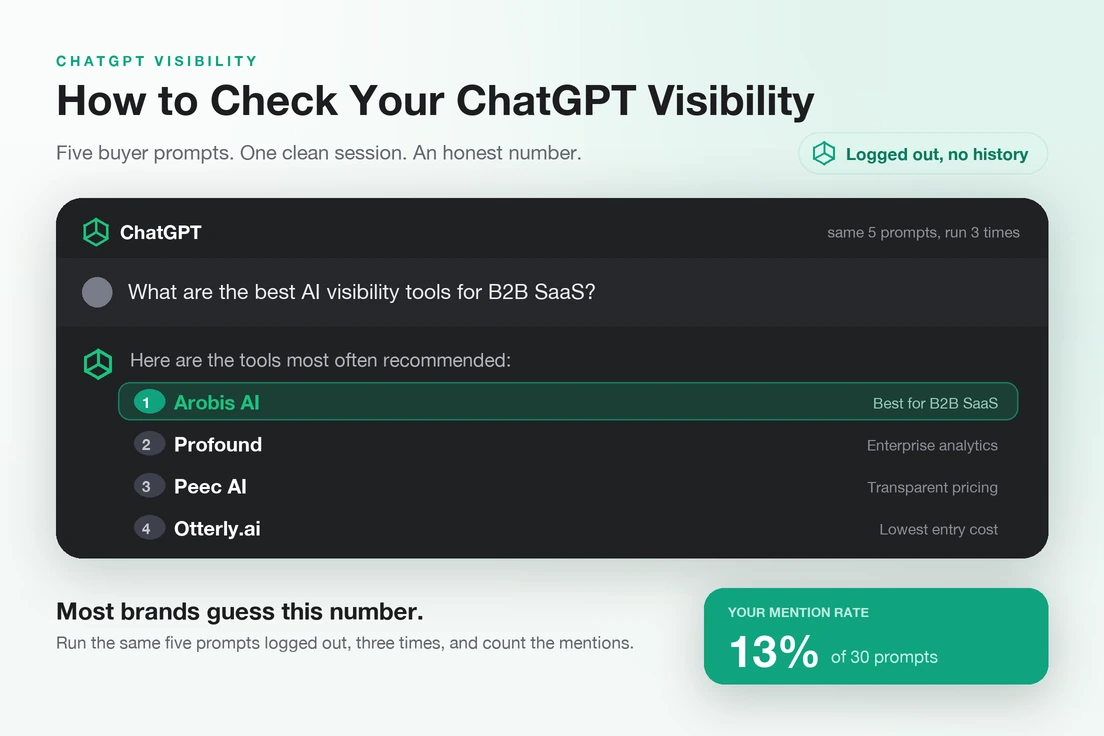
but ChatGPT, Gemini and Perplexity consistently recommend three competing platforms without mentioning it. If you want that picture for ChatGPT alone before paying for either toolkit, the free ChatGPT mention check shows your mention rate, position and the sources ChatGPT cited.
From a traditional SEO perspective, that company may look highly visible.
From an AI-search perspective, it has a recommendation gap.
That distinction is precisely what tools such as Ahrefs Brand Radar and Semrush AI Visibility Toolkit are trying to measure.
Why compare Ahrefs Brand Radar and Semrush AI Visibility Toolkit?
There is now an entire category of dedicated AI visibility platforms, but Ahrefs and Semrush are different because many marketing teams already use one of them.
That creates a practical buying question:
Do you actually need another dedicated AI visibility platform, or can the SEO software already in your stack handle the job?
Ahrefs approaches the problem through large-scale AI response and citation research.
Semrush approaches it as another layer inside a broader search-marketing workflow.
Both can tell you considerably more than a traditional rank tracker.
But their strengths, pricing models and ideal use cases are different.
That is what this comparison focuses on.
Rather than comparing every SEO feature inside Ahrefs and Semrush, we'll concentrate specifically on what matters for AI search:
- Engine coverage
- Prompt discovery
- Custom prompt monitoring
- AI citations and source attribution
- Competitor benchmarking
- Brand sentiment
- AI-search technical readiness
- Pricing
- Real-world usefulness
And most importantly:
Which one gives you information you can actually turn into better AI visibility?
What Is Ahrefs Brand Radar?
Ahrefs Brand Radar is an AI visibility and brand-monitoring platform that tracks how brands, competitors and websites appear across AI-generated answers and other searchable surfaces. Its biggest differentiator is scale: Ahrefs currently reports more than 449 million prompts across six AI platforms in its AI Visibility Index, with Claude added for custom prompts.
As of October 2026, Brand Radar covers:
- ChatGPT
- Google AI Overviews
- Google AI Mode
- Gemini
- Perplexity
- Microsoft Copilot
- Claude (custom prompts only)
Rather than requiring you to build a prompt list before seeing useful data, Brand Radar lets you search an existing database of AI responses to discover where your brand appears, which competitors are being recommended, what topics trigger those mentions and which sources influence the answers.
That distinction matters.
If you sell customer support software, for example, you don't necessarily need to know every prompt buyers are using before you start. You can investigate your brand, competitors and category inside Brand Radar and uncover relevant AI-search demand from the data already collected.
Ahrefs also supports custom prompt tracking, so Brand Radar is not limited to discovery. Teams can monitor a defined set of commercially important questions alongside the larger AI-response dataset.
Where Ahrefs Brand Radar stands out
The strongest use case is competitive AI-search research and source discovery.
Brand Radar can help answer questions such as:
- Which AI engines mention our brand?
- Which competitors appear more often?
- What topics are competitors associated with that we are not?
- Which websites and pages are repeatedly cited in our category?
- Which third-party sources influence AI answers?
- What buyer questions are we currently missing?
- Is our AI visibility increasing over time?
This makes Brand Radar particularly useful when you don't simply want to monitor a predetermined list of prompts—you want to investigate the wider information environment shaping AI recommendations.
Ahrefs Brand Radar's citation advantage
One of the most useful parts of Brand Radar is its ability to connect AI visibility with the sources appearing in AI answers.
A visibility score tells you what happened.
Citation and source analysis can help explain why.
Suppose Perplexity repeatedly recommends Competitor A for a high-intent query. If the supporting sources include an industry comparison article, a Reddit discussion and a third-party review page, those sources become strategically more interesting than the visibility percentage alone.
Instead of only seeing:
Competitor A: 34% visibility
Your brand: 12% visibility
you can investigate the pages and domains surrounding that difference.
That turns AI visibility monitoring into competitive research.
It's also an important distinction to make accurately: Semrush provides AI citation and source information too. Ahrefs' advantage is not that it is the only platform capable of source analysis. Its advantage is how citation research connects with Ahrefs' large searchable AI-response dataset and broader web data.
Bottom line: Ahrefs Brand Radar is strongest when you want to explore a market, reverse-engineer competitor visibility and understand the sources influencing AI answers—not simply watch a fixed dashboard.
What Is Semrush AI Visibility Toolkit?
Semrush AI Visibility Toolkit is Semrush's platform for tracking how a brand appears across AI search and generative-answer experiences, including visibility, prompts, competitors, citations and brand perception.
Its philosophy is somewhat different from Ahrefs.
Rather than making a massive searchable AI-response index the center of the product, Semrush brings AI visibility into the broader workflow marketers already use for SEO and competitive research.
Its AI-search functionality includes areas such as:
- AI Visibility Overview
- Prompt Research
- Competitor Research
- Brand Performance
- AI citations and cited pages
- Custom prompt tracking
- AI Search Site Audit
For an in-house marketing team already working inside Semrush, that integration is a significant advantage.
You can investigate organic search visibility, competitors and technical SEO, then move into AI-search performance without adopting an entirely separate workflow.
Where Semrush AI Visibility Toolkit stands out
Semrush is particularly strong for structured monitoring and operational workflow.
You can define commercially important prompts, track how your brand performs against competitors and monitor changes over time.
For example, a B2B SaaS company might track questions such as:
“Best project management software for agencies”
“Asana alternatives for enterprise teams”
“Best project management platform with resource planning”
Those prompts are much closer to actual buying decisions than a generic metric such as total brand mentions.
Semrush can then help the team understand whether the brand appears, which competitors win the answer, how the brand is described and which sources are being cited.
Semrush's broader workflow advantage
Semrush becomes particularly attractive when AI visibility is one part of your search strategy rather than the entire strategy.
The same team may already use the platform for:
- Keyword research
- Organic competitor analysis
- Backlink research
- Technical SEO
- Content planning
- Rank tracking
Adding AI visibility to that environment reduces tool fragmentation.
That doesn't automatically make Semrush better at AI-search research than a more specialized platform. It makes it easier to operationalize for teams that already live inside Semrush.
Its dedicated AI Search Site Audit also gives it an interesting technical angle: teams can investigate AI visibility while checking whether their website is accessible and technically prepared for AI-search systems.
Bottom line: Semrush AI Visibility Toolkit is strongest for teams that want AI-search measurement, prompt monitoring and competitor intelligence integrated into an existing SEO operation.
Ahrefs vs Semrush: AI Visibility Features Compared
Now we get to the part that actually matters.
Both platforms can tell you whether your brand appears in AI search.
The more useful question is:
Which platform gives you the better information for the job you're trying to do?
Let's compare them feature by feature.
1. AI Engine Coverage
Both Ahrefs and Semrush cover several of the AI surfaces that matter most to marketers, but their engine coverage is not identical.
Ahrefs Brand Radar currently includes six AI platforms in its AI Visibility Index, plus Claude for custom prompts:
ChatGPT, Google AI Overviews, Google AI Mode, Gemini, Perplexity and Microsoft Copilot.
Semrush's self-serve AI Visibility Toolkit covers ChatGPT, Google AI Overviews, Google AI Mode, Perplexity and Gemini. Claude, Copilot, Grok and DeepSeek are only on its custom-priced Enterprise AIO plan.
That creates a surprisingly practical buying consideration.
If you're selling into Microsoft-heavy enterprise environments, visibility in Copilot may deserve more attention.
If your audience frequently uses Claude for research and evaluation, Ahrefs covers it through custom prompts, while Semrush only offers it on Enterprise AIO.
And if you want Grok included in your AI visibility research, check first: Ahrefs says it is temporarily unable to gather new Grok data, and Semrush only offers Grok on Enterprise AIO.
Winner for overall engine breadth: Ahrefs
For most teams, Ahrefs currently has the broader mix of AI indexes.
But don't choose an AI visibility platform by counting logos alone.
The most important engines are the ones your actual buyers use.
A SaaS company whose customers overwhelmingly research products through ChatGPT, Google and Perplexity should care far more about the quality of the data on those three surfaces than whether a platform technically tracks one additional assistant.
One coverage detail is worth getting right, because most comparisons get it wrong. Ahrefs Brand Radar tracks Microsoft Copilot as one of its six AI engines. The Semrush AI Visibility Toolkit does not track Copilot on its base plan at all. On Semrush, Copilot, along with Claude, Grok and DeepSeek, is an Enterprise AIO feature, so if Copilot coverage is the reason you are buying, the entry Semrush plan will not deliver it and Ahrefs will. We verified this against both tools' live plans on October 1, 2026.
2. Prompt Discovery vs Custom Prompt Tracking
This is one of the most important differences between the two products—and one that is easy to explain incorrectly.
Both Ahrefs and Semrush now support custom AI prompt tracking.
The difference is what happens beyond the prompts you already know about.
Ahrefs: discover the market before defining it
Ahrefs' major advantage is its existing database of hundreds of millions of AI prompts and responses.
That makes Brand Radar useful for discovery.
Instead of starting with:
“Here are the 25 prompts we think buyers ask.”
you can also ask:
“What topics and questions are already generating AI answers around our brand, competitors and category?”
That's valuable because marketers are not always good at predicting how buyers phrase questions to AI systems.
A prospect might search Google for:
“customer support software”
but ask ChatGPT:
“We're a 40-person SaaS company with a remote support team and Zendesk is getting too expensive. What should we switch to?”
AI-search behavior can be considerably more conversational, specific and contextual than traditional keyword research.
A large response database gives you another way to discover that landscape.
Semrush: define the prompts that matter and monitor them
Semrush is particularly useful when you already know the commercial questions you care about.
You can build a curated prompt set around:
- Product categories
- Alternatives
- Comparisons
- Use cases
- Pain points
- Industry-specific requirements
- Buying scenarios
Then monitor those prompts consistently.
For a CMO or demand generation team, this is often the cleaner reporting model.
You don't necessarily need millions of prompts.
You may need the 50 prompts most likely to influence pipeline.
Which approach is better?
Neither replaces the other.
In fact, a mature AI visibility program should do both:
Discovery finds opportunities you didn't know existed.
Tracking measures the opportunities you've decided matter.
Ahrefs currently has the stronger discovery story because of the scale of Brand Radar's existing AI-response data.
Semrush has a very natural workflow for teams building and monitoring a controlled set of commercially important prompts.
Winner for prompt discovery: Ahrefs
Winner for structured prompt monitoring: Tie
The important correction is that custom prompt tracking is no longer a Semrush-only advantage. Ahrefs supports it too.
3. AI Citations and Source Attribution
This may be the most strategically important feature in the entire comparison.
Knowing that your company appears in an AI answer is useful.
Knowing which sources are associated with that answer can tell you what to do next.
Imagine you track:
“Best payroll software for international startups”
Your company isn't recommended.
Three competitors are.
The visibility dashboard tells you that you lost.
The citation data may tell you something much more useful:
- Competitor A is supported by a software comparison site.
- Competitor B appears in an industry publication.
- Competitor C is repeatedly discussed in community content.
- A category roundup cited by the AI system doesn't mention you at all.
Now you have a strategy.
That is why we consider citation-source analysis more actionable than visibility scores alone.
Ahrefs citation analysis
Ahrefs is especially compelling here because source research fits naturally with the way Brand Radar is built.
You can investigate which domains and pages appear around relevant AI responses and look for patterns across competitors, topics and platforms.
This helps answer:
Which sources repeatedly influence our category?
That question is often more valuable than:
What is our visibility score this week?
Semrush citation analysis
Semrush also provides citation and cited-page information, so it would be inaccurate to frame this as an Ahrefs-only capability.
Its advantage is that citation information sits alongside the rest of the Semrush workflow, including prompt monitoring, competitor research and site analysis.
For teams already using Semrush operationally, that may be more convenient than moving between products.
The strategic difference
Ahrefs feels stronger as a research environment for exploring sources at scale.
Semrush feels stronger as an integrated monitoring environment where citations are one component of a larger AI + SEO workflow.
Winner for citation and source research: Ahrefs
But there's an important caveat:
Neither tool should turn citation counts into a vanity KPI.
The useful question isn't:
“How many AI citations did we get?”
It's:
“Which sources influence the buying-intent answers we care about, why are competitors appearing there, and what can we realistically do to become part of that evidence set?”
That is where citation tracking becomes strategy rather than reporting.
4. Competitor Benchmarking
Knowing whether your brand appears in AI answers is useful.
Knowing who replaces you when you don't is usually much more valuable.
That's why competitor benchmarking is one of the most important features in any AI visibility platform.
Suppose your company appears in only 12% of buying-intent prompts.
That number alone doesn't tell you much.
But if you discover that one competitor appears in 68% of those same prompts while another appears in just 9%, your priorities immediately become clearer.
Instead of asking:
"How visible are we?"
You start asking:
"Why does AI consistently recommend Competitor A instead of us?"
That's the question that actually improves AI visibility.
Ahrefs
Brand Radar makes competitor discovery feel investigative.
You can compare brands across large volumes of AI responses, identify recurring recommendation patterns and investigate the sources supporting those recommendations.
That often uncovers opportunities you weren't actively looking for.
For example, you might discover that AI consistently associates one competitor with:
- Enterprise security
- SOC 2 compliance
- Healthcare
- Remote support
while your own brand is mostly mentioned in small-business contexts.
That isn't just a visibility difference.
It's a positioning difference.
Semrush
Semrush approaches competitor benchmarking through structured reporting.
Its Competitor Research helps you compare brands across tracked prompts, monitor changes over time and understand how competitors perform for commercially important questions.
For organizations already running SEO reporting inside Semrush, this integrates naturally into existing workflows.
Marketing teams can monitor:
- AI visibility
- Organic rankings
- Share of Voice
- Competitor changes
- Prompt performance
inside one reporting environment.
Which approach is better?
The answer depends on your workflow.
If you're trying to discover new competitive opportunities, Ahrefs generally provides the stronger research experience.
If you're presenting recurring reports to leadership every month, Semrush's structured dashboards may be easier to operationalize.
Winner: Tie
Both products handle competitor benchmarking well.
The difference is less about capability and more about philosophy.
Ahrefs leans toward exploration.
Semrush leans toward monitoring.
5. Brand Perception and Sentiment
Appearing in an AI answer isn't always a win.
How your brand is described matters just as much.
Imagine these two responses.
"Company A is one of the leading customer support platforms for fast-growing SaaS businesses."
versus
"Company A is suitable for smaller teams but lacks advanced enterprise capabilities."
Both count as brand mentions.
Only one helps sales.
Modern AI visibility isn't simply about frequency.
It's also about association.
What ideas does AI consistently connect with your company?
Are you associated with:
- Enterprise?
- Security?
- Innovation?
- Affordable pricing?
- Healthcare?
- Compliance?
- AI?
- Customer service?
Those associations shape future recommendations.
Ahrefs
Brand Radar focuses primarily on visibility, citations and competitive discovery.
While you can infer positioning by examining prompts and cited sources, sentiment analysis is not the product's primary focus.
Semrush
Semrush places greater emphasis on how brands are represented inside AI answers.
Its Brand Performance reporting helps marketers understand not only whether they're mentioned, but also the context surrounding those mentions.
For companies operating in competitive or highly regulated industries, this can provide valuable reputation insight.
Winner: Semrush
If understanding how AI describes your brand is important, Semrush currently has the advantage.
6. AI Crawlability and Technical Readiness
Before an AI system can recommend your content, it has to discover it.
That sounds obvious.
In practice, many websites still make life unnecessarily difficult for AI crawlers.
Examples include:
- blocked AI user agents
- poor internal linking
- orphan pages
- missing structured data
- weak entity signals
- fragmented content architecture
Technical SEO remains important.
It simply isn't the entire story anymore.
Ahrefs
Ahrefs has long been one of the strongest technical SEO platforms on the market.
Its Site Audit remains excellent for identifying crawlability issues, indexing problems and technical improvements that indirectly support AI visibility.
However, its technical recommendations are broader than AI search alone.
Semrush
Semrush takes a more AI-specific approach through its AI Search Site Audit.
Instead of only identifying traditional SEO issues, it also evaluates whether your website is technically prepared for AI search experiences.
This makes it particularly useful for teams beginning an AI-search initiative and looking for quick technical wins before investing in broader authority-building work.
Winner: Semrush
For AI-search-specific auditing, Semrush currently offers the more focused experience.
Feature Comparison Scorecard
After comparing the features that matter most, here's how Ahrefs Brand Radar and Semrush AI Visibility Toolkit stack up.
| Category | Winner |
|---|---|
| AI engine coverage | Ahrefs |
| Prompt discovery | Ahrefs |
| Custom prompt tracking | Tie |
| Citation and source research | Ahrefs |
| Competitor benchmarking | Tie |
| Brand perception | Semrush |
| AI-search technical auditing | Semrush |
| Overall research depth | Ahrefs |
| Integrated marketing workflow | Semrush |
Beyond AI Visibility: You're Buying an SEO Platform Too
It's easy to compare Brand Radar and AI Visibility Toolkit in isolation.
In reality, very few companies buy either product for AI visibility alone.
They're choosing an SEO platform that they'll likely use every day.
That broader context matters.
Why many companies choose Ahrefs
Ahrefs has earned its reputation through:
- backlink intelligence
- keyword research
- competitor analysis
- content exploration
- technical SEO
Brand Radar extends that ecosystem into AI search rather than replacing it.
For agencies and SEO teams already living inside Ahrefs, adding AI visibility often feels like a natural progression rather than adopting a separate product.
Why many companies choose Semrush
Semrush has always positioned itself as an all-in-one marketing platform.
Alongside SEO, many organizations also use it for:
- PPC research
- content marketing
- local SEO
- competitive intelligence
- social media management
- reporting
Adding AI Visibility Toolkit means those teams can monitor AI search without introducing another platform into the stack.
Don't let your existing subscription decide automatically
One common mistake is assuming:
"We're already paying for Ahrefs."
or
"We already have Semrush."
Therefore, the decision is made.
Not necessarily.
If AI visibility is becoming a major acquisition channel for your business, it's worth evaluating whether the AI capabilities—not just the SEO capabilities—actually fit your goals.
For some companies, the bundled solution is more than enough.
For others, AI visibility becomes important enough to justify a deeper specialist workflow.
The right answer depends on how central AI search is to your marketing strategy—not simply which invoice you're already paying.
Which Platform Is Better for Different Teams?
After evaluating both products, the buying decision becomes fairly straightforward.
Choose Ahrefs Brand Radar if you:
- Want the deepest AI-search research capabilities.
- Care about discovering new buyer prompts.
- Need large-scale citation and source analysis.
- Spend significant time investigating competitors.
- Want broad AI engine coverage, including Copilot and Claude.
- View AI visibility as a strategic research function rather than just another dashboard.
Choose Semrush AI Visibility Toolkit if you:
- Already rely heavily on Semrush.
- Want AI visibility integrated into your daily SEO workflow.
- Care about brand perception and AI positioning.
- Need structured prompt monitoring for leadership reporting.
- Want AI-search auditing alongside technical SEO.
- Prefer an all-in-one marketing platform.
If you're still undecided...
Ask yourself one simple question:
Do I need to discover opportunities, or do I need to monitor performance?
If your answer is discover, Ahrefs generally provides more research depth.
If your answer is monitor, Semrush generally provides the smoother operational workflow.
That distinction matters far more than comparing feature checklists.
Ahrefs vs Semrush Pricing: What You'll Actually Pay
Pricing is where these two products start to separate more clearly.
On the surface, both Ahrefs and Semrush now offer AI visibility capabilities.
Once you look beyond the marketing pages, however, the pricing models are quite different.
Ahrefs treats Brand Radar as a premium research product that sits alongside its SEO platform.
Semrush positions AI Visibility Toolkit as another layer inside a broader marketing suite.
Understanding that difference can save you hundreds—or even thousands—of dollars each month.
Ahrefs Pricing (2026)
Ahrefs recently updated its pricing structure, introducing a new Starter plan while continuing to position Brand Radar as an additional premium capability.
Ahrefs Pricing (2026)
Ahrefs recently updated its pricing structure, introducing a new Starter plan. Brand Radar is included in the core plans with a small tracked-prompt allowance, and Brand Radar AI is also sold on its own.
| Plan | Monthly Price |
|---|---|
| Starter | $29 |
| Lite | $129 |
| Standard | $249 |
| Advanced | $449 |
| Enterprise | From $1,499 |
These plans provide access to Ahrefs' traditional SEO platform including keyword research, backlinks, site auditing and competitor analysis.
Brand Radar AI is also sold on its own.
Ahrefs Brand Radar Pricing
Brand Radar is currently sold two ways: the AI Visibility Index and custom prompt packages.
Pricing starts at:
- $199/month for Brand Radar AI, sold standalone with no base plan required
- $50/month Basic, $100/month Growth or $250/month Scale for custom prompt packages
Ahrefs also offers custom prompt tracking with usage-based limits depending on your subscription.
The $199 Brand Radar AI Visibility Index price is per platform: each extra platform adds $199, and all platforms are capped at $699 a month, with Claude available through custom prompts. Model the platforms you need before you compare.
For teams that only want to track their own prompts, the $50 to $250 custom prompt packages are the cheaper route.
Who Ahrefs Pricing Makes Sense For
Ahrefs becomes easier to justify when:
- AI visibility is a strategic priority.
- Competitive AI research happens every week.
- Multiple brands or product lines are monitored.
- Source attribution is central to decision making.
- Teams already rely heavily on Ahrefs.
If your primary goal is simply checking whether your brand appears in ChatGPT once a month, Brand Radar may be more capability than you actually need.
Semrush Pricing (2026)
Semrush approaches pricing differently.
Instead of positioning AI visibility as a separate premium research product, it treats AI monitoring as another component of a larger marketing platform.
Semrush Pricing (2026)
Semrush approaches pricing differently. Instead of positioning AI visibility as a separate premium research product, it treats AI monitoring as another component of a larger marketing platform.
| Plan | Monthly Price |
|---|---|
| Starter | $199 |
| Pro+ | $299 |
| Advanced | $549 |
These plans combine traditional SEO with AI visibility capabilities in one subscription.
That means many organizations already paying for Semrush gain AI visibility without adding another dedicated platform.
Where AI visibility sits in Semrush's plans
Semrush bundles AI Search into its main plans, and still sells AI Visibility on its own from $99 a month per domain (billed annually) for 25 tracked prompts.
Pricing starts from:
- $199/month for the Starter plan, $165.17 billed annually
Higher tiers add prompts: Pro+ at $299 for 100 a day, Advanced at $549 for 200.
For companies already on Semrush, the $99 AI Visibility plan is the cheapest way to add AI-search monitoring without buying a second platform.
Ahrefs vs Semrush Pricing: Side-by-Side
Ahrefs vs Semrush Pricing: Side-by-Side
Both full tiers start at $199 a month (Ahrefs also sells prompt packages from $50, Semrush sells AI Visibility alone from $99), so the real difference is what you get for it: Semrush bundles AI Search into its broader SEO platform, while Ahrefs sells Brand Radar AI standalone with deeper AI-search research.
| Category | Ahrefs Brand Radar | Semrush AI Visibility Toolkit |
|---|---|---|
| Lowest AI visibility entry point | $50/mo prompts, $199/mo index | $99/mo AI Visibility, $199/mo with SEO |
| Bundled with SEO platform | Yes, in Lite, Standard and Advanced | Yes, in SEO + AI Search plans |
| Premium research capabilities | Excellent | Strong |
| AI-search discovery | Excellent | Strong |
| Best value for existing customers | Ahrefs users | Semrush users |
| Best budget option | From $50 for custom prompts | $99 for AI Visibility on its own |
Winner for Pricing
It is close to a tie on entry price.
Both full tiers start at $199 a month (Semrush also sells AI Visibility alone from $99, Ahrefs sells prompt-only packages from $50), so the deciding factor is which suite you already pay for. Semrush bundles AI Search into a full SEO plan, while Ahrefs sells Brand Radar AI standalone. If you would rather add it to your CRM than your SEO suite, HubSpot's $50 AEO tool is the third option, and we reviewed HubSpot AEO with the same honesty.
Ahrefs wins on research depth.
For the full Brand Radar AI index you're paying more ($199 a month against Semrush's $99), but you're also buying one of the deepest AI-search research environments currently available.
Neither pricing model is objectively better.
One prioritizes value.
The other prioritizes capability.
Reviews and User Feedback
Feature lists tell you what software can do.
User reviews tell you what it's actually like to live with.
Both Ahrefs and Semrush receive consistently strong ratings across major software review platforms, making this less about product quality and more about choosing the workflow that best fits your team.
Ahrefs Reviews
Across major review platforms, Ahrefs is consistently praised for:
- Industry-leading backlink intelligence
- Excellent keyword research
- Clean, intuitive interface
- Reliable competitor analysis
- Fast performance
The most common criticism is pricing.
Many freelancers and smaller businesses describe Ahrefs as expensive, particularly once additional products like Brand Radar are added.
Overall, however, users generally agree that the quality of the data justifies the premium for organizations that rely heavily on SEO.
Semrush Reviews
Semrush is frequently praised for:
- Its all-in-one marketing platform
- Strong keyword research
- Comprehensive competitive analysis
- Content marketing tools
- Extensive reporting capabilities
Users often describe Semrush as replacing several separate subscriptions, making it attractive for growing marketing teams.
The most common complaints relate to pricing complexity and subscription management rather than the quality of the platform itself.
Our Take on the Reviews
There isn't a clear winner.
Both products are mature, widely adopted and trusted by thousands of marketing teams worldwide.
The real difference isn't software quality.
It's philosophy.
Ahrefs is built around research depth.
Semrush is built around workflow breadth.
That's ultimately the decision you're making.
Which Tool Should You Choose?
After comparing engine coverage, prompt discovery, citation analysis, competitor research, AI-search auditing, pricing and user feedback, the decision becomes surprisingly straightforward.
Choose Ahrefs Brand Radar if:
- AI visibility is becoming a strategic growth channel.
- You want the deepest AI-search research capabilities.
- Citation-source analysis is important.
- Competitive intelligence is part of your workflow.
- You regularly investigate emerging AI-search opportunities.
You'll spend more.
You'll also gain one of the strongest AI-search research products currently available.
Choose Semrush AI Visibility Toolkit if:
- You're already invested in Semrush.
- AI visibility is one component of a broader SEO strategy.
- You want one platform instead of several.
- Budget is an important consideration.
- Operational reporting is more important than deep AI-search investigation.
For many in-house marketing teams, this will be the simpler choice.
The Decision Most Companies Should Make
If your organization already relies heavily on either Ahrefs or Semrush, start there.
Both platforms provide enough AI visibility insight to establish a reliable baseline.
Only consider adding another specialized platform once you've identified limitations that genuinely affect your strategy.
The biggest mistake isn't choosing Ahrefs instead of Semrush.
It's believing that buying either platform automatically improves AI visibility.
Neither does.
They measure the problem.
Improving AI visibility requires earning the citations, authority and third-party validation that AI systems rely on when generating recommendations.
That's an entirely different challenge.
And it's where many companies discover that measurement is only the beginning.
Why Measuring AI Visibility Isn't the Same as Improving It
This is the biggest blind spot in the entire AI visibility software category.
Ahrefs and Semrush can tell you:
- whether your brand appears
- which prompts trigger a mention
- which competitors appear instead
- which pages are being cited
- how your visibility changes over time
That data is valuable.
But measurement and improvement are two different jobs.
A dashboard can tell you that your brand appears in 14% of commercially relevant AI answers.
It cannot automatically turn 14% into 40%.
That's the part many teams underestimate.
AI Visibility Tools Measure the Outcome
Think of AI visibility software as a diagnostic layer.
It tells you where your brand stands today.
For example:
Your brand appears in 8 of 50 tracked buying-intent prompts.
Competitor A appears in 31.
Competitor B appears in 22.
Your strongest category association is "small business."
Your enterprise product is rarely mentioned.
Most competitor citations come from third-party comparison pages and industry publications.
That's useful intelligence.
But none of those findings improve visibility by themselves.
They simply tell you where the gap exists.
The next question is much harder:
Why does AI have more evidence to recommend those competitors than it has to recommend us?
That's where the real work begins.
The AI Search Demand Gap
Traditional SEO teams are accustomed to fixing visibility problems with familiar levers:
- improve the page
- target the keyword
- build links
- strengthen internal linking
- improve technical SEO
Those still matter.
But AI recommendations introduce another layer.
A brand can have a technically excellent website and strong Google rankings while still being absent from AI-generated shortlists.
Why?
Because AI systems are not evaluating one webpage in isolation.
They retrieve evidence from across the web.
That evidence can include:
- first-party website content
- third-party comparison articles
- software review platforms
- industry publications
- customer reviews
- community discussions
- YouTube
- expert roundups
- structured company information
- documentation
- case studies
The exact mix varies by engine, query and retrieval system.
But the strategic implication is straightforward:
Your website is only one part of the evidence AI systems can use to understand and recommend your brand.
That creates what we call an AI Search Demand Gap.
It is the distance between:
what your company says about itself
and
the evidence AI systems can retrieve about your company across the wider web.
The larger that gap becomes, the harder it is to earn consistent recommendations.
A Simple Framework: Measure → Diagnose → Build → Re-Test
The most useful way to think about AI visibility is as a four-stage cycle.
1. Measure
Start by establishing where your brand actually appears.
Track:
- buying-intent prompts
- recommendation frequency
- competitor presence
- engine differences
- cited sources
- category associations
This is where tools like Ahrefs Brand Radar and Semrush AI Visibility Toolkit are valuable.
They give you the baseline.
2. Diagnose
Next, investigate why competitors are appearing when you are not.
Look for patterns.
Are competitors repeatedly cited from:
- G2?
- Reddit?
- industry roundups?
- comparison articles?
- review sites?
- original research?
- their own category pages?
Are they associated with a use case your brand barely mentions?
Does AI understand your company, but put it in the wrong category?
Are you visible for informational prompts but absent from commercial ones?
The goal is not simply to find more citations.
It is to understand the evidence pattern behind the recommendation.
3. Build the Missing Evidence
This is the part monitoring software cannot do for you.
Once you identify the gap, you have to create or earn the evidence required to close it.
That may involve:
- strengthening category and use-case pages
- creating comparison content
- improving product positioning
- earning inclusion in third-party roundups
- improving review presence
- publishing original research
- earning credible industry mentions
- participating authentically in relevant communities
- improving entity consistency across the web
- strengthening internal linking and topical authority
- making content easier to retrieve and cite
The right tactics depend entirely on the gap.
If competitors are winning because AI repeatedly retrieves a specific review platform, publishing ten more blog posts may accomplish very little.
If AI doesn't understand that your product serves enterprise buyers, another backlink alone probably won't fix the problem.
The diagnosis determines the work.
4. Re-Test the Same Buyer Questions
After making meaningful changes, test the same prompt set again.
Don't constantly change the measurement framework.
Otherwise, you won't know whether visibility actually improved.
Track whether:
- recommendation frequency increases
- new categories appear
- competitor gaps shrink
- sentiment changes
- stronger sources begin supporting your brand
- buying-intent visibility improves
This is where AI visibility software becomes genuinely useful.
It closes the feedback loop.
Measure → Diagnose → Build → Re-Test.
The dashboard is part of the system.
It isn't the whole system.
Visibility Is Not the Same as Recommendation
There's another distinction worth making.
A company can technically be "visible" without being recommended.
Consider this answer:
"Other platforms in this category include Company A, Company B and Company C."
Company C has technically received a mention.
Now compare it with:
"For enterprise teams, Company C is one of the strongest options because of its security controls, integrations and deployment flexibility."
Those are very different outcomes.
The first is visibility.
The second is recommendation.
For companies selling complex or high-value products, recommendation is usually the more important metric.
That's why we believe teams should look beyond raw mention counts and monitor something closer to Recommendation Rate:
The percentage of commercially relevant AI prompts in which your brand is actively recommended as a viable option.
A visibility dashboard can show you mentions.
A demand-generation strategy should aim to increase recommendations.
Why Citation Counts Alone Can Mislead You
The same problem applies to citations.
More citations sound good.
But not every citation has equal business value.
Being cited for:
"What is customer support software?"
is not equivalent to being recommended for:
"What's the best customer support platform for a 500-person SaaS company?"
The second query is much closer to a buying decision.
So instead of asking:
"How many times did AI cite us?"
ask:
"Are we being cited and recommended when buyers are actually choosing vendors?"
That is a far more useful KPI.
AI Visibility Monitoring vs AI Search Demand Generation
This distinction is the easiest way to understand where Ahrefs and Semrush fit.
AI visibility monitoring tells you what is happening.
AI Search Demand Generation focuses on changing what happens.
Monitoring includes:
- prompt tracking
- mention frequency
- share of voice
- competitor benchmarking
- citation analysis
- sentiment monitoring
AI Search Demand Generation includes the work required to improve those outcomes:
- category positioning
- answer optimization
- authority building
- third-party validation
- comparison coverage
- original research
- community presence
- citation-ready content
- entity strengthening
- continuous recommendation testing
The two disciplines are complementary.
You need measurement to know where to act.
You need execution to change the measurement.
So, Do You Need Ahrefs, Semrush, an Agency, or All Three?
For many teams, the answer depends on internal capability.
If you have an experienced SEO, content and digital PR team capable of turning citation and prompt data into execution, a platform like Ahrefs or Semrush may be enough.
If you know how to:
- identify recommendation gaps
- create the right content
- earn the right third-party mentions
- strengthen brand entities
- improve comparison coverage
- build category authority
then the software gives you the data required to run the program internally.
If your team can see the problem but isn't sure how to close it, software alone will probably leave you staring at the same dashboard every month.
That's when external execution becomes more useful.
At Arobis AI, this is the distinction we focus on.
We use AI visibility measurement to identify where brands are missing from high-intent AI answers, then work on the content, authority and external evidence required to improve recommendation frequency.
The objective isn't a prettier dashboard.
It's moving from:
Unseen → Mentioned → Trusted → Recommended
That is the difference between monitoring AI search and generating demand through it.
Before You Buy Either Tool, Run This 5-Minute AI Visibility Test
You don't need Ahrefs or Semrush to establish whether you have an AI visibility problem.
You can get a surprisingly useful baseline manually.
Step 1: Pick Five Buyer-Intent Prompts
Choose questions a real prospect might ask while evaluating vendors.
Avoid branded prompts.
Instead of:
"Is Company X good?"
use questions such as:
"What are the best customer support platforms for remote SaaS teams?"
"Best Zendesk alternatives for enterprise support teams"
"Which customer service software has the strongest AI automation?"
The closer the prompt is to an actual buying decision, the more useful the test becomes.
Step 2: Test Three AI Engines
Run the same five prompts through three major AI experiences.
For example:
- ChatGPT
- Google AI Mode
- Perplexity
That gives you 15 total responses.
Use the same wording for every engine.
Step 3: Score Each Answer
For every response, record:
Mentioned?
Did your company appear anywhere?
Recommended?
Was it presented as a genuine option?
Competitors?
Which brands appeared instead?
Sources?
What pages or domains were cited?
Step 4: Calculate Your Recommendation Rate
If your company was actively recommended in 3 of the 15 responses:
Recommendation Rate = 20%
If your strongest competitor appeared in 11:
Competitor Recommendation Rate = 73%
You now have a simple baseline.
It isn't as sophisticated as a dedicated monitoring platform.
But it tells you whether there is a meaningful gap.
Step 5: Study Why the Winners Won
This is the most important part.
Don't stop at:
"Competitor X appeared more often."
Open the sources.
Look for patterns.
Are competitors repeatedly supported by:
- category pages?
- Reddit?
- G2?
- comparison articles?
- industry publications?
- original research?
Those patterns tell you much more than the score alone.
They give you the beginning of a strategy.
And that's exactly why the best AI visibility tool isn't necessarily the platform with the prettiest dashboard.
It's the one that helps you understand what to do next.
How We Evaluated Ahrefs and Semrush
AI visibility software changes quickly.
New AI engines are added, pricing evolves and features ship regularly, so a comparison written six months ago can already be outdated.
To make this comparison as useful as possible, we evaluated both platforms across the areas that matter most when measuring AI visibility.
Specifically, we compared:
- AI engine coverage
- Prompt discovery capabilities
- Custom prompt tracking
- Citation and source analysis
- Competitor benchmarking
- Brand perception reporting
- AI-search technical auditing
- Workflow integration
- Pricing
- Overall value
We also reviewed each product's latest public documentation, pricing information and feature announcements to verify that engine support, product capabilities and plan structures reflected the most current information available at the time of writing.
Last manually verified: October 1, 2026.
Because both Ahrefs and Semrush continue to expand their AI visibility capabilities, we recommend confirming pricing and supported AI engines before making a purchasing decision.
Final Verdict
After comparing every major capability, one thing became clear:
There isn't one universal winner.
There is a better tool for different types of teams.
Choose Ahrefs Brand Radar if...
Your primary objective is understanding why AI systems recommend certain brands.
Brand Radar currently offers the stronger research environment for discovering buyer prompts, investigating citation sources, exploring competitor visibility and understanding the evidence behind AI-generated recommendations.
If AI search is becoming a strategic acquisition channel for your business, Ahrefs provides exceptional research depth.
Choose Semrush AI Visibility Toolkit if...
Your goal is integrating AI visibility into an existing SEO workflow.
Semrush combines prompt monitoring, competitor analysis, AI-search auditing and traditional SEO inside one platform, making it easier for marketing teams already using Semrush to operationalize AI visibility without introducing another product.
For many in-house teams, it will also be the more cost-effective option.
Our Recommendation
If you're already an Ahrefs customer, start with Brand Radar.
If you're already using Semrush across your marketing team, begin with AI Visibility Toolkit.
For most organizations, the platform you already know will provide more value than switching ecosystems solely for AI visibility.
The more important question is not:
"Should I buy Ahrefs or Semrush?"
It's:
"Do we actually have a process for improving AI visibility once we've measured it?"
That's where many organizations struggle.
Measurement is relatively easy.
Building the authority, content, positioning and third-party evidence required to improve AI recommendations is significantly harder.
The software tells you where the opportunity exists.
Your marketing strategy determines whether you capture it.
Bottom Line
If your priority is:
✅ Deep AI-search research
✅ Citation discovery
✅ Competitive investigation
✅ Prompt discovery
Choose Ahrefs Brand Radar.
If your priority is:
✅ Workflow efficiency
✅ Integrated SEO operations
✅ Lower entry cost
✅ AI visibility inside an existing marketing platform
Choose Semrush AI Visibility Toolkit.
Both are excellent products.
Both provide meaningful AI visibility insights.
Neither automatically improves your AI visibility.
That's the job of your content, authority, positioning and demand-generation strategy.
The companies that will win AI search over the next few years won't necessarily be the ones with the biggest dashboards.
They'll be the ones that consistently create the strongest evidence for AI systems to retrieve, trust and recommend. If you'd like to learn more about AI visibility and AI traffic you should visit our GA4 + Search Console tracking guide here.
Why AI Visibility Requires More Than Traditional SEO
Traditional SEO mainly optimizes webpages for rankings. AI search relies on a broader evidence layer before a brand earns a recommendation.
Sources and Data Freshness
This comparison was manually verified against the latest publicly available Ahrefs and Semrush product documentation and pricing information available on October 1, 2026.
Because AI visibility products evolve rapidly, supported AI engines, pricing, prompt limits and available features may change after publication.
Whenever either platform introduces significant updates, we review and update this comparison to keep it accurate.
Frequently asked questions
Is Ahrefs Brand Radar better than Semrush AI Visibility Toolkit?
It depends on your goals.
Ahrefs Brand Radar is generally stronger for AI-search research, prompt discovery, citation analysis and competitor investigation.
Semrush AI Visibility Toolkit is stronger if you want AI visibility integrated into an existing SEO workflow with prompt monitoring, AI-search auditing and broader marketing tools.
Does Ahrefs Brand Radar track ChatGPT?
Yes.
Ahrefs Brand Radar currently tracks visibility across several major AI search experiences, including ChatGPT, Google AI Overviews, Google AI Mode, Gemini, Perplexity and Microsoft Copilot, plus Claude through custom prompts.
Does Semrush AI Visibility Toolkit track ChatGPT?
Yes.
Semrush AI Visibility Toolkit includes ChatGPT monitoring alongside other major AI search experiences and provides prompt tracking, citation analysis, competitor monitoring and AI visibility reporting.
Which tool has better AI engine coverage?
Based on the features available at the time of writing, Ahrefs currently supports the broader range of primary AI indexes.
Semrush's self-serve plans cover ChatGPT, Google AI Overviews, Google AI Mode, Perplexity and Gemini, with Claude, Copilot, Grok and DeepSeek reserved for Enterprise AIO, so the better choice depends on which AI platforms your buyers actually use.
Can either tool improve my AI visibility automatically?
No.
Both Ahrefs and Semrush measure AI visibility.
Neither platform automatically improves it.
Improving AI visibility requires creating stronger evidence through better content, third-party validation, authority building and category positioning.
Which tool is better for agencies?
Many agencies will prefer Ahrefs because of its research depth and competitive analysis capabilities.
Teams focused on recurring client reporting and integrated SEO operations may prefer Semrush.
Which tool is better for SaaS companies?
Both can work well.
Companies looking to understand why competitors appear in AI recommendations may benefit more from Ahrefs.
Organizations wanting AI visibility alongside broader SEO management may find Semrush the more practical option.
Which tool is more affordable?
It depends on what you need. Ahrefs has the cheapest way in, with custom prompt packages from $50 a month, while Semrush's AI Visibility Toolkit is $99 a month per domain (billed annually) for 25 prompts.
For full index-level research, Ahrefs Brand Radar AI starts at $199 a month, so it is the larger investment.
Is AI visibility replacing SEO?
No.
AI visibility builds on SEO rather than replacing it.
Technical SEO, crawlability, content quality and authority remain important, but AI systems also evaluate evidence from third-party sources such as review sites, industry publications and community discussions.
What is AI Search Demand Generation?
AI Search Demand Generation focuses on increasing how often AI systems recommend a brand during commercial buying journeys.
Unlike AI visibility monitoring, which measures existing performance, AI Search Demand Generation focuses on improving recommendation frequency by strengthening the evidence AI systems retrieve and trust.
What should I measure besides AI visibility?
Some of the most useful KPIs include:
- Recommendation Rate
- Buying-intent prompt coverage
- Competitor recommendation share
- Citation quality
- Category association
- AI-assisted referral traffic
- AI-assisted conversions
Looking beyond simple mention counts provides a much clearer picture of AI search performance.
Which platform would we choose?
If your primary goal is research, competitor intelligence and understanding why AI recommends certain brands, we'd choose Ahrefs Brand Radar.
If your priority is operational efficiency, integrated SEO workflows and cost-effective AI monitoring, we'd choose Semrush AI Visibility Toolkit.
Either platform provides valuable insight.
The more important question is what your team does with that insight after the dashboard is built.
Does the Semrush AI Visibility Toolkit track Microsoft Copilot?
Not on its base plan. The entry Semrush AI Visibility Toolkit tracks ChatGPT, Google AI Overviews, Google AI Mode, Perplexity and Gemini. Copilot, along with Claude, Grok and DeepSeek, is an Enterprise AIO feature, so Copilot coverage requires the custom-priced Enterprise plan. This is the most common mistake buyers make when comparing the two tools.
Does Ahrefs Brand Radar track Microsoft Copilot?
Yes. Ahrefs Brand Radar tracks six AI engines including Microsoft Copilot, alongside Google AI Overviews, Google AI Mode, ChatGPT, Perplexity and Gemini. Brand Radar AI is sold standalone from $199 a month, with no base Ahrefs plan required.
Which is best for citation analysis: HubSpot AEO, Ahrefs Brand Radar, Semrush AI Toolkit or Profound?
Ranked best to worst for citation analysis: Ahrefs Brand Radar for category-wide citation research, Profound for per-prompt depth with prompt volume, Semrush AI Visibility Toolkit for a 25-prompt view with a Google overlay, and HubSpot AEO last because it tracks only ChatGPT, Gemini and Perplexity on 25 prompts.
Which free tools can benchmark industry-level AI visibility?
HubSpot's AEO Grader gives a one-time score with no account. Semrush and Ahrefs both offer free AI visibility checkers with limited prompts. The Arobis AI Visibility Checker runs six engines with no signup. All of them are snapshots, so re-run the same prompts several times before drawing conclusions.
Does HubSpot AEO track Google AI Overviews?
No. As of October 2026 HubSpot AEO tracks ChatGPT, Gemini and Perplexity. Google AI Overviews, Google AI Mode, Claude, Copilot, Grok, Meta AI and DeepSeek are not covered. Semrush covers AI Mode on its base tier, and Ahrefs covers AI Overviews and AI Mode through its AI Visibility Index.