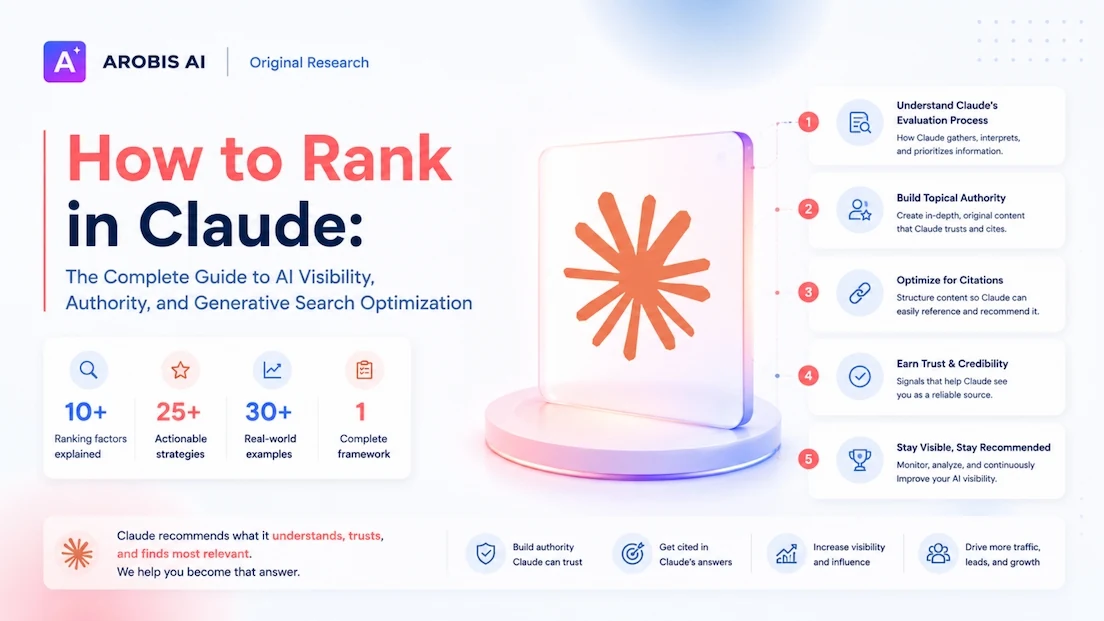
Last updated: October 2026. To rank in Claude, you first have to rank in Brave Search. When Claude searches the web it pulls results from Brave, and in a June 2026 study of about 35,000 Claude citations, 79.2% of cited URLs sat in Brave's top 10 for the same query, against 34% in Google's top 10.
How to rank in Claude: be discoverable by Brave and Anthropic's crawlers, earn a Brave top 10 spot for your buyers' questions, and be the clearest, best-corroborated source on that results page so Claude quotes you. Claude visibility sits downstream of search, because Brave mostly discovers pages through Google and Bing.
Key takeaways
- Google Cloud's documentation for Claude web search lists Brave Search as the third-party search service Anthropic's web search can call.
- In a June 2026 Profound analysis reported by MERJ, 79.2% of about 35,000 Claude-cited URLs appeared in Brave's top 10, against 34% in Google's top 10.
- Anthropic runs three crawlers: ClaudeBot for training, Claude-User for user-requested fetches and Claude-SearchBot for search quality.
- Each Claude citation carries up to 150 characters of cited text, so short, self-contained sentences are what Claude quotes.
- Brave has no search console or sitemap submission. According to MERJ, the easiest route into Brave is ranking on Google or Bing, where opted-in Brave users see your page.
Everything below is built on primary sources (Anthropic's own documentation, Google Cloud's Claude docs, and a public study of how Brave finds pages) plus data from 1,450 site scans run by Arobis AI. Where the evidence is thin, we say so.
What "ranking in Claude" actually means
Ranking in Claude means being mentioned, cited, or recommended inside Claude's answer, because Claude, by Anthropic, does not show a list of ten blue links. Claude writes one answer, and that answer either names your brand or it doesn't.
Claude builds that answer from two places. The first is what the model learned in training, which is slow to change and reflects what the web said about you months ago. The second is live web search, which Claude runs when a question needs current information. You can influence both, but the second one is where a B2B SaaS brand can move the needle within weeks. For the wider picture, start with our AI visibility guide, and the disciplines behind it in our GEO guide and AEO guide.
Why ranking in Claude matters
Claude is used heavily for the moments that decide deals: software research, workflow recommendations, market analysis, and careful product comparisons. SaaS buyers increasingly run their shortlisting through it. If Claude recommends a competitor instead of you, you lose consideration and pipeline, even if your traditional SEO is strong. See why traditional SEO is dying for the shift.
There is also a quieter reason. Claude is not only a chat app. Developers build it into their own products through Anthropic's API, and the web search tool there runs the same way. When a procurement tool, a research agent, or an internal assistant is built on Claude, your brand's visibility travels with it.
How does Claude search the web?
Claude searches the web only when a prompt needs current information, and it pulls those results from Brave Search. Anthropic's web search documentation spells out the process. Claude decides whether to search based on the prompt, the search runs (sometimes several times in one answer), and Claude then writes a response with cited sources.
The part that matters for brands is when Claude chooses to search. Anthropic lists "information about specific organizations, people, or products that might have changed" as a search trigger, next to current prices and recent news. Almost every vendor question a buyer asks falls into that bucket. Questions about stable knowledge, such as maths or coding concepts, are usually answered from memory.
Three more details shape how you should write:
- Brave is the search provider. Google Cloud's documentation for Claude web search lists Brave Search as the third-party search service Anthropic's web search can call (checked 1 October 2026).
- Citations are short. Every web-sourced answer carries citations, and each one holds the URL, the page title, and up to 150 characters of cited text. Claude quotes sentences, not pages.
- Freshness is visible. Each search result passed to Claude includes a page_age field showing when the page was last updated, so a stale page competes with that label attached.
Why do you have to rank in Brave to rank in Claude?
You have to rank in Brave because Claude can only cite what Brave returns. In a June 2026 re-run by Profound, reported by the technical SEO firm MERJ, about 35,000 Claude citations across roughly 400 queries were checked against search results. 79.2% of the cited URLs appeared in Brave's top 10 for the matching query. Only 34% appeared in Google's top 10.
You will see an older figure, 86.7%, in most guides. It came from an early 2025 test on a very small sample. The larger 2026 number is lower but far more reliable, and it still says the same thing: Brave's top 10 is the shortlist Claude picks from.
Here is the part most guides miss. According to MERJ's study of how Brave discovers pages (July 2026, updated August 2026), Brave finds new URLs in three ways:
- The query channel. A single opted-in Brave user sees your page on another search engine's results page. This is the easiest route in.
- The page channel. Around 20 different opted-in users visit your page from different networks. A high bar for a new B2B page.
- Brave's own crawler. It is gated on your page being crawlable by Googlebot, and it follows your Googlebot rules in robots.txt.
Put together, the chain looks like this: a page that ranks on Google or Bing gets seen, Brave discovers it, it earns a Brave top 10 position, and then Claude can cite it. Claude visibility is not a separate game from search. It sits downstream of it.
How Claude chooses which brands to mention
Claude chooses brands it can verify. Once Claude has a set of results, it has to decide which brands to name. Anthropic designs Claude to be helpful, honest, and careful, so it avoids stating things it can't stand behind. In practice that makes verifiability the main currency. Claude names brands it can describe confidently from the pages in front of it, and it is more comfortable when several independent sources say the same thing.
That is also why self-promotion alone rarely works. In one Arobis AI audit, a Dutch healthcare firm was named in 2 of 9 test runs, and both times the only source cited was the firm's own website. Nothing independent backed it up, so it never became a confident recommendation. We break the full selection logic down in how Perplexity, ChatGPT, Claude, and Gemini choose which brands to mention and how AI search engines work.
The key factors that influence visibility in Claude
Seven factors decide whether Claude names your brand: entity clarity, corroboration, depth, experience-driven content, semantic relevance, quotable structure and Brave eligibility. The last one is the gate for all the others.
1. Entity clarity
Claude relies on entities to know who you are, your category, what you solve, and who you serve. If your positioning is inconsistent across the web, Claude won't know when to include you. Make your description identical across your site, LinkedIn, G2, Capterra, directories, and press. This coherent identity is the heart of AI recommendation authority.
2. Trust and corroboration
Claude is cautious about claims a brand only makes about itself. The same positioning echoed across reputable, independent sources (reviews, editorial, community) is what makes you safe to recommend. See the 5 signals AI engines use to recommend brands and which sources carry weight in the most influential domains in AI search rankings.
3. Topical authority and depth
Claude favors demonstrable depth: a content ecosystem, not scattered posts. Because it is used for considered research, thorough and well-reasoned coverage of a topic beats shallow content.
4. Helpful, experience-driven content
Original insight, first-hand experience, and a clear point of view earn citations. Thin, generic AI filler does not. Specific numbers, named integrations, and real outcomes give Claude something concrete to quote.
5. Semantic relevance
Claude reads for meaning, not exact-match keywords. Cover related concepts, industry language, and the sub-questions a topic naturally involves. Keyword stuffing lowers quality.
6. Clear, quotable structure
Organized headings, concise explanations, definitions, lists, and FAQ blocks make your content easy to interpret. Since each citation carries at most 150 characters of your text, write key claims as short, self-contained sentences that still make sense when lifted out on their own.
7. Brave eligibility
Brave eligibility is the factor most brands never check. If Brave hasn't discovered a page, or quietly dropped it, none of the six factors above can help that page get cited. The step-by-step section below covers how to pass Brave's filters.
Traditional SEO vs Claude optimization
Traditional SEO and Claude optimization work together: SEO earns a ranked page, and Claude optimization earns a named brand inside the answer. Here is the clean distinction:
- Goal. SEO: rank a page and earn clicks. Claude optimization: get named inside the answer.
- Focus. SEO: keywords and backlinks. Claude: entities, context, corroboration, and quotable facts.
- Index. SEO: mostly Google. Claude: Brave, which itself leans on Google and Bing to discover pages.
- Intent. SEO: search-query intent. Claude: conversational, research intent.
- Unit of success. SEO: a ranked URL. Claude: a cited sentence.
The brands that win do both. You still need to be crawlable and ranked in classic search, because that is how Brave finds you, and then optimized for the answer layer. In practice, the easiest way to do both is a SaaS SEO program that treats classic rankings and AI answers as one deliverable instead of two separate projects.
How Claude differs from ChatGPT, Gemini, and Perplexity
Claude differs from ChatGPT, Gemini and Perplexity mainly in its plumbing: Claude is the only major assistant whose documented search provider is Brave. The fundamentals are universal, but Microsoft Copilot sits on Bing, and Gemini and Google AI Overviews sit on Google's index. That single fact explains most of the gap between your ChatGPT and Claude results: a page can be strong in Google and invisible in Claude if Brave never picked it up.
If you are working through several engines, the sibling guides cover each one: how to rank in ChatGPT, Microsoft Copilot, Google Gemini, Google AI Overviews, and Perplexity. We compare their behavior side by side in how ChatGPT, Claude, and Gemini search differently. Build one strong foundation, then tune per engine.
Which Anthropic crawlers should you allow?
Anthropic runs three bots, each with its own robots.txt user agent. According to Anthropic's help center:
- ClaudeBot collects public web content that may be used for model training. Blocking it tells Anthropic to leave your future content out of training data.
- Claude-User fetches pages when a person asks Claude a question that needs them. Blocking it can reduce your visibility for user-directed web search.
- Claude-SearchBot crawls to improve the quality of Claude's search results. Blocking it can reduce your visibility and accuracy in those results.
Anthropic says all three respect robots.txt, support the Crawl-delay extension, publish their IP ranges, and will not try to get past CAPTCHAs. For a B2B SaaS brand that wants to be recommended, the safe default is to allow Claude-User and Claude-SearchBot. ClaudeBot is a business decision about training data, but blocking it also means the model's built-in memory of you stops updating.
The bigger risk is blocking you don't know about. In the Arobis AI Readiness Report (1,450 site scans, June to September 2026), 19.3% of sites returned nothing to a live ChatGPT fetch, while only 4.3% blocked GPTBot in robots.txt. The gap is firewalls, bot protection, and JavaScript-only pages turning AI visitors away silently. We measured this with ChatGPT's fetcher, and the same CDN rules often catch other AI agents, so test Claude-User separately rather than trusting your robots.txt. See what AI crawlers actually read for the details.
How to rank in Claude: step by step
To rank in Claude, work through these nine steps in order: crawler access first, then Brave eligibility, then content, entity, corroboration and structured data.
1. Make sure Claude can reach you
Allow Claude-User and Claude-SearchBot in robots.txt, then check that your CDN or bot protection isn't blocking them anyway. Key pages should be server-rendered, not assembled by JavaScript after load.
2. Pass Brave's silent drop rules
MERJ found that Brave quietly discards pages that trip certain filters. Check your priority pages against each one:
- No redirect on the canonical URL. Brave treats redirected pages as private and rejects them.
- Real text in the HTML. Brave does not run JavaScript, so JS-only content is never discovered.
- No stray "noindex" in the HTML head. Brave drops the page immediately.
- Put noindex and canonical rules in the HTML, not in HTTP headers. Brave ignores X-Robots-Tag and Link headers.
- Pages that respond within 10 seconds and weigh under 2 MB.
- Clean URLs, without stacks of query parameters.
3. Earn a Google or Bing ranking for the same question
Brave has no search console, no sitemap submission, and does not take part in IndexNow. Its Submit URL form only re-fetches pages Brave already knows. The fastest path into Brave is the query channel: rank somewhere on Google or Bing for the buyer's question, so opted-in Brave users see your page and Brave picks it up. Then check your position directly on search.brave.com.
4. Write answer-first, well-reasoned content
Open each priority page with a direct answer of 40 to 60 words, then back it with depth and evidence. Claude rewards reasoning and accuracy, so show your work rather than asserting. Keep the most quotable claims under about 150 characters so they survive being cited on their own.
5. Fix your entity everywhere
Write one specific identity sentence (what you are, category, who you serve) and use it on every profile. Add Organization schema so the model can read it directly.
6. Earn trustworthy corroboration
Pursue reviews, editorial mentions, podcasts, and authentic community presence so reputable, independent sources echo your positioning. Our Reddit guide for SaaS covers one high-leverage channel. Honest comparison content also helps Claude place you accurately, like our platform comparison.
7. Build the topic cluster
Anchor the topic with a pillar page and link to focused supporting pieces, so Claude sees end-to-end expertise rather than one isolated article.
8. Publish original research and keep it dated
Proprietary data, benchmarks, and studies are exactly what a research-oriented model reaches for, because nothing else has them. Show a visible "last updated" date and refresh key pages on a schedule, since Claude sees each result's page age.
9. Add structured data and an llms.txt file
Deploy FAQPage, Article, Organization, Product, and Breadcrumb schema to improve how you are extracted and represented. An llms.txt file is cheap to add with our free llms.txt generator, but be realistic about it: we found no Anthropic documentation saying Claude's search reads it. In our scans, 45.6% of sites have llms.txt and 75.3% ship JSON-LD, and sites with both averaged an AI readiness score of 93.2 against 47.2 for sites with neither. Our sample is self-selected, AI-aware sites, so treat that as a signal of overall technical care, not proof that either file causes citations.
The Claude ranking checklist
A page that passes all of these is far more likely to be named by Claude:
- Claude-User and Claude-SearchBot allowed, and actually able to fetch the page past your CDN.
- Server-rendered HTML, no redirect on the canonical URL, no stray noindex, under 2 MB, fast.
- Ranks somewhere on Google or Bing for the target question, and appears in Brave's top 10.
- Opens with an answer of 40 to 60 words, backed by depth and evidence.
- Key claims written as short sentences that make sense when quoted alone.
- Entity (name, category, who you serve) identical across site, LinkedIn, G2, Capterra, and directories.
- Corroborated by reputable independent sources, not self-published only.
- Organization, Article, and FAQPage schema in place, with a visible update date.
- Original insight or data, accurately sourced, inside a linked topic cluster. To compare tracking options, see our 17 best AI visibility tools and best free AI visibility tools.
How to measure your Claude AI visibility
Measure Claude AI visibility by tracking mention rate, citation rate, share of voice against competitors, sentiment, and AI referral traffic, not just clicks. A simple routine that works:
- Build a buyer prompt set. Write 10 to 20 questions your buyers really ask ("best X for Y", "X vs Y", "alternatives to Y"). Run them in Claude with web search on and record who gets named and which URLs get cited.
- Track Brave as a proxy. Search the same questions on Brave and log your position. Given the 79.2% overlap, a move into Brave's top 10 is the leading indicator that Claude citations can follow.
- Watch referral traffic. Look for claude.ai as a referral source in your analytics. It undercounts, because many readers never click, so pair it with the prompt set.
- Repeat monthly. AI answers vary run to run, so judge trends over several runs, not a single screenshot.
The starting point is often lower than teams expect. In recent Arobis AI audits, a publicly listed BI company appeared in 0 of 9 buyer prompts, and a scale-up automation consultancy appeared in 0 of 8. Baseline where you appear today with a free AI visibility check, or go deeper with a full AI visibility audit (here is what an AI visibility audit is). We keep the market numbers current in our AI search statistics and the deeper 100 AI search statistics research report.
Common mistakes that keep brands out of Claude
Most brands missing from Claude are either missing from Brave or blocked without knowing it. These are the mistakes we see most often.
- Treating Claude as separate from search. If Brave never discovered the page, Claude can't cite it.
- Trying to submit URLs to Brave. There is no sitemap intake or console. Earn discovery through Google and Bing instead.
- Redirects, JavaScript-only pages, or noindex set only in HTTP headers. Each one can drop you from Brave without warning.
- Blocking Claude-User or Claude-SearchBot, often by accident through a firewall rule.
- Inconsistent entity signals. Claude won't confidently place you.
- Self-published authority only. No independent corroboration to verify your claims.
- Thin, undated, or overstated content. Claude is built to avoid claims it can't check, and it sees how old your page is.
- Planning around stale numbers. The 86.7% Brave overlap figure most guides still quote came from a tiny 2025 sample.
If you're absent across the board, diagnose the cause with why your brand doesn't appear in AI answers and the 10 reasons your brand never appears in AI answers.
Why Claude visibility is mission-critical for SaaS
Claude visibility is mission-critical for SaaS because Claude is used for careful, research-heavy evaluation, so being named there reaches buyers at their highest-intent moment. If Claude recommends a competitor, the shortlist narrows before a rep is ever involved. That's why this is really AI search demand generation, not a technical checkbox. The full case is on our AI visibility for SaaS page.
For the mechanics of how AI ranks vendors, see how AI analyzes, recommends, and ranks SaaS products. For the strategic shift, read how AI search changes SaaS marketing, and for the boardroom framing, the CMO guide to AI recommendation share.
How Arobis AI helps you rank in Claude
Arobis AI is an AI Search Demand Generation agency for B2B SaaS. It is a done-for-you service: our team does the work to change what Claude, ChatGPT, Gemini, Perplexity, and Copilot say about you. That covers the technical layer (crawler access, Brave eligibility, schema), the content layer (answer-first, quotable pages built around your buyers' real prompts), and the corroboration layer (the independent sources Claude trusts).
When you're ready, our pricing page lays out the options. We track the category in the State of AI Search Visibility, and if you want to compare specialist partners, see the best SEO, GEO, and AEO agencies for SaaS. Claude is rarely the only engine that matters, so if ChatGPT is also on your list, run the same exercise for ChatGPT visibility.
Which Claude facts in this guide change over time?
The facts most likely to change are Anthropic's and Google Cloud's documentation and the data sets below, so they are collected here with their dates. Each was checked against its source in October 2026.
- Search provider: Google Cloud's documentation for Claude web search lists Brave Search as the third-party search service (checked 1 October 2026).
- Citations: Anthropic's web search documentation says each citation holds the URL, the page title and up to 150 characters of cited text, and each result includes a page_age field.
- Crawlers: Anthropic's help center lists three bots, ClaudeBot, Claude-User and Claude-SearchBot, all respecting robots.txt.
- Brave overlap: 79.2% of about 35,000 Claude-cited URLs in Brave's top 10 and 34% in Google's top 10 (Profound, June 2026, reported by MERJ in July 2026 and updated August 2026).
- Arobis AI Readiness Report (1,450 scans, June to September 2026): 19.3% of sites unreadable to a live ChatGPT fetch, 4.3% blocking GPTBot, 45.6% with llms.txt, 75.3% with JSON-LD.
Frequently asked questions
Does Claude use Brave Search?
Yes. Google Cloud's documentation for Claude web search lists Brave Search as the third-party search service Anthropic's web search can call. A June 2026 analysis of about 35,000 Claude citations found that 79.2% of cited URLs appeared in Brave's top 10 for the same query, against 34% in Google's top 10.
Can companies optimize for Claude?
Yes. Claude doesn't use traditional rankings, but companies can strongly influence how often Claude names them. Get into Brave's top 10 for your buyers' questions, keep Anthropic's Claude-User and Claude-SearchBot crawlers unblocked, make your entity clear and consistent, and earn independent corroboration on reviews, editorial and community sources.
What influences Claude's recommendations most?
First, whether your page is in the Brave results Claude sees at all, since 79.2% of Claude-cited URLs sit in Brave's top 10. After that, trust and verifiability: Claude favors brands with a clear entity and consistent, independent corroboration over brands that only promote themselves on their own website.
Does Claude use Google rankings?
Not directly. Only 34% of Claude-cited URLs appear in Google's top 10, against 79.2% in Brave's, according to a June 2026 Profound analysis reported by MERJ. Google still matters indirectly, because Brave discovers many new pages when its opted-in users see them on Google or Bing results.
Should I block ClaudeBot?
ClaudeBot collects public web content for Anthropic's model training, so blocking ClaudeBot is a training-data decision, and it also stops the model's memory of you updating. If you want Claude to recommend you, do not block Claude-User or Claude-SearchBot, which fetch and index pages for Claude's live search answers.
How long does it take to rank in Claude?
Crawler, entity, and structure fixes can show up within weeks once Brave has discovered your pages. The corroboration and depth that drive consistent inclusion in Claude's answers build over a few months, then compound. Track progress monthly with the same buyer prompt set and your Brave positions.
What is the difference between SEO and GEO for Claude?
SEO targets ranked links and clicks in search engines. GEO targets inclusion in Claude's generated answers through entity clarity, trust, and quotable structure. For Claude you need both, because classic Google and Bing rankings help Brave discover your pages, and Brave results are what Claude cites.
Final thoughts
Claude rewards what good businesses should be doing anyway: being clear about who you are, publishing accurate and genuinely useful content, and earning the trust of reputable sources. The difference in 2026 is the plumbing. Claude looks at the web through Brave, and Brave largely finds pages through Google and Bing. Win those layers in order, and Claude has a reason to recommend you.