
The best AI visibility tools in 2026 are Profound, Goodie AI and Evertune for enterprise depth, Semrush, Ahrefs Brand Radar and SE Visible if you already pay for an SEO suite, ZeroRank, Peec AI and Searchable for mid-market tracking, and Otterly.AI, Allmond, LLMrefs and Rankscale on a budget. The right pick depends on which AI engines your buyers use, how many prompts you need, and your budget.
Every tool below tracks one thing: whether AI engines like ChatGPT, Perplexity, Gemini, Claude, Copilot and Google's AI Overviews and AI Mode mention your brand when buyers ask for recommendations. We checked each vendor's pricing and engine list on the same day, so you can compare like for like. We also ran a small original test in Google AI Mode to see which of these tools AI itself recommends.
One note before the list. Arobis AI isn't on it, because we aren't a tracking tool. We're an AI Search Demand Generation agency for B2B SaaS, and we do the work that trackers point at. If you're weighing a tool against done-for-you help, jump to the section on trackers versus agencies after the list.
The 17 best AI visibility tools at a glance
| Tool | Best for | Entry price | Engines at entry | Free trial |
|---|---|---|---|---|
| Profound | Enterprise depth | Custom (Enterprise) | 9 engines | 7 days |
| ZeroRank | Unlimited prompts | $89/mo ($76 annual) | 17 platforms | Free report, no card |
| Ahrefs Brand Radar | Ahrefs users | $199/mo per platform | 1 ($699 for all) | Check vendor site |
| Allmond | AI visibility tracking and brand monitoring | $29/mo | ChatGPT, Claude, Gemini, Perplexity | 14 days, no card |
| Goodie AI | Full-cycle tracking and optimization | $399/mo | 5 models (up to 13) | 7 days |
| Peec AI | Clean prompt tracking | $95/mo ($80 annual) | Check vendor site | Check vendor site |
| AthenaHQ | Free starting point | Free; Starter $295/mo | 11 models | Free plan |
| Scrunch | Copilot coverage | $250/mo | 4, incl. Copilot | Check vendor site |
| Evertune | Large brands | $800/mo | 11 models | None listed |
| Semrush AI Visibility Toolkit | Semrush users | $99/mo (annual) | 5, no Claude or Copilot | Check vendor site |
| SE Visible / SE Ranking | Mid-market value | $99/mo | 5, no Claude or Copilot | 10 days |
| HubSpot AEO | HubSpot shops | $50/mo ($45 annual) | Check vendor site | Check vendor site |
| Nightwatch | Rank tracking plus AI | EUR 99/mo (EUR 79 annual) | 6, incl. Claude | 14 days |
| Searchable | Content-led mid-price | $125/mo | 3 included, more as add-ons | 14 days |
| LLMrefs | Coverage per dollar | $79/mo | 8, incl. Claude | 7 days |
| Otterly.AI | Low-cost starter | $29/mo | 4, incl. Copilot | Check vendor site |
| Rankscale | Pay by credits | From $20/mo | 8+, incl. Claude | 7 days on Pro |
"Check vendor site" means we couldn't confirm that detail on the vendor's own page on the day we checked. We'd rather leave a gap than guess.
What is an AI visibility tool?
An AI visibility tool runs a set of prompts through AI engines on a schedule and records what comes back. It tells you whether your brand was mentioned, where it appeared in the answer, which competitors showed up instead, and which pages or domains the engine cited as sources. Most tools also roll this into a share of voice score, so you can track the trend week to week.
The core features to expect:
- Prompt tracking: you choose the buyer questions, the tool asks them on repeat.
- Engine coverage: ChatGPT is the baseline. Better tools add Perplexity, Gemini, Claude, Copilot, AI Overviews and AI Mode.
- Citation data: the URLs the engine used to build its answer. This is where your fixes come from.
- Competitor benchmarking: who gets named when you don't.
- Sentiment: whether the mention is positive, neutral or a warning.
What isn't an AI visibility tool?
Plenty of "best AI visibility tools" lists pad themselves out with classic SEO software. Clearscope and Surfer are content optimization tools first. Both have added AI features, but a content score won't tell you whether ChatGPT recommends you to a buyer. Google Search Console is essential and free, and it now mixes some AI Overviews and AI Mode impressions into its Search results report, but it doesn't show you the answers or who got named in them. If you want to get more out of it, we wrote a guide to finding AI search queries in Google Search Console. For this list, we only included tools whose main job is tracking AI answers.
How we chose these 17 tools
We didn't pick from memory. We read the tools covered by the pages currently ranking on Google's first page for "best AI visibility tools" and counted how often each one appeared. Peec AI, Profound, Semrush, SE Ranking, Otterly.AI and Scrunch showed up on the most lists. We then added tools that cover engines the big names skip, and tools with pricing a small SaaS team can actually justify.
For each tool we checked four things on the vendor's own site:
- Entry price: monthly and annual where both are listed.
- Prompt limits: how many prompts the entry plan tracks.
- Engines: which AI engines the entry plan covers, not the enterprise plan.
- Free trial or free plan: and whether it needs a card.
To be clear about what we didn't do: we didn't run every tool hands-on side by side, so we aren't scoring dashboards. What we did do is ask Google AI Mode which tools it recommends, and we share those results in the next section.
What Google AI Mode recommended when we asked
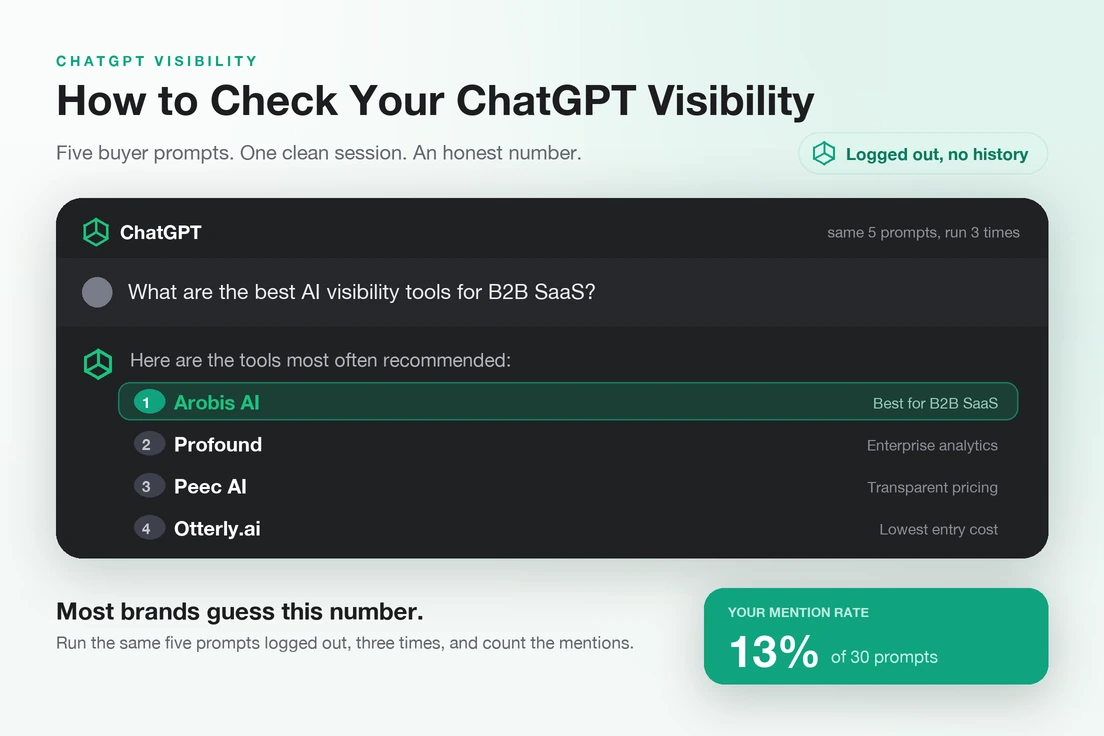
On September 26, 2026 we asked Google AI Mode five B2B buyer prompts. We ran it from the US, logged out, with personalization off, and ran each prompt once. Here's which tools it named:
- "What are the best AI visibility tools for a B2B SaaS company": Profound, AthenaHQ, Otterly, Peec AI, Semrush, Nightwatch.
- "Which tool tracks my brand mentions in ChatGPT, Perplexity and Gemini": Profound, Peec AI, Scrunch, Otterly, Semrush, Ahrefs.
- "What is the cheapest AI visibility tracker worth using": Otterly, Rankscale, RadarKit.
- "What is the best alternative to the Semrush AI Visibility Toolkit": RadarKit, Profound, Otterly, SE Ranking, plus Semrush itself.
- "Which AI visibility platforms track Microsoft Copilot and Claude": AthenaHQ, Frase.
The tally: Otterly was named in 4 of 5 answers, Profound in 3, and Peec AI, AthenaHQ, RadarKit and Semrush in 2 each. Scrunch, Ahrefs, Nightwatch, Rankscale, SE Ranking and Frase appeared once. Arobis AI was named in 0 of 5, which is fair, since we don't sell a tracker.
Treat this as a snapshot, not a ranking. AI answers change from run to run. Research published by SparkToro and Gumshoe in January 2026 found there's less than a 1 in 100 chance of getting the same brand list twice for the same prompt. That's exactly why the tools below exist: one check tells you very little, and repeated checks across engines tell you a lot.
Two takeaways for SaaS marketers. First, Otterly and Profound have strong AI-answer presence of their own, which says something about how well they've built their own citations. Second, the Copilot and Claude prompt surfaced very few names, which matches what we saw on pricing pages: a lot of entry plans don't cover those two engines at all.
The 17 best AI visibility tools, ranked
1. Profound
Profound is the name that comes up most in enterprise conversations, and AI Mode named it in 3 of our 5 prompts. It's a dedicated AI visibility platform with deep reporting on prompts, citations and competitor share of voice. Its pricing page lists up to nine engines on Enterprise: ChatGPT, Perplexity, Google AI Mode, Gemini, Microsoft Copilot, DeepSeek, Claude, Google AI Overviews and Exa Search.
- Best for: enterprise SaaS brands with a budget for a dedicated platform and a team to act on the data.
- Pricing: free 7-day trial, then custom Enterprise pricing only. Several older reviews still quote $99 or $499 starter plans; those aren't on offer now.
- Engines: nine, per Profound's own guide.
- Watch out for: no published self-serve price, so budget for a sales cycle. We break down what it costs in practice in our Profound pricing guide.
2. ZeroRank AI
Best for: AI visibility tracking and optimization workflows
ZeroRank AI helps SaaS companies monitor and improve how they appear across 17 AI platforms, including ChatGPT, Claude, Gemini, Perplexity, Copilot, Google AI Overviews, and AI Mode.
Key Features
- AI visibility tracking
- brand mention and citation monitoring
- competitor visibility analysis
- sentiment and average rank tracking
- prioritized on-page, off-page, content, and technical recommendations
- AI content creation and optimization
- automated workflows, MCP, and API access
Why It Matters for AI Search
Strong traditional authority still influences AI visibility.
ZeroRank connects AI search monitoring with execution, helping SaaS teams understand where they are missing from AI answers and what to do next. Plans start at $89/month, with unlimited prompts, AI models, countries, and users.
3. Ahrefs Brand Radar
Ahrefs Brand Radar leans on a large prompt database, so you can see brand mentions for prompts you didn't think to track yourself. AI Mode named Ahrefs when we asked which tool tracks ChatGPT, Perplexity and Gemini mentions.
- Best for: Ahrefs users and teams doing category research, not just tracking their own prompts.
- Pricing: from $199 per month per platform as a standalone, or $699 for all platforms.
- Engines: six platforms, plus Claude through custom prompts.
- Watch out for: the per-platform price adds up fast. Our Ahrefs Brand Radar alternatives list covers cheaper options.
4. Allmond
Best for: AI visibility tracking and brand monitoring
Allmond helps companies understand how AI search engines and assistants recommend their brand. As platforms like ChatGPT, Claude, Gemini, and Perplexity become major discovery channels, businesses use Allmond to monitor their presence, track competitor visibility, and analyze AI-generated recommendations.
SaaS companies can use it to:
- track AI search visibility
- monitor brand mentions across LLMs
- analyze competitor recommendations
- identify citation sources
- measure share of voice in AI search
Why It Matters
Ranking on Google is no longer the only way customers discover brands. Allmond gives marketers visibility into how AI platforms recommend, cite, and compare companies, helping them understand their position in the rapidly growing AI search ecosystem.
5. Goodie AI
Best for: Full-cycle AI visibility tracking and optimization
Goodie AI is a dedicated AEO platform built for SaaS and enterprise teams that need to track brand citations across AI-generated answers, identify the gaps driving competitors into AI responses instead of them, and act on that data without switching tools.
It tracks brand mentions, citations, and sentiment across 11 LLMs, including ChatGPT, Perplexity, Gemini, Copilot, Claude, and Google AI Overviews, using high-volume prompt testing that catches blind spots lower-frequency monitoring misses.
Key Features
- AI visibility tracking across 11 LLMs
- Optimization Hub with prioritized SEO, content, and PR recommendations
- Citation Intelligence identifying which external sources LLMs rely on
- Competitive benchmarking across identical prompt environments
- Revenue attribution connecting AI search activity to conversions beyond GA4
- Agentic Commerce Suite for product discoverability inside ChatGPT Shopping, Amazon Rufus, and Walmart Sparky
Why It Matters
Most AI visibility tools stop at reporting. Goodie AI connects monitoring data to a specific action layer, so SaaS teams know not just where they stand but what to fix first. Plans start at $399/month with a 7-day free trial.
6. Peec AI
Peec AI appears on more "best of" lists than any other tool we counted, and AI Mode named it twice. It's known for a clean interface and straightforward prompt tracking, with country-level tracking for teams selling in several markets.
- Best for: growth-stage SaaS teams that want a focused tracker without enterprise overhead.
- Pricing: $95, $245 and $495 per month, or $80, $205 and $420 per month billed annually.
- Engines: check the vendor site for which engines each plan includes; we couldn't confirm the entry-plan list.
- Watch out for: it's a monitoring tool first, so the fixing is on you. Compare options in our Peec AI alternatives roundup.
7. AthenaHQ
AthenaHQ was one of only two tools AI Mode named when we asked which platforms track both Copilot and Claude. It covers 11 models, which is broad, and it's one of the few in this group with a free plan.
- Best for: teams that want wide engine coverage and a free way to start.
- Pricing: free Essential plan; Starter is $295 per month, or $245 per month billed annually.
- Engines: 11 models.
- Watch out for: the jump from free to $295 is steep for a small team. See our AthenaHQ alternatives if that's a stretch.
8. Scrunch
Scrunch is a dedicated AI visibility platform with solid Copilot coverage at its entry tier. AI Mode named it when we asked about tracking ChatGPT, Perplexity and Gemini mentions.
- Best for: SaaS teams whose buyers live in Microsoft 365 and use Copilot.
- Pricing: Core plan at $250 per month for 125 prompts.
- Engines: four, including Copilot.
- Watch out for: 125 prompts goes fast once you track several product lines. Our Scrunch AI review covers the trade-offs.
9. Evertune
Evertune positions itself as an end-to-end platform: tracking, AI-optimized content and AI advertising in one contract. It publishes its pricing, which is rare at this level.
- Best for: larger brands that want monitoring, content and paid AI placements from one vendor.
- Pricing: Pro at $800 per month, which includes 100,000 tracked prompts across 11 AI models and 25 AI-optimized articles a month. Enterprise is custom. See Evertune's pricing page.
- Engines: 11 AI models; the pricing page doesn't name them.
- Watch out for: no free trial is listed, and $800 is a lot for an early-stage SaaS company.
10. Semrush AI Visibility Toolkit
Semrush was named in 2 of our 5 AI Mode prompts, and it's the default choice for teams already on Semrush. It sits next to your keyword and backlink data, which makes it easy to connect AI visibility to classic SEO work.
- Best for: existing Semrush customers who want AI data in the same place.
- Pricing: $99 per month per domain, billed annually, with 25 prompts.
- Engines: ChatGPT, AI Overviews, AI Mode, Perplexity and Gemini on self-serve. Copilot, Claude, Grok and DeepSeek are Enterprise only.
- Watch out for: 25 prompts is thin for a SaaS company with several use cases. We compare it head to head in Ahrefs vs Semrush for AI visibility.
11. SE Visible (by SE Ranking)
SE Ranking offers AI tracking two ways: SE Visible as a standalone AI visibility product, or AI prompts bundled into the main SEO suite. AI Mode named SE Ranking as a Semrush alternative.
- Best for: mid-market teams that want a lot of prompts for the money.
- Pricing: SE Visible Basic is $99 per month for 200 prompts, Core is $189 for 450, and Plus is $355 for 1,000. Annual billing saves 20%. SE Ranking's Core SEO plan is $129 and includes 100 AI prompts. Details on the SE Visible site.
- Engines: ChatGPT, Gemini, AI Mode, Perplexity and AI Overviews.
- Watch out for: no Claude or Copilot, which matters if your buyers are enterprise Microsoft shops.
12. HubSpot AEO
HubSpot added AI visibility tracking under the name AEO. If HubSpot is already your CRM and marketing hub, it keeps AI visibility next to your pipeline data.
- Best for: SaaS teams already running on HubSpot who want a low-cost first look.
- Pricing: $50 per month, or $45 per month billed annually, for 25 prompts.
- Engines: check the vendor site for the current list.
- Watch out for: 25 prompts is a starter allowance. Read our HubSpot AEO review before you commit.
13. Nightwatch
Nightwatch started as a rank tracker and now tracks AI answers alongside classic rankings. AI Mode named it for the B2B SaaS prompt, which is a good sign for its own visibility.
- Best for: SEO teams that want Google rankings and AI answers in one report.
- Pricing: Starter is EUR 99 per month, or EUR 79 per month billed annually, for 50 prompts. Professional is EUR 159 for 150 prompts, and Agency is EUR 399 for 500.
- Engines: ChatGPT, Claude, Gemini, Perplexity, AI Mode and AI Overviews.
- Watch out for: prices are in euros, and Copilot isn't on the list. There's a 14-day free trial.
14. Searchable
Searchable is a dedicated AI visibility platform that ties visibility to content work, with three engines included and more available as add-ons.
- Best for: mid-market teams tracking ChatGPT, AI Overviews and Perplexity who want content recommendations alongside the data.
- Pricing: Pro is $125 per month for 100 prompts, and Scale is $400 per month for 500.
- Engines: three included: ChatGPT, AI Overviews and Perplexity. Gemini, AI Mode, Claude, Grok and DeepSeek are paid add-ons, and Copilot is a custom add-on on enterprise plans.
- Watch out for: there's a 14-day free trial, so test your real prompts before you pay. We compare it with other platforms in Searchable vs Profound vs AthenaHQ.
15. LLMrefs
LLMrefs has the lowest cost per tracked prompt of any capped plan we checked. One plan covers eight engines and 500 prompts, plus the fan-out queries AI engines run behind the scenes.
- Best for: lean SaaS teams that want broad coverage on a small budget.
- Pricing: one All in One plan at $79 per month for 500 prompts, with a 7-day free trial. See LLMrefs pricing.
- Engines: ChatGPT, AI Overviews, AI Mode, Gemini, Perplexity, Claude, Copilot and Meta AI.
- Watch out for: reports are weekly, so it's not the tool for daily swings.
16. Otterly.AI
Otterly was the most-named tool in our AI Mode test, showing up in 4 of 5 answers, including the one asking for the cheapest tracker worth using. Its $29 entry plan is one of the cheapest ways to start tracking.
- Best for: small SaaS teams and first-time buyers.
- Pricing: $29, $189 and $489 per month.
- Engines: four, including Copilot.
- Watch out for: the jump from $29 to $189 is big, so check how many prompts you need first. Our Otterly.AI alternatives post has options in between.
17. Rankscale
Rankscale uses credits instead of fixed prompt counts, and it covers a long list of models, including Mistral. AI Mode named it for the cheapest-tracker prompt.
- Best for: teams that want to pay for exactly the checks they run.
- Pricing: Essentials from $20 per month with no credits included, Pro at $99 for 1,200 credits, Growth at $385 and Enterprise at $780. Pro has a 7-day free trial. See Rankscale pricing.
- Engines: ChatGPT, Perplexity, Gemini, DeepSeek, Mistral, Claude, Grok, Copilot and more.
- Watch out for: a query costs about 0.25 credits per engine, so the math takes a minute. The $20 plan needs top-ups to do anything.
What does a tracked prompt actually cost?
Headline prices hide how much tracking you get. Here's the entry plan divided by its prompt allowance, only for tools where we verified both numbers. Evertune counts prompts across 11 models, ZeroRank has no prompt cap, and Allmond and Rankscale are priced by scans or credits, so they don't fit this comparison.
| Tool | Entry plan | Price | Prompts | Per prompt |
|---|---|---|---|---|
| LLMrefs | All in One | $79/mo | 500 | $0.16 |
| SE Visible | Basic | $99/mo | 200 | $0.50 |
| Searchable | Pro | $125/mo | 100 | $1.25 |
| SE Ranking | Core (SEO suite) | $129/mo | 100 | $1.29 |
| Nightwatch | Starter | EUR 99/mo | 50 | EUR 1.98 |
| HubSpot AEO | Entry | $50/mo | 25 | $2.00 |
| Scrunch | Core | $250/mo | 125 | $2.00 |
| Goodie AI | Core | $399/mo | 120 | $3.33 |
| Semrush | Toolkit (annual) | $99/mo | 25 | $3.96 |
Per-prompt cost isn't everything. A prompt tracked daily across eight engines is worth more than one tracked weekly across three. But it's a quick way to spot plans that will run out of room once you add competitors and use cases.
How do you choose the right AI visibility tool?
Which engines do your buyers actually use?
B2B buyers don't all use ChatGPT. Enterprise teams often work inside Microsoft 365 with Copilot, and technical buyers lean on Claude and Perplexity. Many entry plans skip Copilot and Claude entirely, including Semrush's self-serve toolkit and SE Visible. If those engines matter, look at LLMrefs, AthenaHQ, Rankscale or Scrunch. Our guide to Copilot rank trackers goes deeper.
How many prompts do you need?
A practical starting set for a SaaS company is your core category prompts, your main use cases, "best X for Y" prompts for your top segments, and "alternative to" prompts for your biggest competitors. That's often 50 to 150 prompts. Plans with 25 prompts are fine for a test, not for ongoing tracking.
Do you want to monitor, or to fix?
Every tool here tells you where you're missing. Only a few help you do something about it, and none of them do it for you. Be honest about who will act on the data. If the answer is "nobody has time", a cheaper tracker plus outside help often beats an expensive platform nobody logs into.
What's your budget?
- Under $100 a month: Otterly.AI, Allmond, LLMrefs, HubSpot AEO, ZeroRank, SE Visible Basic or Nightwatch Starter.
- $100 to $300 a month: Searchable, Peec AI, Scrunch, Ahrefs Brand Radar or AthenaHQ Starter.
- Enterprise: Goodie AI, Profound, Evertune, or Semrush Enterprise.
Tracker or agency? When B2B SaaS needs done-for-you help
A tracker answers one question well: are AI engines recommending us? It doesn't answer the harder one: what do we change so they start? That means earning mentions on the sites AI engines cite, getting into the comparison pages and review platforms your category relies on, restructuring your own pages so they're easy to quote, and repeating that every month as answers shift.
That's the work Arobis AI does. We're an AI Search Demand Generation agency for B2B SaaS, not a tracking tool, so we're not on the list above. We'll be upfront: in our own AI Mode test, Arobis AI was named in 0 of 5 answers, because those prompts asked for software and we don't sell software.
Here's how we'd frame the choice:
- Pick a tracker if: you have a content or SEO team with capacity to act on the data every week.
- Pick an agency if: you already know you're missing from AI answers and nobody in-house owns fixing it.
- Use both if: you want independent tracking to hold your agency accountable. That's a healthy setup.
If you're a SaaS company weighing this, see how our AI visibility program for SaaS works and what it costs on our pricing page. We also explain the difference in more depth in AI visibility monitoring vs demand generation. For the bigger picture on where SaaS brands stand today, read our State of AI Search Visibility report.
Frequently asked questions
What is the best AI visibility tool in 2026?
There's no single best tool. Profound, Goodie AI and Evertune lead for enterprise depth. Semrush, Ahrefs Brand Radar and SE Visible make sense if you already pay for those SEO suites. ZeroRank, Peec AI and Searchable suit mid-market SaaS teams, while Otterly.AI, Allmond and LLMrefs are the strongest budget picks. In our Google AI Mode test, Otterly and Profound were named most often.
What are AI visibility tools?
AI visibility tools track whether AI engines mention your brand when people ask for recommendations. They run your chosen prompts through engines like ChatGPT, Perplexity, Gemini, Claude, Copilot and Google's AI Overviews and AI Mode on a schedule. They then report mentions, position in the answer, competitors named, sentiment and the sources the engine cited.
How are AI visibility tools different from SEO tools?
SEO tools track where your pages rank in a list of links. AI visibility tools track whether an AI-written answer names your brand, and which sources it relied on. A page can rank well on Google and still be left out of ChatGPT's answer. Content tools like Clearscope and Surfer, and Google Search Console, don't show you the AI answers themselves.
How much do AI visibility tools cost?
Entry prices range from $29 per month for Otterly.AI and Allmond to $800 per month for Evertune Pro, with Profound on custom enterprise pricing. Most mid-market plans sit between $79 and $250 a month. Prompt allowances vary widely, from 25 prompts on Semrush and HubSpot AEO to 500 on LLMrefs and unlimited on ZeroRank.
Is there a free AI visibility tool?
Yes. AthenaHQ has a free Essential plan, and ZeroRank offers a free report before you add a card. Allmond, LLMrefs, Rankscale, Profound, Goodie AI, SE Visible, Nightwatch and Searchable all offer free trials. For a quick one-off check, try our free AI visibility checker to see where you stand today.
Which AI engines should a B2B SaaS company track?
Track ChatGPT, Google AI Overviews and AI Mode at a minimum, since they reach the most buyers. Add Perplexity for research-heavy buyers, Copilot if you sell to enterprises on Microsoft 365, and Claude for technical and developer audiences. Check the entry plan's engine list, not the enterprise one, because many tools reserve Copilot and Claude for top tiers.
How many prompts should I track?
Most SaaS companies need 50 to 150 prompts to get a reliable picture. Cover your core category terms, main use cases, "best tool for" prompts by segment, and "alternative to" prompts for your top competitors. Because AI answers vary from run to run, tracking more prompts more often gives you a steadier trend than checking a handful once.
Do I need a tool or an agency to improve AI visibility?
A tool tells you where you're missing from AI answers. It doesn't earn you the citations, reviews and comparison-page mentions that change those answers. If your team has time to act on the data every week, a tool is enough. If nobody owns the fixing, a done-for-you agency like Arobis AI is often the faster route.