
Ahrefs Brand Radar is a genuinely good AI-visibility tracker but its full AI Visibility Index costs $199/mo on top of whatever you pay for SEO tooling (the core Ahrefs plans include only 5 to 20 tracked AI prompts), and it only measures whether AI engines mention you. If the price, the suite lock-in, or the measure-only ceiling has you shopping around, this is the shortlist we would hand a B2B SaaS marketing team today.
We track these platforms as part of our day-to-day AI Search Demand Generation work, so this is not a scraped list, it is opinionated, and a few of these are better buys than Brand Radar for most teams.
Our top picks at a glance
- If you want to be recommended, not just measured: Arobis AI.
- Solid all-rounder: Nightwatch (from €99/mo, €79 billed yearly).
- Cheapest way to start: Otterly.ai (from $29/mo, with four engines included: ChatGPT, Google AI Overviews, Perplexity and Copilot). HubSpot AEO at $50/mo tracks three engines and skips Google AI Overviews, which is why we wrote a full review of HubSpot AEO before recommending it to anyone.
- Best enterprise analytics: Profound.
- Best competitive intelligence: AthenaHQ.
- Best if you already pay for an SEO suite: Semrush AI Visibility Toolkit.
How we evaluated these Brand Radar alternatives
No affiliate rankings here. We scored each tool on five things that actually matter when you are replacing Brand Radar:
- Engine coverage - does it track ChatGPT, Gemini, Perplexity, Copilot and Google AI Overviews (and Claude)?
- What you get beyond a number - citations, sentiment, competitor share-of-voice, recommendations.
- Price vs. Brand Radar - the whole reason most people leave.
- Who it is genuinely for - and, just as important, who should skip it.
- Does it move the number or just report it? - the distinction almost every buyer misses.
Figures below are public pricing and G2/Trustpilot data as of September 2026; always confirm current pricing on the vendor site, because this category changes monthly.
What is Ahrefs Brand Radar (and why teams leave it)?
Brand Radar is Ahrefs’ AI-visibility product. It tracks how often your brand is mentioned across AI answers, ChatGPT, Google AI Overviews, Google AI Mode, Perplexity, Gemini and Microsoft Copilot and, usefully, shows the source URL an engine pulled your mention from. We put it head-to-head with Semrush in our Ahrefs Brand Radar vs Semrush AI Visibility Toolkit breakdown.
Three reasons teams start looking elsewhere:
- The real cost. Brand Radar AI is sold standalone from $199/mo, with no base Ahrefs plan required. Custom prompt packages are priced separately at $50/mo Basic, $100/mo Growth and $250/mo Scale. Brand Radar is also bundled into the core Ahrefs plans (Lite $129, Standard $249, Advanced $449), but those include only 5, 10 and 20 tracked AI prompts.
- Suite lock-in. The bundled route is an Ahrefs SEO plan from $129/mo, which caps tracked AI prompts at 5 to 20. The standalone AI index starts at $199/mo and prompt-only packages at $50/mo. If you do not need the rest of the suite, price both routes before you buy.
- It measures; it doesn’t move. Like every tracker on this list, Brand Radar tells you that you are missing from AI answers. It does not do the work that gets you cited.
Watch out: Ahrefs has changed Brand Radar packaging more than once in 2026. It is now sold standalone with no base plan, but the AI index is still $199 a month per platform or $699 for all platforms, so model the full cost before you commit.
| What you pay for | Cost |
|---|---|
| Brand Radar AI, sold standalone (no Ahrefs plan needed) | From $199/mo |
| Custom prompt package, Basic (about 80 prompts daily on 1 platform) | $50/mo |
| Custom prompt package, Growth (about 100 prompts daily on 2 platforms) | $100/mo |
| Custom prompt package, Scale (high volume, lowest per-check rate) | $250/mo |
| Core Ahrefs plans, which bundle Brand Radar but cap tracked AI prompts at 5, 10 and 20 | Lite $129, Standard $249, Advanced $449 |
| Realistic starting point for real AI visibility tracking | $199 to $449/mo |
Verified on ahrefs.com, October 2026. Overage on prompt packages is billed monthly at $0.020, $0.015 and $0.010 per check.
The 13 best Ahrefs Brand Radar alternatives in 2026
| Tool | Best for | Starts at | Type |
|---|---|---|---|
| Arobis AI | Being recommended, not just measured | Custom | Agency |
| Otterly.ai | Cheapest way to start | $29/mo | Tracker |
| Peec AI | EU and privacy-conscious teams | $95/mo | Tracker |
| Nightwatch | Rank tracking with AI prompts bundled in | €99/mo, €79 billed yearly | Tracker |
| SE Ranking | Affordable SEO suite with AI tracking | $129/mo, 100 AI prompts included | SEO suite |
| Semrush AI Visibility | All-in-one SEO and AI search | $99/mo billed annually, $199/mo with SEO | SEO suite |
| Scrunch AI | The agentic web | $250/mo | Tracker |
| AthenaHQ | Competitive intelligence | Free tier, then $295/mo | Tracker |
| Profound | Enterprise analytics | Enterprise | Analytics |
| Searchable | Content-led workflows | $125/mo | Tracker |
| ZeroRank | Analytics-to-execution | $89/mo, $76 billed yearly | Content ops |
| AirOps | AI content ops at scale | Usage-based | Content ops |
| Rank Prompt | Free quick check | Free | Free checker |
Entry prices taken from each vendor's own pricing page, October 2026. Confirm current tiers before you buy, since this category reprices often.
1. Arobis AI: best if you want to be recommended, not just measured
Every other tool here is a dashboard. Arobis AI is the outlier: an AI Search Demand Generation agency for B2B SaaS that changes the number a tracker reports. If being named by the engines is the goal, start with our GEO agency built for B2B SaaS, and for question-level answers its AEO agency runs that half. There is also a free llms.txt generator for the quickest possible first move. AI engines recommend brands based on third-party reviews, comparison content, community threads and citation-ready pages — Arobis AI runs the program that earns those citations. You still get measurement (a free AI visibility checker and a full AI visibility audit), but the deliverable is the outcome, not the chart — the honest gap between measuring AI visibility and improving it.
- Best for: SaaS teams tired of watching a flat dashboard.
- Skip if: you only want a self-serve tracker and will do the content work yourself.
- Pricing: done-for-you engagements — see how Arobis AI pricing works.
2. Nightwatch: emerging player
Nightwatch is the pragmatic pick for most teams leaving Brand Radar. From about €99/mo it covers the full stack: LLM monitoring, prompt research, citation-level sentiment, and — crucially — traditional Google rank tracking in the same tool, so you are not paying for two products. For a mid-market SaaS it is the best coverage-per-dollar here.
- Best for: teams that want AI plus classic SEO tracking in one affordable tool.
- Skip if: you need enterprise-grade prompt analytics.
- Pricing: from €99/mo, or €79/mo billed yearly.
Expert tip: if your only reason for leaving Brand Radar is cost, Nightwatch or Otterly usually ends the search — test them before you look at anything pricier.
3. Otterly.ai: cheapest credible entry point
Otterly.ai has the lowest published entry price in the category: about $29/mo on its Lite plan (15 prompts). It tracks brand visibility across ChatGPT, Google AI Overviews, Perplexity and Copilot, with competitor tracking, citation monitoring and Looker Studio export on higher tiers. It is the sensible first step before committing to anything heavier.
- Best for: solo founders and lean teams testing the waters.
- Skip if: you need many tracked prompts — the entry tier is deliberately small.
- Pricing: from $29/mo.
4. Peec AI: best European / privacy-conscious option
Berlin-based Peec AI focuses on brand representation across the three AI models you pick, such as ChatGPT, Gemini and Google AI Overviews, with clean visibility and sentiment monitoring. From $95/mo, it is a straightforward self-serve monitor without enterprise bloat. See how it stacks up against us in Peec AI vs Arobis AI.
- Best for: EU teams that want an EU-hosted vendor.
- Skip if: you need deep enterprise analytics.
- Pricing: from $95/mo.
5. Profound: best enterprise AI analytics
Profound is the enterprise heavyweight: deep prompt, citation and agent analytics, and the widest engine coverage at the top tier. It bets on research-grade measurement of how AI cites brands, and it is the pick when AI search is a funded revenue channel. The catch is complexity and price. More in our Profound alternatives guide.
- Best for: enterprise teams needing the deepest data.
- Skip if: you are a startup on a budget.
- Pricing: a free 7-day trial, then custom Enterprise quotes (often $2,000–$5,000+/mo effective).
6. AthenaHQ: best competitive intelligence
AthenaHQ leans into competitor insight: AI blindspot detection, an action center, and clear reporting on where rivals out-rank you and which fixes move the needle most. Clean and focused for teams that live and die by share-of-voice. Compare it in AthenaHQ alternatives.
- Best for: teams obsessed with competitive AI share-of-voice.
- Skip if: you want a cheap solo tracker.
- Pricing: from around $295/mo.
7. Scrunch AI: best for the agentic web
Scrunch bets on the agentic web — preparing your site for AI agents that act, not just answer — with persona-level filtering and SOC 2 compliance. It is easy to adopt, carries a strong 4.6 G2 rating, and now sits inside a larger stack after being acquired by Sitecore in 2026. See our Scrunch AI review and Scrunch AI alternatives.
- Best for: teams prioritizing agent-facing content delivery.
- Skip if: you want a simple share-of-voice number.
- Pricing: $250/mo on the Core plan, with Enterprise custom-priced.
8. Semrush AI Visibility Toolkit: best all-in-one SEO + AI
If you already live in Semrush, its AI Visibility Toolkit is the natural pick. It tracks ChatGPT, Google AI Overviews, AI Mode, Gemini and Perplexity (Claude is Enterprise AIO only), and bundles into Semrush One so you are not paying twice.
- Best for: teams that want AI tracking beside their existing SEO workflow.
- Skip if: you do not need the wider Semrush suite.
- Pricing: Semrush's SEO + AI Search plans start at $199/mo, or $165.17 billed annually, for 50 prompts tracked daily on one domain. AI Visibility on its own is $99/mo per domain billed annually, for 25 prompts.
9. Searchable: best for content-led workflows
Searchable is built for content teams: it ties AI visibility to the pages and topics driving it, so the output is an editorial to-do list rather than a raw dashboard. It is the natural fit if your growth motion is content. We compare approaches in Searchable vs Arobis AI.
- Best for: content-led SaaS marketing teams.
- Skip if: you want hard enterprise analytics.
- Pricing: Professional $125/mo, Scale $400/mo, Enterprise from $999/mo, with a 14-day free trial on Professional.
10. ZeroRank: best analytics-to-execution
ZeroRank is designed for teams that want to move from analytics to action — combining visibility monitoring with optimization recommendations, content workflows and automation. It is a good middle ground between a pure tracker and a done-for-you service.
- Best for: in-house teams that want guided execution.
- Skip if: you only need monitoring.
- Pricing: Starter $89/mo, or $76/mo billed yearly; Pro $199/mo; Enterprise custom.
11. SE Ranking (SE Visible): best established SEO suite add-on
SE Ranking added AI-search tracking (SE Visible) to its long-standing, affordable SEO suite. If you want a mature all-round SEO platform that also watches AI answers — without Ahrefs-level pricing — it is a solid, lower-cost home base.
- Best for: small agencies and SMBs wanting one affordable SEO + AI tool.
- Skip if: you need best-in-class AI-specific depth.
- Pricing: SE Ranking Core from $129/mo with 100 AI prompts tracked daily; standalone SE Visible from $99/mo for 200 prompts on five engines.
12. AirOps: best for AI content operations at scale
AirOps is less a tracker and more an AI content-operations platform: it helps teams build and ship the citation-ready content that earns AI mentions, with visibility signals feeding the workflow. Useful if your bottleneck is producing enough of the right content.
- Best for: teams scaling content production for AI search.
- Skip if: you just want a monitoring dashboard.
- Pricing: usage-based / custom.
13. Rank Prompt: best free quick check
Rank Prompt is a free, no-signup checker that tells you whether ChatGPT, Perplexity and Gemini name your brand for buyer questions — handy for a zero-cost baseline before you pay for anything. For more no-cost options, see our roundup of the best free AI visibility tools.
- Best for: a fast, free gut-check.
- Skip if: you need ongoing tracking and history on the free checker alone.
- Pricing: free checker; paid tracking from $49/mo, or $39/mo billed annually.
Fun fact: Ahrefs’ own CMO has publicly argued Brand Radar beats pure-play trackers — which tells you how seriously the incumbents now take this category. The tools are converging; the real differentiator is whether anyone acts on the data.
Price snapshot: cheapest to priciest
- Free: Rank Prompt and the Arobis AI visibility checker.
- Under $100/mo: Otterly.ai ($29), ZeroRank ($89), Peec AI ($95).
- $100–$500/mo: Nightwatch (€99), Searchable ($125), Scrunch AI ($250), AthenaHQ ($295).
- Premium: Ahrefs Brand Radar AI (from $199/mo standalone).
- Enterprise: Profound ($2,000–$5,000+), plus custom-priced AirOps.
How to choose (by use case)
- Cheapest start: Otterly.ai or Nightwatch.
- Enterprise depth: Profound.
- Competitor intel: AthenaHQ.
- Agent-first web: Scrunch AI.
- Already on an SEO suite: Semrush AI Visibility Toolkit or SE Ranking.
- Content is your growth motion: Searchable or AirOps — ideally paired with a GEO/AEO partner.
- Copilot matters most: confirm coverage, then read how to rank in Microsoft Copilot.
The trap almost every Brand Radar alternative falls into
Here is the thing no vendor leads with: almost every tool on this list only measures your AI visibility. A cheaper, cleaner dashboard is still a dashboard. AI engines decide who to recommend based on what the wider web says about you — reviews, roundups, comparison pages, Reddit threads and structured, citation-ready content on your own site. That is why teams stare at a flat number for months. If you want the mechanics, start with answer engine optimization and generative engine optimization, then how to build AI recommendation authority and the five signals AI engines use to recommend brands. For the market data, see the state of AI search visibility and which domains most influence AI rankings.
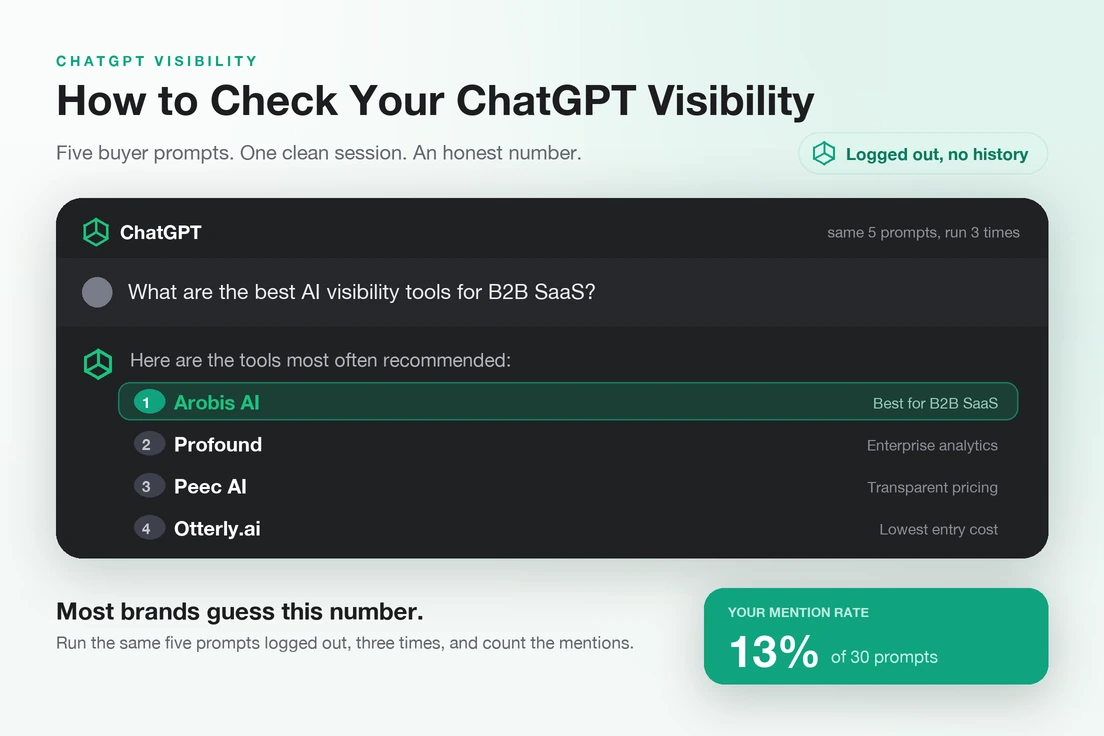
Run the test yourself (5 minutes, no tools)
Before you pay for any Brand Radar alternative, do this reality check — it is exactly what these tools automate.
- Step 1 — Pick 5 buyer prompts your ideal customer would actually ask an AI engine.
- Step 2 — Ask three engines: ChatGPT, Google AI Mode and Perplexity, in a logged-out session.
- Step 3 — Score three things: Are you named? Are competitors named instead? Which sources did the engine cite?
- Step 4 — Tally how many of the 15 answers name your brand. Under 5 out of 15 is a real gap.
- Step 5 — Read the citations. Wherever a competitor won, that cited source is your to-do list.
Want to skip the manual work? Here is how to check whether AI recommends your brand in more depth.
Our verdict
If you are leaving Brand Radar purely on cost, Nightwatch or Otterly.ai will almost always end the search. If you are enterprise, Profound. If you obsess over competitors, AthenaHQ. But if you are honest about the goal — not a prettier chart, but actually being the brand AI recommends — then the tool is only step one. Pairing any tracker with real demand-generation work is what moves the number, and that is the case for Arobis AI. Measure with whatever fits your budget; invest in getting cited.
Frequently asked questions
What is the best Ahrefs Brand Radar alternative?
For most teams leaving on cost, Otterly.ai (from $29/mo) or Peec AI (from $95/mo) are the best value. For enterprise analytics choose Profound; for competitive intelligence, AthenaHQ; for an all-in-one SEO suite, Semrush AI Visibility Toolkit. If your real goal is to be recommended by AI rather than just measured, Arobis AI’ AI Search Demand Generation is the alternative that changes the outcome.
Is there a cheaper alternative to Ahrefs Brand Radar?
Yes — several. Brand Radar AI starts at $199/mo standalone, whereas Otterly.ai starts at $29/mo, Nightwatch at €99/mo, and Peec AI at $95/mo. For a zero-cost baseline, use a free checker like Rank Prompt or the Arobis AI visibility checker.
Why is Ahrefs Brand Radar so expensive?
Brand Radar AI is sold standalone from $199/mo, with no base Ahrefs plan required. If you only want to track your own prompts, custom prompt packages start at $50/mo. Brand Radar is also included in the core Ahrefs plans (Lite $129, Standard $249, Advanced $449), though those cap tracked AI prompts at 5, 10 and 20.
Do these tools improve my AI visibility or just track it?
Almost all of them only track it. AI engines recommend brands based on third-party reviews, comparison content, community mentions and citation-ready pages — improving that is a demand-generation and AEO/GEO program, not a monitoring task. It is the single most important thing to understand before you buy.
Which alternative is best for a small SaaS?
Start cheap with Otterly.ai or Nightwatch to establish a baseline, then invest the money you save into the content and third-party presence that actually earns AI recommendations.
Which tools track Microsoft Copilot?
Brand Radar, Otterly.ai and several others track Copilot alongside ChatGPT, Perplexity and Google AI Overviews. Coverage changes often, so confirm it on each vendor’s site before you buy.
How do these compare to dedicated AI-visibility platforms?
See our side-by-side of Searchable, Profound and AthenaHQ, the wider list of the best AI visibility tools, and our AI visibility metrics guide for how to read the numbers.
How did you choose these 13?
We weighted engine coverage, what you get beyond a raw number, price versus Brand Radar, fit for B2B SaaS, and whether a tool helps you act on the data — not just watch it. Pricing is current as of October 1, 2026, and ratings as of September 28, 2026.
Related reading
Go deeper: how AI search engines actually work and how ChatGPT, Claude and Gemini decide which brands to name. If you would rather earn AI recommendations than watch a dashboard, that is exactly what Arobis AI does.