
TL;DR
Profound is the deepest answer engine analytics platform in the category. It is also priced for teams with an analyst. Most people searching for alternatives are really asking one of two questions: is there something cheaper that does enough, or is there something that acts on the data rather than only reporting it.
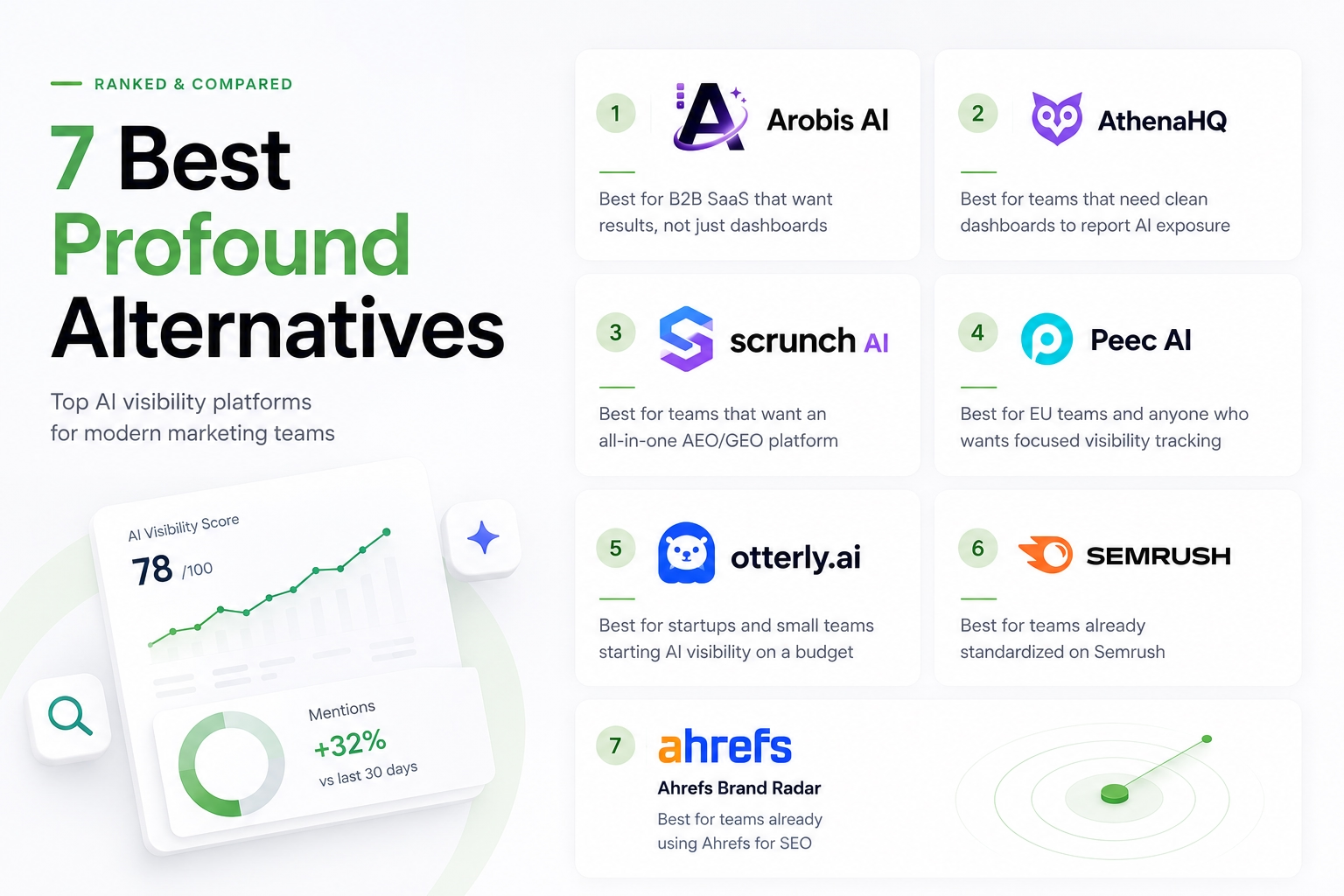
- Cheapest credible alternative: Rankscale from $20 a month.
- Best value for a small team: Otterly.ai at $29 a month, with four engines on every paid tier.
- Best serious self-serve replacement: Peec AI at $80 a month.
- Closest like-for-like on depth: AthenaHQ at $295 a month.
- If you already pay for an SEO suite: Ahrefs Brand Radar, now sold standalone from $199 a month.
- If measuring is not the problem: a programme rather than a platform. That is where Arobis AI sits, and it is not a dashboard.
Every price on this page was read off the vendor's own pricing page on 8 September 2026. This category reprices constantly, and four of the numbers in the previous version of this article were already out of date.
Why people look for Profound alternatives
Profound is a good product. The reasons people shop around are rarely about quality.
Price relative to team size
Profound's Starter tier is around $99 a month billed annually and Growth is $399, with custom Enterprise pricing above that. That is entirely reasonable for the depth on offer. It is a lot for a three person marketing team that wants to know whether ChatGPT mentions them.
The honest framing is not "Profound is expensive". It is that Profound is priced for a team that will extract the value. If nobody is going to open the dashboard weekly, the cheaper tools are not a compromise, they are the correct purchase. Our full breakdown of the tiers is in the Profound pricing guide.
Depth you will not use
Profound's analytical depth is its selling point and its trap. Conversation level analysis, agent analytics and citation forensics are genuinely powerful, and they assume a person whose job is to interrogate them. Buying depth and then looking at a summary chart once a month is the most common way teams waste money in this category.
Measurement is not the bottleneck
This is the one nobody says out loud. A large share of teams shopping for AI visibility tools already know they are invisible. They do not need a more precise measurement of the same bad news. They need the sources, pages and entity work that changes the answer, and no dashboard on this page does that for you.
If that is your situation, the tool comparison below is the wrong shopping list. Skip to the section on programmes versus platforms.
How we evaluated these Profound alternatives
Four rules, applied to all twelve.
- Every price was read off the vendor's own pricing page on 8 September 2026, not copied from another roundup. Where a vendor does not publish a price, this page says so rather than inventing one.
- Entry price means the real entry price, including whether AI tracking is a paid add-on rather than an included feature. Two tools on this list bury it that way.
- Every tool gets a stated trade-off. A comparison where nothing has a downside is a sales page.
- Arobis AI is listed first and it is not a Profound competitor. It is a done-with-you programme, not software. It is on the list because it answers the second question people are actually asking, and it is labelled clearly so you can skip it if you want a dashboard.
If you want the broader category rather than the Profound-shaped slice of it, our roundup of the best AI visibility tools covers everything, and the best free AI visibility tools covers the zero budget end.
The 12 best Profound alternatives in 2026
Listed cheapest to most expensive after the first entry, because price is the reason most people are on this page. Every figure verified 8 September 2026.
1. Arobis AI, for teams where measuring is not the problem
Read this entry only if you have already concluded that you know the score and want it to change. If you want a dashboard, skip to Rankscale and work down the list.
Profound tells you what the engines say about your brand. Arobis AI is a done-with-you AI Search Demand Generation programme for B2B SaaS: an audit of why the engines name someone else, a strategy for the sources and pages that would change it, and the execution to make it happen.
Best for: SaaS teams that want to be recommended by AI, not just to measure whether they are.
Pros: pairs measurement with the work that changes the number, SaaS specific, and there is a free way to baseline first.
Cons: it is a programme with a monthly commitment, not a $29 login. If you genuinely just want a chart, one of the eleven tools below is a better and cheaper answer.
Pricing: published on the pricing page. You can baseline for free first with the AI visibility checker.
2. Rankscale, the cheapest credible entry
A lightweight GEO tool focused on prompt-based monitoring, citation tracking, competitor benchmarking and AI readiness audits, with the lowest entry price in the category.
Verified pricing: Essentials from $20 a month, Pro $99, Growth $385, Enterprise $780.
Best for: solo marketers and small teams that want prompt level tracking without a real budget conversation.
Trade-off: credit based limits on the lower tiers, and it is monitoring first. It will not tell you what to do about what it finds.
3. Otterly.ai, the best value for a small team
Launched in late 2024 and now widely used, Otterly is the most accessible monitor in the category and the cheapest way to get four engines including Microsoft Copilot on an entry plan.
Verified pricing: Lite $29 a month for 15 prompts, Standard $189, Premium $489, roughly 15 percent off annual.
Best for: startups and small teams starting AI visibility on a budget who still want real engine coverage.
Trade-off: 15 prompts on the entry plan is tight for a competitive category, and the feature depth is lighter than the mid-market tools. Alternatives in our Otterly.ai alternatives guide.
4. Writesonic GEO, tracking plus content in one place
Writesonic began as an AI writer and built out an AI Search Visibility platform, pairing tracking with an action centre that turns findings into content fixes.
Verified pricing: Starter $79 a month billed annually for 50 prompts, Basic $199, higher tiers above.
Correction worth noting: Writesonic is frequently described as tracking around ten AI engines. On its pricing page today the AI Search Visibility feature is listed as tracking ChatGPT, Gemini and Google AI Overviews. Three, not ten.
Best for: content teams that want visibility tracking and AI-optimised writing in the same subscription.
Trade-off: visibility is one module inside a wider writing suite, so it is less specialised than a dedicated tracker, and the engine list is narrower than the marketing implies.
5. LLMrefs, broad platform coverage on a flat price
A monitoring tool that tracks visibility and rankings across seven or more AI platforms, giving smaller teams an affordable way into AI search tracking.
Verified pricing: from $79 a month.
Best for: small teams that want breadth of platform coverage without a per-engine pricing puzzle.
Trade-off: monitoring first. It reports visibility and leaves the strategy entirely to you.
6. Peec AI, the best serious self-serve replacement
This is the closest thing to a like-for-like Profound substitute at a fraction of the price, and it is where I point mid-market teams that have someone owning this weekly. Berlin based, GDPR aligned, with strong prompt level analytics, sentiment and citation discovery.
Verified pricing: Starter $80 a month for 50 prompts, Pro $205 for 150, Advanced $420 for 350, Enterprise custom.
The catch every comparison misses: every self-serve tier lets you select only three models from ChatGPT, AI Mode, AI Overviews, Microsoft Copilot, Perplexity and Gemini. A fourth model is a paid add-on at $30 on Starter, $70 on Pro and $140 on Advanced. Claude is Enterprise only, which matters if you saw it listed elsewhere as a Peec engine.
Best for: EU teams and anyone who wants focused, fast, prompt-level tracking without enterprise overhead.
Trade-off: the three model cap is the real cost driver. Budget $110 rather than $80 if you want four engines. Head to head comparison in Peec AI vs Otterly.ai.
7. Ahrefs Brand Radar, and the correction most articles have not caught up with
If you read a roundup published before September 2026, you probably believe Brand Radar requires an expensive Ahrefs subscription plus per platform AI indexes. That was the widely repeated position, including in the previous version of this article, which quoted $199 per platform or $699 for all six on top of a $129 base plan.
It is no longer accurate. On 8 September 2026 Ahrefs lists Brand Radar AI from $199 a month, and its own FAQ states that Brand Radar is available as a standalone tool with a free Ahrefs account included. The $699 figure does not appear on the pricing page.
Verified pricing: from $199 a month, standalone, no base plan required.
Best for: research at scale, backed by one of the largest prompt databases in the category, and teams already living in Ahrefs.
Trade-off: it is a research instrument more than an operating dashboard. See the best Ahrefs Brand Radar alternatives if it is not the fit.
8. ZipTie.dev, usage based rather than tiered
ZipTie tracks where your brand is mentioned and cited across answer engines and bundles content optimisations to help close the gaps it finds. Its pricing model is genuinely different from everything else here.
Verified pricing: usage based. You build the plan from the prompts you monitor and the engines you run them on, with unlimited teammates and projects. There is no flat entry tier, and presets are starting configurations rather than plans. Add-ons include content generation contexts at $20 a month each and API access at $10 a month.
Correction worth noting: the widely repeated "from $69 a month" figure does not correspond to anything on the current pricing page.
Best for: teams with unusual shapes of demand, where a fixed tier would mean paying for prompts you do not run.
Trade-off: usage based pricing is harder to forecast and harder to get through procurement.
9. Scrunch AI, the all-in-one for regulated categories
Founded in 2023, Scrunch bundles monitoring, auditing, optimisation and an agent experience platform that serves AI-optimised content to AI agents, which makes it one of the most complete platforms in the category. Its misinformation detection is the reason regulated brands pick it.
Verified pricing: from $250 a month.
Best for: finance, healthcare and other categories where a wrong AI answer is a compliance problem rather than a marketing one.
Trade-off: newer entrant, and you are paying for risk capability you may not need. Full detail in our Scrunch AI review.
10. AthenaHQ, the closest like-for-like on depth
An AI visibility analytics platform built for structured, executive-ready reporting. Its citation engine and content optimisation agent are the features buyers name most often. Where Profound goes deeper on analysis, AthenaHQ tends to move faster to action.
Verified pricing: Starter $295 a month including 3,600 credits, Enterprise custom. There is a free tier with $25 of credit.
Best for: teams that need clean dashboards to report AI exposure to leadership, and that want the number tied to outcomes.
Trade-off: enterprise orientation shows in the workflow, and it is the most expensive self-serve tier on this list. Substitutes in our AthenaHQ alternatives guide.
11. SE Ranking, if you want classic SEO in the same login
An established, affordable SEO suite that now bundles an AI visibility tracker alongside classic rank tracking and site audits, so you can watch AI answers and traditional search from one dashboard.
Verified pricing: Core $129 a month monthly, or $103.20 billed annually. AI Search is a paid add-on, not an included feature: a further $89 a month monthly or $71.20 annually for 200 prompts. So realistic AI tracking here is around $218 a month.
Coverage warning: SE Ranking's AI Results Tracker covers AI Overviews, AI Mode, Perplexity and ChatGPT. Microsoft Copilot is not listed on its pricing page. If Copilot matters to you, this is the wrong purchase, and we go through the whole field in the best Microsoft Copilot rank trackers.
Best for: teams that want AI visibility sitting next to their everyday SEO tooling.
Trade-off: the add-on pricing means the real cost is roughly double the headline, and the AI side is newer and lighter than the specialists.
12. Semrush, if you are already standardised on it
Semrush layers AI share of voice, visibility trends and competitor benchmarking into an interface your team already knows, backed by a very large prompt database.
Verified pricing: plans run $139.95, $199, $299 and $549 a month. The $99 AI Visibility Toolkit entry point that older articles reference no longer appears on the pricing page.
Coverage warning: Microsoft Copilot is not mentioned on Semrush's public pricing page. If a representative tells you it is included on a custom plan, get the engine list in writing.
Best for: teams already standardised on Semrush who want one fewer vendor.
Trade-off: an add-on rather than a dedicated AI search product, with shallower query analysis than the specialists. Substitutes in the best Semrush AI Visibility Toolkit alternatives.
What these tools actually cost, side by side
Headline prices mislead in this category for two reasons. Some tools bury AI tracking behind a paid add-on, and some cap the number of engines you can watch. Here is the real arithmetic, verified 8 September 2026.
- Under $50 a month: Rankscale from $20, Otterly.ai at $29. Both real products, both genuinely limited on prompt volume.
- $79 to $110 a month: Writesonic at $79, LLMrefs at $79, Peec AI at $80. Budget $110 for Peec if you want four engines rather than three.
- Profound's own entry: around $99 a month billed annually. Worth noticing that Profound Starter is cheaper than several tools people shop as budget alternatives.
- $199 to $299 a month: Ahrefs Brand Radar from $199 standalone, SE Ranking at roughly $218 all in, Scrunch at $250, AthenaHQ at $295.
- $399 and up: Profound Growth at $399, Peec Advanced at $420, Otterly Premium at $489, Semrush top tiers to $549.
- Not a tier: ZipTie, which is usage based, and Arobis AI, which is a programme.
The uncomfortable observation is that Profound at $99 undercuts a lot of the tools marketed as cheaper alternatives to it. If your objection to Profound is price, check the Starter tier before you assume otherwise. If your objection is that you will not use the depth, that is a better reason and the cheaper tools genuinely serve you better.
Which alternative should you actually pick
You want the cheapest thing that is not a toy
Rankscale at $20 or Otterly.ai at $29. Otterly if engine coverage matters, because four engines including Copilot on a $29 plan is the best coverage per dollar on this list. Rankscale if prompt level detail matters more than breadth.
You are replacing Profound like for like
AthenaHQ at $295 or Peec AI at $80 to $110. AthenaHQ if executive reporting is the job. Peec if prompt level analysis is the job and you can live with three engines.
You want tracking and content in one subscription
Writesonic at $79, with clear eyes about the three engine coverage, or ZipTie if your volume is irregular enough that usage based pricing wins.
You are in a regulated industry
Scrunch AI at $250. Nothing else on this list is built around catching and correcting wrong AI claims.
You already pay for an SEO suite
Ahrefs Brand Radar from $199 standalone is now the strongest option in this bucket. SE Ranking works if you want AI beside classic SEO and do not need Copilot. Semrush works if you are already standardised there.
You know the score and want it to change
None of the above, at least not as the main purchase. See the section below.
What Profound actually does well, before you replace it
Most "alternatives" articles are quietly hostile to the product in the title. That is a bad way to make a purchasing decision, so here is the fair version.
Depth of analysis nothing else matches
Profound's conversation level analysis goes past "were you mentioned" into how the answer was constructed, which sources carried the claim, and how the framing shifted between runs. If your job involves explaining why the engines say what they say, rather than just reporting that they said it, very little else in the category gets you there.
Engine breadth
Profound covers a wider spread of answer engines than most self-serve tools, and on the higher tiers that breadth is real rather than marketing. If you need coverage across the long tail of engines rather than the big four, that narrows your alternatives considerably.
It is the category reference point
There is a practical, unglamorous benefit to buying the tool everyone in your industry benchmarks against. When you present a number to a board or an agency, "this is Profound's figure" ends an argument that "this is LLMrefs' figure" does not. That is not a technical advantage, but it is a real one.
When replacing it is the wrong call
If you have an analyst who opens it weekly and acts on it, and the only complaint is the invoice, you are probably about to downgrade your capability to save a few hundred dollars a month. Check Profound Starter at around $99 first. It is cheaper than four of the tools on this list.
Twelve questions to ask any AI visibility vendor on a demo
Every tool on this page will demo well. These are the questions that separate them, and most of them are uncomfortable enough that the answers tell you a lot.
- Exactly which engines are included on the plan you are quoting me? Not the product, the plan. This is where the biggest gaps hide.
- Is AI tracking included or is it a separate line item? At least one vendor here charges a $89 monthly add-on for it.
- Is there a cap on how many engines I can select? And what does an extra one cost?
- How often do you sample each prompt? Daily, weekly, or on demand. Anything less than daily makes trend analysis unreliable.
- How many times do you run each prompt per sample? A single run per day is one draw from a random distribution.
- Can I see the raw answer text, not just the score? The answer text is where the insight is. Vendors who only surface aggregates are hiding the interesting part.
- Which Copilot or ChatGPT surface do you query? Consumer web, logged in, or work context. Very few can answer this crisply.
- Do you show me the cited sources per answer? If not, the tool cannot tell you how to improve, only whether you did.
- Can I export everything, including historical answers? Ask before you sign, not when you leave.
- How do you handle branded versus unbranded prompts in the headline metric? Some tools inflate the number by including brand name queries.
- What happens to my data and access if I cancel? Usually it ends immediately with billing.
- What is your definition of a mention? Naming, linking and citing are three different events and vendors count them differently, which is why two tools can report wildly different numbers for the same brand.
That last question is the one that catches people out. If you ever wonder why two platforms disagree about your visibility by thirty points, this is usually why.
How to run a trial that actually tells you something
Two weeks is enough if you structure it. Most trials fail because the team logs in on day one, looks at a low number, feels bad, and does not open it again until the card is charged.
Before you start the trial
Write your prompt set first, offline. Thirty to forty unbranded buyer questions with real constraints in them: category, company size, industry, integration, region. Generic prompts produce generic answers and will make every tool look identical.
Pick three real competitors, the ones you actually lose deals to, not the category leaders you aspire to. A benchmark against a company ten times your size tells you nothing actionable.
During the trial
Load the same prompt set into every tool you are evaluating, on the same day. Comparing tools on different prompt sets is the most common evaluation mistake and it makes the results meaningless.
Then, crucially, read the raw answers rather than the dashboard. Ten minutes reading actual AI responses about your category will teach you more than the entire aggregate view, because you will see the framing, the competitors, and the sources rather than a number.
At the end of the trial
Answer three questions honestly. Did this tool tell me something I did not already know. Did it tell me what to do about it. Will a named person open this weekly once the novelty wears off.
If the answer to the third question is no, buy the cheapest tool on the list and stop there. Nothing degrades faster than an expensive dashboard with no owner.
What to do with the data once you have it
A visibility score on its own is inert. Three moves turn it into work.
Rank the sources, not the engines
Pull every domain cited across your prompt set and count the appearances. That ranked list is the map of who influences your category in the eyes of the engines. In B2B it is usually a predictable mix of review platforms, comparison articles, industry publications and forum threads. Almost none of it is your own website, which is exactly why on-page work alone rarely moves these numbers.
Find the gap rows
For each high frequency source, check three things: does it mention your competitor, does it mention you, and could you realistically get into it. The rows where a competitor is named and you are not, on a page you could plausibly be added to, are your work queue. That list is usually shorter than people expect, often twenty to forty pages.
Fix the entity before the content
Before commissioning anything, make the description of your company identical across your homepage, your about page, your major review profiles and your LinkedIn. Answer engines are trying to decide what category you belong to, and inconsistency makes them less confident, which makes them reach for a competitor they understand better. It is the cheapest fix available and almost nobody does it first.
What $100, $300 and $500 a month actually buys you
Budget conversations in this category are usually held in the abstract. Here is what each tier realistically gets you, using the verified prices above.
Around $100 a month
Otterly.ai Standard, Peec AI Starter with an extra model, Profound Starter, Writesonic Starter, or LLMrefs. At this level you get a defensible baseline on a real prompt set across three or four engines, sampled daily. You will be able to answer "are we mentioned, and who is mentioned instead" with confidence.
What you will not get is depth. Sentiment, conversation level analysis and serious source forensics start higher. For most B2B teams beginning this work, that is fine. The first year of AI visibility is about direction, not precision.
Around $300 a month
Ahrefs Brand Radar plus a cheap monitor, SE Ranking with the AI add-on, Scrunch, or AthenaHQ Starter. This is where source level analysis and executive reporting become real, and where you can start running the gap analysis that turns a score into a work queue.
This is also the tier where the tool stops being the constraint and the person becomes the constraint. If nobody owns it, $300 a month buys the same outcome as $29 a month.
Around $500 a month
Profound Growth, Peec Advanced, Otterly Premium, or a Semrush upper tier. You are buying prompt volume, engine breadth and analytical depth. It is the right spend if you have an analyst, a competitive category, and a leadership team asking monthly questions.
If you are spending $500 a month on measurement and nothing on the content, sources and entity work that changes the measurement, the budget is in the wrong place. A reasonable split is roughly one part measurement to four parts work.
The one number to report to leadership
Not share of voice. Not mention rate. Report the shortlist rate: of the buying questions your customers actually ask, in what percentage are you named at all.
It works because it maps onto something the business already understands. Everyone knows what a shortlist is, everyone knows that not being on it is fatal, and nobody needs a marketing metrics primer to grasp it. It also stays honest, because it is unforgiving. A brand can have a flattering mention rate and a terrible shortlist rate if the mentions come from branded queries.
Pair it with one qualitative artefact: the actual text of an AI answer about your category, with your competitors named and you absent. One screenshot of that does more inside a company than a quarter of dashboards.
Switching from Profound without losing your history
The migration question comes up in every one of these conversations, and the honest answer is not comforting.
You cannot port historical AI visibility data between platforms. Each tool samples its own prompts, on its own cadence, against its own engine mix. Even if you could export the numbers, they would not be comparable, because a mention rate from 50 prompts across three engines is a different measurement from a mention rate from 150 prompts across six.
So plan for a gap rather than a handover.
- Export what you can before you cancel. Most platforms allow CSV export. Do it while the subscription is live, because access ends with billing.
- Run both tools in parallel for one month. Yes, it costs an extra month. It is the only way to calibrate the new baseline against the old one and know whether a change is real or an artefact of the switch.
- Rebuild the prompt set deliberately, do not copy it. A migration is the best opportunity you will get to drop the generic prompts nobody types and replace them with the constrained buyer questions that actually decide shortlists.
- Keep the source list, not the score. The cited domains you collected are the durable asset. They transfer perfectly, because they are just a list of websites that influence your category.
That last point is the one worth internalising. The score is vendor specific and disposable. The source list is the thing you actually work from, and it survives any tool change.
What changed in this category recently
Four changes verified on 8 September 2026, all of which invalidate figures still circulating in published comparisons.
- Ahrefs Brand Radar became standalone from $199. The base plan plus per platform AI index model is gone. Any article quoting $699, or a total setup between $828 and $1,148, is out of date. That included ours.
- Semrush restructured. The $99 AI Visibility Toolkit entry point no longer appears on the pricing page. Plans now run $139.95 to $549.
- Peec moved to a three model cap. Extra models are $30 to $140 depending on tier, so the effective price of a four engine setup is higher than the sticker.
- Several widely quoted entry prices drifted. Writesonic is $79 rather than the $49 in circulation, Rankscale is $20 rather than $17, and ZipTie no longer has a flat entry tier at all.
The general rule: treat any AI visibility pricing comparison without a verification date as fiction, including older versions of this page. Check the vendor page before you buy.
Five mistakes people make when replacing Profound
- Shopping on price before defining the job. The correct question is not "what is cheaper than Profound", it is "what am I going to do with this data". The answer changes which tool is right by an order of magnitude.
- Not checking engine coverage. Two tools on this list do not track Microsoft Copilot. One tracks three engines while being described everywhere as tracking ten. Coverage is where the marketing and the pricing page diverge most.
- Missing the add-on. SE Ranking's AI Search is a separate $89 a month line item. Peec's fourth engine is a separate charge. The headline price is not the price.
- Tracking branded prompts. Asking an engine about your own brand by name will produce a flattering number that means nothing. Track the unbranded category questions where you compete to be named at all.
- Buying a tool when the problem is the work. If you already know you are invisible, a more precise measurement of invisibility is not progress.
Platforms measure. Programmes change the number.
Every one of the eleven tools above is an instrument. Not one of them will make ChatGPT, Gemini, Perplexity or Copilot recommend you more often. That is not a criticism, it is the category boundary, and it deserves saying plainly on a page full of software recommendations.
What actually changes AI recommendations is a fairly consistent set of things: whether the third party sources these engines cite describe you in the language your buyers use, whether your own pages answer the buying question in a form that is quotable, and whether the entity picture of your company is consistent enough across the web that the engine is confident about what category you belong to.
That is a programme of work spanning content, digital PR and technical hygiene. The discipline is explained in what answer engine optimization actually is and what generative engine optimization actually is, and the benchmark data sits in the State of AI Search Visibility study.
The practical test is simple. If you already know you are not being recommended, buy the cheapest tool that gives you a defensible baseline, and spend the rest of the budget on the work. If you genuinely do not know where you stand, start free with the ChatGPT visibility checker, which runs five real buyer prompts and shows you who gets named instead of you.
If the work is the part you want handled, that is what a GEO agency for SaaS engagement is for, and how to choose an AI SEO agency covers what to ask before you sign anything, including our own.
Frequently asked questions
What is the best Profound alternative?
It depends on the job. For a small team on a budget, Otterly.ai at $29 a month gives the best engine coverage per dollar. For a serious self-serve replacement, Peec AI at $80. For the closest like-for-like on depth and executive reporting, AthenaHQ at $295. All prices verified 8 September 2026.
Is there a cheaper Profound alternative?
Yes. Rankscale starts at $20 a month and Otterly.ai at $29, against Profound Starter at around $99 billed annually. Worth noting that Profound Starter is cheaper than several tools commonly marketed as budget alternatives, so check it before assuming.
Which Profound alternative covers Microsoft Copilot?
Otterly.ai covers Copilot on every paid plan. Peec AI covers it, but only if you spend one of your three model slots on it or pay for an extra model. Ahrefs Brand Radar, Scrunch and AthenaHQ cover it. SE Ranking and Semrush do not list Copilot on their pricing pages.
Do I need a tool at all, or just a strategy?
You need a baseline, which can be free, and then you need the work. If nobody on your team will act on a dashboard weekly, buy the cheapest credible tool and put the difference into content, digital PR and entity consistency.
Can I switch from Profound without losing my historical data?
Not really. AI visibility history is not portable between platforms because each one samples different prompts across different engines on different cadences. Export your CSVs before cancelling, run both tools in parallel for a month to calibrate, and keep the cited source list, which is the part that transfers.
How often should I actually check my AI visibility?
Sample daily, read monthly. Answers vary between runs, so daily sampling is about getting enough readings to see through the volatility. Monthly reading is because nothing you do to influence an answer engine produces a measurable result inside a week.
Related reading
- For the engine-by-engine view, start with the best ChatGPT SEO tools.
- How the engines choose which brands to mention, for the mechanism behind all of it.
- The Reddit guide for SaaS, because Reddit is one of the most cited sources across every answer engine.