
Last updated: September 5, 2026. AthenaHQ pricing re-verified on athenahq.ai/pricing today; see the corrected plan names, free tier and model coverage below.
Most "AthenaHQ alternatives" articles are written by the alternatives themselves. AirOps ranks AirOps first. LLM Pulse ranks LLM Pulse first. GetMint ranks GetMint first. None of them publish a methodology, none of them date their pricing, and none of them will tell you when staying on AthenaHQ is the right call. This guide does all three. We verified every price against vendor pages (AthenaHQ re-checked on September 5, 2026, the rest in August 2026), we show you the exact math behind AthenaHQ's credit model, and we give you a 20-minute test you can run yourself so you do not have to trust anyone's ranking, including ours.
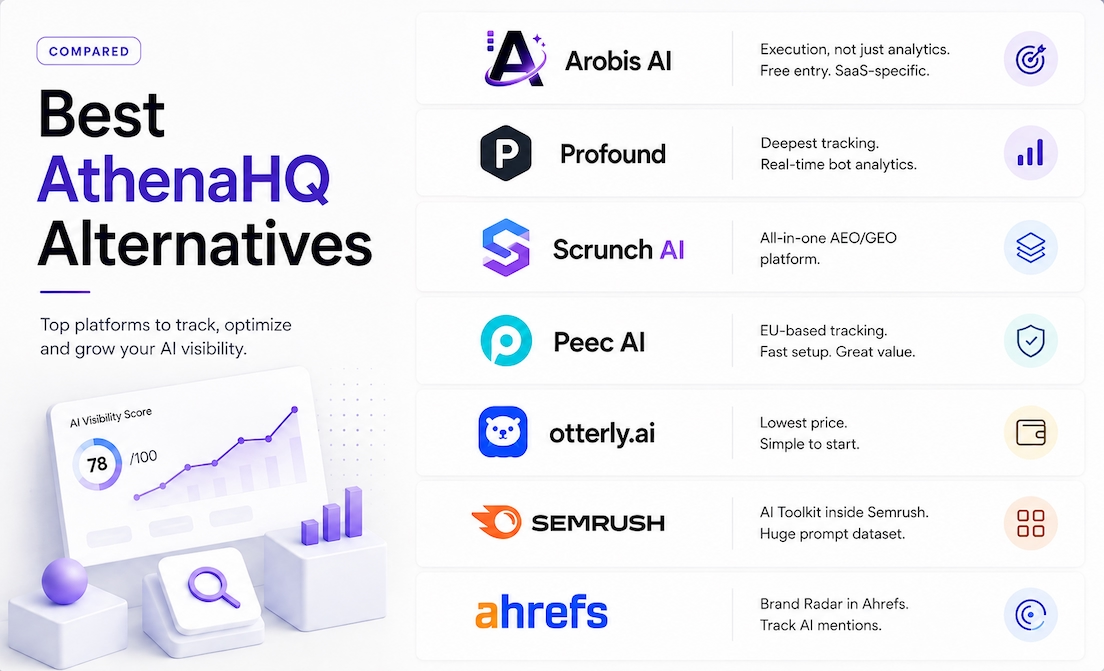
TL;DR: The right AthenaHQ alternative depends on the gap you are filling. Want the outcome delivered rather than another dashboard? Arobis AI is the top pick for B2B SaaS, and you can baseline for free. Want the deepest enterprise tracking? Profound. Want transparent self-serve pricing far below AthenaHQ's $295 per month? Peec AI (from about $80 per month) or Otterly.ai (from $29 per month). Want visibility tracking bundled into tools you already pay for? Semrush AI Toolkit or Ahrefs Brand Radar. The full breakdown, with verified pricing and a choose-it-or-skip-it verdict for all fifteen tools, is below.
What AthenaHQ actually costs in 2026 (verified September 5, 2026)
Here is AthenaHQ's current pricing, checked directly on its pricing page on September 5, 2026:
Two things changed since our August check. The self-serve plan is now called Starter rather than Lite and covers 10 models instead of eight, and AthenaHQ now has a genuinely free Essential tier with 300 credits a month. The $545 Growth tier is no longer listed on the pricing page. What did not change is the model that matters most: one credit equals one AI response collected, and additional credits are billed on top of Starter rather than included.
Who should actually stay on AthenaHQ
An honest alternatives guide should say this plainly: some teams reading this should not switch. AthenaHQ earned its reputation on clean, executive-ready reporting, and its ACE citation engine and content optimization agent are genuinely good at what they do. Stay where you are if all three of these are true:
- Your primary consumer of AI visibility data is leadership, and polished reporting is the deliverable that matters.
- Your prompt list is small and stable enough that Starter's 3,600 credits a month, or a negotiated Enterprise allocation, comfortably covers your refresh cadence.
- You have someone in-house who acts on the findings, so a reporting layer is all you are missing.
If one of those is false, keep reading. The fifteen tools below each fix a specific AthenaHQ limitation: cost predictability, tracking depth, engine breadth, or the biggest one, the gap between knowing your AI visibility and changing it.
How we evaluated these alternatives (and our bias, disclosed)
First, the disclosure no other list on this topic offers: this guide is published by Arobis AI, and Arobis AI appears in it. We put ourselves first for a specific buyer, B2B SaaS teams that want execution rather than software, and we explain exactly why so you can discount it if that buyer is not you. Every competing article in the top results does the same thing without telling you: check who publishes them and who they rank first.
Here is what we actually checked for every tool, with AthenaHQ pricing re-verified on September 5, 2026 and the other vendors on August 14, 2026:
- Depth of tracking: raw prompt and citation level data, not just summary charts. Can you see which pages AI engines cite when they answer?
- Engine coverage: ChatGPT, Gemini, Claude, and Perplexity are table stakes. We checked who also covers Google AI Overviews, Google AI Mode, and Microsoft Copilot, which is where most real buyer volume sits.
- Execution: does the tool help you change what AI recommends, or only measure it? Dashboards are commodity. Movement is not.
- Pricing model: flat and predictable versus credit-based and variable, self-serve versus sales call, and what the entry price actually buys.
- Fit signals: public ratings where they exist (for example Scrunch AI holds a 4.6 out of 5 on G2), platform maturity, and the size of team each tool realistically suits.
AthenaHQ alternatives at a glance
- Arobis AI: executes the program, does not just report (custom pricing; free checker to start)
- Profound: deepest enterprise tracking (no public pricing; reported around $399 per month effective, enterprise $2,000 to $5,000+)
- Scrunch AI: all-in-one monitoring plus agent-ready content delivery (from $250 per month)
- Peec AI: transparent self-serve tracking, EU-hosted (from about $80 per month)
- Otterly.ai: cheapest credible entry point ($29, $189, and $489 per month tiers)
- Semrush AI Toolkit: AI share of voice inside Semrush (add-on to Semrush plans)
- Ahrefs Brand Radar: AI mention tracking inside Ahrefs (included with Ahrefs plans)
- Writesonic GEO: visibility tracking plus AI content in one suite (from about $79 per month)
- SE Ranking: AI visibility inside a full SEO suite (from $129 per month plus an $89 per month AI Search add-on)
- Rankscale: cheapest prompt-level tracking (from about $20 per month)
- ZipTie.dev: affordable tracking plus content optimizations (from usage-based pricing)
- LLMrefs: low-cost monitoring across seven or more AI platforms (from about $79 per month)
- Frase: content optimization with combined SEO and GEO scoring (from about $45 per month)
- GrackerAI: B2B SaaS-focused tracking with a built-in content engine (pricing on request)
- Evertune: wide engine coverage with optimization playbooks (pricing on request)
The 20-minute test that beats every comparison article
Feature tables age fast and vendor claims are marketing. AI engines themselves are a live, free evaluation lab, and twenty minutes there tells you more than any list, including this one. Here is the exact protocol:
- Minutes 1 to 5: open ChatGPT, Gemini, and Perplexity in fresh sessions. Ask each one: "What are the best AthenaHQ alternatives?" and "What are the best AI visibility tools for B2B SaaS?" Note every product named.
- Minutes 6 to 10: ask the buying questions your customers would ask: "Is AthenaHQ worth it?", "cheapest way to track my brand in ChatGPT", "AI visibility tool with flat pricing". Different intent surfaces different names.
- Minutes 11 to 15: for the three tools you are seriously considering, ask "What are the downsides of [tool]?" and watch which criticisms recur across engines. Recurring criticism across independent engines is usually real.
- Minutes 16 to 20: score each shortlisted tool from 0 to 3. Zero: never mentioned anywhere. One: mentioned in one engine only. Two: mentioned in two or more engines. Three: mentioned in two or more engines with a specific, accurate description of what it does.
Anything scoring 0 or 1 deserves a hard question: a vendor that sells AI visibility but has not earned its own is telling you something about how well its method works. Reporting tells you where you stand. Being recommended is the entire point. For a one-on-one look at a single option, read our AthenaHQ vs Arobis AI comparison.
The 15 best AthenaHQ alternatives in 2026
1. Arobis AI: best when you want the outcome, not another report
Every other tool on this list, AthenaHQ included, hands you data and leaves the hard part to you. Arobis AI inverts that. It is an AI Search Demand Generation program for B2B SaaS: it audits where you stand across ChatGPT, Gemini, Claude, Perplexity, Copilot, and Google AI, builds the GEO and AEO strategy, then executes the content and authority work that moves the recommendations. Start with the free part: see whether ChatGPT names you for your category, no signup needed for the score. The benchmarks behind the approach are published in the State of AI Search Visibility 2026 report, and the methodology is documented openly rather than hidden behind a demo call.
The honest trade-off: it is a done-with-you program, not self-serve software. If you want a dashboard login and a monthly invoice for software, choose one of the trackers below. If you want the number on the dashboard to actually move, this is the category Arobis AI exists for. The full offer lives on our GEO agency for SaaS page, and answer-level work runs through the AEO agency for B2B SaaS. See how AI visibility works for SaaS and current Arobis AI pricing.
Choose it if: you are a B2B SaaS team and the metric you care about is being recommended, not being informed. Skip it if: you only need monitoring software. Pricing: custom program pricing; start free with the checker linked at the end of this guide.
2. Profound: the deepest enterprise tracker
Profound is AthenaHQ's closest enterprise rival and the tool most often cross-shopped against it. Where AthenaHQ optimizes for clean executive dashboards, Profound goes deeper on raw data: prompt-level tracking, real-time AI crawler analytics that show which bots hit which pages, and AI commerce visibility. It has raised significant funding and holds strong ratings on G2, where it is one of the most reviewed products in the category.
The trade-offs are cost and weight. There is no public pricing page; buyer reports put effective multi-engine starting costs around $399 per month, with enterprise deployments commonly quoted between $2,000 and $5,000 or more per month. It also assumes you have analysts who will live in the data. Teams that buy Profound for its depth and staff it properly rarely regret it; teams that wanted answers rather than data often churn. We break down the cost question in our Profound pricing guide and the wider field in best Profound alternatives.
Choose it if: you are an enterprise with dedicated search or data people. Skip it if: you need transparent pricing or a tool one marketer can run. Pricing: custom; see Profound pricing.
3. Scrunch AI: the widest all-in-one platform
If AthenaHQ's reporting focus feels narrow, Scrunch AI bundles the most into one platform: monitoring, auditing, optimization, and its distinctive Agent Experience Platform, which serves AI-optimized versions of your content directly to AI crawlers and agents. It also ships hallucination detection, flagging when engines say false things about your brand, which matters more every quarter as buyers ask AI increasingly specific questions. It holds a 4.6 out of 5 rating on G2.
Plans start at $250 per month, with higher tiers and custom enterprise pricing above that, so it is not the budget option, and it is a younger platform than Profound or AthenaHQ. But of the self-serve tools here, it makes the most serious attempt at closing the gap between measuring and fixing. Our best Scrunch AI alternatives guide covers the reverse comparison.
Choose it if: you want monitoring and remediation in one platform and can budget $250 or more per month. Skip it if: you mainly need light tracking. Pricing: from $250 per month; see Scrunch AI pricing.
4. Peec AI: the self-serve counterpoint
Peec AI is the cleanest answer to AthenaHQ's two structural annoyances: opaque enterprise pricing and credit anxiety. It is self-serve from about $80 per month, Berlin-based and GDPR-aligned with EU hosting, and tracks ChatGPT, Gemini, and Perplexity on base plans with additional engines available as paid add-ons. Its custom-prompt and tagging system is one of the best in the category for organizing large prompt sets, and agencies in particular like its workspace model.
The limits: it is monitoring-first, so acting on the data stays your job, and base plans cover three engines, with notable gaps at the cheaper tiers around Google AI Overviews coverage. We compare it head-to-head with its closest budget rival in Peec AI vs Otterly.ai and list its own challengers in best Peec AI alternatives.
Choose it if: you want transparent flat pricing, EU data residency, and disciplined prompt organization. Skip it if: you need broad engine coverage on the base plan. Pricing: from about $80 per month; see Peec AI pricing.
5. Otterly.ai: the budget entry point
Otterly.ai exists for the team that looked at AthenaHQ's $295 per month and closed the tab. Tiers run $29, $189, and $489 per month, and the bottom tier is a real product, not a teaser: prompt tracking, brand mention monitoring, and link citation tracking across the major engines, in an interface designed to feel like familiar SEO rank tracking.
You give up depth: no execution layer, lighter competitive analysis, and prompt volumes that serious programs outgrow. That is the deal at $29 per month, and it is a fair one. Start here if you are validating whether AI visibility matters for your category before committing real budget. Its own field of rivals is covered in best Otterly.ai alternatives.
Choose it if: you want the cheapest credible monitoring to prove the channel matters. Skip it if: you already know it matters and need depth or execution. Pricing: $29, $189, and $489 per month; see Otterly.ai pricing.
6. Semrush AI Toolkit: for teams already on Semrush
If your team lives in Semrush, the AI Toolkit is the lowest-friction path into AI visibility: AI share of voice, brand perception analysis, and competitor benchmarking in the interface you already use, backed by one of the largest prompt datasets in the industry. No new vendor, no new procurement cycle, no new login.
The trade-off is that a module is not a product. Coverage and prompt depth trail the dedicated trackers above, and execution guidance is thin. Treat it as a strong first thermometer rather than a program. We ran a full head-to-head of the two big SEO suites' AI modules in Ahrefs vs Semrush for AI visibility.
Choose it if: you are already paying for Semrush and want AI visibility data this week. Skip it if: AI search is becoming a primary channel for you. Pricing: add-on to Semrush plans; see Semrush pricing.
7. Ahrefs Brand Radar: the same logic, for Ahrefs users
Brand Radar applies the identical bundled-module logic inside Ahrefs: brand mention and visibility tracking across AI answers, including AI Overviews, layered onto the crawl and backlink data Ahrefs is known for. For an Ahrefs shop, it turns AI visibility from a new purchase into a checkbox.
Like the Semrush module, it is a lens rather than a program: fewer engines than dedicated trackers, no prompt-level workflow depth, and nothing that helps you act on what it finds. Its challengers are ranked in best Ahrefs Brand Radar alternatives.
Choose it if: you already run Ahrefs and want directional AI visibility data at no extra vendor cost. Skip it if: you need depth or breadth beyond a module. Pricing: included with Ahrefs plans; see Ahrefs pricing.
8. Writesonic GEO: tracking plus content in one suite
Writesonic started as an AI writing platform and built a genuine GEO product on top: brand tracking across ChatGPT, Gemini and Google AI Overviews, with an Action Center that converts visibility gaps into concrete content tasks its writing tools then help you execute. That loop, see the gap and fix the gap in one suite, is its real differentiator at the price.
The visibility module lives inside a broader writing product, so dedicated trackers beat it on monitoring depth, and content quality still depends on your editorial standards. From about $79 per month, it is one of the strongest value picks here for content-led teams.
Choose it if: a content team owns your AI visibility work. Skip it if: you need pure monitoring depth. Pricing: from about $79 per month; see Writesonic pricing.
9. SE Ranking: AI visibility inside a classic SEO suite
SE Ranking is the established budget SEO platform, rank tracking, audits, backlink data, that now bundles an AI visibility tracker into the same dashboard. For small teams that refuse to run two tools for one channel, watching AI answers next to classic rankings in one place is the whole pitch, from $129 per month plus an $89 per month AI Search add-on.
Its AI module is newer and lighter than the category specialists, with less prompt-level depth and thinner engine coverage. It is the pragmatic choice, not the powerful one.
Choose it if: you want one affordable dashboard for classic SEO and AI visibility together. Skip it if: AI search deserves a dedicated tool in your stack. Pricing: from $129 per month plus an $89 per month AI Search add-on; see SE Ranking.
10. Rankscale: the cheapest prompt-level tracker
Rankscale is the lowest credible entry price in the category, from about $20 per month, and covers the fundamentals with surprising rigor: prompt-based monitoring, citation tracking, competitor benchmarking, and AI-readiness audits of your site. For a solo marketer or a founder doing their own marketing, it answers the core question, who do the engines recommend and why, for the price of a lunch.
Lower tiers are credit-limited, so heavy prompt sets hit walls, and like most tools here it is monitoring-first. But as a first paid step into AI visibility, its price-to-signal ratio is hard to argue with.
Choose it if: you are a solo operator or small team buying your first AI tracking. Skip it if: you need volume, depth, or execution. Pricing: from about $20 per month; see Rankscale.
11. ZipTie.dev: affordable tracking plus content fixes
ZipTie tracks where your brand appears and gets cited across answer engines, then bundles content optimization recommendations to close the gaps it finds, from usage-based pricing. That combination, monitoring plus at least directional remediation, at a mid-market price is its niche between the pure trackers below it and the platforms above it.
Engine coverage and data depth trail the enterprise tools, and the optimization layer is guidance rather than execution. It is a sensible middle rung.
Choose it if: you want more than monitoring but cannot justify platform pricing. Skip it if: you need enterprise depth or full engine breadth. Pricing: from usage-based pricing; see ZipTie.dev.
12. LLMrefs: simple multi-engine monitoring
LLMrefs does one job at a fair price: rank-style visibility tracking across seven or more AI platforms from about $79 per month. Smaller teams like it precisely because it does not try to be a platform; setup is quick, the mental model matches familiar rank tracking, and the bill is predictable.
It reports visibility and stops there. Strategy, content, and authority building remain entirely your job, and there is no execution or optimization layer to grow into.
Choose it if: you want straightforward multi-engine monitoring with no platform overhead. Skip it if: you will need the tool to do more within a year. Pricing: from about $79 per month; see LLMrefs.
13. Frase: content optimization with GEO scoring
Frase comes at the problem from the content side. Its established SEO content workflow, research, briefs, optimization scoring, now includes GEO scoring: how citation-ready your content is for AI engines alongside how well it competes in classic search, with brand visibility tracking layered in. For content teams, optimizing one draft for both surfaces in one pass is genuinely efficient, from about $45 per month.
Its visibility tracking is the lightest of the tools here; it is a content platform with GEO awareness, not a monitoring product with content features.
Choose it if: your AI visibility strategy runs through content production. Skip it if: monitoring is the primary job. Pricing: from about $45 per month; see Frase.
14. GrackerAI: SaaS-specific tracking with a content engine
GrackerAI is built specifically for B2B SaaS, tracking up to nine AI engines and pairing the monitoring with a programmatic content engine included at every paid tier. The SaaS focus shows up usefully: prompt templates and content patterns match how software buyers actually query AI engines, rather than generic brand monitoring adapted to SaaS.
It is a younger platform, and it remains self-serve software: the content engine produces drafts and structures, but strategy and quality control stay with you.
Choose it if: you are a SaaS team that wants tracking plus content scaffolding in one tool. Skip it if: you want a mature platform or a managed program. Pricing: on request; see GrackerAI.
15. Evertune: wide coverage with optimization playbooks
Evertune is a GEO platform whose headline strength is engine breadth: ChatGPT, Google AI Overviews and AI Mode, Gemini, Claude, Perplexity, and Copilot, paired with prompt-volume data, brand audits, and optimization playbooks that tell you what to change and why. That breadth matters because visibility is uneven; brands strong in ChatGPT are routinely invisible in Copilot, and most tools cannot even show you that.
It sits at the heavier end for setup and price, and pricing is quote-based, which is exactly the opacity that sends many AthenaHQ shoppers elsewhere.
Choose it if: engine breadth plus guided optimization is your priority and you tolerate quote-based pricing. Skip it if: you want self-serve transparency. Pricing: on request.
What a real setup costs: the same scenario priced across the market
Take one concrete scenario, one brand tracking 30 prompts with daily refreshes, and price it honestly:
- AthenaHQ Starter: $295 per month covers 3,600 responses. Daily refreshes across its ten models need about 9,000, so you either cut your cadence to two or three runs a week or buy extra credits, which are a paid add-on with no published price: realistically $295 per month plus add-ons.
- Peec AI or LLMrefs: about $79 to $80 per month flat, on three to seven engines, with no credit anxiety.
- Otterly.ai or Rankscale: $20 to $29 per month gets you started at reduced prompt volumes; the honest budget floor.
- Scrunch AI: $250 per month flat, with the optimization and agent-delivery layers included.
- Profound or Evertune: quote-based; budget four figures monthly for enterprise depth.
- Arobis AI: custom program pricing, but the spend buys execution, not response collection, so it competes with your content and agency budget rather than your software budget.
The pattern: flat-priced monitoring has become cheap. What remains expensive is depth (Profound), breadth plus guidance (Evertune, Scrunch AI), and outcomes (Arobis AI). Pay for the one you are actually missing.
Switching without losing your history: a 30-day migration plan
- Days 1 to 5: export everything from AthenaHQ: prompt lists, visibility scores by engine, citation sources, and trend charts. Screenshot the dashboards leadership is used to seeing; you will want continuity in reporting.
- Days 6 to 10: rebuild your prompt set in the new tool before canceling anything. Keep prompt wording identical where possible; changed wording changes results and breaks your trend line.
- Days 11 to 30: run both tools in parallel for at least two weeks. Scores will not match exactly, because sampling methods differ, and that is normal. What you are validating is direction: both tools should agree on where you are strong, where you are absent, and which competitors keep beating you.
- Before you cancel: confirm the new tool covers the engines that matter to your buyers, especially Google AI Overviews and Copilot, and set a quarterly reminder to re-run the 20-minute test above so your tooling choice stays honest.
How to choose: match the tool to the gap
Start from what pushed you to look past AthenaHQ. Need deeper enterprise data? Profound. Hate credit-based pricing? Peec AI, Otterly.ai, or LLMrefs are flat and predictable. Want one platform that also optimizes? Scrunch AI or Writesonic GEO. Already on Semrush or Ahrefs? Switch on their modules this week and learn what you are dealing with. Content-led team? Frase. Solo operator? Rankscale. Want the result delivered rather than reported? That is Arobis AI, and it is the honest reason we run this list at all, and our SaaS SEO services page breaks down exactly what a delivered engagement covers. For the wider field beyond AthenaHQ cross-shoppers, see our best AI visibility tools roundup, the best GEO agencies ranking, and if the discipline is new to you, our guides to answer engine optimization and generative engine optimization.
For a three-way platform breakdown, see Searchable vs Profound vs AthenaHQ.
Quick exercise: is your AI visibility reportable or fixable?
AthenaHQ makes AI visibility easy to report. This 60-second check tells you whether you also know how to fix it. Give yourself one point for every "yes":
- Ask ChatGPT for the best tools in your category: does your brand make the list?
- Can you name the exact pages AI cites when it recommends a competitor?
- Do you track Microsoft Copilot and Google AI Overviews, not just the big three chatbots?
- If your score dropped tomorrow, would you know which content to change?
- Can you tie any AI mention back to a piece of pipeline?
Your score: 0 to 1: you can measure the problem but not solve it; reporting alone will not move it. 2 to 3: you have partial visibility and partial control. 4 to 5: you are already turning AI visibility into action; keep pressing the advantage.
Frequently asked questions
What is the best AthenaHQ alternative?
For B2B SaaS teams that want execution rather than reporting, Arobis AI is the strongest alternative. For a deeper like-for-like enterprise analytics platform, Profound is the closest match. For self-serve tracking at a fraction of the price, Peec AI and Otterly.ai lead.
Is AthenaHQ worth $295 per month?
It depends entirely on your credit consumption. If your prompt set and refresh cadence fit inside 3,600 credits, the Starter plan is fairly priced for the reporting quality. If you need daily refreshes across many prompts and platforms, add-on credits push real costs toward $600 per month, and flat-priced alternatives become significantly cheaper for the same monitoring.
AthenaHQ vs Profound: which is better?
Profound tracks deeper; AthenaHQ reports cleaner. Enterprises with analysts usually prefer Profound. Teams whose main consumer is leadership usually prefer AthenaHQ. Neither executes the fixes for you, which is the gap the execution-side options in this list exist to fill.
Is there a cheaper AthenaHQ alternative?
Yes. Otterly.ai starts at $29 per month, Rankscale at about $20, Peec AI at about $80, and LLMrefs at about $79, all flat-priced with no credit system. The free Arobis AI Visibility Checker costs nothing and gives you a baseline in minutes, and the free llms.txt generator is a zero-cost first optimization. AthenaHQ itself now offers a free Essential tier with 300 credits a month on five platforms, which is enough to sample a few prompts but not to monitor a real prompt set.
Which AthenaHQ alternative is best for a small marketing team?
Small teams usually feel AthenaHQ's enterprise orientation in both price and setup. With one or two marketers, Otterly.ai or Peec AI give you focused tracking you can actually manage, while Arobis AI suits small SaaS teams that would rather hand execution off entirely than learn another platform. Match the tool to the hours you can realistically give it, not the feature list.
Can I switch tools without losing my tracking history?
Mostly. Export your data first, keep prompt wording identical in the new tool, and run both in parallel for two weeks so you can bridge the trend line. Absolute scores will differ between tools because sampling differs; direction and competitive gaps should agree.
Do these tools track Google AI Overviews, not just chatbots?
Coverage varies, so confirm it before you buy. Several tools focus on standalone chatbots and treat Google AI Overviews as secondary, even though Overviews reach the largest audience of all. If AI Overviews matter to your buyers, make coverage a hard requirement on your shortlist. Arobis AI tracks ChatGPT, Gemini, Claude, Perplexity, Copilot, and Google AI together.
Does AthenaHQ have a free plan?
Yes, as of September 2026. The Essential plan is free with a $25 starting credit and 300 credits a month across ChatGPT, Perplexity, Google AI Overviews, Gemini and Copilot. At one credit per AI response, 300 credits covers roughly 10 prompts checked daily on one engine, so it works as a trial rather than as ongoing monitoring.
See where you stand: run the free Arobis AI Visibility Checker. It takes two minutes and shows how AI engines currently see your brand, which is the baseline every decision above should start from.