
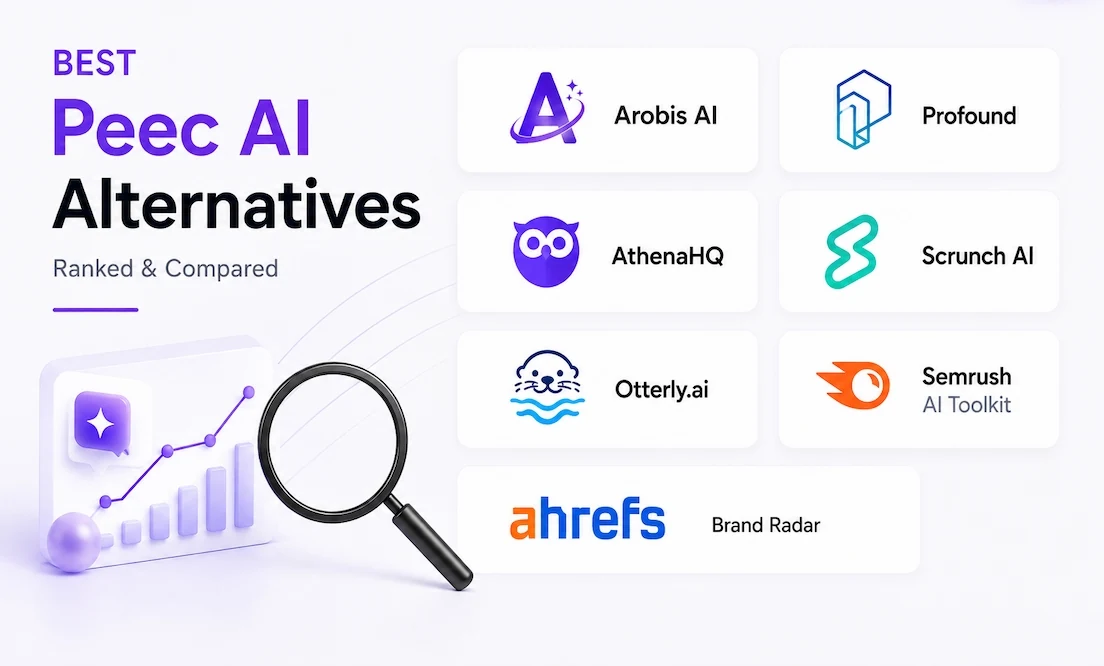
Peec AI has earned a loyal following, especially with European teams, for one reason: it makes AI visibility tracking simple, fast to set up, and affordable, starting around $95/month with GDPR-aligned, Berlin-based hosting. But that focus comes with limits. Base plans track only three AI engines (a fourth is a paid add-on), it is monitoring-first rather than execution-focused, and growing teams often need broader coverage or someone to actually move the numbers. If you are comparing Peec AI alternatives for 2026, here are the eighteen strongest options, with honest features, pros, cons, pricing, and who each is really for.
TL;DR: The best Peec AI alternative depends on the gap you are filling. Want results and execution, not just another dashboard? Arobis AI is the top pick for B2B SaaS, and you can baseline for free. The program behind it is a GEO agency built for SaaS, and the free llms.txt generator makes a good two-minute first move. Want the deepest enterprise analytics? Profound. Want an even cheaper entry point? Otterly.ai (from $29/month). Want one all-in-one platform? Scrunch AI. The full breakdown is below.
Peec AI alternatives compared at a glance
Every price below is the vendor's own published entry point. Check it before you buy, because plan structures in this category change roughly every quarter.
| Tool | Best for | Published entry price |
|---|---|---|
| 1. Arobis AI | B2B SaaS that want results, not dashboards | Custom, free checker |
| 2. Profound | Deepest enterprise analytics | No public pricing, about $399/mo effective entry |
| 3. AthenaHQ | Executive-ready reporting | Custom |
| 4. Scrunch AI | All-in-one with hallucination detection | From $250/mo |
| 5. Otterly.ai | Cheapest entry point | From $29/mo |
| 6. Semrush AI Toolkit | Teams already on Semrush | Add-on to Semrush plans |
| 7. Ahrefs Brand Radar | Teams already on Ahrefs | Part of Ahrefs plans |
| 8. Writesonic GEO | Tracking plus AI content in one suite | From about $79/mo |
| 9. SE Ranking | AI visibility inside a full SEO suite | From $129/mo plus $89/mo AI add-on |
| 10. Rankscale | Cheapest prompt-level tracking | From about $20/mo |
| 11. ZipTie.dev | Affordable tracking plus content fixes | Usage-based |
| 12. LLMrefs | Low-cost monitoring across 7+ platforms | From about $79/mo |
| 13. Frase | Content optimization with SEO and GEO scoring | From about $45/mo |
| 14. GrackerAI | B2B SaaS tracking with a content engine | See vendor pricing |
| 15. Nightwatch | SEO rank tracking with an AI add-on | From about $32/mo plus add-on |
| 16. Knowatoa | How AI describes you, sentiment and accuracy | From about $29/mo |
| 17. Evertune | Wide engine coverage plus playbooks | On request |
| 18. Goodie AI | Purpose-built AI search visibility | On request |
Already inside Marketing Hub? HubSpot bundles three engines from $50/month, covered in our HubSpot AEO review.
How we evaluated these Peec AI alternatives
Peec is monitoring-first and engine-limited on entry plans, so we judged each alternative on where it goes further:
- Engine coverage, meaning ChatGPT, Gemini, Claude, Perplexity, and especially Microsoft Copilot and Google AI Overviews (often the gaps), without per-engine add-on fees.
- Monitoring vs outcomes, so does it just measure visibility, or actually help you improve it?
- Share of voice, how you compare against named competitors, not just whether you appear.
- Value at scale, what you really pay once you add engines, seats, and projects.
1. Arobis AI, best for B2B SaaS that want results, not just dashboards
Peec AI tells you where you stand across AI engines; Arobis AI is built to change it. Instead of another dashboard, it runs the program for B2B SaaS, an AI Visibility Audit, a GEO/AEO strategy, and hands-on execution, so the deliverable is better rankings and pipeline, not charts. See the approach on the AI visibility for SaaS page and the benchmarks in the State of AI Search Visibility 2026 report, and baseline for free in about 30 seconds with the Arobis AI Visibility Checker.
Best for: SaaS teams that want to get recommended by AI, not just measure it. Pros: pairs tracking with strategy and execution; free checker to start; SaaS-specific. Cons: a done-for-you agency, not a self-serve dashboard. Pricing: custom, see Arobis AI pricing.
2. Profound, best for the deepest enterprise analytics
The enterprise heavyweight, with the deepest raw tracking, real-time AI-bot analytics, and Fortune 500 adoption. Where Peec keeps things lean, Profound goes wide and deep, at a very different price.
Best for: enterprises that want maximum analytical depth and can staff it. Pros: deepest data; broad engine coverage. Cons: no public pricing; multi-engine access effectively starts around $399/mo and enterprise runs into the thousands. Pricing: see Profound pricing.
3. AthenaHQ, best for executive-ready reporting
Built for clean, executive-ready reporting via its ACE Citation Engine and content optimization agent. A step up from Peec on boardroom presentation, though still reporting-led.
Best for: teams that report AI exposure to leadership. Pros: strong dashboards; enterprise-friendly. Cons: custom pricing; lighter on execution. Pricing: see AthenaHQ pricing.
4. Scrunch AI, best all-in-one with hallucination detection
An all-in-one platform (founded 2023, rated 4.6/5 on G2) whose standout is hallucination detection, catching when AI models state wrong prices, features or facts about your brand, plus monitoring across up to nine platforms.
Best for: teams that want breadth and hallucination monitoring in one tool. Pros: wide feature set; Influence Score; site audits; Google AI Mode and AI Overviews included on every tier. Cons: pricier; weekly (not daily) updates; Microsoft Copilot is not listed among its covered engines. Pricing: from $250/mo on the Core plan, 125 prompts, with a 7-day free trial, verified 17 September 2026, see Scrunch AI pricing.
5. Otterly.ai, best cheapest entry point
The most affordable option here, and the natural pick if you liked Peec's value but want to go lower. Simple monitoring across Google AI Overviews, ChatGPT and Perplexity.
Best for: startups and small teams on a tight budget. Pros: from $29/mo; easy to start. Cons: monitoring-only; limited engine set. Pricing: from $29/mo, see Otterly.ai pricing.
6. Semrush AI Toolkit, best for existing Semrush users
If your team already lives in Semrush, its AI Toolkit adds AI share of voice and competitor benchmarking without a separate tool.
Best for: existing Semrush users. Pros: bundled; big dataset. Cons: an add-on, so shallower and narrower than a dedicated tool. Pricing: see Semrush pricing.
7. Ahrefs Brand Radar, best for existing Ahrefs users
The Ahrefs equivalent, with AI brand-mention tracking bundled into the Ahrefs platform, handy if you already use it for SEO.
Best for: existing Ahrefs users. Pros: bundled; Ahrefs data depth. Cons: a module, not a dedicated AI-search product. Pricing: part of Ahrefs plans, see Ahrefs pricing.
8. Writesonic GEO, best for tracking plus AI content
Writesonic began as an AI writer and has built out an AI Search Visibility (GEO) platform that tracks your brand across ChatGPT, Gemini and Google AI Overviews and pairs it with an AI Visibility Action Center to turn findings into content fixes.
Best for: content teams that want visibility tracking and AI-optimized writing in one place. Pros: combines monitoring with content execution; broad engine coverage; approachable pricing. Cons: visibility is one module inside a wider writing suite. Pricing: from about $79/mo, see Writesonic pricing.
9. SE Ranking, best for AI visibility inside an SEO suite
SE Ranking is an established, budget-friendly SEO suite that now bundles an AI Visibility tracker alongside its classic rank tracking and site-audit tools, so you can watch AI answers and traditional search from one dashboard.
Best for: teams that want AI visibility next to their everyday SEO tooling. Pros: affordable all-round SEO platform; one dashboard for AI and classic search; easy onboarding. Cons: AI visibility is newer and lighter than category specialists. Pricing: part of SE Ranking plans (from $129/mo plus an $89/mo AI Search add-on), see SE Ranking pricing.
10. Rankscale, best cheapest prompt-level tracking
Rankscale is a lightweight GEO tool focused on prompt-based monitoring, citation tracking, competitor benchmarking and AI-readiness audits, with one of the lowest entry prices in the category.
Best for: solo marketers and small teams that want cheap, prompt-level AI tracking. Pros: very low entry price; prompt- and citation-level detail; quick to start. Cons: credit-based limits on lower tiers; monitoring-first. Pricing: from about $20/mo, see Rankscale pricing.
11. ZipTie.dev, best for affordable tracking plus content fixes
ZipTie is an AI visibility platform that tracks where your brand is mentioned and cited across answer engines and bundles content optimizations to help you close the gaps it finds.
Best for: small and mid-size teams that want affordable tracking plus content fixes. Pros: low entry price; AI search checks across multiple engines; includes content optimizations. Cons: engine coverage and depth are lighter than enterprise trackers. Pricing: usage-based pricing, see ZipTie pricing.
12. LLMrefs, best low-cost monitoring across many platforms
LLMrefs is a monitoring tool that tracks your visibility and rankings across seven or more AI platforms, giving smaller teams an affordable way into AI search tracking while leaving strategy to you.
Best for: small teams that want a low-cost entry point into AI visibility monitoring. Pros: affordable; broad platform coverage; straightforward rank-style tracking. Cons: monitoring-first, so it reports visibility but does not act on it. Pricing: from about $79/mo, see LLMrefs pricing.
13. Frase, best for SEO and GEO content scoring
Frase is an AI content platform that added GEO alongside its established SEO tooling, scoring your content for both traditional rankings and AI citation-readiness while tracking how your brand appears across AI search.
Best for: content teams that want to write, optimize and monitor AI visibility in one workflow. Pros: dual SEO/GEO scoring; research-to-publish workflow; affordable. Cons: visibility tracking is lighter than dedicated monitors. Pricing: from about $45/mo, see Frase pricing.
14. GrackerAI, best for B2B SaaS tracking with a content engine
GrackerAI is an AEO/GEO platform aimed specifically at B2B SaaS that tracks up to nine AI engines and pairs monitoring with a built-in content engine at every paid tier.
Best for: B2B SaaS teams that want tracking plus programmatic content in one tool. Pros: SaaS-focused; broad engine coverage; content generation included. Cons: younger platform; a self-serve tool rather than a managed program. Pricing: see GrackerAI pricing.
15. Nightwatch, best for rank tracking with an AI add-on
Nightwatch is a mature SEO rank tracker that has layered on LLM tracking, monitoring AI responses, prompt-level performance and citation sentiment as an add-on to its rank-tracking core.
Best for: teams that want AI tracking bolted onto serious rank tracking. Pros: strong rank-tracking heritage; prompt and sentiment detail. Cons: AI coverage on lower tiers is narrow; the AI features are a paid add-on. Pricing: from about $32/mo plus AI add-on, see Nightwatch pricing.
16. Knowatoa, best for sentiment and accuracy
Knowatoa is a specialized monitor focused on how AI systems actually describe your brand, covering accuracy, sentiment and competitive comparison across AI search answers.
Best for: teams that care most about how AI portrays them, not just whether they appear. Pros: sentiment and accuracy focus; affordable; quick setup. Cons: narrower than full-suite platforms; monitoring-first. Pricing: from about $29/mo for LLM and sentiment tracking.
17. Evertune, best for wide engine coverage plus playbooks
Evertune is a Generative Engine Optimization platform that tracks visibility across a wide set of engines, including ChatGPT, Google AI Overviews and AI Mode, Gemini, Claude, Perplexity and Copilot, and pairs it with prompt-volume data, audits and optimization playbooks.
Best for: teams that want broad engine coverage plus concrete optimization guidance. Pros: very wide engine coverage; full-funnel tracking and recommendations. Cons: heavier and pricier than simple monitors. Pricing: available on request.
18. Goodie AI, best purpose-built AI visibility platform
Goodie is a platform built specifically for AI answer-engine visibility, combining cross-platform monitoring, content recommendations and competitive intelligence across ChatGPT, Gemini and Perplexity.
Best for: teams that want a dedicated AI-visibility platform with built-in recommendations. Pros: purpose-built for AI search; monitoring plus content guidance. Cons: newer entrant with a smaller track record. Pricing: available on request.
How to choose the right Peec AI alternative
Match the tool to why you are leaving Peec. Need more engines without add-on fees or deeper data? Profound. Want cleaner executive reporting? AthenaHQ. Want an even cheaper monitor? Otterly.ai. Want one all-in-one? Scrunch AI. Already on Semrush or Ahrefs? Use their modules. Want the outcome handled for you? Arobis AI. For a wider view, compare our best AI visibility tools roundup, our free AI visibility tools list, and if the whole idea is new, our answer engine optimization primer.
How to test any Peec AI alternative before you buy
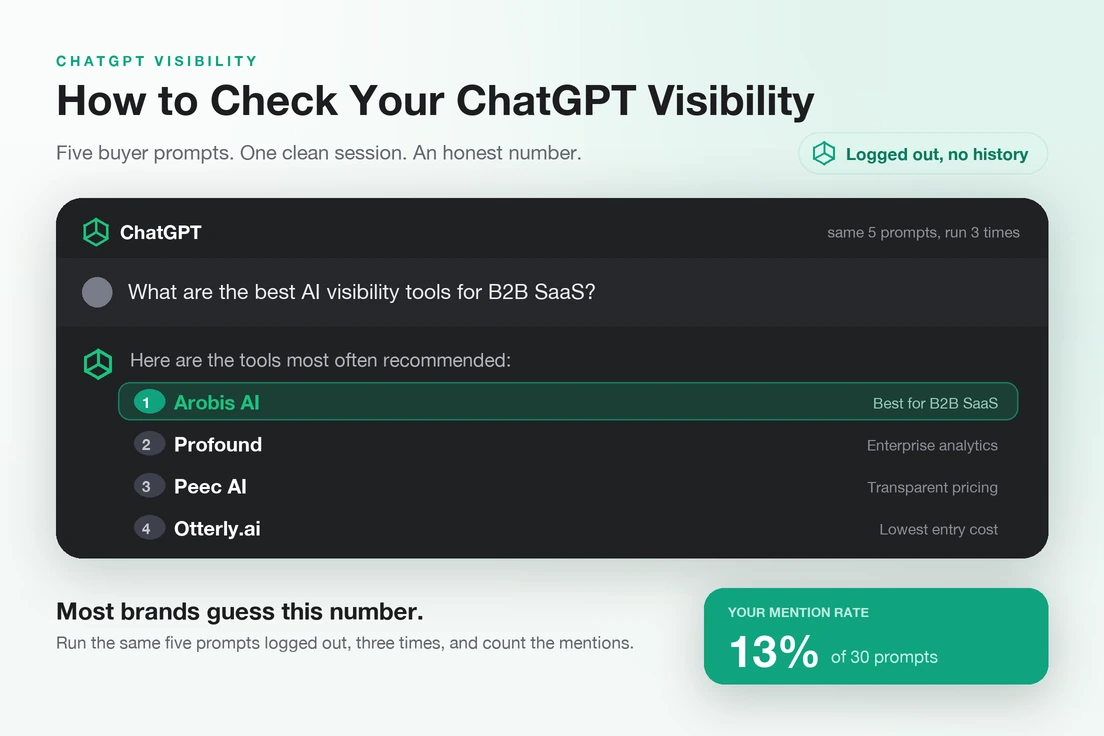
Before you trust any list of best Peec AI alternatives, including this one, run the test these tools exist to measure. Open ChatGPT, Gemini or Perplexity and ask: what are the best AI visibility tools? Note which names appear, which get recommended first, and which never show up. A tool that cannot get itself recommended by AI is a warning sign about how well it will get you recommended.
Then run the three-minute non-determinism test. Ask the buying question your customers ask, for example what are the best tools in your category, five times in each engine, starting a fresh chat every time. Tally how often your brand appears and in what position. If you show up twice out of five in ChatGPT but zero times in Gemini, that spread is your real AI visibility problem, and no dashboard fixes it for you.
That second test matters because large language models are non-deterministic. Ask ChatGPT for the best project management software ten times and you will get different brands in different orders. A tool that reports your visibility from a single run is statistically meaningless. The tools worth paying for, Peec included, re-run each prompt several times and report an average with a range. Ask any vendor exactly how many times they sample each prompt, and if the answer is once, keep looking.
For a one-on-one look at a single option, read our Peec AI vs Arobis AI comparison, and for a broader platform breakdown see Searchable vs Profound vs AthenaHQ.
Score your own AI visibility in 60 seconds
Before you pick a Peec AI alternative, find out how much ground you have to make up. Give yourself one point for every yes:
- Ask ChatGPT for the best tools in your category, does your brand appear?
- Ask Perplexity the same, are you cited with a link to your site?
- Check Microsoft Copilot and Google AI Overviews, do they mention you?
- Do you know which of your pages AI quotes when it recommends you?
- When a competitor is named instead of you, can you say why?
Your score: 0 to 1 means you are close to invisible in AI answers and this is urgent. 2 to 3 means you show up inconsistently and are leaking recommendations. 4 to 5 means you are ahead of most B2B SaaS, so protect and extend the lead. Whatever you scored, the free Arobis AI Visibility Checker turns it into a real baseline in about 30 seconds.
What to know about Peec AI before you switch
Peec AI is barely older than the category it tracks. It was founded in 2025 by Marius Meiners, Daniel Drabo and Tobias Siwonia, a team that met in Antler's Berlin startup program, and went from launch to a reported $100M valuation and an $18M to $21M Series A in roughly a year. That speed cuts both ways: it explains Peec's polish and fast setup, but also why its plan structure, three engines on entry with extra engines as paid add-ons, keeps shifting. When you evaluate any Peec AI alternative, assume the pricing and engine list you see today will change within a quarter, and price the add-ons, not just the sticker.
Frequently asked questions
What is the best Peec AI alternative?
For B2B SaaS teams that want to improve their AI recommendations rather than just watch them, Arobis AI is the strongest alternative, and its dedicated AEO agency program covers the answer-level half. For the deepest enterprise analytics, Profound is the closest like-for-like.
Is there a cheaper Peec AI alternative?
Yes. Otterly.ai starts at $29/month, below Peec's roughly $95 entry, and the Arobis AI Visibility Checker is free to start. Just note cheaper monitors usually cover fewer engines.
Which Peec AI alternative covers the most AI engines?
Coverage varies, so confirm before buying, because Copilot and Google AI Overviews are the common gaps. Peec charges per extra engine on entry plans; Arobis tracks ChatGPT, Gemini, Claude, Perplexity, Copilot and Google AI together.
Is Peec AI or a done-for-you service better for B2B SaaS?
Peec is a lean monitoring tool you run yourself; a done-for-you service like Arobis AI fits teams that want the outcome without operating a platform. If your bottleneck is execution rather than data, the service wins.
Does Peec AI have a free plan?
Peec offers paid plans from around $95/month rather than a free tier. For a free ongoing baseline of your AI visibility, use the Arobis AI Visibility Checker.
Who owns Peec AI, and where is it based?
Peec AI is a Berlin-based company (Peec AI GmbH), founded in 2025 by Marius Meiners, Daniel Drabo and Tobias Siwonia out of Antler's Berlin cohort. Because it is EU-headquartered, GDPR-compliant data handling is built in, a genuine advantage if your legal team cares where brand and prompt data is processed.
Does Peec AI track Google AI Overviews and Microsoft Copilot?
Peec focuses on ChatGPT, Perplexity and Gemini on its core plans and treats extra engines as paid add-ons. Google AI Overviews and Microsoft Copilot are common gaps, so if those matter to your buyers, confirm coverage and price the add-on before committing, or pick a tool that includes them by default.
Is Peec AI worth it for a small marketing team?
For a lean EU team that just needs clean, fast tracking across a few engines, yes, Peec is one of the easier tools to set up. The catch is cost creep: once you add engines, seats and countries, the effective price climbs well past the roughly $95 headline. Map your real engine and seat needs first.
Related comparisons: see the best Profound alternatives, best AthenaHQ alternatives, and best Scrunch AI alternatives.
Ready to see where you stand? Run the free Arobis AI Visibility Checker.