
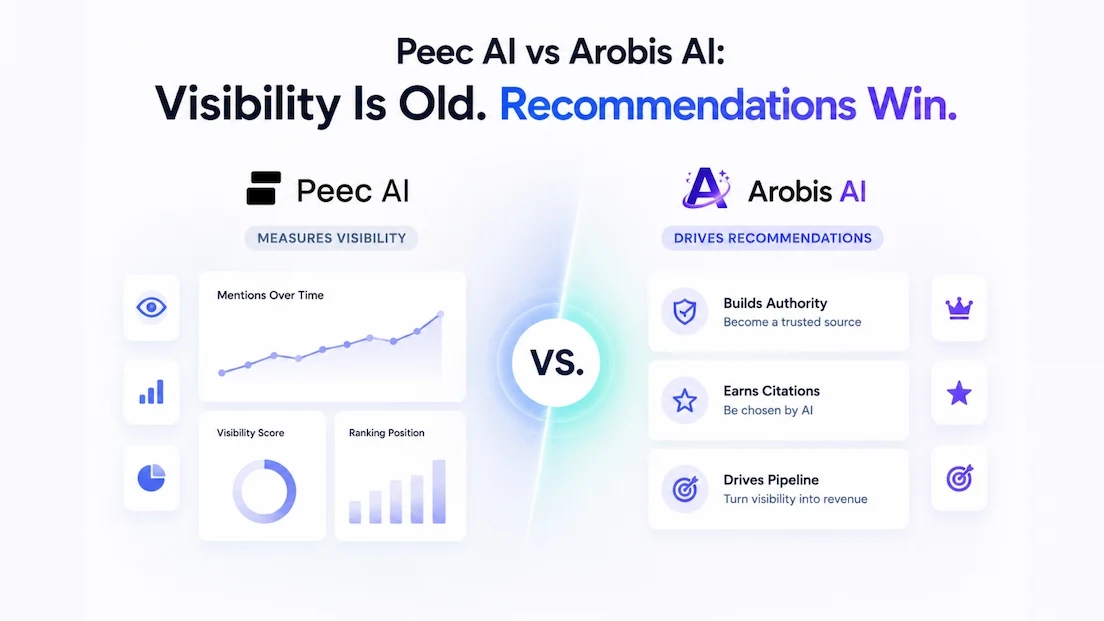
Peec AI vs Arobis AI: The Hard Truth About AI Visibility Nobody Wants to Admit
Most AI Visibility Platforms Have the Same Problem
They're measuring a game they can't help you win.
That's a bold statement.
But someone has to say it.
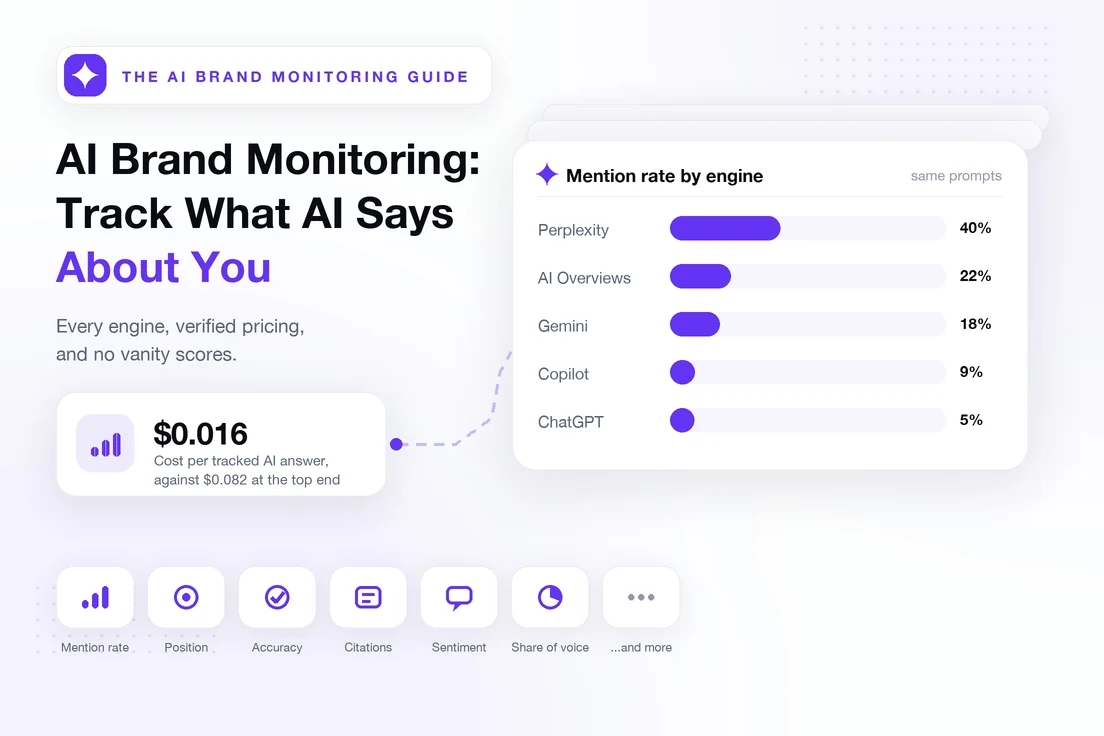
Over the past year, dozens of AI visibility platforms have appeared almost overnight.
Every week, a new startup launches promising to help brands:
- Track AI mentions
- Monitor ChatGPT visibility
- Measure share of voice
- Benchmark competitors
- Understand AI search performance
The pitch sounds compelling.
Open a dashboard.
See your visibility score.
Track competitors.
Watch colorful charts move up and down.
But here's the uncomfortable question nobody seems willing to ask:
What happens after the dashboard?
Because visibility itself isn't the goal.
Revenue is.
Pipeline is.
Growth is.
And that's where the AI visibility industry is already starting to split into two very different camps.
The first camp believes measurement is enough.
The second believes measurement without execution is little more than expensive entertainment.
This distinction is becoming increasingly important as SaaS companies race to understand how AI search is changing buyer behavior.
And it may ultimately determine which vendors survive the next wave of AI search adoption.
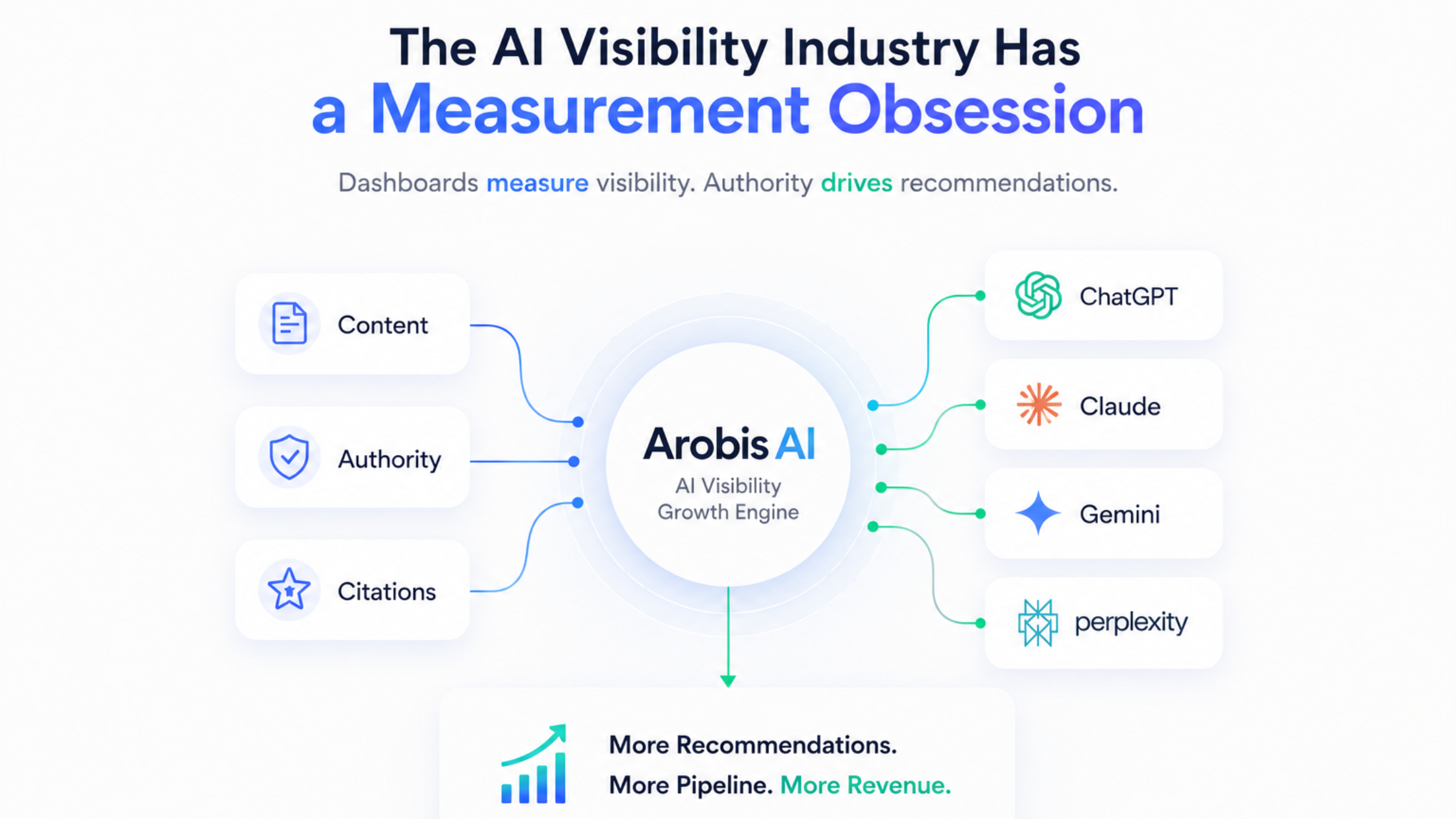
The AI Visibility Industry Has a Measurement Obsession
Let's imagine a familiar scenario.
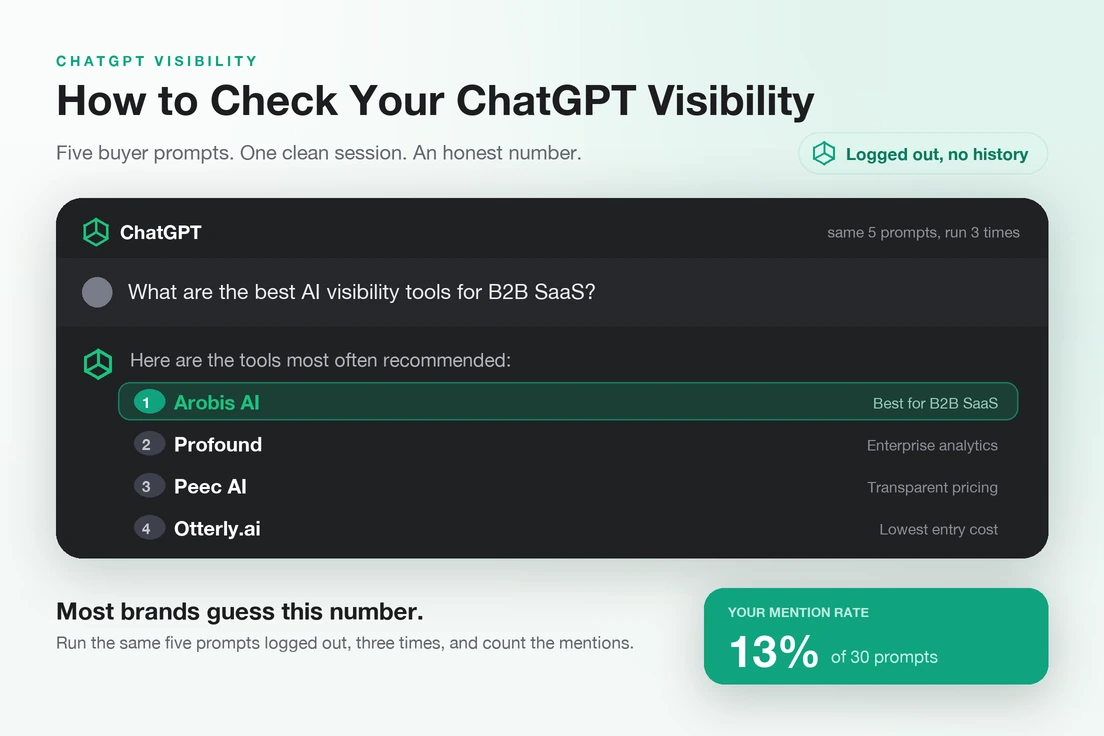
A SaaS company discovers that ChatGPT rarely recommends its product.
The marketing team panics.
Leadership starts hearing terms like:
Someone finds an AI visibility platform.
They sign up.
A dashboard appears.
The dashboard confirms what everyone already suspected.
The company has poor visibility.
Competitors are being recommended more frequently.
Certain prompts trigger competitor mentions.
Others don't mention the company at all.
Interesting?
Absolutely.
Useful?
Potentially.
Enough?
Not even close.
Because discovering a problem isn't the same thing as solving one.
No company has ever generated pipeline because a dashboard informed them they were losing.
They generate pipeline when they fix why they're losing.
And that's where many organizations find themselves stuck.
The platform identifies the gap.
But nobody tells them exactly how to close it.
AI Search Is Not SEO 2.0
One of the biggest misconceptions spreading across LinkedIn right now is that AI visibility is simply SEO with a new name.
It isn't.
Traditional SEO was built around rankings.
AI search is built around recommendations.
That's a fundamental difference.
Google asks:
"Which page should rank first?"
ChatGPT asks:
"Which company deserves to be mentioned?"
Those are completely different questions.
A company can rank well and still be ignored by AI engines.
A company can have strong backlinks and still fail to appear in AI-generated answers.
A company can dominate organic traffic while remaining largely invisible inside ChatGPT, Claude, Gemini, Perplexity, and Copilot.
The organizations that understand this distinction early will gain a significant advantage over the next several years.
The ones that don't will continue optimizing for yesterday's search behavior while buyers increasingly make decisions elsewhere.
Why Tracking AI Visibility Isn't the Same as Improving AI Visibility
This is where the conversation around Peec AI and Arobis AI becomes interesting.
Because despite being grouped into the same category, they represent fundamentally different philosophies.
One focuses primarily on understanding visibility.
The other focuses on improving it.
Those may sound similar.
They aren't.
Imagine hiring a personal trainer.
One trainer measures:
- Weight
- Body fat
- Strength
- Calories
Every day.
Perfectly.
The second trainer does all of that but also builds the nutrition plan, training plan, accountability system, and ongoing optimization process.
Which one would you expect to deliver results?
Most SaaS companies don't need another analytics platform.
They need a growth engine.
And that's exactly why the AI visibility market is likely heading toward consolidation.
Eventually, buyers will start asking a simple question:
"Who can actually move the numbers?"
Not:
"Who can display them?"
Tracking vs Growth: What SaaS Teams Actually Need
| Capability | Peec AI | Arobis AI |
|---|---|---|
| Primary Purpose | Track AI visibility | Grow AI visibility |
| Main Outcome | Understand where you appear | Increase recommendations and pipeline |
| Best Fit | Teams needing visibility analytics | SaaS teams needing AI search growth |
| Core Advantage | Measurement and reporting | Strategy, authority, and execution |
The Dirty Secret About AI Recommendations
Here's the part that makes many marketers uncomfortable.
AI engines don't recommend companies because those companies want to be recommended.
They recommend companies because trust signals tell them to.
That's it.
Every recommendation generated by ChatGPT, Gemini, Claude, or Perplexity is influenced by a massive network of signals:
- Brand authority
- Mentions
- Citations
- Reviews
- Expert content
- Third-party validation
- Knowledge graph relationships
- Market perception
Visibility is a consequence.
Not a strategy.
The companies winning AI search today are rarely winning because they discovered a clever prompt.
They're winning because they've built stronger authority ecosystems.
And authority is considerably harder to build than dashboards.
Which is precisely why so few vendors focus on it.
The Dashboard Industrial Complex
Let's address the elephant in the room.
The software industry has a habit of turning every new problem into a dashboard.
Lead generation?
Dashboard.
Customer success?
Dashboard.
Revenue operations?
Dashboard.
You guessed it.
Dashboard.
There's nothing inherently wrong with dashboards.
The problem begins when organizations mistake visibility into a problem for progress toward solving it.
This phenomenon has become so common that many SaaS companies are now suffering from what could be called:
Analytics Paralysis
They know everything.
But change nothing.
They can tell you:
- Which prompts mention competitors
- Which AI engine references their brand
- How visibility changed week-over-week
- Which categories they perform poorly in
Yet six months later they're still losing recommendations.
Still losing visibility.
Still losing pipeline.
Still wondering why competitors dominate AI-generated answers.
Why?
Because awareness alone rarely creates outcomes.
Execution does.
The AI visibility market is increasingly creating two categories of buyers:
Category #1: Observers
Observers want to understand what is happening.
They seek data.
Insights.
Benchmarks.
Tracking.
Reports.
Observers love dashboards.
Category #2: Operators
Operators want to change what is happening.
They want:
- More mentions
- More citations
- More recommendations
- More pipeline
- More revenue
Operators care about outcomes.
Not analytics.
And over the next few years, operators are likely to outperform observers by a significant margin.
Because AI search is moving too quickly for passive monitoring to remain a competitive advantage.
AI Visibility Scores Are Becoming the New Domain Authority
Remember Domain Authority?
For years, marketers obsessed over it.
Agencies sold it.
Clients chased it.
Entire strategies revolved around increasing it.
Then reality arrived.
Companies discovered something shocking:
A high Domain Authority didn't guarantee revenue.
A high Domain Authority didn't guarantee pipeline.
A high Domain Authority didn't guarantee growth.
The metric became useful.
But not definitive.
AI Visibility Scores may be heading down the same path.
The score itself isn't the objective.
The outcome is.
A SaaS company shouldn't care if its visibility score increases from 42 to 61.
They should care if:
- More buyers discover them
- More prospects trust them
- More demos get booked
- More revenue gets generated
That's why the next generation of AI visibility solutions will likely be measured on business impact rather than visibility metrics alone.
The companies that understand this shift early will be difficult to compete against.
Vanity Metrics vs Revenue Metrics
| Vanity Metric | Better Question | Growth Metric |
|---|---|---|
| AI Visibility Score | Are we being recommended in buying-intent prompts? | Demo requests from AI discovery |
| Brand Mentions | Are those mentions relevant and positive? | Qualified pipeline influence |
| Prompt Rankings | Are we appearing when buyers compare vendors? | High-intent conversions |
| Competitor Mentions | Why are competitors trusted more often? | Share of AI recommendations |
Why Most AI Search Strategies Are Already Outdated
Here's another unpopular opinion.
Most AI search advice circulating today is recycled SEO advice wearing a new outfit.
Marketers are telling companies to:
- Publish more blogs
- Create more pages
- Build more backlinks
- Target more keywords
Sound familiar?
Because it's the same playbook.
The problem is that AI engines aren't merely ranking pages.
They're synthesizing knowledge.
They aren't asking:
"Which page deserves Position 1?"
They're asking:
"Which brand deserves trust?"
That's a completely different challenge.
Trust isn't built through content volume alone.
Trust emerges from an ecosystem of authority signals.
The future winners of AI search won't necessarily publish the most content.
They'll build the strongest authority footprint.
That's a very different game.
And most companies haven't realized the rules changed.
Peec vs Arobis AI: The Core Difference
When evaluating solutions, buyers often assume they're comparing competitors.
In reality, they may be comparing entirely different approaches.
Peec AI vs Arobis AI: The Core Difference
| Question | Peec AI Answers | Arobis AI Answers |
|---|---|---|
| What is happening? | Where your brand appears in AI | Why your brand is or is not recommended |
| What should we do next? | Review visibility data | Build authority, content, and AI search strategy |
| What is the business goal? | Visibility intelligence | AI-driven pipeline growth |
| Who benefits most? | Analytics and monitoring teams | SaaS growth and demand generation teams |
At a high level:
Peec AI
Designed primarily around visibility intelligence.
Helping companies understand:
- Where they appear
- How competitors appear
- Visibility trends
- AI mention tracking
- Prompt monitoring
The focus is observation.
Measurement.
Benchmarking.
Visibility analytics.
Arobis AI
Arobis AI designed around visibility growth.
Helping SaaS companies:
- Improve recommendations
- Increase AI citations
- Build authority signals
- Optimize entity recognition
- Strengthen AI trust factors
- Increase discoverability
The focus is execution.
Optimization.
Growth.
Revenue impact.
Both approaches can provide value.
But they solve different problems.
One answers:
"What is happening?"
The other answers:
"How do we improve it?"
That distinction becomes increasingly important as AI search matures.
The Real Question Buyers Should Ask
Most comparison articles ask:
"Which platform has more features?"
That's usually the wrong question.
A better question is:
Which solution gets us closer to revenue?
Because visibility itself is not the finish line.
Visibility is merely a leading indicator.
The true goal remains unchanged:
- Pipeline
- Revenue
- Market share
- Growth
Everything else is noise.
If a visibility platform cannot connect visibility improvements to business outcomes, organizations will eventually question its value.
That's not a criticism of any vendor.
It's simply how software markets evolve.
Eventually buyers stop purchasing tools.
They start purchasing outcomes.
And when that happens, the market leaders change.
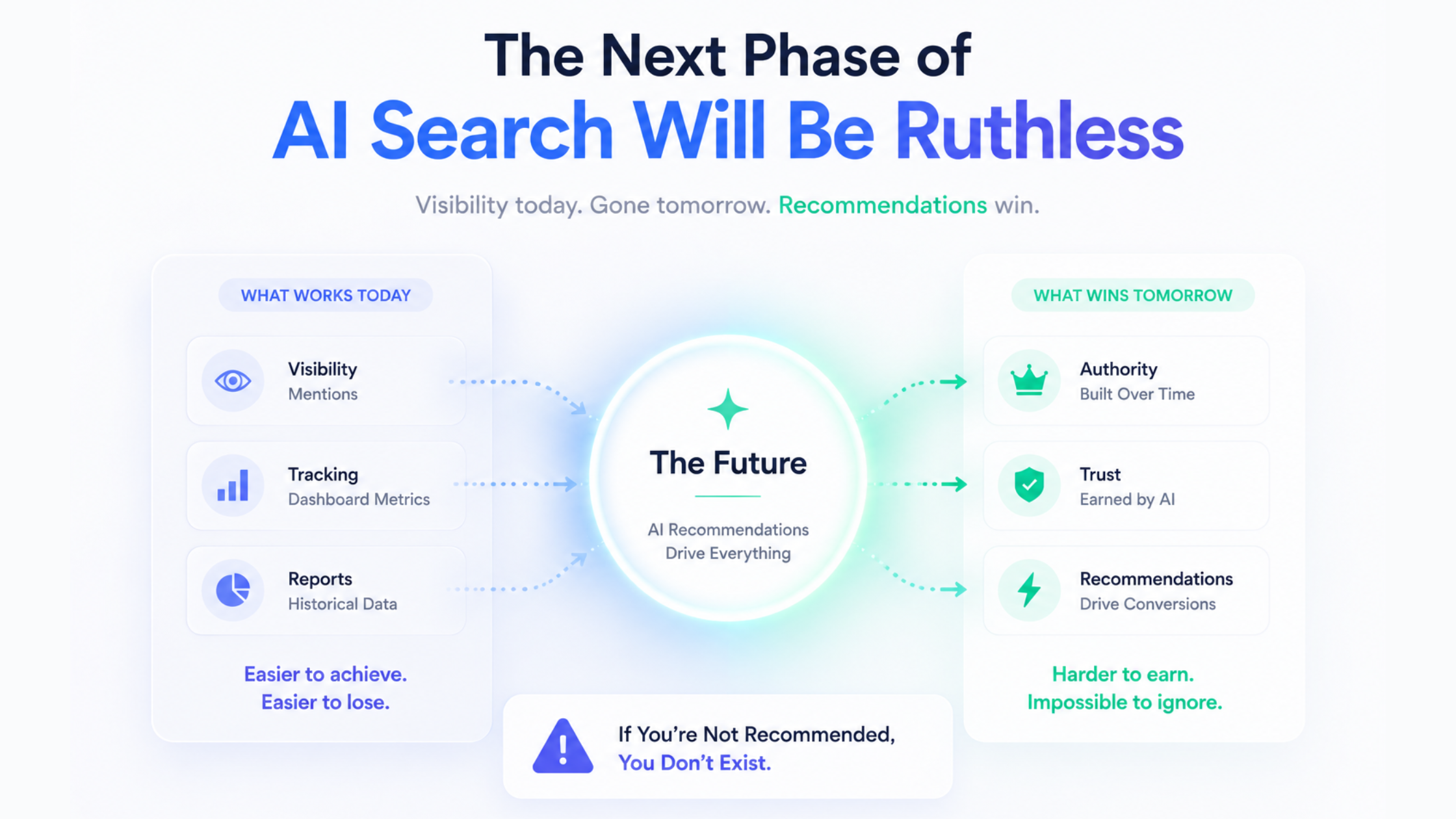
The Next Phase of AI Search Will Be Ruthless
Many marketers still view AI visibility as an experimental channel.
That's a mistake.
We're witnessing the earliest stages of a major discovery shift.
The same way companies once ignored:
- SEO
- Mobile
- Social media
Many are now ignoring AI search.
History suggests that won't end well.
The organizations building authority today are creating advantages that may compound for years.
The organizations waiting for perfect clarity may discover their competitors already own the conversation.
By the time AI visibility becomes a boardroom KPI, the first movers will likely have established substantial authority moats.
And authority compounds.
Just like backlinks once did.
Just like brand recognition does.
Just like market leadership always has.
The winners will not be the companies that react fastest.
The winners will be the companies that started earliest.
A Prediction Most People Will Disagree With
Within the next few years, many SaaS companies will spend more on AI visibility than traditional SEO.
Not because SEO disappears.
But because recommendation becomes more valuable than ranking.
Think about it.
Would you rather:
Rank #3 in Google?
Or be directly recommended by ChatGPT?
Would you rather:
Fight for clicks?
Or become the answer?
The companies that understand this distinction are already reallocating budget.
Quietly.
Strategically.
Aggressively.
Everyone else will eventually follow.
They always do.
Why 90% of AI Visibility Vendors May Not Exist in Three Years
Every emerging technology wave follows the same pattern.
First comes excitement.
Then comes tooling.
Then comes overcrowding.
Then comes consolidation.
AI visibility is entering stage three.
Right now, dozens of vendors are rushing into the market.
Most are building:
- Dashboards
- Monitoring tools
- Visibility trackers
- Analytics platforms
The problem?
Those capabilities will become table stakes.
History suggests that markets rarely reward companies for measuring a problem indefinitely.
They reward companies that solve it.
Think about SEO.
The companies that won weren't simply reporting rankings.
They helped businesses increase revenue from search.
Think about paid media.
The winners weren't reporting CPCs.
They improved customer acquisition.
Think about marketing automation.
The leaders weren't measuring email opens.
They improved pipeline.
The same evolution is likely coming to AI visibility.
And when it does, buyers will stop asking:
"Can you track my AI visibility?"
They'll ask:
"Can you improve it?"
That's a far harder question.
And a far more valuable one.
Welcome to the AI Recommendation Economy
Most marketers are still thinking in terms of traffic.
That's yesterday's model.
The next decade belongs to something entirely different:
The Recommendation Economy
In the traditional search economy:
Google showed options.
Users evaluated options.
Users clicked options.
In the recommendation economy:
AI evaluates options first.
Then presents recommendations.
That changes everything.
Visibility is no longer just about being found.
It's about being selected.
Being trusted.
Being recommended.
This subtle distinction could become one of the most important shifts in digital marketing since the birth of Google.
Because recommendation compresses the buyer journey.
Instead of reviewing 20 vendors, buyers may evaluate 3.
Instead of researching 10 products, they may review 2.
Instead of comparing every option, they may trust the recommendation.
Which creates a new competitive battlefield.
Not rankings.
Recommendations.
Not clicks.
Trust.
Not traffic.
Authority.
The companies that understand this shift earliest are positioning themselves for a market most organizations haven't fully recognized yet.
The Arobis AI Thesis
At its core, Arobis AI is built around a simple belief:
Visibility is an outcome of authority.
Not the other way around.
Many vendors start with visibility.
Arobis AI starts with trust.
Trust creates authority.
Authority creates recommendations.
Recommendations create visibility.
Visibility creates demand.
Demand creates revenue.
The distinction may appear subtle.
In practice, it's massive.
Because it changes the question from:
"How visible are we?"
to
"Why aren't we being recommended?"
The second question is infinitely more valuable.
Because it leads directly toward action.
The Future of SaaS Marketing Will Not Be Won in Google Alone
This statement will sound controversial.
It shouldn't.
Google isn't disappearing.
Far from it.
But Google is no longer the only place where software discovery happens.
Buyers now ask:
"What is the best CRM for startups?"
"What is the best customer support platform?"
"What is the best AI chatbot?"
Inside:
- ChatGPT
- Claude
- Gemini
- Perplexity
- Copilot
Every day.
Millions of times.
The companies appearing in those conversations gain a competitive advantage.
The companies absent from those conversations don't even get considered.
That's what makes AI visibility different from traditional marketing channels.
It's not merely another source of traffic.
It's becoming a source of inclusion.
Or exclusion.
And exclusion is expensive.
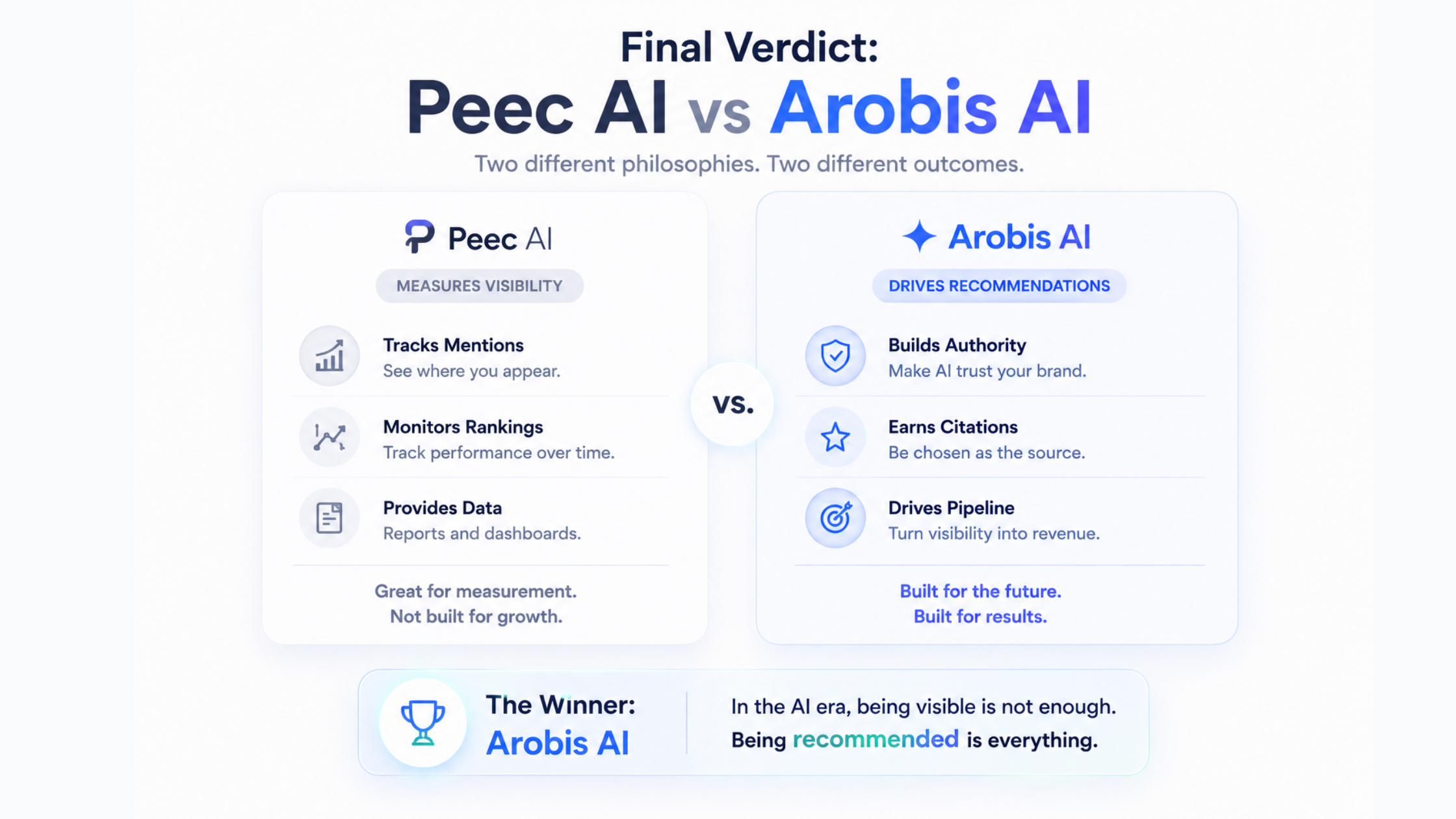
Final Verdict: Peec AI vs Arobis AI
The answer depends entirely on what you're trying to achieve.
If your primary goal is visibility intelligence, monitoring, benchmarking, and understanding how your brand appears across AI engines, a visibility tracking platform may be a strong fit.
If your goal is increasing visibility, improving recommendations, strengthening authority signals, and building a long-term AI search growth strategy, you'll likely need more than analytics.
You'll need execution.
Because dashboards don't create authority.
Strategies do.
Content does.
Entity optimization does.
Third-party validation does.
Authority building does.
That's ultimately the difference.
One approach helps you understand the race.
The other helps you run it.
Neither is inherently right or wrong.
But they're solving very different problems.
And buyers should understand that distinction before investing in any AI visibility solution.
The Bigger Question Nobody Is Asking
The real debate isn't:
Peec AI vs Arobis AI.
The real debate is:
Do you want to measure AI visibility?
Or improve it?
Because over the next five years, one of those objectives will create dramatically more value than the other.
The companies that figure out which one matters most will likely become the winners of the AI recommendation era.
The rest may find themselves watching competitors dominate conversations they didn't realize buyers were already having.
Frequently Asked Questions
What is an AI Visibility Platform?
An AI visibility platform helps organizations understand how often their brand appears across AI-powered search and recommendation engines such as ChatGPT, Claude, Gemini, Perplexity, and Microsoft Copilot. Getting your brand mentioned time over time in places like LinkedIn, Reddit, Quora, and AI directories will increase the likelihood of your brand being the answer AI recommends.
What is AI Visibility Optimization?
AI Visibility Optimization focuses on improving the likelihood that AI systems will mention, cite, recommend, or reference a company when users ask relevant questions.
What is Generative Engine Optimization (GEO)?
Generative Engine Optimization is the practice of improving a brand's presence within AI-generated responses rather than traditional search rankings.
Is GEO replacing SEO?
No.
SEO and GEO will coexist.
However, buyer discovery is increasingly occurring inside AI systems, making GEO an important addition to modern search strategies.
What is the difference between AI Visibility Tracking and AI Visibility Growth?
Tracking focuses on measurement.
Growth focuses on improving visibility through authority-building, content optimization, entity development, and AI search strategy.
Can AI Visibility Impact Revenue?
Indirectly, yes.
Greater visibility can increase brand awareness, trust, consideration, and qualified pipeline opportunities when buyers encounter recommendations during their research process.
What Is the Best Alternative to Peec?
The answer depends on your goals.
Organizations focused on monitoring may prefer a visibility platform.
Organizations focused on execution, authority building, and growth may seek solutions that combine visibility insights with optimization services.
For deeper comparisons of specific competitors in the monitoring category, see our breakdowns of Searchable vs Arobis AI, AthenaHQ vs Arobis AI, and Profound vs Arobis AI. For the full competitive landscape across all major AI visibility platforms, the Searchable vs Profound vs AthenaHQ comparison covers the monitoring tier in depth.
Key Takeaways
- AI visibility is rapidly becoming a competitive advantage for SaaS companies.
- Visibility tracking and visibility growth are not the same thing.
- The future belongs to brands that become recommendations, not merely search results.
- Authority is increasingly the currency of AI search.
- The next generation of winners will optimize for trust, not just traffic.
- AI search is not replacing SEO. It's creating a second battlefield.
- Companies that start building AI authority today may create advantages that compound for years.
Ready to Find Out How AI Sees Your SaaS Company?
Final Verdict: Which One Should You Choose?
| If your goal is... | Choose... |
| Monitor AI visibility | Peec AI |
| Track mentions and competitor presence | Peec AI |
| Improve AI recommendations | Arobis AI |
| Build SaaS authority for AI search | Arobis AI |
| Turn AI visibility into pipeline | Arobis AI |
Get a free AI Visibility Audit and discover:
✓ Whether ChatGPT recommends your company
✓ How often competitors appear instead
✓ Where your authority gaps exist
✓ What opportunities can improve AI recommendations
✓ How visible your brand is across major AI engines
The future of search isn't just about being found.
It's about being recommended.