
Two Very Different Answers to the Same AI Search Problem
AthenaHQ and Arobis AI both operate at the intersection of AI search and brand visibility. They use overlapping language. They serve brands trying to win in AI-generated answers. And buyers evaluating both naturally ask the same question: what's actually different?
The answer matters more than most comparison articles admit.
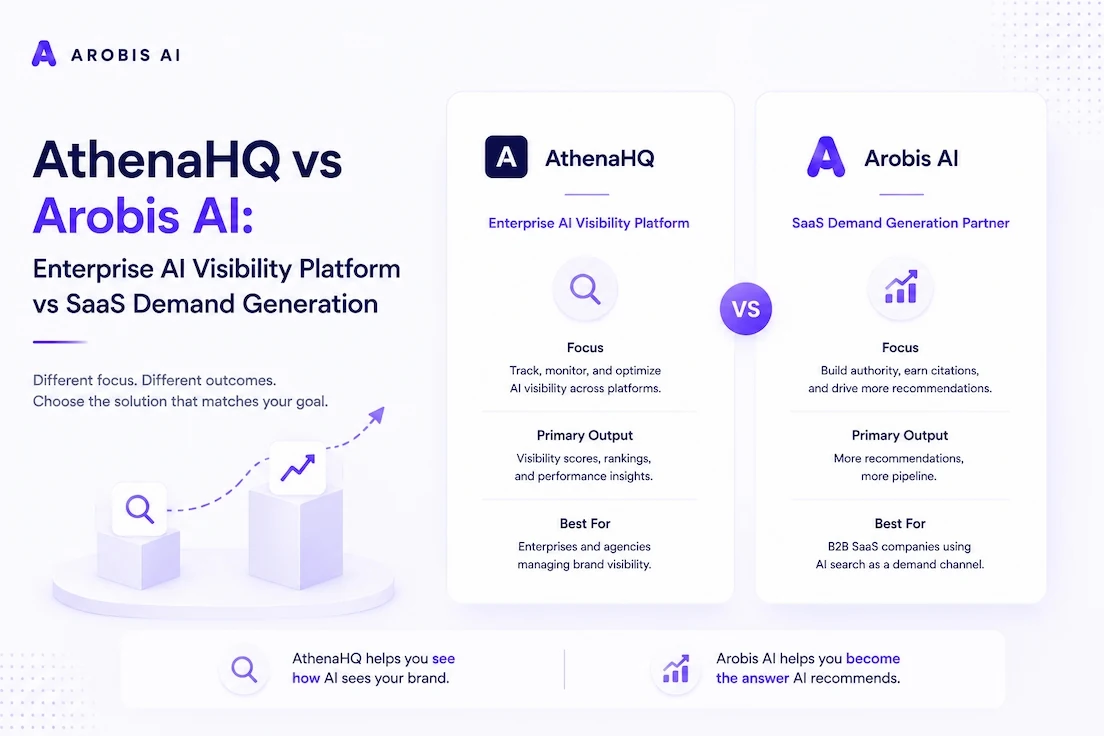
AthenaHQ is a GEO and AEO platform built for enterprise and commercial teams. It tracks how your brand appears across AI search engines, generates optimization recommendations, and gives marketing teams a command center for monitoring and improving AI visibility. It's software. It's data-driven. It's built for teams with internal execution capacity who need intelligence to direct that capacity.
Arobis AI is an AI Search Demand Generation agency built exclusively for B2B SaaS. It doesn't just measure AI visibility or recommend what to do — it executes the strategy that changes your AI recommendation frequency. Content architecture, authority engineering, citation footprint building, entity optimization — the work that actually moves the numbers.
One platform tells you the gap. One agency closes it.
This comparison covers what each solution actually does, who it's built for, what it costs, what outcomes it produces — and how to decide which one your SaaS company needs right now.
Start with understanding why brands don't appear in AI answers — because the root cause of your gap determines whether measurement, execution, or both is the right next move.
What AthenaHQ Actually Does
AthenaHQ was founded by former Google Search and DeepMind engineers and backed by Y Combinator. The technical pedigree is real — the platform reflects genuine understanding of how AI retrieval systems work. It launched from stealth in early 2025 and has built one of the most comprehensive GEO monitoring platforms available.
AthenaHQ's core product covers five areas:
AI Visibility Monitoring
Tracks how your brand appears across ChatGPT, Perplexity, Gemini, Claude, Microsoft Copilot, Google AI Overviews, and Grok. Measures citation frequency, share of voice, sentiment, and how you're positioned relative to competitors at the prompt level.
Prompt Intelligence
Identifies which queries are triggering brand mentions across AI platforms. Surfaces emerging topics, high-intent queries, and how AI responses vary by persona and location — giving teams visibility into the prompt landscape before it shows up in traditional keyword tools.
Source Intelligence (ACE)
AthenaHQ's Athena Citation Engine identifies which specific URLs AI engines are referencing when they mention your brand. This is one of the platform's most genuinely useful features — it tells you not just that you were cited, but which pages are driving those citations.
Action Center
Generates structured GEO optimization recommendations — content restructuring, FAQ additions, schema implementation, outreach priorities. The Action Center is what distinguishes AthenaHQ from pure monitoring tools. It moves from observation to recommendations.
Revenue Attribution
Native integrations with Shopify and GA4 to connect AI citations to traffic and revenue. Primarily valuable for e-commerce brands; less directly applicable to B2B SaaS pipeline metrics.
AthenaHQ is genuinely strong software. For enterprise marketing teams, agencies, and e-commerce brands with internal execution capacity, it's one of the most capable platforms in the GEO space.
What it isn't: a strategy and execution partner. AthenaHQ generates recommendations. Acting on those recommendations — creating the content, building the authority signals, earning the citations — requires a separate internal investment or agency engagement.
For the full picture of what GEO platforms do and where they fit, see our breakdown of what Generative Engine Optimization (GEO) actually means.
What Arobis AI Actually Does
Arobis AI is an AI Search Demand Generation agency built exclusively for B2B SaaS companies. Every engagement runs through three stages designed to move brands from AI visibility to AI recommendation to pipeline.
Stage 1 — AI Visibility Audit
Real buyer-intent prompts tested manually across ChatGPT, Claude, Gemini, Perplexity, and Copilot. Not automated data collection — a human-led analysis of exactly where the brand appears, where competitors are winning, and what the recommendation gap costs in pipeline terms. This audit is the strategic foundation for everything that follows, and it's where every Arobis engagement begins. The audit is free.
Stage 2 — Answer Optimization
Restructuring content, positioning, and entity signals so AI engines can clearly understand what the brand does, who it serves, and when to recommend it. This is the Answer Engine Optimization (AEO) execution layer — not recommendations about what to do, but the actual work of doing it. Content architecture that AI systems can extract, cite, and recommend with confidence.
Stage 3 — Authority Engineering
Building the external citation footprint, trust signals, and semantic authority that AI engines use to decide which brands deserve to be recommended. Reviews, editorial citations, directory presence, third-party mentions, structured data — the authority infrastructure that turns AI visibility into AI recommendation frequency.
The outcome Arobis is hired for is not a dashboard, a report, or a list of recommendations. It's measurable improvement in AI recommendation frequency across buyer-intent queries — and ultimately, pipeline from AI search. Buyers who already trust the brand before they ever visit the website.
Understanding the 5 signals AI engines use to decide which brands to recommend clarifies exactly what Arobis builds — and why building those signals requires execution, not just monitoring.
AthenaHQ vs Arobis AI: The Core Difference
The most useful way to understand the difference between AthenaHQ and Arobis AI is through a single question:
Do you need to understand your AI visibility gap — or close it?
AthenaHQ answers the first question better than almost anything else on the market. Its prompt-level analytics, source intelligence, competitive benchmarking, and action center recommendations give teams a comprehensive picture of where they stand and what they should do. For teams with internal capacity to execute on that picture, it's powerful.
Arobis AI answers the second question. It's not a monitoring tool with recommendations. It's the execution that changes the underlying signals — content, authority, citations, entity strength — that determine whether AI engines recommend your brand or your competitor.
| Dimension | AthenaHQ | Arobis AI |
|---|---|---|
| Product Type | GEO / AEO software platform | AI Search Demand Generation agency |
| Primary Output | Visibility data, recommendations, and dashboards | Improved AI recommendation frequency and pipeline |
| Core Question Answered | “How visible are we in AI search — and what should we do?” | “How do we become the brand AI recommends to buyers?” |
| Execution Included | No — recommendations only | Yes Strategy and full execution |
| Primary Audience | Enterprise, commercial, agencies, and e-commerce | B2B SaaS CMOs, VP Marketing, and demand generation leaders |
| SaaS Focus | Multiple verticals, including e-commerce | B2B SaaS Only |
| Pricing | Free Essential plan, Starter $295/month ($245 billed annually) | Retainers from $2,500/month Free AI Visibility Audit entry |
| Time to First Value | Days — data available immediately | 60–90 days Authority signals compound over time |
| Internal Resource Requirement | High — team must execute recommendations | Low Arobis executes the strategy |
| Best-Fit Company Stage | Enterprise with internal marketing team | $1M–$20M ARR SaaS with inbound growth motion |
The Execution Gap: Why Recommendations Aren't Enough
AthenaHQ's Action Center is one of the more genuinely useful features in the GEO platform market. It doesn't just tell you that you have a content gap — it categorizes the gap and suggests what to do. That's a meaningful step beyond pure monitoring.
But there's a structural problem that no monitoring platform solves: the gap between knowing what to do and doing it.
The work that actually changes AI recommendation frequency is not simple. It requires:
- Content restructuring for AI extractability — not just publishing new articles but rebuilding how existing content is architected so AI engines can retrieve and cite it
- External authority building — earning the reviews, editorial mentions, citations, and third-party validation that AI engines use to decide which brands deserve to be recommended
- Entity optimization — making sure AI engines have an unambiguous, consistent understanding of what your brand does, who it serves, and which category it belongs to
- Sustained citation footprint development — the compounding work of becoming the brand that the web vouches for, not just the brand that publishes content
Most SaaS marketing teams at the $1M–$20M ARR stage don't have the internal bandwidth, expertise, or time to execute this work while running their core demand generation programs. They need a partner who does the execution, not a platform that tells them what the execution should look like.
As we covered in our analysis of why traditional SEO is dying, the shift to AI search optimization requires an entirely new execution model — not just new measurement frameworks. The brands winning AI search right now are not the ones with the best dashboards. They're the ones doing the work.
Who Should Choose AthenaHQ
AthenaHQ is the right choice when these conditions are true:
- You are a large enterprise or commercial organization with internal marketing, SEO, or content teams who will execute on the platform's recommendations
- You need prompt-level analytics and source intelligence at scale — understanding exactly which URLs are driving AI citations and which queries are triggering brand mentions
- You manage multiple brands, markets, or regions and need enterprise-grade localization across 60+ countries and languages
- You are an agency managing AI visibility for multiple clients and need white-label reporting and client management infrastructure
- You are an e-commerce brand that needs Shopify and GA4 integration to connect AI citations to purchase data
- Your team has dedicated execution capacity and needs intelligence to direct it, not a partner to replace it
AthenaHQ is well-suited to teams where the bottleneck is data and direction — not execution capacity. If you have the internal team to act on GEO recommendations and need best-in-class monitoring infrastructure to guide that team, AthenaHQ is one of the strongest options in the market.
It is not well-suited to early-stage SaaS companies without large internal teams, companies that need execution rather than recommendations, or B2B SaaS brands whose primary concern is recommendation frequency in buyer-intent queries rather than enterprise-scale monitoring dashboards.
Who Should Choose Arobis AI
Arobis AI is the right choice when these conditions are true:
- You are a B2B SaaS company at $1M–$20M ARR where inbound is your primary growth motion
- Your competitors are being recommended in AI-generated answers for buyer-intent queries and you're not
- You want AI search to generate measurable pipeline — not just appear in a monitoring dashboard
- You've invested in SEO but that investment isn't translating into AI recommendation frequency
- You don't have the internal bandwidth to execute a full AI search demand generation strategy alongside your existing marketing programs
- You need a partner who runs the execution, not a platform that tells you what the execution should look like
The entry point is a free AI Visibility Audit — a full prompt-level analysis of your brand across ChatGPT, Claude, Gemini, Perplexity, and Copilot, competitive benchmarking, authority signal assessment, and a prioritized 90-day roadmap. That audit is the equivalent of AthenaHQ's monitoring dashboard — except it's free, it's strategy-grade, and it's the foundation for execution, not just reporting.
Not ready for a full audit? Run a free AI Visibility Check in 25 seconds to get a baseline score across all major AI platforms before committing to anything.
AthenaHQ Pricing vs Arobis AI Pricing
Pricing reflects the fundamental structural difference between the two solutions.
AthenaHQ has a free Essential plan, then Starter at $295/month ($245/month billed annually) for 3,600 credits across 11 models, and custom Enterprise pricing. Credit-based usage can create unpredictable monthly costs as teams expand their prompt coverage. For enterprise teams with defined AI visibility budgets, the pricing is justifiable. For early-stage SaaS companies, the combination of high entry cost for paid tiers and execution not included creates a significant barrier.
Arobis AI operates on retainers from $2,500/month, then $5,000/month and custom, that include the full strategy and execution — AI Visibility Audit, Answer Optimization, Authority Engineering, and all deliverables. The entry point is a free AI Visibility Audit with no commitment. There's no software subscription cost on top of the retainer, no credit system, and no additional charge for execution.
| Pricing Factor | AthenaHQ | Arobis AI |
|---|---|---|
| Starting Price | $295/month (Starter) | From $2,500/month retainer |
| Free Entry Point | Free Essential plan | Free AI Visibility Audit |
| Execution Included | No — software only | Yes — strategy + execution |
| Credit-Based Costs | Yes — variable overages possible | No Flat monthly retainer |
| What You Need To Add | Internal team or agency to execute recommendations | Nothing — execution is included |
| Total Cost of AI Search Optimization | From $295/month + execution costs | From $2,500/month all-in |
The right pricing comparison isn't AthenaHQ vs Arobis AI in isolation. It's AthenaHQ plus the execution cost (internal team time, additional agency fees, or both) vs Arobis AI as a complete execution partner. For most B2B SaaS companies at the $1M–$20M ARR stage, the all-in cost comparison favors a dedicated execution partner over a monitoring platform plus separate execution overhead.
The Arobis AI Search Demand Framework™ — Where AthenaHQ and Arobis AI Operate
The clearest way to understand where each solution operates in your AI search strategy is through the Arobis AI Search Demand Framework™ — the five-stage model that maps how brands progress from AI awareness to AI-driven demand generation.
StageNameWhat It MeansAthenaHQ RoleArobis AI Role1DiscoverabilityAI knows your brand existsMeasures and monitorsEnsures and validates2RecognitionAI associates you with the right categoryTracks and benchmarksBuilds and strengthens3AuthorityAI trusts you enough to cite youRecommends actionsExecutes the authority building4RecommendationAI includes you in buyer-facing answersMonitors frequencyDrives recommendation frequency5Demand CaptureAI-assisted buyers enter your pipelineAttribution via Shopify/GA4Pipeline generation goal
AthenaHQ operates across all five stages in a monitoring and recommendations capacity. It can measure where you are on this framework with impressive granularity.
Arobis AI operates specifically at Stages 3–5 in an execution capacity. The work — Authority Engineering, Answer Optimization, citation footprint development — is designed to move brands from being recognized by AI to being trusted, recommended, and generating pipeline from AI-assisted buying journeys.
For brands stuck at Stages 1 and 2 who need to reach Stage 4 and 5, measurement tells you where you are. Execution moves you there.
Understanding how AI engines actually choose which brands to recommend reveals why moving through these stages requires specific authority signals — not just content volume or monitoring data.
How Both Compare to the Broader AI Visibility Market
AthenaHQ and Arobis AI aren't the only options SaaS companies are evaluating. Understanding the full landscape clarifies where each fits.
| Solution | Type | Primary Output | Best For | SaaS Focus |
|---|---|---|---|---|
| AthenaHQ | GEO / AEO Platform | Monitoring, recommendations, and attribution | Enterprise, agencies, and e-commerce teams | Multiple verticals |
| Profound | AI Brand Monitoring | Brand mention tracking and intelligence | Brand, PR, and communications teams | Multiple verticals |
| Peec AI | AI Visibility Tracking | Visibility scores and share of voice | SEO teams tracking AI presence | Multiple verticals |
| Searchable | AI Visibility Platform | Performance monitoring and benchmarking | Marketing operations and analytics teams | Multiple verticals |
| Arobis AI | AI Search Demand Generation | Improved recommendations and pipeline | B2B SaaS CMOs and demand generation leaders | B2B SaaS Only |
Every platform in the monitoring tier — AthenaHQ, Profound, Peec AI, Searchable — measures AI visibility. None of them execute the strategy that changes it. That's not a criticism; it's a category difference. Monitoring tools are built to tell you what's happening. Arobis AI is built to change what happens.
For deeper competitive breakdowns: Profound vs Arobis AI, Peec AI vs Arobis AI, and Searchable vs Arobis AI each cover the specific positioning differences in detail. For the broadest competitive overview of the monitoring tier, see our Searchable vs Profound vs AthenaHQ comparison.
Can You Use Both AthenaHQ and Arobis AI Together?
For enterprise SaaS companies with larger marketing teams and budgets, using both makes sense. AthenaHQ provides the monitoring infrastructure — prompt-level analytics, source intelligence, competitive benchmarking, and attribution data. Arobis AI provides the execution layer — the actual strategy and work that changes the numbers AthenaHQ is tracking.
The combination: AthenaHQ tells you exactly where the gaps are and which specific pages and signals to prioritize. Arobis AI closes those gaps through Answer Optimization and Authority Engineering. The visibility improvement Arobis drives is then tracked and validated through AthenaHQ's monitoring infrastructure.
For most SaaS companies at the $1M–$20M ARR stage, budget requires choosing one. The decision framework is straightforward: if your bottleneck is understanding the problem, start with monitoring. If your bottleneck is solving the problem, start with execution.
The brands winning AI search right now — consistently appearing in buyer-intent queries, getting recommended ahead of competitors, generating pipeline from AI-assisted research journeys — are the ones executing, not just monitoring. As covered in our analysis of how AI search changes SaaS marketing forever, the window to build first-mover authority is finite. The brands that act now compound their advantage. The brands that monitor while competitors execute find the gap harder and harder to close.
The First-Mover Advantage: Why Timing Matters
One of the most consistent findings in AI search optimization is that authority compounds. The brands building citation footprints, entity strength, and recommendation frequency today are significantly harder to displace in six months than they are right now.
AthenaHQ's platform gives you the intelligence to understand this compounding dynamic in real time. Arobis AI gives you the execution to benefit from it.
If your competitors are currently being recommended in AI-generated answers for the buyer-intent queries that matter most to your pipeline — and you're not — that gap is not self-correcting. It widens every month that they compound their authority and you don't.
The State of AI Search Visibility research shows the pattern clearly: early movers in AI search build leads that late entrants struggle to overcome. This isn't theoretical. It's happening in SaaS categories right now.
Not sure where your brand stands? Run a free AI Visibility Check — it gives you an immediate baseline across ChatGPT, Gemini, Claude, and Perplexity in under 30 seconds. No sign-up required.
For the full strategic picture of AI Search Demand Generation for SaaS, that's where the execution question connects to the broader demand generation framework Arobis AI is built around.
Frequently Asked Questions
Is AthenaHQ a competitor to Arobis AI?
They operate in adjacent but distinct categories. AthenaHQ is a GEO and AEO software platform — it monitors AI visibility, tracks brand mentions, generates optimization recommendations, and provides attribution data. Arobis AI is an AI Search Demand Generation agency — it executes the strategy and builds the authority signals that improve AI recommendation frequency for B2B SaaS companies. One is software that tells you what to do. The other is an agency that does it.
Who is AthenaHQ best for?
AthenaHQ is best for enterprise marketing teams, agencies managing multiple clients, and e-commerce brands needing AI citation attribution via Shopify and GA4. Its pricing (a free Essential plan, then Starter at $295/month) and execution-not-included model assumes internal team capacity to act on recommendations. It's less suited to early-stage SaaS companies without large internal marketing teams, or companies that need execution rather than monitoring.
Who is Arobis AI best for?
Arobis AI is built exclusively for B2B SaaS companies at $1M–$20M ARR where inbound is the primary growth motion. It's the right choice when the primary need is closing an AI recommendation gap — not just monitoring it. CMOs, VPs of Marketing, and demand generation leaders who want AI search to generate measurable pipeline, not just appear in dashboards, are the primary buyers. The entry point is a free AI Visibility Audit.
How does AthenaHQ's Action Center compare to what Arobis AI delivers?
AthenaHQ's Action Center generates structured GEO recommendations — it categorizes content gaps and suggests specific actions. That's a meaningful step beyond pure monitoring. Arobis AI doesn't generate recommendations — it executes them. The distinction is whether you need to be told what to do or whether you need someone to do it. For SaaS companies without large internal teams, the execution gap is the real bottleneck, not the recommendation gap.
What does AthenaHQ cost vs Arobis AI?
AthenaHQ has a free Essential plan, and paid plans start at $295/month. Execution costs — internal team time or additional agency fees — are separate. Arobis AI retainers start at $2,500/month all-in, including the full strategy and execution. The entry point is a free AI Visibility Audit with no commitment. The right comparison isn't the subscription cost in isolation — it's the total cost of getting AI search optimization done, including execution.
Can I use AthenaHQ's data to inform an Arobis AI engagement?
Yes. AthenaHQ's source intelligence, prompt-level analytics, and competitive benchmarking are genuinely useful inputs to an AI search execution strategy. If you're already using AthenaHQ, that data can sharpen the Arobis AI Visibility Audit and inform which prompts, competitors, and authority gaps to prioritize. The two solutions are more complementary than competitive for teams that can use both.
What makes Arobis AI different from other GEO and AEO agencies?
Most GEO and AEO agencies are traditional SEO agencies that added AI visibility to their service menu. Arobis AI is built from the ground up for AI Search Demand Generation — specifically for B2B SaaS buying cycles, SaaS buyer personas, and SaaS pipeline metrics. The focus is narrower by design: not rankings, not traffic, not impressions — pipeline from AI search. See our overview of the best GEO agencies for a broader market comparison.
How quickly does Arobis AI produce results vs AthenaHQ?
AthenaHQ produces data immediately — visibility monitoring, benchmark comparisons, and source intelligence are available within days of setup. Arobis AI produces changes in AI recommendation frequency over 60–90 days as authority signals build and content optimization takes effect. The tradeoff is between speed of insight and durability of outcome. AthenaHQ shows you where you are faster. Arobis AI changes where you are in a way that compounds over time. Check our guide to what AI crawlers actually read to understand why authority building takes the time it does.
See how they stack up in our AI visibility platforms comparison.
Also see the best AthenaHQ alternatives.