
The SaaS buying journey has fundamentally changed.
Not evolved.
Changed.
For years, software buyers relied on:
- Google searches
- G2 reviews
- LinkedIn recommendations
- Analyst reports
- Product demos
- Word of mouth
Today?
A growing percentage of buyers simply ask AI:
“What’s the best customer support platform for a fast-growing SaaS company?”
Or:
“Which CRM integrates best with HubSpot and WhatsApp?”
Or even:
“Compare Zendesk, Intercom, and Twilio for omnichannel support.”
And within seconds, ChatGPT, Claude, Gemini, Perplexity, and other AI systems generate a recommendation.
No search results.
No clicking ten blue links.
No traditional funnel.
Just answers.
And that changes everything about SaaS marketing forever.
Because the next billion-dollar question is no longer:
“How do we rank on Google?”
It’s:
“How does AI decide which SaaS products deserve to exist in the answer?”
That’s the new battlefield.
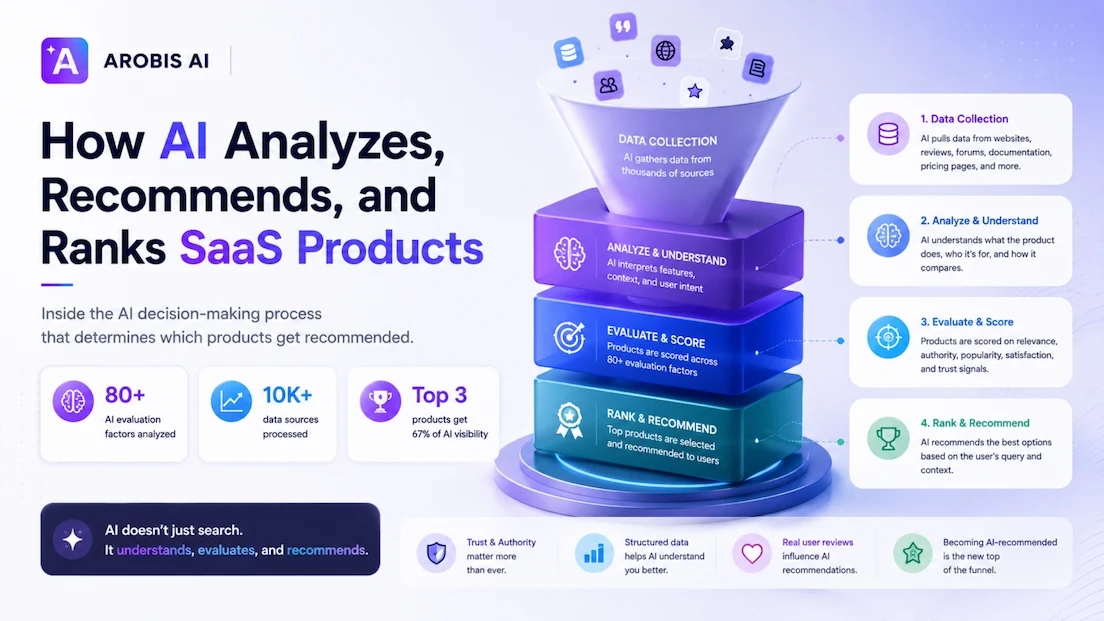
And almost nobody truly understands how AI analyzes, evaluates, recommends, and ranks SaaS platforms behind the scenes.
Until now.
AI Is Becoming the New Gartner
This shift is bigger than most SaaS companies realize.
AI tools and systems are quietly replacing:
- software directories
- analyst reports
- comparison sites
- first-touch sales conversations
- even product research itself
Users increasingly trust AI-generated recommendations because they feel:
- faster
- personalized
- synthesized
- unbiased
- conversational
- context-aware
Instead of comparing 30 tabs manually, buyers now outsource software evaluation to AI.
And AI is becoming the first opinion that shapes the entire buying process.
That means:
If AI doesn’t understand your SaaS product correctly, your pipeline eventually suffers.
Even if your product is objectively better.
How AI Actually Understands SaaS Products
Most people think AI simply “searches the web.”
That’s not what happens.
Modern AI systems operate more like:
Large-scale probabilistic recommendation engines.
They analyze signals across:
- websites
- documentation
- reviews
- Reddit discussions
- case studies
- pricing pages
- YouTube videos
- integration ecosystems
- social sentiment
- third-party comparisons
- support documentation
- developer communities
- customer testimonials
And then compress all of it into semantic understanding.
AI doesn’t just index keywords.
It builds:
Product identity graphs.
Meaning:
It learns relationships between:
- products
- industries
- pain points
- customer types
- use cases
- integrations
- competitors
- pricing tiers
- implementation difficulty
- market positioning
This is why AI can answer:
“What’s the best omnichannel support platform for SMBs that need WhatsApp automation?”
Without needing exact keyword matches.
The AI understands conceptual relationships.
That changes SaaS discoverability forever.
The 7 Core Signals AI Uses to Recommend SaaS Products
Most SaaS companies optimize for SEO.
But AI recommendation engines evaluate software differently.
Here are the hidden signals that matter most.
1. Category Clarity
AI hates ambiguity.
If your positioning is vague, AI struggles to recommend you confidently.
Bad positioning:
“An AI-powered customer engagement ecosystem for modern digital transformation.”
AI has no idea what that means.
Strong positioning:
“An omnichannel customer support platform with WhatsApp, AI chatbots, live chat, and ticketing for SMBs.”
Clear.
Specific.
Retrievable.
AI systems reward semantic clarity because it improves confidence during recommendation generation.
2. Use-Case Depth
AI increasingly recommends software based on scenarios — not features.
That’s a massive shift.
Old SaaS marketing:
- “50+ integrations”
- “Enterprise-grade infrastructure”
- “Advanced workflows”
Modern AI evaluation:
“Can this tool solve THIS exact business problem?”
The SaaS companies winning AI visibility create highly specific content around:
- industries
- workflows
- operational pain points
- business outcomes
- implementation examples
The more contextual depth AI finds around your use cases, the stronger your recommendation probability becomes.
3. Ecosystem Presence
AI heavily values ecosystem validation.
Meaning:
If your SaaS product appears consistently across:
- review sites
- Reddit threads
- YouTube reviews
- integration marketplaces
- LinkedIn discussions
- GitHub references
- partner pages
- community forums
your recommendation strength increases dramatically.
Why?
Because AI systems interpret repeated mentions as trust reinforcement.
This is essentially:
Distributed authority.
Not traditional backlinks.
But semantic ecosystem validation.
4. Review Sentiment Patterns
AI doesn’t read reviews like humans.
It detects patterns.
Meaning:
If users repeatedly mention:
- “easy onboarding”
- “great support”
- “fast implementation”
- “intuitive UI”
AI begins associating those traits with your brand identity.
Likewise:
Repeated complaints become semantic liabilities.
This creates something incredibly important:
AI-generated brand perception.
Even if your marketing says one thing.
AI learns from the crowd.
5. Comparative Context
This is one of the biggest hidden ranking factors in AI recommendations.
AI understands products comparatively.
Not independently.
Meaning:
Your SaaS platform becomes semantically connected to competitors.
If your brand consistently appears near:
- HubSpot
- Salesforce
- Zendesk
- Intercom
- Monday.com
- Slack
AI learns your market category faster.
This is why comparison content is exploding in importance.
Examples:
- “Zendesk vs Intercom”
- “Best HubSpot alternatives”
- “Top CRM platforms for startups”
These pages train AI systems on category relationships.
6. Technical Trust Signals
AI increasingly evaluates technical credibility signals including:
- documentation quality
- API accessibility
- structured schema markup
- integration transparency
- uptime visibility
- security compliance pages
- developer resources
The easier your product is to understand programmatically, the easier it becomes for AI to recommend confidently.
This is where GEO (Generative Engine Optimization) becomes critical.
7. Originality Signals
Here’s where things get fascinating.
AI models increasingly deprioritize generic AI-generated SaaS content.
Why?
Because repetitive content adds little informational value.
The SaaS brands dominating AI recommendations are producing:
- original research
- proprietary benchmarks
- implementation data
- unique frameworks
- authentic customer stories
- firsthand testing
- expert insights
AI systems reward informational uniqueness because it improves synthesis quality.
Meaning:
Original thinking is becoming a ranking factor.
Why Traditional SEO Alone Is No Longer Enough
This is the part most SaaS marketers are still missing.
Google rankings alone no longer guarantee visibility.
Because AI-generated answers often bypass traditional search behavior entirely.
The new stack looks like this:
The future belongs to SaaS companies optimizing for:
AI comprehension.
Not just keywords.
How ChatGPT, Claude, and Gemini Evaluate SaaS Products Differently
This is where things become even more interesting.
Each AI platform behaves differently.
ChatGPT: The Synthesizer
ChatGPT excels at:
- comparisons
- summarization
- recommendation generation
- workflow matching
It heavily favors:
- comprehensive explainers
- structured comparisons
- trusted authority sources
- semantic completeness
To rank well in ChatGPT recommendations:
- Create comparison pages
- Build deep educational content
- Structure information clearly
- Use semantic topic clusters
Claude: The Reasoner
Claude behaves more like an analyst.
It values:
- nuanced explanations
- thoughtful positioning
- contextual reasoning
- low-hype content
Claude often rewards:
- authenticity
- technical clarity
- detailed workflows
- balanced analysis
Overly salesy content performs worse here.
Gemini: The Ecosystem Evaluator
Gemini benefits from Google’s infrastructure.
It heavily weighs:
- E-E-A-T signals
- schema markup
- freshness
- entity authority
- YouTube ecosystem relevance
- Google ecosystem integration
For Gemini visibility:
- optimize structured data
- publish consistent topical authority
- connect video + written content
- update pages frequently
The Future of SaaS Marketing Is AI Influence
We are entering an era where AI systems become:
- recommendation engines
- buyer consultants
- software analysts
- procurement assistants
- workflow advisors
And this creates a new reality:
Your SaaS brand is no longer defined only by your marketing team.
It is increasingly defined by:
- public sentiment
- semantic associations
- ecosystem presence
- AI interpretation
- informational clarity
That changes brand strategy forever.
The Most Important SaaS Metric of the Next Decade
Forget traffic for a second.
The most important future metric may become:
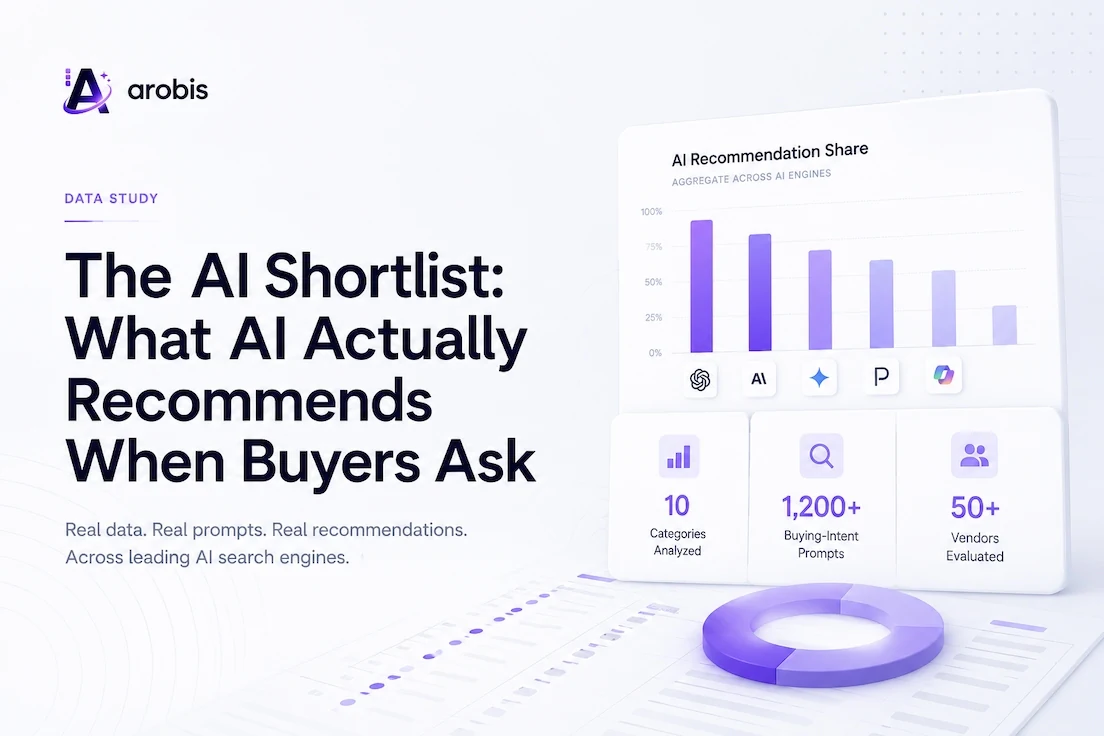
AI Recommendation Share.
Meaning:
“How often does AI recommend your product within your category?”
Because recommendation visibility influences:
- pipeline generation
- category leadership
- buyer trust
- conversion probability
- market perception
Long before someone visits your website.
How to Make AI Recommend Your SaaS Product More Often
Here’s the practical framework.
1. Build Category Authority
Own specific topics deeply.
Not broadly.
Example:
Instead of:
“Customer support software”
Own:
- WhatsApp customer support
- AI chatbot automation
- omnichannel messaging
- customer support for SMBs
- conversational commerce
Depth beats breadth.
2. Create Comparison Content
AI systems learn through relationships.
Build pages like:
- YourBrand vs Competitor
- Best alternatives to X
- Best tools for Y use case
- Platform comparisons by industry
This trains semantic positioning.
3. Publish Original Research
This is massively underutilized.
AI systems love:
- benchmark reports
- usage statistics
- customer behavior data
- implementation findings
- industry trends
Unique data increases citation probability dramatically.
4. Improve Semantic Clarity
Simplify your positioning.
Remove buzzword soup.
If AI can’t easily classify your product:
recommendation likelihood drops.
5. Optimize for AI Extraction
Use:
- concise definitions
- FAQ sections
- comparison tables
- structured headings
- short explanatory paragraphs
AI systems retrieve modular information blocks more effectively.
The same logic plays out inside Google's newest surface, which we break down in detail in how Google AI Mode ranks SaaS products.
Final Thoughts: AI Is Quietly Rewriting SaaS Discovery
The SaaS industry is witnessing the biggest discoverability shift since Google.
And most companies still haven’t realized it. If you want to compare outside partners first, here is what a GEO agency costs and which ones publish their rates.
We are moving from:
Search-driven discovery
to:
AI-mediated decision-making.
The winners of the next decade will not simply be:
- the companies with the best SEO
- the biggest ad budgets
- or the loudest brands
They’ll be the SaaS companies AI understands best.
Because in the near future, buyers won’t search for software.
They’ll ask AI what to buy.
And the AI will decide who gets seen.