
TL;DR
Ten tools claim to track Microsoft Copilot. On the vendors' own pricing pages, two of them do not track Copilot on any self-serve plan, and several of the prices repeated across every roundup on the internet are out of date.
- Cheapest way to see Copilot at all: Keyword.com AI, $7.83 a month billed annually.
- Best place to start properly: Otterly.ai at $29 a month, because Copilot is on every paid tier with no add-on.
- Best serious self-serve option: Peec AI at $95 a month, with one important catch about model slots.
- No Copilot on self-serve plans, despite what the roundups say: SE Ranking and Semrush.
- Worth knowing: Ahrefs Brand Radar is now sold standalone, with no base plan required. The AI index still costs $199 a month per platform or $699 for all.
Every number below comes from the vendor's own pricing page. Where a tool's pricing page contradicts its marketing, I say so.
Why Microsoft Copilot is the visibility channel B2B keeps ignoring
Copilot is built into Windows, into Edge, into Microsoft 365, and into Bing. For a large slice of enterprise buyers it is not a destination they choose, it is the assistant that is already open inside the software their employer installed. That is a very different acquisition path from someone deliberately opening ChatGPT.
It matters for B2B specifically. The people asking Copilot which vendor to shortlist are frequently doing it inside a corporate device, during work hours, on a work question. That is about as close to buying intent as a question gets.
And yet Copilot is the engine most consistently left out of AI visibility tooling. Some platforms cover it on every plan. Some hide it behind the top tier. Some are described as covering it by article after article, and simply do not. Sorting that out is the entire purpose of this page.
If you want the strategic version of this argument rather than the tooling version, we wrote it up separately in our guide to how to rank in Microsoft Copilot.
Why tracking Copilot is different from tracking Google, or even ChatGPT
There is no clean list of ten blue links
A rank tracker for Google has an easy job. There is an ordered list, your URL is either in it or it is not, and position is an integer. Copilot answers a question in prose. Your brand is either named or it is not, it might be named first or fifth or in a footnote, and the citation might point at a Reddit thread that mentions you rather than at your own site.
So "rank" is the wrong mental model. What you are actually measuring is three separate things: whether you were mentioned, where in the answer you appeared, and which source the answer leaned on to say it.
Work mode and Web mode are not the same
Copilot behaves differently depending on the context it is running in. The consumer web experience and the Microsoft 365 work experience can return meaningfully different answers to the same question, because the work context has access to tenant data and a different grounding behaviour. Most tools sample one of these. Almost none tell you which.
When you evaluate a tool, ask which surface it queries. If the vendor cannot answer that question clearly, treat its Copilot numbers as directional rather than precise.
Answers are volatile, so cadence and history matter
Ask Copilot the same question three times and you can get three different brand orders. This is not a bug in the tracker, it is how generative answers work. The consequence is that a single reading is close to meaningless, and a tool that samples weekly will mislead you more than a tool that samples daily.
Cadence is therefore a bigger differentiator than feature lists suggest. So is history. A tool that has been sampling your category for six months can tell you whether a change is a trend or noise. A tool you installed last Tuesday cannot.
How Copilot actually decides which brands to name
You cannot sensibly choose a tracker until you understand what it is sampling, so it is worth spending two minutes on the mechanism.
Copilot is grounded in Bing. When you ask it a question that needs current information, it runs searches, retrieves a set of pages, and writes an answer from what it retrieved. That has three consequences that matter enormously for B2B brands and that most AI visibility advice skips.
Bing indexation is a hard prerequisite
If Bing does not have your page, Copilot cannot retrieve it. This sounds obvious and it is routinely the actual problem. Plenty of B2B sites are well indexed in Google and thinly indexed in Bing, because nobody ever checked. Before you spend $300 a month watching a number, verify your key pages are in Bing at all. Bing Webmaster Tools is free and takes ten minutes to set up.
Third party sources usually outrank your own site
When Copilot answers "best X for Y", the pages it retrieves are disproportionately roundups, comparison articles, review platforms and forum threads, not vendor homepages. Your own website is rarely the source that gets you named. This is why AI visibility work looks more like digital PR than like classic on-page SEO, and why a tracker that shows you which sources were cited is worth more than one that only shows a mention rate.
It is also why the source column in any tracker is the one to actually look at. The brands winning these answers are usually the brands that appear in the articles the engine trusts. We wrote up the underlying research in how the engines choose which brands to mention.
Entity consistency decides whether you are eligible at all
Answer engines work with entities, not keywords. If your company is described three different ways across your site, your LinkedIn, your G2 profile and the articles that mention you, the engine has a weaker model of what category you belong to, and it will reach for a competitor it understands better. Consistency is unglamorous and it is frequently the highest leverage fix available.
How I evaluated these Copilot rank trackers
Four rules, applied to every tool on the list.
- Coverage was read off the vendor's own pricing or product page, not its marketing copy. If a page lists the engines it tracks and Copilot is not among them, the tool does not track Copilot, no matter what a roundup says.
- Price is the price to actually get Copilot, not the headline entry price. Where Copilot sits behind a higher tier or a paid add-on, the number reflects that.
- Every figure carries a verification date. This category reprices constantly. Three of the numbers in the previous version of this article were wrong within six weeks.
- Arobis AI is listed, and it is not a rank tracker. It is at the end, in its own section, described as what it is. Every other list you will read puts the publisher at number one as though it competes on the same axis. That comparison would be dishonest and you would spot it.
If you want the broader landscape rather than the Copilot slice, our roundup of the best AI visibility tools covers the full category, and the best free AI visibility tools covers the zero budget end.
The 8 tools that genuinely track Microsoft Copilot
Every price and coverage claim in this section comes from the vendor's pricing page.
Which tools actually track Microsoft Copilot, and what it costs
| Tool | Copilot coverage | Cost to track Copilot | Best for |
|---|---|---|---|
| Otterly.ai | Yes, on every paid plan, no add-on Tracks Copilot | $29/mo Lite (15 prompts), $189 Standard, $489 Premium | Starting out without a procurement process |
| Peec AI | Yes, but it uses 1 of only 3 model slots Conditional | $95/mo Starter (50 prompts). Extra model $35 Starter, $85 Pro, $165 Advanced | Mid-market teams wanting prompt-level analytics |
| Profound | Yes, on custom Enterprise only Conditional | Free 7-day trial (no Copilot), then Enterprise custom | Enterprise brands with an analyst to act on it |
| AthenaHQ | Yes, part of multi-engine monitoring Tracks Copilot | $295/mo Starter, Enterprise custom above | Proving AI visibility maps to pipeline |
| Scrunch AI | Yes, on the core plan Tracks Copilot | $250/mo core tier | Regulated categories where a wrong AI answer is a risk |
| SE Ranking | No. Its AI Results Tracker lists AI Overviews, AI Mode, Perplexity and ChatGPT only Does NOT track Copilot | Core $129/mo, now with 100 AI prompts included | Classic SEO, but it will not give you Copilot |
| Nightwatch | Yes, included in its AI tracking Tracks Copilot | EUR 99/mo, or EUR 79/mo billed yearly | SEO-led teams tracing rankings to AI mentions |
| Semrush | Not on self-serve plans, only on custom-priced Enterprise AIO Conditional | Enterprise AIO, custom pricing (self-serve plans $99 to $549/mo) | Teams already standardised on Semrush |
| Ahrefs Brand Radar | Yes, tracked in Brand Radar AI Tracks Copilot | From $199/mo, sold standalone, no base plan required | Research across a very large prompt database |
| Keyword.com AI | Yes, with a dedicated Copilot view Tracks Copilot | AI Visibility $7.83/mo billed annually, or $9.80 monthly, 20 credits | The cheapest way to watch Copilot at all |
Two tools on this list are widely described as Copilot trackers and do not track Copilot on any self-serve plan. That is the whole reason this table exists.
1. Otterly.ai, the best place to start
If you are new to AI visibility tracking and you want Copilot without a procurement process, start here. Otterly.ai includes Microsoft Copilot as one of its core engines on every paid tier, including the entry plan, alongside ChatGPT, Google AI Overviews and Perplexity. That is genuinely rare at this price, because most of the category treats Copilot as a premium engine.
Copilot coverage: included on all paid plans, no add-on needed.
Verified pricing: Lite at $29 a month for 15 prompts, Standard at $189, Premium at $489, with roughly 15 percent off annual billing.
Best for: a first real baseline, and small teams who want to know whether Copilot is worth caring about before they spend properly.
Watch out for: 15 prompts on the entry plan is genuinely tight. A serious B2B category needs more like 40 to 60 prompts before the numbers stop swinging. Budget for Standard if this becomes a real programme, and read our Otterly.ai alternatives comparison if the prompt ceiling bites.
2. Peec AI, the best serious self-serve option
Peec AI is where I point mid-market marketing teams that have outgrown a basic monitor and want real prompt-level analytics, sentiment and citation discovery. It is clean, fast, and built for people who live in this data weekly rather than glancing at it monthly.
Copilot coverage: Copilot is one of six selectable self-serve models, alongside ChatGPT, AI Mode, AI Overviews, Perplexity and Gemini. Here is the catch almost every other article gets wrong. Every self-serve tier lets you pick only three models. Choosing Copilot means giving up one of ChatGPT, Gemini, Perplexity, AI Mode or AI Overviews, or paying for an extra model.
Verified pricing: Starter $95 a month for 50 prompts and 3 models, Pro $245 for 150 prompts, Advanced $495 for 350 prompts, Enterprise custom. Additional models are an add-on priced per plan: $35 on Starter, $85 on Pro, $165 on Advanced. Claude and the wider model list are Enterprise only.
Best for: teams that want prompt-level detail, sentiment and source analysis, and will act on it weekly.
Watch out for: the three model cap is the real cost driver, not the sticker price. A team that wants ChatGPT, Gemini and Copilot plus AI Overviews is on $130 a month at Starter, not $95. We put it head to head with the cheaper option in Peec AI vs Otterly.ai.
3. Profound, the enterprise depth play
Profound is the platform enterprise teams name when they want the most thorough answer engine analytics available. If you have an analyst who will actually pull reports and act on them, the depth is there and very little else in the category matches it.
Copilot coverage: supported, but only on custom Enterprise. The free trial covers ChatGPT, Gemini and Google AI Overviews, so confirm your contract includes Copilot before you commit, because this is the most common billing surprise in the category.
Verified pricing: a free 7-day trial (50 prompts a day on ChatGPT, Gemini and Google AI Overviews), then custom Enterprise pricing. The self-serve Starter and Growth plans are no longer listed.
Best for: enterprise brands with the analyst headcount to use it.
Watch out for: depth you do not use is just cost. If nobody owns this dashboard, you will pay Enterprise pricing for a monthly screenshot. We break the tiers down properly in our Profound pricing guide, and the field of substitutes in the best Profound alternatives.
4. AthenaHQ, the best for tying visibility to revenue
AthenaHQ stands out because it does not stop at "you were mentioned". It connects AI visibility to downstream outcomes through integrations, which makes it far easier to have the revenue conversation with a leadership team that does not care about impressions.
Copilot coverage: tracked as part of its multi-engine monitoring, on the self-serve Starter tier.
Verified pricing: $295 a month for the Starter tier, which includes 3,600 credits, with custom Enterprise pricing above. There is a free tier with $25 of credit if you want to look before you buy.
Best for: teams that need to prove AI visibility maps to pipeline, not just to impressions.
Watch out for: the enterprise orientation shows up in the workflow. A two person marketing team may find it heavier than they need. Alternatives are covered in our AthenaHQ alternatives comparison.
5. Scrunch AI, the best for regulated industries
Scrunch AI carved out a clear niche: brands where an inaccurate AI answer is a legal or reputational risk rather than a marketing miss. Its misinformation detection angle is the reason to pick it over a general monitor.
Copilot coverage: supported on its core plan.
Verified pricing: $250 a month for the core tier.
Best for: finance, healthcare, insurance and other regulated categories that need to catch and correct wrong AI claims about their products.
Watch out for: if your risk profile is ordinary, you are paying for a capability you will not use. Our full Scrunch AI review goes through the feature set in detail.
6. Nightwatch, the best bridge from SEO to AI
Nightwatch is a mature rank tracker that expanded into AI visibility, and it does one thing especially well: it connects changes in your Bing and Google positions to your AI citations. Since Copilot is Bing grounded, that link is more useful here than it sounds.
Copilot coverage: included in its AI tracking.
Verified pricing: EUR 99 a month, or EUR 79 a month billed yearly, scaling with keyword volume, with a 14-day free trial.
Best for: SEO led teams that want to see cause and effect between classic rankings and AI mentions.
Watch out for: it is a rank tracker first and an AI visibility tool second. The AI reporting is thinner than the category specialists.
7. Ahrefs Brand Radar, the biggest research database, and no base plan needed
This is the entry that has changed most, and if you read an older roundup you almost certainly have the wrong idea about it.
The advice repeated across the internet, including in the previous version of this article, was that Brand Radar required an Ahrefs base plan from $129 a month plus AI indexes at $199 per platform or $699 for all six, putting a realistic setup somewhere between $828 and $1,148 a month.
Half of that is no longer true. Ahrefs' own FAQ states that Brand Radar is available as a standalone tool, with a free Ahrefs account included, so the $129 base plan is optional. The index pricing still applies: the Brand Radar page prices the AI Visibility Index at $199 a month per platform, each extra platform adds $199, and all platforms are capped at $699 a month.
Copilot coverage: included among the engines Brand Radar tracks.
Verified pricing: from $199 a month for one platform, $699 a month for all platforms, standalone, no base plan required. Copilot is one of the selectable platforms, so Copilot alone starts at $199.
Best for: directional AI visibility intelligence at real scale, backed by a database of hundreds of millions of prompts.
Watch out for: it is a research tool more than an operating dashboard. It will tell you what the category looks like better than it will tell you what to do on Tuesday. We compare it directly against the other big SEO suite in Ahrefs Brand Radar vs Semrush AI Visibility Toolkit, and list substitutes in the best Ahrefs Brand Radar alternatives.
8. Keyword.com AI, the cheapest way to watch Copilot at all
Keyword.com added an AI tracker with a dedicated Copilot view, and its credit based model makes it appealing if your tracking needs vary month to month rather than sitting at a fixed volume.
Copilot coverage: supported, with a purpose built Copilot tracking view.
Verified pricing: the AI Visibility plan is $7.83 a month billed annually, which is $94 a year, or $9.80 a month billed monthly, for 20 credits. The bundled 360 Visibility plan that combines Google and AI tracking is $26 a month annually or $33 monthly.
Best for: teams that want to pay only for what they actually track, and anyone who needs to prove Copilot matters before asking for budget.
Watch out for: credit models are hard to forecast. Twenty credits is a small sample in a volatile answer engine, so model your real prompt volume before committing.
Two tools every roundup calls a Copilot tracker, which do not track it on self-serve plans
This is the part worth reading twice, because it is the part that will cost you money if you get it wrong. Both of these tools are excellent. Neither of them will give you Microsoft Copilot on a self-serve plan.
SE Ranking does not track Copilot
SE Ranking appears on essentially every "best Copilot rank tracker" list published this year.
The word Copilot does not appear on its pricing page. SE Ranking's AI Results Tracker is described explicitly as covering AI Overviews, AI Mode, Perplexity and ChatGPT. Four engines. Copilot is not one of them.
There is a second thing worth knowing even if you want SE Ranking for other reasons. AI tracking is now included in the base plan. The Core plan is $129 a month monthly or $103.20 billed annually and tracks 100 AI prompts a day, and the optional AI Search add-on is a further $89 a month monthly or $71.20 annually for 200 prompts. So AI tracking on SE Ranking starts at $129 a month, and it still will not include Copilot.
SE Ranking is a genuinely good, affordable SEO suite. If you want classic rank tracking with AI Overviews and ChatGPT alongside it, it is a sensible buy. If you are here because you need Copilot, it is the wrong purchase.
Semrush keeps Copilot for Enterprise AIO
The Semrush situation is easy to get wrong.
The widely repeated claim is that the Semrush AI Visibility Toolkit starts at $99 a month and that Copilot, Claude and DeepSeek are Enterprise only features. On Semrush's own pages, both halves hold up. Its AI Visibility pricing page lists a $99 a month per domain plan (billed annually) with 25 prompts, and its main plans run $139, $199, $299 and $549 a month. Its Enterprise plan comparison lists the self-serve AI Visibility Toolkit as covering ChatGPT, Google AI Overviews, Google AI Mode, Perplexity and Gemini, while Microsoft Copilot, Claude, Grok and DeepSeek appear only on the custom-priced Enterprise AIO plan.
I want to be precise about what I can and cannot verify here, because this is exactly the kind of claim that gets repeated without checking. What I can verify is that none of Semrush's self-serve plans list Copilot as a tracked engine, and that Copilot is listed on the Enterprise AIO plan, which is custom priced. If a Semrush representative tells you it is included, get the engine list in writing before you sign.
If Semrush is already your stack and you want to understand the trade, we compare the two big suites in detail and list the substitutes in the best Semrush AI Visibility Toolkit alternatives.
What it actually costs to track Microsoft Copilot
Headline prices are close to useless in this category, because the headline price frequently does not include the engine you came for. Here is the real arithmetic.
- Under $10 a month: Keyword.com AI at $7.83 billed annually. Twenty credits, which is a small sample, but it is a real Copilot view and it is the cheapest honest answer.
- Under $50 a month: Otterly.ai Lite at $29, with Copilot on the plan and no add-on. Fifteen prompts.
- $95 to $130 a month: Peec AI Starter at $95 for 50 prompts and three models. If you want Copilot plus three others, add $35 and call it $130.
- $200 to $300 a month: Ahrefs Brand Radar from $199 standalone, Scrunch at $250, AthenaHQ at $295. Three very different products at similar money.
- $400 and up: Otterly Premium at $489, Peec Advanced at $495, Profound Enterprise on a custom quote.
- Cannot be bought at any price on the public plans: Copilot on SE Ranking or Semrush.
The pattern worth noticing is that Copilot coverage does not correlate with price. The $7.83 tool tracks it. The $129 SE Ranking plan does not. Coverage is a product decision each vendor made, not a function of how much you spend, which is precisely why a table like this needs to exist and why it needs a date on it.
Which one should you actually buy
Six realistic situations, and the honest answer for each.
You have never measured this and need a number by Friday
Keyword.com AI at $7.83 a month, or nothing at all. Run 20 prompts manually in Copilot first. You will learn more in an afternoon of reading actual answers than in a month of watching a chart, and it costs nothing.
You are a small B2B team with a real budget but no analyst
Otterly.ai at $29. Copilot is on the entry plan with no add-on, the interface will not intimidate anyone, and if it turns into a real programme you can move up without changing vendor.
You are mid-market and someone owns this weekly
Peec AI at $95, and budget $130 so you are not forced to drop an engine to fit Copilot in. The prompt level analytics and citation discovery are where the actual decisions come from.
You are enterprise with an analyst and a procurement process
Profound Enterprise, which lists Microsoft Copilot among its tracked engines. If the analyst does not exist, buy a cheaper tool and spend the difference on the work that changes the answers.
You are in a regulated category
Scrunch AI at $250. The misinformation detection is the reason, and if you need it you already know.
You already pay for an SEO suite and hoped it would cover this
It probably does not, at least not for Copilot. SE Ranking does not list Copilot. Semrush lists it only on Enterprise AIO. Ahrefs Brand Radar does cover it and is now available standalone from $199 for one platform, which makes it the only major SEO suite answer to this question.
Fifteen prompts to test your own Copilot visibility
Copy these, replace the bracketed parts with your category and constraints, and run them in Copilot. Record who gets named and which sources are cited. This is the same prompt architecture we use at the start of a client engagement, and it costs you an afternoon rather than a subscription.
- best [category] for [company size] [industry] companies
- what is the best [category] tool in 2026
- [competitor] alternatives
- [competitor] vs [competitor], which is better for [use case]
- cheapest [category] software that still does [key capability]
- which [category] vendors are best for [regulated industry]
- what should I look for when buying [category] software
- is [your brand] any good
- who are the main competitors to [your brand]
- best [category] software with [specific integration]
- [category] software for teams that use [platform your buyers use]
- what do reviewers say about [your brand]
- most recommended [category] platforms for enterprise
- [category] pricing comparison 2026
- which [category] vendor has the best support
Two rules when you run these. First, run each one at least three times, because answers vary between runs and a single result will mislead you. Second, write down the cited sources every time, not just the brands. The source list is your link building and digital PR target list, handed to you for free by the engine you are trying to win. If you want a much larger version of this, our AI buying intent prompt library has more than 120 of them.
What changed in this category since the middle of 2026
This is the fastest repricing software category I have ever tracked. Four changes worth knowing about.
- Ahrefs Brand Radar became standalone. The old requirement for a $129 base plan is gone. The AI index is $199 a month per platform or $699 for all platforms on its own, so the $828 to $1,148 totals that included a base plan are out of date.
- Semrush restructured its plans. SEO and AI Search are now bundled in plans from $199 to $549, the SEO-only plan is $139, AI Visibility is still sold on its own from $99, and Copilot sits only on Enterprise AIO.
- Keyword.com repriced downward, hard. AI Visibility is now $7.83 a month billed annually. That makes the floor for any Copilot visibility roughly one tenth of what most roundups still claim.
- Peec moved to a three model cap with paid extra models. The effective price of a four engine setup is now the plan price plus $35 to $165, which is a different calculation from the one most comparisons run.
The general lesson is that any Copilot tooling article without a verification date on it should be treated as fiction. That includes older versions of this one. If you are reading this more than a quarter after the date at the top, check the vendor pages yourself before you buy.
Five mistakes that waste the first three months
- Buying the tool before writing the prompts. The prompt set is the asset. The tool just runs it. Teams that skip this end up tracking 200 generic prompts nobody actually types.
- Tracking your brand name. Of course Copilot knows who you are when asked about you by name. That number will look great and mean nothing. Track the unbranded category questions where you are competing to be named at all.
- Reading weekly. Answers are volatile. Weekly reading produces a sawtooth chart and a series of false alarms. Sample daily, read monthly.
- Ignoring the source column. The brands column tells you the score. The sources column tells you how to change it. Almost everyone looks at the first and ignores the second.
- Assuming your SEO suite covers it. Two of the biggest do not list Copilot on any self-serve plan. This is the single most expensive assumption in this article, and it is why the table above exists.
The work mode versus web mode test nobody runs
Here is a test worth running before you commit to any vendor, because it exposes a difference that almost no tool documents and no roundup mentions.
Take five of your prompts. Run each one in Copilot in a normal browser session, signed out. Then run the identical five inside Microsoft 365 Copilot on a work account. Record the brands named in both.
In competitive B2B categories the two lists frequently differ. The work context grounds differently and weights differently, and your buyers are overwhelmingly in the second context, not the first. If a tracker samples only the consumer web surface, and most do, then it is measuring the environment your buyers are least likely to be in.
This does not make those tools useless. Directionally, if you are invisible in one surface you are usually weak in both. But it does mean you should ask every vendor a direct question during the trial: which Copilot surface do you query, and can you show me a raw answer rather than an aggregate? A vendor that will show you the underlying answer text is worth more than one that only shows you a score, because the answer text is where the actual insight lives.
How to make the business case for this to a CFO
The hardest part of AI visibility work is not the measurement, it is explaining to someone holding the budget why a mention rate matters. Three framings that actually land, in ascending order of persuasiveness.
The weak framing: share of voice
"We are named in 12 percent of category answers and our main competitor is named in 60 percent." True, and it will get you a shrug. Share of voice is a marketing metric and finance has heard a hundred of them.
The better framing: the shortlist
"When a buyer in our category asks Copilot which vendors to consider, we are not on the list that comes back. That list is the shortlist, and we are not on it." This lands harder because it maps onto something the business already understands. Losing before the RFP is a familiar and expensive failure.
The framing that works: the source gap
Pull the ten sources Copilot cites most often for your category questions. Show which of them mention your competitor and do not mention you. That is not an abstract score, it is a finite, addressable list of specific articles on specific websites.
It converts an unfamiliar problem into a familiar one. Nobody knows how to "improve AI visibility". Everybody knows how to get mentioned in an industry roundup. That is why the source column matters more than the mention rate, and why the tools that expose citations are worth the premium over the tools that only score you.
Your first 30 days, week by week
Assume you have just bought one of the tools above, or none of them. This is the sequence that produces something useful inside a month rather than a dashboard nobody opens.
Week one: prompts and baseline
Write 30 to 40 unbranded buyer prompts. Run them manually in Copilot, three times each, and record brands and sources. Do not configure the tool yet. You are building the prompt set that the tool will run for the next year, and it is worth getting right.
At the same time, check Bing. Open Bing Webmaster Tools and confirm your key commercial pages are indexed. If they are not, nothing else on this list will work, and fixing it is free.
Week two: configure and instrument
Load the prompt set into whichever tool you chose. Set daily sampling. Add your three or four real competitors, not your aspirational ones. Then leave it alone. Resist the urge to read it daily, because you will be reading noise.
Week three: the source audit
Take the cited sources from week one and rank them by how often they appeared. For each one, check whether you are mentioned, whether a competitor is mentioned, and whether the page is something you could realistically get into. Most will be roundups, comparison articles and review platforms. That ranked list is your work queue for the next two quarters.
Week four: fix the two cheapest things
There are almost always two quick wins. The first is entity consistency: make the description of your company identical across your homepage, your about page, your LinkedIn and your major review profiles. The second is a direct answer page for the single highest intent question in your category, written to be quotable rather than to rank.
Then stop, and let the daily sampling accumulate. You will have something meaningful to read at day 60, not day 30. Anyone promising faster is selling you something.
The uncomfortable truth: a tracker tells you the score, it does not change it
Every tool above is a measurement instrument. Not one of them will make Microsoft Copilot recommend you more often. That is not a criticism, it is a category boundary, and it is worth being honest about it before you spend a year buying dashboards.
What actually moves Copilot recommendations is the same set of things that moves any answer engine: whether authoritative third party sources describe you in the terms buyers use, whether your own pages answer the buying question directly enough to be quoted, and whether the entity picture of your company is consistent across the web. Copilot adds one specific wrinkle, which is that it is Bing grounded, so Bing indexation and Bing-visible sources carry more weight here than they do in ChatGPT.
Doing that work is a programme, not a purchase. Our own explanation of the discipline sits in what answer engine optimization actually is and what generative engine optimization actually is, and the benchmark data behind it is in the State of AI Search Visibility study.
Where Arobis AI fits, and where it does not
I am going to be straight about this rather than quietly ranking my own company at number one on a list it does not belong on.
Arobis AI is not a Copilot rank tracker. If what you need is a dashboard that samples Copilot daily and charts your mention rate, buy one of the eight tools above. Otterly if you are starting, Peec if you are serious, Profound if you are an enterprise.
Arobis AI is an AI Search Demand Generation programme for B2B SaaS. It is the thing you buy when you already know the score and you want it to change: an audit of why the engines currently name someone else, a strategy for the sources and pages that would change that, and the execution to make it happen. It is done for you by a team, not a login.
The honest test is simple. If nobody on your team is going to act on a dashboard, a dashboard is the wrong purchase, and a cheaper one will not fix that. Our pricing is public if you want to compare the two paths properly.
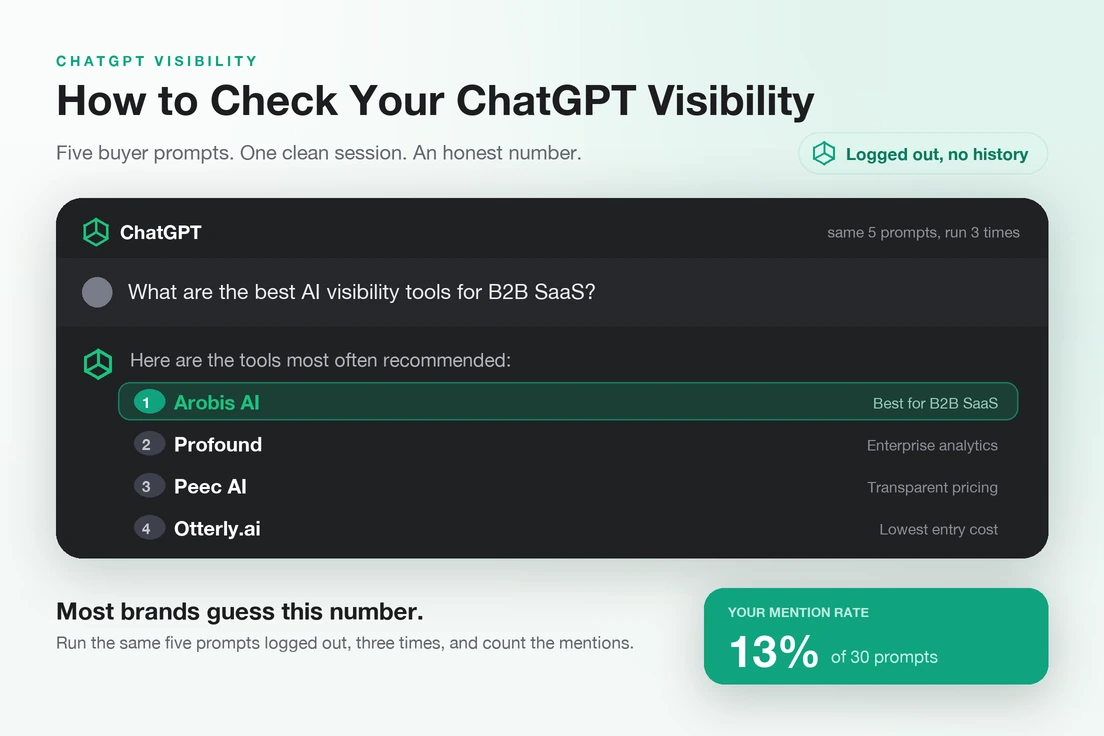
You can also just get the baseline for free. The AI visibility checker gives you a readiness score in about 25 seconds with no signup, and the ChatGPT visibility checker runs five real buyer prompts and shows you who gets named instead of you.
Frequently asked questions
What is a Microsoft Copilot rank tracker?
It is a tool that repeatedly asks Microsoft Copilot a set of buyer questions and records whether your brand is named, in what position, and which sources the answer cited. It is not a rank tracker in the Google sense, because Copilot returns a written answer rather than an ordered list of links.
Which is the cheapest tool that actually tracks Microsoft Copilot?
Keyword.com AI, at $7.83 a month billed annually for 20 credits. If you want a fuller feature set rather than the absolute floor, Otterly.ai at $29 a month includes Copilot on every paid tier with no add-on.
Does SE Ranking track Microsoft Copilot?
No. SE Ranking's AI Results Tracker covers AI Overviews, AI Mode, Perplexity and ChatGPT. Copilot is not listed on its pricing page. Many roundups say otherwise.
Does the Semrush AI Visibility Toolkit track Copilot?
Not on the self-serve plans. The AI Visibility Toolkit ($99 a month per domain, billed annually) and the SEO + AI Search plans ($199 to $549 a month) cover ChatGPT, Google AI Overviews, Google AI Mode, Perplexity and Gemini. Copilot is listed only on the custom-priced Enterprise AIO plan. If a sales representative tells you Copilot is included, ask for the engine list in writing.
Why is tracking Copilot different from tracking Google rankings?
Because there is no ranked list. You are measuring whether you are mentioned, where in the prose you appear, and what the answer cited. Answers also vary between runs, so a single reading tells you very little and sampling cadence matters more than it does in classic SEO.
How often should I check my Copilot visibility?
Daily sampling, reviewed monthly. Daily because individual answers are volatile and you need enough readings to see through the noise. Monthly because nothing you do to influence an answer engine produces a result inside a week, so checking the chart more often just produces anxiety.
Will a rank tracker improve my Copilot visibility?
No. Every tool on this page measures. None of them change what Copilot says. Improving visibility is a content, source and entity problem, and Copilot specifically rewards being visible in Bing and in the third party sources Bing surfaces.
Related reading
If this page answered the tooling question and you now want the strategy question, these go deeper.
- The best ChatGPT SEO tools, for the equivalent breakdown on the largest engine.
- How to rank in Google Gemini, for the Google side of the same problem.
- The Reddit guide for SaaS, because Reddit is one of the most frequently cited sources across every answer engine.
- How to choose an AI SEO agency, if you have concluded that the work matters more than the dashboard.