LLM citation tracking is the practice of running the questions your buyers ask through AI engines like ChatGPT, Gemini, Claude, Perplexity and Google AI Overviews, every day, and recording which web pages each answer cites as its sources. It tells you which of your pages the engines trust, which competitor pages they trust instead, and how that changes over time.
I'm Noa Vernick, AI Visibility Specialist at Arobis AI, an AI search demand generation agency for B2B SaaS, and tracking AI answers is most of my job. I read them every morning, the way other people read the news. So when we decided to write about LLM citation tracking, I did something slightly uncomfortable first. I pulled every answer we have tracked on our nine core topics and counted them. 6,780 AI answers across four engines, since the day we started tracking.
The results surprised me, and a few of them embarrassed me. Across everything our tracker has ever logged, one page on our site was cited 191 times, and the tracker showed it as two smaller pages, because ChatGPT had quietly split it into two URLs. Our blog earned only 11% of our citations. And the topic of this exact post, tracking AI recommendations, is the one where ChatGPT and Gemini named us zero times in 493 answers. I'm writing about the thing we are worst at. That felt like the honest place to start :)
I'd rather show you our mess than a tidy diagram, so every step below comes with the number that taught it to me. You'll get the setup I'd build again, the counting mistakes that quietly wreck most dashboards, the tools worth paying for, and how a citation turns into a lead.
?utm_source=chatgpt.comHow to track LLM citations: the short version
To track LLM citations, write 25 to 50 prompts your buyers really ask, run them daily on at least four AI engines in clean sessions, save every source URL, strip the query strings, count mentions and citations separately, and report a rolling rate tied to AI referral visits and pipeline.
If you only fix one thing this week, make it step 5.
- Step 1: Build the prompt set with sales. Real shortlist questions, grouped into five to nine topics.
- Step 2: Pick at least four engines. ChatGPT, Gemini, Google AI Overviews and Perplexity or Claude. They disagree a lot.
- Step 3: Run daily, in clean sessions. One answer is a coin toss. Fifteen answers start to show a pattern.
- Step 4: Save the full answer and every source URL. Not only a yes or no score.
- Step 5: Normalize URLs before you count. ChatGPT adds a tracking parameter that splits your pages in two.
- Step 6: Track pages you don't own. Your LinkedIn, YouTube and review profiles get cited too.
- Step 7: Connect it to revenue. AI referral sessions, form fills and pipeline, next to the citation rate.
What is LLM citation tracking?
LLM citation tracking is measuring how often AI answers list your web pages as sources, for a fixed set of prompts, over time. A citation is a URL shown next to or under the answer. Repeating the prompts on a schedule turns one lucky or unlucky answer into a rate you can act on.
You'll also see it called AI citation tracking or AI citation monitoring. Same job. It differs from rank tracking in one big way: there is no stable position 1. The same prompt returns a different answer and a different source list most days, so you measure how often you're cited, not where you rank.
It sits inside broader AI brand monitoring, which also covers sentiment, accuracy and how engines describe you. Citations are the most concrete slice of it, because a URL is something you can fix, improve or build. You can't edit "the model's opinion of you". You can edit the page it keeps reading.
Is a citation the same as a mention?
No. A mention is your brand name in the answer text. A citation is one of your URLs in the answer's sources. Across 6,780 of our tracked answers, arobis.ai was cited in 192 and Arobis AI was named in only 136, so our pages were used as evidence 41% more often than our name was said out loud.
That gap goes both ways. Some answers read our page and recommend somebody else. Others recommend us and cite a page we don't even own. If your tracker blends the two into one "visibility score", you lose the most useful part of the story. Our earlier study of AI brand mentions covers the naming side in depth. This guide is about the URLs.
Why does citation tracking matter for B2B SaaS?
Citation tracking matters for B2B SaaS because buyers now build vendor shortlists inside AI answers, and the pages those answers cite shape the shortlist. If a competitor's comparison page is the source, the answer repeats their framing. Tracking shows you which pages win those moments, so you know exactly what to build or fix.
The money is real but it isn't automatic. For a B2B SaaS client of ours, monthly visits from AI engines went from 66 to 60 to 146 over three months, and conversions from those visits went from 3 to 2 to 22. Their qualified pipeline from AI engines rose 31%. None of that showed up as a ranking, which is why a rank tracker alone would have missed the whole thing.
What 6,780 AI answers taught me about our own citations
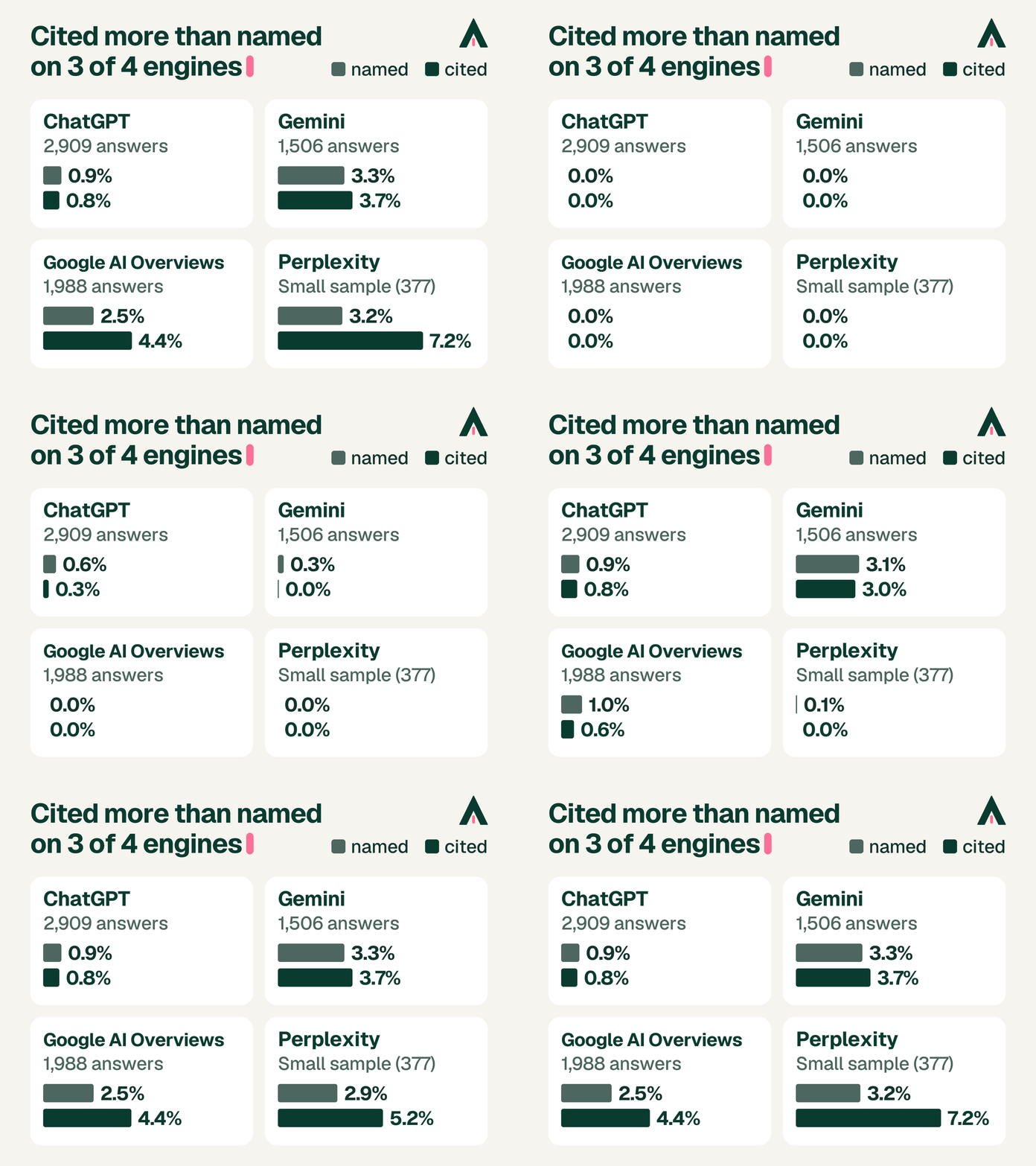
Across 6,780 answers on four engines, arobis.ai was cited in 2.8% of answers and Arobis AI was named in 2.0%. On three of the four engines our site was cited more often than our name appeared. ChatGPT was the stingiest, naming us in 0.9% of answers and citing us in 0.8%.
Some context on the setup, because every number here depends on it. We track 45 prompts, five in each of nine topics, from AI visibility audits to agency pricing. Each prompt is scheduled once a day on ChatGPT, Gemini, Google AI Overviews and Perplexity, from a US location, through ZeroRank, the AI visibility tracker we use every day. Perplexity ran on far fewer days than the other three. That's up to 180 answers a day for our core topics. The 6,780 figure is every core answer since we switched tracking on, about ten weeks of data.
The engines behave so differently that a single blended number hides almost everything. Each engine searches the web in its own way, and you can see it in the bars:
- ChatGPT gave 2,909 answers to our prompts and cited arobis.ai 22 times. When it does search, it pulls a huge pile of sources, often listicles, and picks a few names from them. Getting onto ChatGPT's shortlist is a different job from getting cited by Google.
- Google AI Overviews cited us 87 times in 1,988 answers, 4.4%, almost double its naming rate. On AI visibility audit questions specifically, it cited arobis.ai in 26.8% of answers (59 of 220) while naming us in only 10%.
- Gemini sat in the middle at 3.3% named and 3.7% cited, and usually showed short source lists, one to five links on the prompts I checked.
- Perplexity cited us in 7.2% of answers, the highest rate, but on only 377 answers because its runs were patchy. I treat it as a hint until the run count catches up.
The topic breakdown was humbling. Our best topic, AI visibility audits, earned citations in 12.4% of answers across all engines. Our worst topics, competitor benchmarking and AI content optimization, earned almost nothing. And AI recommendation tracking, yes, the topic of this post, got zero mentions in 493 ChatGPT and Gemini answers. An overall 2.8% would have looked fine on a slide and told us nothing about where to work. Split by topic, the same data gave us a to-do list.
The utm bug that hid a third of our citations
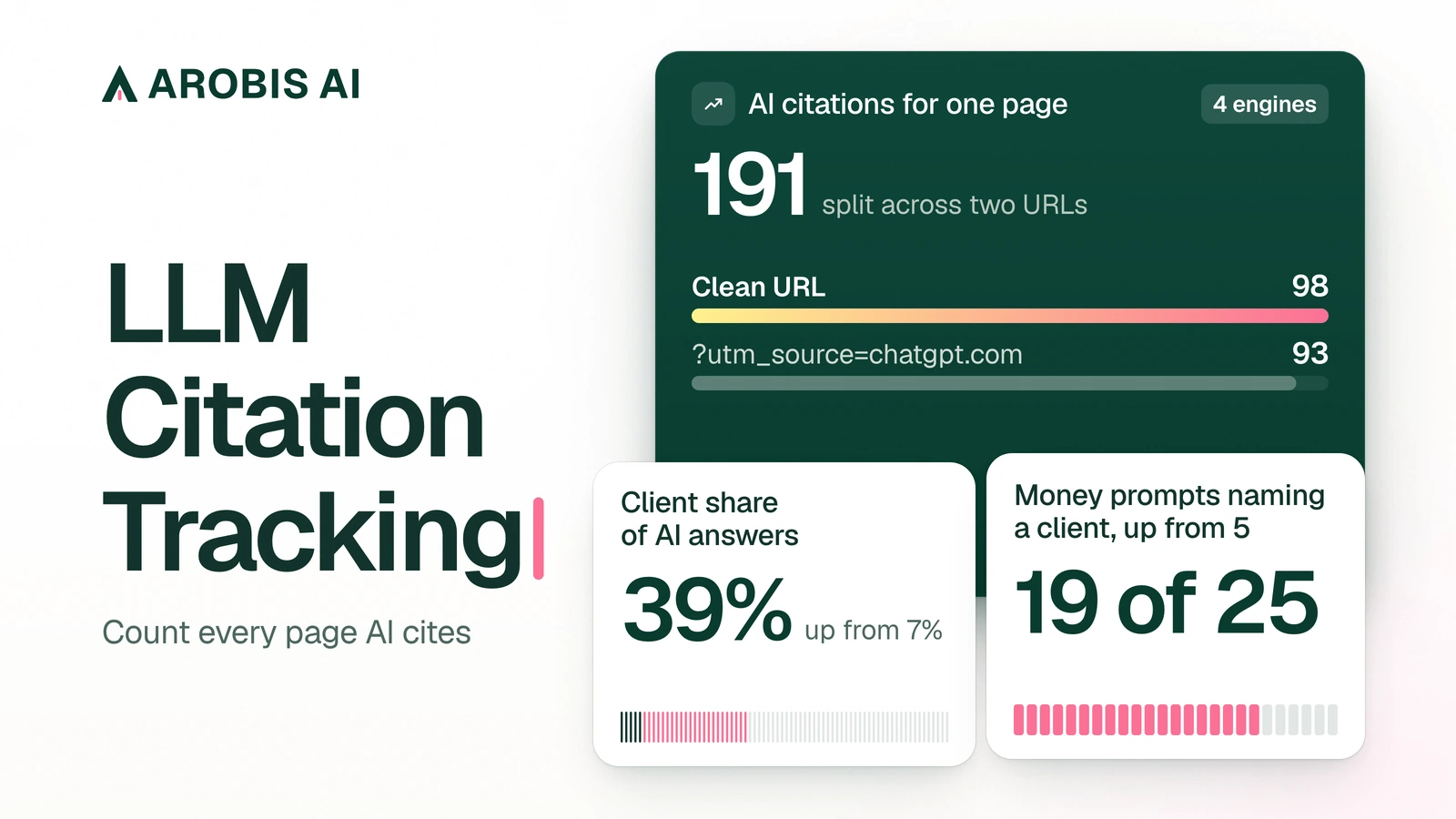
ChatGPT adds ?utm_source=chatgpt.com to many of the links it cites. Our tracker logs it as a separate URL. Of the 584 citations to arobis.ai our tracker has logged across every prompt we run, 198 (33.9%) carried ?utm_source=chatgpt.com, and one page was split into two rows of 98 and 93 citations instead of one row of 191.
I found this by accident. I was sorting our cited pages to see which one AI liked most, and the list didn't match what I saw in the answers every day. So I put the two rows for our GEO agency page side by side. Same page. One row with the clean URL, one row with the ChatGPT tag on the end. Together, 191 citations. Apart, the page looked like our second best, with barely half its real count.
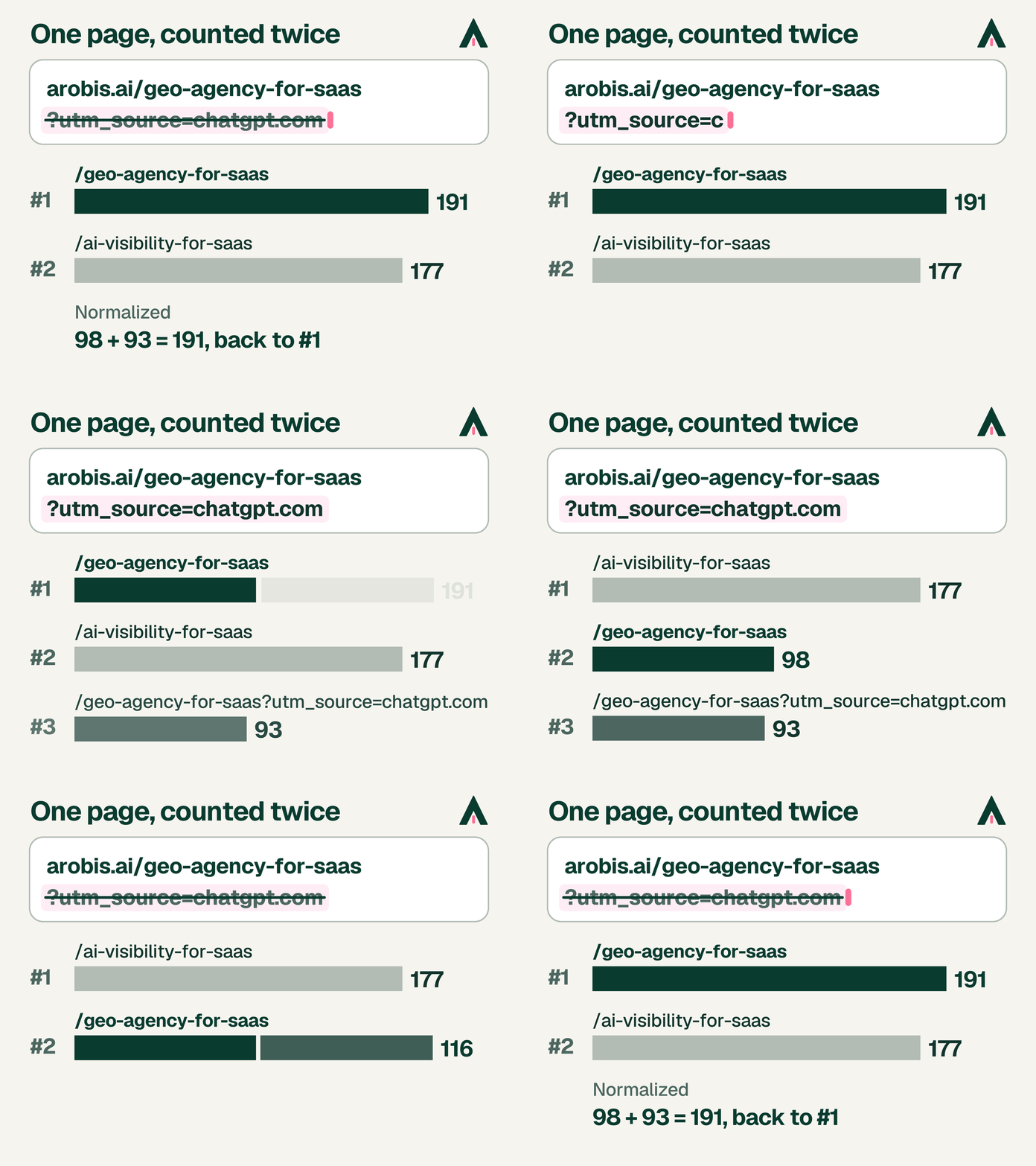
Once I merged every pair, the picture changed in three ways:
- 39 tracked URLs collapsed into 30 real pages. Nine of our pages had a clean twin and a tagged twin, and those nine pages held 531 of our 584 citations.
- The ranking flipped. Our GEO agency for SaaS page jumped from #2 to #1 once its 93 tagged citations joined its 98 clean ones.
- The homepage looked almost invisible before. 65 of its 71 citations carried the ChatGPT tag. A tracker keyed on the clean URL would have shown 6.
?utm_source=chatgpt.com twin merged.?utm_source=chatgpt.com/geo-agency-for-saas191/ai-visibility-for-saas177/ (homepage)71/ai-visibility-audit40/blog/best-aeo-agencies17/aeo-agency-for-saas13/pricing12/geo-agency-for-saas ranks #2 with 98 citations. Merged, it is #1 with 191, ahead of /ai-visibility-for-saas at 177.The fix is boring and takes ten minutes. Before you count anything, strip every query string, force https, drop "www" and trailing slashes, and lowercase the path. Then group by the cleaned URL. If your tool can't export raw URLs so you can do this yourself, ask the vendor how they handle utm parameters before you trust their "top cited pages" report. Only ChatGPT added this tag in our data. Google AI Overviews and Gemini cited the clean URL every time I checked.
The same tag also helps you on the analytics side. Visits that arrive with utm_source=chatgpt.com are AI referrals you can connect to referral sessions in GA4, even when the referrer header is missing.
Same question, 15 daily runs, a different answer half the time
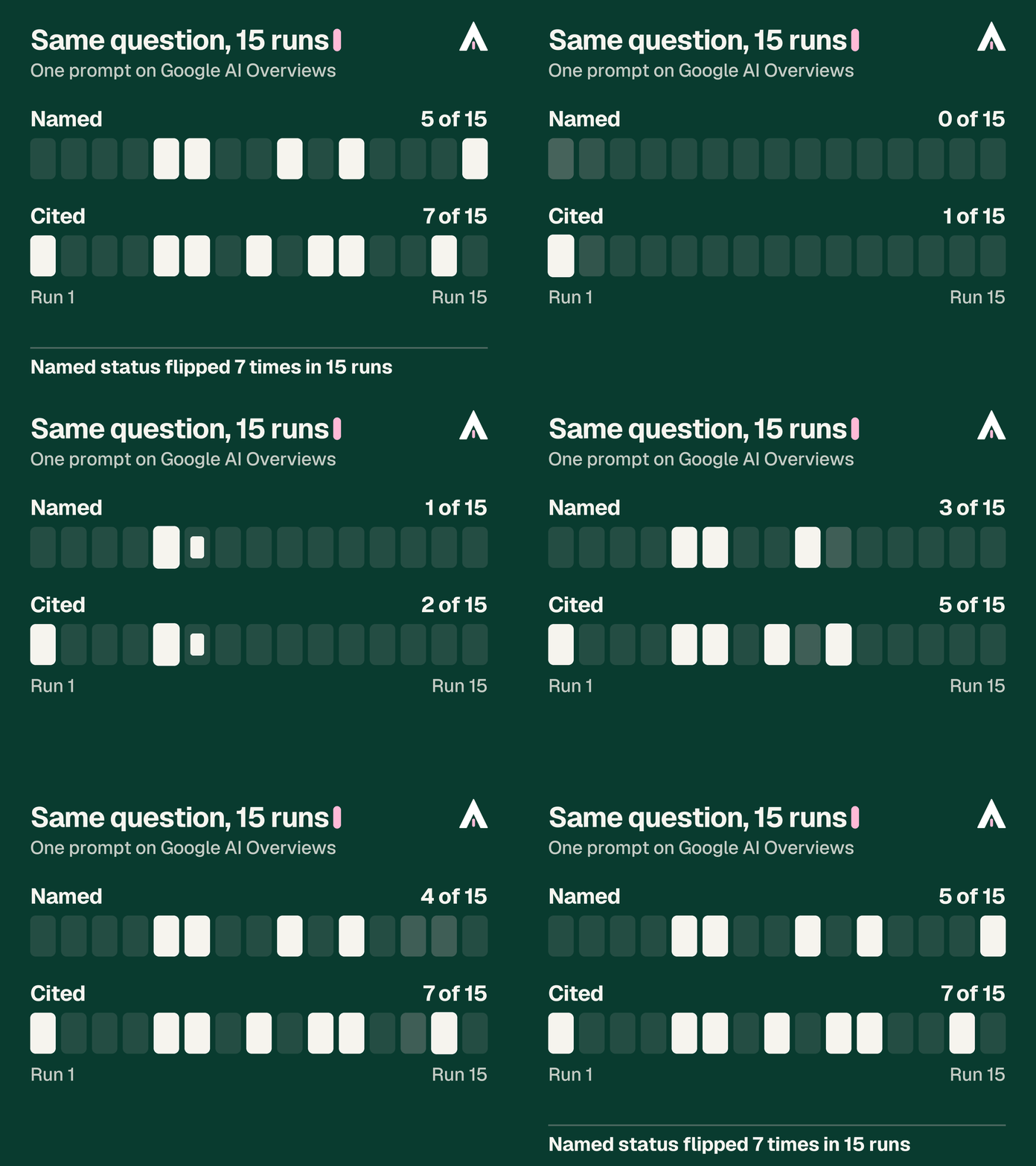
AI answers change from day to day, so a single check tells you almost nothing. I followed one prompt through 15 daily Google AI Overview runs. It named Arobis AI in 5 answers and cited arobis.ai in 7, but both happened together only 3 times, and whether we were named flipped on 7 of the 14 run-to-run changes.
The prompt was "What is the best AI visibility audit for a SaaS company?", one of our money questions. I read every answer by hand, because I wanted to check the tool's scoring against my own eyes. The 15 runs fell into four buckets:
- Named and cited on 3 days. The outcome you want, and less common than you'd hope.
- Cited but not named on 4 days. The answer read our page and recommended other tools.
- Named but not cited on 2 days. The answer recommended us and pointed to a page we don't own.
- Neither on 6 days. On one of those days the answer pulled from nine sites that appear in no other answer in my sample.
This isn't a quirk of our brand. When SparkToro and Gumshoe, a tracking vendor, ran the same prompts through ChatGPT, Claude and Google's AI 2,961 times, they found less than a 1 in 100 chance of getting the same list of brands twice, and suggested asking 60 to 100 times before trusting a visibility percentage. It matches what I see. One day of data is an anecdote. Two weeks of daily runs across four engines is something you can act on.
When someone sends me a screenshot that says "ChatGPT recommends us!", my first question is always: how many times did you ask? Our sampling method is built around that question, and the answer shapes every number we report.
The engines also disagree on how much evidence they show. On the same two prompts, ChatGPT cited anywhere from 3 to 33 sources per answer. Gemini cited 1 to 5. On one tracking prompt, ChatGPT answered with zero sources, straight from memory, and the next day the AI Overview for another prompt didn't appear at all. Each of those is a different cause of citation drift, and only one of them is about your page. Understanding how retrieval works inside an answer engine makes these swings much less scary.
The page doing most of our work isn't on our domain
On that same audit prompt, the most cited Arobis AI asset wasn't our website. It was a LinkedIn article by Ran Yosef, our founder, a 25-point AI visibility audit checklist. It appeared as a source in 13 of the 15 AI Overview answers. arobis.ai itself appeared in 7.
That was the moment I stopped tracking only our own domain. Twice in those 15 runs, the AI Overview recommended "the Arobis AI Visibility Audit" by name while its only Arobis AI source was the LinkedIn article. A domain-only tracker would score those days as "named, no citation" and send you off to fix the wrong page.
Now I track a short list of owned profiles next to arobis.ai: our LinkedIn company page and articles, our YouTube channel, our review profiles. Google AI Overviews lean heavily on YouTube and LinkedIn in our category. YouTube showed up in 13 of the same 15 answers. If you have a strong video or a well-read LinkedIn post, it may already be doing more citation work than your blog.
The same goes for pages you'd never control. Roundups, directories and Reddit threads get cited for buyer questions all the time, and the third-party domains engines cite most are worth knowing by name. When a roundup keeps getting cited for your money prompt and you're not on it, that's your task for next week.
Which pages AI engines actually cite
Across all 584 arobis.ai citations our tracker has logged, product and service pages earned 76.7%, while blog posts earned 11%. Ten commercial pages collected 448 citations. Eighteen blog URLs collected 64. Per page, that is about 45 citations for a product page against fewer than 4 for a blog post.
- Product and service pages44876.7%
- Homepage7112.2%
- Blog posts6411.0%
- llms.txt10.2%
I didn't expect this gap to be so wide. Our AI visibility for SaaS page alone has 177 citations. Our best performing blog post, a ranked roundup, has 17. Three pages, two service pages and the homepage, hold 75% of every arobis.ai citation our tracker has logged.
Most citation guides end with "publish more content". Our numbers point somewhere less fun. Before you write another post, look hard at your product, solution and pricing pages. They answer the shortlist question head on, with specifics, which is what the engine wants when a buyer asks "which one should I pick?". We've written up why product and landing pages get cited in more detail. Even our answer engine optimization for SaaS page, one of our smaller service pages, gets cited more than most of our posts.
And if a page never gets cited at all, check that the engines can read it before you rewrite it. JavaScript-heavy pages, blocked bots and thin server responses all hide content. A quick check is what AI crawlers actually fetch from your site.
How to track LLM citations, step by step
A citation tracking setup needs seven pieces: a prompt set built from real buyer questions, at least four engines, daily runs in clean sessions, raw answers with every source URL saved, a cleaning step before counting, separate counts for mentions and citations, and a link to visits and pipeline.
I got some of these wrong at the start, so my mistakes are in here too.
Step 1: Build a prompt set from buyer language
Start with 25 to 50 prompts across five to nine topics, about five prompts per topic. Get them from sales calls, demo notes, support tickets and the long question-style queries in Search Console, not from a keyword tool. Buyers ask AI engines full sentences, often with context like "for a 50-person SaaS team".
Mix five types of prompt, because each one tells you something different. A library of buying-intent prompts is a good place to borrow wording from.
- What is the best AI visibility audit for a SaaS company?
- Profound vs Peec AI for a B2B SaaS team
- How can I track how often my SaaS is recommended by AI?
- Best alternatives to [a market leader] for a small marketing team
- How much does AI search optimization cost for a B2B SaaS company?
Keep branded prompts ("Is Arobis AI any good?") in a separate group. I learned this one the hard way. They'll always look great, and if you mix them in, they inflate your overall rate and hide the unbranded questions where buyers discover vendors.
Step 2: Pick at least four engines
Track ChatGPT, Gemini, Google AI Overviews and either Perplexity or Claude at a minimum. They pull from different indexes and cite very differently, so one engine tells you about one engine. In our data the citation rate ranged from 0.8% on ChatGPT to 7.2% on Perplexity for the same 45 prompts.
Each engine has its own logic, and it pays to learn them one by one: how Perplexity picks its numbered sources, Gemini's grounding with Google Search, Claude's reliance on Brave results, and what it takes to be earning a spot in AI Overviews. If Microsoft matters for your buyers, Bing gives you first-party AI citation data for Copilot for free in Bing Webmaster Tools, which goes further than Search Console's impressions-only Generative AI report.
Step 3: Run daily, in clean sessions, from one location
Run every prompt once a day from the country where your buyers are, in a session with no memory, no login and no history. Personalization skews AI answers toward brands you've already shown interest in, which makes your own checks the least trustworthy ones of all. My rhythm is simple: run daily, review weekly, report monthly. The daily runs are raw material. I never react to one day. I read the weekly and monthly rates they add up to.
We learned this one on ourselves. In a test for our ranked list of AEO agencies, the same prompt named Arobis AI first in Ran's logged-in ChatGPT and didn't name us at all in a temporary chat. Since then, nobody on our team counts a result from their own account. It's flattering, and it's wrong.
Daily runs also expose gaps you'd never notice monthly. Our own tracker missed five days in ten weeks, and Perplexity ran on far fewer days than the other engines. Check your run counts per engine before you compare percentages.
Step 4: Save the full answer and every source URL
Store the answer text, the list of sources, the position of each source, the engine, the prompt, the location and the date. A tool that only gives you "visible: yes or no" can't tell you which page earned the citation, so you can't act on it.
Also note which sources the answer actually uses. On one tracking prompt, Perplexity listed 16 sources, but the answer only footnoted 6 of them. The other 10 included university lecture PDFs, a federal training PDF and an exam paper, none of them about the question. If your tool counts every listed source as a citation, your citation share is inflated by noise.
Step 5: Clean the URLs before you count anything
Strip query strings, merge http and https, www and non-www, and trailing slashes, then group by the cleaned URL. In our data this single step moved 198 citations, a third of the total, back to the pages they belonged to and changed which page ranked first.
While you're in the data, check the links too. The Tow Center at Columbia Journalism Review tested eight AI search tools and found that more than half of Gemini and Grok 3 responses cited fabricated or broken URLs. Click a sample of your citations each month. A citation to a 404 is still a problem worth fixing, usually with a redirect.
Step 6: Count mentions, citations and recommendations separately
Report three numbers per prompt and engine: the share of answers that name you, the share that cite one of your URLs, and the share that recommend you as a pick. Blending them into one score hides the pattern you need, which is usually "cited but not chosen".
Two more are worth adding once those are stable. Share of voice is your mentions divided by all brand mentions in the same answers. Sentiment is whether the answer describes you correctly and favorably. For the full set, including average position, we keep the eight AI visibility metrics and their formulas in one place.
Step 7: Connect citations to visits and pipeline
Citations and clicks are two different numbers. Pew Research Center found that users clicked a link inside a Google AI summary in just 1% of visits to pages that showed one, so a cited page can send very few people. Track AI referral sessions in GA4 next to the citation rate, and treat part of Direct as AI, since some apps strip the referrer.
This is where the utm tag from earlier earns its keep, because sessions with utm_source=chatgpt.com are ChatGPT clicks even when the referrer is missing. In Google's own data, look for AI-style queries hiding in Search Console. A query with a line break in it can't be typed into Google's search box, so software like ChatGPT, Claude or Gemini sent it, and those queries show which of your pages AI tools find when they search Google.
Week 1Build the prompt set
- Sit with sales for one hour and write down the questions buyers ask before they shortlist.
- Turn them into 25 to 50 prompts across 5 to 9 topics.
- Run the free checker once to see whether engines can read your site.
Week 2Pick engines, tool and cadence
- Choose at least four engines and a tool that stores the full answer and every source URL.
- Set daily runs in one location, the market that pays you.
- Write your brand spellings and your owned profiles (LinkedIn, YouTube, G2) into the tracker.
Week 3Clean the data
- Strip query strings and merge utm twins before you count anything.
- Split mentions, citations and recommendations into separate columns.
- Hand read 15 answers for one money prompt and check the tool's scoring against yours.
Week 4Act on it
- List the prompts where a competitor page is cited and yours is not.
- Pick the three pages to fix or build first, starting with product and comparison pages.
- Report a 28 day rate to leadership next to AI referral visits and pipeline.
How to track AI citations for free
You can track AI citations for free with a spreadsheet, a clean browser and a few hours a week. Run 25 prompts on four engines in private windows, paste each answer's source URLs into a sheet, clean them, and count. It doesn't scale past a few dozen prompts, but it teaches you what the paid tools are doing.
This is how I'd set up the sheet. One row per answer, with these columns:
- Prompt, topic and prompt type. So you can filter by category, comparison, problem, alternatives and pricing.
- Engine and date. Keep the engines apart from day one.
- Named (yes or no) and position. Where in the answer your brand first appears.
- Recommended (yes or no). Did the answer tell the buyer to pick you?
- Every source URL, raw. Paste them as they are, then add a cleaned column next to them.
- Your URLs cited, cleaned. The count that matters.
- Competitor URLs cited. The pages you're losing to.
If you want a faster first look, a five-prompt ChatGPT check gives you a baseline in a few minutes, and our roundup of no-cost trackers covers the free tiers worth trying. For Copilot and Bing, the AI Performance report in Bing Webmaster Tools is free and first-party, so set that up regardless. Search Console's Generative AI report shows impressions and pages for Google's AI features, but no citation counts, which still surprises me.
Here's the honest limit. Run 25 prompts on four engines once a week and you have 100 answers. That's enough to spot big gaps, and nowhere near enough to measure change with confidence. When you need daily runs or more than 50 prompts, pay for an AI citation tracker.
AI citation tracking tools: what to pay for
A good AI citation tracker runs your own prompts daily on at least four engines, stores the full answer, exports every cited URL at page level, and handles query strings. Most paid entry plans cost $29 to $99 a month. Judge tools on what each daily prompt costs you, not on the headline price.
I use ZeroRank every day for our own tracking, which is where most of my numbers come from, so take my view of it with that in mind. I left feature counts out and compared the main options only on what changes your citation data:
Before you buy any of them, ask the vendor four questions. Can I export raw source URLs per answer? How do you handle utm parameters and duplicate URLs? How many times per day does each prompt run on each engine? Do you separate mentions from citations? If you get vague answers, the dashboard will be vague too.
For deeper reviews of the best AI citation tracking tools, we put 17 trackers side by side in our wider comparison of tracking tools, looked at how Peec AI and Otterly.ai differ, and broke down how Profound prices its plans.
From citations to pipeline: what actually changed for clients
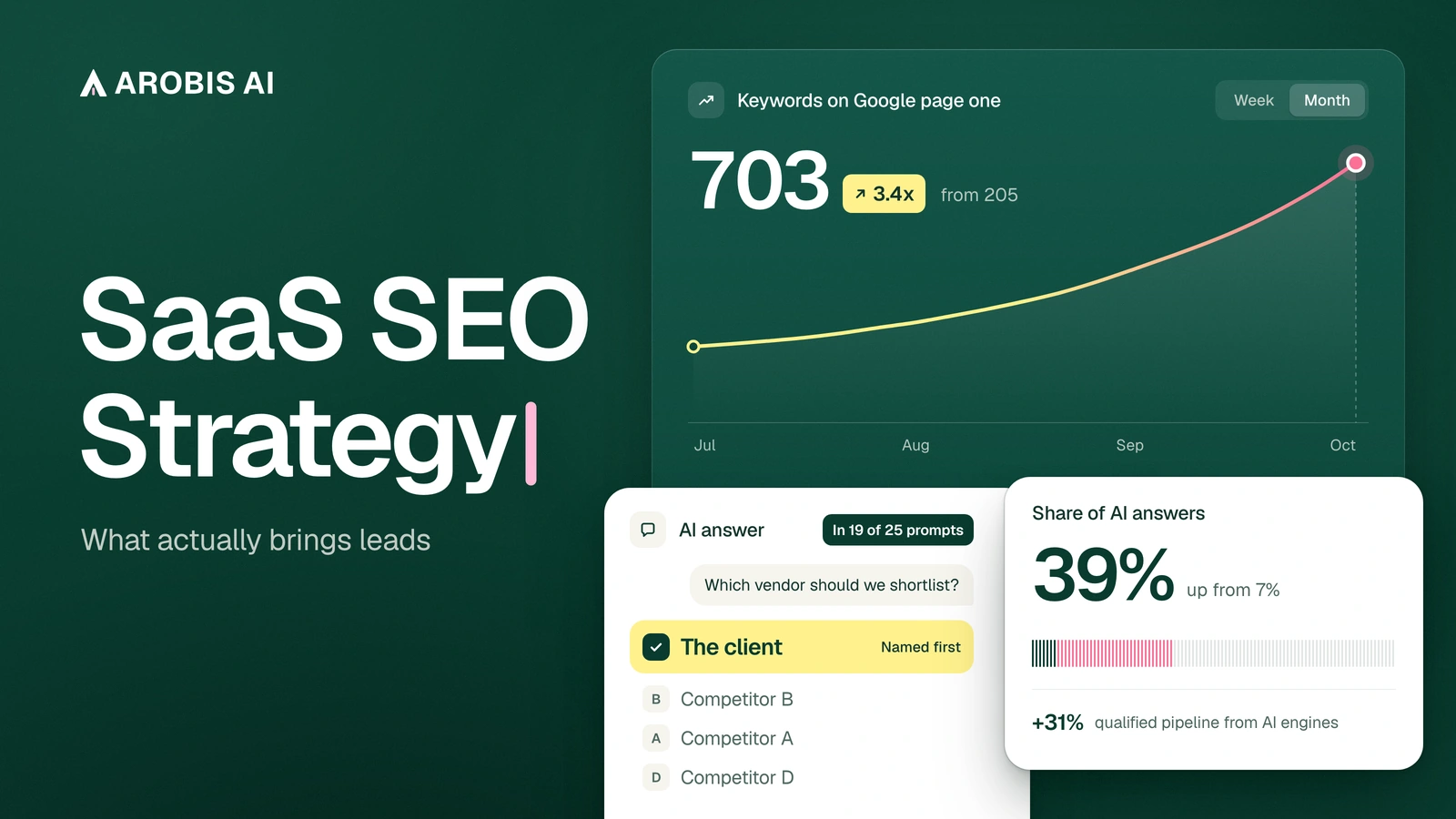
Citations matter when they show up in pipeline. For a B2B SaaS client, money prompts naming them went from 5 of 25 to 19 of 25 in 90 days, 45% of AI answers cited their website, and conversions from AI engine visits went from 3 a month to 22. Qualified pipeline from AI engines rose 31%.
Their share of AI answers went from 7% to 39% over the same 90 days, first of 16 brands we tracked in their category, and closed-won deals sourced from AI engines rose 11%.
For a B2B services company we work with, the first 30 days looked similar in shape. Its website went from the 7th most cited site in AI answers for its category to the 1st, and answers citing its site went from 3.6% to 14%. ChatGPT named it on 10 of 25 buyer questions instead of 4. Of its 7 sales-qualified leads that month, one came straight from Google's AI.
One warning from the same B2B SaaS client, because I'd rather you hear it from us than learn it the slow way. Over 23 days of lead tracking, ChatGPT sent 14 form fills. Eleven of them were partners asking to join, not buyers. AI leads need qualifying like any other source. A rising citation rate is a leading signal, and the CRM is still where you find out what it was worth.
When it's time to put this in front of leadership, I keep it to three lines: citation rate by topic, AI referral visits, and AI-sourced pipeline. Our guide to taking these numbers to your board goes further, and you can see what a monthly citation report looks like in practice.
What I do when a competitor gets the citation
When a competitor's page is cited for one of your money prompts and yours isn't, read the cited page, find what it answers that yours doesn't, and fix or build the page that should win. Citation tracking is only useful if every lost prompt turns into a task with an owner.
Once a week I filter the sheet to prompts where we were not cited and a competitor was, then sort by how often that competitor page appears. For each of the top three, I open the cited page and write down why the engine likes it. It's usually one of these:
- It answers the exact question in the first lines. Our page buries the answer under a hero section and three paragraphs of intro.
- It has a specific number we don't publish. Price, setup time, number of integrations, a named result.
- It's a comparison or "best for" page, and we don't have one. The engine wants a shortlist and we didn't give it one.
- It's a third-party roundup we aren't on. Then the task is outreach, not writing.
Then I check the result in the tracker two to four weeks later, on the same prompts. That loop, lose a prompt, find the cited page, fix ours, check again, is most of the work. We've collected ways to earn more citations from running it many times. If you're not sure whether an engine recommends you at all yet, start by checking whether AI recommends you before you build the full tracker.
It also helps to know what "good" looks like in your category. Our State of AI Search Visibility research has category benchmarks, which is a fairer comparison than your biggest competitor's best day.
Five mistakes that make citation data lie
The five most common mistakes in LLM citation tracking are counting un-normalized URLs, checking from your own logged-in account, trusting single runs, blending mentions with citations, and tracking only your own domain. Every one of them made our own numbers look wrong at some point.
- Counting raw URLs. ChatGPT's utm tag split a third of our citations. Normalize first.
- Checking in your own account. Memory and history push your brand up. Use clean sessions only.
- Reading one day. For one prompt, whether we were named flipped on 7 of 14 run-to-run changes. Report 7 or 28 day rates.
- Blending signals. Cited, named and recommended are different. Keep three columns.
- Watching only your domain. Our LinkedIn article out-cited our website on our audit prompt, 13 answers to 7.
There's a sixth, quieter one: comparing engines without checking how many answers each one had. Perplexity looked like our best engine at 7.2%, until I saw it had 377 answers against ChatGPT's 2,909.
LLM citation tracking checklist
Use this checklist to see whether your citation tracking is measuring reality or guessing. Tick what you already do. Nine or more means you can defend the number in a leadership meeting. Four or fewer means the dashboard is mostly noise right now, which is fixable in a month.
Should you track citations yourself or hand it off?
Track citations yourself if you have someone who'll read answers every week and act on them. Hand it off when you need daily AI citation monitoring on 50 or more prompts, competitor citation maps and someone to fix the pages, because the tracking is the easy half and the fixing is where results come from.
Most teams I talk to buy a tool, look at it for a month, and then stop opening it, because nobody owns the "now fix the page" step. If that sounds familiar, the fixing is the part we do for clients. You can see how our engagements run and what a done-for-you program costs.
Frequently asked questions
What is LLM tracking?
LLM tracking is running a fixed set of prompts through AI engines like ChatGPT, Gemini, Claude and Perplexity on a schedule, and recording how each answer mentions, cites and recommends your brand and your competitors. It turns unpredictable single answers into rates you can compare week to week.
What does citation tracking mean?
In AI search, citation tracking, also called AI citation monitoring, means recording which web pages an AI answer links to as its sources, and how often your own URLs are among them. It is different from academic citation tracking, which counts how often a research paper is referenced by other papers.
How do LLM citations work?
When an AI engine searches the web to answer a question, it retrieves a set of pages, writes an answer from them, and shows some of those pages as sources. Which pages it retrieves depends on the engine's search index, the wording of the question and the run. That's why the same prompt can cite different pages each day.
How to check AI citations?
Ask the AI engine your buyer's question in a clean, logged-out session, open the sources it lists, and note which URLs are yours and which are competitors'. Repeat on at least four engines and over several days, because one answer is not a reliable sample. A tracking tool automates the same steps daily.
How to track brand mentions in ChatGPT?
Write 25 to 50 prompts your buyers would ask, run each one in a temporary ChatGPT chat with memory off, and record whether the answer names your brand, where it appears, and which sources it cites. Do it daily or use a tool that does, and never count results from your own logged-in account.
How to track LLM mentions?
To track LLM mentions, run a fixed prompt set across several AI engines and search each answer for your brand name and its common spellings. Report the share of answers that name you per engine and per topic. Track mentions next to citations, because an answer can cite your page without naming you, and the reverse.
Can you track AI citations for free?
Yes. You can track AI citations for free with a spreadsheet and private browser windows, running about 25 prompts on four engines each week. Bing Webmaster Tools also reports AI citations for Copilot and Bing at no cost. Free methods work for a baseline. Daily tracking across 50 or more prompts needs a paid tool.
What is LLM traffic?
LLM traffic is visits to your website that come from AI engines, such as clicks on a cited link in ChatGPT, Perplexity, Gemini or Claude. In GA4 it appears as referral traffic from domains like chatgpt.com and perplexity.ai, as utm_source=chatgpt.com, and partly as Direct when the app strips the referrer.
How to track LLM traffic?
Create a custom channel group in GA4 that matches AI referrers like chatgpt.com, perplexity.ai, gemini.google.com, claude.ai and copilot.microsoft.com, plus utm_source=chatgpt.com. Then report those sessions, their landing pages and their conversions next to your citation rate. Citations show influence. Traffic and conversions show what it was worth.
How many times should I run each prompt?
Run each prompt at least once a day on every engine you track, review the results weekly, and report monthly. AI answers change from run to run. In our data, one prompt's named status flipped on 7 of 14 run-to-run changes, and SparkToro's research suggests 60 to 100 runs before trusting a visibility percentage.
Related reading
Thanks. Your templates are ready:
Download the full pack (PDF)That didn't go through. Please try again in a moment. Every check and example is also on this page, free to copy.