
Every list of "best AEO agencies" I read while researching this one had the same problem. The agency that published it sat at the top of it, the selection method was never explained, and not one page contained a single piece of original data. They were opinion pieces wearing the costume of research.
So I did the obvious thing nobody in this category had bothered to do. I asked the AI engines themselves.
On 10 September 2026 I ran three buyer prompts across ChatGPT, Google AI Mode and Perplexity and recorded which answer engine optimization agencies each engine named, plus every source it cited. The method is published below, prompts included, so you can repeat it and check my work.
The logic is simple. If an agency sells answer engine optimization, the most relevant proof of competence is whether the answer engines recommend that agency. It is the one test here that cannot be faked with a case study PDF.
Plainly, at the top: Arobis AI published this article and is ranked first. Discount that as you would any list where the author is a contestant. What I offer instead of a claim of neutrality is a method you can rerun, pricing read from vendor sites, and our own results reported honestly, including the ones that do not flatter us.
Arobis AI sits first on its own list for one reason: for a B2B SaaS company that treats AI search as demand generation, I think we're the best fit on this page. For plenty of other buyers we're not, and the section "Where I'd send you instead", just before the FAQ, pairs common situations with the agency here I'd recommend.
What we tested and what we found
Three prompts, three engines, six runs, all on 10 September 2026, all from a United States location. The prompts were written the way a marketing lead actually types, not the way an SEO writes a keyword.
- Prompt 1: "What is the best AEO agency for a B2B SaaS company? Give me a shortlist with names."
- Prompt 2: "I run marketing at a B2B SaaS company. I want an agency that can get us cited and recommended inside ChatGPT and Perplexity. Who should I hire? Name specific agencies."
- Prompt 3: "Best answer engine optimization agencies for SaaS."
Every ChatGPT run used a temporary chat, which switches off memory, custom instructions and plugins. That detail matters more than it sounds, and I will come back to it.
Which agencies the engines actually named
Counting how many of the six runs named each agency:
Six clean runs, three buyer prompts, 10 September 2026. ChatGPT runs used temporary chat with memory, custom instructions and plugins off. The Scalerrs row uses the same six runs and session conditions, run from Israel.
| Agency | ChatGPT | Google AI Mode | Perplexity | Runs named |
|---|---|---|---|---|
| Omniscient Digital | 2 of 2 | 2 of 3 | Yes | 5 of 6 |
| Optimist | 0 of 2 | 3 of 3 | Referenced | 3 of 6 |
| First Page Sage | 1 of 2 | 1 of 3 | Yes | 3 of 6 |
| Siege Media | 2 of 2 | 1 of 3 | No | 3 of 6 |
| iPullRank | 1 of 2 | 1 of 3 | No | 2 of 6 |
| Animalz | 1 of 2 | 1 of 3 | No | 2 of 6 |
| LoudFace | 1 of 2 | 0 of 3 | Yes | 2 of 6 |
| Directive | 1 of 2 | 1 of 3 | No | 2 of 6 |
| Minuttia | 0 of 2 | 1 of 3 | Referenced | 1 of 6 |
| NoGood | 1 of 2 | 0 of 3 | Referenced | 1 of 6 |
| Arobis AI | 0 of 2 | 0 of 3 | Yes, position 7 | 1 of 6 |
| Scalerrs | 0 of 2, cited as a source | 0 of 3 | No | 0 of 6 |
Arobis AI was named once, by Perplexity, in seventh position, with our pricing quoted correctly. That is one citation out of six runs, and we are not going to dress it up as dominance.
The finding I did not expect
I ran Prompt 1 twice on ChatGPT. The first time in a normal logged in session on an account that had previously discussed Arobis AI. ChatGPT put Arobis AI first.
Then I ran the identical prompt in a temporary chat with memory off. Arobis AI did not appear at all. The answer came back as Omnius, Omniscient Digital, LoudFace, Siege Media, Animalz, NoGood and First Page Sage.
Same words, same model, same minute. Completely different answer.
This is the most important practical thing here, and it has nothing to do with agencies. If you have ever typed your own company name into ChatGPT and felt reassured, that reassurance may be worthless. Your account remembers you: your domain, your previous questions, possibly your uploaded documents. The answer you get is not the answer your buyer gets.
Three rules follow, whether you hire anyone or not:
- Check your AI visibility in a clean session every time. Temporary chat in ChatGPT, a logged out window elsewhere.
- Never accept an agency screenshot of an AI answer as proof unless they state the session conditions. A screenshot from a logged in account proves nothing.
- Run the same prompt more than once. These systems are not deterministic, and a single run is an anecdote.
If you want this without the manual work, our free ChatGPT visibility checker runs clean buyer prompts and shows you the answer your market gets rather than the answer your account gets.
The pages that decide which AEO agency gets recommended
This is the part most agencies would rather you did not see, and it is more useful than the ranking above. The recommendation is not decided on the agencies' own websites. It is decided on about a dozen third party pages. Below is what the engines actually cited, and what you could realistically do about each one.
- Optimist's roundup at yesoptimist.com, cited in all three Google AI Mode runs. The single most influential page in this category, and owned by a competing agency, so realistically you are not getting added to it.
- Omniscient Digital's blog at beomniscient.com, cited twice. Same situation: competitor owned, not pitchable.
- Reddit, specifically r/SaaS, cited twice by Google AI Mode as a primary source. Open to everyone and closed to money. You earn it by being genuinely useful in the thread or not at all.
- LinkedIn, cited once, and the only source that named Arobis AI. The one surface you fully control, the cheapest citation in the category, and almost nobody treats it as a search asset.
- First Page Sage, Discovered Labs and Breaking B2B, each cited once, all competitor owned.
- MentionBench and PosiRank, each cited once. Directory and aggregator style pages, and the most pitchable targets on this list.
Now the uncomfortable part. In this category, most of the pages that decide the answer are owned by the agencies competing for the answer. That is unusually hostile, and it is a large part of why AEO agencies are hard to displace in their own search results.
Your category is almost certainly friendlier. In most B2B SaaS markets the citation sources are neutral review sites, comparison pages and communities, and those are winnable. The work is to find the dozen or so pages that decide your category and get accurately represented on them, which is what we mean by third party recommendation authority rather than on-page copy. Our research on the domains that get B2B SaaS cited in AI search covers how to build that list, and Reddit deserves its own plan because it behaves nothing like the rest.
How I picked these nine
The AI test tells you who has visibility, not who is good, and I will not pretend those are the same thing. Visibility can be bought with a large content team, and some excellent boutiques are invisible. So the ranking of AEO agencies below uses five criteria, in this order:
- Is AEO a named service or a rebadged SEO retainer. Read from each agency's own site.
- Is B2B SaaS a stated focus or one vertical among a dozen.
- Is pricing published. A proxy for how an agency treats buyers before they are buyers. Most of this industry hides it.
- Is proof published with numbers attached to named clients, not adjectives.
- Did the engines name them in the six run test above.
Everything below was read off that agency's own website. Where a figure is not published I say "not published" rather than estimating. Pricing here changes often, so verify before signing anything.
The nine best AEO agencies for B2B SaaS
| # | Agency | Best for | Published pricing |
|---|---|---|---|
| 1 | Arobis AI | B2B SaaS treating AI search as demand generation | $2,500 to $5,000 per month |
| 2 | Omniscient Digital | AEO built into a full organic programme | From $10,000 per month |
| 3 | Optimist | Series A to IPO SaaS wanting pipeline framing | $3,000 to $4,000 per month |
| 4 | Scalerrs | SEO, AEO, listicles and Reddit in one SaaS programme | Custom pricing, month to month |
| 5 | Siege Media | Content and digital PR that produces citations | Not published |
| 6 | iPullRank | Enterprise technical and relevance engineering | Not published |
| 7 | Animalz | Subject matter expert content in B2B SaaS | Not published |
| 8 | Minuttia | Established SaaS wanting depth over volume | Not published |
| 9 | First Page Sage | Thought leadership led lead generation | Not published |
1. Arobis AI, best for B2B SaaS treating AI search as demand generation
We are an AEO agency for B2B SaaS and nothing else. No ecommerce, no local, no retail. The whole practice answers one question: when a buyer asks an AI engine which product to choose in your category, does it name you.
What we actually do. We measure your mention rate across four engines, find the sources those engines already trust in your category, and work to get you into them. That means entity and schema work on your site plus the third party surfaces the engines cite. We call it AI search demand generation rather than monitoring, because a dashboard telling you that you are invisible is not a service.
Published pricing. Foundation $2,500 per month, AI Search Growth $5,000 per month, both on a three month minimum, plus a custom Enterprise tier. The pricing page lists what is in each.
What we will not claim. We do not guarantee mentions or rankings, and our pricing page says so in those words. Nobody controls a third party model's output.
Our own AI visibility, reported honestly. Named once in six runs, by Perplexity, at position seven, sourced to LinkedIn. Clean ChatGPT runs did not name us. Google AI Mode did not name us. We publish that because a list where the author scores themselves perfectly is worthless, and because it is the same number we would show a client about their own brand.
Skip us if you need traditional SaaS SEO volume work at enterprise scale, you want a software licence rather than a service, or you need paid, lifecycle and brand owned too. We are deliberately narrow.
Start with a free AI visibility check or a full AI visibility audit before you talk to anyone, including us.
2. Omniscient Digital, best for AEO built into a full organic programme
Omniscient Digital calls itself an organic growth agency for B2B software, and runs SEO, AI visibility and content as one growth programme.
Why they are here. Named in five of six runs, the highest score of any agency tested, across all three engines, and Google AI Mode cited their blog twice as a source. Whatever they do for their own AI visibility works better than anyone else here.
What they actually do. Generative engine optimization is a named service described as appearing in AI search and LLM outputs, sitting inside a broader content and SEO engagement rather than standing alone.
Published pricing. Full service engagements start at $10,000 per month, stated openly. The highest published entry point in this list, and refreshing that it is published at all.
Published proof. Their case studies credit Jasper with 810% organic session growth and 400x product signups, Order.co with 2,117% more blog organic sessions, and Smartling with $3.7M of pipeline from organic search.
Skip them if $10,000 per month is beyond budget, or you want AEO as a standalone project rather than folded into a full organic programme.
3. Optimist, best for Series A to IPO SaaS that wants pipeline framing
Optimist describes itself as the 10x organic growth agency covering SEO, AEO and content for B2B SaaS, building organic growth engines for startups scaling from Series A to IPO.
Why they are here. Named in three of six runs and, more tellingly, their roundup was the single most cited source across my Google AI Mode tests, appearing in all three Google runs. They have made themselves the reference document the engines read.
What they actually do. AEO, GEO and AI visibility is a named service line, described around brand mentions and recommendations across LLMs and AI surfaces.
Published pricing. A one time roadmap at $7,500, advisory from $3,000 per month, full service from $4,000 per month. Founded 2016 by Tyler Hakes.
Published proof. Glide at 14x leads, Stampli at 5x inbound pipeline, Kubera at 43x signups. Clients include Semrush, Superhuman and Contentstack.
Skip them if you want a pure AEO engagement. Their strength is a full organic engine, with AEO as one component.
4. Scalerrs, best for SEO, AEO, listicles and Reddit in one SaaS programme
Scalerrs is a fully remote SEO and AEO agency that works only with SaaS companies, mostly mid-market and enterprise teams.
Why they are here. Its AEO work targets the sources this test found deciding the answer: third party roundups and Reddit. Listicle placement is a standalone service, and Reddit runs white hat through aged employee accounts and the company's own account, with an optional branded subreddit they set up and moderate.
What they actually do. AEO is a named service, run by a dedicated pod alongside listicle placements, Reddit, YouTube, Wikipedia and traditional Google SEO.
Published pricing. Custom quote, month to month with no long term contract. No figure is published on their site.
Published proof. Default at roughly 30% of pipeline from AEO and SEO, Qrvey at pipeline doubled from $740K to $1.5M in a year, AutoRFP at 2,116 domain citations across ChatGPT and Perplexity.
Skip them if you sell outside SaaS, or want paid media run alongside organic.
5. Siege Media, best for content and digital PR that produces citations
Siege Media now positions directly as a full service GEO agency with the line "we make brands the answer in search".
Why they are here. Named in three of six runs, and they publish the most explicitly AI focused metrics of anyone here, which tells you they measure the right thing.
What they actually do. GEO is the headline service, built on long standing strength in content plus link earning digital PR. Since AI engines cite third party pages heavily, an agency whose core skill is getting mentioned on other people's sites is structurally well placed.
Published pricing. Not published.
Published proof. Instacart at 46,500 LLM citations, Zendesk at 98% LLM visibility, Zapier at 96% LLM visibility and $6.1M traffic value increase, Mentimeter at 250,000 ChatGPT visits. Clients include Adidas, Airbnb, Asana and Zoom.
Skip them if you are a seed or Series A team. The roster is enterprise and the programmes are built at that scale.
6. iPullRank, best for enterprise technical and relevance engineering
iPullRank describes itself as a pioneering enterprise and mid market AI search agency, with the line "be recommended by AI and remembered by people".
Why they are here. Named in two of six runs, and the only agency here whose public work goes deep into the mechanics of how retrieval actually functions rather than content volume.
What they actually do. Generative engine optimization, relevance engineering and AI search strategy are named services. Relevance engineering in particular sits closer to how AI search engines actually work than most agency offerings.
Published pricing. Not published.
Published proof. $2.4 billion incremental revenue for a financial services client, $290M for an ecommerce client. Clients include Target, American Express, Nordstrom and the Wall Street Journal.
Skip them if you are a B2B SaaS company under roughly $10M ARR. Both the client list and the pricing posture point enterprise.
7. Animalz, best for subject matter expert content in B2B SaaS
Animalz is a B2B SaaS content agency running on "content so good it doesn't feel like marketing".
Why they are here. Named in two of six runs, including by Google AI Mode with the reasoning that expert driven insight is what LLMs like to cite. That is correct, and Animalz has built that kind of content since long before AEO had a name.
What they actually do. Answer engine optimization is now an explicitly listed service alongside SEO, with dedicated strategy and implementation.
Published pricing. Not published.
Published proof. SupportLogic at 5x organic traffic in twelve months, Lithic at 172% MQL growth year on year. Clients include Airtable, Amplitude, Atlassian and Intercom.
Skip them if your bottleneck is technical or off site rather than content. If your pages are excellent and you are still invisible, more content is not the fix.
8. Minuttia, best for established SaaS wanting depth over volume
Minuttia positions around helping brands dominate the future of search, from Google to ChatGPT and whatever comes next.
Why they are here. Named by Google AI Mode and referenced by Perplexity. Content depth is genuinely high and their own AEO roundup is among the most thorough in the category, though it shares the methodology problem described at the top.
What they actually do. AEO is a named service, with GEO and LLMO also referenced, built on human written senior level content mapped to how SaaS buyers search.
Published pricing. Not published on their site; the homepage routes to an intro call.
Published proof. Toggl at 7M impressions, LearnWorlds at 123.7% organic growth, Respona from zero to 100,000 monthly organic visits. Over 60 B2B SaaS clients including ServiceTitan, Sitecore and Docebo.
Skip them if you have no content engine yet. Their sweet spot is established SaaS with an existing content operation to build on.
9. First Page Sage, best for thought leadership led lead generation
First Page Sage leads with "get qualified leads through SEO and AI", built on thought leadership content that answers prospect queries.
Why they are here. Named in three of six runs across all three engines, a strong showing, and cited as a source by Perplexity.
What they actually do. GEO is a named service alongside SEO, positioned around ranking on both Google and AI platforms.
Published pricing. Not published.
Published proof. No specific case metrics are published on the homepage, which is a gap given the size of the client list. Clients named include Salesforce, Logitech, Verizon, US Bank and Cadence. They state over 17 years of experience.
Skip them if you want AEO specific proof before signing. They publish plenty of ranking research but comparatively little hard outcome data for AI search specifically.
One agency that keeps appearing on these lists and probably should not
Directive Consulting was named in two of my six runs, so by the visibility measure it belongs. I am leaving it out of the ranking anyway, and I want to explain why rather than quietly dropping it.
Directive is a serious B2B marketing agency, founded 2013, over 100 strategists, clients including Adobe, Cisco and Calendly. But reading their site, AEO, GEO and AI search were not named as standalone services. They have an AI powered intelligence platform for client growth, which is a different thing from selling answer engine optimization.
That gap illustrates the most common trap in this market. AI engines recommend agencies partly on general brand authority, so a large, well known agency gets named for AEO queries whether or not it sells AEO. Take the recommendation at face value and you can end up on a call with an excellent agency about a service they do not offer. Ask directly: is AEO a named service with its own methodology and deliverables, or a capability inside your SEO retainer. Both answers can be fine. An unclear one is not.
What you are actually buying in an AEO engagement
A real engagement has six parts. It starts with a baseline of how often engines name you for your buyers' prompts, measured with no personalisation, which is what an AI visibility audit should establish. Then prompt research, which is not keyword research: "best CRM" is a keyword, "we are a 40 person B2B SaaS moving off HubSpot, what CRM should we use" is a prompt, and our buying intent prompt library shows what a good set looks like.
Third is on-site entity and structure work: schema, clean factual pages, consistent naming. Necessary but not sufficient, and knowing what AI crawlers actually read stops teams wasting months on the wrong pages, while an llms.txt file is a cheap hour well spent. Fourth, and where most of the result comes from, is third party citation work, as the source section above shows.
Fifth is per engine work, because they do not behave alike. An AEO agency that wins you a mention in ChatGPT has not automatically done the work for citations in Perplexity, Google AI Overviews, Google AI Mode, Gemini, Claude or Copilot. Ask which are in scope. Sixth is attribution: if nobody is tracking AI traffic or reading AI search queries in Search Console, the engagement gets judged on vibes at month six.
AEO agency, GEO agency or AI SEO agency
In practice these are the same service under three names, and anyone insisting on a rigid technical distinction is selling you the distinction. The nuance that does exist: AEO leans toward being the direct answer, including snippets and voice. GEO leans toward citations inside generated answers. AI SEO is the broadest label and often means using AI tools to do SEO, which is a completely different activity and a common source of confusion on sales calls.
Ask what is in the statement of work, not what the service is called. If the AEO label is muddying your shortlist, compare against our rankings of GEO agencies and of SEO, GEO and AEO agencies for SaaS, and use the guide to choosing an AI SEO agency when you interview them. Arobis AI sells one programme under all three labels, as a GEO agency for SaaS and an AI SEO agency, because buyers search for all three.
What AEO actually costs
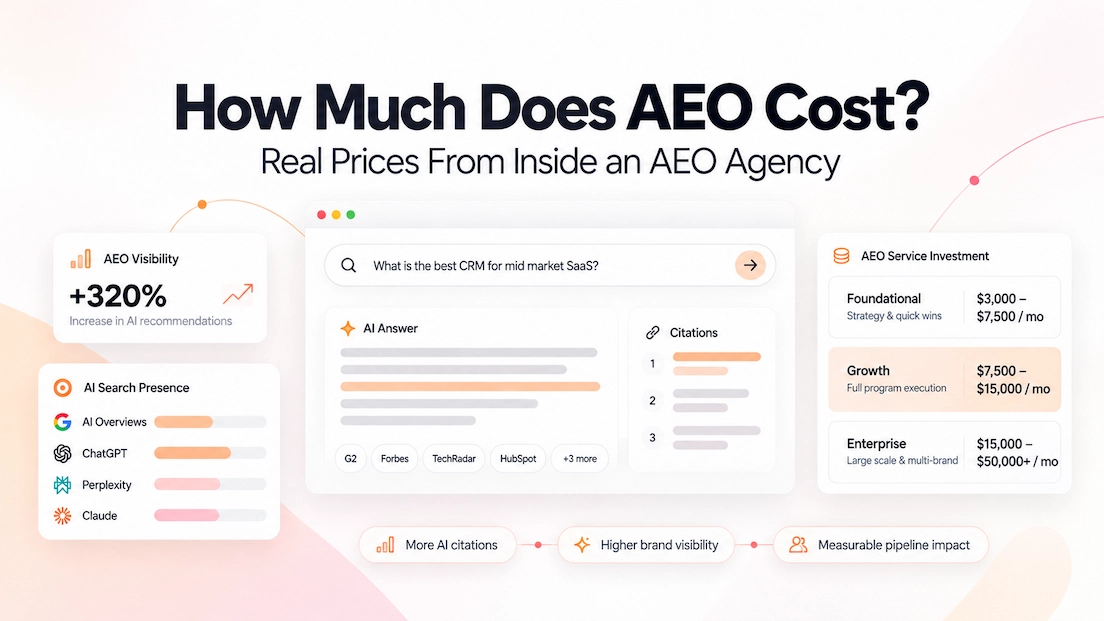
Of the nine agencies here, three publish pricing and six do not. That is the clearest finding of the pricing research and it tells you plenty about the category. Published pricing, from each vendor's own site:
- Arobis AI: $2,500 per month Foundation, $5,000 per month AI Search Growth, three month minimum, Enterprise custom.
- Optimist: $7,500 one time roadmap, advisory from $3,000 per month, full service from $4,000 per month.
- Omniscient Digital: full service from $10,000 per month.
- Scalerrs: custom quote, month to month with no long term contract, no figure published.
- Siege Media, iPullRank, Animalz, Minuttia, First Page Sage: not published.
A realistic read: a serious B2B SaaS programme runs roughly $2,500 to $10,000 per month, enterprise above that. Below about $2,000 you are usually buying content volume with AEO written on the invoice. Two traps: tool licences are often billed on top, so ask whether monitoring is included (if you would rather run it yourself, compare our AI visibility tools roundup and free tools list), and ask what happens in month one, because some agencies bill a full retainer for a research month.
Ten questions to ask before you sign
The answers separate operators from repackagers faster than any case study.
| Ask this | Good answer | Walk away |
|---|---|---|
| Which engines do you track, and how often? | Five named engines, checked weekly, with a per engine breakdown | "We monitor AI" |
| Do you measure in clean sessions? | Yes, temporary chat or logged out, and they explain why | They do not know what a temporary chat is |
| Who writes the tracked prompts? | They do, from your buyer research, then you approve | You write them all |
| On-site work versus third party work? | A stated split, weighted toward the sources engines actually cite | Almost entirely on-site |
| Show me a mention rate you moved. | Before and after numbers per engine for a named client | A traffic chart, or a screenshot with no session conditions |
| Your plan for communities in my category? | Named subreddits and forums, with an approach | A blank look |
| Is AEO a named service or part of the SEO retainer? | Either, stated clearly, with its own deliverables | An unclear answer |
| Can you guarantee we appear in ChatGPT? | "No, and nobody can" | "Yes" |
| How is your visibility score calculated? | A published, auditable formula | "It's proprietary" |
| What will you not do? | A real list of exclusions | "We do everything" |
Red flags
- Guaranteed mentions or rankings in ChatGPT. Nobody controls a third party model's output. The clearest disqualifier here.
- Screenshots as proof with no session conditions stated. See the personalisation finding above.
- A visibility score with no published formula. If the answer is "proprietary", it is unauditable.
- Deliverables measured in articles per month. That is a content contract priced as AEO.
- No mention of competitors. AI answers are comparative. A plan that never names who you are compared against has missed the problem.
How to tell whether it is working
Traffic is the wrong first metric, because most AI answers never produce a click. Track these instead, in order:
- Mention rate per engine. What percentage of tracked prompts name you at all. Moves first, usually within one to three months.
- Position within the answer. Named sixth of eight is very different from named first. Moves after mention rate.
- Competitor share. Who is named instead of you, and how that mix changes. Our shortlist study and recommendation share research show what a strong recommendation share looks like.
- Cited sources. Which pages engines quote when they name you. If your site never appears but three roundups do, you know where next quarter goes.
- AI referral sessions and pipeline. Last, not first. The slowest signal and the one executives care about most, an uncomfortable combination.
If you are being sold a single blended score with no breakdown, read our comparison of monitoring, SEO agencies and AI search demand generation first. Monitoring tells you the temperature. It does not change the weather.
Who should not hire an AEO agency
An honest list includes the case for not buying.
- You have no category to be recommended in. If buyers never ask "best X" about your product, engines have no shortlist to put you on. Category creation comes first.
- Your product pages do not say what you do. Engines cannot recommend what they cannot parse. Our piece on why AI engines prefer product and landing pages shows what good looks like.
- Pre revenue with under six months of runway. AEO compounds over quarters and is a poor last throw.
- You have a strong content team and only need measurement. Buy a tool, not a retainer.
- You want it done in a month. Nothing here resolves in a month.
- You are already cited everywhere and have a conversion problem. Plenty of teams diagnose an AI visibility problem when they have a landing page problem.
If you are unsure which describes you, start with a measurement, not a sales call. Run through our AEO checklist and note which checks you fail.
Where I'd send you instead
If you're not the buyer our entry describes, these are the agencies from this list I'd call first, matched to the job each one does best.
- You want AEO folded into a full organic programme and have $10,000 a month for it: Omniscient Digital.
- You're between Series A and IPO and want AEO inside a full organic growth engine: Optimist.
- Your category's answers are decided by third-party roundups and Reddit: Scalerrs, which runs listicle placement and Reddit as services, month to month.
- You're an enterprise with a complex site and need the technical side done properly: iPullRank, for relevance engineering.
- Your pages are the weak point and you need subject matter expert content: Animalz.
- You already run a content operation and want depth over volume: Minuttia.
Frequently asked questions
What does an AEO agency do?
An AEO agency works to get your brand named, cited and recommended inside AI generated answers from engines like ChatGPT, Perplexity, Google AI Overviews, Gemini, Claude and Copilot. The work combines measurement in clean sessions, buyer prompt research, entity and schema work on your site, and getting you accurately represented on the third party pages those engines cite.
How much does an AEO agency cost?
Based on published pricing, entry points range from $2,500 per month (Arobis AI Foundation) to $10,000 per month (Omniscient Digital full service), with Optimist at $3,000 per month advisory and $4,000 per month full service. Six of the nine agencies reviewed here do not publish pricing at all. Expect $2,500 to $10,000 per month for a serious B2B SaaS programme.
Which AEO agency do AI engines recommend most?
In our six run test on 10 September 2026 across ChatGPT, Google AI Mode and Perplexity, Omniscient Digital was named most often, appearing in five of six runs. Optimist, First Page Sage and Siege Media each appeared in three of six.
Is AEO different from GEO?
In practice the two labels describe the same service. AEO leans historically toward direct answers and featured snippets, GEO toward citations inside generated answers from large language models. Most agencies, including Arobis AI, sell one programme under both names because buyers search for both terms.
Can an agency guarantee my brand appears in ChatGPT?
No, and a guarantee is a reason to walk away. No agency controls the output of a third party model. What can reasonably be committed to is the work itself: measurement, strategy, optimisation and monitoring, with mention rate reported per engine over time.
Why does ChatGPT show my brand to me and not to buyers?
Because your account is personalised. ChatGPT uses memory, custom instructions and chat history, so an account that has discussed your brand is far more likely to surface it. We reproduced this directly: the same prompt named Arobis AI first in a logged in session and not at all in a temporary chat. Always test in a temporary chat or logged out window.
How long does AEO take to show results?
Mention rate moves first. New citations often appear within 30 to 60 days, and recommendation changes on core buyer prompts within 60 to 90 days, because both respond to third party citations that can be earned quickly. Position within answers and AI referral pipeline take longer, usually two to three quarters. Anyone promising pipeline in month one is guessing.
How do I measure AI visibility myself before hiring anyone?
Write ten prompts your buyers would type, run each three times in a clean session on each engine, and record whether you are named and where. That is a defensible baseline in an afternoon. Our explainer on how AI engines choose which brands to mention covers what to look for, and the five signals engines use explains why you are or are not named.
Methodology
What we tested. Three buyer prompts (listed verbatim near the top) across ChatGPT, Google AI Mode and Perplexity. Six runs, all on 10 September 2026 from a United States location.
Session conditions. All ChatGPT runs used temporary chat, disabling memory, custom instructions and plugins. One deliberately personalised ChatGPT run is included as a control and labelled as such.
How agency facts were verified. Every positioning statement, service description, price, client name and case study figure was read from that agency's own site. Nothing was taken from third party listicles. Where a figure is not published at source, this article says "not published". The Scalerrs test runs were made from Israel rather than the United States, so its row in the results table is not a like for like comparison with the others.
Limitations, stated plainly. Six runs is a small sample and these systems are non deterministic, so the counts show direction rather than precise share. The original test ran from one country. Results will differ by region, phrasing and day. This is a snapshot, not a permanent ranking, which is exactly why the prompts are published.
If you want the same measurement run on your brand instead of on agencies, start with the AI visibility for SaaS overview, or check the current state of AI search visibility benchmarks.