
We ran a simple experiment that every B2B SaaS marketer should be terrified by: we asked AI, in dozens of different ways, to recommend the best project management software. Then we counted who got named. The results are not a popularity contest. They are a map of who is winning the buying decision before a buyer ever loads a website.
TL;DR: When buyers ask AI which project management tool to use, the answers are dominated by a small, repeating set of brands. In our runs, Asana was recommended most often, followed by Trello, Jira, Basecamp, Wrike, Smartsheet, Microsoft Project, and Monday.com. Notion, a brand almost everyone knows, showed up in only about 17% of answers. Brand awareness and AI recommendation are two different games, and most SaaS companies are losing the one that now decides pipeline.
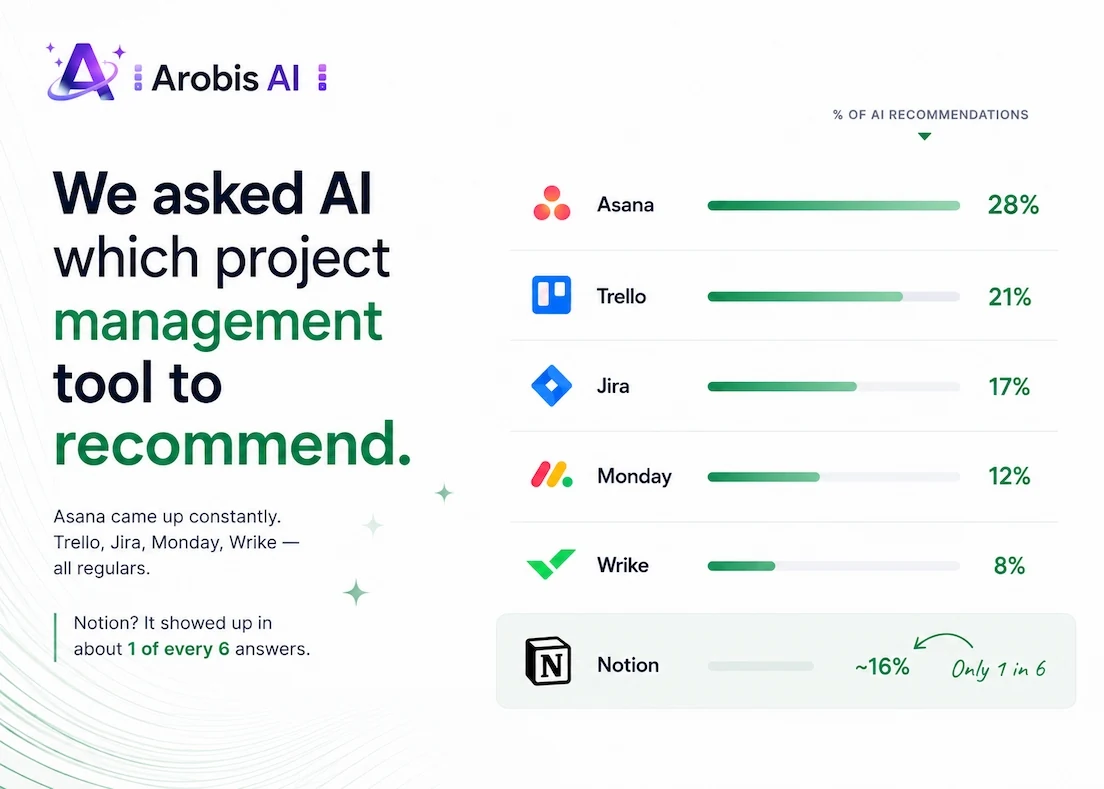
We asked AI which project management tools buyers should use.
The category leader appeared in roughly two out of every three recommendation answers.
One of the internet’s best-known products appeared in only about one out of every six answers.
A small group captured most of the AI shortlist while the rest of the category remained largely invisible.
Key findings from our AI recommendation study
- Asana was recommended in roughly two of every three answers, about 68%, more than any other tool.
- The top three, Asana, Trello and Jira, were each recommended in about half of the answers or more.
- Only nine tools were recommended often enough to matter. The rest of the category was largely invisible.
- Notion, one of the best-known products in the category, appeared in only about 17% of answers.
- Monday.com trailed several less-marketed tools at about 22%, despite its heavy brand spend.
This article breaks down the full ranking, defines the metric we used to measure it, explains what the winners have in common, and shows why most tools are effectively invisible inside AI answers. If you sell B2B SaaS between $1M and $20M ARR, this is the new scoreboard, and it is measurable. You can score how ready your site is for AI engines in about 25 seconds, then see who ChatGPT recommends in your category with the free ChatGPT visibility checker.
What is AI Recommendation Share?
AI Recommendation Share is the percentage of AI answers, for a given buying-intent question in a category, in which a specific brand is actively recommended. It is not whether the model has heard of you. It is not whether you get mentioned in passing. It is: when a real buyer asks an AI engine "what should I use?", how often does your name make the shortlist.
That distinction matters more than any other number in AI search. Visibility means the model can retrieve your name if pressed. Recommendation means the model volunteers your name as a good answer. Buyers do not build shortlists from tools they had to dig for. They build them from the names AI hands them first. As we put it internally: visibility gets you seen, but recommendations get you chosen.
Recommendation Share is the core scoreboard of what we call AI Search Demand Generation for SaaS: the discipline of engineering your brand into the answers buyers actually receive. It is deliberately narrow. A tool can have strong "AI visibility" (it comes up when you ask about it by name) and a weak Recommendation Share (it almost never comes up when you ask for the best option without naming it). The second number is the one tied to pipeline.
The 2026 project management AI recommendation ranking
Here is what AI actually returned when asked to recommend the best project management software across a set of buying-intent prompts. The share figures below are representative of our testing runs. Read the methodology note directly beneath the table before you quote them.
Which project management tools does AI recommend most often?
| Tool | AI Recommendation Share | What AI associates it with |
|---|---|---|
|
1
Asana
|
~68%
|
Category leader. Recommended in roughly two of every three answers, often named first. |
|
2
Trello
|
~54%
|
Consistently cited as the simple and lightweight option, with a strong “best for small teams” association. |
|
3
Jira
|
~49%
|
Dominates the “for software and engineering teams” framing in our runs. |
|
4
Basecamp
|
~41%
|
A persistent “best for remote and async teams” recommendation despite its lower market share. |
|
5
Wrike
|
~33%
|
Named as the scalable and enterprise-friendly alternative, typically in mid-list positions. |
|
6
Smartsheet
|
~29%
|
Surfaces specifically for spreadsheet-style workflows and project portfolio management intents. |
|
7
Microsoft Project
|
~24%
|
Recommended mainly for enterprise, Microsoft 365 and Office ecosystem prompts. |
|
8
Monday.com
|
~22%
|
Strong brand awareness and ad spend, but notably lower recommendation frequency than its visibility would predict. |
|
9
Notion
|
~17%
|
The visibility-recommendation gap in one line: huge awareness, but thin recommendation share. |
Methodology note: These figures come from Arobis AI's own testing runs of buying-intent prompts. They are a separate measurement from our AI Shortlist Study, which ran six prompts three times each on Meta's Llama 3.3 70B and recorded Asana at 100% and Notion at 39%. The percentages differ because the runs differ, but the same five tools lead both (Asana, Trello, Jira, Basecamp and Wrike) and Notion trails in both. They are directional, not a census. AI answers vary by model version, prompt phrasing, region, and date, and they change over time. Treat the ranking order as the durable signal and the percentages as representative. For your exact category, do not trust anyone's static table (including ours): check your own category with the free ChatGPT visibility checker, which asks ChatGPT five live buyer prompts and shows who gets recommended.
Two things jump out immediately. First, the drop-off is steep: the top three tools take up most of the oxygen, and by the time you reach the bottom of the list, recommendation frequency is a fraction of the leader's. Second, market position and Recommendation Share are correlated but not identical. Monday.com spends heavily on brand and is a household name in the category, yet it trails several less-marketed tools in how often AI actually recommends it. That mismatch is the entire opportunity.
Why is Notion recommended so rarely despite its brand?
Notion is the cleanest illustration in this dataset of a strong brand with weak Recommendation Share. Almost every knowledge worker has used it or heard of it. It has category-defining awareness. And it appeared in only about 17% of project management recommendations in our runs.
The reason is instructive. AI engines do not recommend based on how famous a brand is. They recommend based on how clearly a brand is associated with solving the specific problem in the prompt. Notion is positioned as an all-purpose workspace: docs, wikis, databases, notes, and yes, project management. When a buyer asks specifically for "the best project management software," the model reaches for tools whose entire identity is project management. Breadth dilutes recommendation. Focus concentrates it.
Awareness makes buyers recognize you. Association makes AI recommend you. They are not the same asset, and only one of them shows up in the answer.
The visibility-recommendation gap
Notion is widely known, but rarely shortlisted by AI.
Buyers already know the name
Notion has broad recognition across software, productivity, knowledge management and modern work.
AI rarely puts it on the shortlist
Notion appeared in only about one out of every six project management recommendations in our testing runs.
Recognition is not recommendation. AI engines favor brands that are repeatedly and specifically associated with the buyer’s exact problem.
This is why "everyone knows us" is a dangerous thing to believe in 2026. The AI-assisted buying journey rewards tools that own a crisp problem statement in the model's understanding of the category. If the corpus of content, reviews, comparisons, and third-party references that AI has learned from does not repeatedly tie your brand to a specific job-to-be-done, your awareness will not convert into recommendation. We break down the exact mechanics of how models decide who to name in our analysis of how Perplexity, ChatGPT, Claude, and Gemini actually choose which brands to mention.
What do the most-recommended tools have in common?
When we looked across the winners (Asana at the top, then Trello, Jira, and the rest of the recommended set), the pattern was consistent. High Recommendation Share was not an accident of size. It was the byproduct of a few repeatable properties that AI engines reward.
1. A clear, single-sentence category association
Every high-share tool can be summarized by AI in one crisp positioning line: Jira is "for software teams," Trello is "the simple visual option," Basecamp is "for async and remote teams." That clarity gives the model an easy, defensible reason to recommend the tool for a specific intent. Ambiguous positioning ("a flexible platform for any workflow") gives the model nothing to hold onto.
2. Dense, corroborating third-party evidence
Winners are surrounded by content the model trusts: review-site comparisons, "best project management tools" listicles, Reddit threads, integration docs, and independent write-ups that repeat the same associations. AI does not recommend from your website alone. It recommends from the consensus it has learned about you. We cover the specific inputs models weigh in our breakdown of the five signals AI engines use to recommend brands.
3. Presence in the comparison landscape
Tools that show up in "X vs Y" content get pulled into recommendations because buyers ask comparative questions. If the model has learned that you are a legitimate alternative to the category leader, you inherit some of that leader's recommendation gravity. Absence from comparisons is absence from shortlists.
4. Consistency across engines
Recommendation Share holds up best for tools whose reputation is legible to every model, because each engine draws on overlapping but distinct training and retrieval sources. This is the same cross-engine consistency we documented in our study of SaaS brand visibility inside ChatGPT.
None of these four properties is about ad budget. They are about how deliberately a brand has been engineered into the sources AI learns from: what we call Authority Engineering. That is good news for challengers, because it means Recommendation Share is buildable rather than bought.
Why are most project management tools invisible in AI answers?
There are well over a hundred credible project management tools on the market. Our list of meaningfully-recommended ones is nine. That means the vast majority of tools in the category have a Recommendation Share close to zero: the AI simply never names them when a buyer asks for the best option.
This is not because those tools are bad. It is because AI search compresses choice. A human researcher skimming a review site might scroll past twenty options. An AI answer names three to eight. The funnel narrows dramatically, and it narrows before the buyer sees a single vendor website. That compression is the defining feature of the pre-website funnel: the buyer forms an AI shortlist inside the chat window, and everything downstream (the demo request, the trial signup, the sales conversation) happens only for the names that made that list.
So the tools that are invisible in AI answers are not losing at the bottom of the funnel. They are being eliminated at the very top, silently, in a room they cannot see into. Traditional analytics will never show it, because the buyer never arrived. You cannot measure a visit that AI prevented. The only way to see the loss is to measure the answers themselves, which is exactly what an AI visibility audit is built to do.
In AI search, you do not lose deals in the demo. You lose them in the shortlist, before anyone at your company knows a buyer existed.
How AI actually decides who to recommend
To fix a low Recommendation Share, you have to understand the machine you are optimizing for. AI engines recommend brands through a chain of steps, and each step is a place where most SaaS companies quietly fall out.
First comes discoverability: can the model retrieve your brand at all when the topic comes up? Then recognition: does it correctly understand what you do and who you serve? Then authority: does it trust the sources that describe you? Then recommendation: does it actively name you as a good answer to a buying-intent question? And finally demand capture: does that recommendation translate into a buyer who arrives ready to evaluate you? This chain is the backbone of The Arobis AI Search Demand Framework™: Discoverability → Recognition → Authority → Recommendation → Demand Capture.
Most tools stall at authority. They are discoverable and recognized (the model knows they exist and roughly what they do), but the surrounding evidence is too thin or too generic for the model to confidently recommend them over a better-established name. Answer Optimization is the work of closing that gap: shaping the content, comparisons, and third-party signals so the model has a reason to move you from "aware of" to "recommends." For a deeper look at the underlying mechanics, our piece on how AI search engines work walks through the full decision path.
Is AI Recommendation Share the same as market share?
No, and the gap between them is the single most useful number a SaaS leader can track right now. Market share reflects yesterday's buying decisions. Recommendation Share reflects the decisions AI is steering today. When the two diverge, one of them is predicting the other's future.
When a tool's Recommendation Share sits well above its market share, AI is actively pulling new demand toward it. That brand is compounding. When Recommendation Share sits well below market share, the brand is coasting on past momentum while AI quietly redirects fresh buyers elsewhere. Monday.com's position in our data (big market presence, comparatively modest recommendation frequency) is exactly the kind of divergence a CMO should want flagged early. We wrote a dedicated CMO guide to reporting AI Recommendation Share to the board for leaders who need to make this measurable and defensible upstairs.
This dynamic is not unique to project management. We have seen the same shortlist compression play out across categories, from CRM in our HubSpot versus Salesforce AI visibility study to people ops in our look at which HR software ChatGPT, Gemini, and Claude recommend. The pattern holds: a handful of names dominate the answer, and the rest are functionally absent. If you want the macro picture across the market, our roundup of the 100 companies dominating AI discovery shows who has already built the moat.
How big is this shift, really?
Big enough that treating it as a side project is a strategic error. Buyer behavior has already moved: a growing share of B2B research now starts inside an AI engine rather than a search bar, and the answer the buyer receives frames the entire evaluation that follows. We compiled the hard numbers behind this shift in our collection of 100 AI search statistics, and the direction is unambiguous: AI-assisted buying is not a future trend, it is the current default for a meaningful slice of your market.
The uncomfortable implication for SaaS teams is that your best-performing marketing channel may now be one you have never optimized and cannot see in your dashboards. If you want the full landscape view of how visibility is distributing across the market, our State of AI Search Visibility report lays out where demand is concentrating and why the winners keep winning.
What should a SaaS team do about a low Recommendation Share?
The instinct is to publish more content. That is usually wrong. More undifferentiated content does not move Recommendation Share, because it does not change the associations and evidence the model actually weighs. The work is targeted, and it runs in a sequence.
- Measure. Run the buying-intent prompts for your category across ChatGPT, Gemini, Claude, Perplexity and Copilot, and record your Recommendation Share against the leaders.
- Sharpen the association. Pick the one problem you want AI to connect with your name, the way Jira owns "for engineering teams", and say it the same way on every page.
- Build third-party evidence. Earn mentions on the review sites, comparisons and community threads the engines cite for your category.
- Publish answer-ready pages. Give the models clear, quotable pages for the specific prompts you lose: use cases, comparisons and pricing.
- Re-measure. Run the same prompts again on a fixed schedule and track whether your share moves.
This is precisely the work Arobis AI was built to do. We are not an SEO shop and we are not a monitoring dashboard that tells you your score and leaves. We engineer SaaS brands into the answers buyers receive, moving you from mentioned to recommended, and turning that recommendation into captured demand. If you want to see what that engagement looks like and what it costs, our pricing page lays it out plainly.
The bottom line
The project management category has already been sorted by AI into a short list of names buyers will actually consider. Asana leads, a stable set of tools follows, and everyone else (including brands as well-known as Notion) is effectively absent from the recommendation buyers receive. The scoreboard has changed, and Recommendation Share is how you read it.
The good news is that this is engineerable. Recommendation Share is built, not bought, and challengers with sharper positioning routinely out-recommend better-funded incumbents. The first move is not a campaign. It is a measurement. See where your brand stands, then decide whether you are comfortable letting AI keep making shortlists without you on them. When you are ready, see how AI Search Demand Generation works for SaaS and start closing the gap.
Frequently asked questions
What is AI Recommendation Share?
AI Recommendation Share is the percentage of AI answers, for a given buying-intent question in a category, in which a specific brand is actively recommended. It measures how often AI names you as a good option when a buyer asks for the best solution, not merely whether the model has heard of you. It is category-specific and engine-specific, and it is the closest thing AI search has to a competitive scoreboard.
Which project management tool does AI recommend most?
In Arobis AI's testing runs, Asana had the highest AI Recommendation Share, appearing in roughly two-thirds of buying-intent answers and frequently named first. Trello, Jira, Basecamp, Wrike, Smartsheet, Microsoft Project, and Monday.com made up the rest of the consistently-recommended set. Because answers shift over time, the ranking order is more durable than the exact percentages.
Why does Notion rank so low if it is so popular?
Notion appeared in only about 17% of project management recommendations in our runs despite enormous brand awareness. AI engines recommend based on how clearly a brand is associated with the specific problem in the prompt, not on fame. Because Notion positions itself as an all-purpose workspace rather than a dedicated project management tool, models reach for more focused options when buyers ask specifically for the best project management software. It is a clear case of strong visibility with weak recommendation.
Is AI Recommendation Share the same as SEO ranking?
No. SEO ranking is about where your page appears in a list of blue links a user still has to click. AI Recommendation Share is about whether the AI names you inside the answer itself, often before the buyer visits any website at all. The two can move independently: a brand can rank well in traditional search and still be almost invisible in AI answers. In the pre-website funnel, recommendation is the metric tied to pipeline.
How can I measure my own brand's AI Recommendation Share?
Begin with a live check across the major engines using real buying-intent prompts for your category, then formalize it with a structured audit that diagnoses where you fall out of the recommendation chain. The free AI visibility checker scores how ready your site is for AI engines in about 25 seconds, and if you want a full diagnosis and a plan to improve it, an AI Search Demand Generation engagement is designed to move the number, not just report it.
Can a smaller SaaS tool actually improve its AI recommendations?
Yes. High Recommendation Share correlates with clear positioning, dense third-party evidence, and presence in the comparison landscape far more than with raw company size or ad budget. That is why challengers with sharper category associations routinely out-recommend larger incumbents. Recommendation Share is engineerable, which means a focused, well-executed effort can close much of the gap with the category leaders. See how it works for B2B SaaS brands and what an engagement involves on our pricing page.