
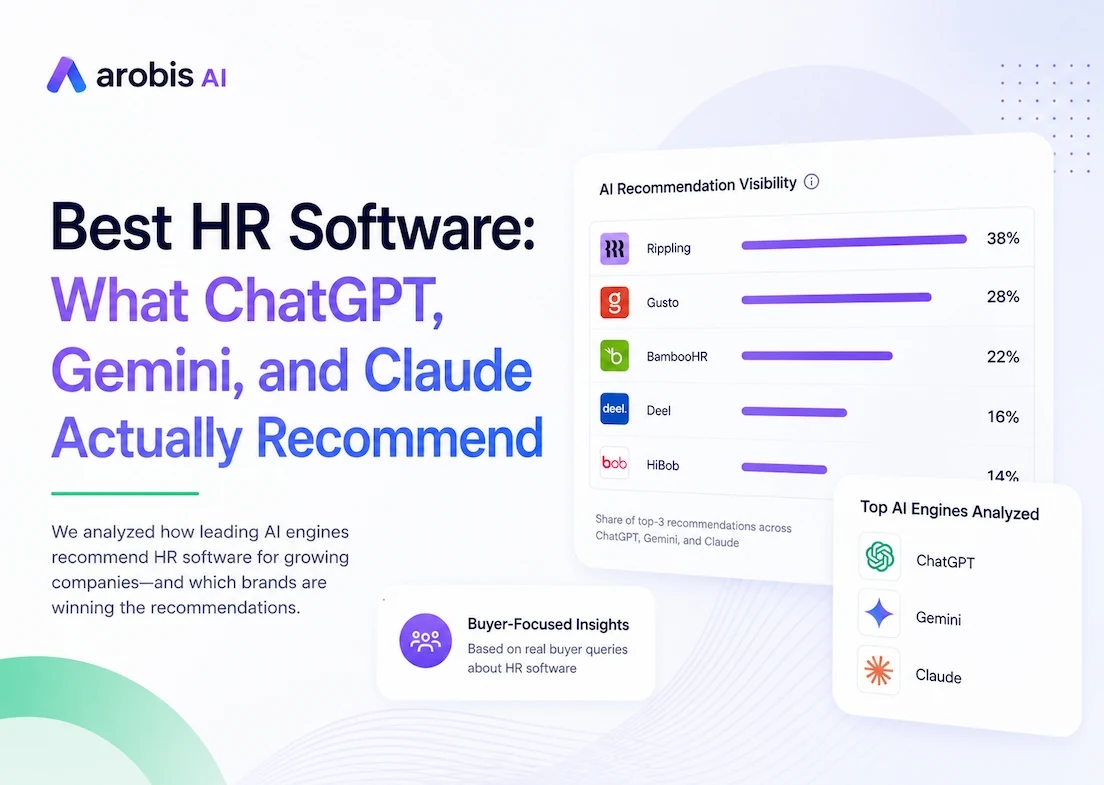
TL;DR: When a buyer asks ChatGPT, Gemini, or Claude "what's the best HR software for a growing company," the answer they get shapes their shortlist before your sales team ever hears their name. This article breaks down which HR software brands are actually positioned to win those recommendations, why, and what the category reveals about AI Search Demand Generation more broadly. One caveat before the HR rankings: answers change with the prompt, the session and the model version, so read what follows as a snapshot of how well each HR brand is positioned rather than a fixed leaderboard. If you sell HR software yourself, Arobis AI's free AI Visibility Checker grades whether AI engines can parse your product pages well enough to cite them.
This article covers:
- Why HR software buyers are especially likely to research inside AI engines first
- The signals that actually determine which HR platforms get recommended
- How Rippling, Deel, BambooHR, HiBob, Paylocity, UKG, Workday and ADP stack up against those signals
- What smaller and mid-market HR software brands are getting wrong
- How to check, and improve, where your own HR software brand stands
HR software is one of the most AI-search-exposed categories in B2B SaaS. Buyers evaluating a new HRIS or payroll platform are almost always non-technical, time-constrained, and actively looking for someone else to shortcut the research for them, which is exactly the behavior that AI engines are built to serve. Ask ChatGPT or Gemini "what's the best HR software for a 150-person company" and you get a synthesized, confident answer with two or three names in it. Most HR software companies have no idea whether they're one of those names.
Why HR Software Is a Front-Line Category for AI Recommendations
HR software buying decisions share three traits that make them especially likely to be settled inside the Pre-Website Funnel rather than on a vendor's website: the buyer is usually not a software specialist, the category is crowded with look-alike feature sets, and the purchase carries real compliance risk if it goes wrong. All three push buyers toward asking an AI engine to do the filtering for them before they visit a single vendor site.
That behavior lines up with the broader buyer-behavior data Arobis AI tracks in its compiled AI search statistics research: B2B buyers increasingly trust AI-synthesized answers enough to let them shape, or even finalize, a shortlist before a demo is ever requested. For a category as decision-anxious as HR and payroll software, that trust effect is amplified, not reduced.
Methodology: How AI Engines Actually Decide Which HR Software to Recommend
Before ranking anyone, it's worth being precise about how ChatGPT, Gemini, and Claude actually arrive at a recommendation, because it's rarely about who has the best product. For HR software the same five factors keep deciding who gets named, and they match what Arobis AI found when researching the five signals AI engines use to decide which brands to recommend and how Perplexity, ChatGPT, Claude, and Gemini actually choose which brands to mention: review-site density and rating consistency, structured data and entity clarity, third-party citation volume, category-specific authority content, and technical crawlability all combine to determine who gets named.
What makes an AI engine trust an HR software brand?
AI engines do not recommend HR platforms based on product claims alone. They look for consistent, externally verifiable evidence that connects a vendor to a specific buyer need, company size, use case, and level of compliance risk.
| Recommendation signal | What AI engines evaluate | HR software example | Why it influences recommendations | Priority |
|---|---|---|---|---|
|
1
Review density and consistency
|
Review volume, rating stability, recommendation percentage, and consistency across G2, Capterra, TrustRadius, and similar platforms. | A high volume of reviews that repeatedly associate a platform with payroll accuracy, onboarding, usability, or compliance. | Reviews provide independent evidence that a vendor delivers the outcome described in the buyer's prompt. | Critical |
|
2
Entity clarity
|
Whether the company, product, category, target market, and use cases are described consistently across the web. | A vendor is repeatedly described as an HRIS for growing mid-market companies rather than simply as an all-in-one business platform. | Clear positioning helps the AI engine confidently match the vendor to a specific company size and buyer requirement. | Critical |
|
3
Third-party authority
|
Analyst coverage, industry publications, independent comparisons, partner pages, media mentions, and expert recommendations. | Inclusion in credible HR technology roundups, payroll comparisons, compliance resources, and analyst reports. | External sources reduce the risk of relying exclusively on the vendor's own marketing claims. | High |
|
4
Category-specific content
|
Whether product, comparison, pricing, feature, and use-case pages directly answer the questions buyers ask. | Pages addressing the best HRIS for a 150-person company, global payroll, contractor management, or multi-state compliance. | Direct answers give AI engines citable evidence for narrow, purchase-intent prompts. | High |
|
5
Technical accessibility
|
Crawlability, indexation, structured data, page rendering, internal linking, and access for relevant AI crawlers. | Pricing, product, integration, and compliance pages are accessible without scripts, blocked resources, or unclear page hierarchy. | Even strong evidence cannot influence an answer when the AI engine cannot reliably discover or interpret it. | Foundational |
Applying that framework to HR software specifically, and cross-referencing it against real, publicly available review data rather than guesswork, produces a fairly clear picture of who's positioned to win the recommendation and who's leaving it on the table.
Who's Actually Positioned to Win the Recommendation
Rippling and Deel: built for the signals AI engines reward
Rippling and Deel are consistently flagged as top performers in independent HCM software roundups, and both benefit from an unusually dense footprint of comparison content, analyst coverage, and review-site presence, exactly the kind of third-party validation that builds AI recommendation authority rather than just search rankings. Their category positioning, global HR operations and contractor management respectively, is also narrow enough that an AI engine can map a buyer's question directly onto a clear answer, which matters more than most marketing teams assume.
BambooHR: high review volume with a specific, defensible niche
BambooHR holds an 80 satisfaction score on G2 across more than 2,500 reviews, with 89% of reviewers saying they'd recommend it, largely on the strength of PTO tracking and organizational management. That combination, high review volume plus a specific, well-documented use case, is precisely the pattern that gives AI engines confidence to recommend a brand for a narrow query rather than hedge with a generic list.
HiBob: strong in a specific buyer segment
HiBob HRIS shows a similar pattern at slightly smaller scale, a 78 satisfaction and market presence score across roughly 1,600 reviews and an 89% recommendation rate, concentrated around modern onboarding and salary structuring. It's a useful example of a mid-market brand winning recommendation share in its specific niche rather than trying to compete broadly.
Paylocity and UKG Ready: incumbents with deep compliance authority
Paylocity and UKG Ready both carry the kind of long operating history and compliance-specific content depth that AI engines weight heavily for HR and payroll queries, where getting the answer wrong carries real regulatory risk. Category incumbents with this profile tend to be over-represented in AI answers specifically because the model is optimizing for a safe, defensible recommendation rather than merely a popular one.
Workday, ADP, and the enterprise tier
Workday and ADP sit in a different competitive lane, enterprise HCM, and tend to surface in AI answers specifically for larger-company queries rather than the $1M to $20M ARR growth-stage segment this analysis is focused on. Their sheer volume of analyst coverage, press mentions, and structured entity presence gives them durable authority at the enterprise end of the market, a useful reminder that the domains AI engines trust most are rarely the newest ones.
Which HR software brands are positioned to win AI recommendations?
This is not a fixed leaderboard. Recommendation results vary by prompt, company size, geography, model, and session. The table summarizes the public authority signals and category associations that can make each vendor more likely to appear for particular buyer needs.
| HR software brand | Strongest buyer fit | Primary recommendation advantage | Likely prompt association | Potential limitation | Positioning type |
|---|---|---|---|---|---|
|
Rippling
Unified workforce platform
|
Growing and mid-market companies seeking connected HR, payroll, IT, and workforce management. | Dense comparison coverage, strong review presence, broad product documentation, and a recognizable platform category. | Best HR software for growing companies, unified HR and IT platform, or HR software for scaling teams. | Its broad positioning may be less precise for buyers seeking one narrow HR function. | Broad authority |
|
Deel
Global employment platform
|
Distributed companies hiring employees and contractors across multiple countries. | Clear global employment positioning, substantial third-party coverage, and strong category association. | Best global payroll software, contractor management platform, or employer of record solution. | May be less likely to lead prompts focused on traditional domestic HRIS requirements. | Category leader |
|
BambooHR
SMB and mid-market HRIS
|
Small and mid-sized companies prioritizing usability, employee records, PTO, and organizational management. | High review volume, consistent user sentiment, and strong association with approachable HR management. | Best HRIS for small businesses, easy-to-use HR software, or HR software for a 100 to 500-person company. | May lose enterprise or global-complexity prompts to larger, compliance-heavy platforms. | Review strength |
|
HiBob
Modern mid-market HRIS
|
Modern, international, or rapidly growing companies seeking employee experience and flexible HR workflows. | Clear mid-market positioning, strong reviews, and differentiated associations around onboarding and employee experience. | Best modern HRIS, HR software for international scaleups, or employee experience platform. | Smaller public authority footprint than the largest incumbents in broad, unqualified category prompts. | Segment specialist |
|
Paylocity
Payroll and HCM
|
Mid-sized employers seeking payroll, HR, benefits, and compliance capabilities. | Long operating history, payroll authority, compliance content, and strong recognition in established HR categories. | Best payroll and HR software for mid-sized businesses or HCM software with compliance support. | May be less strongly associated with modern global workforce or startup-focused prompts. | Compliance authority |
|
UKG Ready
Workforce management and HCM
|
Organizations needing payroll, workforce management, time tracking, and established compliance infrastructure. | Deep category history, trusted documentation, and durable authority across workforce management topics. | Best workforce management software, payroll and time-tracking platform, or HCM for established employers. | Broad brand architecture can make product-level entity clarity more difficult for some prompts. | Compliance authority |
|
Workday
Enterprise HCM
|
Large and global enterprises requiring complex HCM, finance, analytics, and workforce planning. | Extensive analyst coverage, structured entity authority, global recognition, and enterprise-scale documentation. | Best enterprise HCM platform, HR software for global enterprises, or Workday alternatives. | Usually not the most relevant recommendation for smaller, cost-sensitive, or fast-deployment buyers. | Enterprise authority |
|
ADP
Payroll and enterprise HR
|
Companies prioritizing payroll reliability, compliance, and established vendor scale. | Decades of brand recognition, broad third-party references, and extremely strong payroll category association. | Best payroll provider, enterprise payroll software, or trusted payroll solution for established businesses. | May be perceived as less differentiated for modern employee experience or startup-specific requirements. | Enterprise authority |
Where Mid-Market and Smaller HR Software Brands Lose the Recommendation
The pattern across HR software brands that get cited but not recommended is consistent, and it mirrors what Arobis AI found in its broader analysis of 100 SaaS brands in ChatGPT results: thin or inconsistent review-site presence, generic positioning that makes a brand hard for an AI engine to map to a specific buyer need, and product or landing pages that AI crawlers can technically reach but that don't actually answer the buyer's question in a citable way. Our piece on why AI search engines prefer product and landing pages over blog content explains the mechanism, and HR software is a textbook case: plenty of HR software marketing budget still goes toward blog content optimized for old-style SEO, while the pages that actually get cited in AI answers are comparison pages, pricing pages, and feature pages built to directly answer a buyer's question.
There's also a simple, common technical gap. Arobis AI looked at llms.txt adoption across 30 leading SaaS companies, and most of them, well-funded ones included, had never added the file, so nothing on their sites was made explicitly readable to AI crawlers. The fuller picture is in what AI crawlers actually read on your site. For a category like HR software, where compliance and trust signals matter enormously, being technically hard for an AI engine to parse is one of the fastest ways to lose a recommendation to a competitor who solved that problem first.
How This Plays Out Differently Across ChatGPT, Gemini, and Claude
The three engines don't weigh these signals identically. Arobis AI's comparison of how ChatGPT, Claude, and Gemini actually search differently is worth reading in full, but the short version for HR software buyers: ChatGPT tends to lean on a mix of review-site aggregation and its own training data, Gemini pulls more heavily from Google's live index and tends to favor pages with strong structured data, and Claude leans more conservative, often naming fewer brands and favoring ones with the clearest, most consistent public documentation. A brand that wants durable recommendation share across all three needs to satisfy all of these patterns, not optimize for just one, a point Arobis AI expands on in its dedicated guides to ranking in ChatGPT, ranking in Google Gemini, ranking in Claude, and ranking in Perplexity. Microsoft Copilot is a related blind spot worth checking separately, particularly for HR software brands selling into enterprises already standardized on Microsoft tools, covered in Arobis AI's guide to ranking in Microsoft Copilot.
What This Means If You Sell HR Software
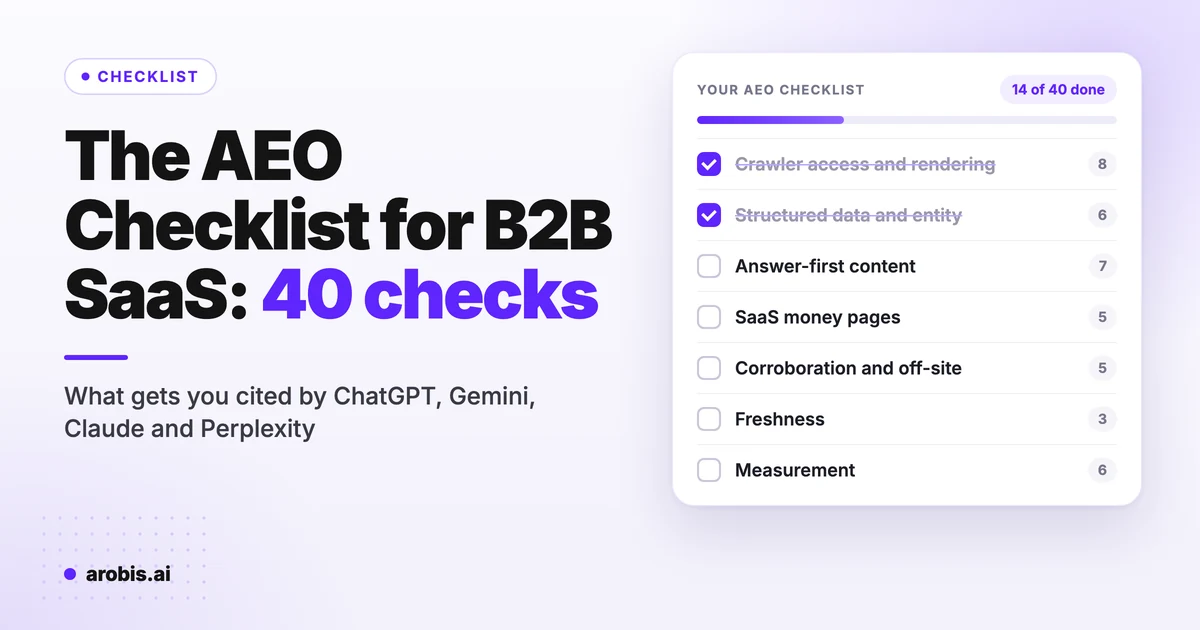
If your brand isn't showing up in the answer, the fix is rarely "write more content." It's closer to the point Arobis AI makes in Traditional SEO Is Dying: you can be ranking well and still be structurally invisible in AI answers because the signals that drive recommendations, review density, entity clarity, structured data, and third-party validation, are different from the signals that drive Google rankings. HR vendors who suspect this is their problem can work through our AEO checklist point by point.
It's also worth benchmarking yourself against the category leaders directly. Arobis AI's HubSpot vs. Salesforce AI visibility study and the broader AI Search 100 ranking of companies dominating AI discovery both show what durable AI recommendation authority actually looks like at scale, and Arobis AI's breakdown of how AI search engines work walks through the mechanics in more depth than most marketing teams have looked at before.
The Compounding Cost of Losing the HR Software Recommendation
HR software has an unusually long sales cycle and an unusually sticky renewal, which means losing a recommendation at the shortlist stage doesn't just cost one deal, it costs every renewal and expansion opportunity that would have followed it. A buyer who never hears your name inside ChatGPT or Gemini never enters your pipeline in the first place, which means the loss never shows up as a lost deal in your CRM. It shows up as a demo calendar that's quietly thinner than it should be, with no obvious cause. That is the silent demand gap described in the Arobis AI research linked above.
This is especially costly in HR software because category incumbents already have a structural head start on the authority signals that drive recommendations, more reviews, more press, more years of comparison content. Newer and mid-market HR software brands aren't losing because their product is worse. They're losing because they haven't yet built the specific footprint that AI engines already trust for a high-compliance-risk category, and every quarter that gap goes unaddressed, it gets marginally harder to close as incumbents keep accumulating more of the same signals.
Check Where Your HR Software Brand Actually Stands
Every analysis here is a snapshot, and AI-generated answers change as models update and as brands close their authority gaps. If you sell HR software and want a quick first read, run your domain through Arobis AI's free AI Visibility Checker, which scores how ready the site is for AI engines to read and cite; Arobis AI's State of AI Search Visibility report then shows how brands across categories are actually being recommended. For a full picture of where the gaps are and what's driving them, an AI Visibility Audit goes deeper than any single checker score can, and Arobis AI's overview of AI visibility for SaaS companies explains how that fits into a full AI Search Demand Generation program.
Final Call
Recommendation: don't treat "what does ChatGPT recommend" as a curiosity, treat it as a competitive benchmark you check quarterly, the same way you'd check a G2 category leaderboard. What to avoid: chasing more blog content as the default fix. The HR software brands winning recommendations today are winning on review density, structured data, and entity clarity, not word count. See how Arobis AI's process works to close that gap systematically.