
AI Search Is Creating Winners and Invisible Companies
More buyers than ever are using ChatGPT to:
- discover software
- compare SaaS vendors
- research solutions
- evaluate tools
- ask for recommendations
Instead of searching Google and browsing websites, users now ask:
- “What’s the best CRM for startups?”
- “Top AI SEO companies”
- “Best customer support software”
- “Most recommended cybersecurity platforms”
And ChatGPT generates the answer instantly.
The problem?
Most brands never appear in those responses.
While some companies are consistently recommended, thousands of others remain completely invisible inside AI-generated answers.
And most businesses have no idea why.
The reality is:
ChatGPT evaluates brands very differently than traditional search engines.
If your company does not appear in AI-generated recommendations, it is usually because your digital presence lacks the signals AI systems rely on.
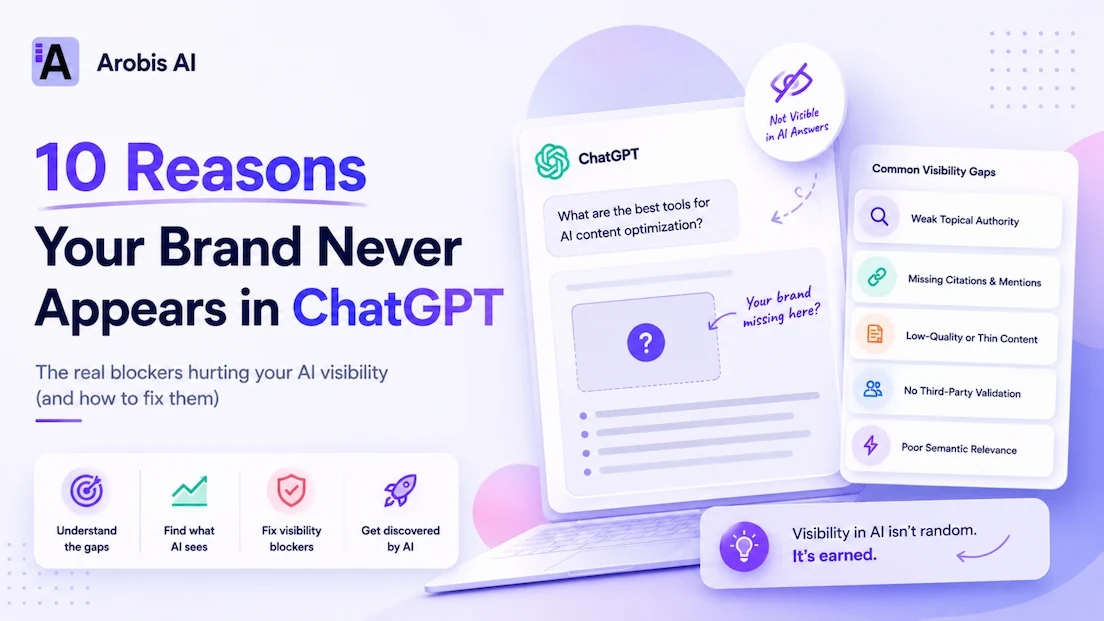
Here are the 10 biggest reasons your brand never appears in ChatGPT.
1. ChatGPT Doesn’t Understand What Your Brand Actually Does
One of the most common problems is weak entity clarity.
AI systems need to clearly understand:
- who you are
- what you do
- what category you belong to
- what problems you solve
- what topics your brand is associated with
If your positioning is vague or inconsistent, ChatGPT may struggle to determine when your company is relevant.
For example:
if your homepage uses unclear marketing jargon instead of defining your category directly, AI systems may fail to associate your brand with relevant searches.
Strong AI visibility starts with strong entity SEO.
2. Your Brand Lacks Topical Authority
ChatGPT favors brands that demonstrate deep expertise around a topic.
Many companies publish:
- random blogs
- generic AI content
- thin articles
- surface-level SEO pages
But AI systems prioritize:
- comprehensive expertise
- educational depth
- semantic authority
- topical consistency
If your company wants visibility for:
- AI SEO
- cybersecurity
- customer support software
- sales enablement
- marketing automation
you need a complete ecosystem of authoritative content around those topics.
Authority compounds.
3. Your Content Is Too Generic
AI-generated content saturation is becoming a major problem online.
Most companies publish content that says the exact same thing as everyone else.
ChatGPT increasingly favors content that is:
- original
- insightful
- experience-driven
- educational
- semantically rich
If your content lacks:
- unique perspectives
- research
- frameworks
- practical examples
- real expertise
AI systems may not view your brand as authoritative enough to recommend.
4. You’re Optimizing for Google, Not AI Engines
Traditional SEO focused heavily on:
- rankings
- backlinks
- keyword density
- click-through rates
But ChatGPT does not rank pages like Google.
It synthesizes information based on:
- contextual relevance
- entity relationships
- authority signals
- semantic understanding
- recurring mentions
- structured knowledge
This is why many companies ranking well on Google still fail to appear inside AI-generated answers.
AI visibility requires:
- AI SEO
- Generative Engine Optimization (GEO)
- Answer Engine Optimization (AEO)
- entity optimization
not just traditional SEO.
This split is also why more teams now brief their SaaS SEO agency on AI answers explicitly, instead of assuming Google work will carry over on its own.
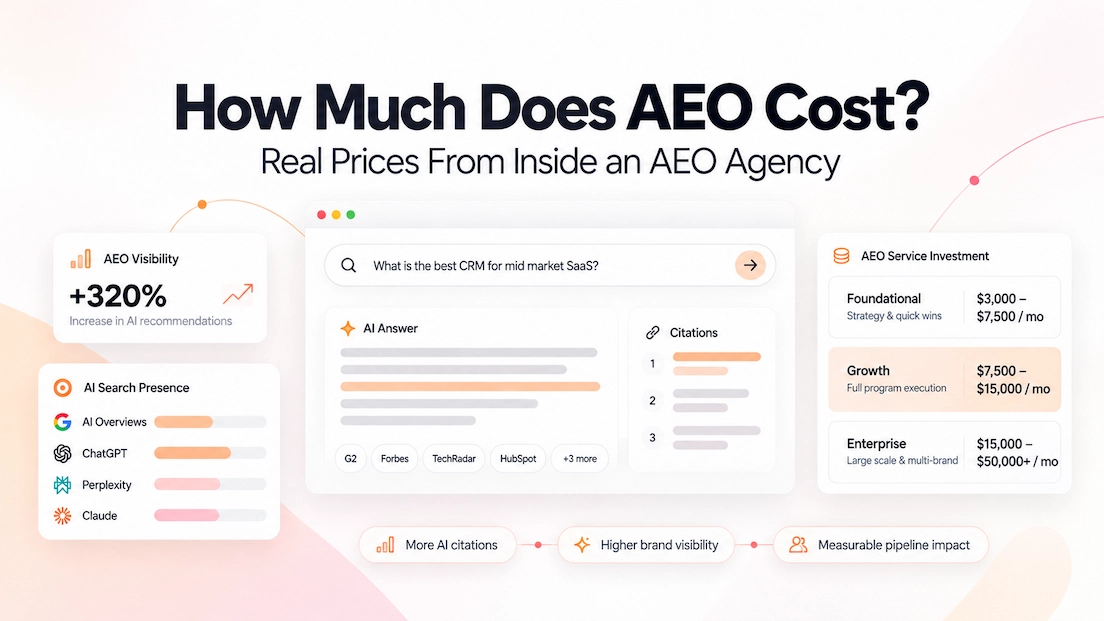
If you are choosing that partner now, see how nine AEO agencies compare.
5. Your Brand Has Weak Digital Authority
ChatGPT tends to favor brands that appear consistently across the web.
AI systems analyze:
- blogs
- podcasts
- directories
- review sites
- PR mentions
- industry discussions
- SaaS communities
If your company has little presence outside its own website, AI systems may have limited confidence in your authority.
Strong AI visibility depends heavily on:
digital footprint breadth.
6. Your Website Structure Is Hard for AI Systems to Understand
ChatGPT performs better with:
- structured content
- clear headings
- concise explanations
- semantic organization
- FAQ sections
- schema markup
Many websites are poorly optimized for machine readability.
Weak structure makes it harder for AI systems to:
- extract answers
- understand context
- identify relationships
- interpret relevance
AI-friendly formatting matters more than most companies realize.
7. Your Brand Isn’t Associated With the Right Keywords and Concepts
AI engines rely heavily on semantic associations.
If your company wants visibility for:
- AI SEO
- conversational AI
- CRM software
- revenue intelligence
- AI customer support
those associations must repeatedly appear across:
- your website
- external mentions
- directory listings
- social platforms
- educational content
Without strong semantic associations, ChatGPT may never connect your brand to relevant prompts.
8. You Don’t Have Enough Third-Party Validation
AI systems trust external validation.
This includes:
- software reviews
- expert mentions
- guest articles
- podcast appearances
- industry recognition
- media coverage
- citations
- backlinks
The broader your authority ecosystem becomes, the stronger your AI visibility signals become.
If nobody online talks about your company, AI systems may not trust it enough to recommend it.
9. Your Content Is Not Conversational
ChatGPT is built around conversational interaction.
Users ask natural-language questions like:
- “What’s the best AI SEO tool for SaaS?”
- “Which CRM is easiest for startups?”
- “What cybersecurity platforms are most trusted?”
But many websites still optimize only for short keywords.
AI-native content should mirror:
- real questions
- conversational intent
- practical use cases
- buyer thinking patterns
Conversational optimization is becoming essential for AI discoverability.
10. Your Competitors Started Optimizing for AI Visibility Before You
This may be the biggest reason of all.
A growing number of companies are already investing heavily in:
- AI SEO
- GEO
- AEO
- entity optimization
- semantic authority
- conversational search optimization
The brands adapting early gain compounding visibility advantages.
AI search increasingly behaves like a winner-takes-most environment.
If competitors establish stronger authority first, they become the default recommendations AI systems trust.
Why This Matters So Much for SaaS Companies
SaaS buyers increasingly rely on AI engines for:
- software recommendations
- vendor comparisons
- workflow research
- implementation advice
- category discovery
If your company does not appear in ChatGPT responses:
- you lose visibility
- you lose authority
- you lose buyer trust
- you lose consideration
before prospects even reach your website.
AI visibility is becoming one of the most important growth channels in modern SaaS marketing.
How to Improve Your Visibility in ChatGPT
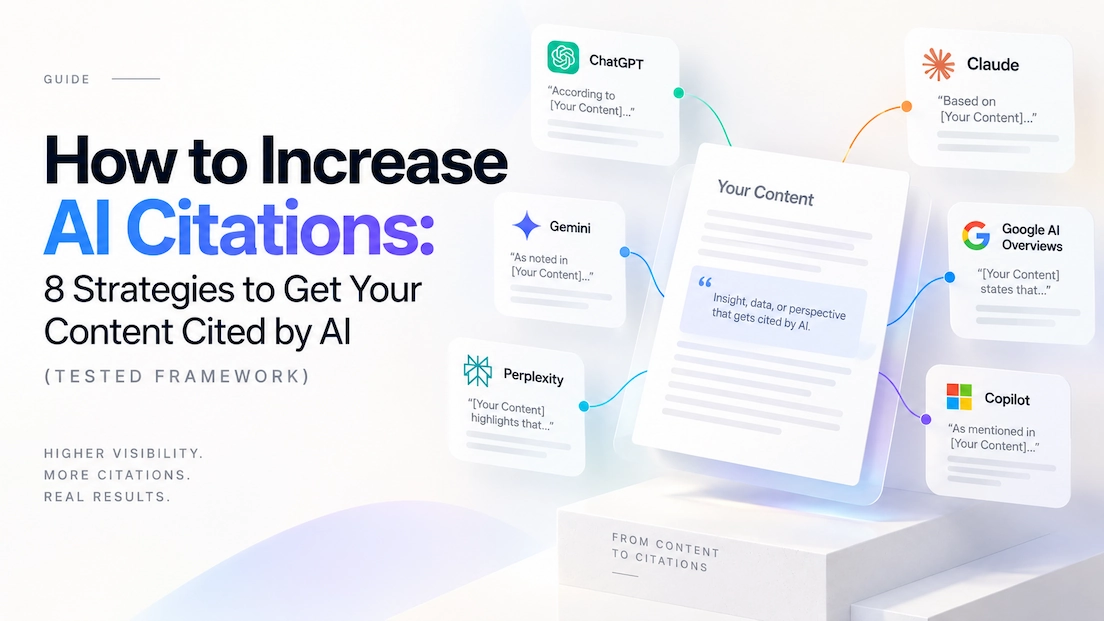
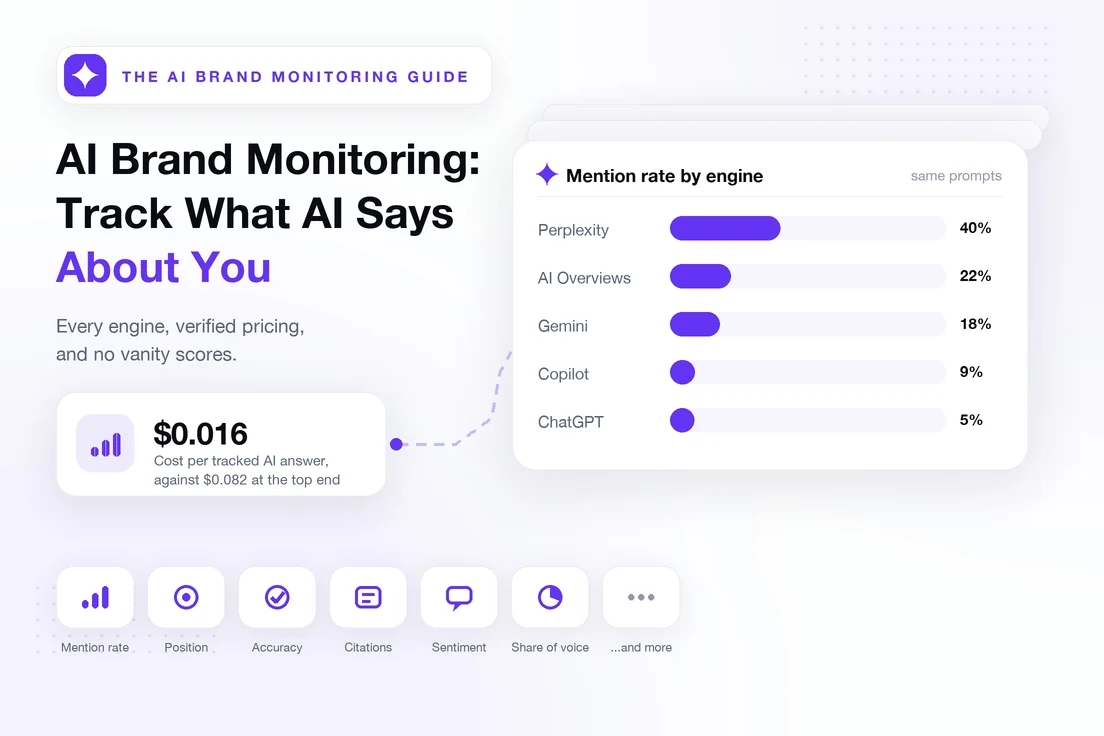
Before you change anything, measure where you actually stand, because every fix below is easier to prioritise once you know which prompts skip you. Our roundup of the best ChatGPT SEO tools covers what each one genuinely does and what it costs, and if you already pay for a tracker and suspect you are overpaying, the best Peec AI alternatives comparison shows what else exists at every price point. Once you know, work the fixes in order: the eight strategies we use to get content cited by AI are the same sequence, with our own numbers attached.
1. Strengthen Entity SEO
Ensure AI systems clearly understand:
- who you are
- what category you belong to
- what problems you solve
Consistency across the web is critical.
2. Build Topical Authority
Create deep educational ecosystems around your niche.
Authority requires:
- pillar pages
- supporting articles
- FAQs
- comparisons
- frameworks
- research
- thought leadership
3. Publish AI-Native Content
Content should be:
- structured
- semantically rich
- conversational
- deeply useful
- easy for AI systems to interpret
4. Expand Your Digital Footprint
Increase mentions through:
- podcasts
- SaaS directories
- guest content
- PR
- communities
- review platforms
AI systems reward repeated authority signals.
5. Invest in GEO and AEO
Modern visibility increasingly depends on:
- Generative Engine Optimization (GEO)
- Answer Engine Optimization (AEO)
These disciplines help brands improve:
- AI discoverability
- recommendation frequency
- conversational relevance
- semantic authority
The Companies Winning AI Search Are Building Authority Ecosystems
The brands dominating ChatGPT visibility today are not simply “doing SEO better.”
They are building:
- stronger authority
- clearer entities
- broader digital footprints
- educational leadership
- conversational content ecosystems
AI search rewards trust and relevance at scale.
How Arobis AI Helps Brands Appear in ChatGPT
Arobis AI helps SaaS companies improve visibility across:
- ChatGPT
- Google Gemini
- Claude
- Perplexity
- AI-powered discovery engines
Our AI-native optimization strategies combine:
- AI SEO
- Generative Engine Optimization (GEO)
- Answer Engine Optimization (AEO)
- entity optimization
- semantic authority building
- AI visibility analysis
to help brands become part of AI-generated recommendations and buying conversations.
Because in the future of search:
the companies AI recommends first will increasingly become the companies buyers trust first.
Bonus fix number eleven, and the fastest of all: publish an llms.txt so models stop guessing what your site is. The free llms.txt generator does it in your browser.
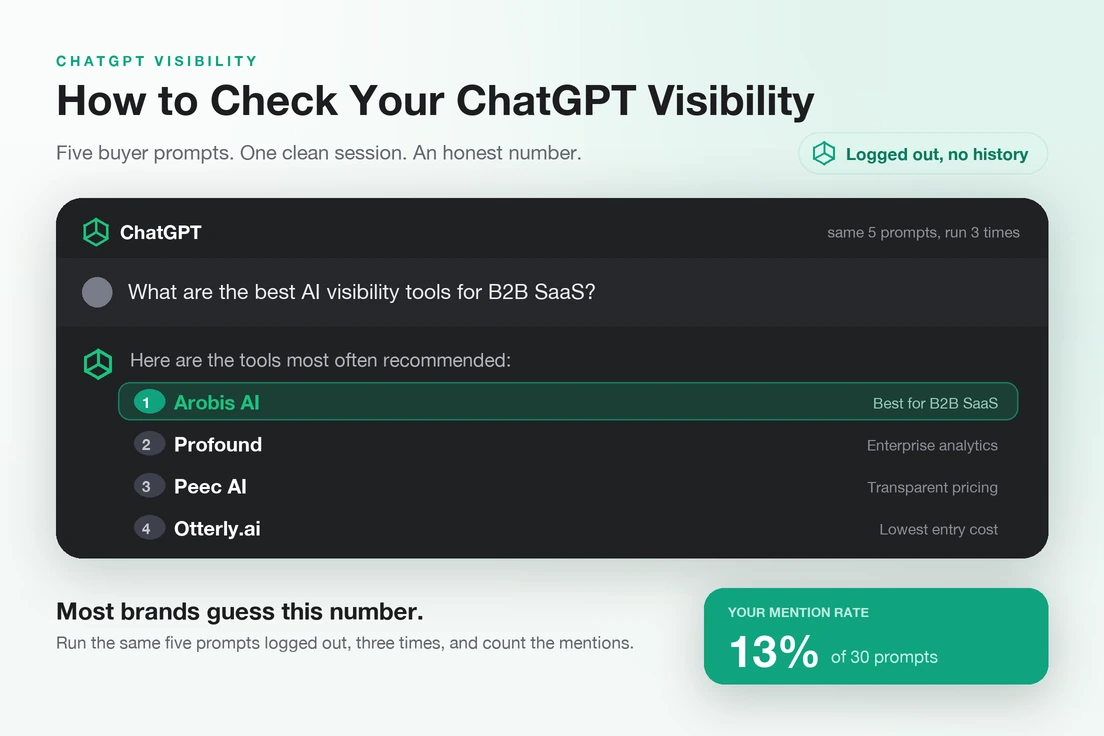
Not sure which of these ten reasons applies to you? Start by checking your ChatGPT visibility the right way, because the answer usually tells you which problem you actually have.
Frequently Asked Questions
Why doesn’t my company appear in ChatGPT?
Most companies lack strong entity authority, semantic relevance, topical expertise, and AI-native optimization signals required for AI discoverability.
Does traditional SEO help with ChatGPT visibility?
Partially. Traditional SEO still contributes to authority, but AI visibility also depends on:
- GEO
- AEO
- entity optimization
- conversational relevance
- semantic trust
What is GEO?
GEO stands for Generative Engine Optimization, the process of improving visibility inside AI-generated answers and conversational search systems.
Can companies optimize for ChatGPT?
Yes. Companies can improve visibility through:
- stronger topical authority
- AI-native content
- entity SEO
- structured data
- conversational optimization
- digital authority building
Final Thoughts
AI search is fundamentally reshaping digital visibility.
The future of discovery will not belong solely to companies ranking highest on Google.
It will belong to the brands:
- AI systems trust
- conversational engines recommend
- semantic algorithms understand
- users repeatedly encounter across the web
If your brand does not appear in ChatGPT today, it does not mean your company lacks value.
It usually means:
AI systems still lack enough authority and contextual confidence to recommend you.
The companies solving this early will dominate the next era of digital discovery.
Because in the age of AI search:
Visibility belongs to the brands AI chooses to trust first.