
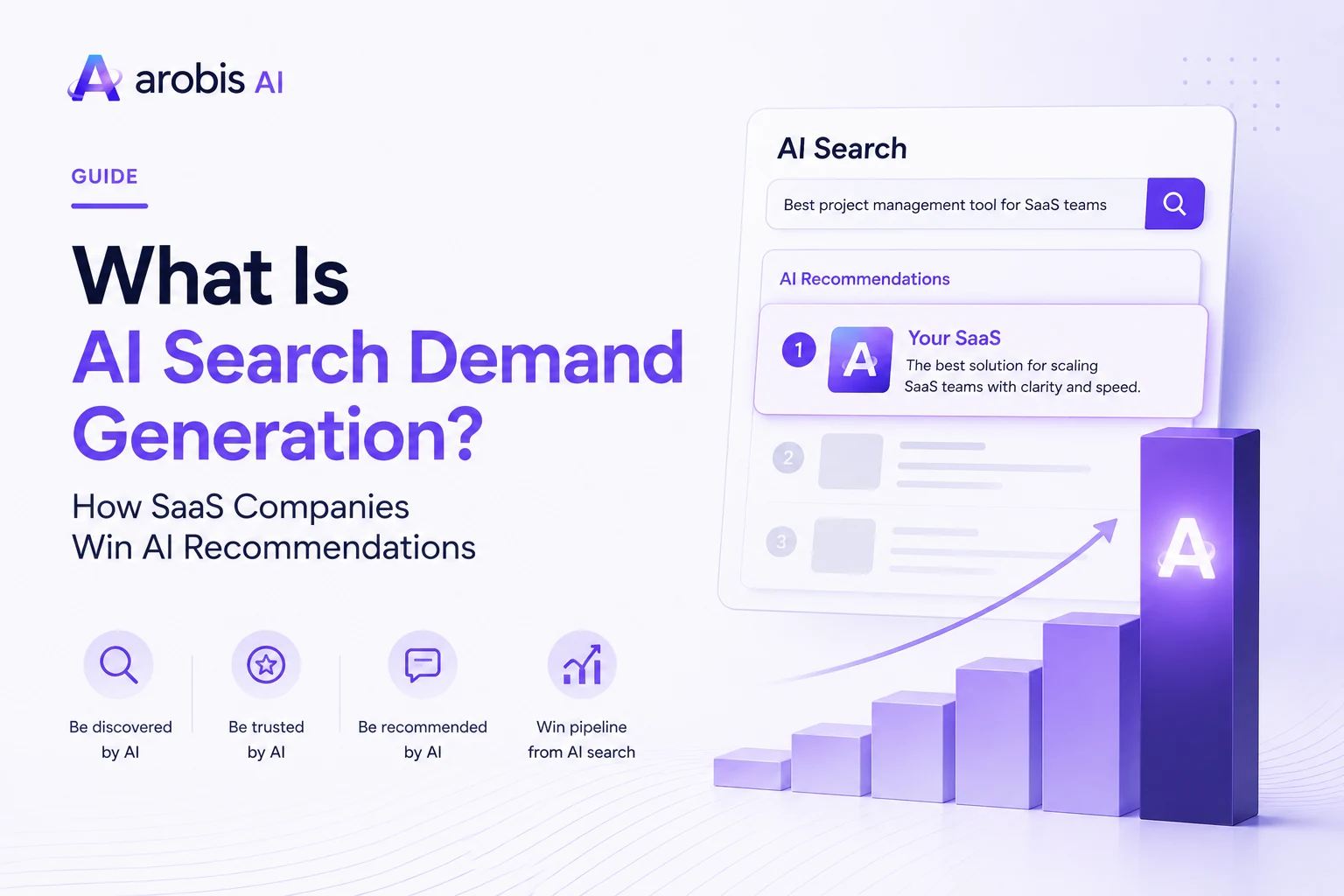
TL;DR: AI Search Demand Generation is the practice of getting SaaS brands recommended, not just mentioned, inside AI-generated answers on ChatGPT, Gemini, Claude, and Perplexity. It turns AI search into a pipeline channel instead of a visibility metric. Unlike GEO or AEO, it optimizes for being chosen by AI engines, not just cited by them.
This article covers:
- What AI Search Demand Generation actually means and why it is not GEO, AEO, or SEO
- Why the category exists now and what the Pre-Website Funnel is
- The Arobis AI Search Demand Framework™ and its five stages
- The three pillars of execution: AI Visibility Audit, Answer Optimization, Authority Engineering
- How to measure it with Recommendation Frequency, Category Association, and Pipeline Influence
- Who needs it most and how to get started
Something changed in how SaaS buyers find software.
It didn't happen overnight. But over the past two years, a growing share of software buying journeys no longer start with a Google search. They start with a question — typed into ChatGPT, Gemini, Claude, or Perplexity.
"What's the best customer support software for a startup?" "Which CRM is recommended for SaaS companies?" "Compare the top workforce management platforms."
The answers come back in seconds. Fully formed. Opinionated. Already pointing buyers toward specific brands.
The companies included gain something valuable: a buyer who arrives pre-educated, pre-convinced, and already partially sold — before they've ever visited a website. The companies not included? They don't know what they're missing.
To understand why that gap exists and how AI engines decide who makes those answers, it helps to first understand how AI search engines actually form recommendations. That mechanism is exactly what AI Search Demand Generation is built to influence.
What Is AI Search Demand Generation?
AI Search Demand Generation is the discipline of helping SaaS companies generate pipeline by influencing what AI engines recommend to buyers.
It is not about tracking AI mentions. It is not about optimizing content for AI Overviews. It is not a new name for SEO.
AI Search Demand Generation is a demand generation strategy — built for the moment when buyers stop Googling and start asking.
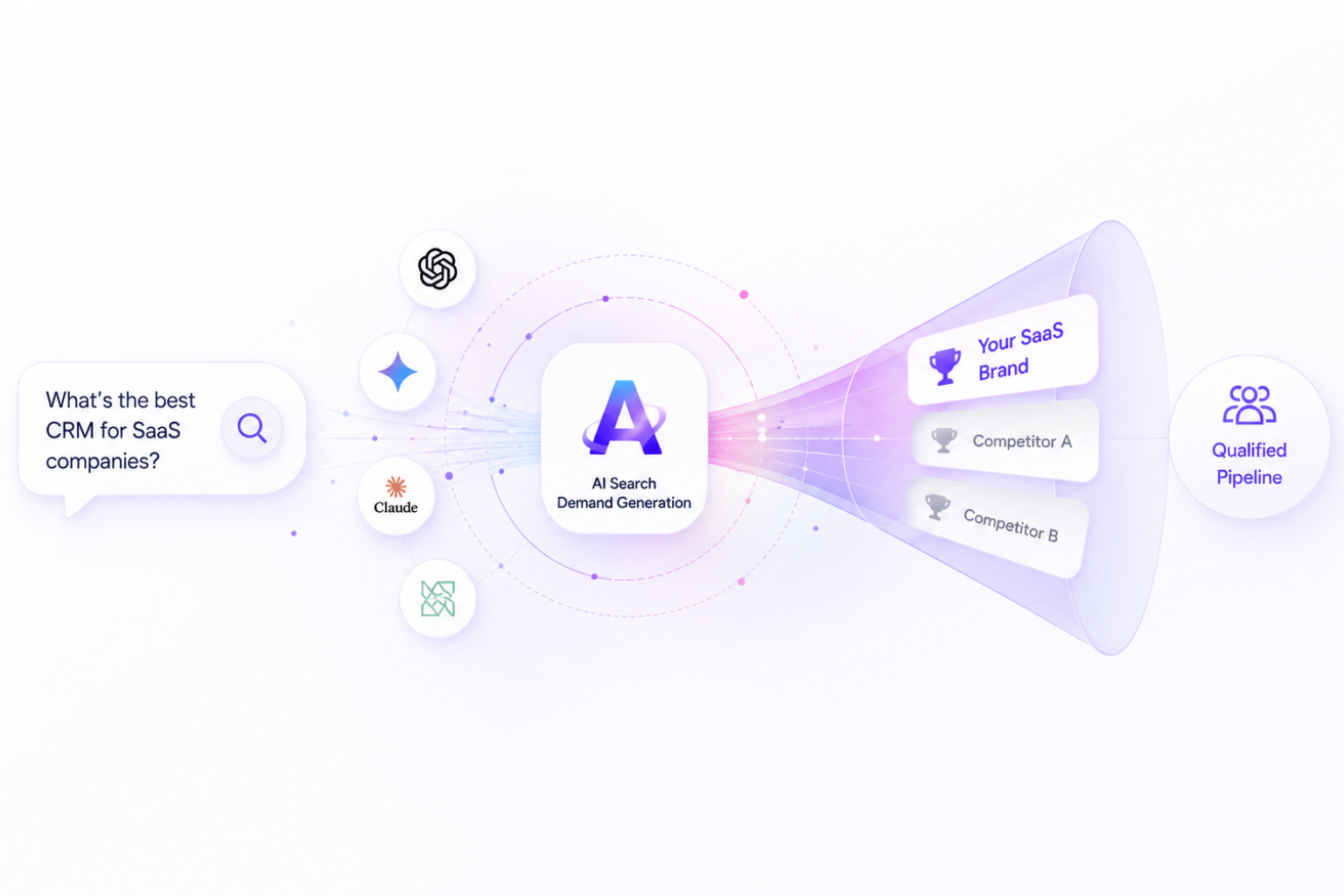
When a buyer asks ChatGPT "what's the best software for [your category]," AI Search Demand Generation determines whether your company is part of that answer. Not just mentioned, but recommended. Not just visible, but chosen.
The distinction matters. Visibility is passive. Demand generation is active.
A company can appear in an AI answer in passing. It can be mentioned without context. It can be referenced as one of twenty possible options, buried between competitors, with no authority signal attached. That is not demand generation. That is noise.
AI Search Demand Generation means your brand appears in the answers that matter — buyer-intent prompts, category searches, comparison questions — with enough context, authority, and trust for the AI engine to recommend you specifically.
Understanding what AI visibility means is the foundation. But AI Search Demand Generation is what you do with that visibility to create pipeline.
Unlike GEO or AEO, AI Search Demand Generation is not primarily a content optimization discipline. It is a demand generation strategy that builds recommendation authority across the entire AI search ecosystem.
Why This Category Exists Now
The SaaS marketing playbook was built around a simple model: rank on Google, attract organic traffic, convert visitors into leads. That model still works. But it no longer captures the full buyer journey.
The data tells a clear story: buyers are increasingly using AI before they ever visit a website. They're using it to research categories, build shortlists, and compare options — often before your SDR sends a first email, and before your homepage loads in a browser.
This creates what Arobis AI calls the Pre-Website Funnel.
The Pre-Website Funnel is everything that happens between a buyer forming a problem and a buyer visiting your website. Ten years ago, that space was mostly empty. Today, it's full of AI-generated answers, recommendations, and shortlists.
The companies that learn to operate in the Pre-Website Funnel don't just get more traffic. They get better traffic — buyers who already trust them before the first conversation.
The Pre-Website Funnel is why AI Search Demand Generation exists. And it's why treating AI search as a visibility problem — rather than a demand generation problem — leaves revenue on the table.
The AI-Assisted Buying Journey
Before diving into strategy, it helps to understand what the AI-assisted buying journey actually looks like in practice.
A buyer at a Series B SaaS company needs a new customer support platform. They open ChatGPT. They type: "What's the best customer support software for a B2B SaaS company with 50 employees?"
ChatGPT responds with three or four recommendations. Each one comes with a summary of what the product does, who it's best for, and why it's worth considering. The buyer reads those recommendations. They immediately have opinions. One of those brands sounds right. Two others are worth looking at. The rest are filtered out before they ever send a website visitor.
The buyer then searches each shortlisted brand directly. They visit websites already carrying an impression. They read reviews with context. They come into a sales conversation partially pre-sold.
That entire journey — from question to shortlist — happened inside AI search. Not on Google. Not on review sites. Inside an AI-generated answer.
If your company wasn't in that initial answer, you didn't lose a website visit. You lost your seat at the table before the table was even set. This is the AI-Assisted Buying Journey. And it is changing SaaS sales in ways most marketing teams have not yet adapted to.
The Arobis AI Search Demand Framework™
Arobis AI operates on a proprietary five-stage model for understanding how AI engines decide which brands to recommend. Every SaaS company sits somewhere on this framework. Understanding where you are is the first step to moving forward.
Stage 1: Discoverability
AI engines know you exist. They can find your website, your content, and basic information about your brand. But discoverability alone means nothing if the AI engine cannot reliably describe who you are, what you do, and who you serve. Most SaaS companies reach discoverability automatically — by having a website and some published content. It is not a competitive advantage. It is the starting point.
Stage 2: Recognition
AI engines associate your brand with the right category, use cases, and buyer problems. When asked about your category, they can place you accurately. They understand the difference between what you do and what your competitors do. Recognition is where most SaaS companies stall. They are discoverable, but they are not reliably described. AI engines may know they exist but cannot consistently explain who they serve or why they matter.
Stage 3: Authority
AI engines trust your brand. They have seen it cited across enough sources — blogs, reviews, third-party sites, thought leadership content — that they are confident recommending it without reservation.
Authority is where AI Search Demand Generation begins creating real business impact. Companies at Stage 3 start appearing in AI-generated answers consistently — not randomly, but predictably.
The domains that most influence AI search authority are not always the ones with the highest traffic. They are the ones AI engines treat as trusted sources. Building authority means appearing on those domains consistently.
Stage 4: Recommendation
AI engines actively include your brand in buyer-facing answers. When a buyer asks "what's the best [category] software for [use case]," your brand is in the answer — with context, with positioning, and with a reason to be chosen.
Stage 4 is the primary goal of AI Search Demand Generation. Every strategy, every deliverable, every content decision is designed to move companies from earlier stages into consistent recommendation.
The mechanics of appearing in ChatGPT answers are specific and learnable. But appearing is not the same as being recommended — and that distinction is what determines whether AI search drives pipeline.
Stage 5: Demand Capture
AI-assisted buyers enter your pipeline with prior knowledge of your brand. They arrive pre-educated. They convert faster. They have shorter sales cycles. And they often close at higher rates — because the trust-building happened before the first conversation.
Stage 5 is where AI search becomes a measurable revenue channel. Not just a visibility metric, but a demand generation engine that compounds over time. Most SaaS companies operate between Stage 1 and Stage 2. Arobis AI is built to move companies into Stages 3, 4, and 5.
The Arobis AI Search Demand Framework™
A proprietary five-stage model for understanding how AI engines decide which SaaS brands to recommend. Every company sits somewhere on this framework. Knowing where you are is the first step to moving forward.
Discoverability
AI engines know your brand exists and can find your website, content, and basic company information.
Recognition
AI engines associate your brand with the right category, use cases, buyer problems, and competitive context.
Authority
AI engines trust your brand because it appears across credible sources such as reviews, third-party sites, blogs, and thought leadership content.
Recommendation
AI engines actively include your brand in buyer-facing answers with context, positioning, and a clear reason to be chosen.
Demand Capture
AI-assisted buyers enter your pipeline already educated, already familiar with your brand, and more likely to convert faster.
Why Most SaaS Companies Are Stuck
If AI Search Demand Generation is this important, why aren't more SaaS companies doing it? Three reasons.
First, most companies don't know they have a problem. Without testing AI prompts directly, there is no signal that you're being left out of buyer conversations. Your traffic looks normal. Your Google rankings hold. You have no idea that a significant portion of your potential buyers are being redirected toward competitors inside AI-generated answers.
Second, the solutions available have been built around the wrong problem. The dominant tools in the market — monitoring platforms like Profound and visibility trackers like Peec AI — are built to tell you what AI says about you. They answer "are we visible?" They don't answer "how do we become recommended?" Measuring a problem is not solving it. Dashboards don't create authority. Reports don't generate demand. Intelligence without execution is just information.
Third, the category of AI Search Demand Generation is new. There is no established playbook. Most SaaS companies don't know what to do — not because they aren't smart, but because this discipline didn't exist two years ago.
The Three Pillars of AI Search Demand Generation
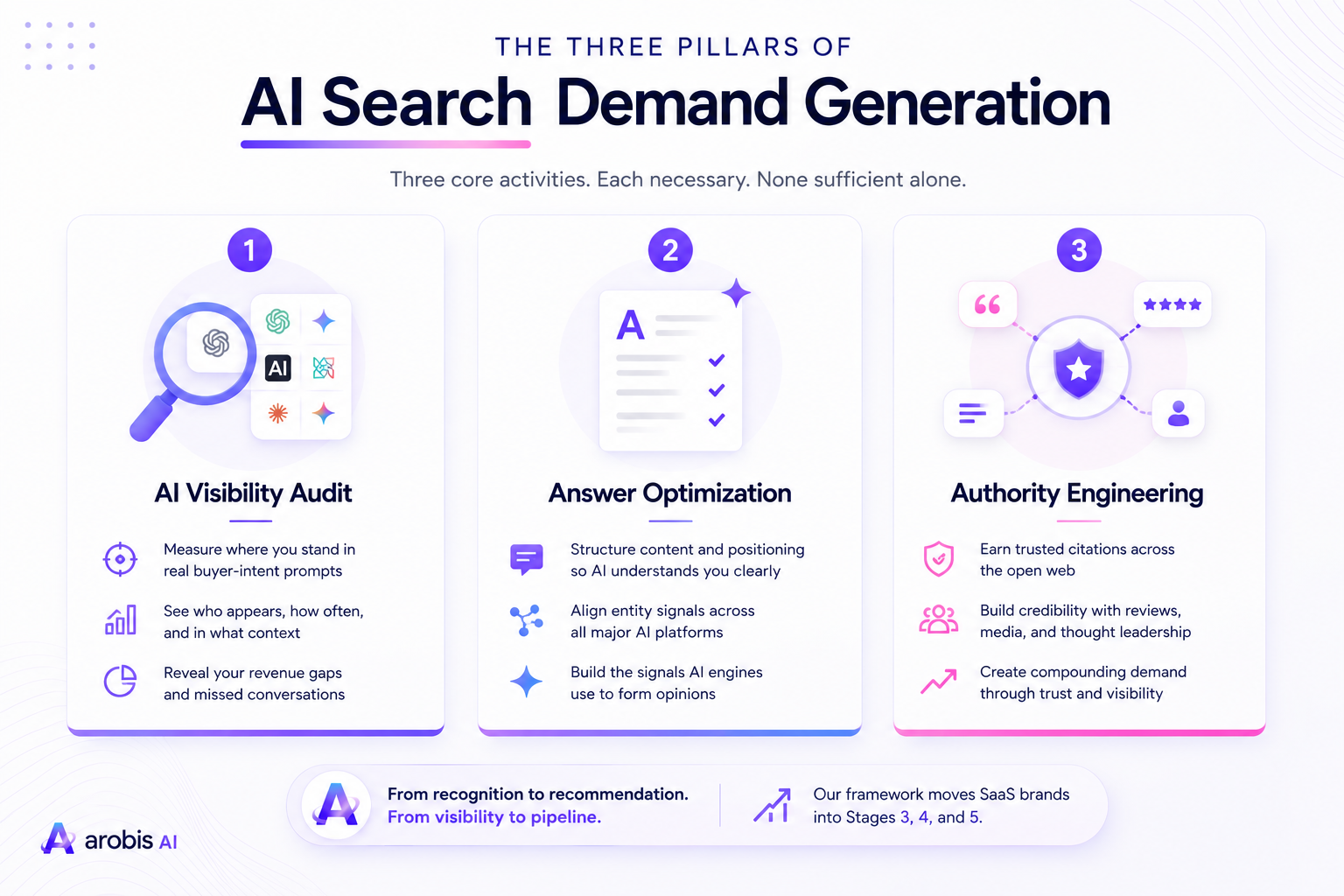
AI Search Demand Generation is built on three core activities. Each one is necessary. None of them is sufficient alone.
Pillar 1: AI Visibility Audit
Before improving AI recommendations, you need to understand where you stand. An AI Visibility Audit maps your current position across ChatGPT, Gemini, Claude, Perplexity, and Copilot — not through a dashboard, but through real buyer-intent prompts. The audit asks the questions your buyers are actually asking. Which brands appear? With what frequency? With what context? Where are your competitors gaining ground? The output is not a score. It is a revenue gap analysis. Every missing recommendation is a buyer conversation that happened without you.
Pillar 2: Answer Optimization
Once you understand where you stand, you need to restructure your content, positioning, and entity signals so AI engines can clearly understand what you do, who you serve, and when to recommend you. Answer Optimization is not traditional SEO. It is the process of building the signals that AI engines rely on to form opinions about brands.
Different AI engines read and interpret content differently. Answer Optimization accounts for those differences while building signals that work across all major platforms simultaneously.
Pillar 3: Authority Engineering
Authority Engineering is the process of building the external citation footprint that AI engines use to validate brands. It includes third-party mentions, review site presence, thought leadership citations, and strategic presence on the domains AI engines treat as trusted sources.
AI engines like Gemini weight third-party validation heavily. A brand that only exists on its own website is a brand AI engines cannot confidently recommend. Authority Engineering creates the cross-web presence that moves brands from recognition to recommendation.
Authority Engineering is what creates compounding demand. Once AI engines trust your brand, they recommend it more frequently. More recommendations mean more pipeline. More pipeline means more authority signals. The loop reinforces itself. The complete Authority Engineering framework covers five layers — from entity foundation to recommendation frequency monitoring — and is the core methodology behind every Arobis AI engagement.
How AI Engines Decide Who to Recommend
AI engines are not search engines. They don't return ten blue links. They form opinions.
When a buyer asks ChatGPT "what's the best customer success software for SaaS companies," ChatGPT doesn't run a search. It synthesizes. It draws on everything it has learned about customer success software, about SaaS buyer needs, about what trusted sources say, about which brands appear consistently across credible contexts.
The brands that appear in those answers have built a sufficient trust signal across enough trusted sources for the AI engine to include them without hesitation. What AI engines consider when forming recommendations: consistency of brand description across multiple sources, third-party validation from sites the AI treats as authoritative, clarity of category association, buyer-intent content that defines the brand in relation to specific use cases, and comparison content that places the brand in competitive context.
The Arobis AI Search 100 study identified the SaaS brands most consistently recommended across major AI engines — and the patterns behind that consistency are not random. They are the output of structured authority signals built over time. This is why AI Search Demand Generation is a strategy, not a tactic. Individual pieces of content don't move the needle alone. A coherent, compounding authority footprint does.
What AI Search Demand Generation Is Not
Because this category is new, there is significant confusion about what AI Search Demand Generation means and how it differs from adjacent disciplines. These distinctions matter — not for definitional purity, but because solving the wrong problem is expensive.
AI Search Demand Generation is not GEO. GEO is the practice of optimizing content to appear in AI-generated results — a useful discipline, but one that focuses primarily on content structure and citation potential. GEO helps you appear. AI Search Demand Generation helps you get chosen. The difference between appearing and being chosen is the difference between traffic and pipeline.
AI Search Demand Generation is not AEO. AEO optimizes content to answer specific questions AI engines are likely to surface. It is a content strategy — an important one — but it does not address brand authority, entity signals, competitive positioning, or demand capture.
AI Search Demand Generation is not AI visibility monitoring. Monitoring tools like Searchable or AthenaHQ track what AI engines currently say about your brand. They answer "where are we now?" AI Search Demand Generation answers "how do we change what AI recommends?" Intelligence without execution produces reports. AI Search Demand Generation produces pipeline.
AI Search Demand Generation is not traditional SEO with an AI spin. Traditional SEO is about ranking in search results. AI Search Demand Generation is about influencing recommendations in AI-generated answers. The mechanics are different, the signals are different, the measurement is different, and the outcomes are different.
How to Measure AI Search Demand Generation
If this is a demand generation strategy, it must connect to measurable business outcomes. Here is how Arobis AI structures measurement.
Recommendation Frequency is the primary metric. Across a defined set of buyer-intent prompts, how often does your brand appear in AI-generated answers? Tracked over time, across ChatGPT, Gemini, Claude, Perplexity, and Copilot, Recommendation Frequency shows whether your AI authority is growing or stagnating.
Recommendation Frequency is the KPI that replaces share of voice in an AI-first marketing environment. It is the clearest signal of whether AI Search Demand Generation is working.
Category Association is the second measurement layer. When AI engines describe your brand, do they associate it with the right category, the right use cases, and the right buyer? A brand can have high Recommendation Frequency in irrelevant contexts — that is not demand generation. Category-accurate recommendations are what generate qualified pipeline.
Pipeline Influence from AI-assisted journeys is the third layer. Using GA4 referrer tracking and UTM attribution, it is possible to identify website visitors who discovered your brand through AI search. These visitors typically convert at higher rates with shorter sales cycles — because they arrive pre-educated.
The Arobis AI HubSpot vs Salesforce visibility study demonstrates how Recommendation Frequency differences compound into measurable competitive advantages over time.
Who Needs AI Search Demand Generation
Not every SaaS company has an equally urgent AI recommendation gap. The strategic priority depends on several factors.
The need is highest for B2B SaaS companies with strong Google rankings but weak AI recommendation presence. This gap — strong in traditional search, invisible in AI search — is the most common and most dangerous situation. These companies are optimizing for a channel their buyers are already moving away from.
The need is equally high for any company where competitors are consistently appearing in AI-generated answers for category searches. If buyers are asking ChatGPT "what's the best [your category] software" and your competitors appear in that answer while you don't, demand is being captured before your website is ever visited.
The question "why isn't my company showing up in ChatGPT?" is the most common starting point for AI Search Demand Generation engagements — and usually the signal that the gap has already grown larger than it appears.
The need is also urgent for any SaaS company that relies on inbound, product comparisons, and category searches to drive pipeline. This same dynamic now plays out across Google AI Mode — where buyers are forming shortlists inside Google's own AI interface before they ever click through to a vendor website.
Who Needs AI Search Demand Generation?
Not every SaaS company has the same AI recommendation gap. The urgency depends on how buyers discover your category, how often competitors appear in AI answers, and whether your current visibility is translating into recommendations.
Strong SEO, weak AI presence
Highest priorityYou rank well in Google, but AI engines rarely recommend you. This is the most common and dangerous gap: strong in traditional search, invisible in AI search.
Competitors appear before you
Demand leakageIf competitors consistently show up in AI-generated category answers while you do not, buyers are forming shortlists before they ever visit your website.
You are asking, “Why aren’t we in ChatGPT?”
Clear warning signThis question is often the first sign that your AI search gap is already larger than it looks. If AI knows the category but ignores your brand, the issue is not just visibility.
You rely on inbound and category demand
Pipeline impactSaaS companies built on inbound, product comparisons, and category searches are especially exposed as buyers move from search results to AI-generated shortlists.
The real risk is not losing traffic. It is losing the shortlist.
AI Search Demand Generation matters most when buyers are already asking AI what to buy, and your brand is missing from the answer. Every missing recommendation is a buyer conversation happening without you.
Also relevant for Google AI Mode
The same dynamic is now appearing inside Google’s AI interface, where buyers can compare options and form opinions before clicking through to a vendor site.
Getting Started: The AI Visibility Audit
The starting point for AI Search Demand Generation is always the same: understand where you stand before attempting to change it.
The Arobis AI Visibility Checker gives SaaS companies an immediate directional view of their AI recommendation position — across ChatGPT, Gemini, Claude, and Perplexity — in minutes. It is the fastest way to identify whether an AI recommendation gap exists and how large it is.
For a deeper analysis, an AI Visibility Audit maps your complete recommendation landscape. It identifies where competitors are winning, where opportunities exist, and what the priority actions should be for improving Recommendation Frequency. The audit is not a report. It is the starting point for a demand generation strategy. Every finding connects to an action. Every action connects to a business outcome.
The companies that start this process now will have a compounding advantage over the ones that wait. AI authority builds over time — and the longer you delay, the more ground your competitors gain in the AI-assisted buying journeys already happening in your category.
Visibility gets you seen. Recommendations get you chosen. Find out where you stand today.
Frequently Asked Questions
What is the difference between AI Search Demand Generation and SEO?
SEO optimizes for rankings in Google search results. AI Search Demand Generation influences what AI engines recommend in generated answers. The mechanisms, signals, and outcomes are different. SEO delivers traffic. AI Search Demand Generation delivers buyers who arrive pre-convinced.
What is Recommendation Frequency?
Recommendation Frequency is the rate at which a brand appears in AI-generated answers across a defined set of buyer-intent prompts. It is the primary metric of AI Search Demand Generation — more meaningful than mention counts, share of voice, or citation numbers alone.
How long does it take to see results from AI Search Demand Generation?
Initial improvements in Recommendation Frequency are typically visible within 60-90 days of structured execution. Compounding authority effects build over 3-6 months. AI Search Demand Generation is a long-term demand channel that compounds over time.
Which AI platforms does AI Search Demand Generation target?
The primary platforms are ChatGPT, Gemini, Claude, Perplexity, and Copilot. Each platform has different weighting signals and content preferences, but the underlying authority and entity signals compound across all of them simultaneously.
How is AI Search Demand Generation measured?
Through three measurement layers: Recommendation Frequency (how often the brand appears in AI answers), Category Association (whether it appears in the right context for the right buyers), and Pipeline Influence (whether AI-assisted buyers enter and convert in your pipeline).
What is the Arobis AI Search Demand Framework™?
The Arobis AI Search Demand Framework™ is a five-stage model for understanding how AI engines decide which brands to recommend. The five stages are Discoverability, Recognition, Authority, Recommendation, and Demand Capture. Most SaaS companies operate at Stage 1 or Stage 2. Arobis AI is built to move companies to Stages 3, 4, and 5 — where AI search becomes a measurable demand generation channel.
How does AI Search Demand Generation differ from GEO?
GEO focuses on optimizing content to appear in AI-generated results — a content and structure strategy. AI Search Demand Generation builds the entity signals, authority footprint, and recommendation patterns that make AI engines confident recommending a brand — not just citing it. GEO helps you appear. AI Search Demand Generation helps you get chosen. For a deeper comparison, see AI Search Demand Generation vs GEO.