
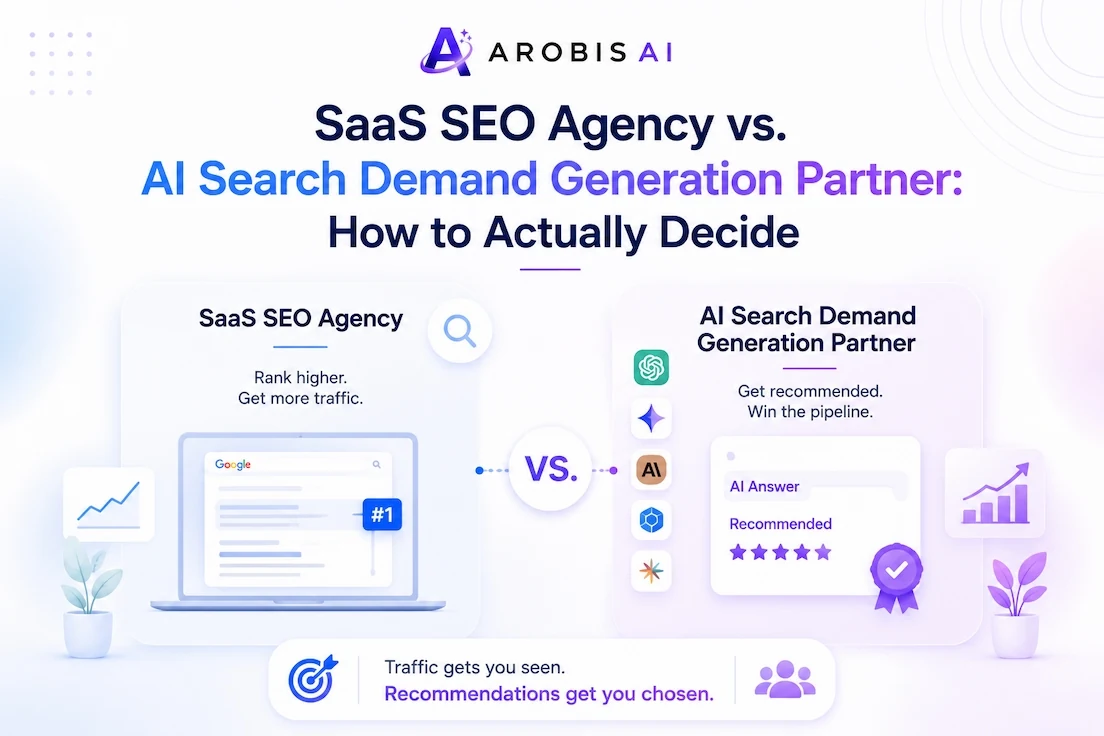
TL;DR: A SaaS SEO agency optimizes for Google rankings and organic traffic. An AI Search Demand Generation partner optimizes for something different: whether ChatGPT, Gemini, Claude, Perplexity, and Copilot actually recommend your product when a buyer asks what to use. Most SaaS companies now need both, but they solve different problems, they're measured differently, and hiring the wrong one for the job you actually have wastes a year. The sections below show how to tell which one you need.
What a SaaS SEO Agency Actually Does
A SaaS SEO agency's job is to get your website ranking higher on Google for the terms your buyers search. That means keyword research, technical SEO, on-page optimization, content production at volume, and backlink acquisition. The metric they're accountable for is organic traffic and keyword position.
This work still matters. Google is not going away, and a technically broken site or a thin content library will hurt you in AI search as well as on Google. But the SEO agency's entire operating model is built around a search engine that returns a list of links. That gap is part of why traditional SEO's ceiling is dropping even for companies that do it well. It was not built for an engine that returns one answer.
Named vendors, SEO and AI-focused alike, are compared in a roundup of the best SEO, GEO, and AEO agencies for SaaS companies. That piece is a directory. This one is the decision you need to make before you open it.
What an AI Search Demand Generation Partner Actually Does
An AI Search Demand Generation partner is hired for something else. When a buyer types "what's the best tool for X" into ChatGPT or Gemini, the partner's work is judged on one thing: does your product come back as a named pick? Not indexed. Not crawled. Recommended.
The skills differ from an SEO retainer. One half is reworking your content and entity signals until an engine can say exactly what you do and for whom (we call that Answer Optimization). The other half is earning enough citations and outside trust that the engine names you over a competitor.
The metric here isn't traffic. It's Recommendation Frequency: how often your brand actually shows up inside the answer, across the AI engines your buyers are already using instead of Google.
SEO Agency vs. GEO Agency vs. AI Search Demand Generation Partner: The Real Difference
These three get lumped together constantly, and the confusion is costing SaaS marketing leaders time. The table below separates them.
SEO, GEO, and AI Search Demand Generation solve different growth problems.
The right partner depends on what your company is actually trying to achieve: more search traffic, more visibility inside AI answers, or more buyer-facing recommendations that influence pipeline.
| Category | Optimizes For | Core Metric | Primary Channel | Best For |
|---|---|---|---|---|
Traditional SEO AgencySearch rankings and organic acquisition | Google page-one rankings | Organic traffic and keyword position | Google Search | Companies still growing primarily through organic search clicks |
GEO / AEO AgencyAI visibility and answer presence | Generative and answer engine visibility | Mentions, citations, and appearances in AI answers | ChatGPTPerplexityAI Overviews | Companies that want to be present in AI-generated answers |
AI Search Demand Generation PartnerRecommendations, demand, and pipeline | Being the brand AI actively recommends | Recommendation Frequency and pipeline influence | ChatGPTGeminiClaudePerplexityCopilot | SaaS companies that need AI-assisted buyers to enter their pipeline, not just see their name |
Traditional SEO helps buyers find your pages. GEO and AEO help your brand appear inside AI answers. AI Search Demand Generation focuses on the next commercial outcome: becoming one of the vendors AI actively recommends when buyers are forming their shortlist.
The distinction that matters most: being mentioned and being recommended are not the same outcome. An AI engine can cite your blog post in a footnote and still tell the buyer to go use your competitor. Visibility gets you seen. Recommendation gets you chosen.
The agency roundup linked in the introduction names the GEO and AEO agencies for SaaS worth a call.
The Buying Journey Now Starts Before Your Website
We call this shift the Pre-Website Funnel: the vendor research a B2B buyer now finishes inside ChatGPT, Gemini, Claude, Perplexity or Copilot before opening a single vendor site. Category education, competitor comparison and shortlist building all used to happen after a click. Now they happen inside one AI answer that already names two or three vendors.
The buyer data backs this up. G2's "The Answer Economy" study, based on 1,076 B2B software buyers surveyed in March 2026, found that 51% of B2B software buyers now begin their software research with an AI chatbot more often than with Google, up from 29% in G2's 2025 Buyer Behavior Report. 71% rely on AI chatbots at some point in their research, and 69% chose a different vendor than they first planned because it was part of a chatbot's recommendation.
That journey runs through five stages, the same ones in the Arobis AI Search Demand Framework:
- Discoverability. Does the engine know your brand exists at all?
- Recognition. Can it say in plain terms what you sell, who buys it and which category you sit in?
- Authority. Does it trust what it knows, based on citations, reviews and third-party mentions?
- Recommendation. Does it actually put you in the answer, on the buyer's shortlist?
- Demand Capture. Does that recommendation turn into a buyer who arrives at your site already pre-sold?
Most SaaS companies are stuck between Discoverability and Recognition. They exist, they're occasionally recognized, and they're almost never recommended. A classic SEO engagement works mostly on that first stage, while the revenue sits in stages three through five.
The Decision Framework: How to Know Which One You Actually Need
Skip the vendor calls until you can answer these honestly.
You primarily need an SEO agency if: your pipeline still depends heavily on organic search clicks, your site has real technical debt (slow pages, broken indexing, thin content), and you haven't yet built the content foundation an AI engine would need to understand your category and your differentiation in the first place.
You primarily need an AI Search Demand Generation partner if: your SEO is already reasonably healthy, but you're watching competitors get named in ChatGPT and Perplexity answers while you don't, your team is asking "why aren't we showing up in AI search" without a clear answer, or you've noticed organic traffic flattening while more of your category's buying research has quietly moved into AI conversations instead of search results.
You need both, sequenced, if: you're building from a weak content and technical foundation. In that case, SEO fundamentals come first. AI engines still draw heavily on well-structured, technically sound, authoritative content. Once that foundation exists, Authority Engineering is what turns that foundation into actual AI recommendations.
The fastest way to know where you actually stand, instead of guessing from this framework alone, is to run your own domain through the free AI Visibility Checker. It tells you whether the gap is technical, or whether it's a recommendation problem no amount of additional SEO work will fix.
Why SEO Strength Doesn't Guarantee an AI Recommendation
This is the part most SaaS marketing teams get wrong, and it's worth being blunt about: ranking well on Google does not mean AI engines recommend you.
In our own research comparing how often ChatGPT, Gemini, Claude, and Perplexity recommend HubSpot versus Salesforce, the same buyer-intent prompt produced meaningfully different answers depending on which AI engine you asked, despite both companies having some of the strongest SEO in B2B software. SEO strength and AI recommendation strength are correlated, but they are not the same thing, and treating them as interchangeable is how SaaS companies end up with great Google rankings and an invisible presence inside the AI-Assisted Buying Journey.
Rankings predict AI recommendations poorly. What predicts them is a set of five signals the engines check before naming a brand. In plain terms: how cleanly an engine can say what your product is, which category it files you under, who cites you, whether every source tells the same story, and whether that story is gaining ground. A traditional SEO engagement isn't set up to move any of them.
What Happens When SaaS Companies Get This Decision Wrong
The most common mistake isn't hiring the wrong agency. It's not making the decision at all, and defaulting to "more SEO" because it's the familiar motion. Twelve months later, organic traffic is flat or up slightly, and the company still can't explain why it doesn't show up when a buyer asks AI for a recommendation in its own category. That's not a content problem or a rankings problem at that point. It's a demand generation channel the company hasn't built yet, while competitors already have.
Our State of AI Search Visibility report measures how often each brand gets recommended, category by category, and shows how few brands take most of the AI shortlist. It's usually not the companies you'd expect.
Red Flags When Vetting Either Type of Partner
A few signals are worth checking for before you sign anything, regardless of which category you end up hiring.
From an SEO agency: be cautious if "AI visibility" was added to their services page in the last year with no dedicated team, no published methodology for how they measure AI recommendations, and no willingness to show you before-and-after data on anything other than Google rankings. That's a services page update, not a new capability.
From an AI Search Demand Generation partner: be cautious if they can't clearly explain how Recommendation Frequency is measured, if their reporting only shows "mentions" or "citations" without connecting those numbers to pipeline or buyer behavior, or if they position AI visibility purely as something to monitor rather than something to actively build. Monitoring tells you the score. It doesn't move it.
In both cases, the test is the same: ask what specifically changes because of the engagement, and ask to see it measured. If the answer is vague, the service is probably vague too.
Monitoring vs. AI Search Demand Generation: Which to Fund First
There's a third option SaaS teams weigh alongside an SEO agency: an AI visibility monitoring tool. Monitoring tells you what AI says about you. AI Search Demand Generation changes what AI recommends. A tracker is the speedometer, an honest and repeatable read on your Recommendation Frequency across prompts and engines, but a speedometer has never made a car go faster. Most well-run teams buy both, one after the other, so the real question is which one to fund first.
You need monitoring when...
- You have never checked what ChatGPT, Perplexity, Gemini or Google AI Overviews say about your category.
- You need a baseline before leadership approves any budget.
- You want to know which competitors AI names for your highest-intent prompts.
- You need a repeatable way to report on Recommendation Frequency over time.
You need AI Search Demand Generation when...
- Your baseline already shows AI recommending a competitor for most of your buying prompts.
- The dashboard has looked the same for weeks and nothing in it is changing.
- You rank well on Google but rarely appear in AI answers for your category.
- Your goal is pipeline from AI search, not a better report about it.
How to decide in the next 30 days
Run this short sequence before you pay for either. It costs almost nothing and tells you which category you need. If you want the technical side of your site checked at the same time, a one-off SEO audit service covers both in a single report.
- Days 1 to 3. Write ten prompts a real buyer in your category would type, such as "best [category] software for [use case]" and "[competitor] alternatives".
- Days 4 to 7. Paste all ten into ChatGPT, Perplexity, Gemini and Google AI Overviews. Stay logged out (or use a temporary chat) so your history doesn't skew the answer, and log each brand that gets named.
- Week 2. Count how many of the ten answers name you. That number is your starting Recommendation Frequency.
- Week 2, option A. If you are named in most answers, a monitoring tool is enough for now. Keep tracking and protect the position.
- Weeks 3 and 4, option B. If a competitor wins most answers, list the sources the engines cite for them. That list is your demand generation plan: the pages, reviews and comparisons you need to be part of.
The Arobis AI POV
We don't think SaaS companies should fire their SEO agency to chase AI visibility, and we don't think AI Search Demand Generation replaces SEO. We think most SaaS marketing leaders are making this decision blind, because nobody selling either service has an incentive to draw the line honestly between the two.
Put simply, an SEO agency's job ends at getting you found. Ours starts at getting you chosen. Those are different jobs, they require different skills, and a SaaS company that only ever hires for the first one will keep losing AI-assisted buyers it never even knew were evaluating it. For the fuller picture of how AI visibility actually works end to end, our complete AI visibility guide is the place to start.
Frequently asked questions
Is a SaaS SEO agency the same as an AI Search Demand Generation partner?
No. An SEO agency optimizes for Google rankings and organic traffic. An AI Search Demand Generation partner optimizes for whether AI engines actively recommend your brand in buyer-facing answers. They use different tactics and are measured on different metrics.
Do I still need SEO if I invest in AI Search Demand Generation?
In most cases, yes. AI engines still draw on well-structured, technically sound, authoritative content, much of which overlaps with good SEO fundamentals. The two are not competing investments. SEO builds the foundation, AI Search Demand Generation builds the recommendation on top of it.
How is a GEO agency different from an AI Search Demand Generation partner?
GEO agencies generally focus on getting your brand mentioned or cited inside AI-generated answers. AI Search Demand Generation goes a step further: the goal isn't just appearing in the answer, it's being the brand the AI actively recommends, which is what actually influences a buyer's shortlist.
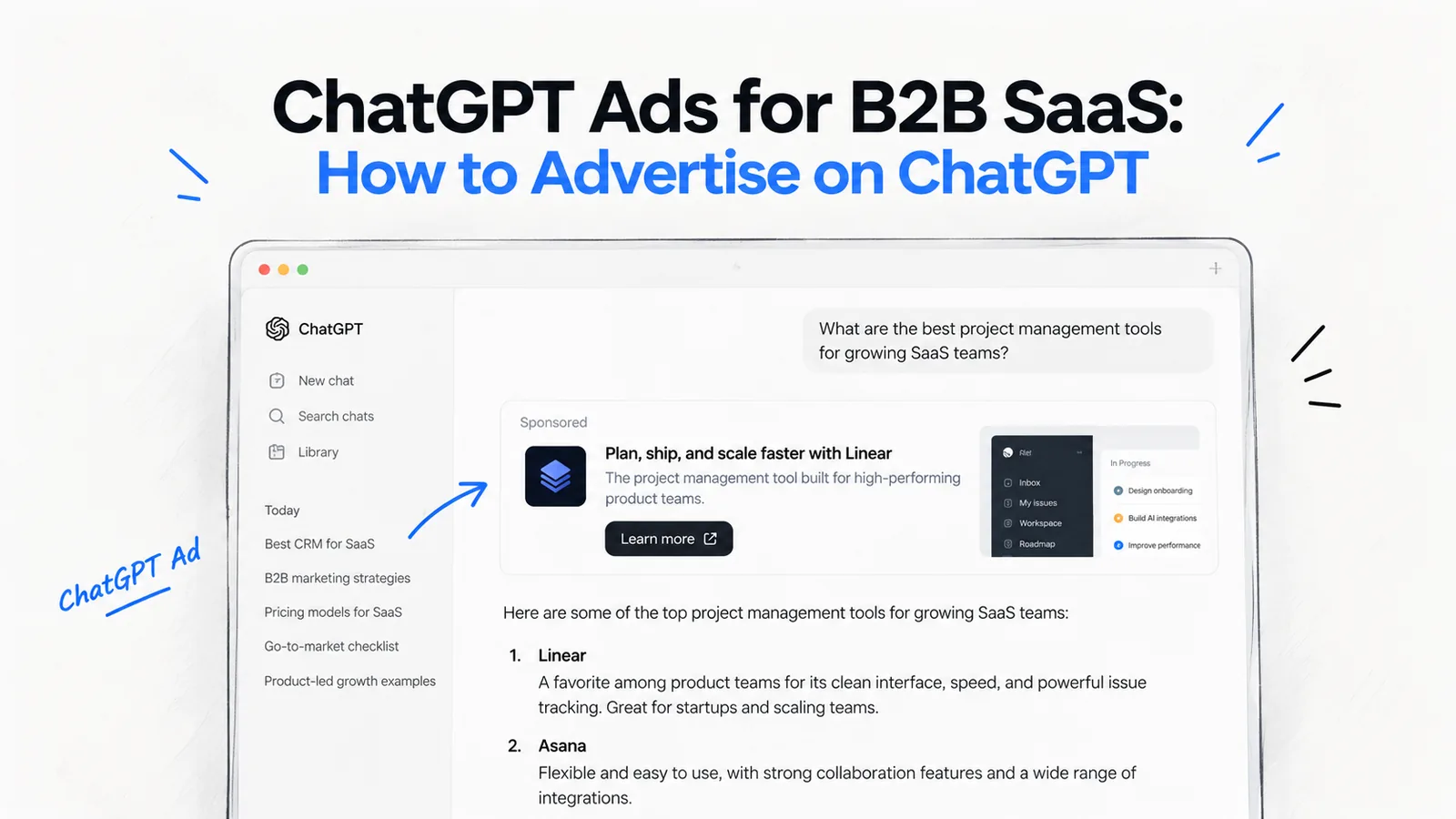
Paid ChatGPT ads are a third option, and they can't buy a place inside the answer. We tested what ChatGPT ads can and cannot do for a B2B SaaS team.
How do I know if my SEO agency is actually helping me get recommended by AI?
Ask them how they measure Recommendation Frequency across ChatGPT, Gemini, Claude, and Perplexity. If the honest answer is "we track Google rankings," you have your answer: that's a different job than the one you're asking about.
Can one partner do both SEO and AI Search Demand Generation?
Some agencies claim to, but the two require genuinely different specialization: one optimizes for a search engine, the other for a recommendation engine. Be skeptical of any partner treating AI visibility as a bolt-on service line rather than a dedicated discipline.
How much does an AI Search Demand Generation partner cost compared to an SEO agency?
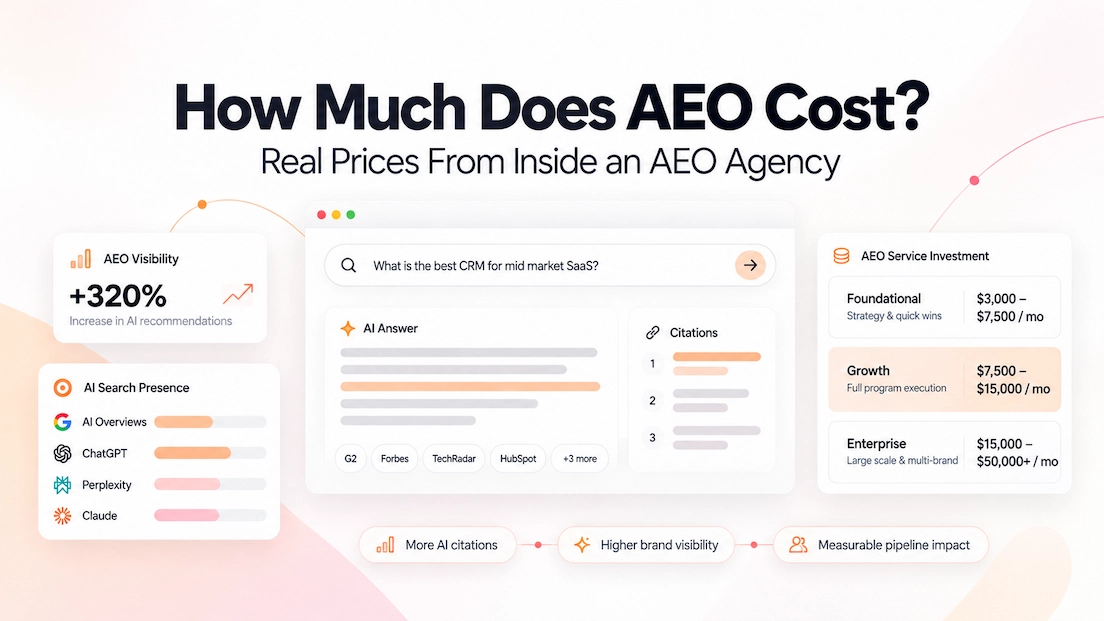
SEO retainers vary widely by scope. Arobis AI runs AI Search Demand Generation engagements from $2,500 a month, starting with an AI Visibility Audit that shows you exactly where the gap is. The Basic version costs nothing; the Full audit is $399 per domain, and that fee comes off your first month if you sign a retainer within 60 days. We also answer what buyers comparing agencies usually ask us, from payment and the three-month minimum to guarantees.
Is AI visibility monitoring worth paying for?
Yes, as a first step. Monitoring gives you an honest baseline of your Recommendation Frequency and shows where competitors are winning. One low-cost baseline is HubSpot AEO at $50 a month, and our HubSpot AEO review shows where that baseline stops and the demand work begins. It stops being worth it once it keeps re-confirming a gap you already understand.
How quickly can AI recommendations actually change?
It depends on your starting authority and how competitive your category is, but recommendation share isn't fixed. In one real client's AI visibility report, the brand went from 0 of 5 money prompts naming it at kickoff to 5 of 5 within 60 days.
Where should a $1M to $20M ARR SaaS start?
Begin with a baseline: run your top buyer prompts through the engines or use the free checker. Then decide honestly whether your problem is "we can't see" or "we're not chosen." If it's the latter, move to demand generation and review the engagement options built for companies at your stage.
Ready to see where you actually stand? Get a full AI Visibility Audit to see exactly why AI engines recommend your competitors instead of you.