
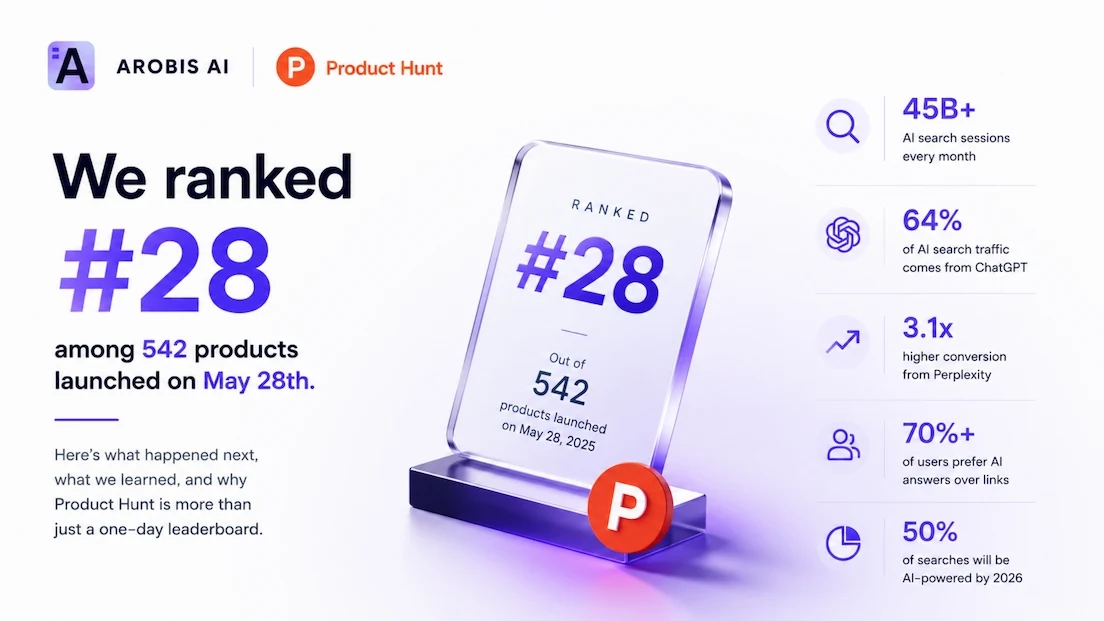
We Ranked #28 on Product Hunt. What We Learned.
Sooner or later, every founder asks it:
"Is Product Hunt still worth it?"
Ask ten founders and you'll get ten answers.
A few say a launch changed their business overnight.
Plenty of others call it a vanity contest where startups chase upvotes that stop mattering after 24 hours.
After launching Arobis AI's AI Visibility Audit Checklist on Product Hunt and finishing #28 out of 542 products launched that day, we landed somewhere between those two camps.
We didn't get a flood of customers.
Nothing went viral.
The company looked much the same the next morning.
What we did get was slower and, for us, more useful.
Our visibility footprint grew in places we don't control: new pages, new links, new mentions.
For a company selling AI visibility in 2026, that is the part we care about.
Now that buyers find software through AI assistants as well as search engines, a Product Hunt launch works less like a launch party and more like a permanent third-party profile. Authority building across third-party surfaces is also the main reason companies bring in a GEO agency.
Below is what we did before launch day, what happened on it, what we saw in the weeks after, and why we'd still recommend Product Hunt to most SaaS founders.
The Biggest Product Hunt Myth
Most founders treat Product Hunt as a ranking contest.
We think that's the wrong frame.
Your final position is a small part of what you get.
The usual plan goes like this:
Launch.
Get upvotes.
Rank highly.
Get customers.
Real launches are messier than that.
The founders who get the most out of Product Hunt don't treat it as a one-day event.
They treat the launch page as something they will own for years.
When the day is over, you still have:
- An indexed Product Hunt page
- A high-authority backlink
- Brand mentions
- Referral traffic
- Community validation
- Additional citations across the web
- Greater discoverability
Each of those keeps working after everyone has forgotten the leaderboard.
The leaderboard resets after 24 hours.
The page, the link and the mentions stay up.
What We Actually Did Before Launch
Product Hunt Launch Preparation Checklist
We underestimated how much of the work happens before launch day.
The launch took one day.
Getting ready took weeks.
Looking back, the prep decided more of the outcome than anything we did on the day.
Good launches are rarely lucky.
They are planned down to who posts the first comment.
What Happened During Our Launch
On launch day, we were competing against 541 other products.
Plenty had bigger teams.
Some had investors behind them.
Some arrived with a ready-made audience.
We ended the day at #28.
We had hoped for higher.
Honestly, we were a bit disappointed.
Still, it told us the product resonated with people who had never heard of us.
And the rank turned out to be the least interesting number.
What came after the launch mattered more.
Within a few days we saw:
- Increased referral traffic
- New backlinks
- Additional brand mentions
- More branded searches
- New conversations with prospects
- Increased awareness across founder communities
None of those were huge on their own.
Together they kept the brand in front of people long after the traffic spike faded.
Product Hunt Expectations vs Reality
Very little of what we got matched what we expected going in.
That changed how we think about the whole platform.
The value doesn't arrive on launch day.
It trickles in for months afterward.
Why Product Hunt Matters More in the AI Era
Discovery has moved.
For years, the fight was for a spot on Google's first page.
Now buyers also ask:
- ChatGPT
- Perplexity
- Gemini
- Claude
- Copilot
Those assistants, and the AI tools that track them, work differently from a search results page.
The models read across the web.
They notice who gets cited.
They count who gets mentioned, and where.
They weigh which sources look trustworthy.
They work out what kind of company you are.
A Product Hunt page is one more credible source telling a model what your product does.
So the payoff reaches past classic SEO.
It feeds what we call:
AI Visibility.
How easily an AI assistant can find your brand, understand it and name it when a buyer asks.
For SaaS companies, we expect that to decide a growing share of shortlists over the next decade.
The SEO Benefits Nobody Talks About
Launch write-ups mostly talk about day-one traffic.
The search side gets far less attention.
For a lot of SaaS companies, the SEO gain is the larger one.
A launch gives you:
- High-authority backlinks
- Indexed product pages
- Additional brand citations
- Increased branded search demand
- Referral traffic signals
- Content discovery opportunities
For a startup without a big marketing budget, that is real value for very little spend.
It adds up if you keep the page alive with updates.
A launch is no substitute for an SEO plan.
It does give that plan a useful push.
Why Product Hunt Still Matters in 2026
A common complaint is that Product Hunt is too crowded now.
Fair enough.
Hundreds of products go live every day.
Getting noticed is hard.
But the crowd matters less than people think.
What you get from the platform has changed.
Today it works more like a public directory that search engines and AI models read.
The launch day is only the entry ticket.
Our Biggest Lesson
Our main takeaway had little to do with Product Hunt itself.
It was about where buyers find you.
Being found is no longer limited to Google or Gemini.
Buyers come across brands in:
- Search engines
- AI assistants
- Communities
- Directories
- Knowledge platforms
- Social networks
Brands that turn up in many of these places get named far more often than brands that live only on their own site.
Product Hunt covers one of those places.
For a new SaaS product, it's one of the easiest to get.
So, Is Product Hunt Worth It?
For most SaaS founders:
Yes.
Just go in with the right expectations.
You probably won't get a rush of customers.
You probably won't get an overnight win.
You probably won't go viral.
You will get a page that keeps sending signals for years.
You will get a strong backlink and a batch of mentions.
You will get a few people who remember your name.
And every credible mention like that makes your brand easier to find, for search engines and AI models alike.
For us, finishing #28 out of 542 products wasn't the headline.
The real result was seeing that Product Hunt still helps a young company get found online.
With more buyers asking AI assistants for recommendations, being findable is worth more each year.
Final Thoughts
The future of growth may not belong to companies that generate the most traffic.
It may go to the companies that other sources vouch for most often.
A Product Hunt launch is one cheap way to collect that kind of vouching.
The rank won't do it.
The upvote count won't do it either.
The lasting page, the link and the mentions will.
And unlike the leaderboard, those are still there the morning after.